warning AUDI A5 CABRIOLET 2015 Owners Manual
[x] Cancel search | Manufacturer: AUDI, Model Year: 2015, Model line: A5 CABRIOLET, Model: AUDI A5 CABRIOLET 2015Pages: 268, PDF Size: 66.88 MB
Page 179 of 268
M N
ci u.. co ,...., \!) 1.1"1
N 1.1"1 ,....,
Driving and the
environment
Breaking in
New engine
The engine needs to be run-in during the first
1,000 miles (1,500 km).
For the first 600 miles (1,000 kilometers ):
"' Do not use full throttle .
"' Do not drive at engine speeds that are more
than
2/3 of the max imum permitted RPM .
From 600 to 1,000 miles (1,000 to 1,500
kilometers):
"' Speeds can gradually be increased to the maxi
mum perm issible road or engine speed.
During and after break-in period
"'Do not rev the engine up to high speeds when it
is cold. This applies whether the transmission is
in N (Neutral) or in gear .
After the break-in period
"'Do not exceed maximum engine speed under
any circumstances.
"'U pshift into the next higher gear
before reach
ing the red area at the end of the tachometer
scale
c=> page 10.
During the first few hours of driving, the engine's
internal friction is higher than later when all the
moving parts have been broken in. How well this
break-in process is done depends to a considera
ble extent on the way the vehicle is driven during
the first 1,000 miles (1,500 kilometers).
(D Note
Extremely high engine speeds are automati
cally reduced. However, these rpm limits are
p rog rammed for an engine wel l run- in, not a
new engine.
@) For the sake of the environment
Do not dr ive with unnecessarily high eng ine
speeds -upshifting early saves fuel, reduces
noise and protects the environment.
Driving and the environment
New tires
If your vehicle is running on new tires, drive very
carefully for the fi rst 350 m iles (500 kilometers)
after fitting .
New tires tend to be slippery and must also
be "broken-in". Be sure to remember this dur
ing the first
350 miles (500 kilometers).
Brake gently. Avoid following closely behind
other vehicles or other situations that might
require sudden, hard brak ing .
Avoid damaging the
vehicle
When you are d riving on poor roads, or over
curbs, steep ramps, etc., ma ke certain that low
lying parts such as spoilers and exhaust system
parts do not bottom out and get damaged.
T his is espec ially true for veh icles with low-s lung
chassis (sports chassis)* and fully loaded
vehicles.
Driving through water on
roads
Note the following to avoid vehicle damage when
driving through water, for example on f looded
roads:
- The water must not be any higher than the bot
tom of the vehicle body.
- Do not drive faster than walking speed.
A WARNING
= -
After driving through water, mud, slush, etc.,
the brakes may be s low to take effect because
of wet brake rotors and pads. Dry the brakes
first by braking carefully to restore the full braking effect.
(D Note
Vehicle components such as the engine,
transmission, suspension or electrical system
can be severely damaged by driving through
water . ""
177
Page 180 of 268

Driving and th e environment
(D Tips
- Check the depth of the water before driving
through it.
- Do not stop the veh icle, drive in reverse or
switch the engine
off when driving through
water.
- Keep in mind that oncoming vehicles may
create waves that raise the water level and
make it too deep for your vehicle to dr ive
through safely.
- Avoid driving through sa lt water because it
can cause corrosion.
Catalytic converter
It is very important that your emission control
system (catalytic converter) is functioning prop erly to ensure that your vehicle is running in an
environmentally sound manner .
~ Always use lead-free gasoline c:::;, page 190,
Fuel supply .
~ Never run the tank down a ll the way to empty .
~ Never put too much motor oil in your engine
c:::;, page 199, 9::?1 Adding engine oil .
~ Never try to push- or tow -start your veh icle.
The cata lytic conve rter is an eff icient "clean-up"
dev ice bu ilt into the exhaust system of the vehi
cle. The cataly tic converter burns many of the
pollutants in the exhaust gas before they are re
leased into the atmosphere.
The ex clusive use of u nleaded fuel is critically im
por tant for the life of the catalyt ic converte r and
p roper functioning o f the engine.
A WARNING ,..___ -
- The temperature of the exhaust system is
high, both when driving and after stopping
the engine.
- Never touch the exha ust tail pipes once they
have become hot. This could result in burns.
- Do not park o r operate the vehicle in areas
whe re the hot exhaust system may come in
contact with dry grass, brush, fue l spill or
other mater ial which can cause a fire.
- Do not apply additional undercoating or
rustproofing on or near the exha ust man i-
178
fold, exha ust pipes, catalytic converter or
heat shields. During driv ing, the substance
used for undercoat ing could overheat and
cause a f ire.
Cl) Note
- Be aware that just one tank fill ing with
le ad·
ed
fue l w ill already ser iously degrade the
performance of the catalytic converter.
- Do not exceed the correct engine oil level
c:::;,page 199.
-Do not drive until the fue l tank becomes
completely empty. The engine co uld m isfire.
Unburned fuel could also get into the ex
haust system and this could cause the cata
lyt ic converter to overheat.
- Do not turn
off the ignition while the vehicle
is moving .
- Do not continue to operate your veh icle un
der these conditions, as otherwise fuel can
reach the catalytic converter . This could re
sult in overheating of the conve rter, requ ir
ing its replacement.
- T o assure efficient operation of the Emission
Cont ro l System:
- Have your vehicle maintained properly and
in accordance with the se rvice recommen
dations in yo ur Warranty
& Maintenance
booklet.
- Lack of proper maintenance as we ll as im
proper use of the vehicle will impair the
function of the emission control system
and could lead to damage.
(® For the sake of the environment
Even when the Emiss ion C ontrol System is op
e rat ing proper ly, the exhaust gas can have a
sulfur-like exhaust gas sme ll under some op
erat ing states. This depends on the sulfur
content of the fuel being used. Us ing a d iffe r
ent brand of fue l may he lp, or fi llin g the tank
wi th lead-free s uper grade gaso line.
Shutting down vehicle
If you would like you r vehicle to remai n inope ra
tive for a longer period of time, con tact an Audi
o r other spec ia liz ed dealer. They can adv ise you .,.
Page 181 of 268
M N
ci u.. co ,...., \!) 1.1'1
N 1.1'1 ,....,
on necessary precautions e.g. corrosion preven
tion, maintenance and storage. Pay attention to
addit ional information concern ing the battery.
Refer to
c> page 204.
Economical and environ
mentally-friendly driving
General
Your personal style of driving will determine the
economy of your vehicle, as well as exhaust and
noise levels.
Fu el economy, environmental impact , and wear
on your engine, brakes and tires largely depend
on three factors:
- your persona l dr iving style
- operating conditions
- technical limitations
If you anticipate what you need to do next and
drive economically, you can easily cut your fuel
consumption by 10-15 percen t. This sec tion will
give you some tips on how you can help the envi
ronment and your pocketbook .
(!) Tips
The consumpt ion estimates as published by
ENVIRONMENTAL PROTECTION AGENCY (EPA)
and Transport Canada may not correspond to
your actual consumption on the road, which
w ill vary depending upon vehicle load and
speed, road and weather conditions, trip
length, etc.
Drive smoothly and keep a lookout ahead
Vehicles use the most fuel when they are acceler
ating.
" Avoid unnecessary accelerating and braking.
Vehicles use the most fuel when they are acceler
ating . If you anticipate what is going to happen
next, you will need to brake less and, thus, accel
e rate less. Let the vehicle coast whenever possi
ble - for example when yo u see that the next traf
fic light is red .
Driving and the environment
Avoid full throttle
Driving at moderate speeds saves fuel and im
proves your mileage .
"Try and keep well below your car's maximum
speed.
Acce lerat ing gently reduces fue l consumption,
engine wear, and does not disturb the environ
ment .
Fuel consumption, exhaust emissions and engine
noise increase disproportionately at high speeds.
If you drive at approximate ly three quarters of
top speed, fuel consump tion will be reduced by
one half. Never drive faster than the posted
speed l imit and weather cond itions permit .
Reducing unnecessary idling
Even when your car is jus t idling it burns up fuel.
" Shut the eng ine off when you are not driving
the vehicle.
" Do not warm up the vehicle by lett ing the en-
gine run at idle.
It makes sense to shut off the engine in traffic
jams, when wa iting for tra ins to pass a t railroad
crossings, or at traffic lights that have long waits
on red . Turning the engine
off for just 30-40 sec
onds saves more fue l than is burned starting the
. . engine again.
It takes a long t ime for the engine to warm up
fully when it is running at idle. However, wear
and noxious emissions are especially high when
the engine is warming up. So you should drive
away as soon as you sta rt the engine and avoid
running at high rpms wh ile the engine is st ill
warming up.
(D Note
Do not leave engine idling unatt ended afte r
starting .
If warning lights should come on to
indicate improper operation, they would go
un heeded . Extended idling also produces
heat, which could result in overheating or oth
er damage to the vehicle or other property.
179
Page 183 of 268

M N
ci u.. co ,...., \!) ..,.,
N ..,., ,....,
Trailer mode Driving with a trailer
General information
Your Audi was designed primarily for passenger
transportation.
If you plan to tow a tra iler, p lease remember that
the additiona l load will affect durability, econo
my and performance .
T railer towing not on ly places more stress on the
vehicle, it also calls for more concentrat ion from
the driver .
F or this reason, a lways fo llow the operating and
d riving instructions provided and use common
sense.
Technical requirements
Traile r hitch
Use a weight-carrying hitch conforming to the
gross trailer weight. The hitch must be suitable
for your vehicle and trailer and must be mounted
securely on the veh icle 's chassis at a technically
sound
location . Use on ly a tra iler hitc h with a re
movable ba ll mou nt. Always chec k w ith the t ra il
e r hitch m anu fac tur er to make sure that you a re
using the co rrec t hitch.
Do not use a bumper hitch .
The hitch must be installed in such a way that it
does not in terfere with the impact-absorbi ng
bumper system. No mod ificat ions should b e
mad e to the vehicle exhaust and brake systems .
Fr om time to t ime, c hec k t hat a ll h itch mou nti ng
bo lts remain sec urely fastened .
When you are no t tow ing a trailer,
remove the
trai ler hitch ball mount . Th is prevents the hitc h
fr om caus ing damage should you r vehicle be
s truck from behind¢,&. .
Trailer brakes
If yo ur tra iler is equipped w it h a braking system,
check to be s ure that it conforms to all regu la
tions.
Trailer mode
T he trailer hyd raulic brake system must not be di
rect ly connected to the ve hicle's hydraulic b rake
system ¢.&. .
Safety chains
Alw ays use s afety ch ains be tween your ve hicle
and t he tra ile r.
Trailer lights
Tra ile r li ghts must meet all regulations. Be sure
to check w it h your author ized Audi deal er for cor
r e ct w iring, sw itches, and relays.
Mirrors
If you are unable to see the traffic behind you us
i ng the regular o uts ide mirrors, then you
must in
sta ll extended mirrors .
It is importa nt that you
always have clea r vision to the rea r.
_&. WARNING
- I f a trai ler has elec trical brake s please note
th at these b ra kes are not acti va ted by the
factory -fitted contro l unit -ris k of acci dent!
- After removing the t railer hi tch, do n ot store
it in your vehicle . In case o f su dden braking,
the hi tch could fly forward and injure you or
your passe ngers.
Operating instructions
Maximum traile r weight
A trai ler for you r vehicle is limited to a typical
class 1 or class 2 trailer.
Trailer load distribution
B e sure the load in the t ra iler i s held secure ly in
pla ce to prevent it from sh ifting forw ard , back
war d or sideways .
Never allow a passenger to ride in a trailer¢.&.
in Driving in struc tion s on page 182.
Engine cooling system
Towing a trailer makes the engine work harder . It
is important that the cooling system's pe rform
ance is up to the additional load . Ma ke s ure that
t h e coo ling system has enoug h fluid.
IIJJ,
181
Page 184 of 268
Trailer mode
Tire pressure
When tow ing a trailer, inflate the tires of your ve
hicle to the cold tire pressure listed under " Full
load" on the label located on the driver's side B
pillar (visible when the door is open). Inflate
trailer tires to trailer and tire manufacturers'
specifications.
Lights
The headlight settings should be checked with
the trailer attached before driving off . Check to
make sure both vehicle and trailer lights are
working properly.
Safety chains
Be su re trailer safety chains are properly connect
ed from the trailer to the hitch on the vehicle.
Leave enough slack in the chains to permit turn
ing corners. When you install safety chains, make
sure they will not drag on the road when you are
driving.
The chains shou ld cross under the trai ler tongue
to prevent it from dropping in case of separation
from the hitch.
Driving instructions
Driving with a trailer always requires extra care
and consideration.
To obtain the best possible handling of vehicle
and trai ler, please note the following:
.. Do not tow a loaded trailer when your car itself
is not loaded .
.. Be especia lly careful when passing other
vehicles.
.. Observe speed limits.
.. Do not drive at the maximum permissible
speed .
.. Always apply brakes early.
.. Monitor the temperature gauge.
Weight distribution
Towing a loaded trai ler with an empty car results
in a highly unstable distribution of weight. If this
cannot be avoided, drive at very low speeds only
to avoid the risk of losing steering control.
182
A "balanced" rig is easier to operate and contro l.
This means that the tow vehicle shou ld be loaded
to the extent possible and permissib le, wh ile
keep ing the trailer as light as possible under the
c ir cumstances. Whenever poss ible, transfer
some cargo to the luggage compartment of the
tow veh icle while observing tongue load require
ments and vehicle load ing considerat ions .
Speed
The higher the speed, the more difficult it be
comes for the driver to control the rig. Do not
drive at the maximum permissible speed. Reduce
your speed even more if load, weather or w ind
cond it ions are unfavorab le - particularly when
go ing downh ill.
Reduce veh icle speed
immediately if the trailer
shows the slightest sign of swaying.
Do not try
to stop the swaying by accelerating.
Observe speed limits. In some areas, speeds for
vehicles towing tra ilers are lower than for regular
vehicles.
Always apply brakes early. When dr iving down
hill, shift into a lower gear to use the engine
braking effect to slow the vehicle. Use of the
brakes alone can cause them to overheat and fail.
Coolant temperature
The coolant temperature gauge¢ page 10 must
be observed carefully. If the needle moves close
to the upper end of the scale, reduce speed im
med iately and/or turn off the air conditioner .
If the coolant temperature warning light . in
the instrument cluster starts flashing, pull off
the road, stop and let the engine
idle for about
two m inutes to prevent heat build-up .
&_ WARNING
Anyone not properly restrained in a moving
vehicle is at a much greater risk in an acci
dent. Never let anyone ride in your car who is
not properly wearing the restraints provided
by Audi.
-
Page 186 of 268
Care and cleaning
Care and cleaning
General information
Regular, proper care he lps to maintain your vehi
cle's value.
It can also be a requirement when
submitting warranty claims for corrosion damage
and paint defects on the body.
The necessary care products can be obtained
from your authorized Audi dealer . Read and fol
low the instructions for use on the packaging.
A WARNING
-Using cleaning and care products incorrectly
can be dangerous to your health.
- Always store cleaning and care products out of reach of children to reduce the risk of poi
soning .
@ For the sake of the environment
-Preferably use environmentally-friendly
products when buying cleaning agents.
- Do not dispose of leftover cleaning and care
products with household trash .
Car washes
The longer that deposits remain on the vehicle,
the more the surface may be damaged. High
temperatures such as those caused by sunlight
increase the damaging effect.
Before washing, rinse
off heavy deposits with
p lenty of water.
Stubborn deposits such as bird dropp ings or tree
sap are best removed with plenty of water and a
microfiber cloth .
A ls o, wash the underside of your veh icle once
road salt stops be ing used for the season .
Pressure washers
When washing your veh icles with a pressure
washer, always follow the operating instructions provided with the pressure washer. This is espe
cially important in regard to the p ressure and
spray ing distance. Do not direct the stream of
water directly onto sea ls for the side windows,
doors, luggage compartment lid or hood or onto
184
the tires , rubber hoses, insulat ing material, the
power top, sensors* or camera lenses *. Keep a
distance of at least 16 inches (40 cm) .
Do not remove snow and ice with a pressure
washer.
Never use rotary nozzles or high pressure noz
zles.
The water temperature must not be above 140 °F
(60 °().
Automatic car washes
Spray off the vehicle before washing.
Make sure that the windows and power top are
closed and the windshield wipers are off. Follow
instructions from the car wash operator, especial
ly if there are accessories attached to your vehi
cle.
If possible, use car washes that do not have
brushes .
Washing by hand
Clean the veh icle starting from the top and work
ing down using a soft sponge or cleaning brush.
Use solvent -free cleaning products.
Washing vehicles with matte finish paint by
hand
To avoid damaging the paint when washing, first
remove dust and large particles from your vehi
c le. Insects, grease spots and fingerprints are
best removed with a specia l cleaner for matte
finish paint.
Apply the product using a microfiber cloth . To
avoid damaging the paint surface, do not use too much pressure.
Rinse the vehicle thoroughly with water. Then
clean using a neutral shampoo and a soft micro
fiber cloth .
Rinse the vehicle thoroughly again and le t it air
dry. Remove any water residue using a sham my.
A WARNING
- Only wash the vehicle when the ignition is
off and follow the instructions from the car
-
Page 189 of 268

M N
ci u.. co ,...., \!) 1.1"1
N 1.1"1 ,....,
Care and cleaning
Component Situation Solution
Te xtile s
Deposits adhering to Vacuum cleaner
artificial leather, the surface
Alcantara Water-based depos its Absorbent
cloth and mild soap solutiona)
such as coffee, tea,
b lood, etc.
Oil-based deposits Apply a m ild soap solution a), blot away the d issolved oil or
such as oil, make-up, dye, treat afterward with water, if necessary
etc.
Special deposits such Specia l sta in remover, blot with absorbent material, treat
as ink, na il polish, la- afterward with mild soap solution, if necessary a)
tex paint, shoe pol-
ish, etc.
Natural leather Fresh stains Woo
l cloth with a mild soap solutiona>
Water-based deposits fresh stains : absorbent cloth
such as coffee, tea, dried stains: stain remover suitable for leather
blood, etc.
Oil-based deposits Fresh stains: absorbent cloth and stain remover sui tab le
such as oil, make-up, for leathe r
etc. dried stains: Oil cleaning spray
Special deposits such Spot remover suitable for leather
as ink, nai l polish, la-
t ex paint, shoe po l-
ish, etc.
Ca re Regularly apply conditioning cream that protects from
light and penetrates into the mate rial. Use specially-col-
ored conditioning cream, if necessary.
Carbon parts Deposits clean the same way as plastic parts
a) Mild soap sol ution : maximu m two tablespoons of neutral soap in 1 quart (1 liter) of water
.8, WARNING
The windshield may not be treated with wa
ter-repelling windshield coating agents . Un
favorab le conditions such as wetness, dark
ness, or low sun can resu lt in increased glare.
Wiper blade chatter is also possible.
@ Note
- Headlights/tail lights
- Never clean headlights or tail lights with a
dry cloth or sponge.
- Do not use any cleaning product that con
tains alcohol, because they could cause
cracks to form.
- Wheels
-
- Never use any paint polish or other abra
sive materials.
- Damage to the protective layer on the
rims such as stone chips or scratches must
be repaired immediately.
- Sensors/camera lenses
-Never use warm or hot water to remove
snow or ice from the camera lens. This
could ca use the lens to crack.
- Never use abrasive cleaning materials or
alcohol to clean the camera lens. This
could cause scratches and cracks.
- Power top
-Remove bird droppings immediately.
187
Page 194 of 268
Fuel and R efue lin g
Gasoline additives
A major concern among many auto manufactur
ers is carbon deposit build- up ca used by the type
of gasoline you use.
Although gasoline grades differ from one manu
facturer to another, they have certa in things in
common. All gaso line grades contain substances
that can cause deposits to collect on v ita l engine
parts, such as fue l injectors and intake valves. Al
though most gasoline brands include additives to
keep engine and fuel systems clean, they are not
equally effective.
Audi recommends using TOP T IER Detergent Gas
oline. For more information on TOP TIER Deter
gent Gasoline, please go to the officia l website
(www.toptiergas.com).
After an extended period of using inadequate
fue ls, built-up carbon deposits can rob your en
g ine of peak performance .
CD Note
-Damage or ma lf u nction due to poor fuel
quality is not covered by the Aud i New Vehi
cle Limited Warranty .
- Do not add aftermarket f uel addit ive prod
ucts to your fuel tank.
Refueling
Fuel filler neck
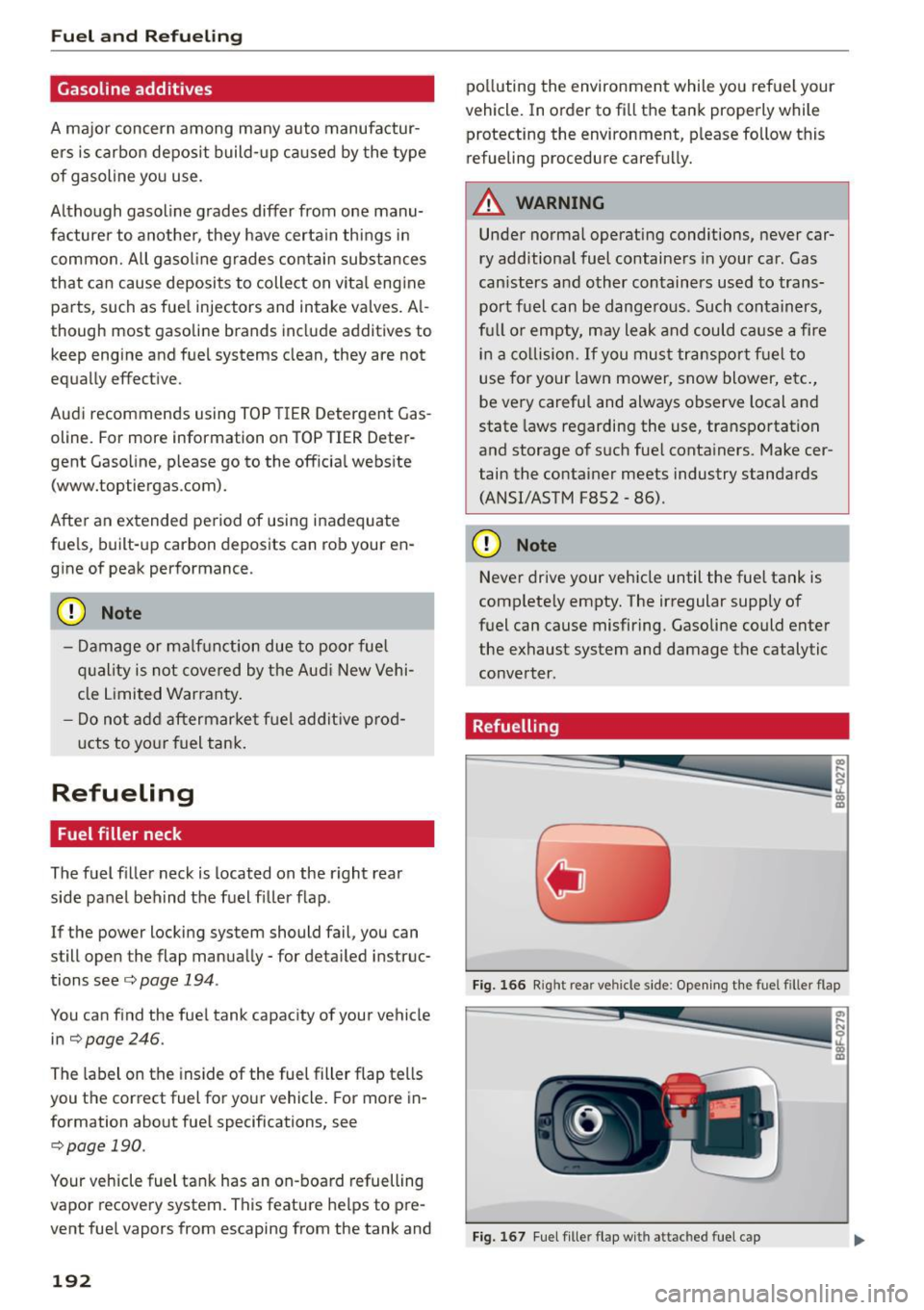
The fuel f iller neck is located on the r ight rear
side panel behind the fuel f iller flap .
If the power Locking system should fail, you can
still open the flap manually -for deta iled instruc
tions seer:>
page 194.
You can find the fue l tank capacity of your vehicle
in r:>
page 246 .
The label on the inside of the fuel filler flap tells
you the correct fuel for your vehicle. For more in
formation about fue l specifications, see
c:> page 190 .
Your vehicle fuel tank has an on -board refuelling
vapor recovery system . This feature helps to pre
vent fuel vapors from escaping from the tank and
192
po lluting the environment while you refuel your
vehicle. In order to fi ll the tank properly while
protecting the environment, please follow this
refueling procedure carefu lly.
A WARNING
Under normal operating conditions, never car
ry additional fuel containers in your car. Gas
can isters and other containers used to trans
port fuel can be dangerous. Such containers,
fu ll or empty, may leak and could ca use a fire
in a co llision.
If you must tra nsport f uel to
use for your lawn mower, snow blower, etc.,
be very careful and always observe local and
state laws regarding the use, transportation
and storage of such fue l containers . Make cer
tain the container meets industry standards (ANSI/ASTM F852 -86).
CD Note
Never drive your vehicle until the fue l tank is
complete ly empty. The irregular supply of
f u el can cause misfiring. Gasoline could enter
the exhaust system and damage the catalytic
converter.
Refuelling
Fig. 166 R ig ht rea r ve hicle side : Open ing t he fue l filler flap
Fig. 167 Fuel fi ller flap w ith attac hed fue l cap
Page 195 of 268
M N
ci u.. co ,...., \!) 1.1'1
N 1.1'1 ,....,
When activating the central locking, the fuel fi ll
er flap is automatically un locked or locked . Re
fue l the vehicle with the ignit ion turned
off.
Tak ing th e fu el cap off
.,. Turn off the ignit ion.
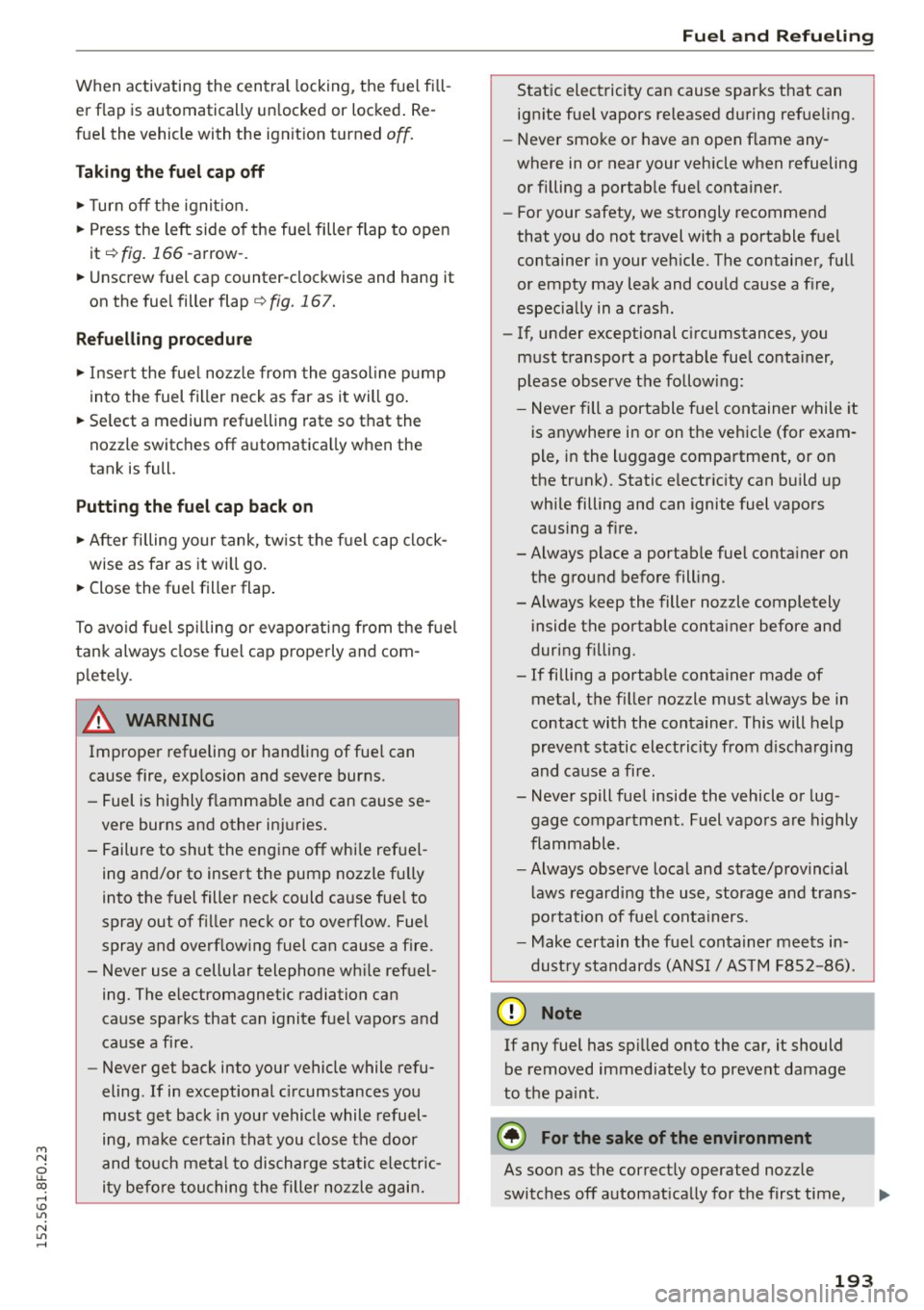
.,. Press the left side o f the fue l filler flap to open
it
c:> fig . 166 -arrow -.
.,. Unscrew fuel cap counter-clockwise and hang it
on the fue l filler flap
c> fig. 167.
R efuellin g proc edu re
.,. Inse rt the fue l nozz le from the gasol ine p ump
into the fuel filler neck as far as it will go .
.,. Se lect a medium refuelling rate so that the
nozzle switches off automatica lly when the
tank is full.
P utting the fuel cap back on
.,. After fi lling your tank, tw ist the fuel cap clock-
wise as far as it wi ll go.
.,. Close the fuel filler flap .
To avo id f uel spi lling or evaporating from the fue l
tank always close fuel cap properly and com
p letely.
A WARNING
Improper refueling or handling of fue l can
cause fire, exp losion and severe burns.
-
- Fuel is highly flammable and can cause se
vere burns and other injuries.
- Failure to shut the engine off whi le refuel
ing and/or to insert the pump nozzle fu lly
into the fuel filler neck could cause fue l to
spray out of f iller neck or to overflow. Fuel
spray and overflow ing fuel can cause a fire.
- Never use a cellular telephone wh ile refuel
ing. The electromagnetic radiation can
cause sparks that can ignite fuel vapors and
cause a fire.
- Never get back into your vehicle while refu
eling. If in exceptional c ircumstances you
must get back in your vehicle while refuel
ing, make certain that you close the door
and touch meta l to discharge static e lectric
ity before touching the filler nozzle again.
Fu el and R efu elin g
Static electricity can cause sparks that can
ignite fue l vapors released during refue ling.
- Never smoke or have an open f lame any
where in or near your vehicle when refueling or filling a portable fuel conta iner .
- For your safety, we strongly recommend
that you do not travel with a portable f uel
container in your veh icle. The container, full
or empty may leak and cou ld cause a fire,
especially in a crash .
- If, under exceptional c ircumstances, you
must transport a portab le fuel container,
please observe the following:
- Never fill a portable fuel container while it
is anywhere in or on the vehicle (for exam
ple, in the l uggage compartment, or on
the trunk). Static e lectric ity can build up
while filling and can ignite fuel vapors
caus ing a fire .
-Always place a portab le fue l conta iner on
the ground before fill ing .
- Always keep the filler nozzle completely
inside the portable container before and
during f il li ng.
- If filling a portab le container made of
metal, the f iller nozzle must always be in
contact with the container. This will help prevent static electricity from d ischarging
and cause a fi re.
- Never spill fuel inside the vehicle or lug
gage compartment. Fuel vapors are highly
flammable.
- Always observe local and state/provincial
laws regarding the use, storage and trans
po rtation of fue l conta iners.
- Make certain the fuel conta iner meets in
dustry standards (ANSI/ AS TM F852 -86).
(D Note
If any fuel has sp illed onto the car, it should
be removed immediately to prevent damage
to the pa int.
@) For the sake of the environment
As soon as the correct ly operated nozzle
switches off automat ically for the first time,
193
Page 197 of 268

M N
ci LL co
rl I.O
"' N
"' rl
Checking and Filling Hood
Releasing and opening the engine hood
The engine hood is released from inside the vehi
cle.
Fig. 170 Driver's side footwell: e ng in e hood release lever
Fig. 171 Releas e lev er un der t he e ngin e hood
Before opening the engine hood, make sure that
the windshield wipers are flat against the wind
shield . Otherwise, they could damage the paint
on the hood.
.. With the driver's door open, pu ll the lever un
der the instrument panel in the direction of the
arrow
c::> fig . 170.
.. Ra ise the hood slightly c::> &.
.. Press the rocker switch under the hood upward
c::> fig . 171. This releases the catch .
.. Open the hood.
A WARNING
Hot engine coolant can burn you.
- To reduce the r isk of being burned, never
open the hood if you see or hear steam or
coolant escaping from the engine compa rt
ment. Wait until no steam or coolant can be
Checking and Filling
seen or heard before carefully opening the
hood .
Closing the engine hood
.. Pull the hood down until the pressure from the
struts is reduced.
"' Let the hood
drop down and latch in place. Do
not try to push it shut;
it may fa il to engage
c::> &. -
A WARNING
A hood that is not comp letely latched could
fly up and block your view while driving.
- When you close the engine hood, check it to
make sure the safety catch has properly en
gaged . The hood should be flush with the
surrounding vehicle body parts.
- If you notice while driv ing that the hood is
not secured properly, stop at once and close
it.
Working in the engine compartment
Be especially careful whenever you work in the
engine compartment.
-
Whenever you must perform any work in the
engine compartment, for example checking and
filling different fluids , there i s a risk of injury ,
burns and accidents. To prevent personal injury
always observe the following WARNINGS . The
engine compartment of any vehicle is a hazard
ous area
c:> .&. .
A WARNING
-
To help avoid injury, before you check any-
thing under the hood:
- Turn off the engine.
- Remove the ignition key .
- Apply the parking brake.
- Move selector lever of automatic transmis-
sion to "P" (Park) .
-Always let the engine cool down. Hot com
ponents wi ll burn skin on contact .
- To reduce the risk of being burned, never
open the hood if you see or hear steam o r
coo lant escaping from the engine
195