fuel AUDI A5 CABRIOLET 2015 User Guide
[x] Cancel search | Manufacturer: AUDI, Model Year: 2015, Model line: A5 CABRIOLET, Model: AUDI A5 CABRIOLET 2015Pages: 268, PDF Size: 66.88 MB
Page 32 of 268

Opening and closing
-If the power locking system should fail, you
can still open the fuel tank flap in an emer
gency ~
page 194.
-You are well advised not to keep valuables
inside an unattended vehicle, visible or not.
Even a properly locked vehicle cannot pro
vide the security of a safe.
- If the LED in the upper edge of the driver's
door panel comes on for about 30 seconds
after the vehicle is locked, there is a mal
function in the power locking or the anti
theft warning system. Have the malfunction
corrected by an authorized Audi dealership
or qualified repair facility.
Key set
Fig . 17 Key set
m 0 ±
~
@ Remote control key with mechanical key
You can centrally lock and unlock your vehicle and
start the engine with the master key with remote
control. A mechanical key is integrated in the
master key
~page 31 .
@ Emergency key
The emergency key is not intended for constant
use . It should only be used in an emergency, for
example, in place of the ignition key
~ page 7 4 . Keep it in a safe place and do not
carry it on your key ring.
Key replacement
If you lose a key, contact your authorized Audi
dealer immediately to have the
lost key disabled.
Be sure to bring all your keys with you .
30
Number of keys
You can check the number of assigned keys to
your vehicle
¢ page 11. This allows you to make
sure you have received all of the keys when you purchase a used vehicle.
Data in the master key
During driving, service and maintenance-relevant
data is continuously stored on your master key .
Your Audi service adviser can read out this data
and tell you about the work your vehicle needs.
This applies also to vehicles with convenience
key*.
Personal comfort settings
If two people use one vehicle, it is recommended
that each person always uses "their own" master key. When the ignition is turned off or when the
vehicle is locked, personal convenience settings
for the following systems are stored and as
signed to the remote master key.
- Climate control
- Power locking system
- Seat memory*
- Parking system*
- Adaptive cruise control* - Side assist*
- Drive select*
The stored settings are automatically recalled
when you unlock the vehicle, when you open the
doors or when you turn on the ignition.
A WARNING
-Do not leave your vehicle unattended with
the key in the ignition lock. Entry by unau
thorized persons could endanger you or re
sult in theft or damage the vehicle.
- Do not leave children unattended in the ve
hicle, especially with access to vehicle keys.
Unguarded access to the keys provides chil
dren the opportunity to start the engine
and/or activate vehicle systems such as the
power windows etc. Unsupervised operation
of any vehicle system by children can result
in serious injury.
.
Page 70 of 268

Warm and cold
Warm and cold Climate control system
Description
The climate control system warms, cools and
adds humidity to the air in the vehicle interior. It
is the most effective when the windows and pow
er top are closed.
If there is a build-up of heat in
side the vehicle , ventilation can help to speed up
the cooling process.
In all heating mode functions except
defrost, the
blower only switches to a higher speed once the
engine coolant has reached a certain tempera
ture.
Condensation from the cooling system can drip
and form a puddle of water under the vehicle.
This is normal and does not mean there is a leak.
Pollutant filter
The pollutant filter removes pollutants such as
dust and pollen from the air.
The air pollutants filter must be changed at the
intervals specified in your Warranty & Mainte
nance booklet, so that the air conditioner can
properly work.
If you drive your vehicle in an area with high air pollution , the filter may need to be changed
more frequently than specified in your Audi War
ranty
& Maintenance booklet. If in doubt, ask
your authorized Audi Service Advisor for advice.
Key coded settings
The climate control settings are automatically
stored and assigned to the remote control key
that is in use . These settings are different when
the power top is open or closed.
_& WARNING
Reduced visibility is dangerous and can cause
accidents.
68
- For safe driving it is very important that all
windows be free of ice, snow and condensa
tion.
- Completely familiarize yourself with the
proper use and function of the heating and
ventilation system and especially how to de
fog and defrost the windows .
- Never use the windshield wiper/washer sys
tem in freezing weather until you have
warmed the windshield first, using the heat
ing and ventilation system . The washer solu
tion may freeze on the windshield and re
duce visibility .
(U;) Note
- If you suspect that the air conditioner has
been damaged, switch the system off to
avoid further damage and have it inspected
by a qualified dealership.
- Repairs to the Audi air conditioner require
special technical knowledge and special
tools. Contact an authorized Audi dealer for
assistance.
@ For the sake of the environment
By reducing the amount of fuel you use, you
also reduce the amount of pollutants emitted
into the air.
(D Tips
- Keep the air intake slots (in front of the
windshield) free from ice, snow and debris in order to maintain the proper function of
the climate control system.
- The energy management system may switch
the seat heating* or rear window defroster
off temporarily. These systems are available
again as soon as the energy balance has
been restored.
- Air escapes through vents under the rear
window. When placing items of clothing on
the luggage compartment cover, ensure
that the openings are not covered.
Page 73 of 268
M N
ci LL co
rl I.O
"' N
"' rl
the risk of injury, these individua ls should
not use seat heating.
(D Note
To avo id damage to the heating elements in
the seats, do not kneel on the seats or place heavy loads on a small area of the seat .
Setup
The basic climate control settings can be adjust
ed in the radio or MMI*.
.. Se lect: I CAR I fu nct ion button > A /C control but
ton . Or
.. Se lect:
ICARI function button> Car system s*
control button > AC.
Automatic recircul ation *
When switched o n, automatic recirculation con
trols the recircu lation mode au toma tically . If the
windows fog up, press the
I '"" F RONT I button.
Synchronization *
When synchronization is sw itched on, the same
settings are applied to both the driver and front
p a ssenger, except fo r the seat hea ting/vent ila
tion* . Synchronization switches off when you ad
just the settings on the front passenger 's side .
You can a lso switch synchroniza tion on by press
i ng a nd ho ld ing the knob on the driver's side.
Supplementary he ater
The supplementary heater warms the inter ior of
veh icles w ith flexible fuel engines more quickly.
The supplementa ry heater is cont rolled automat
ically in the
Auto se tting.
Warm and cold
Upper cabin heating
Applies to vehicles: with upper cabin heating
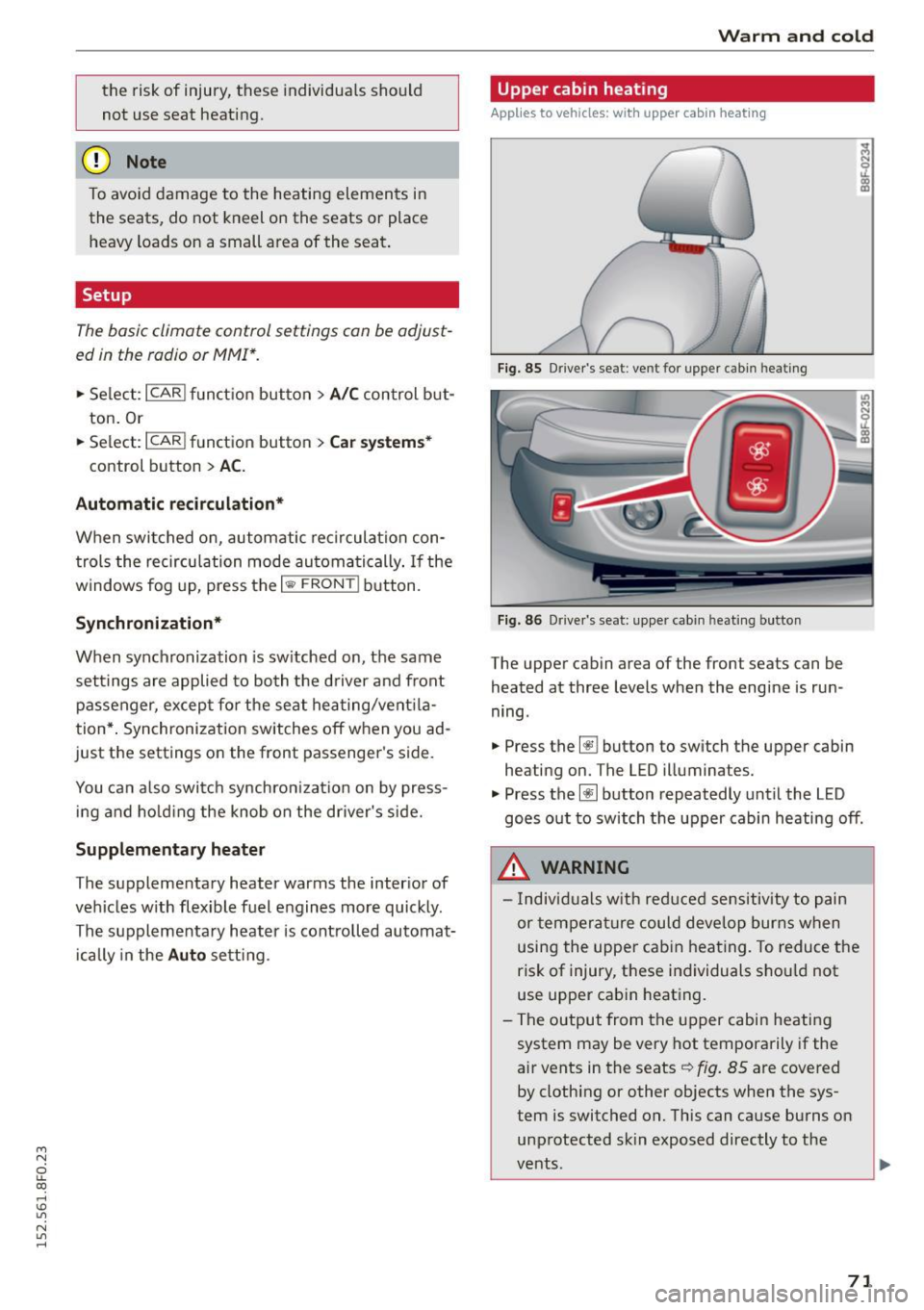
F ig. 85 Driver's seat: ven t fo r upper cabin heating
Fig . 86 Driver's sea t: uppe r cab in hea tin g button
The upper cabin area of the front seats can be
heated at three levels when the engine is run
ning.
.. Press the~ button to switch the upper cabin
heating on. The LED illuminates.
.,. Press the~ button repeatedly until the LED
goes out to switch the upper cabin heating off .
A WARNING
-Individuals w ith reduced sensitivity to pain
or tempera ture could deve lop burns when
using the upper cabin heat ing. To reduce the
risk of injury, these ind ividuals shou ld not
use upper cabin heat ing.
- The output from the upper cabin heati ng
system may be very hot temporarily if the
air vents in the seats<=>
fig. 85 are covered
by clothing or other objects when the sys
tem is switched on. This can cause burns on
unprotected sk in exposed directly to the
vents.
71
Page 85 of 268
M N
ci u.. co ,...., \!) 1.1'1
N 1.1'1 ,....,
Automatic transmission
multitronic, S tronic,
tiptronic
Introduction
Appl ies to vehicles: with multitronic/5 tronic/tiptronic
The automatic transmission is controlled elec
tronically. The transmission upshifts or down
shifts automatically depending on which drive
program is se lected.
When a
moderate driving style is used, the
transmission selects the most economica l driving
mode. It will then change up early and delay the
downshifts to give better fuel economy .
The transmission switches to a sporty mode after
a kick-down or when the driver uses a
sporty driv
ing style
characterized by quick accelerator pedal
movements, heavy acceleration, frequent
changes in speed and traveling at the maximum
speed .
If desired, the driver can also se lect the gears
manually (tiptronic mode) q page 83.
Various automatic transmissions may be instal
led, depending on the model:
multitronic transmission
The multitronic transmission is a continuously
variable transmission. Power is transferred using
a mu ltidisk clutch. In contrast to conventional
automatic transmissions using shifting opera
tions, the transmission ratio in the continuously
variable transmission is changed continuous ly.
This optimi zes the comfort level and conserves
fuel.
S tronic transmission
The 5 tronic is a dual-clutch transmission. Power
is transferred using two clutches that work inde
pendently from one another. They replace the
torque converter used in conventional automatic
transmissions and allow the vehicle to accelerate
without a noticeable interruption in traction .
tiptronic transmission
In the tiptronic transmission, power is transfer
red by a torque converter.
Automatic transmission
Selector lever positions
Applies to vehicles: with multitronic/S tronic/tiptronic
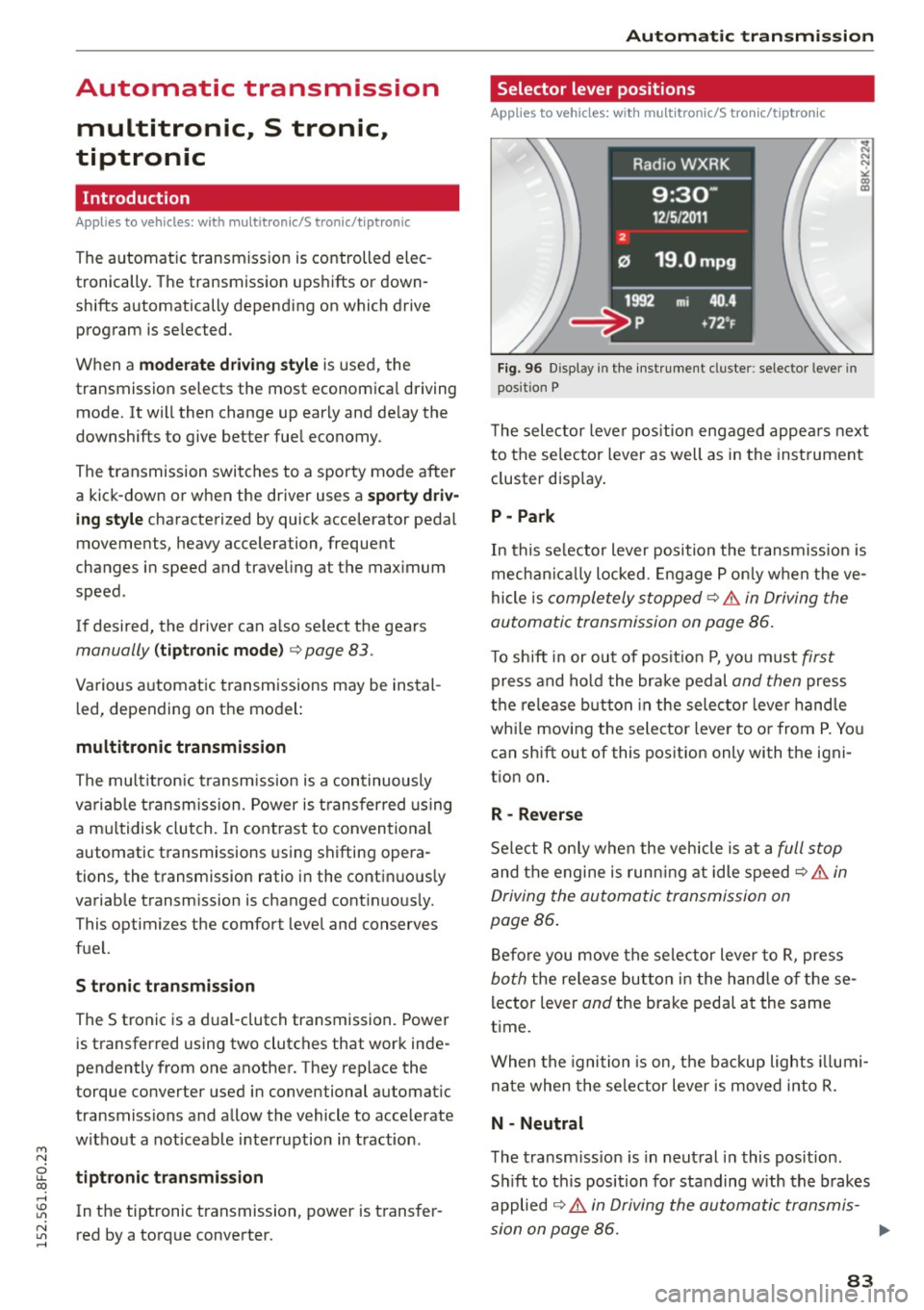
Fig. 96 Disp lay in the instrument cluster: selec tor lever in
position P
T he selector lever position engaged appears next
to the se lector lever as well as in the instrument
cluster display.
P -Park
In this se lector lever position the transmission is
mechanically locked . Engage P only when the ve
hicle is
completely stopped~.&. in Driving the
automatic transmission on page 86.
To shift in or out of posit ion P, you must first
press and hold the brake pedal and then press
the release button in the selector leve r handle
whi le moving the selector lever to or from P. You
can shift out of this position only with the igni
tion on.
R - Reverse
Select R only when the vehicle is at a full stop
and the engine is running at idle speed~ .&. in
Driving the automatic transmission on
page 86 .
Before you move the selector lever to R, press
both the release button in the hand le of these
lector lever
and the brake pedal at the same
time .
When the ignition is on, the backup lights illumi
nate when the selector lever is moved into R.
N -Neutral
The transmission is in neutral in this position .
Sh ift to this position for standing with the brakes
applied
~ .&. in Driving the automatic transmis-
sion on page 86. .,.
83
Page 179 of 268
M N
ci u.. co ,...., \!) 1.1"1
N 1.1"1 ,....,
Driving and the
environment
Breaking in
New engine
The engine needs to be run-in during the first
1,000 miles (1,500 km).
For the first 600 miles (1,000 kilometers ):
"' Do not use full throttle .
"' Do not drive at engine speeds that are more
than
2/3 of the max imum permitted RPM .
From 600 to 1,000 miles (1,000 to 1,500
kilometers):
"' Speeds can gradually be increased to the maxi
mum perm issible road or engine speed.
During and after break-in period
"'Do not rev the engine up to high speeds when it
is cold. This applies whether the transmission is
in N (Neutral) or in gear .
After the break-in period
"'Do not exceed maximum engine speed under
any circumstances.
"'U pshift into the next higher gear
before reach
ing the red area at the end of the tachometer
scale
c=> page 10.
During the first few hours of driving, the engine's
internal friction is higher than later when all the
moving parts have been broken in. How well this
break-in process is done depends to a considera
ble extent on the way the vehicle is driven during
the first 1,000 miles (1,500 kilometers).
(D Note
Extremely high engine speeds are automati
cally reduced. However, these rpm limits are
p rog rammed for an engine wel l run- in, not a
new engine.
@) For the sake of the environment
Do not dr ive with unnecessarily high eng ine
speeds -upshifting early saves fuel, reduces
noise and protects the environment.
Driving and the environment
New tires
If your vehicle is running on new tires, drive very
carefully for the fi rst 350 m iles (500 kilometers)
after fitting .
New tires tend to be slippery and must also
be "broken-in". Be sure to remember this dur
ing the first
350 miles (500 kilometers).
Brake gently. Avoid following closely behind
other vehicles or other situations that might
require sudden, hard brak ing .
Avoid damaging the
vehicle
When you are d riving on poor roads, or over
curbs, steep ramps, etc., ma ke certain that low
lying parts such as spoilers and exhaust system
parts do not bottom out and get damaged.
T his is espec ially true for veh icles with low-s lung
chassis (sports chassis)* and fully loaded
vehicles.
Driving through water on
roads
Note the following to avoid vehicle damage when
driving through water, for example on f looded
roads:
- The water must not be any higher than the bot
tom of the vehicle body.
- Do not drive faster than walking speed.
A WARNING
= -
After driving through water, mud, slush, etc.,
the brakes may be s low to take effect because
of wet brake rotors and pads. Dry the brakes
first by braking carefully to restore the full braking effect.
(D Note
Vehicle components such as the engine,
transmission, suspension or electrical system
can be severely damaged by driving through
water . ""
177
Page 180 of 268

Driving and th e environment
(D Tips
- Check the depth of the water before driving
through it.
- Do not stop the veh icle, drive in reverse or
switch the engine
off when driving through
water.
- Keep in mind that oncoming vehicles may
create waves that raise the water level and
make it too deep for your vehicle to dr ive
through safely.
- Avoid driving through sa lt water because it
can cause corrosion.
Catalytic converter
It is very important that your emission control
system (catalytic converter) is functioning prop erly to ensure that your vehicle is running in an
environmentally sound manner .
~ Always use lead-free gasoline c:::;, page 190,
Fuel supply .
~ Never run the tank down a ll the way to empty .
~ Never put too much motor oil in your engine
c:::;, page 199, 9::?1 Adding engine oil .
~ Never try to push- or tow -start your veh icle.
The cata lytic conve rter is an eff icient "clean-up"
dev ice bu ilt into the exhaust system of the vehi
cle. The cataly tic converter burns many of the
pollutants in the exhaust gas before they are re
leased into the atmosphere.
The ex clusive use of u nleaded fuel is critically im
por tant for the life of the catalyt ic converte r and
p roper functioning o f the engine.
A WARNING ,..___ -
- The temperature of the exhaust system is
high, both when driving and after stopping
the engine.
- Never touch the exha ust tail pipes once they
have become hot. This could result in burns.
- Do not park o r operate the vehicle in areas
whe re the hot exhaust system may come in
contact with dry grass, brush, fue l spill or
other mater ial which can cause a fire.
- Do not apply additional undercoating or
rustproofing on or near the exha ust man i-
178
fold, exha ust pipes, catalytic converter or
heat shields. During driv ing, the substance
used for undercoat ing could overheat and
cause a f ire.
Cl) Note
- Be aware that just one tank fill ing with
le ad·
ed
fue l w ill already ser iously degrade the
performance of the catalytic converter.
- Do not exceed the correct engine oil level
c:::;,page 199.
-Do not drive until the fue l tank becomes
completely empty. The engine co uld m isfire.
Unburned fuel could also get into the ex
haust system and this could cause the cata
lyt ic converter to overheat.
- Do not turn
off the ignition while the vehicle
is moving .
- Do not continue to operate your veh icle un
der these conditions, as otherwise fuel can
reach the catalytic converter . This could re
sult in overheating of the conve rter, requ ir
ing its replacement.
- T o assure efficient operation of the Emission
Cont ro l System:
- Have your vehicle maintained properly and
in accordance with the se rvice recommen
dations in yo ur Warranty
& Maintenance
booklet.
- Lack of proper maintenance as we ll as im
proper use of the vehicle will impair the
function of the emission control system
and could lead to damage.
(® For the sake of the environment
Even when the Emiss ion C ontrol System is op
e rat ing proper ly, the exhaust gas can have a
sulfur-like exhaust gas sme ll under some op
erat ing states. This depends on the sulfur
content of the fuel being used. Us ing a d iffe r
ent brand of fue l may he lp, or fi llin g the tank
wi th lead-free s uper grade gaso line.
Shutting down vehicle
If you would like you r vehicle to remai n inope ra
tive for a longer period of time, con tact an Audi
o r other spec ia liz ed dealer. They can adv ise you .,.
Page 181 of 268
M N
ci u.. co ,...., \!) 1.1'1
N 1.1'1 ,....,
on necessary precautions e.g. corrosion preven
tion, maintenance and storage. Pay attention to
addit ional information concern ing the battery.
Refer to
c> page 204.
Economical and environ
mentally-friendly driving
General
Your personal style of driving will determine the
economy of your vehicle, as well as exhaust and
noise levels.
Fu el economy, environmental impact , and wear
on your engine, brakes and tires largely depend
on three factors:
- your persona l dr iving style
- operating conditions
- technical limitations
If you anticipate what you need to do next and
drive economically, you can easily cut your fuel
consumption by 10-15 percen t. This sec tion will
give you some tips on how you can help the envi
ronment and your pocketbook .
(!) Tips
The consumpt ion estimates as published by
ENVIRONMENTAL PROTECTION AGENCY (EPA)
and Transport Canada may not correspond to
your actual consumption on the road, which
w ill vary depending upon vehicle load and
speed, road and weather conditions, trip
length, etc.
Drive smoothly and keep a lookout ahead
Vehicles use the most fuel when they are acceler
ating.
" Avoid unnecessary accelerating and braking.
Vehicles use the most fuel when they are acceler
ating . If you anticipate what is going to happen
next, you will need to brake less and, thus, accel
e rate less. Let the vehicle coast whenever possi
ble - for example when yo u see that the next traf
fic light is red .
Driving and the environment
Avoid full throttle
Driving at moderate speeds saves fuel and im
proves your mileage .
"Try and keep well below your car's maximum
speed.
Acce lerat ing gently reduces fue l consumption,
engine wear, and does not disturb the environ
ment .
Fuel consumption, exhaust emissions and engine
noise increase disproportionately at high speeds.
If you drive at approximate ly three quarters of
top speed, fuel consump tion will be reduced by
one half. Never drive faster than the posted
speed l imit and weather cond itions permit .
Reducing unnecessary idling
Even when your car is jus t idling it burns up fuel.
" Shut the eng ine off when you are not driving
the vehicle.
" Do not warm up the vehicle by lett ing the en-
gine run at idle.
It makes sense to shut off the engine in traffic
jams, when wa iting for tra ins to pass a t railroad
crossings, or at traffic lights that have long waits
on red . Turning the engine
off for just 30-40 sec
onds saves more fue l than is burned starting the
. . engine again.
It takes a long t ime for the engine to warm up
fully when it is running at idle. However, wear
and noxious emissions are especially high when
the engine is warming up. So you should drive
away as soon as you sta rt the engine and avoid
running at high rpms wh ile the engine is st ill
warming up.
(D Note
Do not leave engine idling unatt ended afte r
starting .
If warning lights should come on to
indicate improper operation, they would go
un heeded . Extended idling also produces
heat, which could result in overheating or oth
er damage to the vehicle or other property.
179
Page 182 of 268
Driving and th e environment
Regular maintenance
A badly tuned engine unnecessarily wastes a lot
of fuel .
.,. Have your vehicle serviced at regula r intervals.
By having your vehicle regularly serviced by an
authorized Audi dealer he lps to ensure that it
runs properly and economically. The condition of
your vehicle not only affects its safety and ability to hold its value, it also affects
f uel c onsump
tion .
C he ck you r oil e ach t ime you fill you r ta nk .
The amount of oil used is related to engine load
and speed.
It is normal for the oil consumption of a new en
g ine to reach its lowes t va lue after a cer tain mile
age has been d riven .
You must d rive you r vehicle about 3,000 miles
(5 ,000 k ilometers) before you can properly as
sess o il cons umption .
This a lso applies to fuel consumption and engine
output.
(D Note
- Have your vehicle maintained properly and
in accordance w ith the service recommenda
tions in you r Warra nty
& M aintenance book
l et . Lack of p roper m aintenance as well as
i mprope r use of the vehicle will impair the
funct ion of the emission control system and
could lead to damage.
- Do not a lter or remove any component of
the Emission Cont ro l System unless ap
proved by the manufacturer.
- Do not a lter o r remove any dev ice, such as
heat shie lds, switches, ignition wires,
va lves, which are designed to protect your
vehicle's Emiss ion Control System and other
i mportant veh icle components.
180
· Fewer short trips
Fuel consumption will always be relatively high
on short trips .
.,. Try to avoid dr iv ing short distances with a cold
eng ine .
The eng ine and catalytic converter have to reach
their opt imal
oper atin g temperature to reduce
fuel consumpt ion and noxious emissions effec
tively .
Just after starting, a co ld engine in a mid-s ize car
on ly achieves a fuel economy of 6-8 mi les per
gallon (30-40 l/100 km). After about a half a
mile, fuel economy climbs to 12 mpg (20 l/100
km) . After about
2.5 miles (4 km), the eng ine is
at its proper operating temperature and fuel
economy has reached a norma l level. So you can
see that you should avo id short trips whenever
poss ible .
The
out side t emp eratur e is also cr itical in th is re
gard. Your car consumes more fuel in the winter
than in the summer.
Page 188 of 268
Care and cleaning
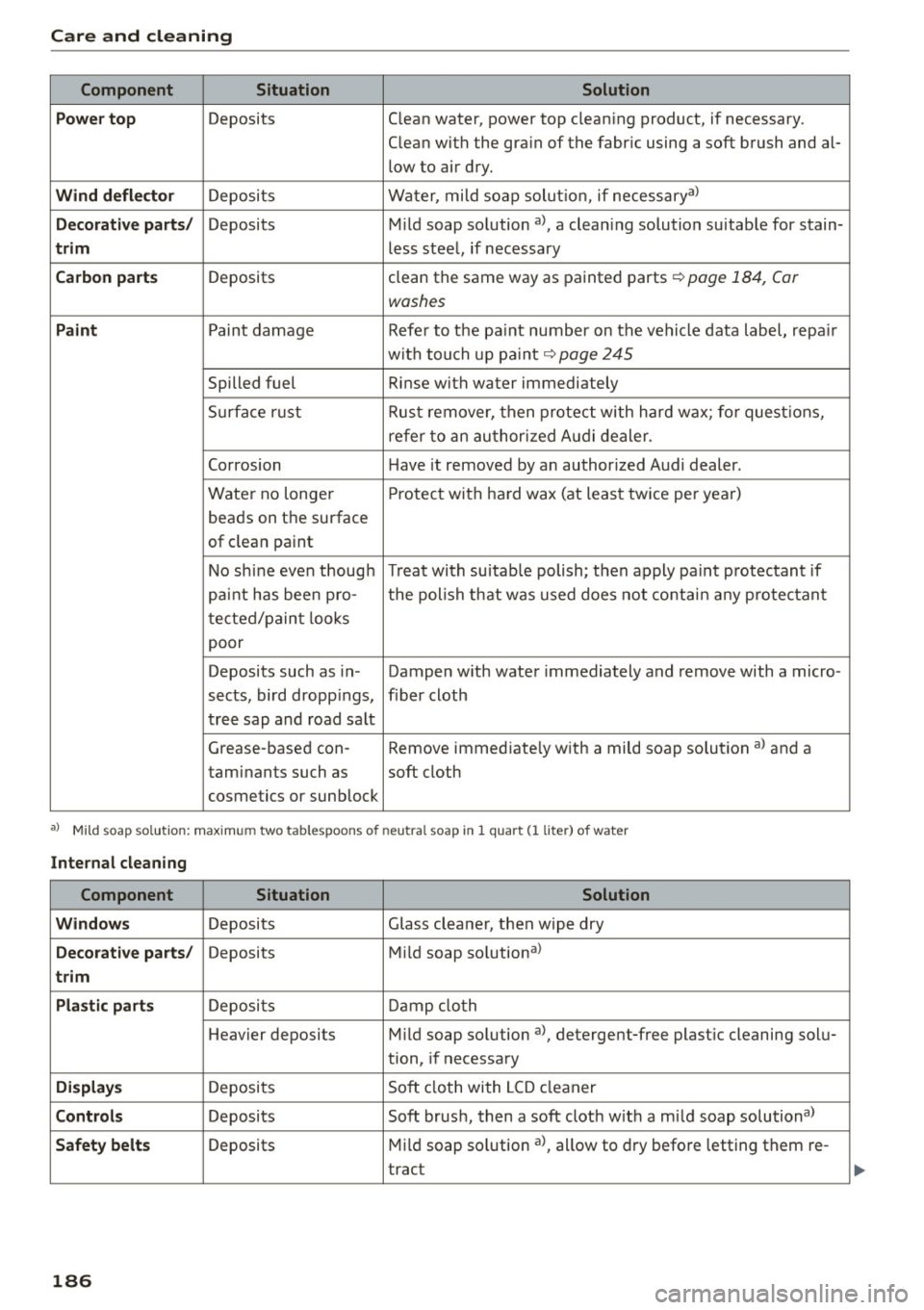
Component Situation Solution
P ower top
Deposits Clean water, power top cleaning product, if necessary.
Clean with the grain of the fabric using a soft brush and al-
low to air dry.
Wind d efle ct or Deposits Water, mild soap solut
ion, if necessaryal
D ec orativ e parts / Deposits Mild soap solution al, a clean ing solution suitable for stain-
t rim less stee l, if necessary
Car bon p art s Deposits clean the same way as painted parts <=>page 184, Car
washes
P aint Paint damage Refer to the pa int number on the vehicle data label, repa ir
with touch up pa int <=>
page 245
Spilled fuel Rinse with water immediately
S urface rust Rust remover, then protect with hard wax; for quest ions,
refer to an authorized A udi dealer.
Corrosion Have it removed by an authorized Audi dealer.
Wate r no longer Protect w ith hard wax (at least twice per year)
beads on the surface
of clean paint
No sh ine even though Treat with suitab le polish; then apply pa int protectant if
pa int has been pro- the polish that was used does not contain any protectan t
tected/paint looks
poor
Deposits such as in- Dampen w ith water immediately and remove with a micro-
sects, bird dropp ings, fiber cloth
tree sap and road salt
Grease-based con-Remove immediate ly with a mild soap solution a) and a
taminants such as soft cloth
cosmetics or sunblock
al Mild soap solution: maximum two tablespoons of neutral soap in 1 quar t (1 liter ) of water
Internal cle ani ng
Component Situation Solution
Window s
Deposits Glass cleaner, then wipe dry
Dec orati ve part s/ Deposits Mild soap solutional
t rim
Pl as tic part s
Deposi ts Damp clo1th
Heavier deposits Mild soap solution al, detergent-free plastic cleaning solu-
tion, if necessary
Di spl ays Deposits Soft cloth with LCD cleaner
Controls Deposits Soft brush, then a soft cloth w ith a mi ld soap solutional
Safet y belt s Deposits Mild soap solution a>, allow to dry before letting them re -
tract
186
Page 192 of 268
Fuel and Refueling
Fuel and Refueling
Fuel
Fuel supply
Using the right fuel helps keep the environment
clean and prevents engine damage.
Fuel recommendation
The fuel recommended for your vehicle is unlead
ed premium
grade gasoline. Audi recommends
using TOP TIER Detergent Gasoline with a mini mum octane rating of 91 AKI (95 RON). For more
information on TOP TIER Detergent Gasoline,
please go to the official website
(www.toptiergas.com).
The recommended gasoline octane rating for
your eng ine can also be found on a label located
on the ins ide of the fuel filler flap. This rating
may be specified as AKI or RON.
Your vehicle may also be operated using unlead
ed regular gasoline with a minimum octane rat ing of 87 AKl/91 RON . However, using 87 AKl/91
RON octane fue l will s lightly reduce eng ine per
formance.
Use unleaded gasoline only. Unleaded gasoline
is available throughout the USA, Canada, and in
most European countries. We recommend that
you do not take your vehicle to areas or countries
where unleaded gasoline may not be available.
For more informat ion on refueling your vehicle,
see
~page 192.
Octane rating
Octane rating ind icates a gasoline's ability to re
sist engine damaging "knock" caused by prema
ture ignition and detonation. Therefore, buying
the correct grade of gasoline is very important to
he lp prevent possible eng ine damage and a loss
of engine performance.
Gasoline most commonly used in the United
States and Canada has the following octane rat
i n gs that can usually be found on the filler pump:
- Premium Grade : 91 - 96 AKI
- Regular Grade: 87 -90 AKI
190
Explanation of the abbreviations:
AKI= Anti Knock Index= (R+M)/2 = (RON+MON)/
2
RON = Re search Octane Number
MON= Motor Octane Number.
CJ) Note
- Do not use any fuel with octane ratings low
er than 87 AKI or 91 RON otherwise expen
sive engine damage will occur.
- Do
not use leaded gasoline. The use of lead
ed gasoline will severely damage your vehi
cle's catalytic converter and its ability to
control exhaust emissions.
Blended gasoline
Use of gasoline containing alcohol or MTBE
( methyl tertiary butyl ether)
You may use unleaded gasoline blended with a l
cohol or MTBE (commonly referred to as oxygen
ates) if the blended mixture mee ts the following
criteria:
Blend of gasoline methanol (wood alcohol or
methyl alcohol)
- Anti-knock index must be 87 AKI or h igher .
- Blend must contain no more than 3% metha-
nol.
- Blend must contain more than 2% co-solvents.
Blend of gasoline and ethanol (grain alcohol or
ethyl alcohol)
-Anti-knock index must be 87 AKI or h igher.
- Blend must not contain more than 1S% etha-
nol.
- Veh icles with flex ible fuel engine: blend must
not contain more than 85% ethanol.
Blend of gasoline and MTBE
-Anti-knock index must be 87 AKI or higher.
- Blend must contain not more than 15% MTBE.
Seasonally adjusted gasoline
Many gasoline grades are blended to perform es
pecially well for winter or summer dr iv ing . Dur-
i ng seasonal change-over, we suggest that you ""