air condition AUDI A5 CABRIOLET 2017 User Guide
[x] Cancel search | Manufacturer: AUDI, Model Year: 2017, Model line: A5 CABRIOLET, Model: AUDI A5 CABRIOLET 2017Pages: 266, PDF Size: 66.64 MB
Page 172 of 266
Intelligent Technology
These electronic control modules record data
dur ing normal vehicle operation that may be
needed by trained technicians for diagnostic and
repair purposes. The recording capability of these
modules is l imited to data (no sound is record
ed). Only a small amount of data is actually re
corded over a very limited per iod of time, or stor
ed when a system fau lt is detected by a control
mod ule. Some of the data stored may re late to
ve hicl e speed, dire ct ion, or brak ing, as well as re
stra int system use and performance in the event
of a crash. Stored data can also only be read and
downloaded with special equipment that is di rectly connected to the veh icle.
@ Tips
Your vehicle may be equipped with Audi con
nect. Your use of certain Audi connect fea
tures requires wireless services that are pro
vided by a third party wire less te lecommuni
cations provider. For detai ls regarding how in
formation obtained through Audi connect is collected, processed, t ransmitted, used, and
shared, please see your contract with the
w ireless te lecommunica tions p rovider and the
"About Aud i connec t" tab in your vehi cle's
M M I:
!MENUI b utton> Audi connect > About
Audi conne ct.
Braking
What affects broking efficiency?
New brake pads
During the fi rs t 250 miles (400 km), new b rake
pads do not possess the ir full braking effect, they
have to be "broken in" first ¢.& . You can com
pensate for this s light ly reduced bra king power
by pushing harde r on the brake pedal. Avoid
heavy braking loads during the break-in period .
Operating conditions and driving habits
The brakes on today's automobiles a re st ill s ub
ject to wea r, depending la rgely on ope rating con
ditions and driving habits¢.&, . On vehicles that
are either dr iven most ly in stop-and-go city traf
f ic or are driven hard, the brake pads should be
checked by your authorized Aud i dea ler more of
ten than specified in the
War ranty & Mainte-
170
nance booklet . Failure to have your brake pads
inspected can result in reduced brake perform
ance.
On steep slopes, you should use the bra king ef
fect o f the engine. This way, you prevent unnec
essary wear on the brake system. If you must use
your brakes, do not ho ld the brakes down contin
uously. Pump the brakes at intervals.
Ope rating nois e
Noises may occu r when braking depen ding on the
speed, braking force and outside conditions such
as temperature and h umidity.
Effect of water and road salt
In certain si tuations, for examp le after d riving
t hr ough water, in heavy rain, after over nigh t con
densa tion or after washing your car, the brak ing
effect can be reduced by moisture or ice on the
brake rotors and brake pads . The brakes must be
dried f irst with a few careful brake app lications.
At higher speeds and w ith the windshield wipe rs
turned on, the brake pads press against the brake rotors for a short amount of time . This occurs at
regu lar intervals without the dr iver not icing and
provides for better brake response t ime under
wet cond itions .
The effectiveness of the brakes can be reduced
when the vehicle is driven on a salt-covered road
and the brakes are not used. Likewise, you clean
off accumulated salt coating from brake discs
and pads with a few caut ious applications of the
brake ¢.& .
Corrosion
There may be a tendency for dirt to build up on
the brake pads and corrosion to form on the discs
i f the car is not driven regularly or only for short
trips with little use of the brakes .
If the brakes are not used frequently, or if corro
s io n has formed on the discs, it is advisable to
clean off the pads and discs by braking firmly a
few times from a moderately high speed ¢ .& .
Page 174 of 266
Intelligent Technology
Do not contin ue driving . See yo ur authori zed
Aud i dea ler or a qua lified repair facility for assis
tance.
'I@ Dynamic steering : Sy stem fault! You can
cont inue d riv ing
If the indi cator lig ht t urns on and the message
appears, the steering m ay be more difficul t to
move or mo re sensit ive than usual. The steering
wheel may also be at an angle when dr iving
straight .
Dr ive s low ly to your author ized A udi dealer or
qu alified wor kshop to have the ma lfunction co r
rected .
l;:r-ij Dynamic steering : initializing
If th is driver message appears and the ind icator
light is flas hing on the instrument panel, dynam
ic stee ring* is be ing rein itia lized . Afte r start ing
the engine , the steer ing wheel will move s light ly.
Re-i nitializ ation m igh t b e necessa ry if the s teer
i n g wheel was moved hard to the left and r igh t
while the veh icle was not moving. The disp lay
goes out as soon as initia lization is complete.
A WARNING
Have the dynamic steering* system malfunc
tion repaired as soon as possible by an au
thorized Audi dealer or qualified workshop -
r isk of accident!
(D Tips
- If the . or l;pij indicator light only stays on
fo r a short time, you may continue driving.
- The dynamic steering* stability systems are
not available in the event of a system mal
funct ion.
- Fo r additional informat ion on dynamic
steering*, refer to
¢ page 101.
172
-
Driving with your
quattro
App lies to : vehicles wit h all -w hee l drive
With all-wheel drive , all four wheels ore driven .
General information
With a ll-wheel d rive, power is distrib uted to a ll
fo ur wheels. Th is happens automat ica lly depend
i ng on your driving style and the road conditions
at the t ime . See also
¢ page 167.
A center d ifferential distributes the driving powe r
variably to the front and rear axle. It works to
gether w ith select ive whee l torque contro l, wh ic h
activates when d rivi ng through curves
¢ page 167. With the spor t different ial*, power
dist ribution to the rear wheels is var iable and can
be adjusted wi th d rive select ¢
page 101 .
The all-whee l dr ive concept is designed for hig h
engine powe r. Your vehicle is except ionally pow
e rfu l an d has excellent driving cha racteristics
bot h unde r no rmal d riving condi tions and o n
snow and i ce. A lways read and follow safety pre
ca utions
~ ..&. .
Winter tires
When dr iving in the winter, yo ur vehicle with all
whee l dr ive has a n advantage, even with regu la r
t ir es. In w inte r road cond it ions i t may be advisa
ble to mo unt win ter tires (o r all-se ason tires) for
i mproved driveability an d braking: these ti res
must be mo unted on
all four whee ls. See also
¢ page 2 22, Winter tires.
Tire chains
Where tire ch ains are mandatory on certain
r oads, t his normally also applies to vehicles wi th
a ll- wheel drive ¢
page 222, Snow chains .
Replacing wheels/tires
Vehicles with all-w heel d rive mus t always have
ti res of the same size. Also avoid tires with diffe r
en t tread dep ths. Fo r d eta ils see page
¢ page 21 4, New tires or wheels. liJJ>
Page 187 of 266
a:,
a:,
...... N r--. N ...... 0
0
LL 00
Care and cleaning
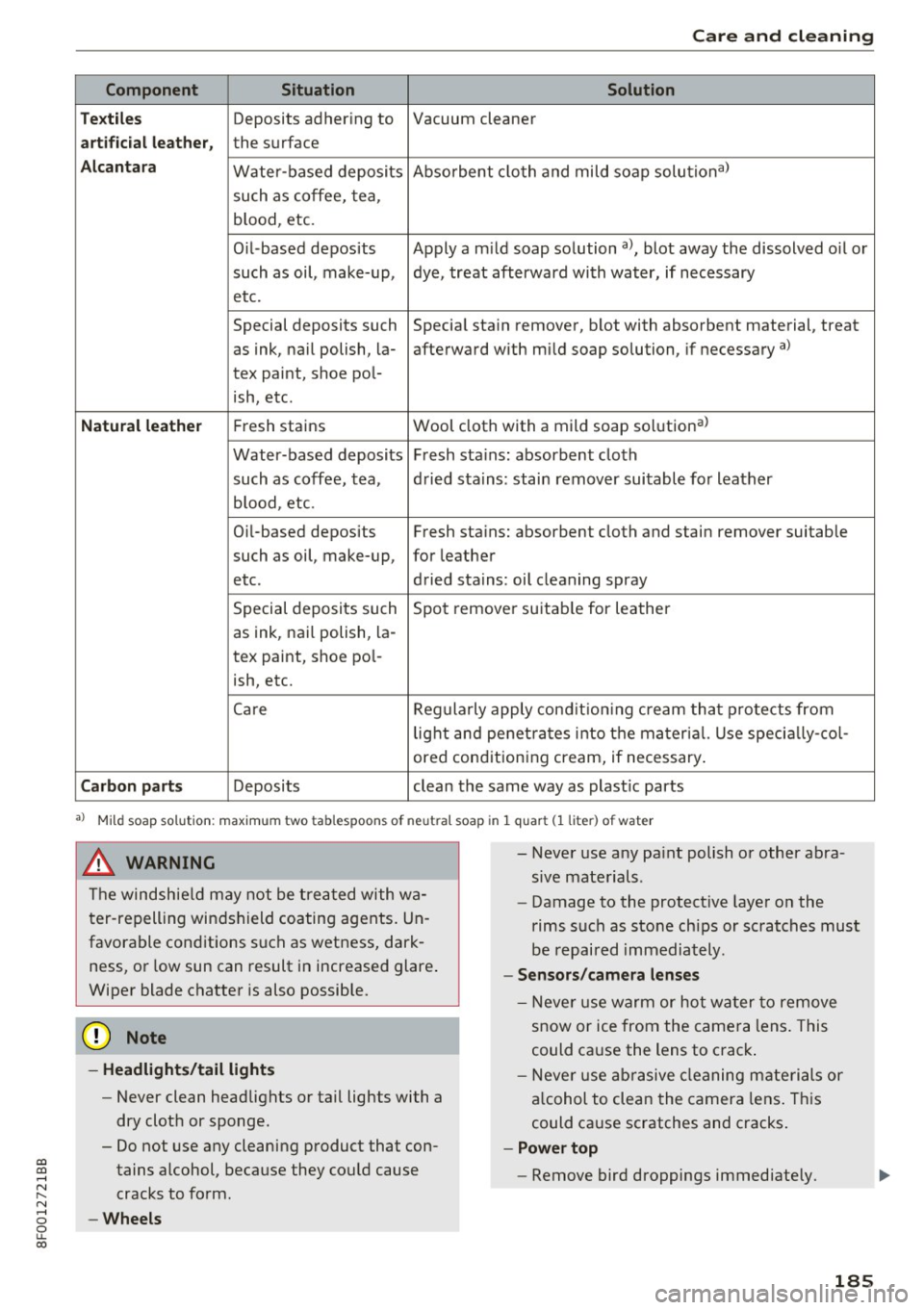
Component Situation Solution
T ex til es
Deposits adhering to Vacuum cleaner
art ifici al leat her, the surface
A lcan tara Water-based deposits Absorbent
cloth and mild soap solutiona>
such as coffee, tea,
b lood, etc.
Oil -based deposits Apply a m ild soap solution
a), blot away the dissolved o il or
such as oil, make-up, dye, treat afterward with water, if necessary
etc.
Special deposits such Special stain
remover, blot with absorbent material, treat
as ink, nail polish, la- afterward with mild soap solution, if necessary
a)
tex paint, shoe pol-
ish, etc.
Natu ral le ath er Fresh stains Wool cloth with a mild soap solution a)
Water-based deposits Fresh stains: absorbent cloth
such as coffee, tea, dried stains: stain
remover suitable for leather
b lood , etc.
Oi [-based deposits Fresh stains: absorbent cloth and stain
remover suitable
such as oil, make-up, for leather
etc. dried stains: oil cleaning spray
Special deposits such Spot remove r suitab le for leather
as ink, nail polish, la-
tex paint, shoe pol-
ish, etc.
Care Regularly apply condit ion ing c ream that protects from
lig ht and penet rates into the material. Use specia lly-co l-
ored conditioning cream, if necessary .
Carbon part s Deposits clean the same way as plast ic parts
a) Mi ld soap solution: maximum two tablespoons of neutral soap in 1 q uart (1 liter) of water
.8, WARNING
The windshield may not be trea ted with wa
ter-repelling windshield coating agents. Un
favorable cond itions such as wetness, dark
ness, or low sun can result in increased glare.
Wiper blade chatter is also possible.
@ Note
- Headlight s/tail li ght s
-Never clean headlights or tail lights with a
dry cloth or sponge.
- Do not use any cleaning product that con
tains alcohol, because they could cause
cracks to form.
- Whe els
-
- Never use any pa int polish or other abra
sive materials .
- Damage to the protect ive layer on the
rims such as stone chips or scratches must
be repaired immediately .
-Sen sor s/cam era l enses
- Neve r use warm or hot water to remove
snow or ice from the camera lens . This
could cause the lens to crack .
- Neve r use ab rasive cleaning materials or
a lcohol to clean the camera lens. This
could cause scratches and cracks .
-Powe r top
- Remove bird droppings immediately .
185
Page 202 of 266

Check ing and F illing
The location of the coolant expansion tank can be
seen in the engine compartment illustration
¢ page 195.
To obtain an accura te reading, the eng ine must
be switched off .
The expans io n tank in your vehicle is equipped
with a n elec tric coolant level sensor.
When the coolant level is too low, the war ning
lig ht in the Auto-Check System¢
page 15 will
blin k until you add coo la nt and the level has bee n
restored to normal. Even t hou gh the re is an e lec
tr ic coolant level sensor, we still re commend you
check the coo lant level from time to time .
Coolant loss
Coolant loss may indicate a leak in the cooling
system. I n the event of coolant loss, the cooling
system should be inspected immediately by your
author ized Audi dealer. It is not enough me rely
to add coolant.
I n a
se aled system, losses can occur only if the
boi ling point of the coo lant is ex ceeded as a re
sul t of over heat ing.
A WARNING
T he cooling system is unde r pressure and can
get very hot . Red uce the risk of scalding from
hot coolant by following these steps.
- Turn off the eng ine and a llow it to cool
down .
- Protect your face, hands and arms from es
caping fluid and steam by cove ring the ca p
with a la rge, thick rag.
- Turn the cap s lowly and very ca refu lly in a
counter-clockwise direction w hile ap ply ing
light, downwa rd pressure o n the top of the
cap.
- To avo id being burned, do not sp ill anti
freeze or coolant on the exha ust system or
hot eng ine parts. Under certain conditions,
the ethy lene g lycol in e ngine coolant can
catch fire.
(D Note
Do not add any type of radiato r leak sealant
to your veh icle's engine coolant. Adding radia-
200
tor repair fluid may a dverse ly affect the func
tion and performance of your coo ling system
and could result in damage not covered by
your New Vehicle Limited Warranty.
Adding coolant
Be very careful when adding engine coolant.
Befo re yo u check any thing in the engine compart
ment,
always read and heed all WARNINGS
¢ A in Working in the engine compartment on
page 193.
Requireme nt: The re mus t be a res idual amo unt
of coolant in the expans ion tank ¢(!) .
""Tur n off t he engine .
"" Let the eng ine cool down.
"" Pla ce a thick rag over the coolan t ex pan sio n
tank ¢
page 199, fig. 174 and carefull y turn
the cap counter-clockwise ¢,&. .
"" Add coolant m ixed in the cor rect rat io
¢page 199, Coolant up to the MAX ma rking.
"" Make sure that the fluid level remains stab le.
Add more coolant if necessa ry .
"" Twis t the cap o n aga in
tightly.
Replacement eng ine coolant must conform to ex
act specifications ¢
page 199, Coolant.
We recommend using only coo lant ad ditive G 12+
+ , G13 or in an emergency G12+. Do
not use a
different additive. In an emergency use plain wa
te r unt il you can get the cor rect addit ive and ca n
r esto re the cor rect rat io. Thi s should be done as
soon as possib le.
If you have lost a considerable amount of coo l
an t, then you s hou ld add co ld a ntifreeze and cold
water only whe n the engine is co ld.
A lways use
new engine coo lant when ref illing.
Do no t fill c oolant above the "MAX" mark . Excess
coolant will be forced out th rough the pressure
r elief valve in the cap when the engine becomes
hot.
~
Page 203 of 266
a:,
a:,
...... N r--. N ...... 0
0
LL 00
A WARNING ,~
- The cooling system is under pressure and
can get very hot. Reduce the risk of scald ing
from hot coolant by following these steps.
- Turn
off the engine and allow it to coo l
down.
- Protect you r face, hands and arms from
escaping fluid and steam by cover ing the
cap with a large, thick rag.
- Turn the cap slowly and very carefully in a
counter-clockwise d irection while applying
light, downward p ressure on the top of
the cap.
- To avoid being burned, do not spill anti
freeze or coolant on the exhaust system or
hot engine parts. Under certa in cond i
tions, the ethylene glycol in eng ine cool
ant can catch fire.
- Antifreeze is poisonous. Always store anti
freeze in its orig inal container and well out
of the reach of children.
- If you dra in the coolant, it must be caught
and safely stored in a proper conta iner
clearly marked "poison".
- Do not add coolant if the expansion tank is
empty. Air cou ld enter the cooling system
and damage the eng ine. If this is the case,
do not continue driving . Seek professional
ass istance.
- Coolant pollutes the env ironment and could
cause an eng ine fire. Excess coolant will be
fo rced o ut through the pressure relief valve
i n the cap when the e ng ine be comes hot.
- If, in an emergency, only wate r can be add
ed, the co rrect r atio betwee n wate r and an
tifree ze
Q page 199 must be res to red as
soon as possib le.
{® For the sake of the environment
Dra ined coolant sho uld not be reused. Always
disp ose of used coolant while obse rving all
env ironment al regulat ions.
-
Ch eck ing and Filling
Rad iator fan
The radiator fan switches on automatically by it
self .
The radiator fan is driven by the engine via the V
belt. The viscous clutch regulates th e speed of
the fan accord ing to the temperature of the cool
ant .
An auxiliary e lectr ic radiator fan* switches on and
off depending on coo lant temperature and other
vehicle operating conditions.
After you switch the engine
off, the auxiliary fan
can continue running for up to 10 m inutes -even
with the ignition
off. It can even switch on aga in
later by itself
Q .& , if
- the temperature of the engine coolant rises due
to the heat build-up from the engine in the en
gine compartment, or
- the engine compartment heats up beca use the
veh icle is parked in intense sunlight.
A WARNING
- To reduce the r isk of persona l injury neve r
touch the radia to r fan .
- The auxiliary e lectr ic fan is temperature
controlled and can switch on s uddenly even
when the engine is not ru nning .
- The a uxiliary radiator fan sw itches on auto
mat ically when the eng ine coolant reaches a
certa in temperature a nd will continue to run
until the coolant temperature d rops.
201
Page 205 of 266
a:,
a:,
...... N r--. N ...... 0
0
LL 00
@ For the sake of the environment
Because of the problem of proper disposal of
brake fluid as we ll as the special toots re
quired and the necessary expertise, we rec
ommend that you have the brake fluid
changed by your authorized Audi dealer .
Battery
General information
Under normal operating conditions, the battery
in your Audi does not need any maintenance.
With
high outside temperatures or long daily
drives we recommend that you have the electro
lyte level checked by an authorized Audi dealer or
qualified workshop. The electrolyte level should
also be checked each time the battery is charged
¢ page 205.
Have the battery checked when you take your ve
hicle in for serv ice. You are well advised to re
place a battery t hat is older than 5 years.
Disconnecting the battery terminals
Some vehicle functions (power window regula
tors, for example) are lost if the battery termi nals are disconnected. These functions have to be
relearned after the battery terminals are con
nected again. To prevent th is, the battery should
only be disco nnected from the vehicle e lectr ica l
system when abso lutely necessary for repairs.
Vehicles not driven for long periods
If you do not drive your vehicle over a period of
several days or weeks, electrical components are
gradually cut back or sw itched off. This reduces
energy consumption and maintains starting ca
pability over a longer period¢
page 173.
Some of the conven ience functions may not oper
ate, such as the interior lights or the power seat
adjustment. The convenience functions will be
available again when you turn on the ignition and
start the engine.
Winter operation
During the winter months, battery capacity tends
to decrease as temperatures drop . T his is be-
Checking and Filling
cause more power is also consumed while start
ing, and the headlights, rear window defogger,
etc., are used more often.
Avo id unnecessary power consumption, particu
larly in city traff ic or when traveling only short
distances . Let your authorized Audi dealer check
the capacity of the vehicle battery before winter
sets in ¢
page 205. A well charged battery will
not only prevent starting problems when the
weather is cold, but will also last longer .
(D Tips
If your vehicle is left standing for several
weeks at extremely low temperatures, the ve
hicle battery should be removed and stored
where it w ill not freeze. This will prevent it
from be ing damaged and having to be re
placed.
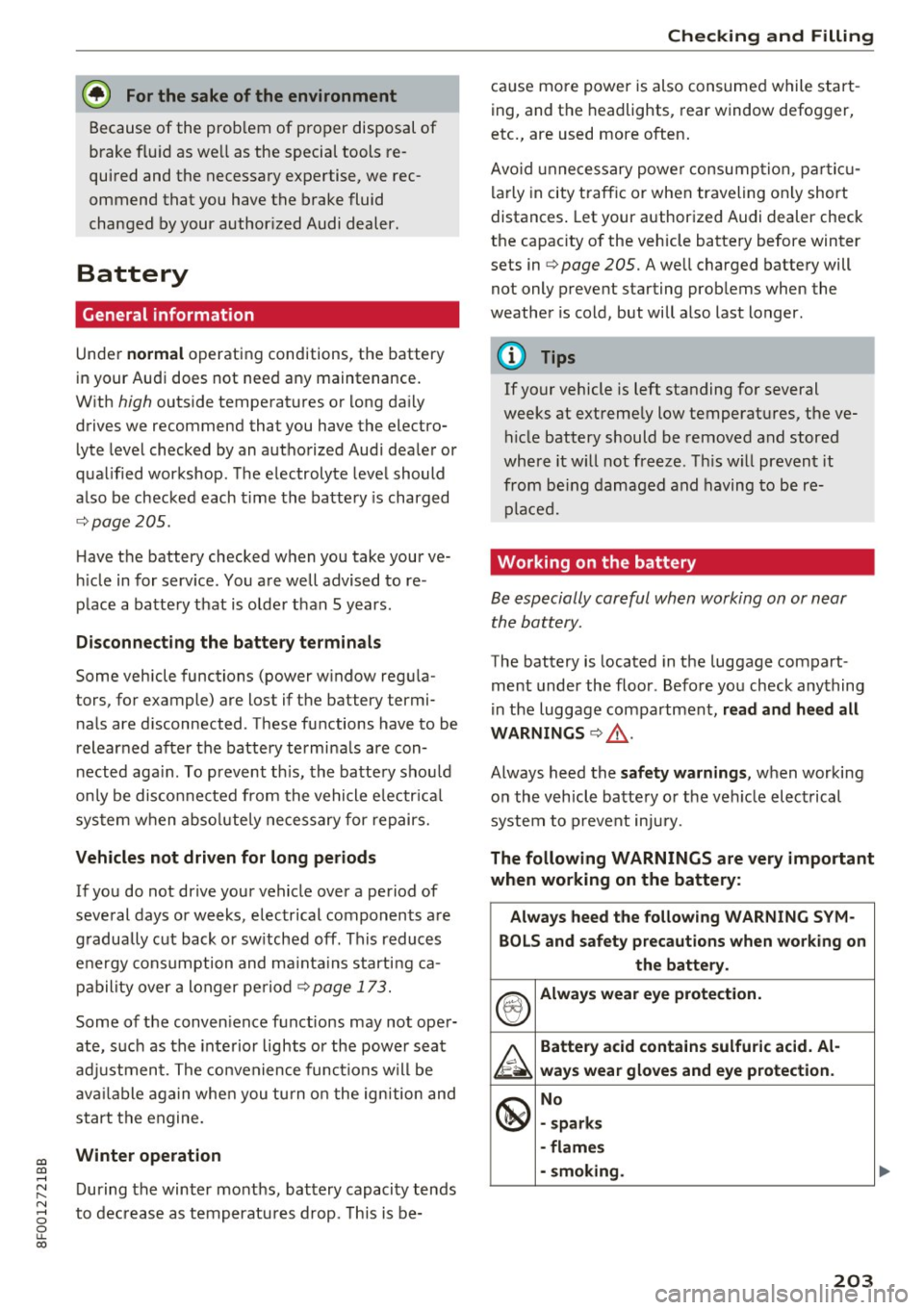
Working on the battery
Be especially careful when working on or near
the battery.
The battery is located in the luggage compart
ment under the floo r. Before you check anything
in the luggage compartment,
read and heed all
WARNINGS ¢
LD.·
Always heed the safety warnings, when working
on the vehicle battery or the veh icle electrical
system to prevent injury.
The following WARNINGS are very important
when working on the battery:
Always heed the following WARNING SYM·
BOLS and safety precautions when working on
the battery.
®
Always wear eye protection.
A
Battery acid contains sulfuric acid. Al·
ways wear gloves and eye protection .
@
No
- sparks
· flames
· smoking.
203
Page 224 of 266

Wheels
and a special procedure. You must not repair or
disassemble them¢&. .
A WARNING
Wheel bolts that are tightened or repaired in
correctly can become loose and result in loss
of vehicle control, which increases the risk of
an accident. For the correct t ightening specifi
cation, see ¢
page 229, After changing a
wheel .
-Always keep the wheel bolts and the
threads in the wheel hub clean and free of
grease.
- Only use wheel bolts that fit the rim .
- Always have damaged rims repaired by an
authorized Audi dealer or authorized Aud i
Service Facility . Never repair or disassemble
rims yourself, because this inc reases the risk
of an accident.
Winter tires
Winter tires s ignificantly improve the vehicle's
handling when driving in winter conditions . Be
cause of their construction (width, compound,
tread pattern), summer tires provide l ess trac
tion on ice and snow.
.,. Use winter tires on all four wheels.
.,. Only use winter tires that are approved for your
vehicle.
.,. Please note that the maximum permitted
speed may be lower with winter tires
q .&,. . An
authori zed Audi dealer or authori zed Audi Serv
ice Facility can inform you about the maximum
permitted speed for your tires .
.,. Check the tire pressure after install ing wheels
q page 217.
The effectiveness of winter tires is reduced great
ly when the tread is worn down to a depth of
0 .157 inch (4 mm). The character istics of winter
tires also decrease greatly as the tire ages, re
gardless of the remaining tread.
A WARNING
- Never drive faster than the maximum per
mitted speed for your tires. This could cause
the tires to heat up too much. This increases
222
-
the risk of an accident because it can cause
the tire to burst.
- Always adapt your driving to the road and
traffic conditions . Drive carefully and reduce
your speed on icy or slippery roads . Even
winter tires can lose traction on black ice .
@ For the sake of the environment
Reinstall summer tires at the appropriate
time, because they prov ide better handling
when roads are free of snow and ice. Summer
tires cause less road noise, tire wear and fuel
consumpt ion .
(D Tips
You can also use all season tires instead of
winter tires. Please note that in some coun
tries where winter tires are required, only
winter tires w ith the ~ symbol may be per
mitted.
Snow chains
Snow chains improve traction in the snow .
.,. Only install snow chains on the front wheels.
This applies also to vehicles with all wheel
drive* .
.,. Check and correct the seating of the snow
chains if necessary after driving a few feet. Fol
low the instructions from the manufacturer.
.,. Note the maximum permitted speed when dr iv
ing with snow chains. Do not exceed 30 mph (SO km/h).
Snow cha ins not only improve the
driving in win
ter road conditions, but also the
braking .
Use of snow chains is only permitted with certain
rim/tire combinat ions due to technical reasons .
Check with an author ized Audi dealer or author
ized Audi Service Facility to see if you may use
snow chains.
Use
fine-mesh snow chains. They must not add
more than 0.53 inch (13.5 mm) in height, includ
ing the chain lock.
You must remove the chains when driving on
roads that are
free of snow . When roads are free ..,.
Page 225 of 266

a:,
a:,
...... N r--. N ...... 0
0
LL 00
of snow, snow chain s can imp air handling and
damage the t ires, and t he chains will quickly be
destroyed.
A WARNING
Using incorrect snow chains or installing snow
chains incorrect ly can result in loss of vehicle
co ntrol, which increases the risk of an acc i
dent .
Snow chains can damage the r ims/wheel cov
ers* if the chains come into d irect contact
w ith them. Remove the wheel covers* first.
Use coated snow chains .
@ Tips
When using snow chains, it may be useful to
switch on sport mode
¢ page 168.
Low aspect ratio tires
Your Aud i is factory-equipped with low aspect ra
t io ti res. These t ires have been tho rough ly tested
a n d been se lected specifically fo r yo ur model for
t he ir superb performance, road feel and handling
under a variety o f driving conditions. Ask your au
thor ized Audi dealer for more details .
The low aspect ratio of these t ires is indicated by
a numera l of
55 or l ess in the tire 's size designa
tion. The numera l represents the rat io o f the
tire's sidewall height in relat ion to its tread width
expressed in pe rcentage. Conventional t ires have
a height/w idth rat io of 60 or more.
The performan ce of low- aspect- ratio tire s is par
ticularl y sensiti ve to imp roper inflat ion pres
sure . It is therefore import ant that low a spect
ratio tires are infl ated to the specified pressure
and that the inflation pre ssure is regularl y
checked and mainta ined . Tire pre ssure s shoul d
be checked at least once a month and alwa ys
befor e a long t rip
¢ page 217.
What you can do to avoid tire and rim
damage
Low aspect rat io tires can be damaged more easi
ly by impact with potho les, curbs, gull ies or
Wh eel s
ridges on the road, particular ly if the tire is un
deri nflated.
In orde r to min imi ze the occurrence of imp act
damage to the tires of yo ur vehicle, we recom
mend that you observe the following preca u
tions:
- Always ma intain recommended inflat io n pres
sures. Check yo ur ti re pressure every 2,000
miles (3,000 km) and add air if necessary .
- Dr ive ca refully on roads w ith po tholes, deep
gullies or ridges . The impac t from dr iving
through or over such obstacles can damage
your tires. Impact with a curb may a lso cause
damage to your tires.
- After any impact, immediate ly inspect your
tires or have them inspected by the nearest au
thorized Audi dealer. Replace a damaged tire as
soon as possible.
- Inspect your tires every 2,000 m iles (3,000 km)
for damage and wear. Damage is not a lways
easy to see . Damage can lead to loss of air and
underinflation, wh ic h could eventually cause
tire fa ilure. If you believe that a tire may have
been damaged, replace the tire as soon as pos
sib le.
- These tires may wear more quickly than others .
- Please also remember that, while these tires
delive r responsive ha ndling, they may ride less
comfortably a nd make more noise than other
choi ces.
Reduced perfo rmance in winter /cold se ason
conditions
All tires are des igned for certai n purposes. The
low aspect ratio, ultra high performance tires
o rigi na lly installed o n your veh icle are intended
f or maximum dry and wet road per formance and
handling . They are not suitable for co ld, snowy or
icy weather conditions . If you drive under those
c ircumstances, you should equip your vehicle
with all-season or winter tires, which offer better
tract ion under those conditions. We suggest you
use the recommended snow or all-season tires
spec ified for your veh icle, or their equiva lent .
Refer to¢
page 222 for more detailed informa
t ion regarding winter tires.
223
Page 248 of 266
Consumer information
Consumer information
Warranty coverages
Your Audi is covered by the following warran
ties:
- New Vehicle Limited Warranty
- Limited Warranty Against Corrosion Perfora-
tion
- Emissions Control System Warranty
- Emissions Performance Warranty
- California Emissions Control Warranty (USA
vehicles only)
- California Emissions Performance Warranty
(USA vehicles only)
Detailed information regarding your warranties
can be found in your
Warranty & Maintenance
booklet .
Operating your vehicle
outside the U.S.A. or
Canada
Government regulati ons in the United States and
Canada require that automobi les meet specific
emission regulations and safety standards.
Therefore, vehicles built for the U.S.A. and Cana
da differ from vehicles sold in other countries.
If you plan to take your vehicle outside the conti
nenta l limits of the United States or Canada,
there is the poss ibility that:
- un leaded fue ls for vehicles with catalytic con
verter may not be available;
- fuel may have a considerably lower octane rat
ing . Improper fuel may cause engine damage;
- service may be inadequate due to lack of proper
service facilities, tools or testing equipment;
- r eplacement parts may not be readily available.
- Nav igation systems for veh icles built for the
U.S .A . and Canada will not necessarily work in
Europe, and may not work in other countries
outside of North America.
246
(D Note
Audi cannot be responsib le for mechanical
damage that could result from inadequate
fuel, service or parts ava ilability.
Audi Service Repair
Manuals and Literature
Audi Official Factory Service Manuals and Litera
ture are published as soon as poss ible after mod
el introduction . Service manuals and literature
are available to order from the Audi Technical Lit
erature Ordering Center at :
www.audi.techliterature .com
Maintenance
General '
Your vehicle has been designed to help keep
maintenance requirements to a minimum. How
ever, a certain amount of regular maintenance is
still necessary to assure your vehicle's safety,
economy and reliability . For detailed vehicle
maintenance consult your Warranty & Mainte
nance booklet .
Under difficult operating conditions, for exam
ple at extremely low outside temperatures, in
very dusty regions, when towing a trailer very fre
quently, etc., some service work should be per
formed between the intervals specified. This ap
plies particularly to:
- oil changes, and
- cleaning or replac ing the a ir filter .
'
@) For the sake of the environment
By regularly maintain ing your vehicle, you
help make sure that em iss ion standards are
maintained, thus minimizing adverse effects
on the environment .
Important considerations for you and your
vehicle
The increasing use of electronics, sophisticated
fuel injection and emission control systems, and
the generally increas ing technica l complexity of ..,_
Page 249 of 266

a:,
a:,
...... N r--. N ...... 0
0
LL 00
today's automobiles, have steadily reduced the
scope of maintenance and repairs which can be
carried out by veh icle owners.
Also , sa fet y a nd
en vironmental
concerns place very strict limits
on the nature of repairs and adjustments to en
g ine and transm ission parts wh ich an owner can
pe rform .
Maintenance, adjustments and repairs usually re
qu ire special tools, test ing devices and other
equ ipment available to specially trained work
shop perso nnel i n order to assure proper per
formance, re liability a nd safety of the ve hicle and
its many systems.
Improper maintenance, adjustments and repairs
can impair the operation and re liab il ity of you r
vehi cle and eve n void your vehicle warra nty .
Therefo re, proof of se rvicing in accordance with
the m aintenance schedule may be a condition fo r
upho ld ing a possib le warranty claim made wi thin
the warranty period.
Above all , ope rational safety can be adversely af
fected, cre ati ng u nnecessa ry risks fo r yo u and
your passengers.
I f in doubt about any se rvicing, have it done by
your author ized Audi dealer or any properly
eq uipped and qua lified workshop. We strongly
urge you to g ive your author ized Audi dealer the
opportunity to perform a ll scheduled mainte
nance and necessary repairs. Your dealer has the
fac ilities, original parts and tra ined specialists to
keep your veh icle running properly .
Performing limited ma intenance yourself
The fo llow ing pages describe a limited number of
procedures which can be performed on your vehi
cle with o rdinary tools, should the need arise and
tra ined personnel be unavailable. Before per
forming any of these procedures, always thor
ough ly read a ll of the app licab le text and careful
l y follow the instructions g iven . Always rigorously
observe the
WARNINGS prov ided .
Before you check an ything in the eng ine com
partment, alw ays read and heed all WARNINGS
c::> .&. and c::> .&. in Working in the engine compart
ment on page 193 . Con
sumer inf ormation
A WARNING
- Ser ious personal in jury may occur as a result
of improperly performed maintenance, ad
justments or repairs .
- Always be extremely careful when work ing
on the vehicle. Always follow commonly ac
cepted safety practices and general com mon sense. Never risk pe rsonal in jury.
- Do not attempt any of the maintenance,
checks or repairs described on the following pages if you are not fu lly familiar wi th these
or other proce dures with respect to t he ve
h icle, o r are uncerta in how to pro ceed.
- Do not do a ny work withou t the proper tools
a nd equ ipment. Have the nece ssary wo rk
done by your authorized Audi dealer or any
p roper ly equipped and qualifie d wo rkshop.
- T he engine compa rtment of any motor veh i
cle is a potent ially hazardous area . Never
reach into the area around or touc h the radi
ator fan. It is temperature controlled and
can switch on suddenly - even when the en
g ine is off and the ignition key has been re
moved . The rad iator fan switches on auto
mat ically when the coo lant reaches a certain
temperature and will con tinue to ru n until
the coolant temperat ure drops.
- Always remove the igni tion key befo re any
one gets under the vehicle.
- Always support your veh icle with safety
stands if it is necessary to work underneat h
the vehicle . The jack supplied with the veh i
cle is no t adequ ate for t his pu rpose and
could collapse c ausing se riou s personal in
jury .
- If you mu st wor k unde rne ath t he vehicle
with the wheels on the ground, always make
sure the vehicle is on level ground, that the
wheels a re always sec urely blocked and that
the engine cannot be started.
- Always make sure the transmission se lector
lever (a utomatic t ransmiss ion) is in "P"
(Park position) and the park brake is firmly
applied.
247