engine oil AUDI A5 CABRIOLET 2017 User Guide
[x] Cancel search | Manufacturer: AUDI, Model Year: 2017, Model line: A5 CABRIOLET, Model: AUDI A5 CABRIOLET 2017Pages: 266, PDF Size: 66.64 MB
Page 178 of 266
Driving and th e en vironm ent
(D Tips
- Check the depth of the water before driving
through it .
- Do not stop the veh icle, drive in reverse or
switch the engine
off when driving through
water.
- Keep in mind that oncoming vehicles may
create waves that raise the water level and
make it too deep for your veh icle to drive
through safely.
- Avoid driving through salt water because it
can cause corrosion.
Catalytic converter
It is very important that your emission control
system (catalytic converter) is functioning prop erly to ensure that your vehicle is running in an
environmentally sound manner .
~ Always use lead-free gasoline ¢ page 188,
Fuel supply .
~ Never run the tank down a ll the way to empty .
~ Never put too much motor oil in your engine
¢ page 19 7, 9::?l Adding engine oil .
~ Never try to push- or tow-start you r vehicle.
The cata lytic converter is an efficient "clean-up"
dev ice bu ilt into the exha ust system of the vehi
cle. The cata lytic conve rter burns many of the
pollutants in the exhaust gas before they are re
leased into the atmosphere.
The exclusive use of unleaded fue l is critica lly im
portant for the l ife of the catalytic conve rter and
p roper functioning of the engine.
A WARNING ,..____ -
- The temperature of the exhaust system is
high, both when driving and after stopping
the engine.
- Never touch the exha ust tail pipes once they
have become hot. This could result in burns.
- Do not park or ope rate t he vehicle in areas
where the hot exha ust system may come in
contact with dry grass, br ush, fue l spill or
other mater ial which can cause a fire.
- Do not apply additional undercoating or
rustproofing on or near the exhaust mani-
176
fold, exha ust pipes, cata lytic conve rter or
heat shields. D uring driving, the substance
used for undercoat ing could overheat and
cause a f ire.
Cl) Note
- Be aware that just one tank f illing wit h
leaded fu e l w ill already seriously degrade
the performance of the catalytic converter.
- Do not exceed the correct engine oil leve l
¢page 197.
-Do not drive until the fue l tank becomes
completely empty. The engine could mis
fire. Unbu rned fue l cou ld also get into the
exhaust system and this could cause the
catalytic converter to overheat.
- Do not turn off the ign ition while the vehicle
is moving .
- Do not continue to operate your vehicle un
der these conditions, as otherw ise fuel can
reac h the catalytic converter. T his could re
sult in overheat ing of the converter, requir
ing its replacement.
- T o ass ure eff icient operat ion of the Emis
sion Contro l System:
- Have you r vehicle maintained properly and
i n accordance wit h the service recommen
dations in your Warranty
& Ma intenance
booklet.
- Lack of proper ma intenance as well as im
p roper use of the veh icle will impa ir the
function of the emission control system
and could lead to damage.
(® For the sake of the environment
Even when the Emiss ion Control System is op
erating properly, t he exhaust gas can have a
sulfur-like exhaust gas smell under some op
erating states. Th is depends on the sulfur
content of the fuel being used. Us ing a d iffer
ent brand of fuel may help, or fi lli ng the tank
wi th lead-free super g rade gasoline.
Shutting down vehicle
If you wo uld like yo ur vehicle to remain inopera
tive for a longer pe riod of time, con tact an Audi
o r other spec ia liz ed dealer. They can adv ise you ..,.
Page 180 of 266
Driving and th e en vironm ent
Regular maintenance
A badly tuned engine unnecessarily wastes a lot
of fuel.
.,. Have your vehicle serviced at regular intervals.
By having your vehicle regu larly serviced by an
author ized Audi dealer he lps to ensure that it
runs properly and econom ically . The condition of
your veh icle not only affects its safety and ability
to hold its value, it also affects
fu el consump
tion .
C he ck your oil e ach t ime you fill you r ta nk .
The amount of oil used is re lated to engine load
and speed.
It is normal for the oil consumpt ion of a new en
g ine to reach its lowest val ue afte r a certa in mile
age has been driven .
You must d rive you r vehicle about 3 ,000 miles
(5,000 k ilome ters) before you can p roperly as
sess o il cons umption .
This a lso applies to fuel consumption and engine
outpu t.
(D Note
- Have your vehicle maintained properly and
in accordance with the service recommenda
tions in you r Warranty
& Maintenance book
l et . La ck of p roper main tenance as well as
i mproper use of the vehicle will impa ir the
f u nct ion of the emission control system and
could lead to damage.
- Do not al ter or remove any component of
the Emission Control System unless ap proved by the manufacturer.
- Do not a lter or remove any device, such as
heat shie lds, switches, ignition wires,
valves, which are designed to protect your
vehicle's Emission Control System and other i mportant vehicle components.
178 ·
Fewer short trips
Fuel consumption will always be relatively high
on short trips .
.,. Try to avoid driving short distances with a cold
eng ine .
T he eng ine and catalytic converter have to reac h
their opt imal
operating temper atu re to reduce
fuel consumpt ion and noxious emiss ions effec
tively .
Just after start ing, a cold engine in a mid-size car
on ly achieves a fuel economy of 6-8 miles per
gallon (30-40 l/100 km) . After about a half a
mile, fuel economy climbs to 12 mpg (20 l/100
km) . After about
2 .5 m iles (4 km), the engine is
at its proper operating temperatu re and fuel
economy has reached a no rma l level. So you can
see that you should avoid sho rt tr ips wheneve r
possible .
The
out sid e temperatur e is also cr it ica l in th is re
gard. Your car cons umes more fue l in the winter
than in the summer.
Page 191 of 266
fill up at busy gas st ations where the season al
adjustment is more likely to be made in time .
(D Note
-Fu els con taining a high pe rcentage of etha
no l such as ESQ and EBS may only be used in
vehicles with flexible fuel engines. Using high ethanol f uel in veh icles not equ ipped
with flexib le fue l engines can cause severe
engine damage.
- Methanol fuels which do not meet these re quirements may ca use corros ion and dam
age to plast ic and rubber components in the
fuel system.
- Do not use fuels that fail to meet the spec i
fied criter ia in this chapter.
- If you are unable to determine whether or
not a particular fuel blend meets the spec i
fications, ask your service station o r its fuel
supplier.
- Do not use fue l for wh ich the contents can
not be identif ied.
- Fuel system damage and performance prob
lems result ing from the use of fuels differ
ent from t hose specif ied a re not the respon
s ibility of Audi and are not covered under
t h e New Veh icle o r the Emiss io n Control
System Wa rra nt ies.
- If yo u experience a loss of fue l economy o r
driveability an d pe rform ance prob le m s du e
to t he use of one of these fuel blends we
,
recommend that you switch to unb lended
fuel.
Ethanol fuel (Bio-ethanol)
Applies to: ve hicles with flex ible fuel engine
You can recognize vehicles wi th a flexible fuel
engine by looking at the label on the inside of the fuel filler flap.
Ve hicl es w ith flex ible f uel engines may be oper
ated w ith b io -e thanol fuels such as EBS (85%
ethano l and 15% gasoline) or with un leaded gas
oline (91 AKI/ROZ 95) . The ve hicle may a lso be
a:, operated with a mixture of these fuels. a:, ...... N r--. N ...... 0
0
LL 00
Fuel and R efueling
Your fuel consumpt ion w ill increase when using
bio-ethano l fue ls due to the lower amount of en
ergy conta ined per un it vol ume in ethanol.
Warming up the flexible fuel engine in low
temperature s
Due to the chemica l composition of b io -ethanol,
a certa in amount of fue l ends up in the engine o il
when driving short distances in very low temper
atures. This fuel evaporates again when the en
gine is warmed up.
II Please warm up eng ine .
If the drive r message appears in the instr ume nt
cluster disp lay, drive with a warm engine to re
duce the oil leve l.
(D Note
- N ever fill wi th metha no l o r with a higher
percentage of b io -ethanol than 85% (E85).
A highe r percentage of bio-ethanol in the
fuel can cause damage to the engine or to the fuel system.
- If you use on ly E85, it is recommende d to
fill the fue l tank complete ly w ith unleaded
premium g rade gasoline every 5,000 mi les.
- If you expe rience starting, rough id le or hes
itat ion d riveab ility prob lems, f ill the fuel
tank complete ly w ith unleaded p remium
grade gaso line and drive it norma lly until
t he gaso line is used. See your author ized
Audi dea ler if the problem persists.
- Inform your author ized Audi dealer that you
are ope rating o r have operate d the vehicle
w ith EBS.
- Read and follow the i nformat ion and tips
abou t gasoli ne
r::;, page 188.
(D Tips
It may take longer to start the engine when
the outs ide temperat ure is very cold. If possi
ble, use w inte rize d fue l if tempe ratures are
below free zing.
189
Page 196 of 266
Checking and Filling
compartment. Wait until no steam or cool
ant can be seen or heard before carefully
opening the hood.
- Keep children away from the engine com
partment.
- Never spill fluids on hot engine compo
nents. They can cause a fire.
- Never touch the radiator fan. The auxiliary
electric fan is temperature controlled and
can switch on suddenly.
- Never open the coolant reservoir cap when
the engine is still warm . The coolant system
is pressurized and hot coolant could spray
out.
- Protect your face, hands and arm from
steam or hot engine coolant by placing a
thick rag over the cap when you open the coolant reservoir .
- Do not remove the engine cover under any
circumstances . This increases the risk of
burns.
- If work on the fuel system or the electrical
system is necessary:
= Always disconnect the battery.
- Never smoke or work near heaters or open
flames. Fluids in the engine compartment
could start a fire.
- Keep an approved fire extinguisher imme
diately available.
- To avoid electrical shock and personal injury
while the engine is running or being started,
never touch:
- Ignition cables
- Other components of the high voltage
electronic ignition system.
- If you must perform a check or repair with
the engine running:
- First, fully apply the parking brake, move
selector lever of automatic transmission
to "P" (Park).
- Always use extreme caution to prevent
clothing , jewelry, or long hair from get-
194
ting caught in the radiator fan, V-belts or
other moving parts, or from contacting
hot parts. Tie back hair before starting,
and do not wear clothing that will hang or
droop into the engine.
- Minimize exposure to emission and chemi
cal hazards
c::> &.
A WARNING
California Proposition 65 Warning:
- Engine exhaust, some of its constituents,
and certain vehicle components contain or
emit chemicals known to the State of Cali
fornia to cause cancer and birth defects and
reproductive harm. In addition, certain flu
ids contained in vehicles and certain prod
ucts of component wear contain or emit
chemicals known to the State of California
to cause cancer and birth defects or other
reproductive harm .
- Battery posts, terminals and related acces
sories contain lead and lead compounds,
chemicals known to the State of California
to cause cancer and reproductive harms.
Wash hands after handling.
([) Note
When adding fluids, always make sure that
they are poured into the proper container or
filler opening, otherwise serious damage to
vehicle systems will occur.
@ For the sake of the environment
To detect leaks in time, inspect the vehicle
floor pan from underneath regularly. If you
see spots from oil or other vehicle fluids, have
your vehicle inspected by an authorized Audi dealer .
Page 197 of 266
a:,
a:,
...... N
l'
N
...... 0
0
LL co
Checking and Filling
Engine compartment
Engine compartment
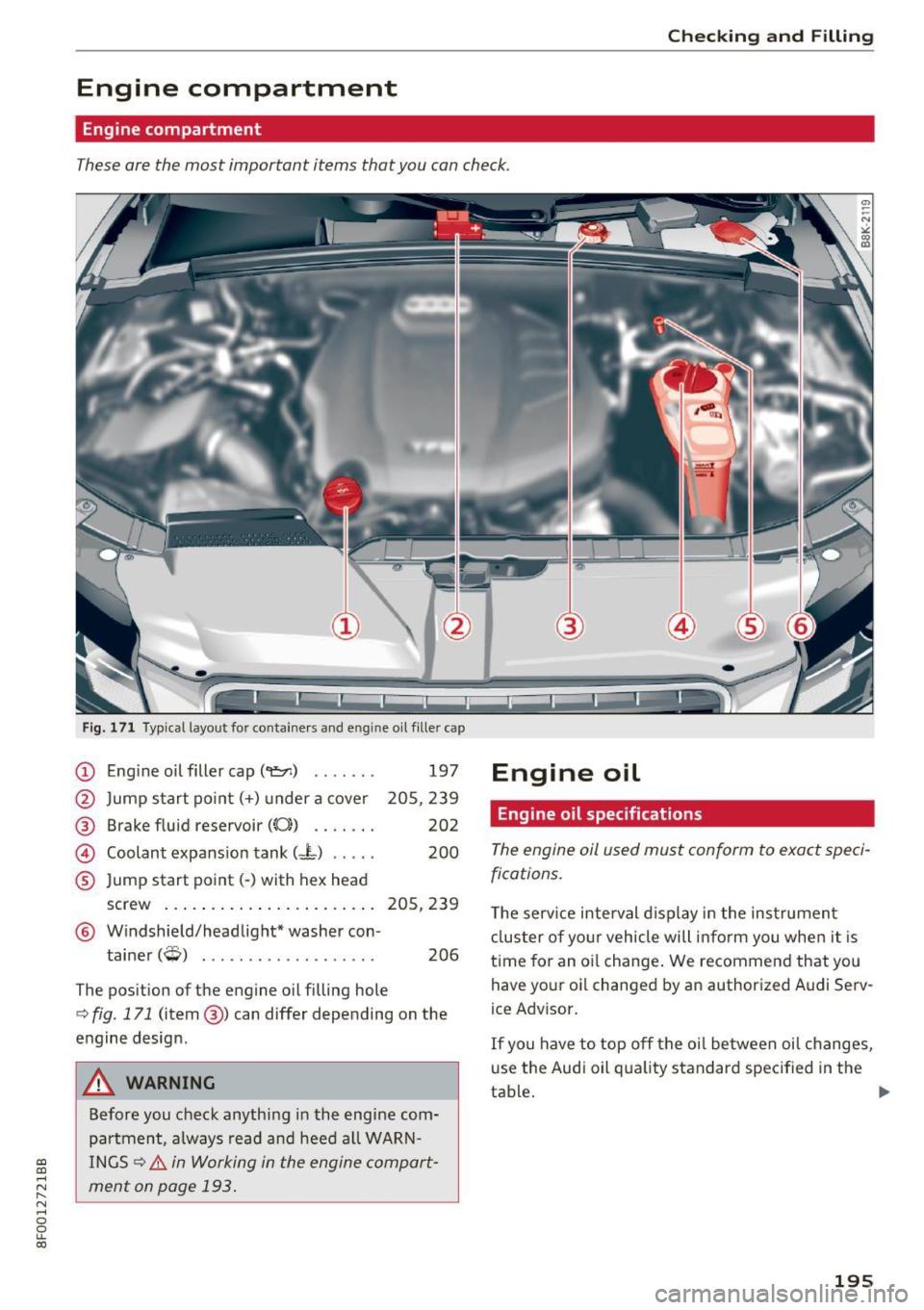
These are the most important items that you can check.
Fig. 171 Typical layout for containers and e ngin e oil fille r cap
(D Eng ine o il filler cap (
@ Brake fluid reservoir
((0) ...... .
@ Coolant expansion tank (- L) .... .
® Jump start point( -) with hex head
197
205,239
202
200
screw . . . . . . . . . . . . . . . . . . . . . . . 205, 239
@ Windshield/headlight* washer con-
tainer
(W) . . . . . . . . . . . . . . . . . . . 206
The position of the engine oil filling hole
c:> fig. 171 (item@) can differ depending on the
engine design .
A WARNING
Before you check anything in the engine com
partment, always read and heed all WARN
INGS
c:> &. in Working in the engine compart
ment on page 193.
Engine oil
Engine oil specifications
The engine oil used must conform to exact speci
fications.
T he serv ice interval display in the instrument
cluster of your vehicle will inform you when it is
time for an oi l change . We recommend that you
have your oi l changed by an authorized Audi Serv
ice Advisor.
If you have to top off the oil between oil changes,
use the Audi oil quality standard specified in the
tab~ .
~
195
Page 198 of 266
Check ing and F illing
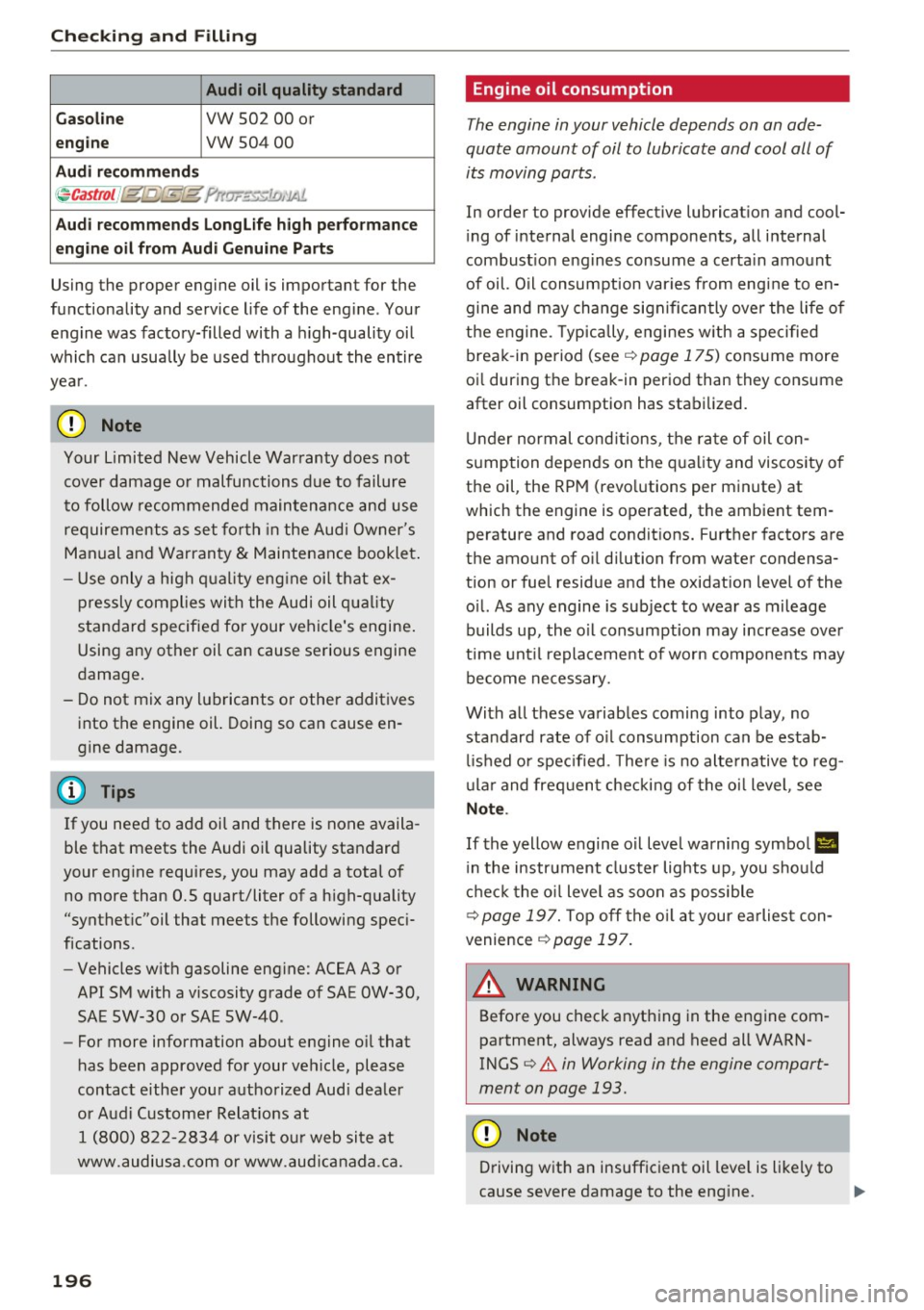
Audi oil quality standard
Gas olin e
VW 502 00 or
engi ne vw 50400
A udi reco mmend s
~Castrol I jgl[J,'fE{g ?r,w.:..~J ri, '.IA!,
Audi rec ommends Longlif e high perform ance
engi ne oil from Au di Genuin e Parts
Using the proper engine oil is important for the
functionality and service life of the engine. Your
engine was factory-filled with a h igh-quality oil
which can usually be used throughout the entire
yea r.
(D Note
Your Limited New Vehicle Warranty does not
cover damage or malfunctions due to failure
to follow recommended maintenance and use
requirements as set forth in the Audi Owner's
Manual and Warranty & Maintenance booklet .
- Use only a high qual ity eng ine oil that ex-
pressly complies with the Audi oil quality
standard specified for your vehicle's engine .
Using any other oil can cause serious engine
damage.
- Do not mix any lubricants or other additives into the engine oil. Doing so can cause en
gine damage.
@ Tips
If you need to add oil and there is none availa
ble that meets the Audi oil quality standard
your engine requires, you may add a total of
no more than 0.5 quart/liter of a h igh-quality
"synthet ic"oil that meets the following speci
fications.
- Vehicles w ith gasoline eng ine: ACEA A3 or
API SM with a viscosity grade of SAE OW-30,
SAE 5W-30 or SAE 5W-40.
- For more information about engine o il that
has been approved for your vehicle, please
contact either your authorized Audi dea ler
or Aud i Custome r Relat ions at
1 (800) 822- 2834 or visit ou r web site at
www.audiusa.com or www .aud icanada.ca.
196
· Eng ine oil consumption
The engine in your vehicle depends on an ade
quate amount of oil to lubricate and cool all of
its moving parts.
In order to provide effect ive lubricat ion and cool
i ng of internal engine components, all internal
combust ion eng ines consume a certa in amount
of oil. Oil consumption var ies from engine to en
gine and may change sign ificantly over the life of
the engine . T ypically, engines w ith a specified
break -in period (see¢
page 175) consume more
oi l during the break-in period than they consume
after oil consumption has stabilized.
U nder normal cond itions, the rate of oil con
sumption depends on the quality and viscosity o f
the oil , the RPM (revo lutions per minute) at
which the engine is operated, the ambient tem perature and road conditions. Further factors are
the amount of o il dilution from water condensa
tion or fuel residue and the oxidation level of the
o il. As any engine is subject to wear as mileage
builds up, the o il consumption may increase over
ti me unt il replacement of wo rn compo nents may
become necessary.
With all these variables coming into play, no standard rate of o il consumption can be estab
li shed or spec ified . T he re is no alte rnative to reg
u la r and freq uent checki ng of the oi l level, see
Note.
If the yellow engine oil level warning symbo l II
in the instrument cluster lights up, you sho uld
chec k the o il level as soon as possible
¢
page 197. Top off the o il at your earlies t con
venience
¢ page 197.
A WARNING
Before you check anything in the engine com
partment, always read and heed all WARN
INGS
¢ .&. in Working in the engine compart
ment on page 193.
(D Note
D riving with an insuffic ient oil level is likely to
cause severe damage to the eng ine.
Page 199 of 266
a:,
a:,
...... N
" N ...... 0
0
LL co
@ Tips
-The oil pre ssure w arning display. i s not
an indicator of the oil level. Do not rel y on
it. Instead , check the oil level in your en
gine at regular inte rval s, preferably each
t ime you refuel , and alway s befo re going
on a long trip.
- If you have the impression your engine con
sumes excessive amounts of oil, we recom
mend that you cons ult an autho rized Aud i
dealer to have the cause of your concern properly d iagnosed. Keep in mind that the
accurate measurement of oil consump tion
requi res great care and may take some
time. An a uthorized Audi dea ler has instruc
tions about how to measure oil consump
tion accurately.
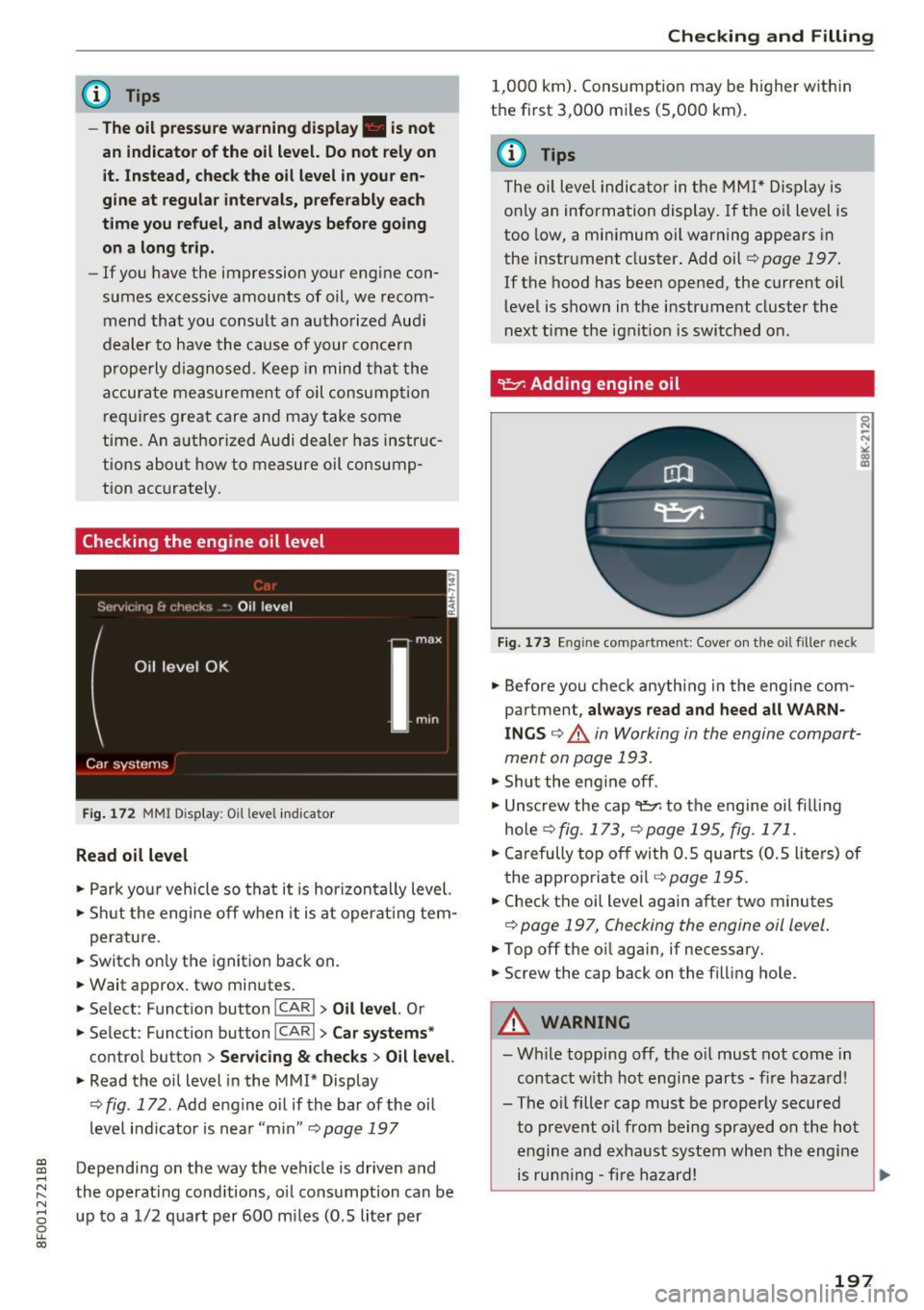
Checking the engine oil level
Fig. 172 MM I D isp lay: O il leve l in dicator
Read oil level
.. Park yo ur vehicle so that it is hor izontally level.
.. Shu t the engine off w hen it is at operat ing tem-
perature.
.. Switch only the ignition back on.
.. Wait approx . two mi nutes .
.. Se lect : Function button
~IC~A~R~I > Oil le vel. Or
.. Select : Funct ion button
ICARI > C ar sy stems *
contro l button > S ervici ng & checks > Oil leve l.
.. Read the oil level in the MMI* Display
¢fig . 172. Add engine o il if the bar of the oil
level indicator is near "min"
r::;, page 197
Depending on the way the vehicle is driven and
the operating cond itions, o il cons umption can be
up to a 1/2 quart per 600 m iles (0.5 liter per
Checking and Filling
1,000 km) . Consumptio n may be higher w ithin
the first 3,000 mi les (5,000 km).
(D Tips
The oil leve l indicato r in the M MI * Display is
on ly an information display. If the oi l level is
too low, a minimum oil warning appears in
the instr ument cluster . Add oil¢
page 197 .
If the hood has been opened, the current oil
l evel is shown in the instrument cluster the
next time the ignit ion is switched on.
"l=:7: Adding engine oil
Fig. 173 En g in e compartment: Cover on the oil filler nec k
.. Before you check anything in the eng ine com
partment,
a lwa ys read and heed all WARN
INGS
r::;, .&. in Working in the engine compart
ment on page 193 .
.. Shu t the eng ine off .
.. Uns crew the cap
't=;,: to the engine oil filling
hole
r::;, fig. 173, r::;,page 195, fig. 171 .
.. Carefully top o ff wi th 0.5 quarts (0.5 liters) of
the appropriate oil
r::;, page 195 .
.. Check the oil level again after two minutes
r::;, page 197, Checking the engine oil level.
.. Top off the o il again, if necessary .
.. Screw the cap back on the filling hole .
A WARNING
-- Wh ile topping off, the o il must not come in
con tact w ith ho t engine parts - fi re hazard!
- The oil filler cap must be p roper ly secured
to p revent o il from being sprayed on t he ho t
engine and exhaust system when the engine
is running - fi re ha zard!
~
197
Page 200 of 266

Check ing and F illing
- If your skin has come in contact with the en
gine oil, you must subsequently cleanse it
thoroughly .
@ Note
-Check the oil level using the radio or MMI*.
If the message
Pleas e reduce oil le vel a p
pears, contact your authorized Audi dea ler
or qualified workshop to have excess oil ex
tracted if necessary .
-Audi does not recommend the use of o il
add it ives. They may damage the eng ine
and adve rsely affect your N ew Vehicl e
Warranty .
@ For the sake of the environment
-Under no circumstances can the oil come in
contact with the sewage network o r the soil.
- Observe and follow legal regulations when
dispos ing of empty oil conta ine rs .
Changing the engine oil
We recommend tha t have your oil changed by an
authorized Audi dealer or a qualified service s ta
tion .
Befo re you check anyth ing in the eng ine compart
ment,
alway s read and heed all WARNINGS¢.&
in Working in the engine compartment on
page 193 .
The engine oil must be changed accord ing to the
intervals specif ied in your Warranty
& Mainte
nance booklet. This is very important because the
lubricat ing propert ies of o il d iminish gradually
du ring normal vehicle use .
Under some circumstances the eng ine o il should
be changed more frequently . Change oil more of
ten if you d rive mostly short distances, operate
the vehicle in dusty areas or under predominant ly
stop-and-go traffic cond it ions , or have yo ur vehi
cle where temperat ures remain below freezing
for extended periods.
D etergent addi tives in the oil will make fresh o il
loo k da rk afte r th e eng ine has been ru nning fo r a
short t ime. This is no rma l and is not a re ason to
change the oil more o ften than re commended.
198
Because of the p roblem of prope r disposa l, along
with the specia l too ls and necessary expertise re
quired, we strongly recommend that yo u have
yo ur oi l changed by an authori zed
Audi deale r or
a qual ified service station.
If you choose to change you r oil yourself , please
note the fo llow ing important information:
A WARNING
To reduce the risk of persona l injury if you
must change the eng ine oil in your vehicle
yourself:
- Wea r eye protect ion.
- To reduce the r is k of burns from hot engine
oil, let the engine cool down to the touch.
-
- W hen removin g the oil drain plug with your
fingers, stay as far away as possible. Always
keep your forearm pa rallel to the gro und to
he lp prevent hot oil from run ning down your
arm .
- Drain the oil into a container designed for
this purpose, one la rge enough to hold at
least the tota l amount of oi l in you r engine.
- Engine oil is poisonous. Keep it well out of
the reach of childre n.
- Continuous contact with used eng ine o il is
harmf ul to your skin . Always protect your
skin by washi ng oil off thoroughly with soap
a nd wate r.
@ Note
N eve r mix oil additives with your engine oil.
These additives can damage your engine and
adverse ly affect you r Audi Limi ted New Vehi
cle Warranty .
@ For the sake of the environment
-Before chang ing your oi l, first make s ure
you know where you can properly dispose o f
the used oil.
- Always dispose of used e ngine o il pro perly .
Do not dump i t on garden soil, wooded
areas, into open streams o r down sewage
dr ains.
- Recycle used e ngine o il by tak ing it to a used
eng ine oil collect ion fac ility in yo ur area, o r
c ont act a servi ce st ation.
Page 201 of 266
a:,
a:,
...... N r--. N ...... 0
0
LL 00
Cooling system
Coolant
The engine coolant performs two functions: it
keeps the engine from overheating and it pro
tects the engine from freezing in the winter .
The cooling system is sealed and generally re
quires little attention.
T he cooling system has been filled at the factory
with a permanent coolant which does not need to
be changed . The coolant consists of a mixture of
specially condit ioned water and the manufactur
er's glycol-basedcoolant add itive G 13 antifreeze
with anticorrosion additives (SO% for USA mod
e ls; 60% for Canadian mode ls). This m ixture
both ass ures the necessa ry frost protection and
protects metal components in the engine's coo l
ing system from corrosion and scaling .
It also
raises the boiling point of the coolant.
Do not red uce the concent ration of the coolant in
the summer by adding p lain water.
The propor
tion of coolant addit ive mu st be at least 50 %
but not more than 60 %
to mainta in antifreeze
protection and cooling efficiency. If the coolant
frost protection is too low, the coolant could
freeze and damage the vehicle heating and en
g ine cooling system .
For year-round driving, antifree ze is added at the
factory for temperatures down to :
- -31° F(- 3S°C)USA
- - 40 ° F ( - 40 °C) Canada.
If you must add coolant, use a m ixture of water
and coolant addit ive. M ixing the coolant additive
with d istilled water is recommended .
_& WARNING
Before you check anythi ng i n t he engine com
partment, always read and heed all WARN
INGS
¢ .&. in Working in the engine compart
ment on page 193 .
(D Note
-Befo re winter se ts in, have the coo lant
checked to see if the coolant additive in your
vehicle is sufficient to meet the cl imate con -
Check ing and Filling
ditions. This is especially important if you
live in a region where the winter is extreme
ly cold. If necessary, increase the proportion
of coolant additive to 60%.
- When adding coolant additive to your cool
ing system, remember :
- We recommend us ing only coolant add i
tive G12+ + or G13 for yo ur vehicle. This
coolant addit ive is avai lab le at aut horized
A udi dealers . O ther types of antifree ze can
significantly reduce corrosion pro tect ion .
The resulting corrosion can cause a loss of
coolant and serious engine damage.
- Do not add any type of radiator leak sealant
to your vehicle's engine coolant. Adding ra
diator repair fluid may adversely affect the
function and performance of your cooling system and cou ld resu lt in damage not cov
ered by your New Veh icle Limited Warra nty .
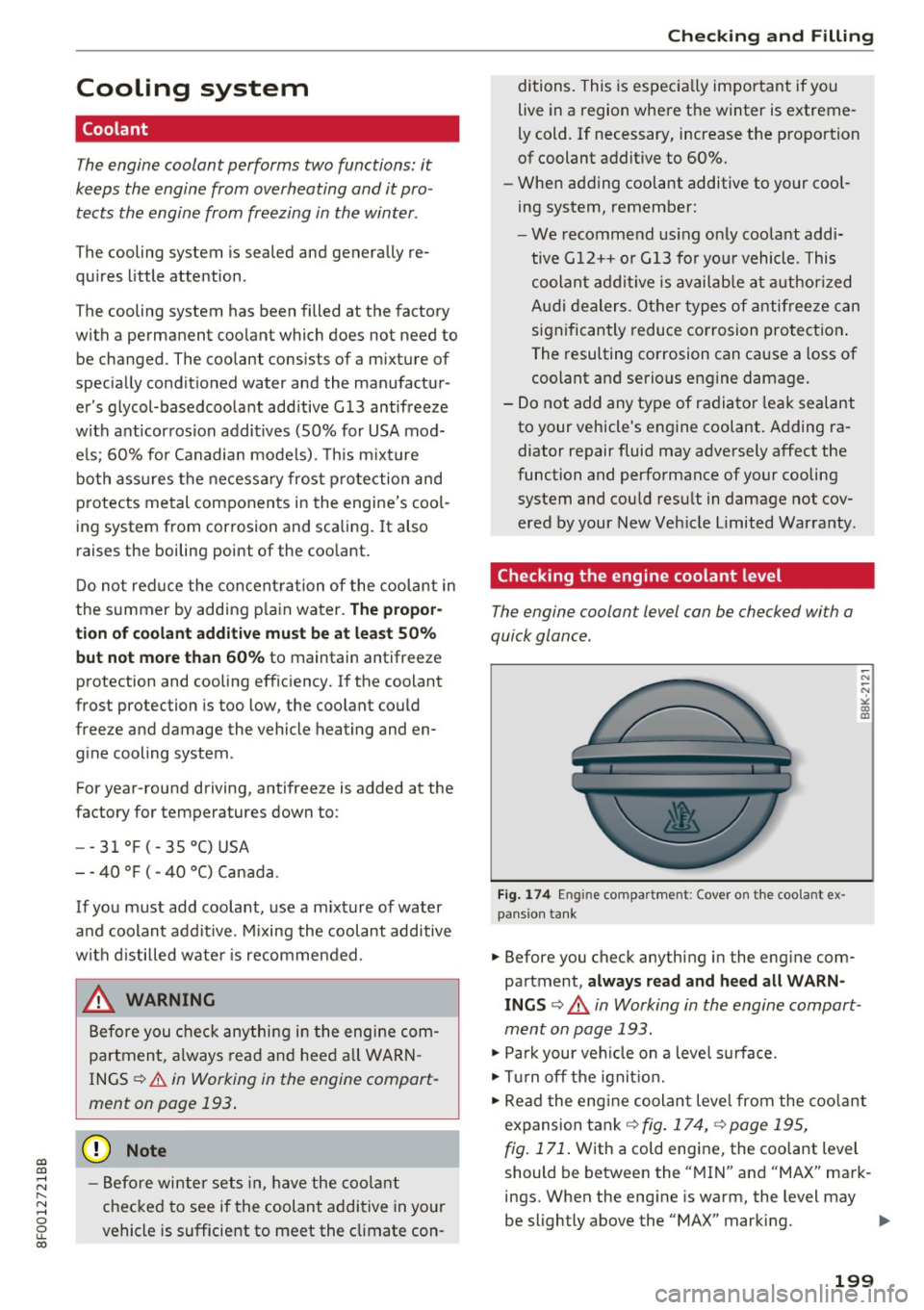
Checking the engine coolant level
The engine coolant level can be checked with a
quick glance.
Fi g. 1 74 Engin e compar tmen t: Cover o n the coo la n t ex
pansion tank
.. Before you check anything in the eng ine com
partment,
always r ead and heed all WARN
INGS ¢ ,A in Working in the engine compart
ment on page 193 .
.. Par k your veh icle on a leve l sur face.
.. Tur n off t he ignit io n .
.. Read the eng ine coolan t leve l from the coo lant
expansion tank
¢ fig . 174, ¢page 195,
fig. 171 .
With a cold engine, the coo lant level
should be b etween the "MIN" and "MAX" mark
ings. When the eng ine is warm, the level may
be slightly above the "MAX" marking. .,..
199
Page 204 of 266
Checking and Filling
Brake fluid
Checking brake fluid level
The brake fluid level can be checked with a quick
glance.
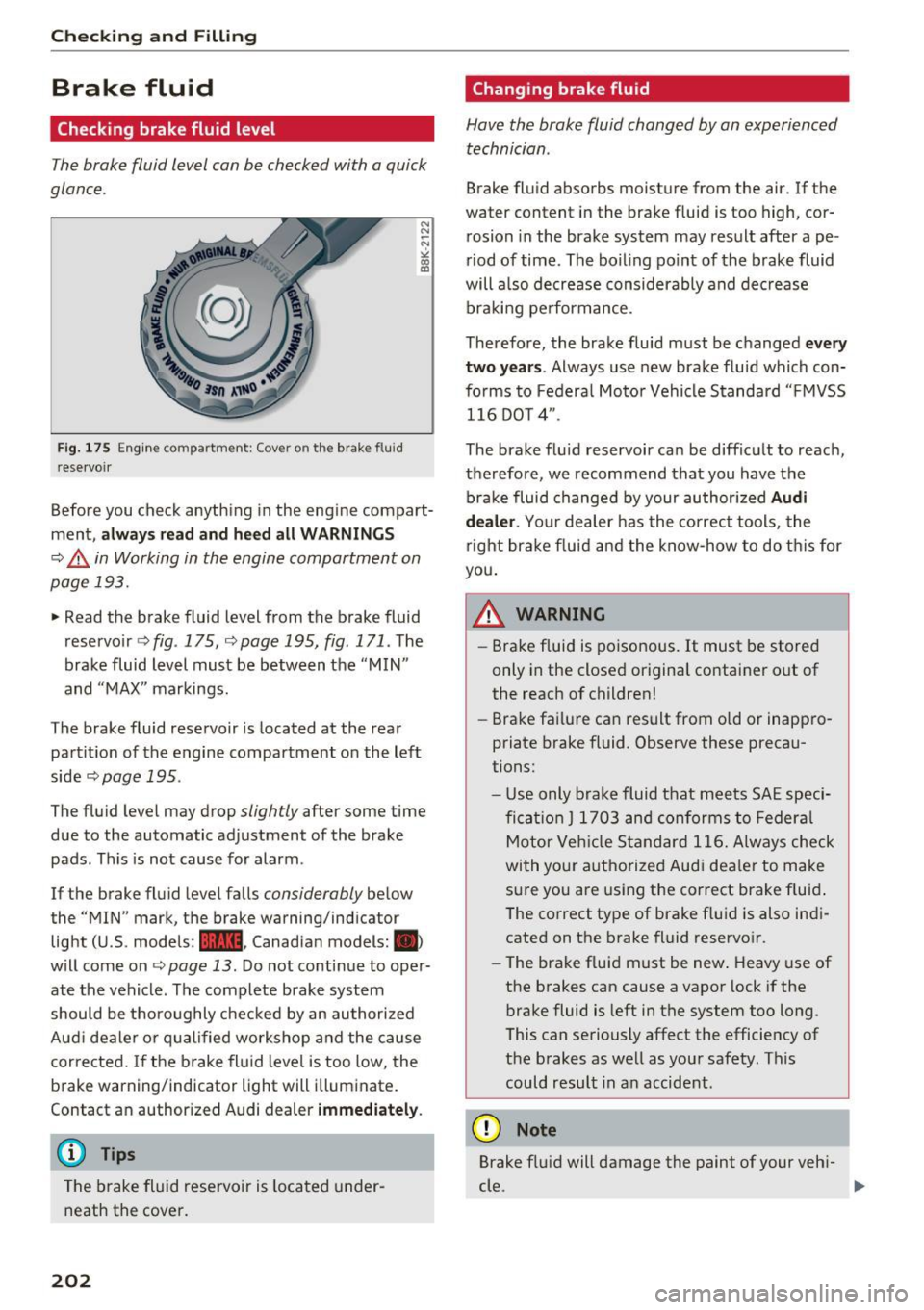
Fig. 175 Engine compartment: Cover on the brake fluid
r eservoir
Before you check anything in the engine compart
ment,
always read and heed all WARNINGS
¢ A in Working in the engine compartment on
page 193.
., Read the brake fluid level from the brake fluid
reservoir
<=> fig . 175, ¢page 195, fig . 171 . The
brake fluid level must be between the
" MIN"
and "MAX " markings.
The brake fluid reservoir is located at the rear
partition of the engine compartment on the left
side
¢ page 195.
The fluid level may drop slightly after some time
due to the automatic adjustment of the brake
pads . This is not cause for alarm .
If the brake fluid level falls
considerably below
the ' 'MIN" mark, the brake warning/indicator
light (U .S. models:
1111 , Canadian models: 1111)
will come on¢ page 13 . Do not continue to oper
ate the vehicle . The complete brake system
should be thoroughly checked by an authorized
Aud i dealer or qualified workshop and the cause
corrected . If the brake fluid level is too low, the
brake warning/indicator light w ill illuminate.
Contact an author ized Audi dealer
immediately.
(D} Tips
The brake fluid reservoir is located under
neath the cover.
202
Changing brake fluid
Have the brake fluid changed by an experienced
technician .
Brake fluid absorbs moisture from the air. If the
water content in the brake fluid is too high, cor
rosion in the brake system may result after ape
riod of time . The boiling po int of the brake fluid
will a lso decrease considerably and decrease
braking performance.
Therefore , the brake fluid must be changed
every
two years .
Always use new brake fluid which con
forms to Feder-al Motor Vehicle Standard "FMVSS
116 DOT 4 ".
The brake fluid reservoir can be difficult to reach ,
therefore, we recommend that you have the
brake fluid changed by your author ized
Audi
dealer .
Your dealer has the correct tools, the
right brake fluid and the know-how to do this for
you.
A WARNING
- Brake fluid is poisonous. It must be stored
only in the closed original container out of
the reach of children!
- Brake fai lure can result from o ld or inappro
priate brake fluid. Observe these precau
tions:
- Use only brake fluid that meets SAE speci
fi cation
J 1703 and conforms to Federal
Motor Veh icle Standard 116. Always check
with your authorized Audi dealer to make
sure you are using the correct brake f luid .
The correct type of brake f luid is also indi
cated on the brake fluid reservoir.
- The brake fluid must be new . Heavy use of
the brakes can cause a vapor lock if the
brake fluid is left in the system too long .
This can seriously affect the efficiency of
the brakes as well as your safety. This
could result in an accident.
(D Note
Brake fluid will damage the paint of your vehi-
cle .
lilJJ,