stop start AUDI A5 CABRIOLET 2017 User Guide
[x] Cancel search | Manufacturer: AUDI, Model Year: 2017, Model line: A5 CABRIOLET, Model: AUDI A5 CABRIOLET 2017Pages: 266, PDF Size: 66.64 MB
Page 76 of 266
Driving
Starting the engine
.,. Step on the b rake pedal and move the se lector
l ever to P o r N
¢ &, .
... Press on the r.l S::-:: T=- A,,., R ""T=-= E~ N":"'. G::- I ;-:N:-:-.:= E-;:Se:;T;=-;: O" P~I button
¢ fig.
90-the engine will start .
Switching the ignition on/off
If yo u wou ld like to switch the ign ition on with
ou t starting the eng ine, fo llow these steps:
.,. Press t he
I STAR T ENGIN E ST OPI button with
out
pressing the brake pedal.
.,. To switc h the ign ition off, press t he bu tton
again.
I f t he engine should not start immed iate ly, the
starting p rocess is a utomat ica lly stopped afte r a
short t ime. Repe at st arting procedu re .
When start ing the e ng ine, major elect rical loads
are switched off temporarily.
After a cold engine is started, there may be a b rief period of increased no ise beca use oil pres
sure must first bui ld up in the hydraulic valve ad
justers. This is no rmal a nd not a cause for con
cern.
.&, WARNING
- Never allow t he eng ine to run in confine d
spa ces -danger of asphyxiation.
- Never t urn off the engine until the vehi cle
has come to a comp lete stop.
- Always take the key wi th you w henever you
leave you r vehicle. Othe rw ise, the eng ine
c ould be sta rted o r ele ctrical eq uipment
s u ch as the power windows co uld be operat
ed. This can lead to se rious injury.
- Never leave children or pe rsons requiring as
sistance unattended i n the vehicle. The
doo rs can be loc ked using the remote trans
mitter, prevent ing people from escaping
from the vehicle on the ir own in the event of
an emergency . Depend ing o n the t ime of
year, peop le inside the vehicle can be ex
posed to very hig h or very low tempe ra-
t u r es.
74
-
(D Note
Avoid high engine rpm, full throttle and heavy
engine loads unti l the engine has reached op
e rating tempe rature -otherwise you risk en
gine damage.
@ For the sake of the environment
Do not let the eng ine run wh ile pa rked to
warm up. Beg in d riving immed iate ly. Th is re
duces unnecessary emissions.
(D Tips
- After starting a co ld eng ine, the re may be a
br ief per iod of increased noise because the
oil pressure must first build up in the hy
dra ulic valve adjusters . Th is is norma l and
not a cause for concern .
- If you leave the ve hicle w ith the ignition
switched on, the ig nition w ill switch off af
ter a ce rtain per iod of t ime . Please note that
elect rical equipment such as exte rior lights
w ill swi tch off as we ll when that happens.
Switching engine off
Applies to: vehicles with convenience key
.,. Br ing your vehi cle to a comple te stop .
.,. Move the se lector lever to the P or N position .
... Press the
I STAR T ENGINE S TOP I button
¢ page 73, fig. 90.
Steering lock
The steer ing locks when yo u turn the eng ine off
u sing t he
I S TART ENGI NE STOPI button and
open the driver's doo r. The locked steering he lps
prevent veh icle theft.
Emergency off
I f necessary, the eng ine can be switched off w ith
t h e se lec to r l ever in t he R or D/S posit ions. The
engine s tops if you press and hold the
I S T AR T EN GINE S TOP ! button at speeds be low
6 mph (10 km/ h) and press the brake pedal. .,,.
Page 77 of 266

a:,
a:,
...... N r--. N ...... 0
0
LL 00
A WARNING ,~
- Never turn off the engine before the veh icle
has come to a comp lete stop. T he f ull func
t io n of the brake booster and the power
steering is no t gua ran teed. You must us e
more for ce to turn or b rake if ne cessa ry. Be
c a use you ca n no t steer a nd bra ke as you
u sually wou ld, thi s could lead to crashes
and ser ious injuries .
- F or sa fe ty reasons, you should always par k
yo ur vehicle wi th t he selec tor lever in P .
Otherwise, the ve hicl e cou ld inadvertently
roll away.
- The radia tor fan can continue to run fo r up
to 10 m inutes even afte r you have turned
off the engine and removed t he ignition key.
The radiato r fan can also turn on again if the
engi ne coolant heats up because of intense
s u nlight or heat bui ld-up in the engine com
partmen t.
- Always take the key with you whenever you
leave your vehicle. Othe rw ise, the engine
cou ld be sta rted o r electrical e quipme nt
s u ch as the power windows co uld be opera t
ed. This can lead t o se rious inj ury.
0 Note
If the engine has been under heavy load for
an exte nded per iod, heat builds up in the en
g in e compa rtment after the eng ine is switch
ed off -there is a risk of damaging the eng ine.
Allow t he engine to r un at idle fo r abo ut two
m inu tes befo re swit chi ng i t off .
Driver messages
Ignition is on
This message appea rs and a warning tone sounds
if you open t he d river's doo r when the ignition is
sw itche d on.
No key identified
This message appea rs when the
I S TAR T ENGINE STOPI button is pressed if the re
is no master key ins ide the ve hicle or if the sys
tem does not recognize it . For examp le, the mas
ter key cannot be recognized if it is cove red by an
D riving
object (e .g. al uminum brief case) which screens
t h e radio signal. Electronic devices such as ce ll
phones can a lso interfe re with the radio signal.
Pre ss brake pedal to start engine
T h is message appears if you do not p ress the
bra ke peda l to s tart t he engine.
Shift to N or P to start engine
This message appears w hen attempting to start
the engine if the se lector lever for the automatic
transm ission is not in the P or N position. The en
gine can on ly be started with the se lector in
these positions .
I!! Is the key in the vehicle?
This message appears if the mas ter key is re
moved from the veh icle with the engine r unning .
If the master key is no longer in the vehicle, you
cannot sw itch on the ign ition after stopping the
engine a nd you also cannot start the engine
again . Moreover, you cannot lock the vehicle
from the o uts ide with the key .
Shift to P otherwise vehicle can roll away. Doo rs
do not lock if le ver is not in P.
This message appears for safety reasons along
with a warning signal. It appears if the selector l ever for the automat ic transmission is not in the
P position when switch ing off the ign ition. Move
t h e se lector lever to the P position, otherw ise the
vehicle is no t secured against roll ing away. Yo u
also cannot lock the vehicle us ing t he lock ing
button * on t he doo r handle o r using t he remo te
k ey.
Convenienc e key defective! Use ignition lock
This message appears if the engine must be
started or stopped using the ignition key and not
th e
I S TA RT ENGINE ST OPI button .
75
Page 78 of 266
Driving
Electromechanical
parking brake
Operation
The electromechanical parking brake replaces
the hand brake.
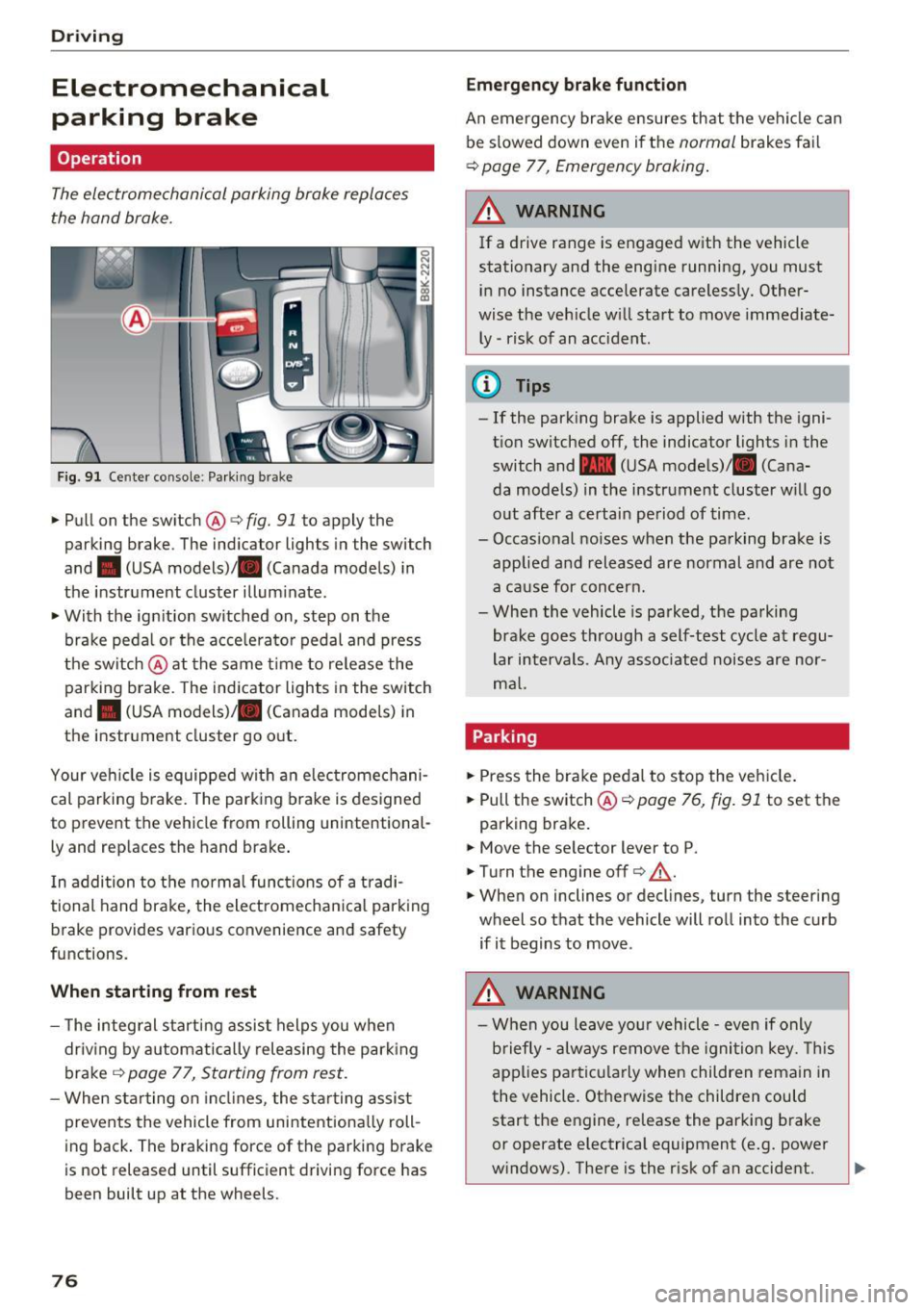
Fig. 91 Ce nter conso le: Park ing brak e
~Pullon the switch @c:>fig. 91 to apply the
parking brake . The ind icator lights in the switch
and . (USA
models) ;II (Canada models) in
the instr ument cluster illum inate.
~ With the ign ition switched on, step on the
brake peda l or the acce lerato r pedal and press
t he switch @at the same t ime to re lease the
parking brake . The indicator lights in the switch
and . (USA
models) ;II (Canada models) in
the instr ument cluster go o ut.
Your ve hicle is equipped wi th an elec tromechani
cal parking b rake. The park ing brake is designed
to prevent the vehicle from rolling un intent ional
ly and rep laces the hand brake .
I n addition to t he norma l func tions of a tradi
tional hand brake, the electromecha nica l park ing
b rake provides various convenience and safety
functions.
When starting from rest
- T he integ ral s tart ing assist helps you when
driv ing by a utomat ically releasing the park ing
brake ¢
page 77, Starting from rest .
-When starting on in cli nes, the sta rting assist
prevents the vehicle from unintentiona lly roll
ing back . The braking forc e of the park ing b rake
is not released until sufficient drivi ng force has
been built up at the wheels.
76
Emergency brake funct ion
An emergency bra ke ensures th at the vehicle can
be s lowed down even if t he
normal brakes fa il
c:> page 77, Emergency braking .
A WARNING
-
If a drive range is e ngaged w ith the vehicle
stationary and the engine running, you must
i n no instance accelerate careless ly. Other
wise the veh icle w ill start to move immediate
ly -risk of an accident.
(D Tips
- If the park ing brake is applied with the igni
t ion switched off, the indicator lights in the
switch and -(USA mode ls)/ . (Cana
da models) in the instrument cluster w ill go
o ut after a certai n pe riod of time.
- Occasional noises when the pa rking brake is
applie d and released are normal and are not
a ca use for conc ern.
- Whe n the vehicle is parked, the parking
brake goes through a self-test cycle at regu
lar intervals. Any associated noise s are nor
m al.
Parking
~ Press the bra ke peda l to stop the ve hicle.
~ Pull the switch@¢ page 76, fig. 91 to set the
parking bra ke .
~ Move the se lector lever to P.
~ T urn the engine off¢.&,. .
~ When on inclines or decl ines, turn the steer ing
wheel so that the vehicle will ro ll into the curb
if it begins to move .
.&_ WARNING
-W hen you leave yo ur vehicle -even if only
b riefly- always re move t he igni tion key. This
app lies p art ic ula rly when children remain in
the vehicle. Ot herwise the children could
start the e ngine, re lease the parking brake
or operate electrica l equipment (e .g. power
w indows) . The re is the r isk of an accident.
Page 79 of 266
a:,
a:,
...... N r--. N ...... 0
0
LL 00
-When the vehicle is locked, no one - part icu
larly not children should remain in the vehi
cle. Locked doors make it more diff icu lt for
emergency workers to get into the vehicle -
putt ing lives at risk.
Starting from rest
The starting assist function ensures that the
parking brake is released automatically upon
starting .
Stopping and applying parking brake
~ Pull the switch @9 page 76, fig. 91 to apply
the parking brake.
Starting and automatically releasing the
parking brake
~ When you start to drive as usual, the parking
brake is automatica lly released and your vehicle
begins to move.
When stopping at a traffic signal or stopping in
city traffic on vehicles w ith an automatic trans
miss ion, the park ing brake can be applied. The
vehicle does not have to be held with the foot brake . The park ing brake eliminates the tendency
to creep with a drive range engaged. As soo n as
you dr ive off as usual, the parking brake is re
leased automatically and the veh icle starts to
move.
Starting on slopes
When starting on inclines, the start ing assist pre
vents the vehicle from unintentionally rolling
back. The braking force of the parking brake is
not released until sufficient driving force has
been built up at the wheels.
(D Tips
For safety reasons, the parking brake is re
leased automatically only when the driver's
safety belt is engaged in the buckle.
Driving
Starting off with a trailer
To prevent rolling back unintentionally on an in
cline, do the following:
~ Keep the switch @9 page 76, fig. 91 pulled
and depress the accelerator. The parking brake
stays applied and prevents the vehicle from
rolling backwa rd .
~ You ca n release the sw itch @once you a re sure
that you are develop ing enough dr iv in g force at
t he wheels by depressing the accelerator.
Depending on the weight of the rig (vehicle and
trailer) and the severity of the incline, you may
roll backwards as you start. You can prevent roll
i ng backwards by holding the pa rking brake
swi tch @ pulled out and accelerating -just as
you wou ld when starting on a hill with a conven
t iona l hand brake .
Emergency braking
In the event that the conventional broke system
foils or locks.
~ I n an emergency, pull the switch@Q page 76,
fig. 91 and continue to pull it to slow your vehi
cle down with the parking brake.
~ As soon as you re lease the switch @or acceler-
ate, the braking process stops .
If you pull the switch @and hold it above a
speed of about 5 mph (8 km/h), the emergency
braking f unction is init iated. The vehicle is braked
at all four whee ls by activating the hydraulic
brake system . The brake performance is s imilar
to making an emergency stop
Q .& .
In order not to activate the emergency braking by
mistake, an audible warning tone (buzzer)
sounds when the switch @is pulled . As soon as
the switch @ is released, or the accelerator pedal
i s depressed, emergency braking stops .
A WARNING
Emergency braking should only be used in an
emergency, when the normal foot bra ke has
failed or the brake pedal is obstructed. Using
the parking brake to perform emergency
braking w ill slow your vehicle down as if you
77
Page 81 of 266
a:,
a:,
...... N
l'
N
...... 0
0
LL co
The maximum speed rema ins stored until it is
chang ed by press ing the
!SE Ti button again brief
l y or unt il it is deleted by a lengthy push on the
button .
Speed warning 2: setting a speed limit
The radio or MM!* control unit is used to set,
change or delete w arning threshold
2 .
• Se lect : I CAR I function button> Instrument
cluster
> Speed warning . Or
• Se lect: I CAR i funct ion button > C ar sy stem s*
contro l button > Dri ver a ssist > Speed wa rning .
Warning threshold 2 can be set in the speed
range start ing from 20 mph to 150 mph (30 km/
h to 240 km/h) . Settings can each be ad justed in
intervals of 5 mph (10 km/h).
Cruise control system
Switching on
The cruise control system makes it possible to
drive at a constant speed starting at
20 mph (30
km/h).
0
f
~
0
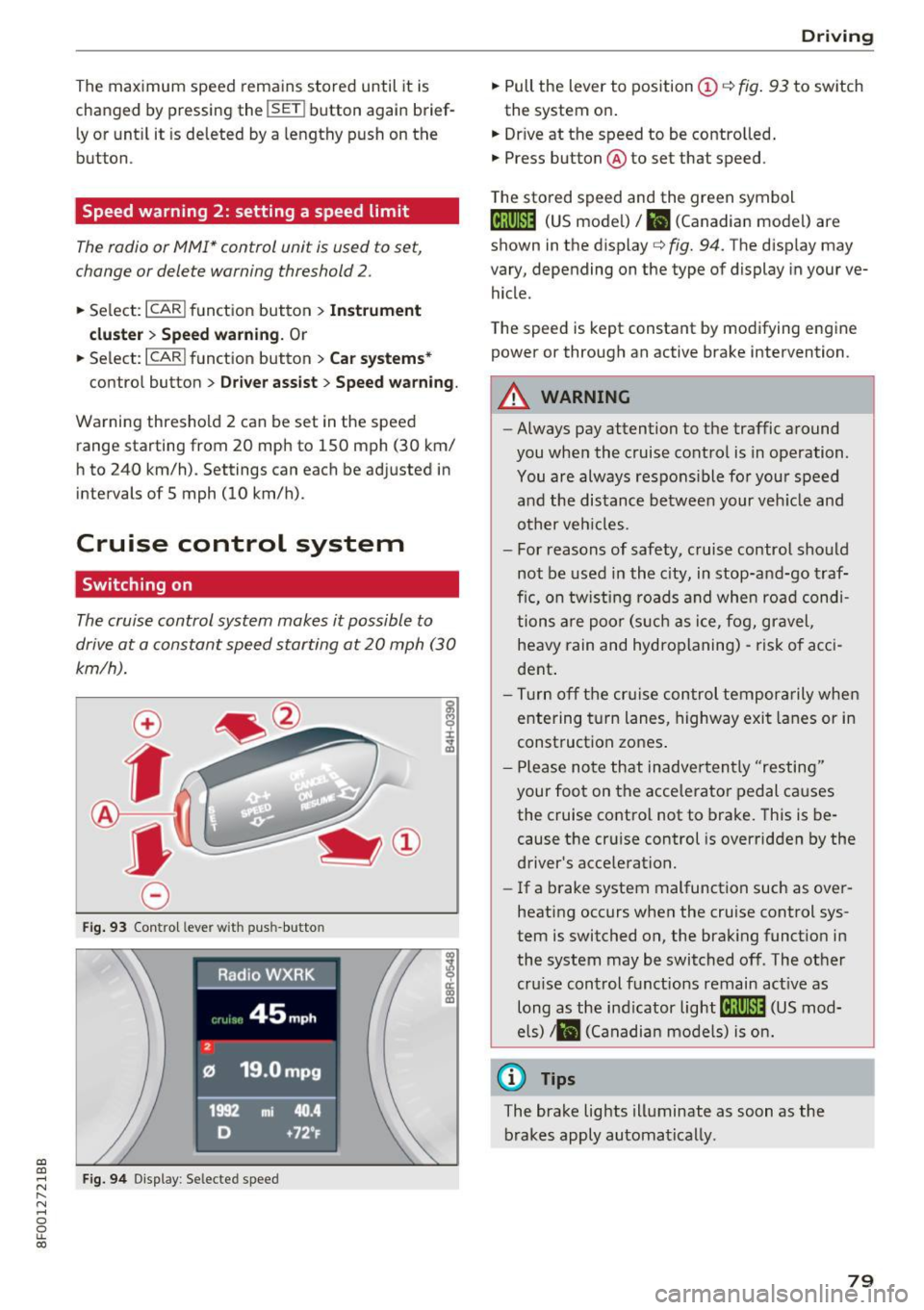
F ig . 93 Co ntrol leve r wit h pus h-butto n
Fig. 9 4 Disp lay : Se lecte d speed
D rivi ng
• Pull the lever to position (D c::> fig . 93 to sw itch
the system on .
• Dr ive at the speed to be contro lled .
• Press button @to set that speed .
T he sto red speed and the green symbol
@;\1)~14 (US mode l)/ El (Canadian model) are
shown in the display
c::> fig. 94. The d isp lay may
vary, depending on the type of display in you r ve
hicle .
The speed is kept constant by modifying engine power or through an act ive brake intervention .
_& WARNING
-Always pay attention to the traffic a round
you when the cruise contro l is in operation.
You are always respons ible fo r your speed
a nd the distance betwee n your ve hicle and
other veh icles.
- For reasons of safety, c ruise control sho uld
not be used in the c ity, in stop-an d-go t raf
fic, on tw ist ing roads and whe n roa d condi
tions a re poo r (s uch as ice, f og, gravel,
heavy rain and hydroplaning) -ris k of a cci
dent .
- Tu rn off the cr uise con trol te mpor arily whe n
e ntering t urn lanes, highway exit lanes or in
construct ion zones .
- P lease no te th at inadve rten tly "resting"
your foot on the acce lerator pedal causes
the cruise control not to brake. This is be
cause the cr uise control is overridden by the
driver's acce leration.
- If a b rake system malfunction such as ove r
heating occurs when the cruise control sys
tem is switched on, the brak ing funct io n in
the system may be switched of f. The other
cru ise control functions remain act ive as
long as the ind icator
light @;\1)~14 (US mod
e ls)
,ii (Ca nadian mo dels) is on .
@ Tips
The brake lights illuminate as soon as the
brakes apply automa tically.
79
Page 85 of 266
At speeds above about 1 mph (2 km/h) the Auto
matic Shift Lock is automatically deactivated in
the N position.
A time delay element prevents the selector lever
from locking when it is moved through the N po
sition (going from R to D/S). The locking e lement
will lock the se lector lever if the lever is left in N
(Neutral) for more than approx imately 2 sec
onds, without the brake pedal being pressed.
Release button
The release button on the se lector lever prevents
the lever from being accidentally sh ifted into cer
tain positions. Depending on the d irection of the
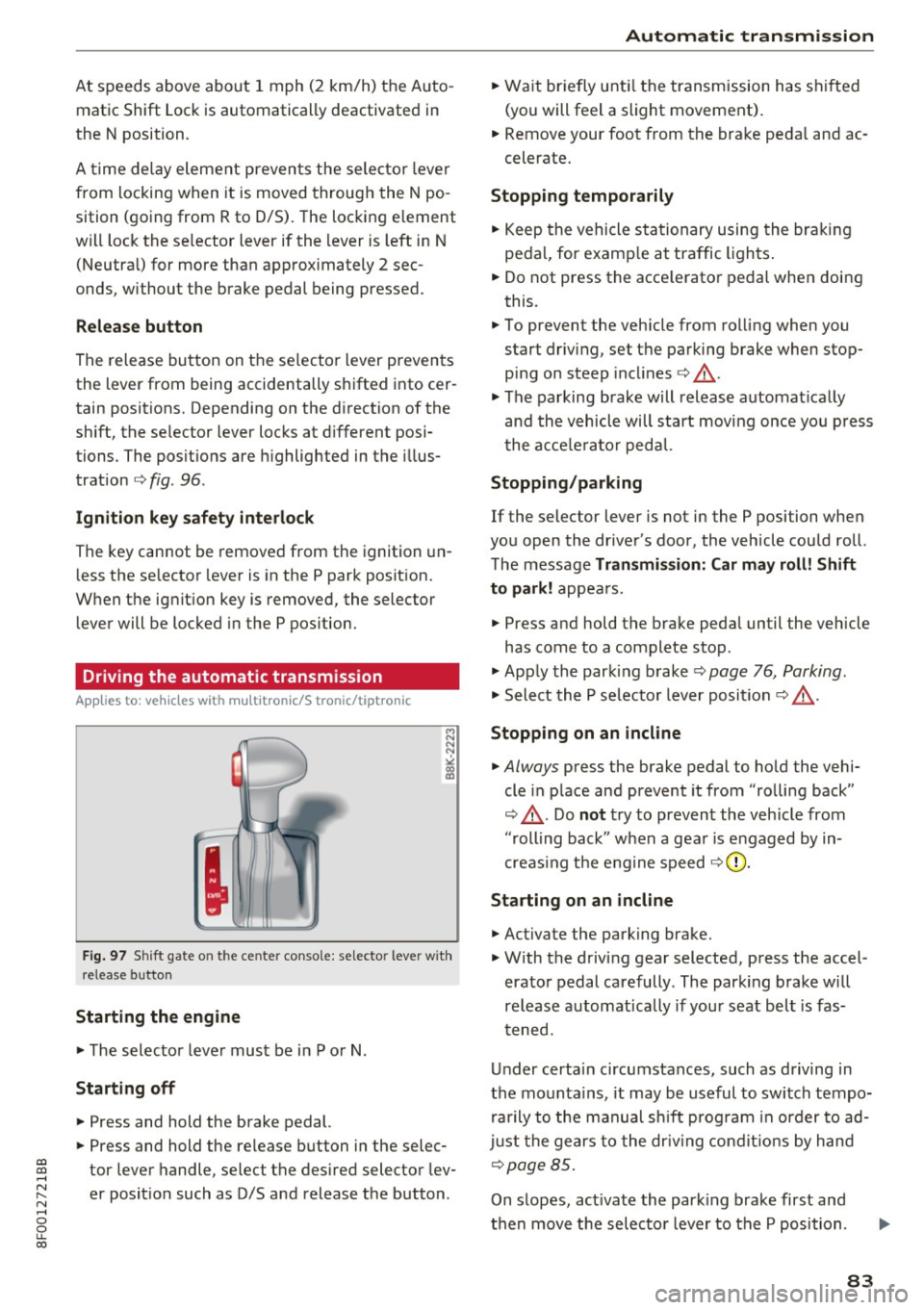
shift, the selector lever locks at d ifferent posi
tions . The positions are highlighted in the illus
tration ¢
fig. 96 .
Ignition key safety interlock
The key cannot be removed from the ignition un
less the selector lever is in the P park posit ion.
When the ignit ion key is removed, the selector
lever will be locked in the P pos ition .
Driving the automatic transmission
App lies to: ve hicles with multitro nic/S tronic/tiptronic
Fig . 97 S hift gate o n the ce nte r conso le: selecto r leve r w ith
release button
Starting the engine
~ The selector lever must be in P or N.
Starting off
~ Press and hold the brake pedal.
~ Press and hold the release button in the selec-
a:,
a:, tor lever handle, select the des ired selector lev-......
~ er position such as D/S and release the button. N ...... 0
0
LL 00
Automatic transm ission
~ Wait briefly unti l the transmission has shi fted
(you will feel a slight movement).
~ Remove your foot from the brake pedal and ac
celerate.
Stopping temporarily
~ Keep the vehicle stationary using the braking
pedal, for examp le at traffic lights.
~ Do not press the acce lerator pedal when doing
this .
~ To prevent the veh icle from rolling when you
start driv ing, set the parking brake when stop
p in g on steep incl ines ¢.&_ .
~ The parking brake will release automat ically
and the vehicle will start moving once you press
the acce le rator pedal.
Stopping/parking
If the selector lever is not in the P position when
you open the driver's door, the vehicle could roll.
The message
Transmission: Car may roll! Shift
to park!
appea rs.
~ Press and hold the brake pedal until the vehicle
has come to a complete stop .
~ Apply the parking brake ¢ page 76, Parking.
~ Select the P selector lever position ¢ .&_ .
Stopping on an incline
~ Always press the brake pedal to hold the vehi
cle in place and prevent it from "rolling back"
¢ .&_ . Do
not try to prevent the vehicle from
"rolling back" when a gear is engaged by in
creas ing the engine speed
¢0.
Starting on an incline
~ Activate the parking brake.
~ With the driving gear selected, press the accel
erator pedal carefully . The park ing brake will
release automatically if your seat belt is fas
t ened.
Under certain circumstances, such as driving in
the mountains , it may be useful to switch tempo
rarily to the manual shift program in order to ad
just the gears to the driv in g conditions by hand
¢page 85.
On slopes, act ivate the park ing brake first and
then move the selecto r lever to the P position.
83
Page 86 of 266
Automatic transmission
This prevents too much stress from being placed
on the locking mechanism.
Vehicles with multitronic transmission: Your ve hicle is equipped with
hill hold assist allowing
you to start while on an incline. The system is ac
tivated when the brake pedal is pressed down
and held
for a few seconds. The brake pressure
will hold for
a moment after the brake pedal
loosens to prevent the vehicle from rolling back
wards while starting up.
A WARNING
- The vehicle can also roll when the engine is
stopped.
- Unintended vehicle movement can cause se rious injury.
- Never leave your vehicle with the engine
running while in gear. If you must leave
your vehicle when the engine is running, ac tivate the parking brake and move the selec
tor lever to P.
- Power is still transmitted to the wheels
when the engine is running at idle. To pre
vent the vehicle from "creeping", you must
keep your foot on the brake when the en
gine is running and the selector lever is in 0/
Sor R or "tiptronic" mode is selected.
- Do not press the accelerator pedal when changing the selector lever position while
the vehicle is stationary and the engine is
running.
- Never shift into R or P while driving.
- Before driving down a steep slope, reduce
your speed and shift into a lower gear with
"tiptronic".
- Do not ride the brakes or press the brake
pedal too often or too long when driving
down a hill. Constant braking causes the
brakes to overheat and substantially re
duces braking performance, increases brak
ing distance or causes complete failure of
the brake system.
- To prevent the vehicle from rolling back
when stopping on inclines, always hold it in
place with the brake pedal or parking brake.
- Never hold the vehicle on an incline with a
slipping clutch. The clutch opens automati-
84
cally when it becomes too hot from the
overload. An indicator lamo
[O ] illuminates
and a driver message appears
c::;, page 86
when the clutch is overloaded.
- If the engine must remain running, never
have any driving position engaged when
checking under the hood. Make sure these
lector lever has securely engaged and is
locked in P with the parking brake set
¢page 193. Otherwise, any increase in en
gine speed may
set the vehicle in motion,
even with the parking brake applied.
(D Note
- S tronic- and tiptronic transmission: When
stopping on an incline, do not try to hold
the vehicle in place by pressing the accelera
tor pedal while a driving gear is selected.
This can cause the transmission to overheat
and can damage it. Activate the parking
brake or press the brake pedal to prevent
the vehicle from rolling.
- S tronic- and tiptronic transmission: Allow
ing th@ vehicle to roll when th@ engine is
stopped and the selector lever is in N will
damage the transmission because it is not
lubricated under those circumstances.
(D Tips
For safety reasons, the parking brake is re
leased automatically only when the driver's
safety belt is engaged in the buckle.
· Hill descent control
App lies to: vehicles with mult itron ic/S tron ic/t iptronic
The hill descent control system assists the driver
when driving down declines .
Hill descent control is activated when the selec
tor lever is in D/S and you press the brake pedal.
The transmission automatically selects a gear
that is suitable for the incline. Hill descent con
trol tries to maintain the speed achieved at the
time of braking, within physical and technical
limitations. It may still be necessary to adjust the
speed with the brakes. ..,..
Page 88 of 266

Automatic transmissio n
Appli es to vehicl es with a S troni c-/ tiptronic
t ran smissi on
When you depress the accelerator peda l beyond
the resistance point, the automatic t ransmission
downshifts into a lower gear, depending on vehi
cle s peed and engi ne speed. The upshift into the
next h igher gear takes place once the maximum
specif ied e ngine speed is reached.
A WARNING
Please note that the drive whee ls can spin if
kick-down is used on a smooth s lippery road -
there is a risk of skidding.
Launch Control Program
A pp lies to: ve hicles w ith S tro nic
The Launch Control Program provides the best
acceleration possible when starting from a stop.
Requirement: The engine must be at operating
temperature and the steer ing wheel must not be
turned .
"' Press the
lfl O FF ! button ¢ page 168 while the
engine is run ning . T he
II indicator light illumi
nates in the instrument cluste r and
Stabil iza
tion control (ESC ): Sp ort. Warning! R estricted
s tab ilit y
appears in the d river informat ion sys
tem display.
"' Move the selecto r lever to the D/S position to
select sport mode (S) or select the
d ynami c
driving mode in drive select * ¢page 102.
"'Press the brake pedal strongly with your left
foot and hold it down fo r at least 1 second.
"' At the same t ime, press the acce lerator pedal
down completely with your right foot until the engine reaches and maintains a high RPM .
"' Remove your foot from the b rake pedal within
S seconds ¢
&-
A WARNING
-Always adapt yo ur driv ing to the traffic flow.
- Only use the La unch Control Prog ram when
ro ad and tra ffic conditions allow it and oth
er drivers will not be endangered or an
noyed by you r driving and the vehicle 's ac
celeration.
86
- Please note that the d riving wheels can spin
and the vehicle can b reak away when sport
mode is switched on, espec ially when the
road is slippery .
- Once you have acce lerated, you should
sw itch sport mode off by pressing the
I ~ OFFI button .
(D Tips
-The transmission temperat ure may increase
significant ly after using the Launch Contro l
Program. If that happens, the program may
not be ava ilable for a few minutes . It will be
available again afte r a cool-down period .
- When accelerating using the Launch Control
program, all vehicle pa rts a re subject to
heavy loads . This ca n result in increased
wea r.
Transmission malfunction
App lies to: vehicles wi th mult itro nic/S tro nic/ tip tronic
I>] Tran smi ssion : Pres s brake ped al and select
gear again.
P ress the b rake peda l and select the desired se
l ector lever posi tion again. Yo u can then co nti nu e
driv ing.
I>] Tran smiss ion ov erheating: Plea se drive con
servativel y.
The transmission temperature has increased sig
nificantly due to t he sporty dr iving ma nner . Drive
i n a less spo rty manner unti l the temperature re
turns to t he norma l range and the i ndicator light
switches of.
I>] Tran smiss ion malfun ct ion : You can co ntinue
driv ing
There is a system malfunction in the transmis
s io n. You may continue driving. Dr ive to your au
thorized Audi dea ler or qua lified repair facility
soon to have the ma lfunction corrected .
I>] Transmission malfunct ion : Limited dri ving
functional ity
There is a system malfunction in the transmis-
s ion. The t ransmission is switch ing to emergency
mode. This mode only s hifts into certain gears or ..,_
Page 90 of 266

Audi adaptive cruise control and braking guard
Audi adaptive cruise
control and braking
guard
Introduction
A pp lies to: ve hicles w ith Aud i adapt ive cruise co ntro l
The adaptive cruise contro l system assists the
driver by regulating vehicle speed and helping to
maintain a set distance to the veh icle ahead ,
within the limits of the system. If the system de
tects a moving vehicle up ahead, adaptive cruise
control can brake and then accelerate your vehi
cle. This helps to make driving more comfortable
on long highway stretches.
The braking guard system can warn you about an
impending collision and initiate braking maneu
vers
c> page 94.
Adaptive cruise control and braking guard have
technical limitations that you must know, so
please read th is section carefully, understand
how the system works and use them properly at
all times.
General information
General information
A pplies to : ve hicles w ith Aud i adapt ive cruise co ntrol
Fig. 102 Front of t he veh icle: Posit ion of radar sensor
The area that contains the radar sensor
c> fig. 102 must never be covered by st ickers or
other objects or obstructed with dirt, insects,
snow or ice that w ill interfere w ith the adaptive
cruise control system and braking guard. For in
formation on cleaning, refer to
c> page 182. The
same appl ies for any modifications made in the
front area .
88
The function of the adaptive cruise control sys
tem and braking guard is limited under some
condit ions:
- Objects can only be detected when they are
within sensor range
<:!) page 90, fig . 105.
-The system has a limited ability to detect ob
jects that are a short distance ahead, off to the
side of your vehicle or moving into your lane.
- Some k inds of veh icles are hard to detect; for
example motorcycles, veh icles with high
ground clearance or overhanging loads may be
detected when it is too late or they may not be
detected at all.
- When driving through curves
c:::> page 89.
- Stationary objects i::!) page 89 .
& WARNING
-Always pay attention to traffic when adaptive
cruise control is switched on and braking
guard is active. As the driver, you are still re
sponsible for starting and for maintaining
speed and distance to other objects . Braking
guard is used to assist you . The driver must
a lways take act ion to avoid a collision . The
driver is always responsible for braking at the
cor rect time.
- Improper use of adaptive cruise contro l can
cause collisions, other accidents and serious
personal injury.
- Never let the comfort and convenience that
adapt ive cr uise control and braking guard
offe r distract you from the need to be alert
to traffic conditions and the need to remain
in full control of your ve hicle at all times,
- Always remember that the adaptive cruise
control and braking guard have limits -they
will not slow the vehicle down or maintain
the set distance when you dr ive towards an
obstacle or something on or near the road
that is not moving, such as vehicles stopped
in a traff ic jam, a stalled or disabled veh icle.
If registered by the radar sensor, veh icles o r
obstacles that are not moving can trigger a
coll ision warning and if confirmed by the
video camera, an acute collision warning. ..,
Page 104 of 266
Audi drive select
sporty shifting characteristics . The S gear
position engages automatically.
- In vehicles that have dynamic steering*, op
erating noise is heard when starting or stop
ping the engine. This does not ind icate a
problem.
Selecting the driving mode
Applies to: vehicl es w ith Aud i dri ve select
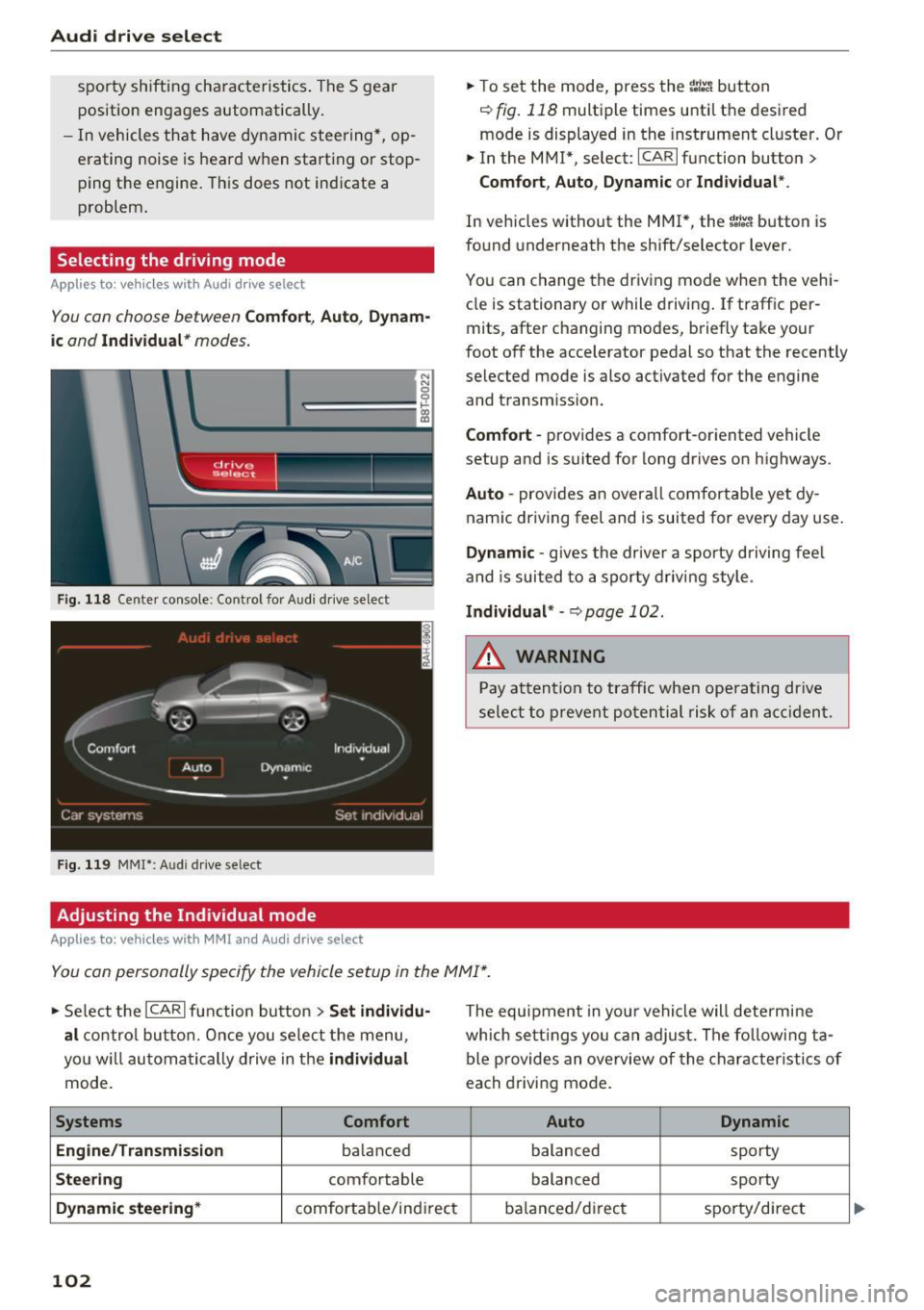
You con choose between Comfort, Auto , Dynam
ic and Individual * modes.
N N 0
0
'l::=====:::: 1-'gi
drive I sel,.c,ct _ J -~-
Fig. 118 Center console: Control fo r Aud i dr ive select
Fig . 119 MMI*: A udi drive select
Adjusting the Individual mode
Applies to : ve hicles w ith MMI and Audi drive select
.,. To set the mode, press the ~:i:a button
r::!) fig. 118 multiple times until the desired
mode is displayed in the instrument cluster. Or
.,. In the MMI* , select: ICARlfunction button>
Comfort, Auto, Dynamic or Individual".
In vehicles without the MMI*, the ~:/:a button is
found underneath the shift/selector lever.
You can change the driving mode when the vehi
cle is stationary or while driving. If traff ic per
mits, after changing modes, briefly take your
foot off the accelerator pedal so that the recently
selected mode is also activated for the engine
and transm iss ion.
Comfort -provides a comfort-oriented vehicle
setup and is suited for long drives on highways.
Auto -provides an overall comfortable yet dy
namic driving feel and is suited for every day use.
Dynamic -gives the drive r a sporty driving fee l
and is suited to a sporty driving style .
Individual* -c>page 102.
&_ WARNING
Pay attention to traffic when operating drive
select to prevent potential risk of an accident.
You can personally specify the vehicle setup in the MMI* .
.,. Select the ICAR I function button > Set individu
al
control button. Once you select the menu,
you w ill automatically drive in the
individual
mode.
Systems Comfort
Engine/Transmission
ba lanced
Steering comfortable
Dynamic steering* comfortab le/indi rect
102
The equipment in you r vehicle will determine
which settings you can adjust. The following ta
ble provides an overview of the characteristics of
each driving mode.
Auto Dynamic
balanced
sporty
balanced sporty
ba lanced/d irec t sporty/direct