brakes AUDI A5 COUPE 2008 User Guide
[x] Cancel search | Manufacturer: AUDI, Model Year: 2008, Model line: A5 COUPE, Model: AUDI A5 COUPE 2008Pages: 313, PDF Size: 13.86 MB
Page 223 of 313
Care of vehicle and cleaning221
Controls
Safety
Driving tips
General maintenance
Self-help
Technical data
WARNING
•
Do not wash the vehicle with the ignition switched on – risk of
accident.
•
Do not clean the underside of th e car or inside the wheel arches
without protecting your hands and arms. You may cut yourself on
sharp metal parts.
•
Take care when washing the car during the winter: moisture
and ice on the brakes may affect braking efficiency – this could
cause an accident.Caution
•
Do not wash the vehicle in direct sunlight – otherwise the paint
can be damaged.
•
Do not use insect sponges, or abrasive household sponges, etc.
– they can damage the surfaces.
•
The headlights should only be washed with water – do not wipe
them with a dry cloth or sponge . It is best to use soapy water.
•
Never wash tyres with a jet that sprays the water out in a direct
stream. This could damage the tyres – even if the spray is kept at a
distance and only used for a very short time.For the sake of the environment
The car should only be washed in special wash bays. This prevents
oily water from getting into the pu blic drains. In some districts,
washing vehicles anywhere else may be prohibited.Waxing and polishingWaxing
Waxing protects the paintwork. It is time to apply a good coat of wax
when water no longer forms droplets and rolls off the clean paint-
work. Even if a
wax solution is used regularly in the car wash, it is advis-
able to protect the paint with a coat of wax at least twice a year.
In the summer, you will find it is much easier to remove dead insects
(which accumulate on the bumper an d the front of the bonnet) if the
car has been waxed recently.
Polishing
Polishing is only necessary if the paint has lost its shine, and the
gloss cannot be brought back by putting on wax.
The car must be waxed after polishing if the polish used does not
contain wax compounds to seal the paint.
Caution
Matt painted and plastic parts mu st not be treated with wax or
polish.Ornamental trim and mouldingsThe metal brightwork on the body is made of aluminium rather than
chrome (for environmental reasons).
Dirt or marks on the trim mouldings should be removed with an
acid-free cleaning agent (do not use a chrome cleaner). Body polish
is also unsuitable for use on trim mouldings. The intensive cleaning
fluids often used before the car goes into a car wash may contain
alkaline substances, which can cause dull or milky patches when
they dry out.
Audi dealers carry stocks of cleaning products which have been
tested for use on your vehicle and are not harmful to the
environment.
document_0900452a8179700c.book Seite 221 Donnerstag, 22. März 2007 10:19 10
--4 -
-T
CD
CD
-+
•
+-
•
•
Page 225 of 313
Care of vehicle and cleaning223
Controls
Safety
Driving tips
General maintenance
Self-help
Technical data
After washing, the wheels should only be cleaned with an "acid-
free" cleaning agent for alloy wheels. This is available from Audi
dealers and specialist retailers. Never leave the cleaning agent on
the rims for any longer than specified in the instructions before
rinsing it off. If the wheel cleaner fluid contains acid it can attack the
surfaces of the wheel bolts.
Car polish or other abrasive agents should not be used. If the
protective paint coating is damaged by stone chips etc., the
damaged area should be touched up immediately.
WARNING
Please note when cleaning the wheel
s that water, ice and road salt
can impair the effectiveness of the brakes – this can cause an
accident.Care of interiorMMI display screen and control consoleThe MMI display screen can be cl eaned with a soft cloth and a
special “LCD cleaner” (available from retailers of electrical goods).
Moisten the cloth with a small amount of the cleaning fluid.
Clean the MMI control console with a fine brush first to prevent any
dirt from getting in between the control buttons and the housing.
We then recommend wiping the MMI control console using a cloth
moistened with washing-up liquid and water.
Caution
To avoid scratching the screen, do not wipe the MMI display with a
dry cloth.•
To avoid any possibility of damage, do not let any liquid get
inside the control console.
Plastic parts and leatherettePlastic parts and leatherette can be cleaned with a damp cloth. If
this is not sufficient, plastic parts and leatherette should only be
treated with a special solvent-free plastic cleaner .Textile covers and trim partsTextile covers and trim parts (e.g. seats, door trim) should be
cleaned regularly with a vacuum cleaner. This will remove surface
dirt which could otherwise be rubbed into the textile material
during use. Do not use steam cleaners, as the steam could carry the
dirt deeper into the textile material.
Normal cleaning
We recommend that you use a soft sponge or lint-free, micro-fibre
cloth for normal cleaning. Only use brushes on floor coverings and
mats, as other textile surfaces could become damaged.
In the case of normal surface dirt you can use a foam cleaner. Use a
sponge to spread the foam on the textile surface and to work it into
the material lightly. However, make sure that the textile material
does not become soaking wet. Then dab off the foam with a dry and
absorbent cloth (e.g. a micro-fibre cloth) and vacuum off any
residue once the surface is completely dry.
Removal of stains
To treat stains caused by spilled drinks (coffee, fruit juice or similar)
make up a solution with a mild detergent for sensitive fabrics and
apply it with a sponge. If the stains are difficult to remove, a
washing paste can be applied directly onto the stain and worked
into the fabric. The surface will then have to be wiped with clear
water to remove any residue left by the paste. To do so, use a damp
cloth or sponge and then dab th e stain with an absorbent cloth.
Treat chocolate or make-up stains with a washing paste and then
rinse off with water (using a damp sponge).
document_0900452a8179700c.book Seite 223 Donnerstag, 22. März 2007 10:19 10
--4 -
-T
•
-+ +-
CD
•
Page 240 of 313
Checking and topping up fluids
238Brake fluidChecking brake fluid level
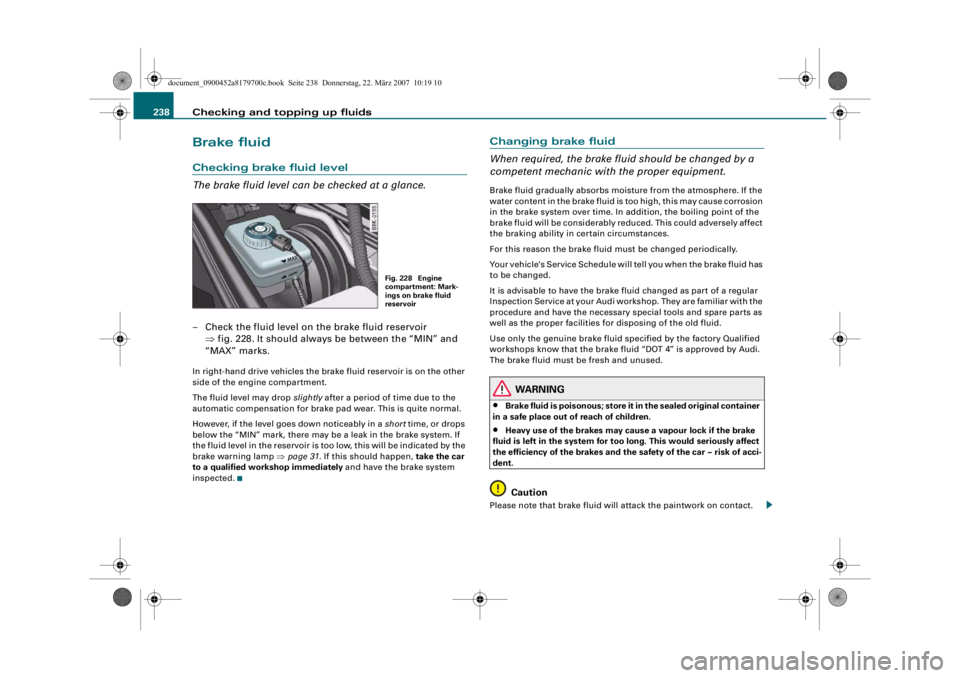
The brake fluid level can be checked at a glance.– Check the fluid level on the brake fluid reservoir
⇒fig. 228. It should always be between the “MIN” and
“MAX” marks.In right-hand drive vehicles the brake fluid reservoir is on the other
side of the engine compartment.
The fluid level may drop slightly after a period of time due to the
automatic compensation for brake pad wear. This is quite normal.
However, if the level goes down noticeably in a short time, or drops
below the “MIN” mark, there may be a leak in the brake system. If
the fluid level in the reservoir is too low, this will be indicated by the
brake warning lamp ⇒page 31 . If this should happen, take the car
to a qualified workshop immediately and have the brake system
inspected.
Changing brake fluid
When required, the brake fluid should be changed by a
competent mechanic with the proper equipment.Brake fluid gradually absorbs moistu re from the atmosphere. If the
water content in the brake fluid is too high, this may cause corrosion
in the brake system over time. In addition, the boiling point of the
brake fluid will be considerably reduced. This could adversely affect
the braking ability in certain circumstances.
For this reason the brake fluid must be changed periodically.
Your vehicle's Service Schedule will tell you when the brake fluid has
to be changed.
It is advisable to have the brake fluid changed as part of a regular
Inspection Service at your Audi workshop. They are familiar with the
procedure and have the necessary special tools and spare parts as
well as the proper facilities for disposing of the old fluid.
Use only the genuine brake fluid specified by the factory Qualified
workshops know that the brake fluid “DOT 4” is approved by Audi.
The brake fluid must be fresh and unused.
WARNING
•
Brake fluid is poisonous; store it in the sealed original container
in a safe place out of reach of children.
•
Heavy use of the brakes may caus e a vapour lock if the brake
fluid is left in the system for too long. This would seriously affect
the efficiency of the brakes and the safety of the car – risk of acci-
dent.Caution
Please note that brake fluid will attack the paintwork on contact.
Fig. 228 Engine
compartment: Mark-
ings on brake fluid
reservoir
document_0900452a8179700c.book Seite 238 Donnerstag, 22. März 2007 10:19 10
--4 -
-T
-+ +-
•
CD
Page 294 of 313
General notes
292General notesExplanation of technical dataWhere not otherwise indicated or separately listed, all technical
data apply to vehicles with st andard equipment for the German
market. Other figures may apply for special versions and export
models.
Please note that the details listed in the vehicle's registration docu-
ments can be taken as correct.
Engine data
The figures for engine power output are determined according to
EU standards.
Performance figures
The performance figures were measured without equipment which
may influence performance, such as mudflaps or extremely wide-
section tyres.
Kerb weight (unladen weight)
These figures (kerb weight according to the currently applicable
version of EU Directive 92/21/EEC) apply to the vehicle with the tank
90% full, with no special equipment. The figures include an addi-
tional 75 kg to allow for the weight of the driver.
When towing a trailer, the gross vehicle weight may be exceeded by
up to 30 kg and the maximum rear axle weight may be exceeded by
up to 80 kg.
Maximum trailer weights
The maximum trailer weights are calculated in accordance with the
currently applicable version of EU Directive 92/21/EEC.
The figures for a trailer with brakes, on gradients up to 8% are appli-
cable only up to a maximum speed of 80 km/h (even though higher
speeds may be permitted when towing a trailer in some countries). The figures for a trailer with brakes on gradients up to 12%
and for
the weight of car and trailer on gradients up to 12% are applicable
up to a maximum speed of 100 km/h. This maximum speed must not
be exceeded even in countries where higher speeds are permitted.
Maximum draw bar loading
The vertical load exerted by the trailer drawbar on the ball joint of
the towing bracket must not exceed 80 kg.
In the interest of safety, we recommend applying the maximum
permitted draw bar weight. The stability of the trailer could be
adversely affected if too little weight is applied.
If the maximum permitted drawbar weight cannot be obtained, e.g.
when using small or light trailers, statutory regulations require that
the drawbar weight be at least 4% of the actual trailer weight (for
single-axle trailers or twin-axle trailers with an axle spacing less
than 1.0 m).
Dimensions1) The height of the vehicle depends on the tyres and suspension.
Take care not to damage low-mounted parts of the car (such as the
spoiler or exhaust system) on steep ramps, uneven road surfaces or
roadside kerbs, etc.Length
mm
4625
Width
mm
1854
Width across mirrors
mm
1981
Height, unladen
1)
mm
1362-1382
Turning circle diameter
m
10.7
document_0900452a8179700c.book Seite 292 Donnerstag, 22. März 2007 10:19 10
--4 -
-T
-+
•
+-
Page 297 of 313
Performance, weights and dimensions295
Controls
Safety
Driving tips
General maintenance
Self-help
Technical data
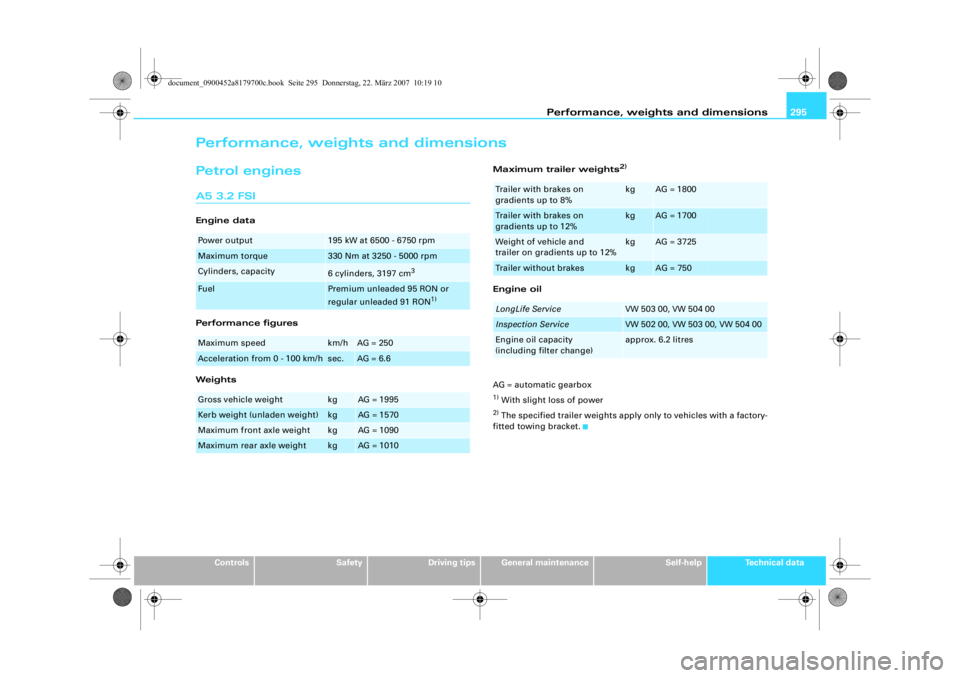
Performance, weights and dimensionsPetrol enginesA5 3.2 FSIEngine data
Performance figures
Weights Maximum trailer weights
2)
Engine oil
AG = automatic gearbox1) With slight loss of power2) The specified trailer weights apply only to vehicles with a factory-
fitted towing bracket.
Power output
195 kW at 6500 - 6750 rpm
Maximum torque
330 Nm at 3250 - 5000 rpm
Cylinders, capacity
6 cylinders, 3197 cm
3
Fuel
Premium unleaded 95 RON or
regular unleaded 91 RON
1)
Maximum speed
km/h
AG = 250
Acceleration from 0 - 100 km/h
sec.
AG = 6.6
Gross vehicle weight
kg
AG = 1995
Kerb weight (unladen weight)
kg
AG = 1570
Maximum front axle weight
kg
AG = 1090
Maximum rear axle weight
kg
AG = 1010
Trailer with brakes on
gradients up to 8%
kg
AG = 1800
Trailer with brakes on
gradients up to 12%
kg
AG = 1700
Weight of vehicle and
trailer on gradients up to 12%
kg
AG = 3725
Trailer without brakes
kg
AG = 750
LongLife Service
VW 503 00, VW 504 00
Inspection Service
VW 502 00, VW 503 00, VW 504 00
Engine oil capacity
(including filter change)
approx. 6.2 litres
document_0900452a8179700c.book Seite 295 Donnerstag, 22. März 2007 10:19 10
--4 -
-T
-+ +-
•
Page 298 of 313
Performance, weights and dimensions
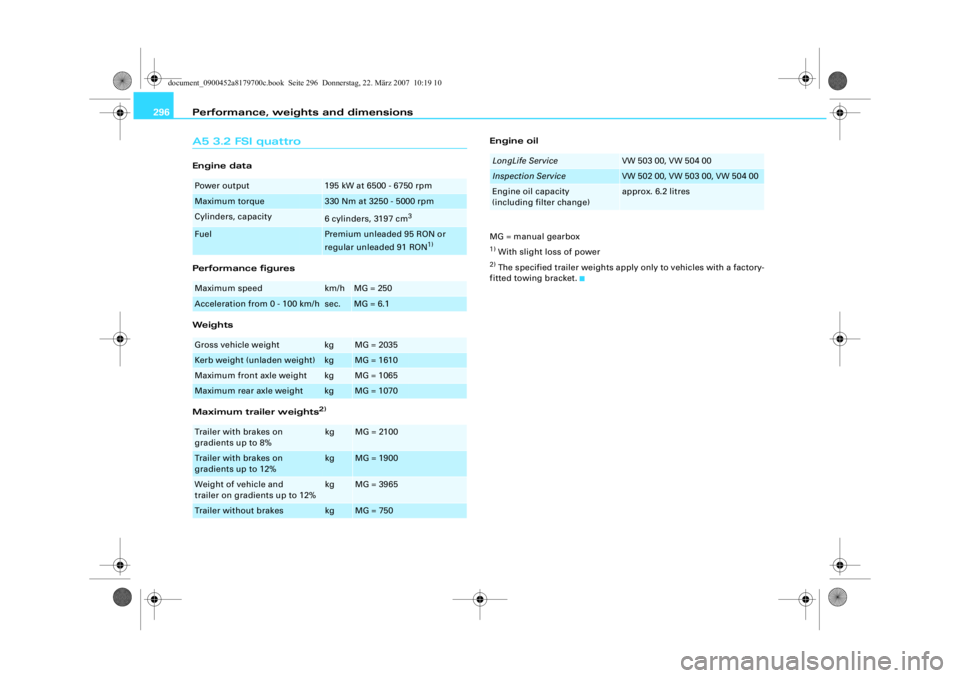
296A5 3.2 FSI quattroEngine data
Performance figures
Weights
Maximum trailer weights
2)
Engine oil
MG = manual gearbox1) With slight loss of power2) The specified trailer weights apply only to vehicles with a factory-
fitted towing bracket.
Power output
195 kW at 6500 - 6750 rpm
Maximum torque
330 Nm at 3250 - 5000 rpm
Cylinders, capacity
6 cylinders, 3197 cm
3
Fuel
Premium unleaded 95 RON or
regular unleaded 91 RON
1)
Maximum speed
km/h
MG = 250
Acceleration from 0 - 100 km/h
sec.
MG = 6.1
Gross vehicle weight
kg
MG = 2035
Kerb weight (unladen weight)
kg
MG = 1610
Maximum front axle weight
kg
MG = 1065
Maximum rear axle weight
kg
MG = 1070
Trailer with brakes on
gradients up to 8%
kg
MG = 2100
Trailer with brakes on
gradients up to 12%
kg
MG = 1900
Weight of vehicle and
trailer on gradients up to 12%
kg
MG = 3965
Trailer without brakes
kg
MG = 750
LongLife Service
VW 503 00, VW 504 00
Inspection Service
VW 502 00, VW 503 00, VW 504 00
Engine oil capacity
(including filter change)
approx. 6.2 litres
document_0900452a8179700c.book Seite 296 Donnerstag, 22. März 2007 10:19 10
--4 -
-T
•
-+ +-
Page 299 of 313
Performance, weights and dimensions297
Controls
Safety
Driving tips
General maintenance
Self-help
Technical data
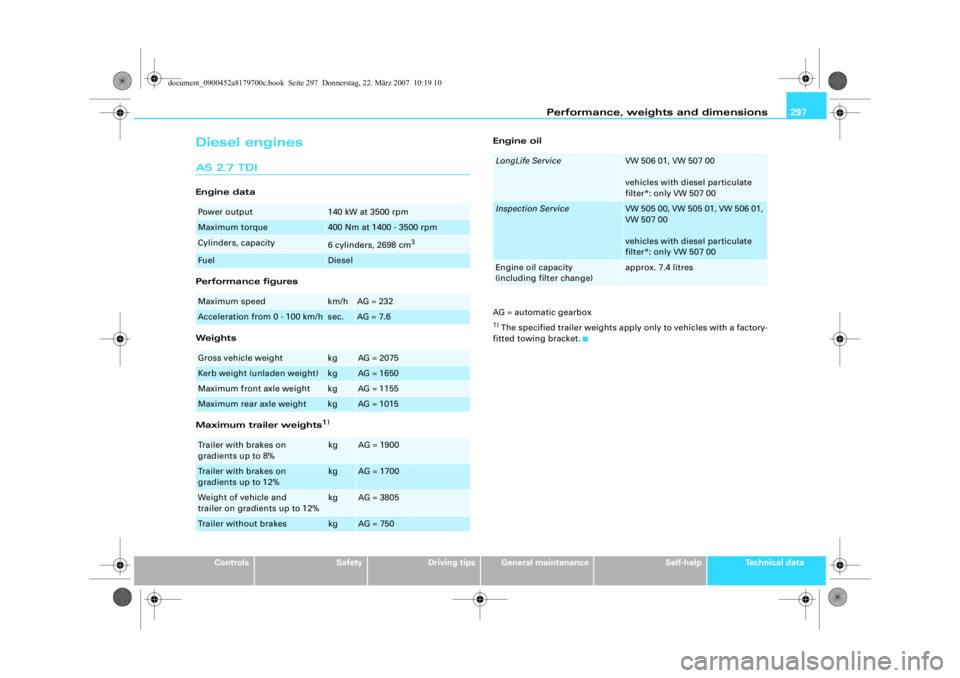
Diesel enginesA5 2.7 TDIEngine data
Performance figures
Weights
Maximum trailer weights
1)
Engine oil
AG = automatic gearbox1) The specified trailer weights apply only to vehicles with a factory-
fitted towing bracket.
Power output
140 kW at 3500 rpm
Maximum torque
400 Nm at 1400 - 3500 rpm
Cylinders, capacity
6 cylinders, 2698 cm
3
Fuel
Diesel
Maximum speed
km/h
AG = 232
Acceleration from 0 - 100 km/h
sec.
AG = 7.6
Gross vehicle weight
kg
AG = 2075
Kerb weight (unladen weight)
kg
AG = 1650
Maximum front axle weight
kg
AG = 1155
Maximum rear axle weight
kg
AG = 1015
Trailer with brakes on
gradients up to 8%
kg
AG = 1900
Trailer with brakes on
gradients up to 12%
kg
AG = 1700
Weight of vehicle and
trailer on gradients up to 12%
kg
AG = 3805
Trailer without brakes
kg
AG = 750
LongLife Service
VW 506 01, VW 507 00
vehicles with diesel particulate
filter*: only VW 507 00
Inspection Service
VW 505 00, VW 505 01, VW 506 01,
VW 507 00
vehicles with diesel particulate
filter*: only VW 507 00
Engine oil capacity
(including filter change)
approx. 7.4 litres
document_0900452a8179700c.book Seite 297 Donnerstag, 22. März 2007 10:19 10
--4 -
-T
-+
•
+-
Page 300 of 313
Performance, weights and dimensions
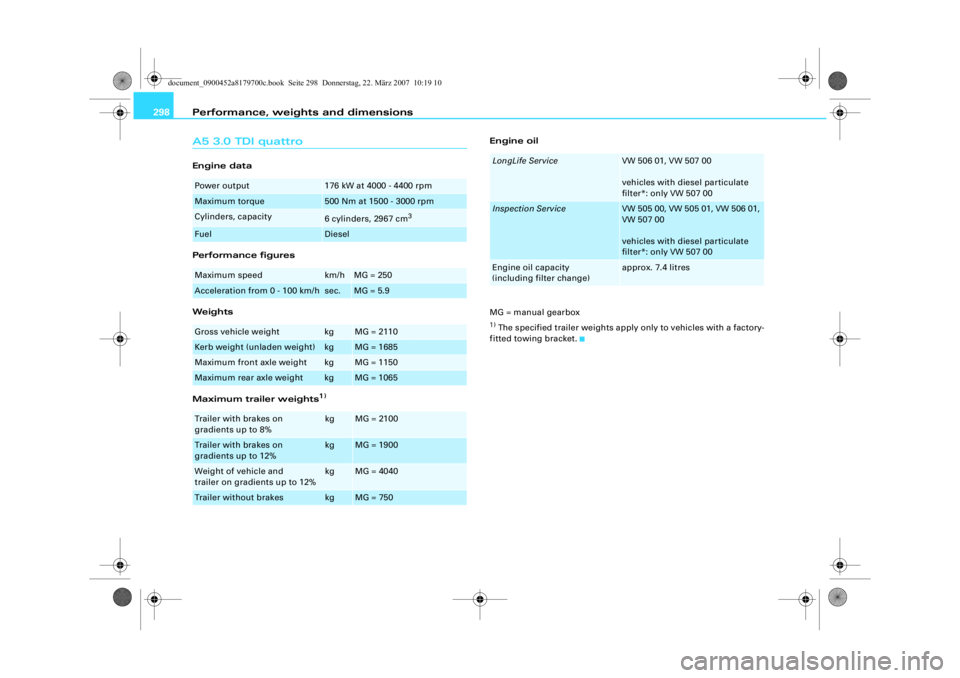
298A5 3.0 TDI quattroEngine data
Performance figures
Weights
Maximum trailer weights
1)
Engine oil
MG = manual gearbox1) The specified trailer weights apply only to vehicles with a factory-
fitted towing bracket.
Power output
176 kW at 4000 - 4400 rpm
Maximum torque
500 Nm at 1500 - 3000 rpm
Cylinders, capacity
6 cylinders, 2967 cm
3
Fuel
Diesel
Maximum speed
km/h
MG = 250
Acceleration from 0 - 100 km/h
sec.
MG = 5.9
Gross vehicle weight
kg
MG = 2110
Kerb weight (unladen weight)
kg
MG = 1685
Maximum front axle weight
kg
MG = 1150
Maximum rear axle weight
kg
MG = 1065
Trailer with brakes on
gradients up to 8%
kg
MG = 2100
Trailer with brakes on
gradients up to 12%
kg
MG = 1900
Weight of vehicle and
trailer on gradients up to 12%
kg
MG = 4040
Trailer without brakes
kg
MG = 750
LongLife Service
VW 506 01, VW 507 00
vehicles with diesel particulate
filter*: only VW 507 00
Inspection Service
VW 505 00, VW 505 01, VW 506 01,
VW 507 00
vehicles with diesel particulate
filter*: only VW 507 00
Engine oil capacity
(including filter change)
approx. 7.4 litres
document_0900452a8179700c.book Seite 298 Donnerstag, 22. März 2007 10:19 10
--4 -
-T
-+
•
+-
Page 308 of 313
Index
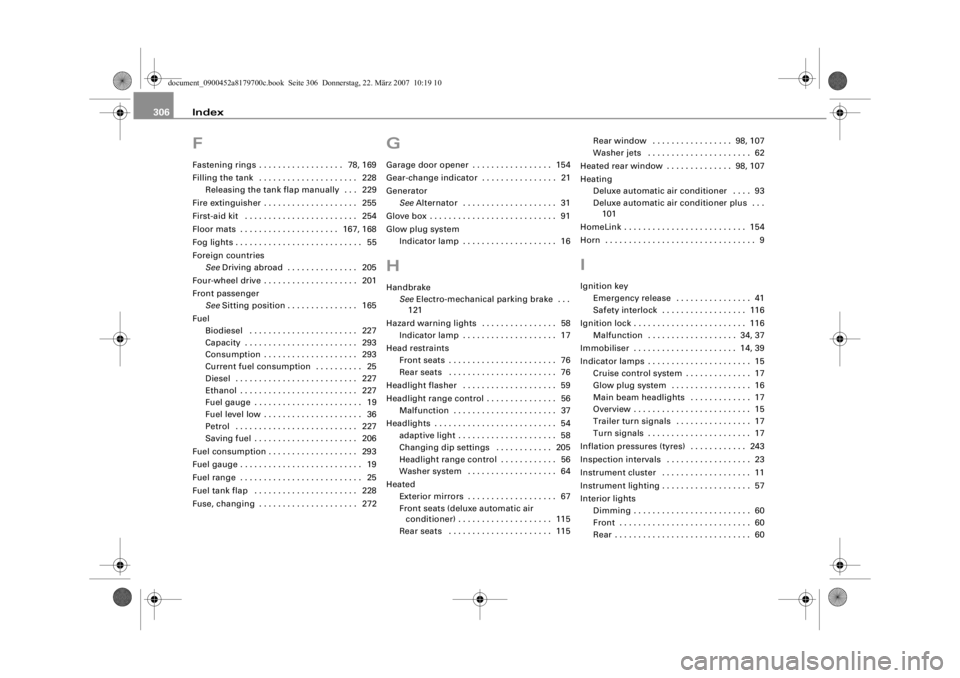
306FFastening rings . . . . . . . . . . . . . . . . . . 78, 169
Filling the tank . . . . . . . . . . . . . . . . . . . . . 228
Releasing the tank flap manually . . . 229
Fire extinguisher . . . . . . . . . . . . . . . . . . . . 255
First-aid kit . . . . . . . . . . . . . . . . . . . . . . . . 254
Floor mats . . . . . . . . . . . . . . . . . . . . . 167, 168
Fog lights . . . . . . . . . . . . . . . . . . . . . . . . . . . 55
Foreign countries See Driving abroad . . . . . . . . . . . . . . . 205
Four-wheel drive . . . . . . . . . . . . . . . . . . . . 201
Front passenger See Sitting position . . . . . . . . . . . . . . . 165
Fuel Biodiesel . . . . . . . . . . . . . . . . . . . . . . . 227
Capacity . . . . . . . . . . . . . . . . . . . . . . . . 293
Consumption . . . . . . . . . . . . . . . . . . . . 293
Current fuel consumption . . . . . . . . . . 25
Diesel . . . . . . . . . . . . . . . . . . . . . . . . . . 227
Ethanol . . . . . . . . . . . . . . . . . . . . . . . . . 227
Fuel gauge . . . . . . . . . . . . . . . . . . . . . . . 19
Fuel level low . . . . . . . . . . . . . . . . . . . . . 36
Petrol . . . . . . . . . . . . . . . . . . . . . . . . . . 227
Saving fuel . . . . . . . . . . . . . . . . . . . . . . 206
Fuel consumption . . . . . . . . . . . . . . . . . . . 293
Fuel gauge . . . . . . . . . . . . . . . . . . . . . . . . . . 19
Fuel range . . . . . . . . . . . . . . . . . . . . . . . . . . 25
Fuel tank flap . . . . . . . . . . . . . . . . . . . . . . 228
Fuse, changing . . . . . . . . . . . . . . . . . . . . . 272
GGarage door opener . . . . . . . . . . . . . . . . . 154
Gear-change indicator . . . . . . . . . . . . . . . . 21
Generator See Alternator . . . . . . . . . . . . . . . . . . . . 31
Glove box . . . . . . . . . . . . . . . . . . . . . . . . . . . 91
Glow plug system Indicator lamp . . . . . . . . . . . . . . . . . . . . 16HHandbrakeSee Electro-mechanical parking brake . . .
121
Hazard warning lights . . . . . . . . . . . . . . . . 58 Indicator lamp . . . . . . . . . . . . . . . . . . . . 17
Head restraints Front seats . . . . . . . . . . . . . . . . . . . . . . . 76
Rear seats . . . . . . . . . . . . . . . . . . . . . . . 76
Headlight flasher . . . . . . . . . . . . . . . . . . . . 59
Headlight range control . . . . . . . . . . . . . . . 56 Malfunction . . . . . . . . . . . . . . . . . . . . . . 37
Headlights . . . . . . . . . . . . . . . . . . . . . . . . . . 54 adaptive light . . . . . . . . . . . . . . . . . . . . . 58
Changing dip settings . . . . . . . . . . . . 205
Headlight range control . . . . . . . . . . . . 56
Washer system . . . . . . . . . . . . . . . . . . . 64
Heated Exterior mirrors . . . . . . . . . . . . . . . . . . . 67
Front seats (deluxe automatic air conditioner) . . . . . . . . . . . . . . . . . . . . 115
Rear seats . . . . . . . . . . . . . . . . . . . . . . 115 Rear window . . . . . . . . . . . . . . . . . 98, 107
Washer jets . . . . . . . . . . . . . . . . . . . . . . 62
Heated rear window . . . . . . . . . . . . . . 98, 107
Heating Deluxe automatic air conditioner . . . . 93
Deluxe automatic air co nditioner plus . . .
101
HomeLink . . . . . . . . . . . . . . . . . . . . . . . . . . 154
Horn . . . . . . . . . . . . . . . . . . . . . . . . . . . . . . . . 9
IIgnition key Emergency release . . . . . . . . . . . . . . . . 41
Safety interlock . . . . . . . . . . . . . . . . . . 116
Ignition lock . . . . . . . . . . . . . . . . . . . . . . . . 116 Malfunction . . . . . . . . . . . . . . . . . . . 34, 37
Immobiliser . . . . . . . . . . . . . . . . . . . . . . 14, 39
Indicator lamps . . . . . . . . . . . . . . . . . . . . . . 15 Cruise control system . . . . . . . . . . . . . . 17
Glow plug system . . . . . . . . . . . . . . . . . 16
Main beam headlights . . . . . . . . . . . . . 17
Overview . . . . . . . . . . . . . . . . . . . . . . . . . 15
Trailer turn signals . . . . . . . . . . . . . . . . 17
Turn signals . . . . . . . . . . . . . . . . . . . . . . 17
Inflation pressures (tyres) . . . . . . . . . . . . 243
Inspection intervals . . . . . . . . . . . . . . . . . . 23
Instrument cluster . . . . . . . . . . . . . . . . . . . 11
Instrument lighting . . . . . . . . . . . . . . . . . . . 57
Interior lights Dimming . . . . . . . . . . . . . . . . . . . . . . . . . 60
Front . . . . . . . . . . . . . . . . . . . . . . . . . . . . 60
Rear . . . . . . . . . . . . . . . . . . . . . . . . . . . . . 60
document_0900452a8179700c.book Seite 306 Donnerstag, 22. März 2007 10:19 10
--4 -
-T
-+ +-