key battery AUDI A5 COUPE 2008 User Guide
[x] Cancel search | Manufacturer: AUDI, Model Year: 2008, Model line: A5 COUPE, Model: AUDI A5 COUPE 2008Pages: 313, PDF Size: 13.86 MB
Page 138 of 313
Automatic gearbox
136Applies to vehicles: with multitronic®Manual release of selector lever
The selector lever can be rele ased manually if the elec-
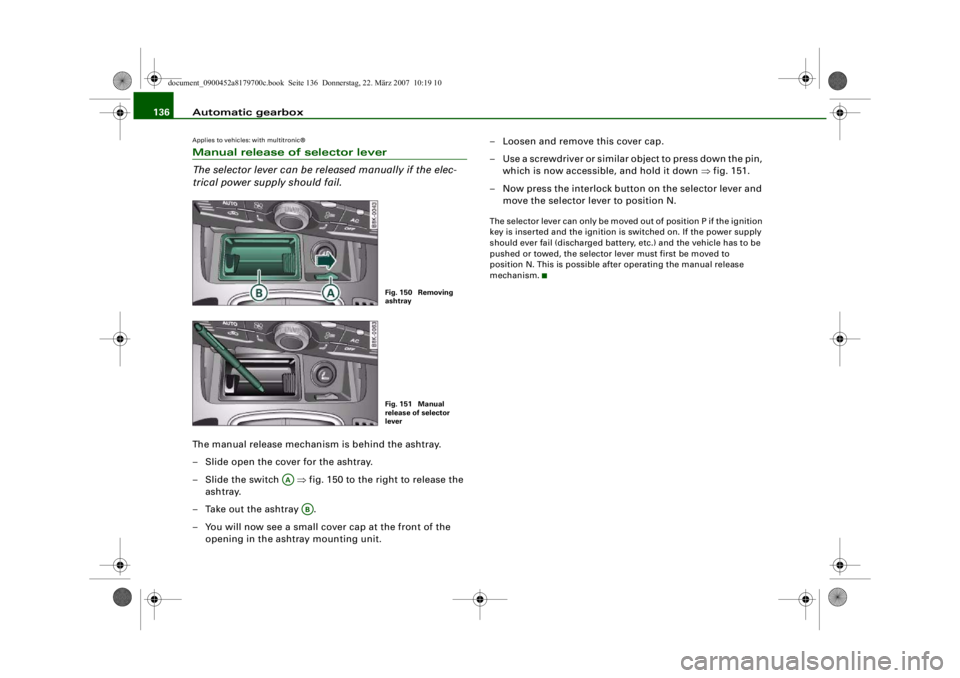
trical power supply should fail.The manual release mechanism is behind the ashtray.
– Slide open the cover for the ashtray.
–Slide the switch ⇒fig. 150 to the right to release the
ashtray.
– Take out the ashtray .
– You will now see a small cover cap at the front of the opening in the ashtray mounting unit. – Loosen and remove this cover cap.
– Use a screwdriver or similar object to press down the pin,
which is now accessible, and hold it down ⇒fig. 151.
– Now press the interlock button on the selector lever and move the selector lever to position N.
The selector lever can only be moved out of position P if the ignition
key is inserted and the ignition is switched on. If the power supply
should ever fail (discharged battery, etc.) and the vehicle has to be
pushed or towed, the selector lever must first be moved to
position N. This is possible after operating the manual release
mechanism.
Fig. 150 Removing
ashtrayFig. 151 Manual
release of selector
lever
AA
AB
document_0900452a8179700c.book Seite 136 Donnerstag, 22. März 2007 10:19 10
--4 -
-T
•
-+ +-
Page 205 of 313
Intelligent technology203
Controls
Safety
Driving tips
General maintenance
Self-help
Technical data
Dynamic power management
While the vehicle is moving, this function distributes the available
power to the various electrical components and systems according
to their requirements. The power management ensures that on-
board systems do not consume more electrical power than the
alternator can supply, and thus
maintains the maximum possible
battery power level.
Note
•
The power management system is not able to overcome the
given physical limits. Please reme mber that the power and life of
the battery are limited.
•
A warning message will appear ⇒page 204, “Driver message in
the instrument cluster display” if the battery power has dropped to
a level where reliable starting is impaired.
Points to remember
Starting ability has first priority.Short trips, city traffic and low te mperatures all place a heavy load
on the battery. In these conditions a large amount of power is
consumed, but only a small amount is supplied. The situation is also
critical if electrical equipment is in use when the engine is not
running. In this case power is consumed when none is being gener-
ated.
In these situations you will be aware that the power management
system is intervening to control the distribution of electrical power.
When the vehicle is parked for long periods
If you do not drive your vehicle for a period of several days or weeks,
the power management will gradually shut off the on-board
systems one by one, or reduce the amount of current they are using.
This limits the amount of power consumed and helps to ensure reli-
able starting even after a long period. Please note that certain convenience features, such as the Audi
advanced key*, the remote control key or the electrical seat adjust-
ment may not be available when yo
u unlock the vehicle. These func-
tions will be restored when you switch on the ignition and start the
engine.
With the engine switched off
If you listen to the radio or us e the other MMI functions when the
engine is not running, this will discharge the battery.
The MMI display will show this wa rning message before the battery
power drops to a level where the starting ability is impaired.
Please start engine, otherwise system will switch off
in 3 minutes.
This message warns you that the system you are using will be
switched off automatically after 3 minutes. You should therefore
start the engine if you wish to continue using the system.
When the engine is running
Although the alternator generates electrical power, the battery can
still become discharged while the vehicle is being driven. This can
occur when a lot of power is being consumed but only a small
amount supplied, especially if the battery is not fully charged
initially.
To restore the necessary energy balance, the system will then
temporarily shut off the electrical components that are using a lot
of power, or reduce the current they are consuming. Heating
systems in particular use a large am ount of electrical power. If you
notice, for instance, that the seat heating* or the rear window
heater is not working, they may have been temporarily switched off
or regulated to a lower heat output. These systems will be available
again as soon as sufficient electrical power is available.
You may also notice that the engine runs at a slightly faster idling
speed. This is quite normal, and no cause for concern. The increased
idling speed allows the alternat or to meet the greater power
requirement and charge the battery at the same time.
document_0900452a8179700c.book Seite 203 Donnerstag, 22. März 2007 10:19 10
--4 -
-T
[I]
•
-+ +-
•
Page 233 of 313
Checking and topping up fluids231
Controls
Safety
Driving tips
General maintenance
Self-help
Technical data
Working on components in the engine compartment
Extra caution is necessary when working on components
in the engine compartment.Always be aware of the danger of injury and scalding as well as the
risk of accident or fire when working in the engine compartment
(e.g. when checking and refilling fluids). Always observe the warn-
ings listed below and follow al l normal safety precautions. The
engine compartment of any motor vehicle is a potentially
hazardous area . ⇒ .
WARNING
•
Switch off the engine.
•
Remove the ignition key.
•
Apply the parking brake.
•
Put the gear lever in neutral or selector in P.
•
Wait for the engine to cool down.
•
Keep children away from engine compartment.
•
Never spill fluids on hot engine components. These fluids can
cause a fire (e.g. radiator anti-freeze).
•
Take care not to cause short circ uits in the electrical system,
especially when working on the battery.
•
Do not touch the radiator fan when the engine is hot. The fan
may start running suddenly.
•
Do not unscrew the cap on the ex pansion tank when the engine
is hot. The cooling system is under pressure.
•
Protect face, hands and arms by covering the cap with a large,
thick rag to protect against escaping coolant and steam.
•
If any tests have to be performed with the engine running,
there is an extra safety risk from the rotating parts, such as the
drive belts, alternator and radiator fan, etc., and from the high-
voltage ignition system.
•
Vehicles with automatic gearbox: Never open the throttle inad-
vertently (for instance by hand from the engine compartment) if a
gear is engaged while the vehicle is stationary with the engine
running. The vehicle could otherwise start moving immediately
and possibly cause an accident.
•
Observe the following a dditional warnings if work on the fuel
system or the electrical system is necessary:
−Always disconnect the battery.
− Do not smoke.
− Never work near naked flames.
− Always keep an approved fire extinguisher immediately
available.Caution
When topping up fluids make sure the correct fluid is put into the
correct filler opening. This can otherwise cause serious malfunc-
tions or engine damage.
For the sake of the environment
Inspect the ground un derneath your vehicle regularly so that any
leaks are detected at an early stag e. If you find oil spots or other
fluids, have your vehicle inspected by a qualified workshop.
Note
On right-hand drive vehicles* some of the containers/ reservoirs
mentioned below are located on the other side of the engine
compartment.
WARNING (continued)
document_0900452a8179700c.book Seite 231 Donnerstag, 22. März 2007 10:19 10
--4 -
-T
-+
CD
+-
[I]
•
Page 241 of 313
Checking and topping up fluids239
Controls
Safety
Driving tips
General maintenance
Self-help
Technical data
For the sake of the environment
If the fluid has to be drained out of the brake system, use an appro-
priate container to catch the used brake fluid and dispose of it in the
proper manner.BatteryGeneral notes
All work on batteries requires specialist knowledge.The battery is virtually maintenance-free . It is checked as part of the
Inspection Service.
We recommend that you replace a battery once it is older than 5
years.
When an airbag is triggered, the battery will, under certain circum-
stances, be disconnected from the on-board power supply for
safety reasons ⇒ in “General notes on airbag system” on
page 176 .
Disconnecting the battery
If the battery is disconnected, some of the vehicle's functions will
become inoperative (e.g. electric windows). These functions will
require resetting after the battery is reconnected. For this reason,
the battery should only be disconnected from the vehicle's electrical
system when absolutely necessary.
If the vehicle is not used for long periods
If you do not drive your vehicle for a period of several days or weeks,
the power management will gradually shut off the on-board
systems one by one, or reduce the amount of current they are using.
This limits the amount of power consumed and helps to ensure reli-
able starting even after a long period ⇒page 202 . Please note that certain convenience features, such as the Audi
advanced key*, the remote control key or the electrical seat adjust-
ment may not be available when yo
u unlock the vehicle. These func-
tions will be restored when you switch on the ignition and start the
engine.
Winter conditions
At low temperatures the battery has to work very hard. It also
provides only a fraction of the starting power it has at normal
temperatures.
For this reason, we recommend having the battery checked and
charged if necessary before the start of winter ⇒page 241 .
WARNING
•
All work on batteries requires sp ecialist knowledge. For queries
regarding the vehicle battery please contact an Audi dealership or
other qualified workshop (risk of chemical burns / risk of explo-
sion).
•
The battery must not be opened. Do not attempt to make any
changes to the electrolyte level of the battery. Otherwise, there is
a risk that a mixture of oxygen and hydrogen gas can accumulate
and cause an explosion.Note
If the vehicle is to be left standing for a period of several weeks at
extremely low temperatures, the battery should be removed from
the vehicle. This ensures that it cannot “freeze up” and be
damaged.
document_0900452a8179700c.book Seite 239 Donnerstag, 22. März 2007 10:19 10
--4 -
-T
•
-+ +-
[I]
•
Page 242 of 313
Checking and topping up fluids
240Important safety warnings for handling a car battery
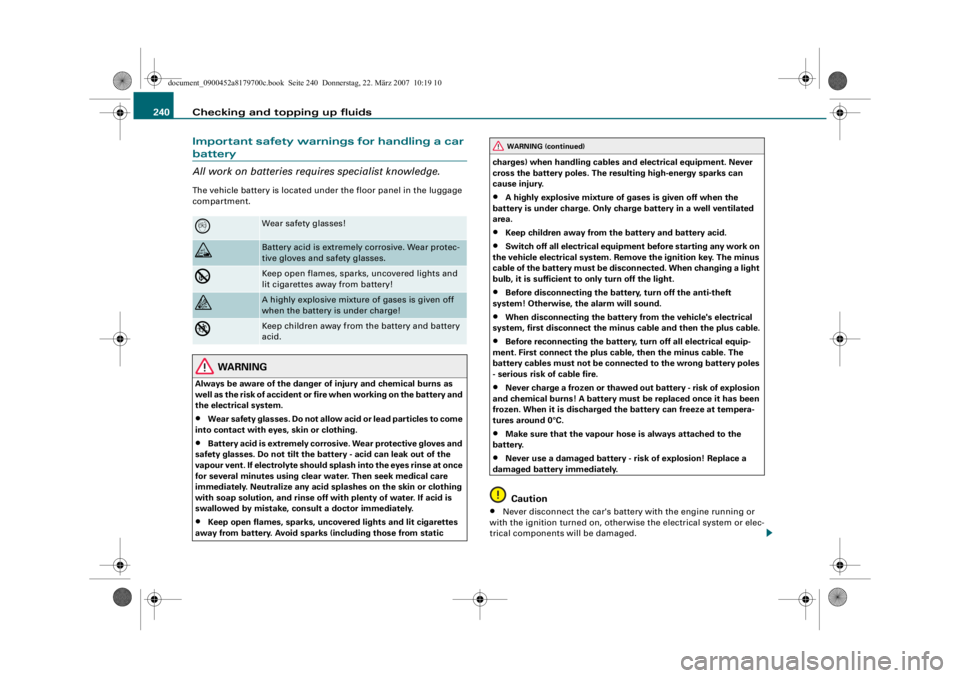
All work on batteries requ ires specialist knowledge.The vehicle battery is located under the floor panel in the luggage
compartment.
WARNING
Always be aware of the danger of injury and chemical burns as
well as the risk of accident or fi re when working on the battery and
the electrical system.•
Wear safety glasses. Do not allow acid or lead particles to come
into contact with eyes, skin or clothing.
•
Battery acid is extremely corrosiv e. Wear protective gloves and
safety glasses. Do not tilt the battery - acid can leak out of the
vapour vent. If electrolyte should sp lash into the eyes rinse at once
for several minutes using clear wa ter. Then seek medical care
immediately. Neutralize any acid splashes on the skin or clothing
with soap solution, and rinse off wi th plenty of water. If acid is
swallowed by mistake, co nsult a doctor immediately.
•
Keep open flames, sparks, uncover ed lights and lit cigarettes
away from battery. Avoid sparks (including those from static charges) when handling cables
and electrical equipment. Never
cross the battery poles. The re sulting high-energy sparks can
cause injury.
•
A highly explosive mixture of gases is given off when the
battery is under charge. Only char ge battery in a well ventilated
area.
•
Keep children away from the battery and battery acid.
•
Switch off all electrical equipm ent before starting any work on
the vehicle electrical system. Remo ve the ignition key. The minus
cable of the battery must be disc onnected. When changing a light
bulb, it is sufficient to only turn off the light.
•
Before disconnecting the battery, turn off the anti-theft
system! Otherwise, the alarm will sound.
•
When disconnecting the battery from the vehicle's electrical
system, first disconnect the minus cable and then the plus cable.
•
Before reconnecting the battery, turn off all electrical equip-
ment. First connect the plus cabl e, then the minus cable. The
battery cables must not be conne cted to the wrong battery poles
- serious risk of cable fire.
•
Never charge a frozen or thawed out battery - risk of explosion
and chemical burns! A battery must be replaced once it has been
frozen. When it is discharged the battery can freeze at tempera-
tures around 0°C.
•
Make sure that the vapour hose is always attached to the
battery.
•
Never use a damaged battery - ri sk of explosion! Replace a
damaged battery immediately.Caution
•
Never disconnect the car's battery with the engine running or
with the ignition turned on, otherwise the electrical system or elec-
trical components will be damaged.
Wear safety glasses!
Battery acid is extremely corrosive. Wear protec-
tive gloves and safety glasses.
Keep open flames, sparks, uncovered lights and
lit cigarettes away from battery!
A highly explosive mixture of gases is given off
when the battery is under charge!
Keep children away from the battery and battery
acid.
WARNING (continued)
document_0900452a8179700c.book Seite 240 Donnerstag, 22. März 2007 10:19 10
--4 -
-T
-+ +-
CD
Page 243 of 313
Checking and topping up fluids241
Controls
Safety
Driving tips
General maintenance
Self-help
Technical data
•
Do not expose the battery to direct sunlight over a long period of
time, as the intense ul traviolet radiation can affect the battery
housing.
•
If the car is left standing for long periods, protect the battery
from extreme cold temperature so that it does not “freeze up” and
become damaged.
Charging the battery
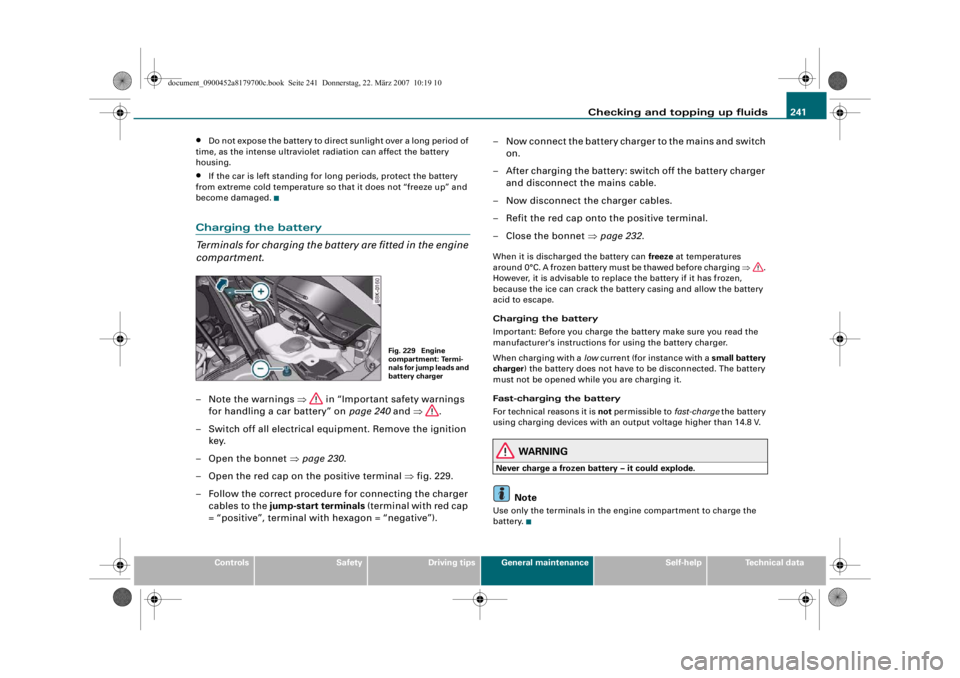
Terminals for charging the battery are fitted in the engine
compartment.– Note the warnings ⇒ in “Important safety warnings
for handling a car battery” on page 240 and ⇒.
– Switch off all electrical equi pment. Remove the ignition
key.
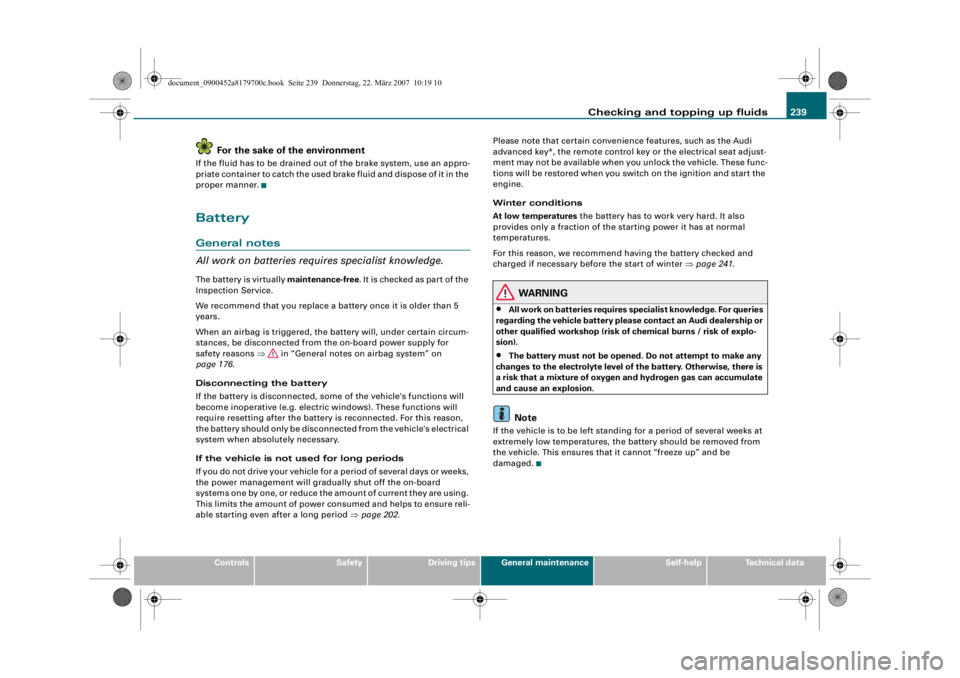
– Open the bonnet ⇒page 230 .
– Open the red cap on the positive terminal ⇒fig. 229.
– Follow the correct procedure for connecting the charger cables to the jump-start terminals (terminal with red cap
= “positive”, terminal with hexagon = “negative”). – Now connect the battery charger to the mains and switch
on.
– After charging the battery: switch off the battery charger and disconnect the mains cable.
– Now disconnect the charger cables.
– Refit the red cap onto the positive terminal.
– Close the bonnet ⇒page 232 .
When it is discharged the battery can freeze at temperatures
around 0°C. A frozen battery must be thawed before charging ⇒.
However, it is advisable to replace the battery if it has frozen,
because the ice can crack the batte ry casing and allow the battery
acid to escape.
Charging the battery
Important: Before you charge the battery make sure you read the
manufacturer's instructions for using the battery charger.
When charging with a low current (for instance with a small battery
charger ) the battery does not have to be disconnected. The battery
must not be opened while you are charging it.
Fast-charging the battery
For technical reasons it is not permissible to fast-charge the battery
using charging devices with an ou tput voltage higher than 14.8 V.
WARNING
Never charge a frozen battery – it could explode.
Note
Use only the terminals in the engine compartment to charge the
battery.
Fig. 229 Engine
compartment: Termi-
nals for jump leads and
battery charger
document_0900452a8179700c.book Seite 241 Donnerstag, 22. März 2007 10:19 10
--4 -
-T
•
-+ +-
&
&
j& [I]
•
~
Page 304 of 313
Index
302AABS
See Anti-lock brake system . . . . . . . . . 18
AC mode . . . . . . . . . . . . . . . . . . . . . . . 98, 107
Acceleration figures See Performance, weights and
dimensions . . . . . . . . . . . . . . . . . . . . 295
Accessories . . . . . . . . . . . . . . . . . . . . . . . . 250 Trailer . . . . . . . . . . . . . . . . . . . . . . . . . . 211
Adapter for anti-theft wheel bolts . . . . . 264
adaptive light . . . . . . . . . . . . . . . . . . . . . . . 58 Defective . . . . . . . . . . . . . . . . . . . . . . . . 37
advanced key Locking and unlocking the vehicle . . . 45
START ENGINE STOP button . . . . . . . 118
Starting the engine . . . . . . . . . . . . . . . 118
Switching on the ignition . . . . . . . . . . 118
Air conditioner . . . . . . . . . . . . . . . . . . 93, 101 AC mode . . . . . . . . . . . . . . . . . . . . . . . . . 98
See also Deluxe automatic air conditioner
93
Air recirculation mode Deluxe automatic air conditioner . . . . 97
Deluxe automatic air conditioner plus . . .106
Airbag . . . . . . . . . . . . . . . . . . . . . . . . . . . . 176 Deactivating . . . . . . . . . . . . . . . . . . . . . 183
Front airbags . . . . . . . . . . . . . . . . . . . . 178
Head-protection airbag . . . . . . . . . . . 181
Key-operated switch for front passenger's airbag . . . . . . . . . . . . . . . . . . . . . . . . 183
Side airbags . . . . . . . . . . . . . . . . . . . . . 180 Triggering . . . . . . . . . . . . . . . . . . . . . . 177
Warning lamp . . . . . . . . . . . . . . . . . . . . 16
Alterations to the vehicle . . . . . . . . . . . . . 250
Alternator Fault . . . . . . . . . . . . . . . . . . . . . . . . . . . . 31
Anti-dazzle interior mirror . . . . . . . . . . . . . 66
Anti-freeze additive . . . . . . . . . . . . . . . . . 235
Anti-knock properties of petrol . . . . . . . . 227
Anti-lock brake system How the system works . . . . . . . . . . . . 197
Warning lamp . . . . . . . . . . . . . . . . . . . . 18
Anti-theft alarm . . . . . . . . . . . . . . . . . . . . . . 42 Interior monitor . . . . . . . . . . . . . . . . . . . 47
Tow-away protection . . . . . . . . . . . . . . 47
Anti-theft wheel bolts . . . . . . . . . . . . . . . . 264
Armrest (front) Adjusting . . . . . . . . . . . . . . . . . . . . . . . . 77
Storage compartment . . . . . . . . . . . . . 77
Ashtrays Front . . . . . . . . . . . . . . . . . . . . . . . . . . . . 86
Rear . . . . . . . . . . . . . . . . . . . . . . . . . . . . . 87
Audi hold assist . . . . . . . . . . . . . . . . . . . . 124 Warning lamp . . . . . . . . . . . . . . . . . . . . 18
Auto Lock . . . . . . . . . . . . . . . . . . . . . . . . . . . 42
Auto-check control . . . . . . . . . . . . . . . . . . . 29
Automatic air conditioner plus See Deluxe automatic air conditioner plus
101
Automatic gearbox Manual release (multitronic®) . . . . . . 136
multitronic® . . . . . . . . . . . . . . . . . . . . 130
Safety interloc k for ignition key . . . . 116 Selector lever positions (multitronic®) . . .
131
Steering wheel with tiptronic controls . . . 135
Automatic headlight control . . . . . . . . . . . 54
Auxiliary heating Deluxe automatic air co nditioner plus . . .
111
Description . . . . . . . . . . . . . . . . . . . . . . 111
Remote control . . . . . . . . . . . . . . . . . . 114
Running time . . . . . . . . . . . . . . . . . . . . 113
Switching on/off immediately . . . . . . 112
Timer . . . . . . . . . . . . . . . . . . . . . . . . . . . 112
Average fuel consumption . . . . . . . . . . . . . 25
Average speed . . . . . . . . . . . . . . . . . . . . . . . 25
Axle weights See Performance, weights and
dimensions . . . . . . . . . . . . . . . . . . . . 295
BBattery
Charging . . . . . . . . . . . . . . . . . . . . . . . . 241
Low charge . . . . . . . . . . . . . . . . . . . . . . 202
Power level . . . . . . . . . . . . . . . . . . . . . . 202
Power management . . . . . . . . . . . . . . 202
Replacing . . . . . . . . . . . . . . . . . . . . . . . 242
Winter conditions . . . . . . . . . . . . . . . . 239
Battery power . . . . . . . . . . . . . . . . . . . . . . . 36
Bayonet fastener Bulb . . . . . . . . . . . . . . . . . . . . . . . . . . . . 277
Bulb holder . . . . . . . . . . . . . . . . . . . . . . 278
Belt tensioners . . . . . . . . . . . . . . . . . . . . . 175
document_0900452a8179700c.book Seite 302 Donnerstag, 22. März 2007 10:19 10
--4 -
-T
-+ +-
Page 309 of 313
Index307
Controls
Safety
Driving tips
General maintenance
Self-help
Technical data
Interior mirrors
See Mirrors . . . . . . . . . . . . . . . . . . . . 65, 66
Interior monitor . . . . . . . . . . . . . . . . . . . . . . 47
Intermittent wipe . . . . . . . . . . . . . . . . . . . . 62 Rain sensor . . . . . . . . . . . . . . . . . . . . . . . 62
ISOFIX . . . . . . . . . . . . . . . . . . . . . . . . . . . . . 191
JJack . . . . . . . . . . . . . . . . . . . . . . . . . . . 255, 262
Jacking points . . . . . . . . . . . . . . . . . . . . . . 262
Jump-starting . . . . . . . . . . . . . . . . . . . . . . 265KKey-operated switch for front passenger's airbag . . . . . . . . . . . . . . . . . . . . . . . . . 183
Keys . . . . . . . . . . . . . . . . . . . . . . . . . . . . . . . 39 Emergency key . . . . . . . . . . . . . . . . . . . . 41
Replacement keys . . . . . . . . . . . . . . . . . 39
Replacing the battery . . . . . . . . . . . . . . 40
Kick-down multitronic® . . . . . . . . . . . . . . . . . . . . . 133LLeather careAlcantara . . . . . . . . . . . . . . . . . . . . . . . 226
Natural leather . . . . . . . . . . . . . . . . . . . 225
Light sensor . . . . . . . . . . . . . . . . . . . . . . . . . 54
Light sensor defective . . . . . . . . . . . . . . . . 35
Lights . . . . . . . . . . . . . . . . . . . . . . . . . . . . . . 54 Coming home . . . . . . . . . . . . . . . . . . . . . 56
Daytime running lights . . . . . . . . . . . . . 56 Exterior lighting . . . . . . . . . . . . . . . . . . . 56
Front fog lights . . . . . . . . . . . . . . . . . . . 55
Headlight control . . . . . . . . . . . . . . . . . . 54
Leaving home . . . . . . . . . . . . . . . . . . . . . 56
Rear fog lights . . . . . . . . . . . . . . . . . . . . 55
Switching on and off . . . . . . . . . . . . . . . 54
Loading luggage compartment . . . . . . . . 168
Load-through hatch . . . . . . . . . . . . . . . . . . 83
Locking . . . . . . . . . . . . . . . . . . . . . . . . . . . . . 44 Central locking system . . . . . . . . . . . . . 46
Locking and unlocking the vehicle from in- side
Central locking system . . . . . . . . . . . . . 47
Locking doors manually . . . . . . . . . . . . . . . 48
LongLife Service . . . . . . . . . . . . . . . . . . . . 233
Luggage compartment . . . . . . . . . . . . . . . . 77 Extending . . . . . . . . . . . . . . . . . . 80, 81, 82
Fastening rings . . . . . . . . . . . . . . . . . . . 78
Loading . . . . . . . . . . . . . . . . . . . . . . . . . . 77
Load-through hatch . . . . . . . . . . . . . . . . 83
Side storage compartment . . . . . . . . . . 79
Stretch net . . . . . . . . . . . . . . . . . . . . . . . 79
See also Loading luggage compartment
168
Luggage rack See Roof carrier . . . . . . . . . . . . . . . . . . . 84
MMain beam headlights . . . . . . . . . . . . . . . . 59
Indicator lamp . . . . . . . . . . . . . . . . . . . . 17
Make-up mirrors . . . . . . . . . . . . . . . . . . . . . 61 Manual operation
Boot lid . . . . . . . . . . . . . . . . . . . . . . . . . . 49
Fuel tank flap . . . . . . . . . . . . . . . . . . . . 229
Tilting panorama roof . . . . . . . . . . . 52, 53
Manual release Selector lever (multitronic®) . . . . . . . 136
Maximum speed See Performance, weights and
dimensions . . . . . . . . . . . . . . . . . . . . 295
Memory for driver's seat . . . . . . . . . . . . . . . 74 Activating remote control key . . . . . . . 75
Recalling settings . . . . . . . . . . . . . . . . . 74
Storing settings . . . . . . . . . . . . . . . . . . . 74
Messages . . . . . . . . . . . . . . . . . . . . . . . . . . . 30
Mileage recorder . . . . . . . . . . . . . . . . . . . . . 14
Minimising pollution . . . . . . . . . . . . . . . . . 206
Mirrors Anti-dazzle setting . . . . . . . . . . . . . . . . . 66
Automatic anti-dazzle exterior mirrors 68
Automatic anti-dazzle interior mirror . 66
Exterior mirrors . . . . . . . . . . . . . . . . . . . 67
Interior mirror . . . . . . . . . . . . . . . . . . . . . 65
Make-up mirrors . . . . . . . . . . . . . . . . . . . 61
MMI control console, cleaning . . . . . . . . 223
MMI display, cleaning . . . . . . . . . . . . . . . . 223
Mobile phones . . . . . . . . . . . . . . . . . . . . . . 251
Modifications . . . . . . . . . . . . . . . . . . . . . . . 250
multitronic® . . . . . . . . . . . . . . . . . . . . . . . . 130 Driving with multitronic® . . . . . . . . . . 130
Dynamic gear control program . . . . . 133
Kick-down feature . . . . . . . . . . . . . . . . 133
Selector lever lock . . . . . . . . . . . . . . . . 132
Selector lever positions . . . . . . . . . . . . 131
document_0900452a8179700c.book Seite 307 Donnerstag, 22. März 2007 10:19 10
--4 -
-T
-+ +-
Page 311 of 313

Index309
Controls
Safety
Driving tips
General maintenance
Self-help
Technical data
Rear fog lights . . . . . . . . . . . . . . . . . . . . . . . 55
Rear lights
Defective . . . . . . . . . . . . . . . . . . . . . . . . . 36
Rear View camera See Reversing camera . . . . . . . . . . . . . 140
Rear view mirrors See Mirrors . . . . . . . . . . . . . . . . . . . . 65, 66
Rear window, sun blind . . . . . . . . . . . . . . . 61
Remote control keys . . . . . . . . . . . . . . . . . . 39 Indicator lamp . . . . . . . . . . . . . . . . . . . . 40
Replacing the battery . . . . . . . . . . . . . . 40
Unlocking and locking . . . . . . . . . . . . . 44
Replacement keys . . . . . . . . . . . . . . . . . . . . 39
Replacement parts . . . . . . . . . . . . . . . . . . 250
Reset button . . . . . . . . . . . . . . . . . . . . . . . . 14
Retaining net . . . . . . . . . . . . . . . . . . . . . . . . 79
Rev counter . . . . . . . . . . . . . . . . . . . . . . . . . 12
Reverse gear multitronic® . . . . . . . . . . . . . . . . . . . . . 131
Reversing camera . . . . . . . . . . . . . . . 140, 143 Parking mode 1 . . . . . . . . . . . . . . . . . . 145
Parking mode 2 . . . . . . . . . . . . . . . . . . 146
RME fuel . . . . . . . . . . . . . . . . . . . . . . . . . . . 227
Roof carrier . . . . . . . . . . . . . . . . . . . . . . . . . 84 Attachment points . . . . . . . . . . . . . . . . . 84
Roof load . . . . . . . . . . . . . . . . . . . . . . . . 85
Running in . . . . . . . . . . . . . . . . . . . . . . . . . 205 New engine . . . . . . . . . . . . . . . . . . . . . 205
SSAFE . . . . . . . . . . . . . . . . . . . . . . . . . . . . . . . 14
Safe driving . . . . . . . . . . . . . . . . . . . . . . . . 162 Safety . . . . . . . . . . . . . . . . . . . . . . . . . . . . . 163
Safety features . . . . . . . . . . . . . . . . . . . . . 162
Seat adjustment
Backrest angle (manual) . . . . . . . . . . . . 70
Easy-entry function . . . . . . . . . . . . . 71, 73
Electrical . . . . . . . . . . . . . . . . . . . . . . . . . 72
Forwards and backwards (manual) . . . 70
Manual . . . . . . . . . . . . . . . . . . . . . . . . . . 70
Seat height (manual) . . . . . . . . . . . . . . . 70
Seat belts . . . . . . . . . . . . . . . . . . . . . . . . . . 170 Adjusting seat belts . . . . . . . . . . . . . . . 173
Belt tensioners . . . . . . . . . . . . . . . . . . . 175
Cleaning . . . . . . . . . . . . . . . . . . . . . . . . 226
During pregnancy . . . . . . . . . . . . . . . . 174
Putting on . . . . . . . . . . . . . . . . . . . . . . . 173
Safety notes . . . . . . . . . . . . . . . . . . . . . 171
Taking off . . . . . . . . . . . . . . . . . . . . . . . 174
Warning lamp . . . . . . . . . . . . . . . . . . . . . 17
Seat heating Front (deluxe automati c air conditioner)
115
Rear . . . . . . . . . . . . . . . . . . . . . . . . . . . . 115
Seat memory . . . . . . . . . . . . . . . . . . . . . . . . 74
Selector lever Manual release (multitronic®) . . . . . . 136
Selector lever positions multitronic® . . . . . . . . . . . . . . . . . . . . . 131
Service interval display . . . . . . . . . . . . . . . . 23
Service position for windscreen wipers . . 64
servotronic . . . . . . . . . . . . . . . . . . . . . . . . . 201
Side lights . . . . . . . . . . . . . . . . . . . . . . . . . . 54
Single journey memory . . . . . . . . . . . . . . . 26 Sitting position
Driver . . . . . . . . . . . . . . . . . . . . . . . . . . . 164
Front passenger . . . . . . . . . . . . . . . . . . 165
Incorrect sitting position . . . . . . . . . . . 167
Rear passengers . . . . . . . . . . . . . . . . . . 165
Snow chains . . . . . . . . . . . . . . . . . . . . . . . . 248
Sockets 230 Volt . . . . . . . . . . . . . . . . . . . . . . . . . . 89
Spare key . . . . . . . . . . . . . . . . . . . . . . . . . . . 39 Starting the engine . . . . . . . . . . . . . . . . 42
Spare parts . . . . . . . . . . . . . . . . . . . . . . . . . 250
Spare wheel . . . . . . . . . . . . . . . . . . . . . . . . 256
Speed warning . . . . . . . . . . . . . . . . . . . . . . . 28
Speedometer . . . . . . . . . . . . . . . . . . . . . 14, 22
Starting the engine After fuel tank has been run dry . . . . 228
Jump-starting . . . . . . . . . . . . . . . . . . . . 265
Spare key . . . . . . . . . . . . . . . . . . . . . . . . 42
Tow-starting . . . . . . . . . . . . . . . . . . . . . 267
Starting with jump leads . . . . . . . . . . . . . 265
Steering Locking the steering . . . . . . . . . . . . . . 116
Malfunction . . . . . . . . . . . . . . . . . . . . . . 33
Steering wheel height adjustment (manual) . . . . . . . . . . . . . . . . . . . . . . . 116
Storage compartments . . . . . . . . . . . . . . . . 91 Front seats . . . . . . . . . . . . . . . . . . . . . . . 92
Stretch net . . . . . . . . . . . . . . . . . . . . . . . . . . 79
Sun blind . . . . . . . . . . . . . . . . . . . . . . . . . . . 61
Sun roof (tilting panorama roof) . . . . . . . . 52 Manual operation . . . . . . . . . . . . . . . 52, 53
Tilting open and closed . . . . . . . . . . . . . 52
Sun visors . . . . . . . . . . . . . . . . . . . . . . . . . . . 61
document_0900452a8179700c.book Seite 309 Donnerstag, 22. März 2007 10:19 10
--4 -
-T
-+ +-