warning lights AUDI A5 COUPE 2008 Service Manual
[x] Cancel search | Manufacturer: AUDI, Model Year: 2008, Model line: A5 COUPE, Model: AUDI A5 COUPE 2008Pages: 313, PDF Size: 13.86 MB
Page 211 of 313
Towing a trailer209
Controls
Safety
Driving tips
General maintenance
Self-help
Technical data
additional mirrors fitted. Both exterior mirrors should be mounted
on hinged extension brackets. Adjust the mirrors to give sufficient
vision to the rear.
Headlights
Before starting a journey, check
the headlight beam settings with
the trailer hitched up. If necessary, alter the height of the headlight
beams by means of the headlight range control ⇒page 56 .
Power supply
When you remove the ignition key the power supply to the trailer is
interrupted.
Removable ball joint coupling
Vehicles with a factory-fitted towing bracket are equipped with a
removable ball joint coupling. It is carried under the floor panel on
the left-hand side of the luggage compartment.
Note
We recommend having the car serviced between the normal inspec-
tion intervals if it used frequently for towing a trailer.Applies to vehicles: with towing bracketTrailer stabilisation system
Trailer stabilisation helps to reduce the risk of the vehicle
skidding when towing a trailer.When is the trailer stab ilisation system activated?
Trailer stabilisation is active when the following requirements are
met:•
The ESP must NOT be switched off ⇒page 196 ,
•
The trailer connector must be properly secured in the vehicle
socket.
•
Vehicle speed must be higher than approx. 60 km/h. How trailer stabilisation works:
In many cases, the driver can stabilise a swaying trailer by manually
braking the vehicle.
However, if the ESP detects that th
e trailer is swaying and this is
affecting the towing vehicle, it will automatically brake the vehicle
to stabilise the trailer by slowing it down. The warning lamp
will
light up in the instrument cluste r. If possible, do not turn the
steering wheel at this stage.
In order to warn traffic behind you, the brake lights will come on
during this automatic braking operation.
A trailer weighing less than 70% of the kerb weight of the towing
vehicle may sway quite considerably without the trailer stabilisation
system intervening. This can happen when the swaying movements
of the light-weight trailer are not or hardly passed on to the towing
vehicle and are therefore not detected by the ESP.
If the system for activating the trai ler brake lights is defective, this
will be indicated in the instrument cluster display ⇒page 36, “Bulb
monitor ”.
Requirements for correct functioning of the trailer
stabilisation system
If these conditions are not met in full, the trailer stabilisation system
will only intervene to a limited extent or not at all ⇒.
•
The electrical connection between the towing vehicle and the
trailer must be functioning correctly, without any defects.
•
The load on the trailer must be properly secured.
•
The tyre pressures on both the vehicle and the trailer must be
adapted to the load that is being carried.
•
Where possible, operate the trai ler with the maximum permitted
draw bar weight.
•
The trailer overrun brake must be set correctly. This is important
to ensure that the trailer can be braked correctly, to avoid the vehicle
and trailer “jack-knifing” and to pr event excess braking of the trailer.
document_0900452a8179700c.book Seite 209 Donnerstag, 22. März 2007 10:19 10
--4 -
-T
•
+-
Page 223 of 313
Care of vehicle and cleaning221
Controls
Safety
Driving tips
General maintenance
Self-help
Technical data
WARNING
•
Do not wash the vehicle with the ignition switched on – risk of
accident.
•
Do not clean the underside of th e car or inside the wheel arches
without protecting your hands and arms. You may cut yourself on
sharp metal parts.
•
Take care when washing the car during the winter: moisture
and ice on the brakes may affect braking efficiency – this could
cause an accident.Caution
•
Do not wash the vehicle in direct sunlight – otherwise the paint
can be damaged.
•
Do not use insect sponges, or abrasive household sponges, etc.
– they can damage the surfaces.
•
The headlights should only be washed with water – do not wipe
them with a dry cloth or sponge . It is best to use soapy water.
•
Never wash tyres with a jet that sprays the water out in a direct
stream. This could damage the tyres – even if the spray is kept at a
distance and only used for a very short time.For the sake of the environment
The car should only be washed in special wash bays. This prevents
oily water from getting into the pu blic drains. In some districts,
washing vehicles anywhere else may be prohibited.Waxing and polishingWaxing
Waxing protects the paintwork. It is time to apply a good coat of wax
when water no longer forms droplets and rolls off the clean paint-
work. Even if a
wax solution is used regularly in the car wash, it is advis-
able to protect the paint with a coat of wax at least twice a year.
In the summer, you will find it is much easier to remove dead insects
(which accumulate on the bumper an d the front of the bonnet) if the
car has been waxed recently.
Polishing
Polishing is only necessary if the paint has lost its shine, and the
gloss cannot be brought back by putting on wax.
The car must be waxed after polishing if the polish used does not
contain wax compounds to seal the paint.
Caution
Matt painted and plastic parts mu st not be treated with wax or
polish.Ornamental trim and mouldingsThe metal brightwork on the body is made of aluminium rather than
chrome (for environmental reasons).
Dirt or marks on the trim mouldings should be removed with an
acid-free cleaning agent (do not use a chrome cleaner). Body polish
is also unsuitable for use on trim mouldings. The intensive cleaning
fluids often used before the car goes into a car wash may contain
alkaline substances, which can cause dull or milky patches when
they dry out.
Audi dealers carry stocks of cleaning products which have been
tested for use on your vehicle and are not harmful to the
environment.
document_0900452a8179700c.book Seite 221 Donnerstag, 22. März 2007 10:19 10
--4 -
-T
CD
CD
-+
•
+-
•
•
Page 242 of 313
Checking and topping up fluids
240Important safety warnings for handling a car battery
All work on batteries requ ires specialist knowledge.The vehicle battery is located under the floor panel in the luggage
compartment.
WARNING
Always be aware of the danger of injury and chemical burns as
well as the risk of accident or fi re when working on the battery and
the electrical system.•
Wear safety glasses. Do not allow acid or lead particles to come
into contact with eyes, skin or clothing.
•
Battery acid is extremely corrosiv e. Wear protective gloves and
safety glasses. Do not tilt the battery - acid can leak out of the
vapour vent. If electrolyte should sp lash into the eyes rinse at once
for several minutes using clear wa ter. Then seek medical care
immediately. Neutralize any acid splashes on the skin or clothing
with soap solution, and rinse off wi th plenty of water. If acid is
swallowed by mistake, co nsult a doctor immediately.
•
Keep open flames, sparks, uncover ed lights and lit cigarettes
away from battery. Avoid sparks (including those from static charges) when handling cables
and electrical equipment. Never
cross the battery poles. The re sulting high-energy sparks can
cause injury.
•
A highly explosive mixture of gases is given off when the
battery is under charge. Only char ge battery in a well ventilated
area.
•
Keep children away from the battery and battery acid.
•
Switch off all electrical equipm ent before starting any work on
the vehicle electrical system. Remo ve the ignition key. The minus
cable of the battery must be disc onnected. When changing a light
bulb, it is sufficient to only turn off the light.
•
Before disconnecting the battery, turn off the anti-theft
system! Otherwise, the alarm will sound.
•
When disconnecting the battery from the vehicle's electrical
system, first disconnect the minus cable and then the plus cable.
•
Before reconnecting the battery, turn off all electrical equip-
ment. First connect the plus cabl e, then the minus cable. The
battery cables must not be conne cted to the wrong battery poles
- serious risk of cable fire.
•
Never charge a frozen or thawed out battery - risk of explosion
and chemical burns! A battery must be replaced once it has been
frozen. When it is discharged the battery can freeze at tempera-
tures around 0°C.
•
Make sure that the vapour hose is always attached to the
battery.
•
Never use a damaged battery - ri sk of explosion! Replace a
damaged battery immediately.Caution
•
Never disconnect the car's battery with the engine running or
with the ignition turned on, otherwise the electrical system or elec-
trical components will be damaged.
Wear safety glasses!
Battery acid is extremely corrosive. Wear protec-
tive gloves and safety glasses.
Keep open flames, sparks, uncovered lights and
lit cigarettes away from battery!
A highly explosive mixture of gases is given off
when the battery is under charge!
Keep children away from the battery and battery
acid.
WARNING (continued)
document_0900452a8179700c.book Seite 240 Donnerstag, 22. März 2007 10:19 10
--4 -
-T
-+ +-
CD
Page 261 of 313
Self-help259
Controls
Safety
Driving tips
General maintenance
Self-help
Technical data
– Check whether a repair is possible using the Tyre
Mobility System ⇒page 257.
– Ensure that all passengers leave the vehicle and move
away from the danger area ⇒.
– Take the tyre sealant can and the electric compressor out
of the luggage compartment ⇒page 255.
– Fix the sticker “max. 80 km/h”, which is included with the tyre sealant can, onto the instrument cluster where the
driver will see it.
Filling the tyre
– Shake the tyre sealant can well.
– Screw the enclosed filling hose onto the sealant can as far as it will go. This will automatically pierce the foil
sealing the can.
– Take the valve cap off the tyre valve and use the enclosed valve insert tool to unscrew the valve insert ⇒page 258,
fig. 240.
– Place the valve insert onto a clean surface.
– Remove the sealing plug from the filling hose and insert the hose into the tyre valve.
– Hold the tyre sealant can upside down and fill the complete contents of the can into the tyre.
– Then disconnect the hose and screw the valve insert firmly back into the tyre valve. Inflating the tyre
– Screw the filling hose of th
e electric compressor onto the
tyre valve and plug the connector into the cigarette
lighter.
– Pump the tyre up to 2.0 to 2.5 bar and monitor the pres- sure shown on the pressure gauge.
– If the tyre pressure remains lower than the value speci- fied above drive the vehicle approx. 10 metres forwards
or backwards, so that the sealant can spread evenly in
the tyre. If the pressure is still lower than the specifica-
tion the tyre is too badly damaged and cannot be
repaired using the tyre sealant.
Final checks
– After about 10 minutes stop to check the tyre pressure.
– If tyre pressure is less than 1.3 bar, the tyre is too badly damaged. Do not drive on. You should obtain profes-
sional assistance.
WARNING
•
If you have a puncture in moving traffic, switch on the hazard
warning lights and place the warning triangle in a visible location.
This is for your own safety and also warns other road users.
•
Make sure your passengers wait in a safe place (for instance
behind the roadside crash barrier).
•
Please observe the manufacturers' safety notes on the
compressor and the instructions supplied with the tyre sealant
can.
•
If it was not possible to build up a tyre pressure of 2.0 bar
within 6 minutes this means that the tyre is too badly damaged.
Do not drive on.
document_0900452a8179700c.book Seite 259 Donnerstag, 22. März 2007 10:19 10
--4 -
-T
-+ +-
Page 262 of 313
Self-help
260•
Seek professional assistance if th e repair of a tyre puncture is
not possible with the sealing compound.
•
If tyre pressure is less than 1.3 bar after driving about 10
minutes, the tyre is too badly damaged. Do not drive on. You
should obtain professional assistance.Caution
Take special care if you have to repair a tyre on a gradient.
Note
•
Do not use the compressor for longer than 6 minutes at a time,
as it could overheat. When the compressor has cooled down, you
can use it again.
•
If tyre sealant should leak out, leave it to dry and then pull it off
like foil.
•
After carrying out a tyre repair remember to buy a new tyre
sealant can at a qualified workshop. This will ensure that the Tyre
Mobility System is operative again.
•
Please observe the relevant regulations.
Changing a wheelPreparations
Some preparations are necessary before changing a
wheel.– If you have a flat tyre, stop the car well away from moving traffic. Choose a location that is as level as possible.– All passengers should
leave the car. They should wait in
a safe place (for instance behind the roadside crash
barrier).
– Apply the parking brake to stop the vehicle moving acci-
dentally.
–Engage first gear (manual gearbox) or move selector
lever to position P (automatic gearbox).
– When towing a trailer: unhitch the trailer from your vehicle.
– Take the tools ⇒ page 255 and the spare wheel*
⇒ page 256 out of the luggage compartment.
WARNING
If you have a puncture in moving traffic, switch on the hazard
warning lights and place the warning triangle in a visible location.
This is for your own safety and also warns other road users.
Caution
If you have to change the tyre on a gradient, block the wheel oppo-
site the wheel being changed by placing a stone or similar object
under it to prevent the vehicle from rolling away.
Note
Please observe the relevant regulations.How to change a wheel
Change the wheel as described below.–Pull off the hub cap . Also refer to ⇒page 261, “Hub
caps”.
WARNING (continued)
document_0900452a8179700c.book Seite 260 Donnerstag, 22. März 2007 10:19 10
--4 -
-T
0 [I)
-+
I&
+-
0
•
•
Page 270 of 313
Self-help
268Do not pull too hard with the towi ng vehicle and take care to avoid
jerking the towrope. When towing on a loose surface there is always
a risk of overloading and damaging the anchorage points.
Caution
If there is no oil in the gearbox or no lubricant in the automatic
transmission the car may only be towed with the driven wheels
lifted clear of the road, or transported on a special car transporter
or trailer.
Note
•
Note the regulations concerning towing.
•
The hazard warning lights of bo th vehicles must normally be
switched on. However, observe an y regulations to the contrary.
•
Make sure that the towrope is not twisted, as otherwise the front
towline anchorage on your vehicle could work itself loose.
Front towline anchorage
The front towline anchorage is only mounted if the vehicle
has to be towed.
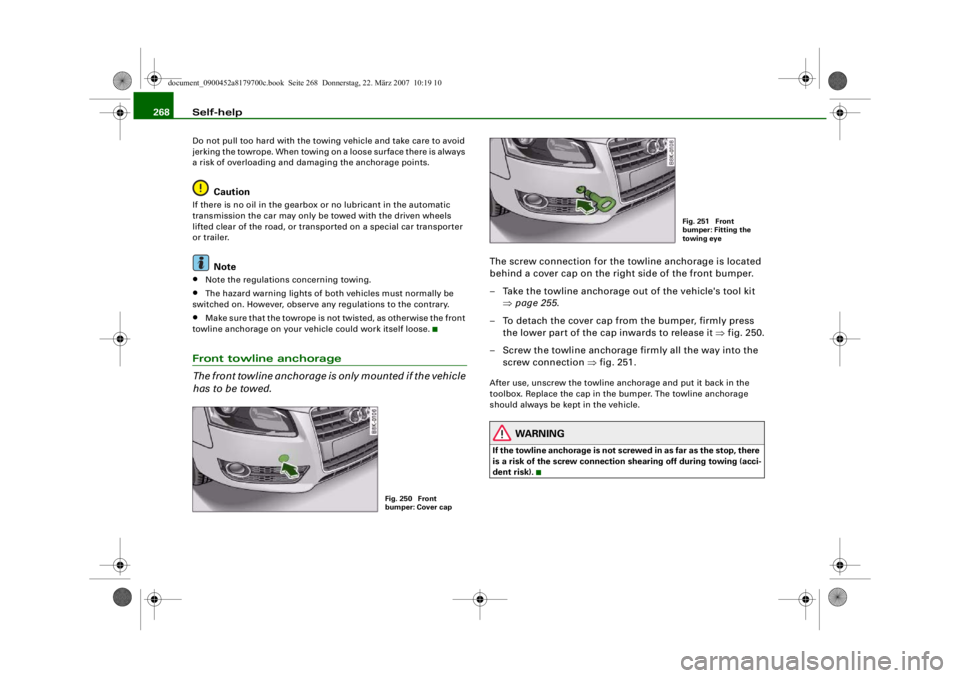
The screw connection for the towline anchorage is located
behind a cover cap on the right side of the front bumper.
– Take the towline anchorage ou t of the vehicle's tool kit
⇒ page 255 .
– To detach the cover cap from the bumper, firmly press the lower part of the cap inwards to release it ⇒fig. 250.
– Screw the towline anchorage firmly all the way into the screw connection ⇒fig. 251.After use, unscrew the towline anchorage and put it back in the
toolbox. Replace the cap in th e bumper. The towline anchorage
should always be kept in the vehicle.
WARNING
If the towline anchorage is not scre wed in as far as the stop, there
is a risk of the screw connection shearing off during towing (acci-
dent risk).
Fig. 250 Front
bumper: Cover cap
Fig. 251 Front
bumper: Fitting the
towing eye
document_0900452a8179700c.book Seite 268 Donnerstag, 22. März 2007 10:19 10
--4 -
-T
0 [I]
-+
•
+-
Page 279 of 313
Fuses and bulbs277
Controls
Safety
Driving tips
General maintenance
Self-help
Technical data
WARNING
•
Take particular care when working on components in the
engine compartment if the engine is warm - risk of burns!
•
Bulbs are sensitive to pressure. The glass can break when you
touch the bulb, causing injury.
•
Incorrect handling of the high-voltage element of xenon gas-
discharge bulbs* can have potentially fatal consequences.
•
When changing bulbs, please take care not to injure yourself on
sharp edges, in particular on the headlight housing.Caution
•
Always remove the ignition key before carrying out any work on
the electrical system - danger of short circuiting!
•
Switch off the lights or parking lights before you change a bulb.
•
Take good care to avoid damaging any components.
•
Removing the lights in particular can lead to the paintwork
becoming damaged. This is another reason why we recommend
having the bulbs changed by a qualified workshop.For the sake of the environment
Please ask your specialist retailer how to dispose of used bulbs in
the proper manner.
Note
Place the parts you have removed on a soft cloth so that they do not
become scratched.
•
Please check at regular intervals that all lighting (especially the
exterior lighting) on your vehicle is functioning properly. This is not
only in the interest of your own sa fety, but also in that of all other
road users.
•
Before changing a bulb, make sure you have the correct new
bulb.
•
Do not touch the glass part of the bulb with your bare hands, use
a cloth or paper towel instead. Otherwise, the fingerprints left on
the glass will vaporise as a result of the heat generated by the bulb,
be deposited on the reflector and impair its surface.
Bulbs with a bayonet fastenerBulbs with a bayonet fastener must be changed as follows:
Removing the bulb
– Lightly press the defective bulb into the bulb holder, then turn it anti-clockwise and remove it.
– Do not touch the glass part of the new bulb with your bare hands, use a cloth or paper towel instead.
Fitting the bulb
– Fit the new bulb, pressing it into the bulb holder, and turn it clockwise as far as it will go.
– If necessary, use a cloth to remove any fingerprints from the glass part of the bulb.
Reversing lights
W 16 W
Rear fog light
H 21 W
Number plate lights
5 W
document_0900452a8179700c.book Seite 277 Donnerstag, 22. März 2007 10:19 10
--4 -
-T
•
-+
0
+-
•
[I]
Page 305 of 313

Index303
Controls
Safety
Driving tips
General maintenance
Self-help
Technical data
Bicycle rack
Trailer . . . . . . . . . . . . . . . . . . . . . . . . . . 211
Biodiesel . . . . . . . . . . . . . . . . . . . . . . . . . . . 227
Bioethanol fuel . . . . . . . . . . . . . . . . . . . . . 227
Blower Deluxe automatic air conditioner . . . . 96
Deluxe automatic air conditioner plus . . 105
Bonnet Closing . . . . . . . . . . . . . . . . . . . . . . . . . 232
Opening . . . . . . . . . . . . . . . . . . . . . . . . 230
Releasing . . . . . . . . . . . . . . . . . . . . . . . 230
Boot See Loading luggage compartment . 168
See Luggage compartment . . . . . . . . . 77
Boot lid Central locking system . . . . . . . . . . . . . 48
Manual release . . . . . . . . . . . . . . . . . . . . 49
Brake system Brake assist system . . . . . . . . . . . . . . . 197
Brake fluid . . . . . . . . . . . . . . . . . . . . . . 238
Brake light defective . . . . . . . . . . . . . . . 36
Brake pads worn . . . . . . . . . . . . . . . . . . 36
Brake servo . . . . . . . . . . . . . . . . . . . . . . 199
Electro-mechanical parking brake . . . 121
General notes . . . . . . . . . . . . . . . . . . . . 199
Malfunction . . . . . . . . . . . . . . . . . . . . . . 31
Warning lamp . . . . . . . . . . . . . . . . . . . . 19
Bulb holder Bayonet fastener . . . . . . . . . . . . . . . . . 278
Bulb monitor . . . . . . . . . . . . . . . . . . . . . . . . 36 Bulbs
Bayonet fastener . . . . . . . . . . . . . . . . . 277
Changing (general notes) . . . . . . . . . . 276
Bulbs, changing . . . . . . . . . . . . . . . . . . . . . 276 Brake lights . . . . . . . . . . . . . . . . . . . . . . 284
Bulb holder with bayonet fastener . 277, 278
Dipped headlights . . . . . . . . . . . . . . . . 280
Front fog lights . . . . . . . . . . . . . . . . . . 283
Main beam headlights . . . . . . . . . . . . 279
Number plate light . . . . . . . . . . . . . . . 288
Rear fog light . . . . . . . . . . . . . . . . . . . . 286
Rear lights . . . . . . . . . . . . . . . . . . . . . . 284
Reversing light . . . . . . . . . . . . . . . . . . . 286
Turn signals (rear) . . . . . . . . . . . . . . . . 284
Business equipment . . . . . . . . . . . . . . . . . 251
CCapacities . . . . . . . . . . . . . . . . . . . . . . . . . . 293
Car keys . . . . . . . . . . . . . . . . . . . . . . . . . . . . 39
Care of vehicle . . . . . . . . . . . . . . . . . . . . . . 220
Catalytic converter . . . . . . . . . . . . . . . . . . 205
Central locking system . . . . . . . . . . . . . . . . 42 Boot lid . . . . . . . . . . . . . . . . . . . . . . . . . . 48
Deadlock mechanism . . . . . . . . . . . . . . 46
Fuel tank flap . . . . . . . . . . . . . . . . . . . . 228
Locking . . . . . . . . . . . . . . . . . . . . . . . . . . 46
Locking and unlocking the vehicle from inside . . . . . . . . . . . . . . . . . . . . . . . . . . 47
Manual locking . . . . . . . . . . . . . . . . . . . . 48
Opening and closing windows . . . . . . . 50
Switches on driver's door . . . . . . . . . . . 47
Unlocking . . . . . . . . . . . . . . . . . . . . . . . . 46 Cetane number . . . . . . . . . . . . . . . . . . . . . 227
Changing a wheel . . . . . . . . . . . . . . . . . . . 260
Changing bulbs
See Bulbs . . . . . . . . . . . . . . . . . . . . . . . . 276
Chassis number . . . . . . . . . . . . . . . . . . . . . 293
Child safety . . . . . . . . . . . . . . . . . . . . . . . . 185
Child safety seat . . . . . . . . . . . . . . . . . . . . 186 Child seat categories . . . . . . . . . . . . . . 186
Fitting . . . . . . . . . . . . . . . . . . . . . . . . . . 189
ISOFIX system . . . . . . . . . . . . . . . . . . . . 191
On front passenger's seat . . . . . . . . . . 186
Safety notes . . . . . . . . . . . . . . . . . . . . . 185
Cigarette lighter . . . . . . . . . . . . . . . . . . . . . . 87
Cleaning . . . . . . . . . . . . . . . . . . . . . . . . . . . 220
Cleaning Alcantara . . . . . . . . . . . . . . . . . . 226
Cleaning seat covers Alcantara . . . . . . . . . . . . . . . . . . . . . . . . 226
Natural leather . . . . . . . . . . . . . . . . . . . 225
Textile covers . . . . . . . . . . . . . . . . . . . . 223
Cleaning textile covers and trim parts . . 223
Clock, setting . . . . . . . . . . . . . . . . . . . . . . . . 13
Closing Bonnet . . . . . . . . . . . . . . . . . . . . . . . . . . 232
Coat hooks . . . . . . . . . . . . . . . . . . . . . . . . . . 92
Colour code . . . . . . . . . . . . . . . . . . . . . . . . 293
Compact temporar y spare wheel
See Spare wheel . . . . . . . . . . . . . . . . . . 256
Compartment for (sun)glasses . . . . . . . . . 91
Compass in mirror . . . . . . . . . . . . . . . . . . . . 68
Controls and displays Overview . . . . . . . . . . . . . . . . . . . . . . . . . . 9
Convenience close function . . . . . . . . . . . . 50
document_0900452a8179700c.book Seite 303 Donnerstag, 22. März 2007 10:19 10
--4 -
-T
-+ +-
Page 306 of 313

Index
304Convenience open function . . . . . . . . . . . 50
Cooling system
Anti-freeze additive . . . . . . . . . . . . . . . 235
Checking coolant level . . . . . . . . . . . . 236
Coolant . . . . . . . . . . . . . . . . . . . . . . . . . 235
Coolant temperature gauge . . . . . . . . . 11
Malfunction . . . . . . . . . . . . . . . . . . . . . . 32
Radiator fan . . . . . . . . . . . . . . . . . . . . . 237
Topping up coolant . . . . . . . . . . . . . . 236
Cruise control system Adjusting speed . . . . . . . . . . . . . . . . . 127
Control lever on steering wheel . . . . 125
Cruise mode . . . . . . . . . . . . . . . . . . . . 126
Indicator lamp . . . . . . . . . . . . . . . . . . . . 17
Introduction . . . . . . . . . . . . . . . . . . . . . 125
Pre-selecting a speed . . . . . . . . . . . . . 128
Resuming cruise control . . . . . . . . . . 128
Safety notes . . . . . . . . . . . . . . . . . . . . . 125
Switching off . . . . . . . . . . . . . . . . . . . . 129
Switching off temporarily . . . . . . . . . 128
Cup holders . . . . . . . . . . . . . . . . . . . . . . . . . 85
Current fuel consumption . . . . . . . . . . . . . 25DDate display . . . . . . . . . . . . . . . . . . . . . . . . 13
Daytime running lights . . . . . . . . . . . . . . . 56
DCP See Dynamic gear control program . 133
Deactivating front passenger's airbag . . 183
Deadlock mechanism . . . . . . . . . . . . . . 43, 46
Defrosting windows . . . . . . . . . . . . . . 98, 107 Deluxe automatic air conditioner . . . . . . . 93
Air distribution . . . . . . . . . . . . . . . . . . . 97
Air outlets . . . . . . . . . . . . . . . . . . . . . . . . 99
Air outlets for rear passengers . . . . . . 99
Air recirculation mode . . . . . . . . . . . . . 97
Automatic mode . . . . . . . . . . . . . . . . . . 95
Basic settings . . . . . . . . . . . . . . . . . . . 100
Blower . . . . . . . . . . . . . . . . . . . . . . . . . . 96
Controls . . . . . . . . . . . . . . . . . . . . . . . . . 94
Defrosting . . . . . . . . . . . . . . . . . . . . . . . 98
Description . . . . . . . . . . . . . . . . . . . . . . . 93
Economical operation . . . . . . . . . . . . . 100
Heated rear window . . . . . . . . . . . . . . . 98
Seat heating, front . . . . . . . . . . . . . . . 115
Supplementary heater . . . . . . . . . . . . 101
Switching on and off . . . . . . . . . . . . . . 95
Temperature . . . . . . . . . . . . . . . . . . . . . 96
Deluxe automatic air conditioner plus . . 101 AC mode . . . . . . . . . . . . . . . . . . . . . . . . 107
Air distribution . . . . . . . . . . . . . . . . . . 106
Air outlets . . . . . . . . . . . . . . . . . . . . . . . 108
Air outlets for rear passengers . . . . . 108
Air recirculation mode . . . . . . . . . . . . 106
Automatic mode . . . . . . . . . . . . . . . . . 104
Automatic recirculation . . . . . . . . . . . 110
Auxiliary heating . . . . . . . . . . . . . . . . . 111
Auxiliary heating - remote control . . 114
Auxiliary heating - running time . . . . 113
Basic settings . . . . . . . . . . . . . . . . . . . 109
Blower . . . . . . . . . . . . . . . . . . . . . . . . . 105
Controls . . . . . . . . . . . . . . . . . . . . . . . . 103
Defrosting . . . . . . . . . . . . . . . . . . . . . . 107
Description . . . . . . . . . . . . . . . . . . . . . . 101
Economical operation . . . . . . . . . . . . . 109 Heated rear window . . . . . . . . . . . . . . 107
Supplementary heater . . . . . . . . . . . . 110
Switching on and off . . . . . . . . . . . . . . 104
Synchronisation . . . . . . . . . . . . . . . . . 110
Temperature . . . . . . . . . . . . . . . . . . . . 104
Diesel . . . . . . . . . . . . . . . . . . . . . . . . . . . . . 227
Diesel particulate filter . . . . . . . . . . . . 37, 205 Engine oil . . . . . . . . . . . . . . . . . . . . . . . 233
Digital clock . . . . . . . . . . . . . . . . . . . . . . . . . 13
Digital compass . . . . . . . . . . . . . . . . . . . . . 68
Digital speedometer . . . . . . . . . . . . . . . . . . 22
Dimensions . . . . . . . . . . . . . . . . . . . . . . . . 292
Dipped headlights . . . . . . . . . . . . . . . . . . . 54 Defective . . . . . . . . . . . . . . . . . . . . . . . . . 36
DIS See Driver information system . . . . . . 20
Door catches/boot lid warning . . . . . . . . . 23
Doors Manual locking . . . . . . . . . . . . . . . . . . . 48
Driver See Sitting position . . . . . . . . . . . . . . . 164
Driver information system . . . . . . . . . . . . . 20 Auto-check control . . . . . . . . . . . . . . . . 29
Bulb monitor . . . . . . . . . . . . . . . . . . . . . 36
CD and radio display . . . . . . . . . . . . . . . 21
Digital speedometer . . . . . . . . . . . . . . . 22
Door catches/boot lid warning . . . . . . 23
Driver messages . . . . . . . . . . . . . . . . . . 30
On-board computer . . . . . . . . . . . . . . . . 25
Outside temperature display . . . . . . . . 21
Red symbols . . . . . . . . . . . . . . . . . . . . . 30
Service interval display . . . . . . . . . . . . . 23
document_0900452a8179700c.book Seite 304 Donnerstag, 22. März 2007 10:19 10
--4 -
-T
-+ +-
Page 307 of 313

Index305
Controls
Safety
Driving tips
General maintenance
Self-help
Technical data
Speed warning . . . . . . . . . . . . . . . . . . . . 28
Yellow symbols . . . . . . . . . . . . . . . . . . . 34
Driver messages . . . . . . . . . . . . . . . . . . . . . 30
Driving abroad . . . . . . . . . . . . . . . . . . . . . . 205 Headlights . . . . . . . . . . . . . . . . . . . . . . 205
Unleaded fuel . . . . . . . . . . . . . . . . . . . . 205
Driving away from a standstill . . . . . . . . . 122
Driving away when towing a trailer . . . . 123
Driving safety . . . . . . . . . . . . . . . . . . . . . . 163
Driving time . . . . . . . . . . . . . . . . . . . . . . . . . 25
Dust filter Deluxe automatic air conditioner . . . . 93
Deluxe automatic air conditioner plus . . 101
DVD player . . . . . . . . . . . . . . . . . . . . . . . . . . 79
Dynamic gear control program . . . . . . . . 133
EEasy-entry function . . . . . . . . . . . . . . . . 71, 73
Economical driving . . . . . . . . . . . . . . . . . . 206
EDL See Electronic differential lock . . . . . . . 18
Electric seat adjustment See Seat adjustment . . . . . . . . . . . . . . . 72
Electric windows . . . . . . . . . . . . . . . . . . . . . 50 Central locking system . . . . . . . . . . . . . 50
Controls . . . . . . . . . . . . . . . . . . . . . . . . . 50
Convenience open/close function . . . . 50
Malfunctions . . . . . . . . . . . . . . . . . . . . . 51
Settings . . . . . . . . . . . . . . . . . . . . . . . . . 51
Electrical accessories See Electrical socket . . . . . . . . . . . . . . . 88 Electrical socket . . . . . . . . . . . . . . . . . . 87, 88
Electro-mechanical parking brake . . . . . . 124
Auto release function . . . . . . . . . . . . . 122
Driving away from a standstill . . . . . . 122
Driving away when towing a trailer . . 123
Emergency braking function . . . . . . . 123
Malfunction . . . . . . . . . . . . . . . . . . . . . 123
Operation . . . . . . . . . . . . . . . . . . . . . . . 121
Parking . . . . . . . . . . . . . . . . . . . . . . . . . 122
Releasing and applying . . . . . . . . . . . . 121
Warning lamp . . . . . . . . . . . . . . . . . . 18, 19
Electronic differential lock How the system works . . . . . . . . . . . . 199
Warning lamp . . . . . . . . . . . . . . . . . . . . . 18
Electronic immobiliser . . . . . . . . . . . . . . . . 14
Electronic stab ilisation program
How the system works . . . . . . . . . . . . 196
Warning lamp . . . . . . . . . . . . . . . . . . . . . 16
Emergency braking function . . . . . . . . . . 123
Emergency key . . . . . . . . . . . . . . . . . . . . . . 41
Emergency release Ignition key . . . . . . . . . . . . . . . . . . . . . . . 41
Emission control systems Catalytic converter . . . . . . . . . . . . . . . . 205
Diesel particulate filter . . . . . . . . . . . . 205
Emissions . . . . . . . . . . . . . . . . . . . . . . . . . . 293
Engine compartment Safety notes . . . . . . . . . . . . . . . . . . . . . 231
Engine compartment layout . . . . . . . . . . 232
Engine data See Performance, weights and
dimensions . . . . . . . . . . . . . . . . . . . . 295 Engine hood
See Bonnet . . . . . . . . . . . . . . . . . . . . . . 230
Engine management (EPC) warning lamp . . . . . . . . . . . . . . . . 15
Engine oil . . . . . . . . . . . . . . . . . . . . . . . . . . 233 Checking oil level . . . . . . . . . . . . . . . . . 234
Consumption . . . . . . . . . . . . . . . . . . . . 234
LongLife Service . . . . . . . . . . . . . . . . . . 233
Topping up . . . . . . . . . . . . . . . . . . . . . . 234
See also Performance, weights and
dimensions . . . . . . . . . . . . . . . . . . . . 295
Engine oil capacity See Performance, weights and
dimensions . . . . . . . . . . . . . . . . . . . . 295
Engine oil pressure Warning lamp . . . . . . . . . . . . . . . . . . . . . 33
Engine oil sensor Malfunction . . . . . . . . . . . . . . . . . . . . . . 37
Environmental compatibility . . . . . . . . . . 207
Environmental tips Filling the tank . . . . . . . . . . . . . . . . . . . 228
Heated rear window . . . . . . . . . . . 98, 107
Leaks . . . . . . . . . . . . . . . . . . . . . . . . . . . 231
Roof carrier . . . . . . . . . . . . . . . . . . . . . . . 85
EPC See Engine management . . . . . . . . . . . 15
ESP See Electronic stabilis ation program . . 16
Ethanol fuel . . . . . . . . . . . . . . . . . . . . . . . . 227
Exterior mirrors . . . . . . . . . . . . . . . . . . . . . . 67
document_0900452a8179700c.book Seite 305 Donnerstag, 22. März 2007 10:19 10
--4 -
-T
-+ +-