tires AUDI A5 COUPE 2010 Owner's Manual
[x] Cancel search | Manufacturer: AUDI, Model Year: 2010, Model line: A5 COUPE, Model: AUDI A5 COUPE 2010Pages: 360, PDF Size: 84.39 MB
Page 299 of 360

4. The resulting figure equals th e available
amount of cargo and luggage load capacity. For example, if the
" XXX"
amount equals 1400 lbs. and there will
be five 150 lbs. passeng ers in your
v ehicle , the amount of available cargo
and luggage load capacity is 650 lbs.
(1400-750 (5
X 150) = 650 lbs.)
5. Determine the combined weight of luggage and cargo being loaded on the
vehicle. That weight may not safely
exceed the available cargo and luggage
load capa city calculated in Step 4.
6. If your vehicle will be towing a trailer ,
load from your trailer will be transferred
to your vehicle. Consult this manual to determine how this reduces the avail
able cargo and luggage load capacity of
your vehicle.
- Check the tire sidewall (~
page 299 ,
fig. 233) to determine the designat ed
load rating for a specific tire. •
Tires and wheels -
Tire service life
T he ser vic e life of ti res depends on a lo t o f different things
inclu ding p roper i nstallation and bal ancing, correc t tire
pressu re a nd drivi ng style .
(-----~
_____ __,,:)
Tread Wear Ind icator (TWll
N
"' 0 9
"" ~
Fig . 2 3 1 Tire tread:
tre ad we ar indi cato rs
(TWll
Fig . 232 Rotating tire s
for mo re even wear
The or iginal tires on your vehicle have 1 /16 inch ( 1.6 mm) high " wea r
indicators"=> fig. 231 running across the tread. Depending on the
make, the re w ill be six to eight of them even ly p la ced a rou nd the
t ire . Marks on the tire sidewall (for example "TWI" or other symbols)
indicate the positions of the tread wear indicators. Worn tires must
be r eplaced. Di fferen t fi gures may apply in other countries ::::>,& . .,_
Vehic le care I I Technical data
Page 300 of 360
-~_T_ ir_e_ s_ a_ n_d _ w_ h_ e_e _l_s _________________________________________________ _
Tire pr essure
Inco rrect tire pressure causes prematu re wear and can cau se
sudden tire blow-out. For this reason, tire pressure must be checked
at least once a month
~ page 293 .
Driving style
Dr iv ing fa st around curves, heavy acceleration and hard brak ing
increase tire wear.
Rotating tire s for more even wear
For all four t ires on your vehic le to have the same service life, we
recommend that the front and rea r tires are rotat ed acc ord ing to the
tire manufacturer 's suggested tire rotation intervals. Please
remembe r the f ollo wi ng :
• Tire rotat ion i nterva ls m ay d iffer from the vehic le serv ice inte r
vals outl ined in your Maintenance and Warranty Book let.
• The longer one tire is used in one location on the vehicle, t he
more it wears at certain points; the refo re, we recommend that you
f ollow the tire manu facturer's sug ges ted t ire rotat ion i nte rvals.
• Vehicles with fro nt-w hee l dr ive e xper ience more tread wear on
the front wheels compared to all -wheel drive (quattro®l .
• Please rotate tires as sh ow n~
page 297, fig. 232 .
• Extra care must be taken when rotating direction -specific tires
~ pag e 318 .
Wheel balancing
T he w heels o n new v ehic les are balanced. However, various s itua
tions during everyday driving can cause them to become unba l
anc ed, resu lti ng in vib rati ons yo u ca n usually feel thro ugh t he
steer ing whee l.
U nba la nce d w heels must be re ba lance d to avoid excessive wea r on
steering, suspension and tires. A whee l must a lso be reba lanced
when a new tire is installed.
Incorrect wheel alignment
Incorrect w hee l al ig nm ent ca n cause e xcess ive ti re wea r, impa iring
t h e s afety of th e veh ic le. If t ires show excessive wear, have the
w hee l a lig nme nt checke d by a n autho rize d Aud i deale r or qualifie d
wo rkshop.
All wheel drive
Vehic les with quattro® must always have tires of the same size,
co nstruct ion an d tread ty pe. For deta ils see ~
page 240.
& WARNING
Sudden tire failure can lead to loss of control , a crash and serious
personal injury !
• Never drive a vehicle when the tread on any tire is worn down
to the wear indicators.
• Worn tires are a safety hazard , they do not grip well on wet
roads and in crease your risk of "hydroplaning " and loss of control.
• Always keep chemicals that can cause tire damage , such as
grease, oil, gasoline and brake fluid away from tires .
• Tires age even if they are not being used and can fail suddenly ,
especially at high speeds. Tires that are more than 6 years old can
only be used in an emergency and then with special care and at
lower speeds .
• Never mount used tires on your vehicle if you are not sure of
their "previous history. " Old used tires may have been damaged
even though the damage cannot be seen that can lead to sudden
tire failure and loss of vehicle control . •
Page 301 of 360
__________________________________________________ T_ ir_e _ s_ a_ n _ d_ w_ h_ e_ e_ls _ ____. ffllll
New tires and replacing tires and wheels
New tires and wheels have to be broken in.
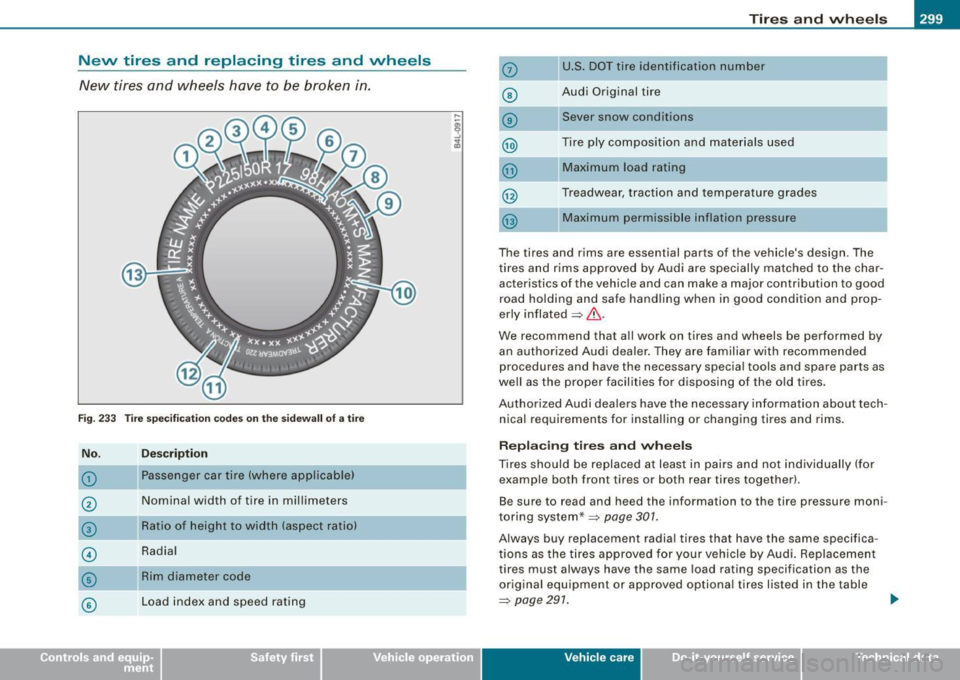
Fig. 233 Tire specification codes on the sidewall of a tire
No.
G)
@
©
©
©
©
Description
Passenger car tire (where applicable)
Nominal width of tire in millimeters
Ratio of height to width (aspect ratio)
Radial
Rim diameter code
Load index and speed rating
0
©
U.S. DOT tire identificat ion number
Audi Original tire
Sever snow condit ions
Tire ply composition and materials used
@ Maximum load rating
@ Treadwear, traction and temperature grades
@ Maximum permissible inflation pressure
The tires and rims are essential parts of the vehicle's design . The
tires and rims approved by Audi are specially matched to the char
acteristics of the vehicle and can make a major contribution to good
road holding and safe handling when in good condition and prop
erly inflated
=> & .
We recommend that all work on tires and wheels be performed by
an authorized Audi dealer. They are familiar with recommended
procedures and have the necessary special tools and spare parts as
well as the proper facilities for disposing of the old tires.
Authorized Audi dealers have the necessary information about tech
nical requirements for installing or changing tires and rims.
Replacing tires and wheels
Tires should be replaced at least in pairs and not individually (for
example both front tires or both rear tires together).
Be sure to read and heed the information to the tire pressure moni
toring system* =>
page 301.
Always buy replacement radial tires that have the same specifica
tions as the tires approved for your vehicle by Audi. Replacement
tires must always have the same load rating specification as the
original equipment or approved optional tires listed in the table
=> page 291. ~
Vehic le care I I irechnical data
Page 302 of 360
-~_T_ ir_e_ s_ a_ n_d _ w_ h_ e_e _l_s _________________________________________________ _
Audi-approved specification tires are specially matched to your
vehicle and its load limits, and can contribute to the important road
holding, driving characteristics, and safety of the vehicle . The table
(~ page 291) lists specifications of the tires approved for the Audi
models covered by your Owner's Literature.
The tire pressure label (On USA vehicles, the tire pressure label is located on the driver's side 8 -p illar. On Canada vehicles, the tire
pressure label is located either on the driver's side B-pillar or inside
t he fue l filler flap)( ~
page 291, fig. 230) lists the specifications of
the origina l equipment tires instal led on your vehicle at the time it
was manufactured.
Federal law requires tire manufacturers to place standardized infor
mation on the sidewa ll of all tires~
page 299, fig. 233 . This informa
tion identif ies and describes the fundamenta l characteristics, the
quality grade of the tire and a lso provides a tire identification
number for safety standard certificat ion and in case of a recall.
Tir e s pec ifica tio ns
Knowledge of tire specifications makes it easier to choose the
correct tires . Radial tires have the tire specifications marked on the
sidewa ll, for example:
P255 / 3 5 R19 96V XL
This contains the fo llowing information:
P Indicates the tire is for passenger cars (where applicable)
25 5 Nominal tire width in mm of the tire from sidewall edge to side -
wa ll edge. In general, the larger the number, the wider the t ire
3 5 Height/width ratio in percent (aspect ratio)
R T ire construction: Radial
19 Rim diameter code (in inches)
96 Load rating code
Y Speed rating letter code
XL (or "xi", "EXTRA LOAD", or "RF" Indicates that the tire is a"Rein
forced" or an "Extra Load" tire
M+ S (or "M/S") Indicates that the t ire has some mud and snow capa-
bility
The ti res cou ld also have the information of direction of rotation
~ page 287.
T ire m anuf acturing d ate
The manufacturing date is a lso indicated on the tire sidewa ll
(possibly on ly on the
inner side of the wheel) :
"DOT ... 2209 ... " means, for example, that the tire was produced in
the 22nd week of 2009.
S pe ed ra ting
permissible road speeds~
& in "Winter tires" on page 304.
P up to 93 mph (150 km/h)
Q up to 99 mph ( 158 km/h)
R up to 106 mph (170 km/h)
s up to 110 mph (180 km/hl
T up
to 118 mph (190 km/h)
u up to 124 mph (200 km/h)
H up to 130 mph (210 km/h)
V up to 149 mph (240
km/hJ31
z over 149 mph (240 km/h)31
w up to 168 mph (270 km/h)31
y up to 186 mph (298 km/hJ31
Your vehicle is norma lly factory equipped w ith tires, which possess
excellent driving characteristics and give your Audi optimum
driving comfort. An e lectronic speed limiter ~
page 23will normally .,,_
31 For tires with a maximum speed capability over 149 mph (240 km/h), t ire
manufacturers sometimes use the letters "ZR."
Page 303 of 360
__________________________________________________ T_ ir_e_ s_ a_ n_d _ w_ h_ e_ e_l_s __ _
•
prevent your vehicle from going faster than the tire speed rating
=>& .
U.S. DOT Tire Identification Number (TIN ) and tire
manufacture date
T his is the tire's "seria l number". It begins with the letters "DOT"
and indicates that the tire meets all federal standards. The next two
numbers or letters indicate the plant where it was manufactured,
and the last four numbers represent the week and year of manufac
ture. For example, the numbers 2209 mean that the tire was
produced in the 22nd week of 2009. The other numbers are
marketing codes that may or may not be used by the tire manufac
turer. This information is used to contact consumers if a tire defect
requires a recall.
Audi Original tire
Tires with the identification "AO" or "RO" have been specially
matched with your Audi. We recommend using only these tires
because they meet the highest standards regarding safety and
driving characteristics when used correctly. Your authorized Audi
dealer will gladly prov ide you with more information.
Tire ply composition and materials used
The number of plies indicates the number of layers of rubber-coated
fabric in the tire. In general, the greater the number of plies, the
more weight a tire can support . Tire manufacturers also must indi
cate the materia ls in the tire, which include steel, nylon, polyester,
and others.
Maximum Load Rating
This number indicates the maximum load in kilograms and pounds
that can be carried by the tire.
Tire qual ity grading for treadwear , traction, and
temperature resistance
Tread wear, traction and temperature grades=> page 303.
Maximum Permissible Inflation Pressure
This number is the greatest amount of air pressure that should ever
be put in the tire under normal driving conditions.
Replacing tires or rims on vehicles equipped with tire
pressure monitoring system*
The wheels on your vehicle are equipped with a sensor which
constantly monitors the air pressure inside the tire, and then trans
mits this information to the tire pressure monitoring system*. If you
are going to replace the wheel rims on your vehic le, make sure the
new rims also have these sensors. The sensors must be compatible
with the tire pressure monitoring system* on your vehic le.
If you instal l rims, which do not have the sensors, or have sensors
which are not compatible, then the tire pressure monitoring
system* wil l not work properly. In this case, the tire pressure moni
toring system* would not be able to monitor the tire pressure or
warn you if it is necessary .
• The battery inside of the tire pressure sensor has a limited
service life .
• Always drive with the valve stem caps secure ly mounted. We
recommend using factory instal led valve stem caps. Ask your autho
rized Audi dea ler to replace lost valve stem caps.
The installation of replacement tires with steel cord body p lies in
the tire sidewall may cause malfunction of the tire pressure moni
toring system*, and is not recommended (cord material information
in molded on the tire sidewall).
Always check your tire pressure monitoring system* indicator after
replacing one or more tires on your vehic le. If the tire pressure
monitoring system* indicator flashes, or is on, your system is not
working properly. Your replacement tire might be incompatible with
your tire pressure monitoring system*, or some component of the
t ire pressure monitoring system* may be damaged. .._
Vehicle care I t •
Page 304 of 360

___ T_ ir_e_ s _ a_ n_d_ w_ h_ e_e _ l_s _________________________________________________ _
& WARNING
• Using incorrect or unm atched t ires and / or wheels o r improper
tire and wheel combinations can lead to lo ss of control , collision
and se rious per sonal injury .
• Always use tires , rim s and wheel bolts that meet the specifica
t ions of original f actory -installed tire s or other combinations that
have been spe cifically approved by the vehicle manufacturer .
• T ires age even if they are not being used and can fail suddenly ,
especially at high speeds . Tires that are more than 6 years old c an
only be used in an emergen cy and then with spec ial care and at
lower speeds .
• Never mount used tires on your vehi cle if you are not sure of
their "previou s history." Old used tires may have been damaged
e ven though the damage cannot be seen that can lead to sudden
tire failure and loss of vehicle control.
• All four wheels must be fitted w ith radial tires of the same type ,
size (rolling circumference ) and the same tread pattern . Driving
with different tires reduces veh icle handling and can lead to a loss
of control.
• If the spare t ire is not the same as the tires that are mounted
on the vehicle -for example with winter tires -only use the spare
tire for a short period of time and drive with e xtra care . Refit the
normal road wheel as soon as safely possible.
• Never drive faster than the ma ximum speed for which the tires
on your vehicle are rated because tires that are driven faster than
their rated speed can fail suddenly .
• Overloading tires cause heat build -up , sudden tire failure,
in cluding a blowout and sudden deflation and lo ss of control.
• Tempe rature grades apply to tires that are properly inflated and
not over or under inflated .
• For technical reasons it i s not always po ssible to use wheel s
from other veh icles - in some cases not even wheels from the
same vehicle model .
& WARNING (continued )
• If you install wheel trim discs on the vehicle wheels, make sure
that the air flow to the brakes is not blocked . Reduced airflow to
the brakes can them to overheat , increasing stopping distances
and causing a collision .
• Run flat tires may only be used on vehicles that were equipped
with them at the factory . The vehicle must have a cha ssis designed
for run flat tires and a fa ctory-installed tire pressure monitoring
system* that indicates a loss of tire pressure. Incorrect use of run
flat tires can lead to vehicle damage or acc idents . Check with an
authorized Audi dealer or tire specialist to see if your vehicle can
be equ ipped with run f lat tires . If run flat t ires are used , they must
be installed on all four wheels . Mixing tire types is not permitted.
0 Note
• For technical r eas ons, it is not gen erally possible t o us e the
whee l rims from other veh icles . ihis can ho ld true for whee ls of the
same veh ic le type.
• I f the spare tire is different from the tires that you have mounted
o n yo ur vehicl e (f or example wi nter tires or wide p rofile t ires), then
use the spare tire for a short period of time on ly and drive with extra
care . Rep lace the flat tire wi th the ti re m atchi ng t he o thers on you r
vehic le as soon as possib le.
• I f you should put diff ere nt w heels and tires o n your v ehicle (e. g.
winter wheels and tires), you must be certain that the wheels and
t ires are c ompatib le wi th the tire p ressu re monitoring system* .
Otherwise the system will register a malfunction and a fau lt
mes sage will be displayed . For more info rmation, contact your
author ized Aud i dea ler.
0 Note
• When insta lling new t ires, be care fu l not to damage the va lves o r
tire pressure mon itoring system* sensors. .,_
Page 305 of 360

__________________________________________________ T_ ir_e_ s_ a_ n_d _ w_ h_ e _ e_l_s __ lllll
•
• Never drive without the valve stem cap. The valves could get
damaged.
• If the sensors must be replaced, then the valve must also be
replaced at the same time.
For the sake of the environment
Dispose of old tires in accordance with the local requirements. •
Uniform tire quality grading
• Tread wear
• Traction AA A B C
• Temperature A B C
Quality grades can be found where applicable on the tire side wall
between tread shoulder and maximum section width~
page 299,
fig. 233.
For example: Tread wear 200, Traction AA, Temperature A.
All passenger car tires must conform to Federal Safety Require ments in addition to these grades .
Tread wear
The
tread wear grade is a comparative rating based on the wear rate
of the tire when tested under controlled conditions on a specified
government test course.
For example, a tire graded 150 would wear one and one half (1 1/2)
times as well on the government course as a tire graded 100.
The relative performance of tires depends upon the actual condi
tions of their use, however , and may depart significantly from the
norm due to variations in driving habits, service practices and differ
ences in road characteristics and climate. Traction
The
traction grades, from
highest to lowest, are AA, A, Band C.
Those grades represent the tire's ability to stop on wet pavement as measured under controlled conditions on specified government
test surfaces of asphalt and concrete. A tire marked C may have
poor traction performance~& .
Temperature
The
temperature grades are A (the highest), B, and C, representing
the tire's resistance to the generation of heat and its ability to dissi
pate heat when tested under controlled conditions on a specified
indoor laboratory test wheel.
Sustained high temperature can cause the material of the tire to
degenerate and reduce tire life, and excessive temperature can lead
to sudden tire failure=>&.
The grade C corresponds to a level of performance which all
passenger car tires must meet under the Federal Motor Vehicle
Safety Standard No. 109. Grades Band A represent higher levels of
performance on the laboratory test wheel than the minimum
required by law .
& WARNING
The traction grade assigned to this tire is based on straight-ahead
braking traction tests, and does not include acceleration,
cornering, hydroplaning or peak traction characteristics .
& WARNING
The temperature grade for this tire is established for a tire that is
properly inflated and not overloaded. Excessive speed, underinfla
tion, or excessive loading, either separately or in combination, can
cause heat buildup and possible tire failure. •
Vehicle care
I t •
Page 306 of 360

___ T_ ir_e_ s _ a_ n_d_ w_ h_ e_e _ l_s _________________________________________________ _
Winter tires
Winter tires can improve vehicle handling on snow and
ice. At temperatures below 45 °F (7 °C) we recommend
changing to winter tires .
In some heavy snow areas, local governments may require true
winter or "snow" tires, those with very deeply cut tread . These tires
should only be used in pairs and be installed on a ll four wheels.
Make sure you purchase snow tires that are the same size and
construction type as the other tires on your vehicle.
Your vehicle is equipped with all -whee l drive, this wi ll improve trac
tion during winter driving, even with the standard tires. However,
we strong ly recommend that you a lways equip all four whee ls on
your vehicle with correctly fitted winter tires or all-season tires,
when winter road conditions are expected. This also improves the
vehicle's braking performance and reduces stopp ing distances.
Summer tires provide less grip on ice and snow.
Winter tires (snow ti res) must a lways be fitted on a ll four wheels.
Compatible tire pressure monitoring sensors must be installed on
a ll fou r winter tires for the tire pressure monitoring system* to func
tion proper ly=>
page 301.
Ask your authorized Audi dealer or qualified workshop for permitted
wint er tire size s. Use only radial winter tires.
Winter tires lose their effectiveness when the tread is worn down to a depth of 0.157 inch (4 mm).
Only drive with winter tires under winter conditions. Summer tires
handle better when there is no snow or ice on the roads and the
temperature is above 45 °F (7 °C) .
If you have a flat tire, see notes on spare wheel =>
page 299.
Please always remember that winter tires may have a lower speed
rat ing than the tires originally installed on your vehicle at the time
it was manufactured. Please see=>
page 300, "Speed rating (letter code)" for a listing of the speed
rating letter codes and the
maximum speed at which the tires can be driven .
T he speed rating letter code(=>
page 290) is on the side wall of the
tire =>
page 299.
& WARNING
Winter tire s hav e maximum speed l imit s that m ay be lower than
yo ur veh icle' s ma xim um speed . Al ways kno w the ma ximum speed
before driving off . Never drive fa ste r th an the speed permitted for
yo ur spe cifi c w inte r tir es. Thi s will cause dam age to the tire s
leading to an a ccident and seriou s personal injury to you and your
p as sengers.
& WARNING
Driving f aster th an the m aximum speed for whi ch t he winter tire s
on your v ehi cle w ere de sig ned can cau se tire failur e including a
blow out and sudden def lation , lo ss of con trol, c rashe s and se riou s
personal injuries . Have worn or damaged tire s repl aced immedi
ately .
• Winter tires hav e maximum speed r ating that may be lower
than you r vehicle 's maxi mum speed .
• Never d riv e fa ster than the sp e ed for which the winter or other
tire s in sta lled on your vehicl e are r ated .
& WARNING
Always adju st your dri ving to the r oad and tr aff ic c ondit ions .
Ne ver let th e good acceleration of the winter tire s and all -wheel
dri ve t empt you into t aking extra risks. Alw ay s rem embe r:
• When br aking , an all -wheel driv e vehicl e handle s in the same
w ay as a fr ont drive vehi cle .
• Drive ca refull y and redu ce you r speed o n ic y and slipp ery road s,
e ven wint er tire s cannot h elp u nde r bla ck ice c onditi ons.
~
Page 307 of 360
__________________________________________________ T_ ir_e_ s_ a_ n_d _ w_ h_ e_ e_l_s __ _
•
ffi For the sake of the environment
Use summe r tires whe n weather co nditio ns perm it. Th ey are
quieter, do not wear as quic kly and reduce fue l consumption. •
Snow chains
Snow cha ins may be fitted only to the front wheels, and only to
certa in t ire s izes. Ask your author ized Aud i dea ler on wh ic h tir e
s izes snow chains can be used .
The snow c hai ns mu st have low -pro file l inks and must n ot be thicker
than 0.53 inch (13 .5 mm), including the loc k.
R emove wheel cente r covers a nd trim di scs bef ore p utting snow
c h ains on you r ve hicle=:>
0 . For sa fety reasons cove r caps must
then be fitted o ver the wheel bo lts . These a re avai lable fr om autho
r iz ed Au di deale rs.
& WARNING
Using the wrong snow chains for your vehicle or installing them
incorrectly can increase the risk of loss of control leading to
serious per sonal injury.
• Snow chains are available in different sizes. Always make sure
to follow the instructions provided by the snow chain manufac
turer.
• When driving with snow chains never drive faster than the
speed permitted for your specific snow chains.
• Always observe local regulations .
0 Note
• Remove snow chains before driving on roads not covered with
s no w to avoid da mag ing tires a nd wea ring the s now cha ins down
unnecessari ly. •
Snow chains, which come into direct contact with the wheel rim,
can s cratch or damage i t. Therefo re, ma ke s ure t hat the sn ow cha ins
are suitably covered . Check the pos itio n of the snow c hains after
driv ing a few ya rds a nd co rrec t if necessa ry . Fo llow the i nstr uct ions
from the snow chain manufacturer when doing so.
[ i ] Tips
W here snow cha ins are manda tory on certa in roads, t his no rmally
a lso a ppl ies to ve hic les with all wheel d rive. •
Wheel bolts
Wheel bol ts mus t alw ays be ti ght en ed to the corr ec t
t orque .
The de sign of whee l bolts i s matched t o the fac to ry ins tal led rims. I f
d ifferent rims are fitted, the correct wh eel bo lts with the ri ght l ength
and c orrectly s haped bo lt head s mus t be use d. T his ensu res that
w hee ls are fitted securely and that the brake sys tem func tio ns
co rrectly.
I n certa in c ircumsta nces, you may not use w heel bo lts fr om a
different vehicle -even if it is the same model=:>
page 341.
& WARNING
Improperly tightened or mainta ined wheel bolts can become loose
causing loss of control , a collision and serious personal injury .
• Always keep the wheel bolts and the threads in the wheel hubs
clean so the wheel bolts can turn easily and be properly tightened.
• Never grease or oil the wheel bolts and the threads in the wheel
hubs . They can become loose while driving if greased or oiled ,
even if tightened to the specified torque .
• Only use wheel bolts that belong to the rim being installed .
• Never use different wheels bolt s on your vehicle.
Vehicle care
I t •
Page 308 of 360
-~_T_ ir_e_ s_ a_ n_d _ w_ h_ e_e _l_s _________________________________________________ _
& WARN ING (continued )
• Always maintain the correct tightening torque for the wheel
bolt s to reduce the risk of a wheel loss . If the tightening torque of
the wheel bolts is too low, they can loo sen and come out when the
vehicle is moving . If the tightening torque is too high , the wheel
bolts and threads can be d amaged and the wheel can be come
loose .
0 Note
The specified torque for the whee l bo lts is 90 ft lbs . (120 Nm) with a
tolerance of ± 7,4 ft lbs .(± 10 Nml. Torque wheel bo lts diagona lly.
Af te r cha ng ing a whe el, the torque mus t be checked as so on as
possible with a torque wrench -preferably by an authorized Audi
dea ler o r qua lified w orksh op.•
Low as pect rat io tires
Yo ur Audi is fac tory-equipped with l ow aspec t ratio tires . Thes e tires
have been thorough ly tested and been selected specifically for your
m odel f or their superb pe rformance, r oad feel and hand ling under
a variety of driving conditions . Ask your authorized Audi dealer for
m ore deta ils .
T he low aspec t rat io of these ti res is indicated by a nu meral o f
55 or
less
in the tire's si ze designation. The numeral represents the ratio
o f the tire's sid ewa ll heig ht in relat ion t o it s tread w idth express ed
in percentage. Conventiona l tires have a height/width ratio of 60 or
m ore .
The performance of low -aspect -ratio tires is particularly sensitive to
improper inflation pressure . It is therefore important that low
aspect ratio tires are inflated to the specified pres sure and that the
i nflation pressure is regularly checked and maintained . Tire pres
sures should be checked at least once a month and alway s before a
long trip ~
page 293, "Checking tire pr essure".
What you can do to avoid tire and rim damage
Lo w aspec t r ati o t ir es ca n be da maged more easi ly by impact wi th
potholes, curbs, gullies or ridges on the road, particularly if the tire
i s un derinflate d.
In order to minimize t he occurrence o f impac t damage to the t ires
of your vehicle , we recommend that you observe the following
p recau tions:
• Always ma intain recommended inflation pressures . Check your
t ire pressure every 2,000 miles (3,000 k m) and ad d air i f neces sa ry .
• D rive careful ly on roads with potholes, deep gullies or ridges.
Th e impa ct from driving throug h or over such o bstacles can
damage your tires. Impact with a curb may also cause damage to
you r ti res .
• After any impact, immediately inspect your tires or have them
inspected by the neares t autho rize d Audi deale r. R eplace a
damaged tire as soon as possib le.
• I nspect you r tir es eve ry 2 ,0 0 0 m iles (3 ,000 k m) for damage a nd
wear. Damage is not always easy to see. Damage can lead to loss of
a ir and under infla tion , wh ic h co ul d even tually cause tire fa ilu re . If
you believe t hat a tire may have been damaged , rep lace the tire as
soon as p ossi ble.
• T hese tires may wear more quickly than others .
• Please also re member th at, wh ile t hese tir es de liver respo nsive
handling, they may ride less comfortably and make more noise than
ot her c hoic es.
Reduced performance in winter /cold season
conditions
A ll tires are designed for certain purposes. The low aspect ra tio,
u ltra high per form ance t ires or ig ina lly ins tal led on yo ur ve hicle are
intended for maximum dry and wet road performance and hand ling.
Th ey a re not su itab le f or cold, sn owy or ic y weathe r co nd ition s. If
you drive under those c ircumstances, you should equip your vehic le
wi th all -season o r wi nter ti re s, w hic h offe r bett er trac tion und er
ti-