fold seats AUDI A5 COUPE 2010 Owners Manual
[x] Cancel search | Manufacturer: AUDI, Model Year: 2010, Model line: A5 COUPE, Model: AUDI A5 COUPE 2010Pages: 360, PDF Size: 84.39 MB
Page 74 of 360

Seats and storage
Applies 10 vehicles: with manually adjustab le seats
Easy entry function
The easy entry function makes it easier for the rear
passengers to enter and leave the vehicle.
Fig . 72 Driver's seat:
Latch on the seat back
Tilt the seat back forward and push the front
seats forward
- Lift the latch
=} fig. 72.
- Hold the latch and tilt the seat back forward.
- Release the latch and push the seat forward.
Push the front seats back and fold the seat back
up
- Push the front seat back
before you fold the seat backs
up . Otherwise the seat cannot be pushed back to its orig
inal position.
& WARNING
Always be certain that the front seats are upright and securely
latched when you drive. •
Power front seat adjustment
Applies to vehicles: with power adjustable seats
Seat adjustment controls
The operating logic for the switches corresponds to the
construction and function of the seat.
.,
~ 9
"' "' m
Fig . 73 Front seat:
Controls for seat
adjustment
The switches to adjust the seat cushion and the seat back corre
spond to the layout, the design and the function of the seat. The
seats are adjusted by moving the switches following this logic.
Controls
© Lumbar support
@ Seat adjustment
© Seat back and head restraint height adjustment*
© Upper thigh support *•
Page 76 of 360
Seats and storage
Applies to vehicles: with power adjustable seats
Easy entry function
The easy entry function makes it easier for the rear
passengers to enter and leave the vehicle.
Fig. 74 Driver's seat:
Controls for easy entry
assist
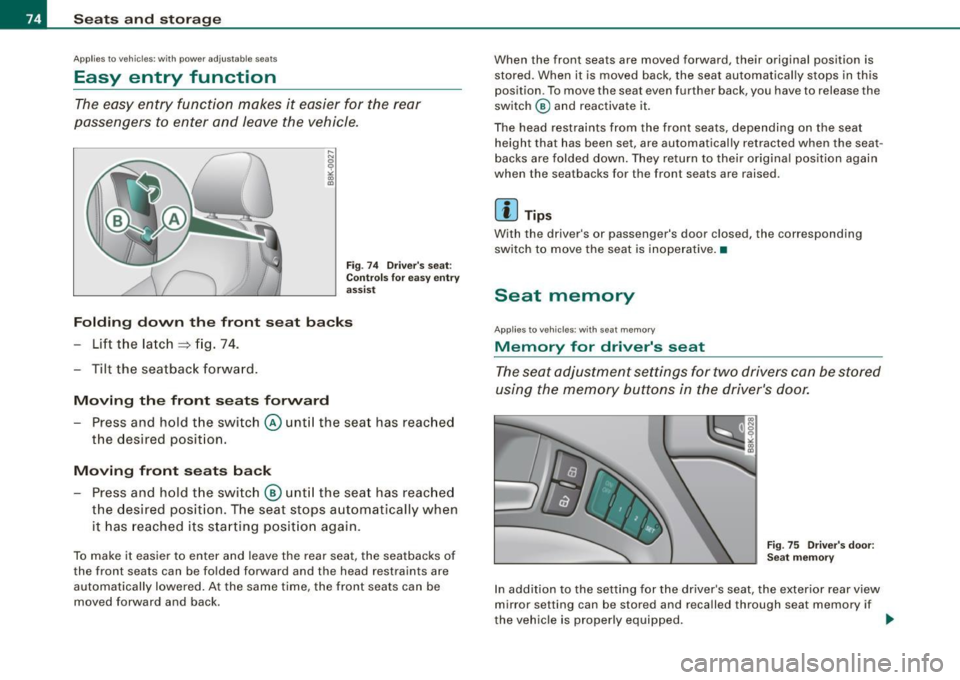
Folding down the front seat backs
- Lift the latch
~ fig. 74.
- Tilt the seatback forward.
Moving the front seats forward Press and hold the switch
© until the seat has reached
the desired position.
Moving front seats back
- Press and hold the switch
@ until the seat has reached
the desired position. The seat stops automatically when
it has reached its starting position again.
To make it easier to enter and leave the rear seat, the seatbacks of
the front seats can be folded forward and the head restraints are
automatically lowered. At the same time, the front seats can be
moved forward and back. When
the front seats are moved forward, their original position is
stored. When it is moved back, the seat automatically stops in this
position . To move the seat even further back, you have to release the
switch
@ and reactivate it.
The head restraints from the front seats, depending on the seat height that has been set, are automatically retracted when the seat
backs are folded down. They return to their original position again
when the seatbacks for the front seats are raised.
[ i ] Tips
With the driver's or passenger's door closed, the corresponding
switch to move the seat is inoperative. •
Seat memory
Applies to vehicles: with seat memo ry
Memory for driver's seat
The seat adjustment settings for two drivers can be stored
using the memory buttons in the driver's door.
Fig. 75 Driver 's door:
Seat memory
In addition to the setting for the driver's seat, the exterior rear view
mirror setting can be stored and recalled through seat memory if
the vehicle is properly equipped. .,
Page 80 of 360
Seats and storage
[ i J Tips
Correctly adjusted head restraints and safety belts are an extremely
effective combination of safety features. •
Center armrest
The center armrest can be adjusted to several levels.
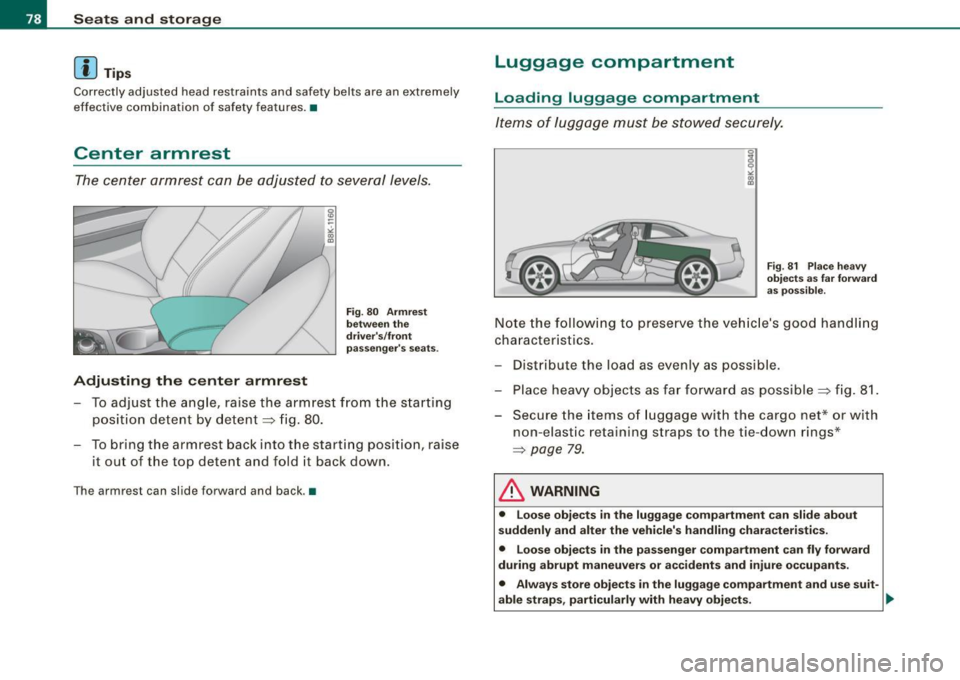
Adjusting the center armrest
Fig. 80 Armrest
between the
driver's /front
passenger's seats .
To adjust the angle, raise the armrest from the starting
position detent by detent => fig. 80.
To bring the armrest back into the starting position, raise
it out of the top detent and fold it back down.
The armrest can slide forward and back.•
Luggage compartment
Loading luggage compartment
Items of luggage must be stowed securely.
Fig. 81 Place heavy
objects as far forward
as possible.
Note the following to preserve the vehicle's good handling
characteristics.
- Distribute the load as evenly as possible.
- Place heavy objects as far forward as possible => fig. 81.
- Secure the items of luggage with the cargo net* or with
non -elastic retaining straps to the tie-down rings*
=> page 79.
& WARNING
• Loose objects in the luggage compartment can slide about
suddenly and alter the vehicle's handling characteristics.
• Loose objects in the passenger compartment can fly forward
during abrupt maneuvers or accidents and injure occupants.
• Always store objects in the luggage compartment and use suit-
able straps, particularly with heavy objects. •
Page 82 of 360
Seats and stor ag e
St orage n et
- Engage the hooks on the cargo net in the fastening
eyelets in the f loor at the rear of the l uggage compart
me nt
~ page 79, fig . 84 .
Fo ld down the attaching hooks in t he upper area of the
luggage compartment, pull the net up and hang the
eyelets on the net into the hooks .
You can use the attaching hooks~ page 79, fig. 84 to hang bags,
sacks, etc.
If nothing is attached to the hooks , they fold back by themselves.
& WARNING
Fo r rea sons of str ength , only o bjects wit h a m axim um weight of
5 kg should b e carri ed in the sto rag e net . H ea vier obje cts a re not
a d equ atel y s ecur ed . T here is risk of p ers onal inj ury. •
Ap plies to vehicle s: with fo lding s ea t b ack
Enlarging cargo capacity of the vehicle
interior
The seat backs can be folded forward to enlarge the cargo
capacity.
Fi g. 85 Release handle
on the seat bac k
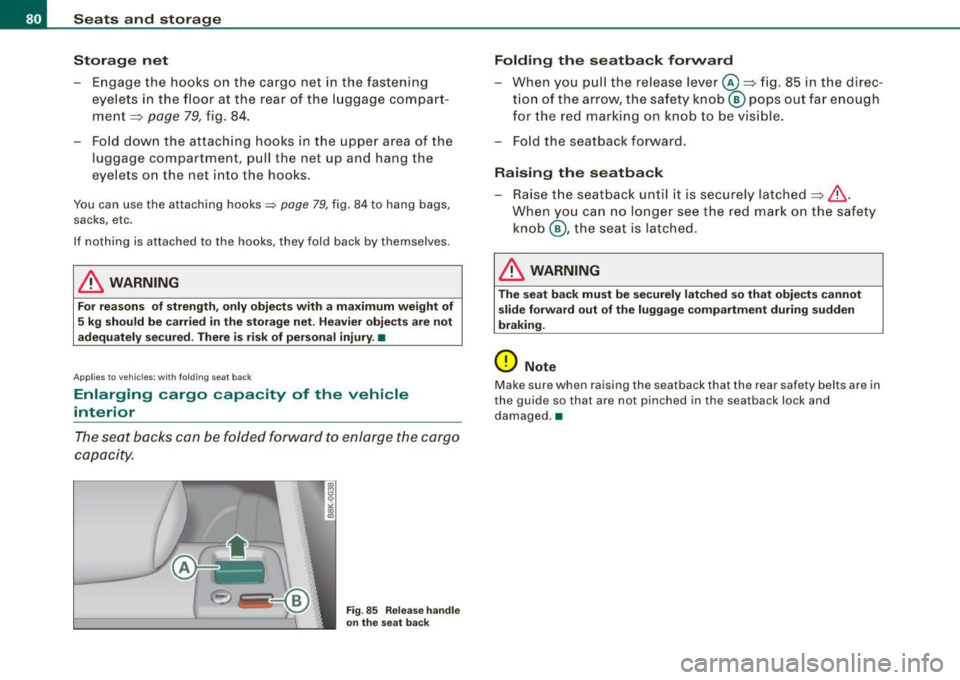
Folding th e se atback forward
- When you pull the release lever@~ fig. 85 in the direc
tion of the a rrow, the safety knob© pops out far enough
for the red mar king on knob to be vis ible .
- Fo ld the seatback forward .
Raising the seatback
- Ra ise t he seatback un til it is securely latched~& .
When yo u can no longer se e the red ma rk o n the safety
knob @, the seat is latched.
& WARNING
The sea t ba ck mu st be securely l atc h ed so that obje cts c annot
s lide for ward out of the luggage compartm ent during sudd en
br ak ing.
0 Note
Make sure when raising the seatback that the rear safety belts are in
the guide so that a re not pinched in the seatback lock and
damaged. •
Page 83 of 360
Applies to vehi cle s: wi th fo ldi ng seat bac k
Enlarging cargo capacity of the luggage
compartment
The se at backs can be folded f orw ard to enl arge the c argo
c ap acity.
0 Fi g. 86 Relea se lev er in
car go ar ea
Fig . 8 7
S afet y k nob
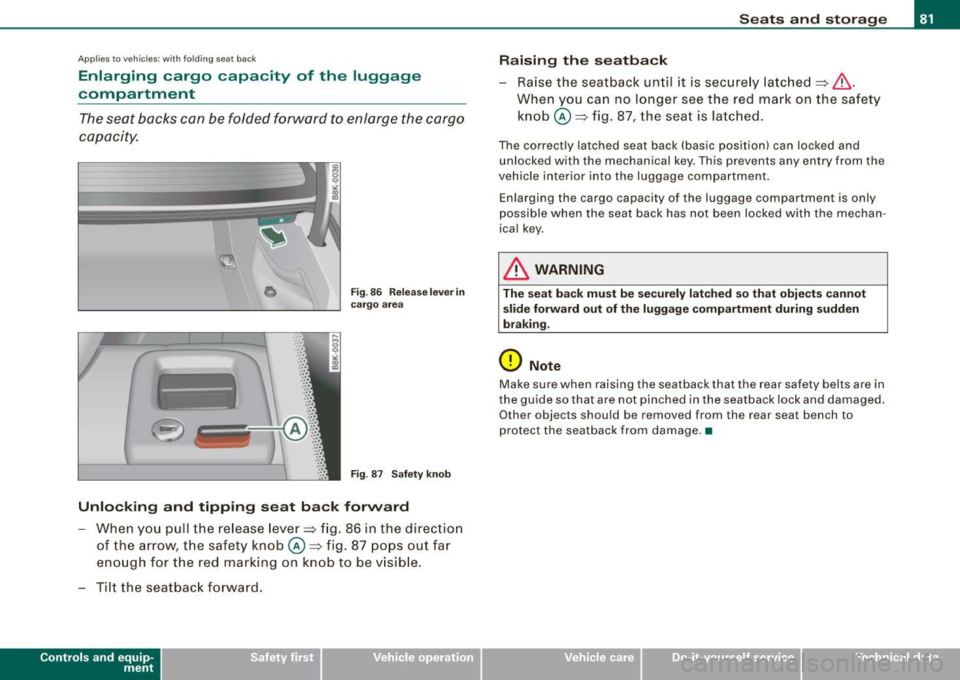
Unlocking and tipping seat back forward
-When y ou pu ll the re le a se lev er=? fig. 86 in the di rec tion
of th e arr ow, t he safe ty knob @~ fig. 87 pops ou t far
eno ugh for t he re d markin g on kno b to be visib le.
- Tilt th e sea tb ac k f orwa rd .
Con tro ls and eq uip
ment
Seats and storag e
Raising the seatback
- Raise the seatback un til it is secure ly la tc h ed =? &.
When you can no lon ger see the red mark on the safety
knob @~ fig. 87, the sea t is l atch ed .
The correctly latched seat back (basic position) can locked and
unlocked with the mechanical key . This preven ts any entry from the
vehicle interior into the luggage compartment .
Enlarging the cargo capacity of the luggage compartment is only
possible when the seat back has not been locked with the mechan
ica l key.
& WARNING
The seat back must be se curely lat ched so that obje cts cannot
s lide forward out of the luggage compartment during sudden
braki ng.
0 Note
Make sure when raising the seatback that the rear safety be lts are in
t he guide so that a re not pinched in th e sea tback lock and damaged .
Other objects should be removed from the rear seat bench to
protect the seat back from damage. •
Vehicle care I I irechnical data
Page 85 of 360
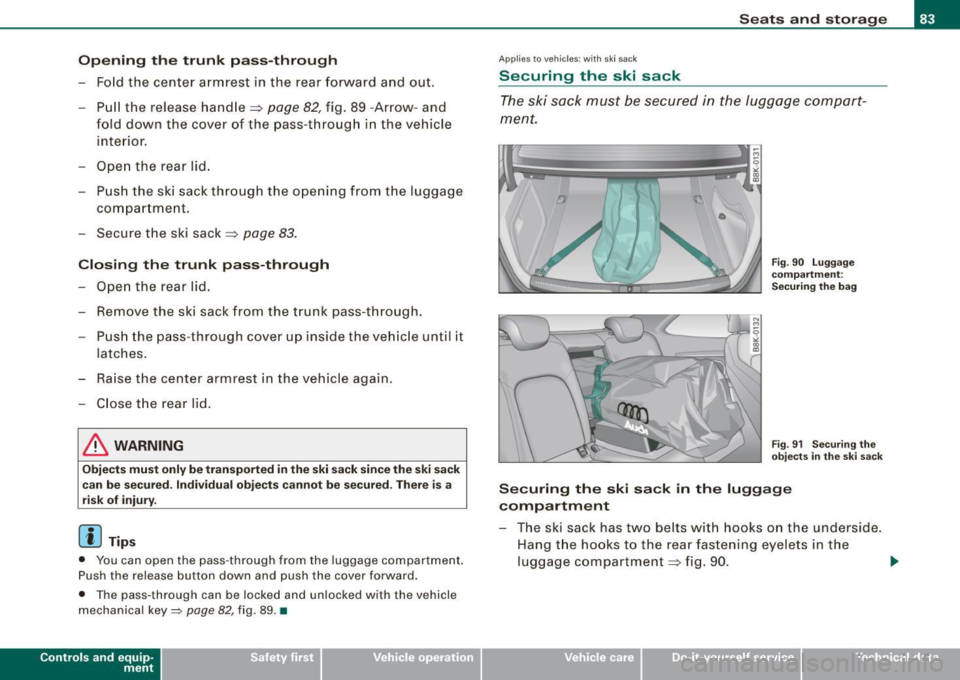
Opening the trunk pass-through
-Fold the center armrest in the rear forward and out .
- Pull the release handle=:> page
82, fig. 89 -Arrow- and
fold down the cover of the pass-through in the vehicle interior.
- Open the rear lid.
- Push the ski sack through the opening from the luggage
compartment.
- Secure the ski sack => page
83.
Closing the trunk pass-through
- Open the rear lid.
- Remove the ski sack from the trunk pass-through.
- Push the pass-through cover up inside the vehicle until it
latches.
- Raise the center armrest in the vehicle again .
- Close the rear lid .
& WARNING
Objects must only be transported in the ski sack since the ski sack
can be secured. Individual objects cannot be secured. There is a
risk of injury.
[ i] Tips
• You can open the pass -through from the luggage compartment.
Push the release button down and push the cover forward.
• The pass -through can be locked and unlocked with the vehicle
mechanical key:::::, page
82, fig. 89 . •
Con tro ls and eq uip
ment
A pp lies to vehicles: wit h ski sa ck
Securing the ski sack
Seats and storage
The ski sack must be secured in the luggage compart
ment.
Fig . 90 Luggage
compartment :
Securing the bag
Fig . 91 Securing the
objects in the ski sack
Securing the ski sack in the luggage
compartment
- The ski sack has two belts with hooks on the underside.
Hang the hooks to the rear fastening eyelets in the
luggage compartment => fig. 90.
Vehicle care I I irechnical data
Page 173 of 360

Driving Safely -
----------------
& WARNING (continued)
to help reduce the risk of personal injury if the driver's airbag
inflates.
• Never hold the steering wheel at the 12 o'clock position or with
your hands at other positions inside the steering wheel rim or on
the steering wheel hub . Holding the steering wheel the wrong way
can cause serious injuries to the hands, arms and head if the
driver's airbag deploys .
• Pointing the steering wheel toward your face decreases the
ability of the supplemental driver's airbag to protect you in a colli
sion.
• Always sit in an upright position and never lean against or
place any part of your body too close to the area where the airbags
are located .
• Before driving, always adjust the front seats and head
restraints properly and make sure that all passengers are properly
restrained.
• Never adjust the seats while the vehicle is moving. Your seat
may move unexpectedly and you could lose control of the vehicle.
• Never drive with the backrest reclined or tilted far back! The
farther the backrests are tilted back, the greater the risk of injury
due to incorrect positioning of the safety belt and improper
seating position.
• Children must always ride in child safety seats
=> page 213.
Special precautions apply when installing a child safety seat on
the front passenger seat
=> page 188 . •
Controls and equip
ment Safety first Vehicle operation
Proper seating position for the front
passenger
The proper front passenger seating position is important
for safe, relaxed driving.
For your own safety and to reduce the risk of injury in the
event of an accident, we recommend that you adjust the
seat for the front passenger to the following pos ition:
- Move the front passenger seat back as far as possible.
There must be a minimum of 10 inches (25 cm) between
the breastbone and the instrument panel
=> &.
- Adjust the angle of the seatback so that it is in an upright
position and your back comes in full contact with it
whenever the vehicle is moving.
- Adjust the head restraint so that the upper edge is as
even with the top of your head as possible but not lower
than eye level and so that it is as close to the back of your
head as possible .
- Keep both feet flat on the floor in front of the front
passenger seat.
- Fasten and wear safety belts correctly =>
page 183.
For detailed information on how to adjust the front passenger's
seat, see
=> page 69.
& WARNING
Front seat passengers who are unbelted, out of position or too
close to the airbag can be seriously injured or killed by the airbag
as it unfolds. To help reduce the risk of serious personal injury : .,
Vehicle care Do-it-yourself service Technical data
Page 174 of 360
-Driving
Safely ------=-------=----------------
& WARNING
(continued)
• Passengers must always sit in an upright position and never
lean against or place any part of their body too close to the area
where the airbags are located.
• Passengers who are unbelted, out of position or too close to the
airbag can be seriously injured by an airbag as it unfolds with
great force in the blink of an eye .
• Always make sure that there are at least 10 inches (25 cm)
between the front passenger's breastbone and the instrument
panel.
• Each passenger must always sit on a seat of their own and
properly fasten and wear the safety belt belonging to that seat.
• Before driving, always adjust the front passenger seat and
head restraint properly.
• Always keep your feet on the floor in front of the seat . Never
rest them on the seat, instrument panel, out of the window, etc.
The airbag system and safety belt will not be able to protect you properly and can even increase the risk of injury in a crash.
• Never drive with the backrest reclined or tilted far back! The
farther the backrests are tilted back, the greater the risk of injury due to incorrect positioning of the safety belt and improper
seating position.
• Children must always ride in child safety seats~
page 213.
Special precautions apply when installing a child safety seat on
the front passenger seat
~ page 188 . •
Proper seating positions for passengers in
rear seats
Rear seat passengers must sit upright with both feet on
the floor consistent with their physical size and be prop
erly restrained whenever the vehicle is in use.
To reduce the risk of injury caused by an incorrect seating
position in the event of a sudden braking maneuver or an
accident, your passengers on the rear bench seat must
always observe the following:
- Make sure that the seatback is securely latched in the
upright position~
page 80.
Keep both feet flat in the footwell in front of the rear seat.
Fasten and wear safety belts properly ~
page 183.
-Make sure that children are always properly restrained in
a child restraint that is appropriate for their size and age
~ page 213.
& WARNING
Passengers who are improperly seated on the rear seat can be
seriously injured in a crash.
• Each passenger must always sit on a seat of their own and
properly fasten and wear the safety belt belonging to that seat.
• Safety belts only offer maximum protection when the seatback
is securely latched in the upright position and the safety belts are
properly positioned on the body . By not sitting upright, a rear seat
passenger increases the risk of personal injury from improperly
positioned safety belts!
• Always adjust the head restraint properly so that it can give
maximum protection . •
Page 199 of 360
crash situations. Be sure to read the important information about
safety and heed the WARNINGS in this chapter.
Dep loyment of the Advanced Airbag System and the activation of
the safety be lt pretensioners depend on the deceleration measured
by the crash sensors and registered by the electronic control un it.
The amount of inflation of the front airbags can also be adapted to
the front seat position, depending on the distance between the respective front seat and the steering whee l or instrument panel as
registered by sensors in the seats . Crash severity depends on speed
and deceleration as well as the mass and stiffness of the vehicle or
object involved in the crash.
On the passenger s ide, regardless of safety belt use, the airbag w ill
be turned off if the weight on the passenger seat is less than the
amount programmed in the elec tronic control unit. The front airbag
on the passenger side wi ll also be turned off if one of the child
safety seats that has been certified under Federal Motor Vehicle
Safety Standard 208 has been recognized on the seat. The
PASSENGER A IR BAG OFF light comes on and stays on to tel l you
when the front Advanced Airbag on the passenger side has been
t urned off=>
page 190, "Child rest raints on the front seat-some
important things to know".
& WARNING
To reduce the risk of injur y when an airbag infl ate s, a lways wear
safety belt s properly.
• If you are unr estr ained , leaning forward , sitting sideways or out
of po sition in any way , your ri sk of injury is much hig her.
• You will al so rece ive seriou s injuries and could even be killed if
you are up ag ainst the airbag or too clo se to it when it infl ate s -
even wi th an Advan ced Airb ag =>
page 188. •
Safety first
Airbag sy ste m
More important things to know about front
airbags
F ig . 196 I nfl at ed front
airba gs
Safety belts are important to help keep front seat occupants in the
proper seated position so tha t airbags can unfold proper ly and
provide supplementa l protection in a fronta l collision.
The fron t airbags are designed to provide addit ional p rotection for
the chest and face of the driver and the front seat passenger when:
• safety belts are worn properly,
• the seats have been positioned so that the occupant is properly
seated as far as p ossi ble from the a irbag,
• and the head restraints have been properly adjusted .
Because airbags inflate in the blink of an eye with grea t force , things
you have on your lap or have p laced on the seat cou ld become
dangerous projectiles, and be pushed into you if the airbag inflates .
When a n airbag deploys, fine d ust is released . This is norma l and is
not caused by a fire in the vehicle. This dust is made up mostly of a
powder used to lubrica te the airbags as they d eploy . It could irri tate
skin.
I t is important to remember that while the supplemental airbag
system is designed to reduce the likel ihood of serious injuries, othe r
injuries, for example swelling, bruising and minor abrasions, can
a lso happen when airbags inflate . Airbags do no t pro tect the arms •
Vehicle care I I irechnical data
Page 200 of 360
-L~A:::..:,: ir:....: b:!..::: a~g L.:: s:1y :...:s::..: t~ e:.: m:...:...:.. ________________________________________________ _
or the lower parts of the body. Front airbags only supp lement the
th ree p oint safe ty belts in som e front al co llis ions in which the
vehic le dece leration is h igh enou gh to deploy the a irba gs.
Front airbags will not deploy:
• if the ignition is switched off when a crash occurs,
• i n sid e collis io ns,
• i n rea r- e nd collisi ons ,
• in ro llovers,
• when th e c ras h de celerat io n measur ed by the a irba g system is
less than the minimum threshold needed for a irbag deployment as
r egi stere d by th e ele ctro nic con trol uni t.
The front passenger airbag will also not deploy :
• when th e fr ont pass enger seat is no t occupi ed,
• when the weight on the front passenger seat a s sensed by the
A dvanced A irbag Syste m indica tes tha t the fr ont air bag o n the
passenger side has to be turned off by the e lectronic cont rol unit
(t he PASSENGER AIR BAG OFF li gh t comes o n and s tays o nl.
& WARNING
Sitting in the wrong position can increase the risk of serious injury
in crashes .
• To reduce the risk of injury when the airbags inflate , the driver
and passengers must always sit in an upright position , must not
lean against or place any part of their body too close to the area
where the airbags are located.
• Occupants who are unbelted , out of position or too close to the
airbag can be seriously injured by an airbag as it unfolds with
great force in the blink of an eye=> page 190.
& WARNING
A child in a rearward-facing child safety seat installed on the front
passenger seat will be seriously injured and can be killed if the
front airbag inflates -even with an Advanced Airbag System .
• The inflating airbag will hit the child safety seat or infant
carrier with great force and will smash the child safety seat and
child against the backrest, center armrest , door or roof.
• Always install rear-facing child safety seats on the rear seat.
• If you must install a rearward facing child safety seat on the
front passenger seat because of exceptional circumstances and
the PASSENGER AIR BAG OFF light does not come on and stay on, i mmediately install the rear-facing child safety seat in a rear
seating position and have the airbag system inspected by your
authorized Audi dealer .
& WARNING
Objects between you and the airbag will increase the risk of injury
in a crash by interfering with the way the airbag unfolds or by
being pushed into you as the a irbag inflates .
• Never hold things in your hands or on your lap when the vehicle
is in use.
• Never transport items on or in the area of the front passenger
seat. Objects could move into the area of the front airbags during
braking or other sudden maneuver and become dangerous projec
tiles that can cause serious personal injury if the airbags inflate .
• Never place or attach accessories or other objects (such as
cupholders, telephone brackets , large, heavy or bulky objects) on
the doors , over or near the area marked "AIRBAG" on the steering
wheel , instrument panel , seat backrests or between those areas
and yourself . These objects could cause injury in a crash , espe
cially when the airbags inflate .
• Never recline the front passenger's seat to transport object s.
Items can also move into the area of the side airbag or the front ..,