light AUDI A5 COUPE 2011 Owners Manual
[x] Cancel search | Manufacturer: AUDI, Model Year: 2011, Model line: A5 COUPE, Model: AUDI A5 COUPE 2011Pages: 362, PDF Size: 84.88 MB
Page 265 of 362
____________________________________________ C_l_e _a_ n_ in--= g=-- a_n_ d_ p ,__r_o _t_ e_ c_ t _ io_ n __ _
Exhaust tail pipes
Road salt and other corrosive materials will damage the material in
the exhaust tai l pipes if they are not cleaned regularly . Do not clean
the tail pipes with wheel cleaner, paint po lish, chrome polish or other
abras ive cleaners. Clean the ta il pipes w it h ca r care products that are
suitable for sta inless steel.
Your authorized Audi dealer can provide cleaning products that have bee n tested and approved for your veh icle .•
Care of interior
Ap plies to ve hic le s: wit h MMI
MMI display
- Clean the MMI display with a sof t clean cloth and an LCD
cleaner .
The MMI display can be cleaned with a p rofessionally available "LCD
cleaner". The cloth should be slightly dampened with the cleaning
fluid to clean the d isp lay.
0 Note
T o avoid scratching the MMI disp lay, you should never clean it dry .•
Ap plies to ve hicle s: with MMI
MMI control console
- First clean the MMI control console with a brush to
remove dust from the housing.
- Then wipe the MMI control consol e with a clean, soft,
slightly damp cloth.
Safety first
The MMI control console should be cleaned with a brush first so that
no dirt is trapped be tween the bu tto ns and the ho using. We recom
mend g iv ing the MMI co ntrol console a final w ipe with a cloth moist
ened with water and d ish washing detergent .
0 Note
To prevent damage, make sure that no fluid ever gets into the MM I
control console. •
Aluminum trim
Use only neutral-pH products to remove spots and deposits from
aluminum surfaces . Chrome care products and alkaline cleaners wi ll
attack alumi num surfaces and ca n damage them ove r time .
& WARNING
Always read and he ed all WARNIN GS and other information
~page 256. •
Fabrics and fabric coverings
Fabrics and fabr ic coverings (e.g. seats , door tr im panels, etc.) should
be cleaned at regular intervals with a vacuum cleaner . This removes
surface dirt particles which could become embedded in the fabric
through use . Steam cleaners should not be used, because the steam
tends to push the dirt deeper into the fabric and lock it there .
Normal clean ing
Genera lly, we recommend using a soft sponge or a lin t-free
microfiber cloth to the clean fabric . Brushes should only be used for
carpets and floor mats, since other fabric surfaces could be harmed
by brushes . _,,
Vehicle care Technical data
Page 267 of 362
____________________________________________ C_l_e _a_ n_ i n--= g,___ a_n_ d----' p,___ r_o _t_ e_ c_ t_ i _o_ n __ _
The intensity of the color determines the visual characteristics and
appea rance. If the s urface of the leather has a typical natu ral look,
then the leather is a nappa leather that has been left in a relatively
natura l condition. This leather offers partic ularly good comfort and
breathes well. Fine veins, closed grains, insect b ites, sk in folds, and
subtle var iations in co lor remain visible. These character istics demon
st rate that the mater ia l is nat ura l.
Natural nap pa leather is not covered by a color fin ish. It is therefore
mo re sensitive to soiling and we ar, which is some thi ng you need to
consider if children, animals or other factors mig ht prove to be partic
ularly hard on the leather.
By contrast, leather types that a re cove red by a colo red fi nish layer
are more durab le . This has a positive effect on the leather's resistance
to wear and so ilin g in daily use. On the othe r hand, the typical charac
teristics of natura l leather are barely or not apparent . However, this
does not mean that the leathe r itse lf is of inferio r quali ty.
Care and handling
Be cause of the exclusive na ture of t he types of leat her t ha t Audi uses
and their unique properties (such as sensitivity to oils, grease, soiling,
e tc. ), yo u will need to be somewhat c arefu l with these leat hers , a nd
a certain type of care is requ ired. For example, dark clothing mate
r ia ls can dis co lor leather seats (especially if s uch cloth ing is damp and
was not dyed correctly). Dust and dirt particles in pores, folds, and
seams can have an ab rasive effect and can damage the leathe r
surface as well as weaken seams.
T he leather s ho ul d be cleaned regularly as needed . After having been
used for a relatively long time, your leather seats will a cquire a rich
aged f in ish. This is a characterist ic of natura l leather and a s ign of
t rue quality.
In order to maintain the value of this natural product over the life of
yo ur vehicle, you sho uld fo llow the recommendations below :
Safety first
0 Note
• To keep you r leat he r from b leach ing out, do not a llow it to be
exposed to bright s unlight for long periods of time . If yo u have to
leave t he veh icle parked o utside for long pe riods, cover the leather to
protect it from direct exposure to sunlight.
• Sharp objects on clot hing, such as z ippers, rivets or sha rp pieces
on belts can leave permanent scratches or scrape mar ks on the
surfa ce of the leathe r.
(I] Tips
• After ea ch t ime you clean the le athe r and at regular inte rvals, use
a leather preservat ive cream that contains UV-blockers and that
works into the leather . This cream will nourish and moistu rize the
leather, helping it to breathe and stay supp le. It also he lps to build up
a protect ive coa ting on the surface .
• Clean the leather every 2 -3 months, and clean any areas t hat get
so ile d.
• Remove fresh marks made by ballpoint pens, ink, lipstick, shoe
polish, etc. as soon as poss ible.
• Preserve the color of the leather as needed by using a special
c o lored leat he r car e cream to touch up a reas of uneven color. •
Applies to vehicles: w it h na tur al leat her
Cleaning and caring for leather upholstery
and trim
Natural leather requires s pecial care and attention .
Normal cleaning
-Clean soiled areas w it h a slightly moistened cotton or
woolen cloth.
Vehicle care Technical data
Page 268 of 362
-~_C_ le_ a_n_ i_ n_ g=- a_ n_d___. p_ ro_ t_e _c_ t_ i_o _n ___________________________________________ _
More stubborn dirt
- More stubborn dirt can be removed using a cloth sa tu
rated w ith a mild soap solution (2 tablespoons mild liquid
soap).
- Never allow the soap solution to saturate the leather, and
make certain that no water soaks into the seams .
- Wipe off the soap solution with a soft, dry cloth .
Cleaning spots
- Remove fresh water -ba sed spots (such as coffee, tea,
juices, blood) with an absorbent cloth or paper towel.
- Remove fresh
g rease or oil-based spots (such as butter,
mayonnaise, chocolate) with an absorbent cloth or paper
towel, or use the cleaner from the leather care ki t if the
spot has not yet penetrated into the surface of the
leather.
- Use an oil/grease dissolving spray, if
oil /grease spots
have dried on .
-Remove specific kinds of spots (bal lpoint pen, felt marker ,
fingernail polish, water-based paint, shoe polish, etc.)
with a spot remover specifically formulated for leather.
Leather care
- Every half year use an approved leather care produc t
(available from your authorized Audi dealer) to care for
the leather .
- Apply the product very sparingly.
Wipe it off with a damp cloth.
If you have any questions about cleaning and caring for the leather in
your vehicle, it is best to contact your au thor ized Aud i dealer, who will
be glad to help you and tell you about our full range of leather care
products, such as:
• Leather cleaning and care k it
• Creams to care for colored leather
• Spot removers for ballpoint pens, shoe polish, etc .
• Oil/grease dissolv ing sp ray
• New and upcoming products.
& WARNING
Alw ays re ad and heed all WARNINGS and other information
=> page 2 56 .
0 Note
• Never use chemical so lve nts (e.g . lighter fluid, turpentine), waxes,
shoe po lish or simi lar products on the leather surfaces in your Audi .
• T o avo id damage, have stubborn sta ins removed by a commerc ial
cleaning specialist .•
Ap plies to veh icl es: w it h Alc anta ra ® u pholst ery
Cleaning Alcantara ® (synthetic suede)
Removing dust and dirt
- Moisten a cloth, squeeze out excess water and wipe down
the seat surfaces.
Removing stains
- Moi sten a cloth with lu kewarm water or with diluted ethyl
( rubb ing ) al cohol.
- Dab at t he stain . Start at the ou tside and work inwards. .,
Page 269 of 362
____________________________________________ C_l_e _a_ n_ i n--= g=--- a_n_ d----' p,__ r_o _t_ e_ c_ t_ i _o_ n __ lffll
- Once the sta in is no longer v isible, use a soft dry cloth or
tissue to soak up t he mois ture.
Do not use leathe r cle an in g p rodu cts on Alc ant ara® .
You may use a suitable shampoo for removing dust and d irt.
Dust an d grit in the pores and seams can scratch and damage the
surface. If the car is left standing in th e su n fo r long p eriods, th e
Alcantara ® sho uld be protected against direct sun light to prevent it
from fading. S lig ht co lor var iat io ns w ill develop in no rm al use a nd are
not a n ind ication of mater ial deterio ration.
0 Note
• N ever use chem ica l solvents (e .g . lighter fluid, turpentine), waxes,
shoe polish or sim ilar pr od uct s on A lc antar a® su rfa ces .
• To avo id damage, have stubborn sta ins removed by a commerc ia l
cl eaning spe cialis t.
• Do not use brushes, stif f sponges or sim ilar ly abrasive clea ning
aids .•
Safety belts
O nly well -maintained s afety belts work reli ably when
nee ded .
- Keep bel ts clean.
- F or cl ean ing , u se a mild so ap and wa ter so lut io n. Let belts
dr y t ho ro ughly and a way fr om direct s unlig ht .
- Do not a llow in ertia re el safety b elt s to retrac t be fore they
are co mpletely dry.
- Chec k t he co ndition of yo u r safety be lts
regularly .
Heavily soiled safety be lts may not retract properly.
Safety first
& WARNING
Damaged safety belts can break in a crash.
• Anything that might damage your safety belts could mean
that you and your passengers would not be adequately protected
in an accident.
• Safety belt performance depends on correct installation . Never
remove belt s from the vehicle to clean them .
• Do not use chemical cleaning agents , bleach or dyes. They have
corrosive properties which weaken the webbing.
• When cleaning your safety belts , inspect them fo r damage . If
you discover damage, see your authorized Audi dealer.
• Always read and heed all WARNINGS and other information
~page 256. •
Engine compartment
B e especi ally careful when clean ing the engine co m part
me nt.
Always switch off the ign ition before cleaning the engine~& .
Plenum panel
Remove leaves from the plenum pane l in front of the win dshi eld
under the eng ine hoo d. Thi s preven ts the water d rain holes fro m
becoming blocked, and it prevents debris from enter ing th e veh icle
in ter ior thro u gh t he heat ing and ven tilat ion ducts.
Corrosion protection
Th e eng ine com partment and transm iss io n have bee n co rros io n
protected at the facto ry .
G oo d ant i- cor ros io n trea tmen t is very i mport an t, pa rt icu larly in t he
wi nte r. If the ve hicle is freq uently d riven on sa lt treated roads, the
entire engine compartment and plenum pane l sho uld be tho roug hly .,
Vehicle care Technical data
Page 276 of 362
___ C_h_ e_c _k _i_n -=g :a,__ a_n_ d_ f_ i_ l _li _n _,g;._ __________________________________________ _
Checking and filling
Engine hood
Releasing the engine hood
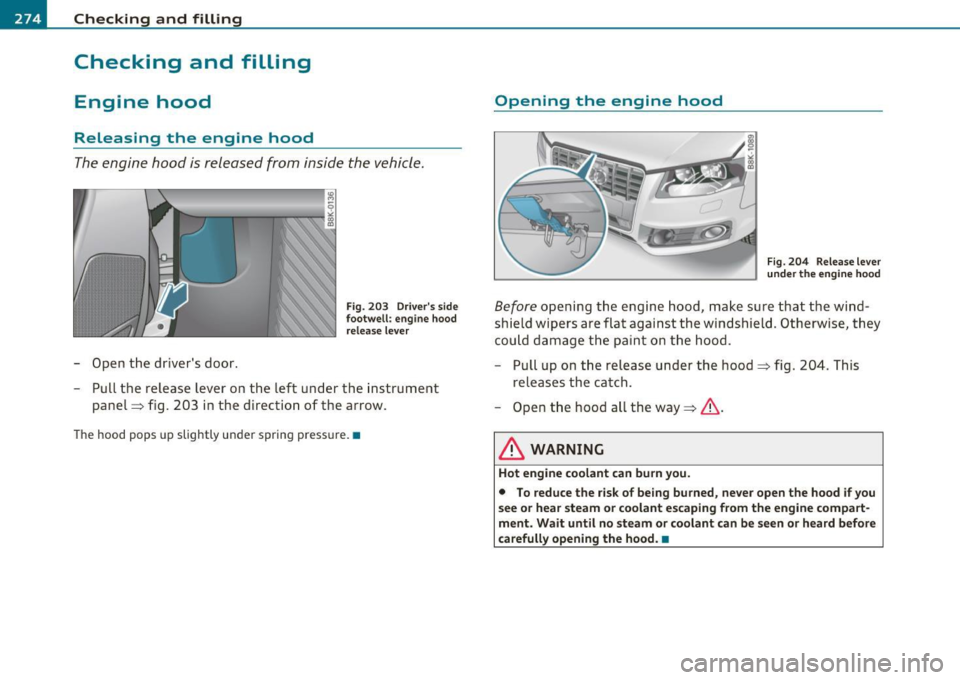
The engine hood is released from inside the vehicle.
- Open the dr iver's door.
F ig . 20 3 Driver 's sid e
f oo twell : e ng in e ho od
r elease leve r
-Pull the re lease lever on the left under the instrument
panel ~ fig. 203 in the directio n of the arrow.
The hood pops up slightly under spring press ure. •
Opening the engine hood
Fig. 204 Rel ease le ver
unde r th e eng in e hood
Before opening the eng ine hood, make sure that the wi nd
shield wipers are flat against the win dshiel d. Otherwise, they
cou ld damage the paint on the hood .
Pull up on t he release under the hood~ fig. 20 4. T his
releases the catch.
- Open t he hood all the way~& .
& WARNING
Hot eng ine coolant can burn you.
• To redu ce the r isk o f be ing burned, never open the hood if you
see or hear steam or coolant escaping from the engine compa rt
ment. Wait until no ste am or co olant can be seen or heard before
carefully opening the hood .•
Page 279 of 362
___________________________________________ C_ h_e _c _k_ i_n ~g_ a_n_ d_ f_ i_ll _i_n _g __ ,n
© Windshield/headlight* washer container (W ) . . . . . . . 290
(J) Power steering reservoir . . . . . . . . . . . . . . . . . . . . . . . . . 242
The position of the engine oil filling hole=:> fig. 205 (item@) can
differ depending on the engine design .
& WARNING
Before you check anything in the engine compartment, always
read and heed all WARNINGS=:>
& in "Working in the engine
compartment" on
page 275. •
Engine oil
Engine oil specifications
The engine oil used in your Audi needs the right kind of oil.
The engine in your Audi is a sophisticated power plant that was built
to exacting specifications. This engine needs the right kind of engine
oil that meets specifications regarding quality and viscosity so that it
can run smoothly and reliably. Choosing the right oil and changing oil
within the time and mileage intervals printed in your vehicle's
Warranty
& Maintenance booklet matters a lot more today than it did
years ago. Audi has developed a special quality standard for engine oil
that will help assure that your vehicle's engine will get the lubrication
it needs for proper operation.
Modern engine lubrication has taken a quantum leap in the last few
years. Many synthetic oils available today provide better engine lubri
cation that can outlast traditional petroleum-based oils, making
them a smart choice for use throughout the life of your Audi.
Whether you use synthetic or petroleum-based engine oil, the oil that
you use must conform to Audi's oil quality standard VW 502 00 to help keep your vehicle's engine running smoothly and help prevent
the formation of harmful deposits, sometimes called "sludge", that
over time can lead to expensive repairs.
Safety first
At the time of printing, engine oils available in the U.S. and Canada
that meet the exacting specifications of Audi oil standard VW 502 00
are synthetic engine oils. This does not mean, however, that every
synthetic engine oil will meet Audi oil standard VW 502 00. So always
be sure that you use an approved oil.
To help prevent the formation of harmful deposits use only oil with
the following specifications printed on the oil container:
Audi oil standard VW 502 00
Oil container labels may carry the specification singly or in combina
tion with other designations and oil quality standards.
Viscosity
Engine oils are graded according to their viscosity. The proper
viscosity grade oil for your engine depends on climactic or seasonal conditions where you drive. You can use oil with a viscosity grade of
SAE SW40 across all temperature ranges for normal driving condi
tions.
However, if engine oil viscosity grade SAE SW40 is not available, you
can also use viscosity grade SAE SW-30 or SAE OW-40 as long as it
meets Audi oil quality standard VW 502 00 specifications.
Because engine oil that meets the Audi oil standard may not be avail
able everywhere when you need it, we strongly recommend that you
always carry with you an extra quart (liter) of oil that expressly
conforms to the VW 502 00 specification, in case you have to top off
the oil while on the road.
Only if the level of the oil is at or below the minimum mark - and no
oil that expressly conforms to Audi oil standard VW 502 00 specifica
tions is available -may you top off with a high quality engine oil, pref
erably synthetic-based, that meets ACEA A3, ACEA AS or ACEA BS or
API SL specifications, but even then, only in viscosity grades SAE SW-
40, SAE SW-30, or SAE OW-40. However, during the entire time
between oil change intervals, never top off with more than a total of
0.5 qt/liter engine oil that does not conform to Audi oil specification
vw 502 00. ..
Vehicle care Technical data
Page 280 of 362
-Checking and filling
-------=----- -=-----------------------------------------
For more information about engine oil that has been approved for
your veh icle, please contact either your authorized Audi dealer or
Audi Customer Relations at 1 (800) 822-2834 or visit our web site at
www.audiusa .com or www.audicanada.ca . Here you will also find a
current list of oils (manufacturers, brand names etc.) that conform to
Audi oil standard VW 502 00 .
Changing the engine oil
The engine oil and oil filter must be changed according to the mileage
(kilometers) and time intervals specified in your vehicle's Warranty
&
Maintenance booklet . Do not exceed these intervals - harmful
deposits from o ld engine oil can reduce engine performance and can
lead to expensive engine repa irs.
Changing the oil at the recommended intervals is so very important
because the lubricating properties of oil decrease gradually during
normal vehicle use. If you are not sure when you have your oil
changed, ask your authorized Audi Service Adviso r.
Under some circumstances the engine o il should even be changed
more frequent ly. Change oil more often if you drive mostly short
distances, operate the veh icle in dusty areas or mostly under stop
and-go traffic conditions, or when you use your vehicle where temper
atures stay below freez ing po int for long periods.
Detergent additives in the oil will make fresh oil look dark after the
engine has been running for a short time. This is normal and is not a
reason to change the oil more often than recommended .
Damage or malfunctions due to lack of maintenance
It is essentia l that you change yo ur oil at the recommended intervals
using only engine oil that complies with Audi oil standard
VW 502 00. Your Limited New Vehicle Warranty does not cover
damage or malfunctions due to fa ilure to follow recommended main
tenance and use requirements as set forth in the Audi Owner's
Manual and Warranty
& Maintenance booklet. Your dealer will have
to deny warranty coverage unless you present to the dealer proof in
the form of Service or Repair Orders that all scheduled maintenance
was performed in a timely manner. •
Engine oil consumption
The engine in your vehicle depends on an adequate
amount of oil to lubricate and cool all of its moving parts.
In order to provide effective lubrication and cooling of internal
eng ine components, all inte rnal comb ustion eng ines consume a
certain amount of oil. Oil consumption varies from engine to engine
and may change sign ifican tly over the life of the engine. Typically,
engines with a specified break-in period (see~
page 246) consume
more oil dur ing the break- in period than they consume after oil
consumption has stab ilized.
Under normal conditions, the rate of oil consumption depends on the
quality and viscosity of the oil, the RPM (revolutions per minute) at
which the engine is operated, the ambient temperature and road
conditions. Further factors are the amount of oil dilution from water
condensation or fuel residue and the oxidation level of the oil. As any
eng ine is subject to wear as mileage builds up, the oil consumption
may increase over time until replacement of worn components may
become necessary.
With all these variab les coming into play, no standard rate of oil
consumption can be established or specified . There is no alternative
to regular and frequent checking of the oil level, see
Note .
If the yellow engine oil level warning symbol in the instrument
cluster lights up, you should check the oil level as soon as possible
~ page 279. Top off the oil at your earliest convenience~ page 279.
& WARNING
Before you check anything in the engine compartment , always
read and heed all WARNINGS ~
& in "Working in the engine
compartment" on page
275.
Page 284 of 362
___ C_h_ e_c _k _i_n -=g :a,__ a_n_ d_ f_ i_ l _li _n _,g;._ __________________________________________ _
0 Note
• Before w inter sets in, have the coolant checked to see if the
coolant additive in your vehicle is sufficient to meet the climate
conditions. This is especially important if yo u live in a region where
the winter is extremely cold.
If necessary, increase the proportion of
coolant additive to 60% .
• When adding coolant additive to your cooling system, remember :
- We recommend using only coolant additive G12++ (check the
label) for your vehicle. This coolant additive is available at autho
r iz ed Audi dealers. Other types of antifreeze can s ignificantly
reduce corrosion protection. The resulting corrosion can cause a
loss of coolant and serious engine damage.
• Do not add any type of radiator leak sealant to your vehicle 's
engine coolant. Adding radiator repair flu id may adversely affect the
function and performance of your cooling system and cou ld result in
damage not covered by your New Vehicle Limited Warranty .•
Checking the engine coolant Level
The engine coolant level can be checked with a quick
glance.
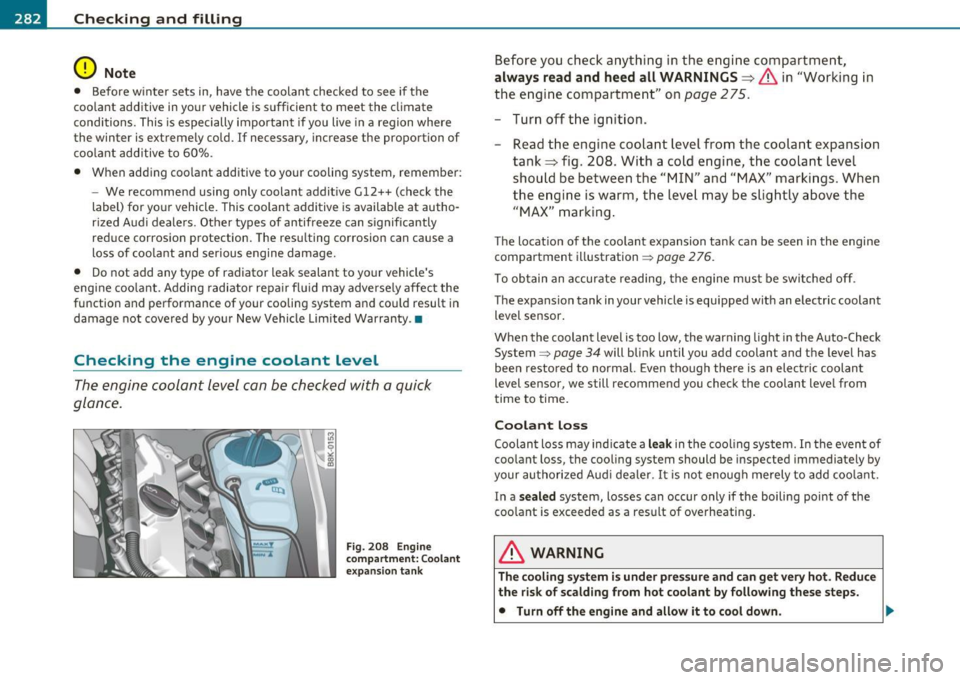
Fig. 208 Engine
co mpartment : Coolant
expansion tank
Before you check anything in the engine compartment,
always read and heed all WARNINGS~ & in "Working in
the engine compartment" on
page 275.
-Turn off the ignition.
- Read the engine coolant level from the coolant expansion
tank~ fig. 208 . With a cold engine, the coolant level
should be between the "MIN" and "MAX" markings. When
the engine is warm, the level may be slightly above the
"MAX" marking.
The locat io n of the coolant expansion tank can be seen in the engine
compartment illustration~
page 276.
To obtain an accurate reading, the engine must be switched off.
The expansion tank in your vehicle is equipped with an electric coolant level sensor.
When the coolant level is too low, the warning light in the Auto-Check
System =>
page 34 will blink until you add coolant and the level has
been resto red to normal. Even though there is an electric coolant
level sensor, we still recommend you check the coolant level from
time to time.
Coolant loss
Coolant loss may indicate a leak in the coo ling system. In the event of
coolant loss, the cooling system should be inspected immediately by
your authorized Audi dealer. It is not enough merely to add coolant.
In a
sealed system, losses can occur only if the boiling point of the
coo lant is exceeded as a result of overheating .
& WARNING
The cooling system is under pressure and can get very hot. Reduce
the risk of scalding from hot coolant by following these steps.
• Turn off the engine and allow it to cool down.
Page 285 of 362
___________________________________________ C_ h_e _c _k_ i_n ~g_ a_n_ d_ f_ i_ll _i_n _g __ _
& WARNING (co ntinued )
• Prote ct your face , hands and arms from escaping fluid and
st eam by covering the cap with a large, thick rag.
• Turn the cap slowl y and very carefully in a counter-clockwise
d irection while applying light, downward pressure on the top of
the cap.
• To avoid being burned, do not spill ant ifreeze or coolant on the
exhaust system or hot engine part s. Under certain conditions , the
e thylene glycol in engine coolant can catch fire .
0 Note
Do not add any type of radia tor leak sealant to your vehicle 's eng ine
coo la nt. Adding radiator repair fluid may adverse ly affect the func
t ion and pe rforma nce o f yo ur cooling system and could result in
damage not covered by yo ur New Vehicle Limited Warranty. •
Adding coolant
Be very careful when adding engine co olant.
Before you c heck anythi ng in the eng ine co mpart men t,
always read and heed all WARNINGS~ & in "W ork ing in
the e ngine compartm ent" on
page 2 75.
- Turn o ff t he engine.
- Let t he engine cool dow n.
- Place a thi ck rag over the coolan t expans io n tank
~ page 282 , fig . 2 08 a nd carefully turn the ca p cou nter
clockw ise
~ & .
- Ad d cool ant .
- Twist t he ca p on again
tightly.
Safety first
Replaceme nt eng ine coolant must conform to exact spec ifications
=> page 281, "Cool an t". Even in an emerge ncy, i f coolan t additive
Gl2 ++, Gl2+ or Gl2 is not available, do not use a different add itive .
U se plain water instead until you can get the correct additive and ca n
restore the correct ratio . This should be done as soon as possible .
If you have lost a considerable amount of coolant, then you shou ld
add co ld antifree ze and co ld wate r only w hen t he e ng ine is co ld .
Always use
new engine coo la nt w hen refi lling.
Do not fill coolant a bove the "M AX" mark . Excess coolant will be
forced ou t thr ough t he pr ess ure relief va lve in t he cap when the
engine becomes hot.
& WARNING
• The cooling system i s under pressure and can get very hot.
Reduce the risk of scalding from hot coolant by following these
steps.
-Turn off the engine and allow it to cool down .
- Protect your face , hands and arms from escaping fluid and
steam by covering the cap with a large, thick rag.
- Turn the cap slowly and very carefully in a counter-clockwise
direction while applying light, downward pre ssure on the top
of the cap .
- To avoid be ing burned, do not spill antifreeze or coolant on
the exhaust system or hot engine parts. Under certain condi
tions, the ethylene glycol in engine coolant can catch fire.
• Antifreeze i s poisonous . Always store antifreeze in its original
c ontainer and well out of the reach of children .
• If you drain the coolant, it must be caught and safely stored in
a proper container clearly marked "poison ". ..
Vehicle care Technical data
Page 286 of 362
•--=C:.:.h.:.. e=. c=.:..:: k .:.:in ..:. g ~ a::..:..: n~d .:...:.. f:....:il ..:.li :.:.n.;.: g~ ------------------------------------------
0 Note
• Coolant pollutes the environment and could cause an engine fire.
Excess coolant will be forced out through the pressure relief valve in
the cap when the engine becomes hot .
• If, in an emergency, only water can be added, the correct ratio
between water a nd antifreeze ::::>
page 281 must be restored as soon
as possible.
ci> For the sake of the environment
Drained coolant should not be reused. Always dispose of used coolant
wh ile observ ing all environmental regulations.•
Radiator fan
The radiator fan switches on automatically by itself.
The radiator fan is driven by the engine v ia the V-belt. The viscous
clutch regulates the speed of the fan according to the temperature of
t he coo lant.
An auxiliary electr ic radiator fan* sw itches on and off depending on
coolant temperature and other vehicle operating conditions.
After you switch the engine off, the auxiliary fan can cont inue running
for up to 10 minutes- even with the ignition off. It can even switch on
again later by itse lf::::>
/1 , if
• the temperature of the engine coolant rises due to the heat build
up from the engine in the engine compartment, or
• the engine compartment heats up because the veh icle is parked in
intense sunlight.
& WARNING
• To reduce the risk of personal injury never touch the radiator
fan.
/1 WARNING (continued)
• The auxiliary electric fan is temperature controlled and can
switch on suddenly even when the engine is not running.
• The auxiliary radiator fan switches on automatically when the
engine coolant reaches a certain temperature and will continue to
run until the coolant temperature drops .•
Brake fluid
Checking brake fluid level
The brake fluid level can be checked with a quick glance.
Fig . 209 Engine
co mpartm ent : Brake
fluid reservoir
Before you check anything in the engine compartment,
always read and heed all WARNINGS=> & in "Working in
the engine compartment" on
page 275.
-Read the brake fluid level from the brake fluid reservoir
=> fig. 209. The brake fluid level must be between the
"MIN" and "MAX" markings.
The brake fluid reservoir is located at the rear partition of the engine
compartment on the left side=>
page 276. .,