brake fluid AUDI A5 COUPE 2011 User Guide
[x] Cancel search | Manufacturer: AUDI, Model Year: 2011, Model line: A5 COUPE, Model: AUDI A5 COUPE 2011Pages: 362, PDF Size: 84.88 MB
Page 278 of 362

lffll __ C_h_ e_c _k _i_n -=g :a,__ a_n_ d_ f_ i_ l _li _n _,g;._ __________________________________________ _
& WARNING (continued )
-First, fully apply the parking brake , move selector lever of
automatic transmission to "P" (Park); put manual transmi s
sion in Neutral.
- Alway s use extreme caution to prevent clothing, jewelry , or
long hair from getting caught in the radiator fan , V-belts or
other moving part s, or from contacting hot parts. Tie back hair
before starting , and do not wear clothing that will hang or
droop into the engine .
• Minimize expo sure to em is sion and chemical hazards=>& .
& WARNING
California Proposition 65 Warning:
• Engine exhaust , some of its constituents, and certain vehicle
c omponents contain or emit chemicals known to the State of Cali
fornia to cause cancer and birth defects and reproductive harm. In
addition , certain fluid s contained in vehicle s and certain products
of component wear contain or emit chemicals known to the State
of California to cause cancer and birth defects or other reproduc
tive harm.
• Battery posts, terminals and related acces sories contain lead
and lead compounds, chemicals known to the State of California
to cause cancer and reproductive harms. Wash hand s after
handling .
0 Note
When adding fluids, a lways make sure that they are poured into the
proper container or filler opening, otherwise serious damage to
veh icle systems w ill occur.
<£' For the sake of the environment
T o de tect leaks in time, inspect the veh icle floo r pa n from u nder neat h
regu larly. If you see spots from oil or other vehicle fluids, have your
vehicle inspe cted by an au thor ized Aud i dea le r.•
Engine compartment
Engine compartment
These are the most important i tems that y ou can chec k.
Fig. 205 Typ ical layout f or contain ers and engine o il filler cap
(D Jump start poi nt( +) unde r a cover . .... ..... .. .... 288, 3 29
@ Brak e fluid reservo ir ( ) . . . . . . . . . . . . . . . . . . . . . . . . 284
® Engine oil fill er cap(~) . . . . . . . . . . . . . . . . . . . . . . . . 279
© Coolant e xpansion tank (- L ) . . . . . . . . . . . . . . . . . . . . . 282
® Jump start point( -) with hex head screw ........... 288,329.,.
Page 286 of 362
•--=C:.:.h.:.. e=. c=.:..:: k .:.:in ..:. g ~ a::..:..: n~d .:...:.. f:....:il ..:.li :.:.n.;.: g~ ------------------------------------------
0 Note
• Coolant pollutes the environment and could cause an engine fire.
Excess coolant will be forced out through the pressure relief valve in
the cap when the engine becomes hot .
• If, in an emergency, only water can be added, the correct ratio
between water a nd antifreeze ::::>
page 281 must be restored as soon
as possible.
ci> For the sake of the environment
Drained coolant should not be reused. Always dispose of used coolant
wh ile observ ing all environmental regulations.•
Radiator fan
The radiator fan switches on automatically by itself.
The radiator fan is driven by the engine v ia the V-belt. The viscous
clutch regulates the speed of the fan according to the temperature of
t he coo lant.
An auxiliary electr ic radiator fan* sw itches on and off depending on
coolant temperature and other vehicle operating conditions.
After you switch the engine off, the auxiliary fan can cont inue running
for up to 10 minutes- even with the ignition off. It can even switch on
again later by itse lf::::>
/1 , if
• the temperature of the engine coolant rises due to the heat build
up from the engine in the engine compartment, or
• the engine compartment heats up because the veh icle is parked in
intense sunlight.
& WARNING
• To reduce the risk of personal injury never touch the radiator
fan.
/1 WARNING (continued)
• The auxiliary electric fan is temperature controlled and can
switch on suddenly even when the engine is not running.
• The auxiliary radiator fan switches on automatically when the
engine coolant reaches a certain temperature and will continue to
run until the coolant temperature drops .•
Brake fluid
Checking brake fluid level
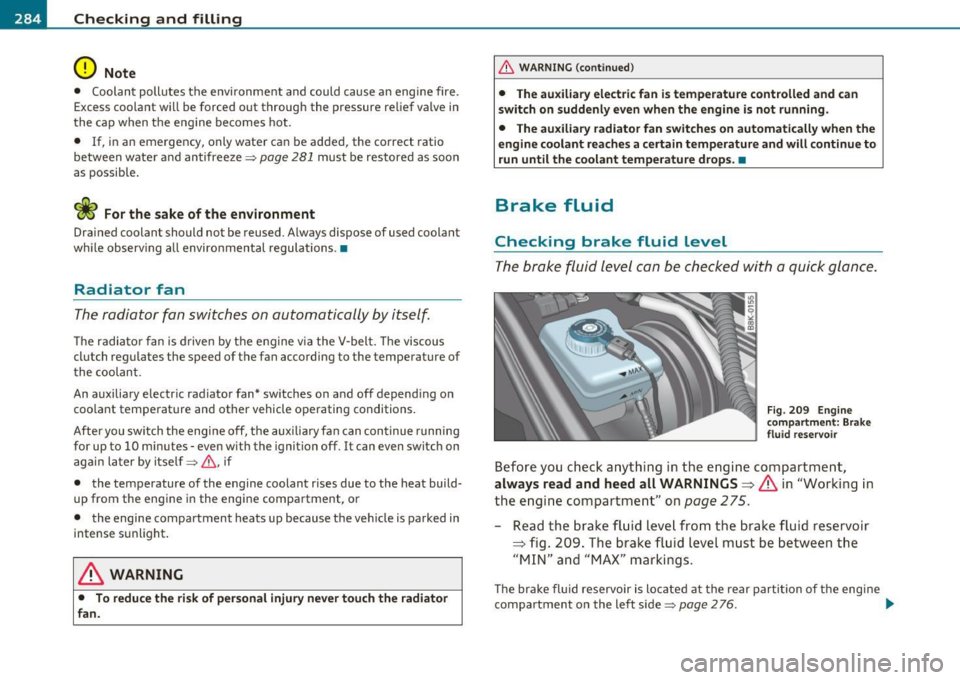
The brake fluid level can be checked with a quick glance.
Fig . 209 Engine
co mpartm ent : Brake
fluid reservoir
Before you check anything in the engine compartment,
always read and heed all WARNINGS=> & in "Working in
the engine compartment" on
page 275.
-Read the brake fluid level from the brake fluid reservoir
=> fig. 209. The brake fluid level must be between the
"MIN" and "MAX" markings.
The brake fluid reservoir is located at the rear partition of the engine
compartment on the left side=>
page 276. .,
Page 287 of 362
___________________________________________ C_ h_e _c _k_ i_n ~g_ a_n_ d_ f_ i_ll _i_n _g __ _
The fluid level may drop slightly after some time due to the auto
matic adjustment of the brake pads. This is not cause for alarm.
If the brake flu id level falls considerably below the "MIN " mark, the
brake warning/indicator light (U.S. models:
BRAKE , Canadian mode ls:
{(j)) ) will come on=> page 18 and=> page 33. Do not continue to
ope rate the vehicle. The complete brake system should be thorough ly
checked by an authorized Audi dealer or qualified workshop and the
cause corrected. If the brake fluid level is too low, the brake
wa rning/ind icator light will illuminate. Contact an authorized Aud i
dealer
immediately .
[I] Tips
The brake fluid reservoir is located undernea th the cover. •
Changing brake fluid
Hove the broke fluid changed by on experienced techni
Clon.
Brake fluid absorbs moisture from the air. If the water content in the
brake fl uid is too high, corrosion in the brake system may result after
a period of time. The boiling point of the brake fluid will also decrease
considerably and decrease braking performance.
Therefore, the brake flu id must be changed
every two years. Always
use new brake fluid which conforms to Federal Motor Vehicle Stan
dard "FMVSS 116 DOT 4".
The brake fluid reservoir can be difficult to reach, therefore, we
recommend that you have the brake fluid changed by your authorized
Audi dealer. Your dealer has the correct tools, the right brake fluid
and the know-how to do this for you .
& WARNING
• Brake fluid is poi sonous. It must be stored only in the closed
original container out of the reach of children!
Safety first
& WARNING (continued )
• Brake failure can result from old or inappropriate brake fluid.
Observe these precautions:
-Use only brake fluid that meets SAE specification
J 1703 and
conforms to Federal Motor Vehicle Standard 116. Always check
with your authorized Audi dealer to make sure you are using
the correct brake fluid . The correct type of brake fluid is also
indicated on the brake fluid reservoir.
- The brake fluid must be new. Heavy use of the brakes can
cause a vapor lock if the brake fluid is left in the system too
long. This can seriously affect the efficiency of the brakes as
well as your safety. This could result in an accident .
0 Note
Brake fluid will damage the paint of your vehicle.
ffi For the sake of the environment
Because of the prob lem of proper disposal of brake fluid as well as
th e special tools required and the necessary expertise, we recom
mend that you have the brake fluid changed by your author ized Audi
dealer. •
Battery
General information
Under normal operating conditions, the battery in your Audi does not
need any maintenance . With high outside temperatures or long daily
drives we recommend that you have the electro lyte level checked by
an authorized Audi dealer or qualified workshop . The electrolyte leve l
should also be checked each t ime the battery is charged=> page 288.
~
Vehicle care Technical data
Page 304 of 362

-~_T_ i_ re _ s_ a_n _ d_ w_ h _e_ e_ ls _________________________________________________ _
Tire pressure
Incorrect tire pressure causes premature wea r a nd can cause sudden
t ire blow-out. For this reason, ti re p ressure must be checked at least
once a month ~
page 297.
Driving style
Driving fast around curves, heavy acce le ra tion and hard brak ing
increase tire wear .
Rotating tires for more even wear
For all four tires on your veh icle to have the same service life, we
re commend that the fron t and re a r tires are rotate d according to the
tire manufact urer's suggested tire rotation interva ls . Please
remember the fo llow ing:
• Tir e rotat ion inte rvals may differ from t he ve hicl e service intervals
outlined in your Maintenance and War ranty Booklet .
• T he longer one tire is used in one location on the veh icle, the more
it wears at certa in points; therefore, we recommend that you follow
t he t ire m anufac ture r's suggested tire rotation in terva ls.
• V ehicles with front-whee l drive expe rience mo re tread wea r on t he
fron t wheels compa red to all-whee l drive (quattro
® ).
• Please rotate tires as s hown ~fig. 215.
• Extra care must be taken when rotating d irection-specific tires
~ page 321.
Wheel balancing
The w heels on new vehicles are balanced. Howeve r, va rious sit uat io ns
dur ing eve ryday dr iv ing can cause them to become unbalanced,
re su lt ing in v ibr ations yo u can usually fee l throug h the steering
wheel.
Unbalanced wheels must be rebalanced to avoid excessive wea r on
steeri ng, suspension and t ires . A wheel must also be rebalanced
w hen a new tire is installed.
Incorrect wheel alignment
Incorrec t whee l alignment can ca use excessive tire wear, impai ring
t he sa fety of the veh icle . If tires show excess ive wear, have the wheel
alignment checked by an authorized A udi dealer or qualified wo rk
shop .
All wheel drive
Vehicles w ith q uattro ® must always have ti res of the same size,
const ructio n and trea d type. For details see~
page 242 .
& WARNING
Sudden tire failure can lead to loss of control , a crash and serious
personal injury!
• Never drive a vehicle when the tread on any tire is worn down
to the wea r ind icato rs.
• Worn tire s are a safety hazard, they do not grip well on wet
roads and in crease your risk of "hydroplaning" and lo ss of control.
• Always keep chemicals that can cause tire damage, such as
grease , oil , gasoline and brake fluid away from tires.
• Tires age even if they are not being used and can fail suddenly,
especially at high speeds . Tires that are more than 6 years old can
only be used in an emergency and then with special care and at
lower speeds.
• Never mount used tire s on your vehicle if you are not sure of
their "previous history ." Old used tires may have been damaged
even though the damage cannot be seen that can lead to sudden
tire failure and loss of vehicle control. •
Page 348 of 362
___ A_ l_. p_ h _ a_b_ e_ t_ic _a_ l_ in_ d_e _ x ____________________________________________ _
A Additives
Engine oil .......... .. .. .. .. .. ... 279
A/C mode ................. .. .. 100, 107
Adjusting
Accessories ... .. ..... ....... ....... 342 Steering column manually .. .. .. .. . 111
Adaptive cruise control .............. 122 Adjusting front seats ......... .. .. .. .. 73
Changing speed . .. ...... ......... 125
Airbag
Driver information ............. .. 128
Warning/indicator lights ..... .... .. 16
Driver intervention prompt ...... .. 132
Airbag system .. ................ 190, 210
Driving in traffic .. .. ... ... .... ... 123
Advanced Airbag System ......... . 194
Dr iving program .. .. .. ... ........ 133
Advanced Airbag System components 197
Error messages . . . . . . . . . . . . . . . . . . 131
Care ............... ........ ... . 204
Open road ...... ... ............. 123
Child restraints ... ... ... .. .. .. .. . 217
Override ................ ...... .. 123
Children ....... .. .... .... .. ..... 216
Request for driver to ass ume control 123
Components (front airbags) . .. .... . 197
Save speed . .. .. .. .. .. .. ......... 125
Danger of fitting a child safety seat on the
Setting distance ................. 127
front passenger seat ............ 19 2
Setting time interva l .............. 127
Disposal .... ... .. ... ... .. .. .. .. . 204
Settings ..................... ... 133
Front airbags .......... ...... 194, 195
Special driving situations .......... 133
How do the front airbags work? ..... 199
Status messages ........ ......... 131
How many airbags does my vehicle have? .
Switching on and off .............. 124 197
System limits ................. .. 133 How the Advanced Airbag System compo-
Temporarily turning off ...... .. ... 126 nents
work together ............ 198
Warning/ind icator lights .......... 129 Important safety
instructions on the knee
Adaptive dampers ... ............... 147
Adapt ive light ... .. .. .. .... ...... ... . 61
defect ive ...... .. .. .... .......... 40 airbag system
........... .. .. .. . 208
Important things to know ........ . 190
Indicator light ...... .. ... ... .. .. . 201
Adding Engine coolant ..... ............. 283
Engine oil ....... ......... ....... 279
Windshield washer fluid ........ . .. 290
Additional accessories .. .. .. ......... 342 Knee airbags
........... .. .. .... . 206
Monitor ing . .. ................. . 201
PASSENGER A IR BAG OFF l ight ..... 202
Repairs ......... .... ..... .. .. ... 204
Safety instructions ........ .. .. ... 203
Side airbags ................... .. 209 Side curtain airbags
............ .. 212
We ight-sensing mat ...... .. .. .. .. 216
When must the system be inspected? 201
All wheel drive .. .. .. .. .. .... ... .. .. 242
Alloy wheels ............ .... ..... .. 261
All-wheel drive
Winter t ires .. .. .... ............. 307
Alternator Malfunction .. .. .. .. .............. 33
Anti-freeze
See Engine coolant system ......... 281
Anti-glare inside day-night mirror ...... . 68
Anti-lock brake system
How the ABS system works ...... .. 241
Warning/indicator lights ........ ... 17
Anti-Slip Regu lation System (ASR)
How the system works
Anti-theft systems 238
Electronic immobilizer ...... .... .. . 45
Ashtray ............... ............ . 91
A5R How the Anti -Slip Regu lation System
works ................. ... .... 238
Asterisk What does it mean when something is
ma rked with an asterisk? . . . . . . . . . . . 6
Audi braking guard .... ....... ... .. .. 135
Error messages .... .... .. .. .. .. .. 137
Settings ........ .. .. .. .. .. .. .. .. 137
Status messages ............... .. 137
Switching on and off .......... .. .. 137
Page 349 of 362
___________________________________________ A_ l::.. p _h _a_ b_ e_t _ic _a_ l_ in_ d _ e_x __ fflll
Audi drive select .. .. .. ...... .. .. . .. . 147
Adaptive dampers ................ 147
Description ............. .. ....... 147
Dynamic steer ing ... ....... ..... .. 147
Sett ing the driv ing mode . .. .. .. .. . 148
Audi Serv ice Repai r Manuals and Litera ture .
340
Auto Lock .. .. ... ..... ... ... ... .. .. .. 46
Auto Safety Hotline ... ... ... . .. ..... 179
Auto-Check Control .... .. ... ...... .. .. 31
Automatic belt retractor .......... .. . 185
Automatic car wash
See Washing ....... .. .... .. .... . 257
Automatic climate control
A/C mode .......... .... .. .... .. .
100
Automatic climate control plus ..... .. . 101
A/C mode .... .......... ...... .. . 107
See also Deluxe automa tic clima te cont rol
plus ..........................
101
Automatic climate control system . ...... 95
See also Deluxe automat ic climate contro l
95
Automatic driving light control ......... 58
Automatic Shift Lo ck (ASL) ......... .. .
153
Automatic transmission .............. 150
Automatic Shift Lock (ASL) ..... .... 153
Driving ...... ...... .. .. .. .. .... . 151
Dynamic shift p rogram . .. .. ... . .. . 154
Eme rgency release ......... .... .. . 156
Fail-safe mode . .. ................ 156
Kick -down ........ .. .... ... .. .. . 154
Manual shift program ..... .... .... 155
Selector lever ............ ... ..... 152
Controls and equip
ment Safety first
Shift buttons
... ...... .. .... ..... 156
Steering wheel with tiptronic ...... . 156
Automatic wipe/wash system .......... 65
Average speed ......... .. .. .......... 24
Avoid damaging the vehicle .... .... ... 247
B
Battery . .. .. .. .. .... ...... ......... 285
Bat tery location inside the luggage
compartment . ........ .... .....
286
Charging ........................ 288
Important warnings when working on the
battery ... .. .. ... ..... .... ... ..
286
Jump start ing . ........... ...... .. 328
Low ... .. .. .. .... .... ........... 243
Replacing the battery .. .. .. ....... 289
State of charge ..... .............
243
Winter operation ... ..... ......... 285
Work ing on the battery .... ... .. .. .
286
Battery voltage .. .... .... .. .. .... ... . 39
Befo re driving ..... .... .. .. .. .. .... .
171
Blended gasoline .. ......... ...... .. 269
Body cavity sealing ..... ....... ...... 262
Booster seats ... .. .... .. ........... 223
Brake assist ... .. ........... ........ 241
Brake booster ... .. ... ... .. ......... 240
Brake fluid
Changing the brake fluid ...........
285
Checking the brake fluid level ....... 284
Reservoir .. .. .. ...... .. .... ..... 284
What is the correct brake fluid level? . 284
What should I do if the brake fluid warning
light comes on? ... .. .. .. ........
284
Brake system . .... .. .. ... .... ... ... . 284
Anti-lock brake system .......... ... 17
Brake fluid .. ...... ............. . 284
Brake fluid specificat ions for refill and
replacement . .... ............. .
285
Brake light defective .... ... .. .. .. .. 39
Brake pads .. .. .... ..... .... .... .
246
Electromechanical parking brake . ... 116
General information ............ .. 239
How does moisture or road salt affect the
brakes? ... .... .. ............. . 239
Malfunction .............. ...... .. 33
Warning/indicator lights ... .. .. .. ..
18
Worn brake pads symbol ........... 38
Braking guard
See Audi braking guard .......... .. 135
Break-in period . .. .. .. .... .......... 246
Brake pads . ... ................ .. 246
Tir es ... ........................ 246
Bulbs . ................ ... .. .. .. ... 327
C
California Proposition 65 Warning .. ... 276
Battery specific .. .. .... ... .... ... 288
Capacities . ......... ... . .... .. .. .. . 339
Car care ... ................ ...... .. 256
Interior ............ .. .... .... .. .
263
Plastic and vinyl ................ .. 260
Weatherstrips ...... ...... .. .. .. . 261
Care of exterior ...... .. .. .. .. .. .. ... 256
Vehicle operation Vehicle care Do-it-yourself service Technical data
Page 352 of 362
___ A_ l_. p_ h _ a_b_ e_ t_ic _a_ l_ in_ d_e _ x ____________________________________________ _
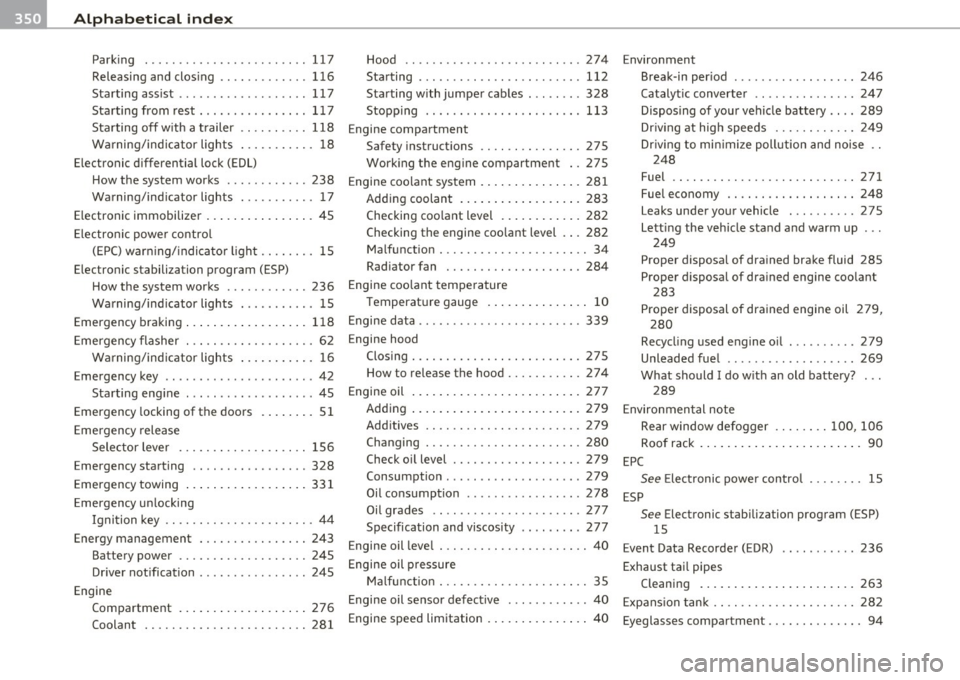
Parking ........ ..... .. .. .... ... 117 Hood .. .. .. .. .. .... ... . ... .. .. . 274
Releasing and clos ing .. .. ......... 116 Starting ........... .. .. .. ....... 112
Starting assist ................ ... 117 Sta rting with jumpe rr cab les ........ 328
Starting from rest . .. ...... ..... .. 117 Stopp ing ... .. ..... .... .. .. .. .. . 113
Sta rting off w ith a t railer ... . .. .. .. 118
Engine compartment
W arning/ind icator lights . .......... 18
Safety instruct ions .... .. .. .. .. ... 275
Elect ronic differential lock (EDL) Working the eng ine compartment . . 275
How the system works .... ... .. ... 238
Engine coo lant system . .. ... . ... .... . 281
Warning/ind icator lights . .......... 17
Adding coolant ... .... .. . .. ... .. . 283
Electronic immobilizer .. .. . ... ... .. ... 45
Checking coo la nt level . ..... ..... . 282
Electro nic powe r contro l Checking the engine coo
lant level . .. 282
( E PC) war ning/ indicato r light .. ...... 15 Ma
lfunction ... ................. .. 34
Electronic stabilization program (ESP) Radiator fan ...
...... .. .. .. .. ... 284
How the system works ............ 236 Engine coo
lant temperature
Wa rning/ind icator lights . .......... 15 T
emperat ure gauge . .... . ... .. .. . . 10
Emergency braking ..... .. .. .. .. .. ... 118 Engine data
... ... ...... ... .. .. .. .. . 339
Emergency flasher . . . . . . . . . . . . . . . . . . . 62
Engine hood
W arning/ind icator lights ... .. ... ... 16 Closing ........
...... ...... ..... 275
E mergency key .. ................ .... 42 How to re
lease the hood .......... . 2 7 4
Starting eng ine . .. .... .. ..... ..... 45 Engine oil
.... ..... ..... .... .. .. .. . 277
Emergency locking of the doors . ... .. .. 51 Adding ...
... .... .... .... ... . ... 279
Eme rgency release
Sele ctor leve r ............. .... .. 156 Add
itives ...... .. .. .. ...... .. ... 279
Changing ............ .... .. ..... 280
E mergency starting .. .. ... ....... ... 328
Emergency towing ..... .. .. ..... .... 331
Emergency u nlocking
Ignition key .. .... ............. ... 44
Energy management .......... .... .. 243
Battery power ................... 245
Dr iver not ification ..... .. .. ... .. .. 245 Check o
il level ............ .. .... . 279
Consumption ....... .. .. .. ....... 279
Oil consumption .... .... . ... .. .. . 278
Oi l grades .. ..... ............. .. 277
Specification and viscosity .. .. .. .. . 277
E ngine oil leve l ... .... ............. .. 40
E ngine oil pressure
M al fun ctio n ... ........... ...... .. 35
Engine
Compartment .. .. .. .. . ... ... .. .. 276
Coolant ...... .......... ...... .. 281 Engine oil sensor defec
tive ..... .. .. ... 40
Engine speed limitatiorn . ....... ..... .. 40 Environment
Break-in per iod ......... ... .. .. .. 246
Catalytic converte r ............... 24 7
Disposing of you r vehicl e battery .. .. 289
Dr iv ing at hig h speeds ............ 249
Dr iv ing to mi nimize poll ution and noise ..
248
Fuel .. .. .... ............. ...... 271
Fuel economy .. .... .... ... .. .. .. 248
Leaks under you r vehicle ... .. ... .. 275
Lett ing the vehicle stand and warm up ...
249
Proper disposa l of dra ined brake fluid 285
Proper disposal of d ra ined engine coo lant
283
Proper disposal of drained engine oil 279,
280
Recycl ing used e ng ine o il ... .. .. .. . 279
Unleaded fue l ............ ... .. .. 269
What should I do w it h an old batte ry?
289
E nvironmen tal note
Re ar w indow defogger ...... .. 100, 1 06
Roo f rack . . . . . . . . . . . . . . . . . . . . . . . . 90
EPC See Elect ronic power con tro l ........ 15
ESP See Electronic stabilization program (ESP)
15
Event Data Recorde r (EDR) 236
Exhaust tai l pipes
Cleaning ... .... ... .. . .... .... .. 263
E xp ans ion tank .. .. .. .. ............. 282
Eyeglasses compartment ......... . ... . 94