cooling AUDI A5 COUPE 2011 User Guide
[x] Cancel search | Manufacturer: AUDI, Model Year: 2011, Model line: A5 COUPE, Model: AUDI A5 COUPE 2011Pages: 362, PDF Size: 84.88 MB
Page 106 of 362

llll..__w __ a _r _m __ a_n _ d_ c_ o_ ld ________________________________________________ _
Applies to veh icles : w ith Deluxe automatic climate contro l p lus
Turn ing the climate control on and off
- Briefly press [ OFF ], or press [AUTO) to turn the climate
control
on .
Press the [ OFF] button for at least 2 seconds to turn the
climate control
off and to block the air supply from the
outside. "OFF" appears in the display.
Climate control turns on again when you press the tem per atur e
re gulator •
Applies to veh ic les: with Deluxe automatic climate contro l plus
Automatic mode !AUTO]
The standard operating mode for all times of the year.
Turning on autom atic mode
- Set the temperature between 60 ° F (+16 °C) and 84 °F
(+28 °().
- Press the [AUTO I button.
Automatic mode ensures constant temperatu res in the interior and
dehumidifies the air inside the vehicle. Air temperature, volume and
distribution are controlled automatically to reach or maintain the
desired interior temperature as q uickly as possib le . Fluctuations in
exterior temperature and the effects of temperature from the posi
tion of the sun are compensated for automatically.
Th is operating mode works only in an adjustable temperature range
of 60° F (+16°() to 84°F (+ 28°C) . If a temperature below 60° F
(+ 16°() is selec ted, LO appears in the display . At temperatures above
84°F (+28°(), HI is disp layed . At both extreme settings, climate
control runs continuously at maximum cooling or heat ing power .
T he re is no temperature regulation .•
Applies to veh icles: w ith De luxe automat ic climate control p lus
Setting the temperature
The temperature can be set separately for the driver's
side and front passenger's side.
Fig . 1 0 1 T emperat ure
s etti ng regu lator
- Rotate the regulator ~ fig. 101 to the left to reduce the
temperature, or to the right to increase the temperature .
The selected temperature appears on the climate control display.
When the MMI d isp lay is turned on, the temperature setting appears
for a few seconds on the screen. •
Page 109 of 362
_______________________________________________ W_ a _r_m _ a_ n_d _ c_o _l_ d _ __.ffl'I
<£> For the sake of the environment
As soon as the rear window is clear, you should switch the rear
window defogger off. The reduced power consumpt ion has a benefi
cial effect on fue l consumption .•
Ap plies to vehicl es : w ith De lux e auto matic cl ima te cont ro l plu s
AC mode !AC ]
Turning AC off
-Press the !AC] button .
Turning AC on
-Press the !AC] button again.
The cooling system is turned on in AC mode. The heating and ventila
tion system is cont rolled automatically.
[I] Tips
If the LED in the switch does not illumin ate after AC mode has been
turned on(= turning the AC off), there is a fault in an air-conditioning
component. Please consult a authorized dealership if there is an
operat ing problem. •
Contro ls a nd e quip
m en t Vehicle
OP-eration
Applies to ve hicles : wi th Deluxe au tomat ic cl im at e con tro l plus
Air vents
Air distribution determines the air flow from the indi
vidual vents .
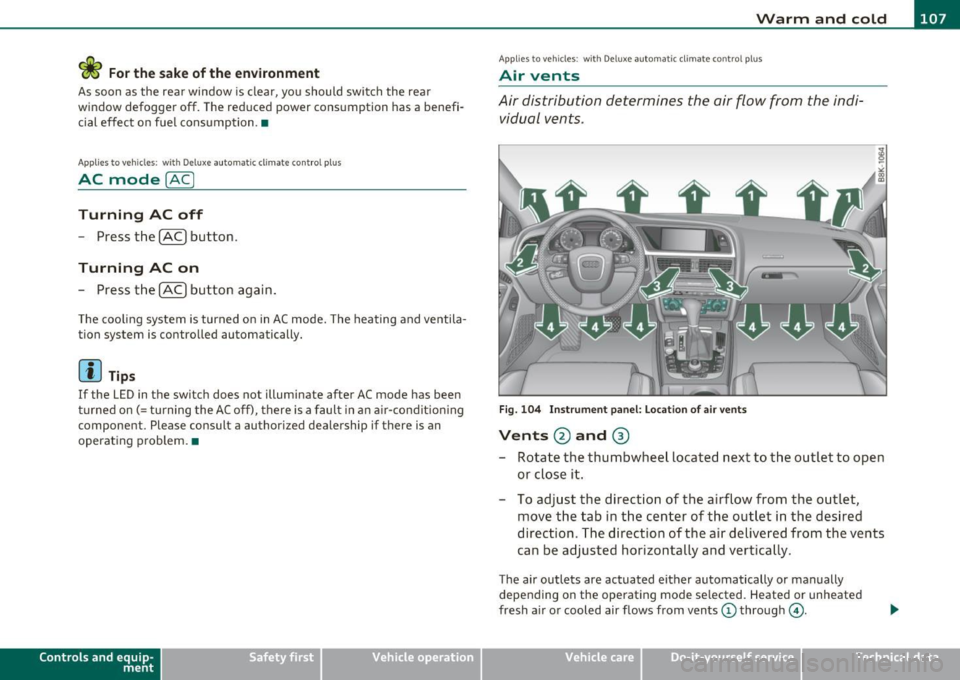
Fig. 104 Instrument panel: Location of air vents
Vents @and ®
- Rotate the thumbwheel located next to the outlet to open
or close it.
- To adjust the direction of the airflow from the outlet,
move the tab in the center of the outlet in the desired
direction . The direction of the air delivered from the vents
can be adjusted horizontally and vertically .
The air outlets are actuated either automatically or manually
depending on the operat ing mode selected. Heated or unheated
fresh air or cooled air flows from vents(!) through @.
Vehicle care Do-it-yourselt service iTechnical data
Page 110 of 362
![AUDI A5 COUPE 2011 User Guide 1111....__w __ a _r_ m __ a_n_ d_ c_ o _ l_d _______________________________________________ _
(I] Tips
If the climate control is running in cooling mode, air flows mainly
from vents @ and @. T](/img/6/57583/w960_57583-109.png "AUDI A5 COUPE 2011 User Guide 1111....__w __ a _r_ m __ a_n_ d_ c_ o _ l_d _______________________________________________ _
(I] Tips
If the climate control is running in cooling mode, air flows mainly
from vents @ and @. T")
1111....__w __ a _r_ m __ a_n_ d_ c_ o _ l_d _______________________________________________ _
(I] Tips
If the climate control is running in cooling mode, air flows mainly
from vents @ and @. To achieve adequate cooling, you should never
close these vents completely. •
Applies to vehicles: with Deluxe automatic cl imate control plus
Rear air vents
The rear air vents are located in the center console.
- Rotate the thumbwheel to open and close the vents .
- To adjust the direction of the airflow from the outlet,
move the tab in the center of the outlet in the desired
direction . The direction of the air delivered from the vents
can be adjusted horizontally and vertically.
The air vents are actuated either automatically or manually
depending on the operating mode selected. Heated or unheated
fresh air, or cooled air flows from the vents .
The air vents to heat the rear footwell are located under the front
seats.
(I] Tips
If the climate control is operating in cooling mode, air flows primarily
from the vents in the center console. To achieve adequate cooling,
you should never close these vents completely. •
Applies to vehicles: with De luxe automatic climate contro l p lus
Economical use of the climate control
system
Economical use of the climate control system helps save
fuel.
When the climate control system is working in cooling mode,
engine performance is reduced and fuel consumption is
affected. To keep the time the climate control system is on as
short as possible, you should do the following:
- To save fuel, turn off cooling mode by pressing the AC
button (indicator light goes out).
- In addition, if you open the window or the panoramic
sliding/tilting sunroof* while driving, turn off cooling
mode by pressing the AC button (indicator light goes out).
- If the vehicle is extremely hot due to the heat of the sun,
briefly open doors and windows.
~ For the sake of the environment
When you save fuel, you reduce emissions from the vehicle. •
Deluxe automatic climate control
plus - basic settings
Applies to veh icles: with De luxe automatic climate control plus
General information
The basic climate control settings can be adjusted in the
radio or f\1/\11*.
-Select: Function button I CAR] > Control button AC. ~
Page 254 of 362
Trailer towing
"-------------------------------------------------
Trailer load distribution
Be sure the load in the trailer is held securely in pla ce to prevent it
from shifting forward, backward or s ideways.
Never allow a passenger to ride in a trailer => & in "Driving instruc
tions" on
page 252.
Engine cooling system
Towing a trailer makes the eng ine work harde r. It is important that
the cooling system's performance is up to the additional load. Make
sure that the cooling system has enough fluid.
Tire pressure
When towing a trailer, inflate the tires of your vehicle to the cold tire
pressure listed under "Full load" on the label located either on the
dr iver's side B-pillar (visible when the door is open) or inside the fuel
filler flap . Inflate trailer tires to trailer and tire manufacturers' spec
ifications.
Lights
The headl ight settings should be checked w ith the trailer attached
before driving off. Check to make sure both vehicle and trai ler lights
are working properly.
Safety chains
Be sure trailer safety cha ins are properly connected from the trailer
to the hitch on the vehicle. Leave enough s lack in the chains to permit
turning corners. When you install safety chains, make sure they will
not drag on the road when you are driving.
T he chains should cross under the trailer tongue to p revent it from
dropping in case of separation from the hitch.
Driving instruct!ons
Driving with a trailer always requires extra care and
consideration.
To obtain the best possible handling of vehicle and trailer,
please note the following:
- Do not tow a loaded trailer when your car itself is not
loaded.
- Be especially careful when passing other veh icles .
- Observe speed limits.
- Do not drive at the maximum permissible speed.
- Always apply brakes early.
- Monitor the temperature gauge .
Weight distribution
Towing a loaded trailer w ith an empty car results in a highly unstable
distr ibution of weight. If this cannot be avoided, drive at very low
speeds only to avo id the r isk of losing steer ing control.
A "balanced" rig is easier to operate and control. Th is means that the
tow vehicle should be loaded to the extent possible and permissible,
wh ile keeping the trailer as light as possible under the c ircumstances.
Whenever possible, trans fer some cargo to the luggage compart
ment of the tow vehicle while observing tongue load requirements
and vehicle loading considerations.
Speed
Th e higher the speed, the more difficult it becomes for the driver to
control the r ig . Do not drive at the maximum permiss ible speed.
Reduce your speed even more if load, weather or wind conditions are
unfavorable -part icularly when go ing downhill.
Reduce vehicle speed
immediately i f the trailer shows the slightest
sign of swaying.
Do not try to stop the swaying by accelerating. _,
Page 280 of 362
-Checking and filling
-------=----- -=-----------------------------------------
For more information about engine oil that has been approved for
your veh icle, please contact either your authorized Audi dealer or
Audi Customer Relations at 1 (800) 822-2834 or visit our web site at
www.audiusa .com or www.audicanada.ca . Here you will also find a
current list of oils (manufacturers, brand names etc.) that conform to
Audi oil standard VW 502 00 .
Changing the engine oil
The engine oil and oil filter must be changed according to the mileage
(kilometers) and time intervals specified in your vehicle's Warranty
&
Maintenance booklet . Do not exceed these intervals - harmful
deposits from o ld engine oil can reduce engine performance and can
lead to expensive engine repa irs.
Changing the oil at the recommended intervals is so very important
because the lubricating properties of oil decrease gradually during
normal vehicle use. If you are not sure when you have your oil
changed, ask your authorized Audi Service Adviso r.
Under some circumstances the engine o il should even be changed
more frequent ly. Change oil more often if you drive mostly short
distances, operate the veh icle in dusty areas or mostly under stop
and-go traffic conditions, or when you use your vehicle where temper
atures stay below freez ing po int for long periods.
Detergent additives in the oil will make fresh oil look dark after the
engine has been running for a short time. This is normal and is not a
reason to change the oil more often than recommended .
Damage or malfunctions due to lack of maintenance
It is essentia l that you change yo ur oil at the recommended intervals
using only engine oil that complies with Audi oil standard
VW 502 00. Your Limited New Vehicle Warranty does not cover
damage or malfunctions due to fa ilure to follow recommended main
tenance and use requirements as set forth in the Audi Owner's
Manual and Warranty
& Maintenance booklet. Your dealer will have
to deny warranty coverage unless you present to the dealer proof in
the form of Service or Repair Orders that all scheduled maintenance
was performed in a timely manner. •
Engine oil consumption
The engine in your vehicle depends on an adequate
amount of oil to lubricate and cool all of its moving parts.
In order to provide effective lubrication and cooling of internal
eng ine components, all inte rnal comb ustion eng ines consume a
certain amount of oil. Oil consumption varies from engine to engine
and may change sign ifican tly over the life of the engine. Typically,
engines with a specified break-in period (see~
page 246) consume
more oil dur ing the break- in period than they consume after oil
consumption has stab ilized.
Under normal conditions, the rate of oil consumption depends on the
quality and viscosity of the oil, the RPM (revolutions per minute) at
which the engine is operated, the ambient temperature and road
conditions. Further factors are the amount of oil dilution from water
condensation or fuel residue and the oxidation level of the oil. As any
eng ine is subject to wear as mileage builds up, the oil consumption
may increase over time until replacement of worn components may
become necessary.
With all these variab les coming into play, no standard rate of oil
consumption can be established or specified . There is no alternative
to regular and frequent checking of the oil level, see
Note .
If the yellow engine oil level warning symbol in the instrument
cluster lights up, you should check the oil level as soon as possible
~ page 279. Top off the oil at your earliest convenience~ page 279.
& WARNING
Before you check anything in the engine compartment , always
read and heed all WARNINGS ~
& in "Working in the engine
compartment" on page
275.
Page 283 of 362
___________________________________________ C_ h_e _c _k_ i_n ~g_ a_n_ d_ f_ i_ll _i_n _g __ _
& WARNING (co ntinued )
• When removing the oil drain plug w ith your fingers , sta y as far
away as possible . Alway s keep your forearm parallel to the ground
to help p revent hot oil from running down your arm.
• Drain the oil into a container de signed for this purpose, one
large enough to hold at least the total amount of oil in your
engine .
• Engine oil is poisonous. Keep it well out of the reach of chil
dren.
• Continuous contact with u sed engine oil is harmful to your
skin. Always protect your skin by washing oil off thoroughly with
soap and water.
0 Note
N ever mix o il additives wi th you r engine oil. These a dditives can
damage your engine and adversely affect your Audi L imited New
Vehicle Warranty.
ffi For the sake of the environment
• Before changing your oil, first ma ke s ure you know w here yo u can
prope rly dispose of the used o il.
• Always dispose of used engine oil properly . Do not dump it on
garden so il, wooded areas , into open streams or down sewage drains .
• Recy cle used e ngine o il by taking it to a used eng ine oil colle ction
facili ty in your area, or contact a service statio n.•
Safety first
Engine cooling system
Coolant
The engine coolant performs two functions: it keeps the
engi ne f rom over heat in g and it prote cts the engine fro m
free zing in the winter .
The coo ling system is sealed and generally requires little attention.
Th e cool ing sys tem h as been filled a t the f actory w ith a permanent
coo lant wh ic h does not need to be changed . The coolant consists of a
mi xtu re of water and the manufacturer 's glyco l-basedcoo lant add i
t ive Gl2++ antifreeze w ith anticor ros ion addit ives (50% for USA
mode ls ; 60% for Ca nadian mode ls). This mixture both ass ures the
necessa ry frost protect ion and p rotects meta l components in the
engine's cooling system from corrosion and scaling. It also raises the
boiling poin t of the coo lant.
Do not red uce the concentrat io n of the coolant in t he summer by
adding p lain wate r. The proportion of coolant additive must be at
least 50 % but not more than 60 %
to maintain antifreeze protection
and coolin g efficiency. If the coolan t fros t pro tection is too low , the
coo la nt cou ld freeze and damage t he veh icle heat ing and engine
cooling system .
For year-ro und d riving, a ntifree ze is adde d at the fac to ry fo r tempe r
atures down to:
• - 31°F(-3 5°C) USA
• -40°F ( -40°() Canada.
Yo u can mix the Gl2 ++ coo lant add itive with other additives (G12 + or
Gl2) . A lways check wi th yo ur auth o rized Audi dealer .
& WARNING
Before you check anything in the engine compartment, always
read and heed all WARNINGS =>
& in "Working in the engine
compartment " on
page 275.
Vehicle care Technical data
Page 284 of 362
___ C_h_ e_c _k _i_n -=g :a,__ a_n_ d_ f_ i_ l _li _n _,g;._ __________________________________________ _
0 Note
• Before w inter sets in, have the coolant checked to see if the
coolant additive in your vehicle is sufficient to meet the climate
conditions. This is especially important if yo u live in a region where
the winter is extremely cold.
If necessary, increase the proportion of
coolant additive to 60% .
• When adding coolant additive to your cooling system, remember :
- We recommend using only coolant additive G12++ (check the
label) for your vehicle. This coolant additive is available at autho
r iz ed Audi dealers. Other types of antifreeze can s ignificantly
reduce corrosion protection. The resulting corrosion can cause a
loss of coolant and serious engine damage.
• Do not add any type of radiator leak sealant to your vehicle 's
engine coolant. Adding radiator repair flu id may adversely affect the
function and performance of your cooling system and cou ld result in
damage not covered by your New Vehicle Limited Warranty .•
Checking the engine coolant Level
The engine coolant level can be checked with a quick
glance.
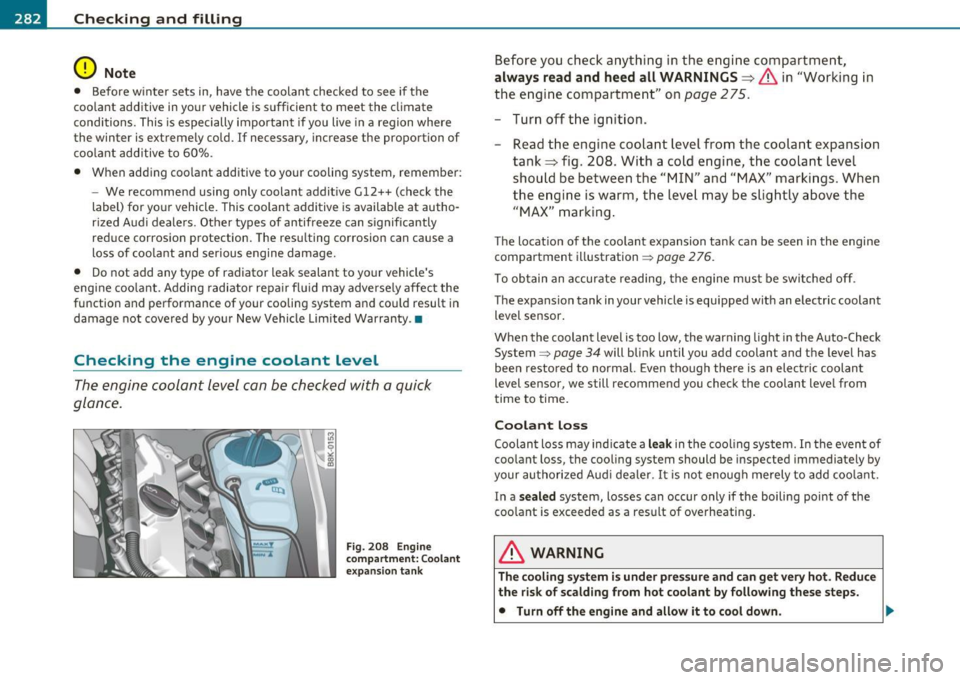
Fig. 208 Engine
co mpartment : Coolant
expansion tank
Before you check anything in the engine compartment,
always read and heed all WARNINGS~ & in "Working in
the engine compartment" on
page 275.
-Turn off the ignition.
- Read the engine coolant level from the coolant expansion
tank~ fig. 208 . With a cold engine, the coolant level
should be between the "MIN" and "MAX" markings. When
the engine is warm, the level may be slightly above the
"MAX" marking.
The locat io n of the coolant expansion tank can be seen in the engine
compartment illustration~
page 276.
To obtain an accurate reading, the engine must be switched off.
The expansion tank in your vehicle is equipped with an electric coolant level sensor.
When the coolant level is too low, the warning light in the Auto-Check
System =>
page 34 will blink until you add coolant and the level has
been resto red to normal. Even though there is an electric coolant
level sensor, we still recommend you check the coolant level from
time to time.
Coolant loss
Coolant loss may indicate a leak in the coo ling system. In the event of
coolant loss, the cooling system should be inspected immediately by
your authorized Audi dealer. It is not enough merely to add coolant.
In a
sealed system, losses can occur only if the boiling point of the
coo lant is exceeded as a result of overheating .
& WARNING
The cooling system is under pressure and can get very hot. Reduce
the risk of scalding from hot coolant by following these steps.
• Turn off the engine and allow it to cool down.
Page 285 of 362
___________________________________________ C_ h_e _c _k_ i_n ~g_ a_n_ d_ f_ i_ll _i_n _g __ _
& WARNING (co ntinued )
• Prote ct your face , hands and arms from escaping fluid and
st eam by covering the cap with a large, thick rag.
• Turn the cap slowl y and very carefully in a counter-clockwise
d irection while applying light, downward pressure on the top of
the cap.
• To avoid being burned, do not spill ant ifreeze or coolant on the
exhaust system or hot engine part s. Under certain conditions , the
e thylene glycol in engine coolant can catch fire .
0 Note
Do not add any type of radia tor leak sealant to your vehicle 's eng ine
coo la nt. Adding radiator repair fluid may adverse ly affect the func
t ion and pe rforma nce o f yo ur cooling system and could result in
damage not covered by yo ur New Vehicle Limited Warranty. •
Adding coolant
Be very careful when adding engine co olant.
Before you c heck anythi ng in the eng ine co mpart men t,
always read and heed all WARNINGS~ & in "W ork ing in
the e ngine compartm ent" on
page 2 75.
- Turn o ff t he engine.
- Let t he engine cool dow n.
- Place a thi ck rag over the coolan t expans io n tank
~ page 282 , fig . 2 08 a nd carefully turn the ca p cou nter
clockw ise
~ & .
- Ad d cool ant .
- Twist t he ca p on again
tightly.
Safety first
Replaceme nt eng ine coolant must conform to exact spec ifications
=> page 281, "Cool an t". Even in an emerge ncy, i f coolan t additive
Gl2 ++, Gl2+ or Gl2 is not available, do not use a different add itive .
U se plain water instead until you can get the correct additive and ca n
restore the correct ratio . This should be done as soon as possible .
If you have lost a considerable amount of coolant, then you shou ld
add co ld antifree ze and co ld wate r only w hen t he e ng ine is co ld .
Always use
new engine coo la nt w hen refi lling.
Do not fill coolant a bove the "M AX" mark . Excess coolant will be
forced ou t thr ough t he pr ess ure relief va lve in t he cap when the
engine becomes hot.
& WARNING
• The cooling system i s under pressure and can get very hot.
Reduce the risk of scalding from hot coolant by following these
steps.
-Turn off the engine and allow it to cool down .
- Protect your face , hands and arms from escaping fluid and
steam by covering the cap with a large, thick rag.
- Turn the cap slowly and very carefully in a counter-clockwise
direction while applying light, downward pre ssure on the top
of the cap .
- To avoid be ing burned, do not spill antifreeze or coolant on
the exhaust system or hot engine parts. Under certain condi
tions, the ethylene glycol in engine coolant can catch fire.
• Antifreeze i s poisonous . Always store antifreeze in its original
c ontainer and well out of the reach of children .
• If you drain the coolant, it must be caught and safely stored in
a proper container clearly marked "poison ". ..
Vehicle care Technical data
Page 350 of 362
___ A_ l_,, p_ h _ a_b_ e_ t_ic _a_ l_ in_ d_e _ x ____________________________________________ _
Cargo area
See Loading the luggage compartment
177
Cargo net .. .. ... ..... .. .. .. .. .. . .. . 84
Catalytic converter .................. 247
Center a rmrest
Adjusting .. .. .................... 82
Sto rage compartment ... ..... ..... 82
Cert ification .. .. .. .. .. .. ... .... .... 343
Changing a flat ti re .. .. .. .. ......... 316
Cha ng ing a wheel ........... .. .. .. .. 316
Chang ing engine oil .. .. ... .......... 280
Chassis Undercoating ... .. .. ...... .... . .. 262
Checking Engine coo lant level ........ .... .. 282
Checking tire pressure ............ ... 297
Child res tra int system anchors ... .. .. . 229
Child restra ints
Dange r of using chi ld restraints in the front
seat ........ ...... ...... .. .. .. 192
Where can I get add itiona l information
a bou t child rest rain ts and t he ir u se? ...
234
Chi ld safety ....... ... ... .. ... ... ... 215
Convertible locking retractor . ... ... 225
Important sa fety instructions for using
child safety seats .... .... ... .. .. 218
Importa nt th ings to know whe n driving
w ith children ................. .. 215
Insta lling a child restraint using the LATCH
system . ... ..... ....... .. .. . .. 231
Lower anchorages . ............. .. 230 Mounting and releas
ing the anchorage Coat hooks ... ... ... .. .. .... ... . ... . 94
hook ........ .. .... ...... ..... 23 1
Cold t ire inflation p ressure .... ... . ... 295
T ethe r anchors .. ... .. .. .. .. .... . 232
T ethe r straps . ....... .. .. ... .. .. . 232 Compact spare tire
........... ....... 314
See also Spare t ire ............... 314
Chi ld safety seats ............ .. .. .. . 221
Booste r se ats .. .. .... .... .. .... . 223
Convert ible chi ld sea ts ......... .. . 222
Convert ib le lock ing retractor . ... ... 225
Dange r of using child restraints in the front
seat .. .. .. .. .. ... ... ... .. ... .. 192 Compass mirror .
.... .. .............. 71
Com pliance . ................. .... .. 343
Consumer Information ... .... ... 179, 340
Contacting N HTSA ....... .. ... .... .. 179
Conven ience closed .. .. .. .. .......... 54
How do I p roperly install a child safety seat Conven
ience key . .. .. .. ............. . 48
in my vehicle? ...... .. .. ... .. .. . 218 START ENGINE STOP button .
.. 114, 115
In fant seats .............. .. ..... 221 Starting engine ..
... ..... .. .. .. .. 114
Insta lling .. .... .. .. .. .. . ... .. ... 225 Switching eng
ine off ...... .. .. .... 115
LATC H system .. ...... ...... ..... 231 Switching on
ignition ........ ... .. 114
Safety instruct ions .. .. .. .. .. .. ... 218 Unlock
ing and lock ing vehi cle ... .... 48
Cigare tte lig hter . ... .... ... . ... .... .. 92 Conven
ience opening . .. .... .......... 54
Cleaning Convert
ible chi ld safety seats .. ... .. .. 2 22
Al canta ra ® (syn the tic sue de) .. .... . 266
Convert ible lock ing retractor
E ngine comp artment ...... .. .. .. . 267
Activat ing .... ........... ... .... 227
E xhaust t ail pipes .... ... . ... .. .. . 263
Deactivating ... ... .... ..... .... . 228
Fabrics an d fabric cove rings ... .... . 263
Using to secu re a child safety seat . . 225,
Instrument panel ..... .. . ... .... . 264 227
Interior .. .. ... .. .. .. .... .. .. .. . 263
Coolant system .. .... .. ............. 28 1
Leathe r ............. .... .. ..... 265
Cooling System
MMI control console ............. . 263
Expansion tank ........... ... ... . 282
M MI display . .. .. ............... . 263
Cornering light .... .. .. .... .......... 61
Plastic and viny l ............... .. 260
Cruise con trol
Plastic parts ........... .. ... ... . 26 4
Safety belts ......... ... .. .. .. .. . 267
Tr im st rips ..... ...... .... .. .. .. . 259
tr im str ips .. .. ........... .. .. .. . 260 Ch
angin g speed .. .. .... ......... 1 20
Prese lect speed ...... .. .. .. .... .. 12 0
Switching off ... .. .. .. .. ... .. .. .. 120
Switching on ... .. .. .. .. ... .. ... . 119
Cleaning and protection ...... .. .. .. . 256
Warning/indicator lights ... .. .. ... . 17
Clo ck ............ ...... ...... .. .. .. 12
Cruis ing range .. ... . .. .... ... ..... .. 24