fuel cap AUDI A5 COUPE 2011 User Guide
[x] Cancel search | Manufacturer: AUDI, Model Year: 2011, Model line: A5 COUPE, Model: AUDI A5 COUPE 2011Pages: 362, PDF Size: 84.88 MB
Page 297 of 362
________________________________________________ T_ i_ re _ s_ a_ n_d_ w_ h_ e_ e_l _s _ ....... JIII
Occupant loading and distribution for vehicle normal load for various designated seat ing capacities
Designated seating capacity, num- Vehicle normal load , number of Occupant distribution in a nor
mally loaded vehicle
ber
of occupants occupants
4 2 2 in front •
Co ld tire inf lation pressure
Tire pr essur e aff ects the overall handling, performance and safety of a vehicle.
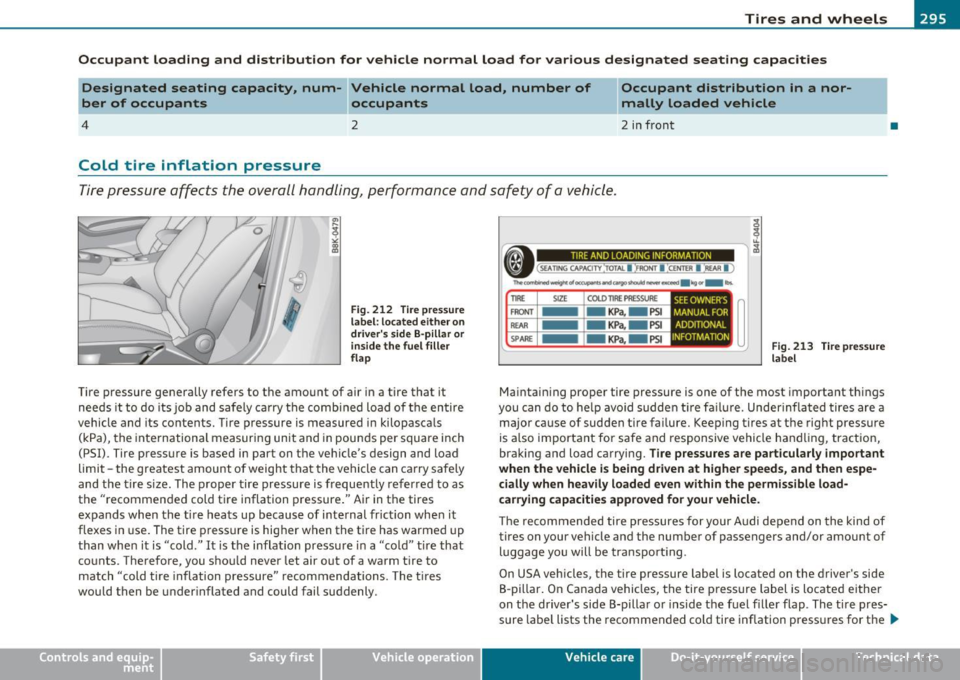
F ig . 2 12 Tire pre ssure
label : loca te d e ithe r on
drive r's s ide B -pillar or
i ns ide th e fuel fille r
flap
Tire pressure generally refers to the amount of air in a tire that it
nee ds it to do its job and safe ly ca rry the combi ned load of t he en tire
vehicle and its contents. Tire pressure is measured in kilopascals
(kPa), the inte rn ational measuri ng un it and in pou nds per square i nch
(PSI) . Tire pressure is based in part on the ve hicle's design and load
limit -the greatest amount of weight that the vehicle can ca rry safe ly
and the t ire size . The proper tire pressure is frequent ly refe rred to as
the "recommended cold t ire inflation pressure ." Air in t he tires
expands when the t ire hea ts up because of i nternal fric tion whe n it
flexes in use . The tire press ure is higher when the ti re has warmed up
t han whe n it is "cold."
It is the inflat io n pr essu re in a "co ld" t ire that
counts. The refore, you sho uld never let air out of a warm t ire to
match "cold ti re infla tion pressure" recommendations . The t ires
would then be under inflated and could fail suddenly.
Vehicle OP-eration
(.
~ ( SEATING CAPACllY JOTAL l:FRONT l:CENTER I )!EAR I )
TIRE AND LOADING INFORMATION
Tot--""'91"dOCC10-,ndQ,gc>"""-"1 ___ "90<- lb$.
TIRE SIZE COW TIRE PRESSURE
FRONT -KPa, - PSI
REAR -KPa, -PSI
Fig . 213 Tire pres sure
label
Ma intain ing proper tire pressure is one of the most important things
you can do to he lp avoid sudde n tir e f ailur e. Under infl ated tires a re a
major cause of sudden tire fa ilure. Keep ing t ires at the rig ht pressure
is a lso important for s afe and responsive vehi cle ha nd ling, tractio n,
braking and load carrying.
Tire pressures are particularly important
when the vehicle is being driven at higher speeds , and then e spe·
cially when heavily loaded even within the permissible load
carrying capacities approved for your vehicle .
The recommended tire pressures for your Audi depend on the kind of
ti res on your vehicle and the numbe r of passengers and/or amou nt of
l u ggage you will be transpo rting .
On USA vehicles, the tire pressure label is located on the d river 's side
8 -pi lla r. O n Ca nada vehi cles, the tire pressure label is located either
on t he driver's side 8- pilla r o r i nside the f uel filler flap . The tire pres ·
s u re labe l lists the recommended co ld tire inflation press ures for the ..,.
Vehicle care Do-it-yourselt service iTechnical data
Page 298 of 362
-~_T_ ir_e_ s_ a_ n_ d_ w_ h_e_ e_ ls _______________________________________________ _
vehicle at its maximum capacity weight and tires that were on your
vehicle at the tim e it was manufactured.
If you wish to improve comfort when operating the vehicle at
normal load (up to 3 occupants) , you can adjust tire pressures to
those specified for normal vehicle load. Before operating the
vehicle at maximum load, you must increase the tire pressures to
those specified for maximum vehicle load
=> &.
Bear in mind that the tire pressure monitoring system* ca n only
monitor the tire pressures you have stored. The system does not
recogn ize the load condit ion of your vehicle.
The effectiveness of the tire pressure monitoring system* wi ll be
impaired if you store normal load pressures but then operate the
vehicle at its maximum load
=> &.
See the illustration => page 295, fig. 212 for the locat ion of the label
either on driver's side B-pillar or inside the fuel filler flap (color of the
actual label and exact location on the vehicle will vary slightly).
Note that the following tab le is accurate at the time of going to press
and is subject to change. In the event of discrepancies, the tire pres
sure label (On USA vehicles, the tire pressure label is located on the
dr iver's side B-pillar. On Canada vehicles, the tire pressure label is
located e ither on the driver's s ide B-pillar or inside the fuel filler flap)
always takes precedence.
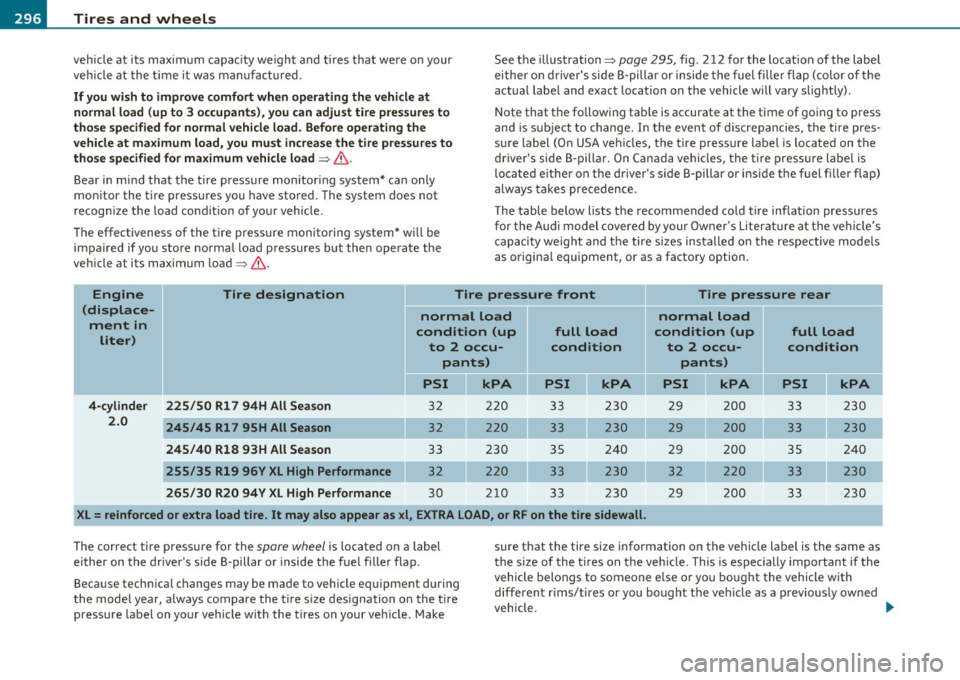
The table below lists the recommended cold tire inflation pressures
for the Audi model covered by your Owner's Literature at the vehicle's
capacity weight and the tire sizes installed on the respective models
as origina l equipment, or as a factory option.
Engine
(displace ment in liter) Tire designation
Tire pressure front Tire pressure rear
normal load normal load
condition (up full load condition
(up
full load
to 2 occu- condition to 2 occu- condition pants) pants)
PSI Jl kPA PSI kPA PSI kPA PSI II kPA
4-cylinder 225/50 Rl 7 94H All Season 32 220 33 230 29 200 33 230
2.0
245/45 Rl 7 95H All Season 32 220 33 230 29
200 33 230
245/40 R18
93H All Season 33 230 35 240 29 200 35 240
255/35 R19 96V XL High Performance 32 220 33 230 32 220 33 230
265/30 R20 94Y XL High Performance 30 210
33 230 29 200
33 230
XL=
reinforced or extra load tire. It may also appear as xi, EXTRA LOAD, or RF on the tire sidewall.
The correct tire pressure for the spare wheel is located on a label
either on the driver's s ide B-pillar or inside the fuel filler flap.
Beca use technica l changes may be made to vehicle equipment during
the model year, always compare the tir e s ize designation on the tir e
pressure label on your vehicle with the tires on your vehicle. Make sure that the tire size information on the vehicle label is the same as
the
size of the tires on the vehicle. This is especially important if the
vehicle belongs to someone e lse or you bought the vehicle with
different rims/tires or you bought the veh icle as a previous ly ow ned
vehicle. _.,,
Page 300 of 362

-~_T_ ir_e_ s_ a_ n_ d_ w_ h_e_ e_ ls _______________________________________________ _
pressure for a trip -even one that you would not consider to be
" long. " See =>
page 299, "Tires and vehicle load limits" for more
important information.
Always use an accurate tire pressure gauge when checking and
adjusting inflation pressures. Check all of the tires and be sure not to
forget the spare tire. If the pressure in any tire is too high when the
tire is "cold ," let air out of the tire slowly with the edge of the tire
gauge and keep checking the pressure until you reach the pressure
that is correct for the load (passengers and luggage) and kind of
driving you plan to do .
If the pressure in any tire is too low, note the difference between the
pressure in the cold tire and the pressure you need and add the air
that you need to reach the correct pressure for the vehicle load
(passengers and luggage) for the tires on your vehicle as listed on the
on your vehicle and in this manual and the kind of driving you plan to
do.
Never exceed the maximum inflation pressure listed on the tire
sidewall for any reason.
Remember that the vehicle manufacturer, not the tir e manufacturer,
determines the correct tire pressure for the t ires on your veh icle.
It is important to check the tire pressure when the tires are cold.
• Read the required tire pressure from the tir e pressure label. On
USA vehicles, the tire pressure label is located on the driver's side 8-
pillar. On Canada vehicles, the tire pressure label is located either on
the driver 's side 8 -pillar or inside the fuel filler flap. The tire pressure
label lists the recommended cold t ire inflation pressures for the
vehicle at its maximum capac ity weight and the tires that were on
your vehicle at the time it was manufactured. For recommended tire
p ressures for normal load cond it ions, please see chapter
==> page 295.
• Turn the valve stem cap counter-clockw ise to remove it from the
tire valve.
• Place the air pressure gauge on the valve. •
The tire pressures should only be checked and adjusted when the
ti res are cold . Th e slightly raised pressures of warm tires must not be
reduced .
• Adjust the tire pressure to the load you are carrying .
• Reinstall the valve stem cap on the valve .
When should I check the tire pressure?
The correct tire pressure is especially important at high speeds . The
pressure shou ld therefore be checked at least once a month and
always before starting a journey . Do not forget to check the tire pres
sure for the spare wheel.
When should I adjust the tire pressures?
Adjust the t ire pressure to the load you are carrying . After chang ing a
wheel
or replacing whee ls you have to adjust the tire pressures on all
wheels. In addition, you must then initialize the new tire pressures in
the tire pressure monitoring system*=>
page 310.
& WARNING
Incorrect tire pressures and/or underinflation can lead sudden tire
failure, loss of control, collision, serious personal injury or even
death.
• When the warning symbol appears in the instrument
cluster, stop and inspect the tires .
• Incorrect tire pressure and/or underinflation can cause
increased tire wear and can affect the handling of the vehicle and
stopping ability .
• Incorrect tire pressures and/or underinflation can also lead to
sudden tire failure, including a blowout and sudden deflation,
causing loss of vehicle control.
• The driver is responsible for the correct tire pressures for all
tires on the vehicle. The applicable pressure values are located on
a sticker on the driver's side B-pillar or on the inside of the fuel
filler flap. .,_
Page 301 of 362
________________________________________________ T_i_r _e _s _ a_n _ d_ w_ h_ e _ e_l_s __ _
& WARNING (co ntinued )
• Only when all tire s on the vehicle are filled to the correct pre s
sure, the tire pressure monitoring sy stem* can work correctly .
• The u se of incorrect tire pressure values can lead to accidents or
other damage. Therefore it is essential that the driver observe the
specified tire pressure values for the tires and the correct pres
sures for the function of the tire pre ssure monitoring system *.
• Always inflate tires to the recommended and correct ti re pre s
sure before driving off.
• Driving with underinflated tire s bend more , letting them get
too hot resulting in tread separat ion, sudden tire failure and loss
of control.
• Excessive speed and /overload ing can cause heat build-up ,
sudden tire failure and loss of control.
• If the tire pressure is too low or too high , the tires will wear
prematurely and the vehicle will not handle well.
• If the tire is not flat and you do not have to change a wheel
immediately, drive at reduced speed to the neare st service station
to check the tire pressure and add air as requ ired.
0 Note
Dr iv ing without valve stem caps can cause damage to the tire valves.
T o preven t this, a lways make su re t hat fac tory ins talle d va lve stem
caps on all wheels a re securely mo unted on the valve.
'£> For the sake of the environment
Under inflated t ires will a lso increase the fuel consumption .•
Tires and vehicle Load Limits
T here are lim its to the amount of load or we ight that any vehicle a nd
any t ire can c arry . A veh icle t hat is over loaded w ill not hand le well an d
Safety first
is more difficult to stop . Overloading can not only lead to loss of
veh icle co ntro l, bu t ca n also d amage important p art s o f the ve hicl e
and can lead to sudden ti re failure, including a blowout and sudden
deflation that can cause the vehicle to crash.
Your safety a nd tha t of you r passe ngers also depe nds o n mak ing s ure
that load limits are not exceeded. Vehicle load incl udes everybody
and everyt hing in and on t he ve hicle. T hese lo ad lim its are techn ic a lly
referred to as the vehicle's
Gross Vehicle Weight Rating ("GVWR").
Th e "GVWR" includes the weight of the basic vehi cle, all facto ry
installed accessories, a fu ll tank of fue l, o il, coo la nt and other fluids
plus maxim um loa d. Th e maxim um loa d includes t he nu mber of
passeng ers th at t he ve hicl e is intended to car ry ("sea ting capa city ")
with an ass umed weig ht of 150 lbs . (68 kg) for each passenger at a
design ated seating posit ion a nd the to tal weig ht of any luggage in
the vehicle. If yo u tow a tra iler, the weight of the trailer hitch and the
t ongue weig ht of the lo ad ed t railer mus t be include d as pa rt of the
vehicle load.
Th e
Gross Axle Weight Rating ("GAWR") is the maximum load that
can be a pplied at each of t he ve hicle's two axles .
The Gross Vehicle We ight Rating and the Gross Ax le We ight Rating
are li sted on the safety comp lia nce s tick er label loca ted either on the
dr ive r's side B-pilla r o r on the inside of the fuel filler flap . Aud i has
4 se ating posi tions, 2 in the fron t and 2 in the rea r for tot al s eating
capacity of 4. Each seating position has a seat belt~
page 181,
"Safety be lts".
Th e fact t hat there is an upper lim it to your v eh icle 's Gross Vehicle
Weight Rating means that t he tota l weight of whatever is being
c a rried in th e veh icle ( in cl ud ing the w eight of a t railer hitch and the
tongue weight of the loaded tra iler) is limited. The mo re passengers
in the veh icle or p assengers who are heavier th an the sta ndar d
we ights assumed mean that less we ight can be carried as luggage.
Th e ti re pressure label on yo ur Audi also lis ts th e maxim um combined
we ight of all of the occupants and luggage or other cargo that the
vehicle can car ry. For the location o f the labe l~
p age 2 95, fig . 21 2. ~
Vehicle care Technical data
Page 306 of 362
-~_T_ i_ re _ s_ a_n _ d_ w_ h _e_ e_ ls _________________________________________________ _
holding, driving characteristics, and safety of the vehicle . The table
(::::>
page 295) lists specifications of the tires approved for the Audi
models covered by your Owner's Literature.
The tire pressure label (On USA vehicles, the tire pressure label is
located on the driver's side B-pillar. On Canada vehicl es, the tire pres
sure label is located either on the driver's side B-pillar or inside the
fuel filler flap)(=>
page 295, fig. 213) l ists the specifications of the
orig inal equipment tires installed on your vehicle at the time it was
manufactured.
Federal law requires tire manufacturers to place standardized infor
mation on the sidewall of all tires =>
page 303, fig. 216. This infor
mation identifies and descr ibes the fundamental characteristics, the
quality grade of the tire and also provides a tire identification number
for safety standard cert ification and in case of a reca ll.
Tire specifications
Knowledge of tire specifications makes it easier to choose the correct
tires. Radia l tires have the tire specifications marked on the sidewall,
for examp le:
P255 / 35 Rl9 96V XL
This contains the following information:
P Indicates the tire is for passenger cars (where applicable)
255 Nominal tire width in mm of the tire from sidewall edge to side -
wall edge . In general, the larger the number, the wider the tire
35 Height/w idth ratio in percent (aspect ratio)
R Tire construction: Radial
19 Rim diameter code (in inches)
96 Load rating code
Y Speed rating letter code
XL (or "xl", "E XTRA LOAD", or "RF" Indicates that the tire is a"Rein
forced" or an "Extra Load" tire
M+S (or "M/S") Indicates that the tire has some mud and snow capa
bility The tires could a
lso have the information of direction of rotation
=>
page 291 .
Tire manufacturing date
The manufacturing date is also indicated on the tire sidewall
(poss ibly only on the
inner side of the wheel):
"DO T ... 2209 ... "means, for example, that the tire was produced in
the 22nd week of 2009.
Speed rating (letter code)
The speed rating letter code on the wheels ind icates the maximum
permissible road speeds =>
& in "Winter tires" on page 307.
P up to 93 mph (150 km/h)
Q up to 99 mp h (158 km/h)
R up to 106 mph (1 70 km/h)
S up to 110 mph (180 km/h)
T up to 118 mph (190 km/h)
U up to 124 mph (200 km/h) H up to 130 mph (210 km/h)
V up to 149 mph (240 km/h)
3
)
Z over 149 mph (240 km/h)3
)
W up to 168 mph (270 km/h)3
)
Y up to 186 mph (298 km/h)3>
Your vehicle is normally factory equipped with tires, which possess
excellent driving characterist ics and give yo ur Audi optimum driv in g
comfort. An electronic speed limiter=>
page 29 will normally prevent
your vehicle from go ing faster than the tire speed rating::::>
&-
U.S. DOT Tire Identification Number (TIN) and tire
manufacture date
This is the tire's "serial number". It begins with the letters "DOT" and
ind icat es that the tire meets all federal standards. The next two
~
3l For tires w ith a maximum speed capability over 149 mph (240 km/h), t ire
man ufact urer s sometimes use the letters "ZR."
Page 310 of 362
IIIL-_T.:..:..: ir:....:e~ s=---= a~ n:..:..: d:......: w..:....:.. h:....:e~ e= ls=--------------------------------------------------
& WA RNING (conti nu ed )
• Winter t ires have ma ximum speed rating that may be lower
than your vehicle' s maximum speed .
• Never drive faster than the speed for which the winter or other
tires installed on your vehicle are rated .
& WARNING
Always adjust your driving to the road and t raffic conditions.
Never let the good ac celeration of the winter tire s and all-wheel
drive tempt you into taking extra risks . Always remember:
• Wh en braking, an alt-wheel drive vehicle handle s in the same
way as a front drive vehicle.
• Drive carefully and reduce your speed on icy and slippery roads,
even w inter tires cannot help under black ice conditions.
~ For the sake of the environment
Use summe r tires when weather condit ions permit. They are quieter,
do not wea r as quickly and redu ce fuel consumpt io n.•
Snow chains
Snow c hains may be fitted only to the front wheels, and only to
certain tire sizes. Ask your authorized Audi dealer on which tire sizes
snow chains c an be u sed.
T he snow cha ins must have low-profile links and m ust not be thicker
t han 0 .53 in ch ( 13 .5 mm), incl uding the lock .
Remove wheel center covers and t rim discs befor e put ting snow
chains on your vehicle=:,
0. For safety reasons cover caps must then
be fi tted ove r th e wheel bo lts. These a re available from auth orized
Audi dealers.
& WARNING
Using the wrong snow chains for your veh icle or installing them
in correctly can incre ase the risk of loss of control le ading to
serious personal injury.
• Snow chains are available in different size s. Always make sure
to follow the instructions provided by the snow chain manufac
turer .
• When driving with snow chains never dri ve faster than the
s peed permitted for your specific snow chain s.
• Always observe local regulations.
0 Note
• Remove snow chains before d riving on roads not covered with
s now to avoid d am ag ing t ires and wear ing t he snow chains dow n
unnecessarily.
• Snow chains, which come into direct contact with the wheel rim,
can scratch o r damage it. Therefo re, make sure that the snow chains
are sui tably cove red. C heck t he pos it ion of the snow cha in s a ft e r
dr iving a few yards and correct if necessary . Fo llow the instruct ions
from t he snow ch ain man ufactur er when doing so.
[ i ] Tips
Whe re snow chains are mandatory on certain roads, t his normally
also app lies to ve hicles with all wheel drive. •
Wheel bolts
Wheel bolts must al ways be tightened to the c orrect
torque .
The desig n of wheel bo lts is matched to the factory installed rims. If
differen t rims a re fitted, the co rrect wheel bolts wi th the r ig ht length
and correctly shaped bolt heads must be used. This e nsures that ..,_
Page 339 of 362

______________________________________________ G_e_ n_e _ r_ a_ l_ in_ f_o _r_ m_ a_ t_ i _o_ n __ ,n
The safety compliance sticker
is your assurance that yo ur new vehicle complies with all applicable
Fede ral Motor Veh icle Safe ty Standards which were i n effect at the
time the vehicle was manufact ured . Yo u can fi nd this sticker on the
left doo r jamb.
It shows the mont h and year of prod uct io n and the
vehicle identification number of your veh icle (perforation) as well as
the Gross Vehicle Weight Rating (GV WR) and the Gross Axle Weight
Rating (GAWR).
The high voltage warning label
is located o n the loc k carrier.
The spark ignition system complies with the
Canadian standard ICES-002. •
Weights
Gross Vehicle Weight Rating
The Gross Vehicle Weight Rating (GVWR), and the Gross Axle Weight
Rating (GAWR) for front and rear are listed on a sticker on the left
door jamb.
T he Gross Vehicle Weight Rating includes the weight of the basic
vehicle pl us f ull f uel tank, oil and coo la nt, plus max im um load, whi ch
includes passenger weight (150 lbs./68 kg per des ignated seating
position) and luggage weight~& .
Gross Axle Weight Rating
The Gross Axle Weight Ra ting is the ma ximum lo ad that can be
applied at each axle of the vehicle~&.
Vehicle capacity weight
The vehicle capac ity weight (max . load) is listed either on the driver's
side B -pillar or inside the fuel fille r flap .
Safety first
Roof weight
The maximum permissible roo f weig ht is 165 lbs. (75 kg ). T he roof
we ight is made up of the weight of the roof rac k system and t he
we ight of the o bject being transported ~
page 90, "R oof load" .
& WARNING
• The a ctual Gros s Axle Weight Rating at the front and rear axle s
should not exceed the permissible weights, and their combinat ion
must not exceed the Gros s Vehicle Weight Rating.
• Exceeding permissible weight rat ings can result in veh icle
damage, accident s and per sonal injury.
0 Note
• T he veh icle c apac ity we ight fig ures apply when the lo ad is distrib
uted evenly i n the vehicle (passengers and luggage) . When t rans
porting a heavy load in the l uggage compa rtment, ca rry the load as
near to the rear ax le as possible so that the veh icle's handling is not
impai red .
• Do not exceed the max imum permissible axle loads or the
maximum gross vehicle weig ht. Always remember that the vehicle's
hand ling will be affected by the extra load . Therefore, adjust your
speed according ly.
• Always observe loca l regu lat ions .•
Dimensions
The specifications refe r to the basic model. Differe nces may occur
depending on the mode l ty pe a nd options ordered, for examp le, t ire
sizes . .,,
Do-it,yourself service Technical data
Page 353 of 362
_____________________________________________ A_ l..:, p_ h _ a_b_ e_ t_ ic_a_ l_ in_ d_e _ x __ _
F
Fan
Deluxe automatic climate control ... . 98
Deluxe automatic climate cont rol p lus ..
1 05
Radiato r ... ........ .... .. .. .. .. . 284
Fas tening
Booster seats .. .... .. .. ... .. .. .. . 223
Convert ible chi ld safety seats .... .. . 222
I nfant seats ...... .. . ... .. .. .... . 221
Fla t tire
Ch anging . .. ........... .. .... .. . 316
Floor ma ts ...... .. .... .. .. .. .. .... . 176
Fog lights ....... ... .. .. .. .. .... .. .. 59
Foot pedals .. .. .. .. ... .... .. ... . .. . 176
For the sake of the environment Gaso line fumes and the env ironment 271
Reducing eng ine no ise by early upshifting
11
Ref ueling ..... .. .. .. .. .. .. ... ... 271
Saving fue l by early upshifting .. ... .. 11
Fro nt airbags
Description ......... .. .. .. .. ..... 194
How they wo rk . ........... .... .. . 199
Fro nt ashtray ... .. .. .. .. ........ .... . 91
Front seats . ... .. .. .. ... ... .... .. .. . 73
Adjusting ... ... .... ... .. ... . ... . 173
Child restra ints in the front seat . .. . 192
Conven ience side view . .. ....... .... 80
Symmetrical seat posit ions ... ....... 80
F ronta l co llisions and the laws of physics 182
Controls and equip
ment Safety first
Fuel
Add itives .. ... ..... ... ... .. ..... 269
Blended gasoline .... .. .. ......... 269
Consumpt ion .... .... ... ... ... .. . . 24
Filler neck .. .. .. .... .. .. ... .... .. 270
Fuel gauge . .... ...... .. .......... 1 2
Gaso line ................ .... .. .. 2 69
G asoline additives ... ... ... .... .. . 270
Octane rating ... .... .. .. ..... .... 2 69
Recommendation ... ...... ... .. .. 269
Ref uelli ng ..... .... .. .. .. ...... . 271
Reserve ................. .. .. .. .. . 12
Tank capacity . .... .. ........ ..... 339
Unlocking the fuel filler flap by hand . 273
F uel economy messages (efficiency program)
28
Fuel filler flap Unlocking the fuel filler flap by hand . 273
Fuel supply too low ... .. .. .. .... .... .. 39
Fuses Assignment ............ 324, 325, 326
Rep lacing . ... .. .... .. .. .. .. .. .. . 323
G
Garage door opener (Homelink ®) ... ... 166
Gas d ischarge lamps ........ ......... 327
Gauges Engine coo la nt tem 1pe ra ture ......... 10
F uel gauge . ...... ...... .......... 1 2
Ta chometer . ... .... ... . ... .... . .. 11
Gear recommendat io n ... ... ......... . 27
Gearshift indicator ... .... ............ 22 Gearsh
ift lever
6 -speed manual transmission ...... 150
General illustration Instruments and contro ls ..... . ... .. . 9
Glossary of tire and loading terminology 292
Glove compartment . .. .. .. .. .. .... .. . 93
Gross Veh icle Weight Rating (GVWR) . .. 33 7
H
Head lig hts
Fog lights ... .. .. .. .. .. .. ... ... ... 59
Rear fog lights ....... ..... .. .. .. .. 59
Head rest ra ints . ....... ...... .... .. . 17 4
Adjus ting ................ ...... . 17 4
F ront seats ........ ............... 80
Rear se ats . ... .. .. .. .. .. ..... .... 81
Remov ing ... .. .. .. ... .... ..... ... 81
Headlight Washe r system .... .. ....... ...... 65
Headlight washe r reservoi r .......... . 290
Headl igh ts
Adaptive light ...... .... .... .. .. .. 61
Headlight range con trol defective . ... 40
Heatable Front sea ts .. ....... .... .. .. .... . 109
Heated Rear window . . . . . . . . . . . . . . . 100, 106
Washer fluid nozzles ............... 65
Heated outside mirrors .. ... .. .. . ... .. 69
Heate r
Del uxe au toma tic clim ate cont rol .. .. 95
Vehicle operation Vehicle care Do-it-yourself service Technical data
Page 359 of 362
_________________________________________ ..!.A~ lp~ h~a ~b~ e~ t~ i~c ~a ~l ...!_i~n ~d ~e~ x~ _ffllll
Tires and vehicle load limits .. .. .... 299 Trunk pass-through .... .. .. .. ... ..... 88 W
Wheel bolts ..................... 308 Turn s ignals ... .. ... .... ..... .. .. .. .. 62
W inter t ires ............. ... ... .. 307 Warning/indicator lights ... ..... .. . 16 Warning lights . .. ................... 14
T ires/Wheels
Low aspect ratio tires ............. 309
Tire pressure mo nitoring system 16,310
T ool kit .. ................... .. .. .. . 314
T orn or frayed safety be lts ............ 184
T ouch -up paint ....... .. .. .. ... .. .. . 260
T ow ing
Fro nt eye let ..................... 331
Rea r eye let ...................... 332
T ow tr uck procedu res . .. .......... 3 31
TP MS
Ti re pressure monito ring system . .. . 3 11
Trailer towing ................... .. . 251
Operating instructions ... ...... .. .
251
Tech nica l requirements ..... .. 251,252
Tips .................... ... .. .. . 253
T .. ransm1ss1on ... ..... .... ... ... .. .. . 150
6-speed manual transmission . .. . ... 150
tiptronic . ... .. .. ... ..... .... . .. . 150
Tr ansport Canada . .................. 180
Tread Wear Indicator (TWI) ........... 301
T rip comp uter
Fuel consumption ... .. .. .. .... .. .. 24
Mileage ......... .. .. ... .... .. .. .. 24
Single-trip memory ............ .. .. 25
Total-trip memory ................. 25
Tr ip odometer .... .. ... . ..... .. .. .. .. 13
T runk escape handle .................. 52
T ru nk lid
See Luggage compartment .......... 51
Controls and equip
ment Safety first
Warning/indicator lights .
... .... .. .. .. 10
u Adaptive cruise control ............ 129
Airbag system ...... ...... .. .... .. 16
Undercoating ... .. ... ... .. .. .. .. ... 2 62
Anti-lock brake system (ABS) ........ 17
Unfasteni ng safety be lts .. ... ........ 188
Brake system .. ..... ..... ... . ... .. 18
Unidirect ional tires .. ... .. .. .. .. ..... 291 Cru
ise con trol . ................... 17
Uniform t ire quali ty g r.ad ing . ......... 306 Electromechanical
parking brake ..... 18
Unlocking Lu ggage compartment lid ....... .... 51
Powe r locking switch ... ........ ... . SO
Remote cont rol key ................ 47
Us ing the me chanical key ........ .. . 4 9 E
lectron ic power cont rol . ........... 15
E lectron ic stabi liz ation prog ram ( ESP) 15
Hi gh beam ........ ............. .. 17
Ma lf u n ction Indi cato r L amp ( MIL) .... 17
Sa fety belt . ... ... ... .... .. .. ... .. 16
Use of jumper cables ... .. .. .. .. .. ... 329 T
ir e pressure mon itoring system ... .. 16
T urn signals ... ... ... ... .. ... ... .. 16
V Warra nty cove rages . .. ..... ......... 340
Washer reservo ir ............. .. .. .. . 290
Valet parking .................... ... . 55
w h'
a s ing .... .. ... .... .. .. .. .... .. . 2 56
Vani ty mir ror . ... ...... .. .. ... .... .. . 64 Automatic car wash ... ... .... .. .. . 257
Vehicle Ide ntificat io n Numbe r (VIN) .. .. 336 by hand ......
... .. .. .. .. .... .. . 257
Vehicle jac k ................ .. ...... 319 Genera
l informat ion ...... ... .. .. . 256
Vehicle lite rat ure ... ............ .... .. S with
a power washer ............. . 258
Vehicle tool kit ..................... 314 Waxing .
.. .... ....... ...... .. .... . 2 59
Vehicle-care products ... .... ... ... .. . 256 Wea r indicator ... ... ...... ... .... .. 301
Ventilation Deluxe au tomatic climate control .... 95
Delu xe au tomati c clim ate cont rol p lu s
101 Weatherstrips .
... .. .. ...... .. .. ... . 26 1
w' h e1g ts ... ..... ....... ....... . ... . 337
What happens if you wear your safety belt too
loose? ........... .. .... .... .. . 186
What happens to u nbelted occupants? .. 183
What impairs driving safety? . .... . .. .. 171
Vehicle operation Vehicle care Do-it-yourself service Technical data