air condition AUDI A5 COUPE 2011 Owner's Manual
[x] Cancel search | Manufacturer: AUDI, Model Year: 2011, Model line: A5 COUPE, Model: AUDI A5 COUPE 2011Pages: 362, PDF Size: 84.88 MB
Page 242 of 362
Intelligent technology
'-------------------------------------------------
Corrosion
T he re may be a te ndency fo r d irt to build u p on the bra ke pads and
co rrosion to form on the d iscs if the car is not dr iven reg ularly o r only
for short trips with litt le use of the bra kes .
If the brakes a re not used freq uen tly, or if co rrosion has formed o n
the discs, it is advisable to clean off the pads and discs by braking
fir mly a few times from a mode rat ely h igh spee d~ & .
Faults in the brake system
If yo u sh ou ld noti ce a sudden increase in b rake peda l trave l, then one
of the two brake circu its may have failed~& .
Low brake fluid level
Ma lfunctions can occ ur in t he brake system if the brake fluid level is
t oo low. The bra ke f lu id level is moni tore d elec tron ically.
Brake lin ing wear status
Brake lin ing wear may be checked by v isua l inspect ion of the condi
tion of the brake pads throu gh the open ings in the whee l.
If neces
sary, the whe el may be removed fo r thi s insp ection~
page 3 16,
"Changing a w hee l".
& WARNING
• You should perform braking maneuvers for the purpose of
cleaning the brake system only if road conditions permit. Other
road users must not be put at risk - you may cau se an accident!
• Before descending a steep grade, reduce speed and shift trans
mission into a lower gear or lower driving range. Do not ride the
brakes or hold the pedal down too long or too often . This could
cause the brakes to get hot and diminish braking efficiency.
• Do not "ride the brakes " by resting your foot on the pedal when
you do not intend to brake . This may cause the brakes to overheat ,
premature wear and increased stopping distance.
• Under certain climatic and operating condition s such as
passing through water , driving in heavy rain or after washing the
& WARNING (co ntinued )
vehicle, the effectiveness of the brakes can be reduced . In winter,
ice can ac cumulate on the brake pads, linings, dis cs and drums.
Carefully apply brakes for a test. Brakes will dry and ice coatings
will be cleaned off after a few careful brake appli cations.
• Driving for an extended period of time on salt-covered roads
without u sing your brakes can also affect braking efficiency . Clean
off accumulated salt coating from b rake discs and pads with a few
careful brake applic ations.
• If you damage the front spoiler, or if you install a different
spoiler, be sure the air flow to the front brakes i s not obstructed .
Otherwise the brake system could overheat reducing the effective
ness of the entire brake system.
• Failure of one brake circuit will impair the braking capability
resulting in an increased stopping di stance. Avoid driving the
vehicle and have it towed to the nearest authorized Audi dealer or
qualified workshop.
n
Brake booster
The b roke boost er odds extra broking po wer.
The bra ke boos ter wor ks wi th v acuum pressure whi ch is crea ted o nly
when the eng ine is ru nning~ &.
& WARNING
• Never let the vehicle roll to a stop with the engine shut off.
• If the brake booster is not working, for example when towing
your vehicle , or because the brake booster has somehow been
damaged, the brake pedal mu st be pressed considerably harder to
make up for the lack of booster assistance. •
Page 250 of 362
Driving and environment
The catalytic converter is an effic ient ''clean-up" dev ice built into the
ex hau st system of the ve hicle. The c ata ly tic converter bu rns many of
the pollutants in the exhaust gas before they are released into the
atmosphere.
T he exclusive use of unleaded fuel is c rit ical ly import ant for the life of
the cata lytic converter and proper funct ioning of the eng ine.
& WARNING
• Do not park or operate the vehicle in areas where the hot
e xhaust system may come in contact with dry grass, brush, fuel
spill or other material which can cause a fi re.
• Do not apply additional undercoating or rustproofing on or
near the e xhaust man ifold , exhaust pipes , catalytic converte r or
heat shields . During driving, the substance used for undercoating
could overheat and cause a fire.
0 Note
• Be aware that j ust one tank filling with leaded fuel will already
seriously degrade the performance of the ca talytic conve rter.
• Do not exceed the correct engine oil level =>
page 279.
• Do not dr ive until the fuel tan k becomes complete ly empty . The
engine could misfire . Unburned fuel cou ld also get into the exha ust
system and th is cou ld cause the catalyt ic converter to overheat .
• Do not tu rn o ff the igni tion while t he vehi cle is moving.
• Do not contin ue to operate your vehicle under these conditions, as
otherwi se fuel c an reac h the c atal ytic conve rter. This co uld res ult in
overheat ing of the converter, requir ing its replacement.
• T o ass ure eff icient ope ra ti on of the Emiss ion Cont rol System:
- Have your vehicle maintained properly and in accordance with
the se rvice recommendations in your Wa rranty
& M aintenance
booklet. -
Lack of proper maintenance as well as improper use of the
veh icle w ill impair the f unc tion of the emiss io n con trol sys te m an d
co uld lead to damage.
<£> For the sake of the environment
Even when the Emiss ion Control System is operating p roperly, the
exhaust gas can have a s ulfur -like exhaust gas smell under some
operat ing states . This depends on the sulfur content of the fu el being
used. Using a different brand of fuel may help, or filling the tank with
lead -free supe r grade gasoline. •
Operate your vehicle economically
and minimize pollution
General
Your personal style of d riving will det ermine the economy
of your vehicle, as well as exhaust and noise le vels.
Fuel eco nomy, e nvir onmenta l impa ct, and wea r o n your eng ine ,
brakes and tires large ly depend on three factors:
• your persona l driving style
• operat ing cond itions
• t echni cal lim itat io ns
If you anticipate what you need to do next and drive economica lly,
you c an easily cut yo ur fuel consum ptio n by 10- 15 pe rcen t. T his
sect io n w ill give you some tips on how you can he lp the env ironment
and your pocket book.
[ i ] Tips
Th e consumption estimates as pub lished by ENV IRONMENTAL
PROTECTIO N AG ENCY ( EPA) and Transport Ca nada may not co rre
spond to your act ua l cons umption on the road, which will vary
Page 255 of 362

Observe speed limits. In some areas, speeds for vehicles towing
t railers are lowe r than for regular veh icles.
Always apply brakes early. When dr iv ing downh ill, sh ift in to a lower
gear to use the engine braking effect to slow the vehicle. Use of the
brakes alone can cause them to overheat and fail.
Coolant temperature
The coolant temperature gauge~ page 10 must be observed care
fully. If the needle moves close to the upper end of the scale, reduce
speed immediately and/or turn off the air conditione r.
If the coolant temperature warning light in the instrument cluster
star ts flashing
-t- , pull off the road, stop and let the engine idle for
about two minutes to prevent heat bu ild-up.
& WARNING
Anyone not properly restrained in a moving vehicle is at a much
greater risk in an accident. Never let anyone ride in your car who is
not properly wearing the restraints provided by Audi. u
Trailer towing tips
Important to know
------------
Your vehicle handles differently when tow ing a tra iler because of the
additiona l weight and different weight distribution. Safety, perfor
mance and economy will greatly depend on how carefu lly you load
your trailer and operate your rig .
Before you actua lly tow your trailer, practice turning, stopp ing and
backing up in an area away from traffic. Keep pract icing until you have
become completely familiar with the way your vehicle-t railer combi
nation behaves and responds.
Controls and equip ment Safety first Vehicle operation
Backing up
is d iff icult and requ ires practice . Backing up with a trailer
generally requires steer ing action opposite to that when backing up
your vehicle without a trailer.
Maintain a greater distance between your vehicle and the one in front
of you. You will need more room to stop . To compensate fo r the
trailer, you will need a larger than norma l turning radius.
When passing, remember that you cannot accelerate as fast as you
normally would because of the added load. Make sure you have
enough room to pass. After passing, allow plenty of room for you r
trailer before changing lanes again.
Avoid jerky starts, sharp turns or rapid lane changes .
[I) Tips
• Do not tow a trai ler during the break-in per iod of your vehicle.
• If you tow a tra iler, your Audi may requi re more frequent mainte
nance due to the extra toad~
page 340. •
Parking on a slope
Do not park on a slope with a trailer. If it cannot be
avoided, do so only after doing the following:
When parking:
-Apply the foot brake.
- Have someone place chocks under both the vehicle and the
trailer wheels.
- With chocks in place, slowly release the brakes until the
wheel chocks absorb the load.
- Turn the wheels towards the curb.
- Apply the parking brake .
Vehicle care Do-it-yourself service Technical data
Page 258 of 362
-~_C_ le_ a_n_ i_ n_ g=- a_ n_d___. p_ ro_ t_e _c_ t_ i_o _n ___________________________________________ _
Cleaning and protection
General information
Regular care preserves vehicl e val ue.
Any automobile is exposed to industria l fumes, co rrosive road salt,
e tc. A well ca red for Audi c an look lik e new many ye ars after pur cha se.
Regu lar and correct care w ill contribute to mai nta in ing t he bea uty
a nd valu e of your Au di.
Furthermore, good care may be a condition for substantiating a
warranty claim should corrosion damage or paint defects occur.
Yo ur au thori zed Audi d eale r h as a var iety of dedicated vehicle-care
products
and can advise w hich ones to use for clea ning the exterior
a n d inter io r of your ve hicle.
W het her you use products recommended by Aud i or other comme r
cia lly availab le cleaning agents , please make sure yo u appl y them
co rrectly .
& WARNING
• Cleaning agents may be poisonous . Keep them out of the reach
of children.
• Heed all caution labels .
• Always read directions on the container before using any
product. Follow the directions carefully.
• Most chemical cleaners are concentrated and have to be
diluted .
• Use spot removing fluids only in well ventilated areas.
• Do not use gasoline, kero sene , diesel fuel , nail polish remover
or other volatile fluids . They may be toxic, flammable or
hazardous in other ways. Do not wash, wax or dry the vehicle with
the ign ition on or the engine running .
& WARNING (continued )
• Do not clean the under sides of chassi s, fenders , wheel covers,
etc. without protecting your hands and arms. You may cut your
self on sharp-edged metal parts.
• Moisture and ice on brakes may impair braking efficiency
~ page 239, "General information ". Test the brakes carefully
each time you wash the vehicle .
'£> For the sake of the environment
Select only envir onmenta lly fr iendly clea ning produc ts . Leftover
cleaning pro ducts sho uld not dis posed of i n the household waste .•
Care of exterior
Washing
F re quent w ashin g protec ts th e vehicle.
T he best protection aga inst env ironmental influences is frequent
w ashi ng and w ax ing. How oft en thi s is requ ired depen ds on :
• How m uch the vehicle is used
• Whe re the ve hicle is parke d (gar age, in the o pen un der tr ees, etc.)
• The seasona l and weather conditions
• Environ mental influences
T he longer bird droppings , insects , tree resin, road and industria l
gr ime, t ar, soo t, road sa lt and o ther ma ter ia ls remain on t he veh icle
body, the more lasti ng their destructive effects w ill be. H igh temper
atu res cause d by ex pos ure to intense s unlight int ensify the co rrosive
effect, part icu larly when humid ity is high as we ll.
~
Page 263 of 362
____________________________________________ C_l_e _a_ n_ i n--= g=--- a_n_ d----' p,__ r_o _t_ e_ c_ t_ i _o_ n __ _
The best way to remove snow from windows and mirrors is to use a
brush. Use a non-abrasive
plastic ice scraper -better still, a spray
deicer -to remove
ice from windows and mirrors.
Th e windows must not be cleaned with insect remover or wax since
these can interfere with the function of the windshie ld wipe r blades
(chatter).
Oil , grease, or silicone residue can be removed with
glass cleaner or
silicone remover. However, wax residue requires the use of a specially
formulated solvent . P lease contact your authorized Audi dea le r for
advice on safe products for wax removal.
Windows should also be cleaned on the inside at regular intervals .
Never dry windows w ith the same chamo is that you use to dry painted
surfaces. Wax residue on the chamois can impair vision through the
windows.
& WARNING
• Always read and heed all WARNINGS and other information
=> page 256.
• The windshield must not be treated with water-repellent
materials. They can increase glare under poor visibility conditions
such as wetness, darkness, or when the sun is low on the horizon.
In addition, they can cause the windshield wipers to chatter.
0 Note
• Never use warm or hot water to remove snow and ice from
windows and mir rors . This could cause the glass to crack.
• To prevent damage to the wires of the rear defogger, do not place
any adhesive stickers on the inside of the rear window over the wires.
• T o help prevent dirt from scratching the window, a lways scrape in
a forward direction -pushing the scraper away from you -never back
and forth.
• Water leaking from the inside of the rear windows may damage
sensitive e lectrica l components located either under the rear parce l
Safety first
shelf or in the rear trunk area. Always ensure that water never leaks
t hrough the body section of the vehicle . You can do this by using
waterproof protection over the vehicle's electrical components (e .g.
when installing window tinting).
• Damage or malfunct ion of electrical components due to water
damage or any other outside influence is not covered by the Audi New
Vehicle Limited Warranty. See your Warranty
& Ma intenance booklet
for additional details about your warranty .•
Weatherstrips
Complete car care includes the weatherstrips as well.
-Apply a suitable rubber conditioner to the weatherstrips
from time to t ime.
To be able seal properly, the weatherstrips around the hood, doors,
rear lid, etc. must remain pliable. Spray the weatherstrips with sili
cone or coat them with talcum powder or glycerin to reta in the flexi
bility of the rubber and to protect them against freezing in the
wi nter.
& WARNING
Always read and heed all WARNINGS and other information
=> page 256.
[ i ] Tips
Keep silicone sprays off the windshield to avoid wiper smear in rain .•
Cast (Light) alloy wheels
Cast (light) alloy wheels require special care.
- Wash the wheels with a sponge or hose brush every other
week. _,.
Vehicle care Technical data
Page 279 of 362
___________________________________________ C_ h_e _c _k_ i_n ~g_ a_n_ d_ f_ i_ll _i_n _g __ ,n
© Windshield/headlight* washer container (W ) . . . . . . . 290
(J) Power steering reservoir . . . . . . . . . . . . . . . . . . . . . . . . . 242
The position of the engine oil filling hole=:> fig. 205 (item@) can
differ depending on the engine design .
& WARNING
Before you check anything in the engine compartment, always
read and heed all WARNINGS=:>
& in "Working in the engine
compartment" on
page 275. •
Engine oil
Engine oil specifications
The engine oil used in your Audi needs the right kind of oil.
The engine in your Audi is a sophisticated power plant that was built
to exacting specifications. This engine needs the right kind of engine
oil that meets specifications regarding quality and viscosity so that it
can run smoothly and reliably. Choosing the right oil and changing oil
within the time and mileage intervals printed in your vehicle's
Warranty
& Maintenance booklet matters a lot more today than it did
years ago. Audi has developed a special quality standard for engine oil
that will help assure that your vehicle's engine will get the lubrication
it needs for proper operation.
Modern engine lubrication has taken a quantum leap in the last few
years. Many synthetic oils available today provide better engine lubri
cation that can outlast traditional petroleum-based oils, making
them a smart choice for use throughout the life of your Audi.
Whether you use synthetic or petroleum-based engine oil, the oil that
you use must conform to Audi's oil quality standard VW 502 00 to help keep your vehicle's engine running smoothly and help prevent
the formation of harmful deposits, sometimes called "sludge", that
over time can lead to expensive repairs.
Safety first
At the time of printing, engine oils available in the U.S. and Canada
that meet the exacting specifications of Audi oil standard VW 502 00
are synthetic engine oils. This does not mean, however, that every
synthetic engine oil will meet Audi oil standard VW 502 00. So always
be sure that you use an approved oil.
To help prevent the formation of harmful deposits use only oil with
the following specifications printed on the oil container:
Audi oil standard VW 502 00
Oil container labels may carry the specification singly or in combina
tion with other designations and oil quality standards.
Viscosity
Engine oils are graded according to their viscosity. The proper
viscosity grade oil for your engine depends on climactic or seasonal conditions where you drive. You can use oil with a viscosity grade of
SAE SW40 across all temperature ranges for normal driving condi
tions.
However, if engine oil viscosity grade SAE SW40 is not available, you
can also use viscosity grade SAE SW-30 or SAE OW-40 as long as it
meets Audi oil quality standard VW 502 00 specifications.
Because engine oil that meets the Audi oil standard may not be avail
able everywhere when you need it, we strongly recommend that you
always carry with you an extra quart (liter) of oil that expressly
conforms to the VW 502 00 specification, in case you have to top off
the oil while on the road.
Only if the level of the oil is at or below the minimum mark - and no
oil that expressly conforms to Audi oil standard VW 502 00 specifica
tions is available -may you top off with a high quality engine oil, pref
erably synthetic-based, that meets ACEA A3, ACEA AS or ACEA BS or
API SL specifications, but even then, only in viscosity grades SAE SW-
40, SAE SW-30, or SAE OW-40. However, during the entire time
between oil change intervals, never top off with more than a total of
0.5 qt/liter engine oil that does not conform to Audi oil specification
vw 502 00. ..
Vehicle care Technical data
Page 280 of 362
-Checking and filling
-------=----- -=-----------------------------------------
For more information about engine oil that has been approved for
your veh icle, please contact either your authorized Audi dealer or
Audi Customer Relations at 1 (800) 822-2834 or visit our web site at
www.audiusa .com or www.audicanada.ca . Here you will also find a
current list of oils (manufacturers, brand names etc.) that conform to
Audi oil standard VW 502 00 .
Changing the engine oil
The engine oil and oil filter must be changed according to the mileage
(kilometers) and time intervals specified in your vehicle's Warranty
&
Maintenance booklet . Do not exceed these intervals - harmful
deposits from o ld engine oil can reduce engine performance and can
lead to expensive engine repa irs.
Changing the oil at the recommended intervals is so very important
because the lubricating properties of oil decrease gradually during
normal vehicle use. If you are not sure when you have your oil
changed, ask your authorized Audi Service Adviso r.
Under some circumstances the engine o il should even be changed
more frequent ly. Change oil more often if you drive mostly short
distances, operate the veh icle in dusty areas or mostly under stop
and-go traffic conditions, or when you use your vehicle where temper
atures stay below freez ing po int for long periods.
Detergent additives in the oil will make fresh oil look dark after the
engine has been running for a short time. This is normal and is not a
reason to change the oil more often than recommended .
Damage or malfunctions due to lack of maintenance
It is essentia l that you change yo ur oil at the recommended intervals
using only engine oil that complies with Audi oil standard
VW 502 00. Your Limited New Vehicle Warranty does not cover
damage or malfunctions due to fa ilure to follow recommended main
tenance and use requirements as set forth in the Audi Owner's
Manual and Warranty
& Maintenance booklet. Your dealer will have
to deny warranty coverage unless you present to the dealer proof in
the form of Service or Repair Orders that all scheduled maintenance
was performed in a timely manner. •
Engine oil consumption
The engine in your vehicle depends on an adequate
amount of oil to lubricate and cool all of its moving parts.
In order to provide effective lubrication and cooling of internal
eng ine components, all inte rnal comb ustion eng ines consume a
certain amount of oil. Oil consumption varies from engine to engine
and may change sign ifican tly over the life of the engine. Typically,
engines with a specified break-in period (see~
page 246) consume
more oil dur ing the break- in period than they consume after oil
consumption has stab ilized.
Under normal conditions, the rate of oil consumption depends on the
quality and viscosity of the oil, the RPM (revolutions per minute) at
which the engine is operated, the ambient temperature and road
conditions. Further factors are the amount of oil dilution from water
condensation or fuel residue and the oxidation level of the oil. As any
eng ine is subject to wear as mileage builds up, the oil consumption
may increase over time until replacement of worn components may
become necessary.
With all these variab les coming into play, no standard rate of oil
consumption can be established or specified . There is no alternative
to regular and frequent checking of the oil level, see
Note .
If the yellow engine oil level warning symbol in the instrument
cluster lights up, you should check the oil level as soon as possible
~ page 279. Top off the oil at your earliest convenience~ page 279.
& WARNING
Before you check anything in the engine compartment , always
read and heed all WARNINGS ~
& in "Working in the engine
compartment" on page
275.
Page 284 of 362
___ C_h_ e_c _k _i_n -=g :a,__ a_n_ d_ f_ i_ l _li _n _,g;._ __________________________________________ _
0 Note
• Before w inter sets in, have the coolant checked to see if the
coolant additive in your vehicle is sufficient to meet the climate
conditions. This is especially important if yo u live in a region where
the winter is extremely cold.
If necessary, increase the proportion of
coolant additive to 60% .
• When adding coolant additive to your cooling system, remember :
- We recommend using only coolant additive G12++ (check the
label) for your vehicle. This coolant additive is available at autho
r iz ed Audi dealers. Other types of antifreeze can s ignificantly
reduce corrosion protection. The resulting corrosion can cause a
loss of coolant and serious engine damage.
• Do not add any type of radiator leak sealant to your vehicle 's
engine coolant. Adding radiator repair flu id may adversely affect the
function and performance of your cooling system and cou ld result in
damage not covered by your New Vehicle Limited Warranty .•
Checking the engine coolant Level
The engine coolant level can be checked with a quick
glance.
Fig. 208 Engine
co mpartment : Coolant
expansion tank
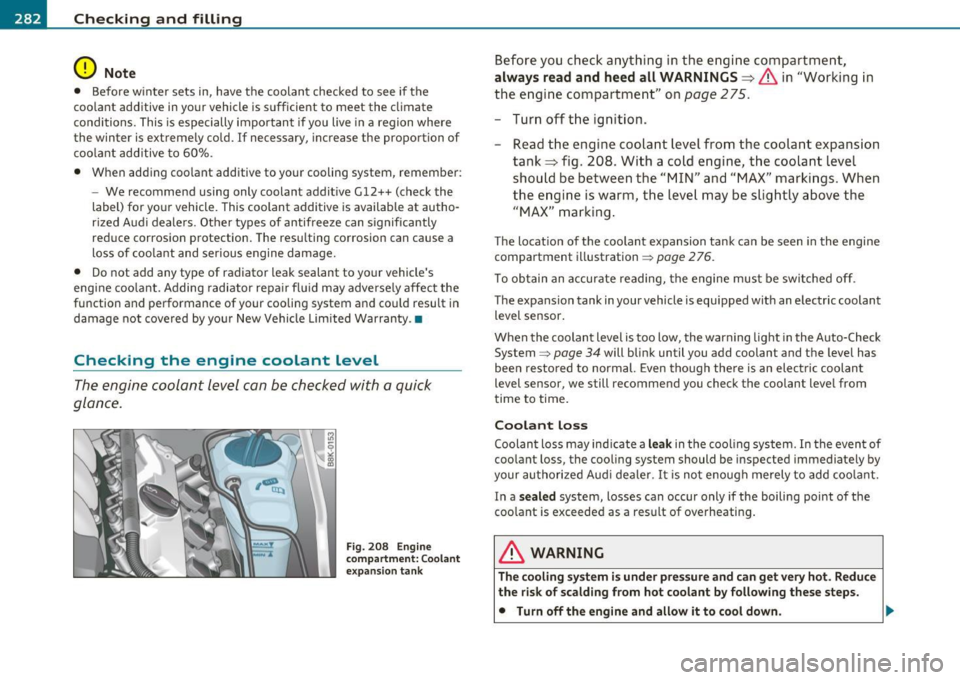
Before you check anything in the engine compartment,
always read and heed all WARNINGS~ & in "Working in
the engine compartment" on
page 275.
-Turn off the ignition.
- Read the engine coolant level from the coolant expansion
tank~ fig. 208 . With a cold engine, the coolant level
should be between the "MIN" and "MAX" markings. When
the engine is warm, the level may be slightly above the
"MAX" marking.
The locat io n of the coolant expansion tank can be seen in the engine
compartment illustration~
page 276.
To obtain an accurate reading, the engine must be switched off.
The expansion tank in your vehicle is equipped with an electric coolant level sensor.
When the coolant level is too low, the warning light in the Auto-Check
System =>
page 34 will blink until you add coolant and the level has
been resto red to normal. Even though there is an electric coolant
level sensor, we still recommend you check the coolant level from
time to time.
Coolant loss
Coolant loss may indicate a leak in the coo ling system. In the event of
coolant loss, the cooling system should be inspected immediately by
your authorized Audi dealer. It is not enough merely to add coolant.
In a
sealed system, losses can occur only if the boiling point of the
coo lant is exceeded as a result of overheating .
& WARNING
The cooling system is under pressure and can get very hot. Reduce
the risk of scalding from hot coolant by following these steps.
• Turn off the engine and allow it to cool down.
Page 285 of 362
___________________________________________ C_ h_e _c _k_ i_n ~g_ a_n_ d_ f_ i_ll _i_n _g __ _
& WARNING (co ntinued )
• Prote ct your face , hands and arms from escaping fluid and
st eam by covering the cap with a large, thick rag.
• Turn the cap slowl y and very carefully in a counter-clockwise
d irection while applying light, downward pressure on the top of
the cap.
• To avoid being burned, do not spill ant ifreeze or coolant on the
exhaust system or hot engine part s. Under certain conditions , the
e thylene glycol in engine coolant can catch fire .
0 Note
Do not add any type of radia tor leak sealant to your vehicle 's eng ine
coo la nt. Adding radiator repair fluid may adverse ly affect the func
t ion and pe rforma nce o f yo ur cooling system and could result in
damage not covered by yo ur New Vehicle Limited Warranty. •
Adding coolant
Be very careful when adding engine co olant.
Before you c heck anythi ng in the eng ine co mpart men t,
always read and heed all WARNINGS~ & in "W ork ing in
the e ngine compartm ent" on
page 2 75.
- Turn o ff t he engine.
- Let t he engine cool dow n.
- Place a thi ck rag over the coolan t expans io n tank
~ page 282 , fig . 2 08 a nd carefully turn the ca p cou nter
clockw ise
~ & .
- Ad d cool ant .
- Twist t he ca p on again
tightly.
Safety first
Replaceme nt eng ine coolant must conform to exact spec ifications
=> page 281, "Cool an t". Even in an emerge ncy, i f coolan t additive
Gl2 ++, Gl2+ or Gl2 is not available, do not use a different add itive .
U se plain water instead until you can get the correct additive and ca n
restore the correct ratio . This should be done as soon as possible .
If you have lost a considerable amount of coolant, then you shou ld
add co ld antifree ze and co ld wate r only w hen t he e ng ine is co ld .
Always use
new engine coo la nt w hen refi lling.
Do not fill coolant a bove the "M AX" mark . Excess coolant will be
forced ou t thr ough t he pr ess ure relief va lve in t he cap when the
engine becomes hot.
& WARNING
• The cooling system i s under pressure and can get very hot.
Reduce the risk of scalding from hot coolant by following these
steps.
-Turn off the engine and allow it to cool down .
- Protect your face , hands and arms from escaping fluid and
steam by covering the cap with a large, thick rag.
- Turn the cap slowly and very carefully in a counter-clockwise
direction while applying light, downward pre ssure on the top
of the cap .
- To avoid be ing burned, do not spill antifreeze or coolant on
the exhaust system or hot engine parts. Under certain condi
tions, the ethylene glycol in engine coolant can catch fire.
• Antifreeze i s poisonous . Always store antifreeze in its original
c ontainer and well out of the reach of children .
• If you drain the coolant, it must be caught and safely stored in
a proper container clearly marked "poison ". ..
Vehicle care Technical data
Page 287 of 362
___________________________________________ C_ h_e _c _k_ i_n ~g_ a_n_ d_ f_ i_ll _i_n _g __ _
The fluid level may drop slightly after some time due to the auto
matic adjustment of the brake pads. This is not cause for alarm.
If the brake flu id level falls considerably below the "MIN " mark, the
brake warning/indicator light (U.S. models:
BRAKE , Canadian mode ls:
{(j)) ) will come on=> page 18 and=> page 33. Do not continue to
ope rate the vehicle. The complete brake system should be thorough ly
checked by an authorized Audi dealer or qualified workshop and the
cause corrected. If the brake fluid level is too low, the brake
wa rning/ind icator light will illuminate. Contact an authorized Aud i
dealer
immediately .
[I] Tips
The brake fluid reservoir is located undernea th the cover. •
Changing brake fluid
Hove the broke fluid changed by on experienced techni
Clon.
Brake fluid absorbs moisture from the air. If the water content in the
brake fl uid is too high, corrosion in the brake system may result after
a period of time. The boiling point of the brake fluid will also decrease
considerably and decrease braking performance.
Therefore, the brake flu id must be changed
every two years. Always
use new brake fluid which conforms to Federal Motor Vehicle Stan
dard "FMVSS 116 DOT 4".
The brake fluid reservoir can be difficult to reach, therefore, we
recommend that you have the brake fluid changed by your authorized
Audi dealer. Your dealer has the correct tools, the right brake fluid
and the know-how to do this for you .
& WARNING
• Brake fluid is poi sonous. It must be stored only in the closed
original container out of the reach of children!
Safety first
& WARNING (continued )
• Brake failure can result from old or inappropriate brake fluid.
Observe these precautions:
-Use only brake fluid that meets SAE specification
J 1703 and
conforms to Federal Motor Vehicle Standard 116. Always check
with your authorized Audi dealer to make sure you are using
the correct brake fluid . The correct type of brake fluid is also
indicated on the brake fluid reservoir.
- The brake fluid must be new. Heavy use of the brakes can
cause a vapor lock if the brake fluid is left in the system too
long. This can seriously affect the efficiency of the brakes as
well as your safety. This could result in an accident .
0 Note
Brake fluid will damage the paint of your vehicle.
ffi For the sake of the environment
Because of the prob lem of proper disposal of brake fluid as well as
th e special tools required and the necessary expertise, we recom
mend that you have the brake fluid changed by your author ized Audi
dealer. •
Battery
General information
Under normal operating conditions, the battery in your Audi does not
need any maintenance . With high outside temperatures or long daily
drives we recommend that you have the electro lyte level checked by
an authorized Audi dealer or qualified workshop . The electrolyte leve l
should also be checked each t ime the battery is charged=> page 288.
~
Vehicle care Technical data