automatic transmission AUDI A5 COUPE 2011 Owner's Manual
[x] Cancel search | Manufacturer: AUDI, Model Year: 2011, Model line: A5 COUPE, Model: AUDI A5 COUPE 2011Pages: 362, PDF Size: 84.88 MB
Page 158 of 362

1111..__T_ r_a _ n_ s_m_ i _s_ s_ io_ n _____________________________________________________ _
Applie s to veh icles : wi th tiptro nic steer ing whe el
Steering wheel with tiptronic
The shift buttons on the steering wheel allow the driver to
shift gears manually.
F ig. 15 0 Steering
wh eel: Sh ift butt ons
- To downshift, touch the button on the left Q.
- To upshift , touch the button on the right G) .
The shift but tons are a ct ivated when the selec to r l ever is in D, Sor in
the manual shift program (t iptronic).
Of course, you can continue to use the manual shift program with the
selector lever on the cente r console. •
Applies to veh icles: w ith automat ic transm ission
Automatic transmission malfunction l
In the event of a system malfunction, the automatic transmission
switches to emergency operation mode.
Gearbox malfunction : you can continue driving
You can continue to dr ive the vehicle . See an authorized Audi dealer
or other qualifie d workshop at the next opportu nity.
Gearbo x malfunction : you can continue driving (limited
functionality)
T he re is a ser ious system malfunc tion:
• The program sh if ts only into certa in gea rs .
• T he engine may stall.
• It is not possible to restart the engine if it has been switched off.
• Continuing to d rive cou ld res ult in subseq uent damage .
0 Note
If the transmission switches to fail-safe mode, you sho uld take the
vehicle to an authorized Audi dea lership as soon as poss ible to have
t he con ditio n corre cted. •
Applies t o vehi cles: with au to m ati c transm iss ion
Emergency release of the selector lever
I f the vehi cle's power supply fails, the selector lever can
be released in an emergency.
Fig. 1 51 Removi ng
as htr ay in sert ..
Page 256 of 362

Trailer towing
"-------------------------------------------------
- Place an automatic transmission* in P, respectively a
manual transmission in first or reverse gear.
When restarting after parking:
- Apply the foot brake.
- Start the engine.
- Move the selector lever to
D, respectively a manual trans-
mission in first gear.
- Release the parking brake and slowly pull out and away
from the wheel chocks.
- Stop and have someone retrieve the wheel chocks.
00 Tips
If you move the selector lever of the automatic transmission* to P
before applying the parking brake and before blocking the wheels,
you may have to use more force later to move the lever out of the P
position. •
Page 277 of 362

Checking and filling Ill
-------------~--
Closing the engine hood
- Pull the hood down until the pressure from the struts is
reduced.
- Let the hood
drop down and latch in place. Do not try to
push it shut;
it may fail to engage=:> &.
& WARNING
A hood that is not completely latched could fly up and block your
view while driving.
• When you close the engine hood, check it to make sure the
safety catch has properly engaged. The hood should be flush with
the surrounding vehicle body parts.
• If you notice while driving that the hood is not secured prop
erly, stop at once and close it. •
Working in the engine compartment
Be especially careful whenever you work in the engine
compartment.
Whenever you must perform any work in the engine compartment,
for example checking and filling different fluids, there is a risk of injury, burns and accidents. To prevent personal injury always
observe the following WARNINGS. The engine compartment of any
vehicle is a hazardous area=>& .
& WARNING
To help avoid injury, before you check anything under the hood:
• Turn off the engine.
• Remove the ignition key.
• Apply the parking brake.
Safety first
& WARNING (continued)
• Move selector lever of automatic transmission to "P" (Park);
put manual transmission in Neutral.
• Always let the engine cool down. Hot components will burn
skin on contact.
• To reduce the risk of being burned, never open the hood if you
see or hear steam or coolant escaping from the engine compart
ment. Wait until no steam or coolant can be seen or heard before
carefully opening the hood.
• Keep children away from the engine compartment.
• Never spill fluids on hot engine components. They can cause a
fire.
• Never touch the radiator fan. The auxiliary electric fan is
temperature controlled and can switch on suddenly.
• Never open the coolant reservoir cap when the engine is still
warm. The coolant system is pressurized and hot coolant could
spray out.
• Protect your face, hands and arm from steam or hot engine
coolant by placing a thick rag over the cap when you open the
coolant reservoir.
• If work on the fuel system or the electrical system is necessary:
-Always disconnect the battery.
- Never smoke or work near heaters or open flames. Fluids in
the engine compartment could start a fire.
- Keep an approved fire extinguisher immediately available.
• To avoid electrical shock and personal injury while the engine is
running or being started, never touch:
-Ignition cables
- Other components of the high voltage electronic ignition
system.
• If you must perform a check or repair with the engine running: ..,
Vehicle care Technical data
Page 278 of 362

lffll __ C_h_ e_c _k _i_n -=g :a,__ a_n_ d_ f_ i_ l _li _n _,g;._ __________________________________________ _
& WARNING (continued )
-First, fully apply the parking brake , move selector lever of
automatic transmission to "P" (Park); put manual transmi s
sion in Neutral.
- Alway s use extreme caution to prevent clothing, jewelry , or
long hair from getting caught in the radiator fan , V-belts or
other moving part s, or from contacting hot parts. Tie back hair
before starting , and do not wear clothing that will hang or
droop into the engine .
• Minimize expo sure to em is sion and chemical hazards=>& .
& WARNING
California Proposition 65 Warning:
• Engine exhaust , some of its constituents, and certain vehicle
c omponents contain or emit chemicals known to the State of Cali
fornia to cause cancer and birth defects and reproductive harm. In
addition , certain fluid s contained in vehicle s and certain products
of component wear contain or emit chemicals known to the State
of California to cause cancer and birth defects or other reproduc
tive harm.
• Battery posts, terminals and related acces sories contain lead
and lead compounds, chemicals known to the State of California
to cause cancer and reproductive harms. Wash hand s after
handling .
0 Note
When adding fluids, a lways make sure that they are poured into the
proper container or filler opening, otherwise serious damage to
veh icle systems w ill occur.
<£' For the sake of the environment
T o de tect leaks in time, inspect the veh icle floo r pa n from u nder neat h
regu larly. If you see spots from oil or other vehicle fluids, have your
vehicle inspe cted by an au thor ized Aud i dea le r.•
Engine compartment
Engine compartment
These are the most important i tems that y ou can chec k.
Fig. 205 Typ ical layout f or contain ers and engine o il filler cap
(D Jump start poi nt( +) unde r a cover . .... ..... .. .... 288, 3 29
@ Brak e fluid reservo ir ( ) . . . . . . . . . . . . . . . . . . . . . . . . 284
® Engine oil fill er cap(~) . . . . . . . . . . . . . . . . . . . . . . . . 279
© Coolant e xpansion tank (- L ) . . . . . . . . . . . . . . . . . . . . . 282
® Jump start point( -) with hex head screw ........... 288,329.,.
Page 294 of 362
-~_T_ ir_e_ s_ a_ n_ d_ w_ h_e_ e_ ls _______________________________________________ _
& WARNING (conti nu ed )
• Tire s age even if they are not being used and can fail suddenly ,
especially at high speeds . Tires that are more than 6 year s old can
only be used in an emergency and then with special care and at low
s peed .
Glossary of tire and loading terminology
Accessory weight
means the combined we ight (in excess of those sta nda rd items which
may be rep lace d) of automatic transmission, power steering, power
bra kes, powe r w indows , power seats, radio, and heater, to the extent
that these items are avai lab le as factory- installed equipment
(w het he r i nsta lled or no t).
Aspect ratio
me ans the ratio of t he he ight to t he w id th of the tir e in percent .
Numbe rs of 55 o r lower indicate a low sidewa ll for improved steer ing
respo nse an d be tter overa ll handling on dry p avemen t.
Bead
means the part o f the tire that is made of stee l w ires , wrap ped o r
re in forced by ply cords and that is shaped to fit the rim.
Bead separation
means a brea kdown of the bon d between components in the bead .
Cord
means the st rands forming the plies in the tire.
& W ARNING (continued )
• Never mount used tire s on your vehicle if you are not sure of
their "previous hi story ." Old used tires may have been damaged
eventhoughthedamagecannotbeseenthatcanleadtosudden
tire failure and lo ss of vehicle control.
• If you notice unu sual vibration or if the vehicle pull s to one side
when driving, alway s stop as soon as it is safe to do so and check
the wheels and tires for damage. •
Cold tire inflation pressure
means the tire pressure recommended by the vehicle ma nufa cturer
for a tire of a des ignated size t hat has not been driven for more than
a couple of m iles ( kilomete rs) a t low speeds in the t hree ho ur period
before the tire pressure is measured or ad justed.
Curb weight
mea ns the weig ht of a motor vehicle wit h standard equ ipment
including the max imum cap aci ty of f ue l, oil, and coo lan t, air condi
tioning and additiona l weight of optional equipment.
Extra load tire
means a tire design to operate at higher loa ds and at higher inflation
pressures than the co rrespo nd ing standard tire. Extra load tires may
be identified as "XL", "xl", "EXTRA LOAD", or "RF" on the sidewal l.
Gross Axle Weight Rating ( "GAWR ")
means the load -ca rry ing capacity of a s ingle ax le system, measured at
t he t ire-grou nd inte rfaces .
Gross Vehicle Weight Rating ("GVWR")
means the max imum total loaded we ight of the vehicle .
Page 318 of 362
lffll.___W __ h_a_ t_ d_ o_ I_ d_o_ n_ o_w _ ? _____________________________________________ _
Changing a wheel
Before changing a wheel
Observe the following precautions for your own and your
passenger's safety when changing a wheel.
- After you experience a tire failure, pull the car well away
from moving traffic and try to reach
level ground before
you stop
~ & .
- All passengers should
leave the car and move to a safe
location (for instance, behind the guardrail)~& .
- Engage the
parking brake to prevent your vehicle from
rolling unintentionally~ &.
- Shift into
1st gear on vehicles with manual transmission,
or move the
selector lever to the P position on vehicles
with automatic transmission*.
- If you are towing a trailer: unhitch the trailer from your vehicle.
- Take the
jack~ page 314 and the spare tire~ page 314
out of the luggage compartment.
& WARNING
You or your passengers could be injured while changing a wheel if
you do not follow these safety precautions:
• If you have a flat tire, move a safe distance off the road. Turn
off the engine, turn the emergency flashers on and use other
warning devices to alert other motorists.
• Make sure that passengers wait in a safe place away from the
vehicle and well away from the road and traffic.
& WARNING (continued)
• To help prevent the vehicle from moving suddenly and possibly
slipping off the jack, always fully set the parking brake and block
the wheel diagonally opposite the wheel being changed with the
folding chocks or other objects. When one front wheel is lifted off
the ground, placing the Automatic Transmission in "P" (Park) will
not prevent the vehicle from moving.
• Before you change a wheel, be sure the ground is level and
firm. If necessary, use a sturdy board under the jack.
• After installing the inflatable spare tire, make sure that you
replace the flat tire/wheel in its storage area properly and tighten
the knurled retaining screw securely.
0 Note
If you are changing the wheel on a steep incline, use a rock or simila r
object to block the opposite wheel to prevent the vehicle from
moving.
[ i] Tips
Obey all laws. •
Changing a wheel
When you change a wheel, follow the sequence described
below step-by-step and in exactly that order.
1. Remove the decorative wheel cover* or the wheel bolt
caps* .
For more details see also~ page 317, "Decorative
wheel covers" or~
page 318, "Wheels with wheel bolt
caps".
2. Loosen the
wheel bolts~ page 318. .,_
Page 321 of 362
_____________________________________________ W __ h....:a_ t ___ d_o ___ I_ d_o :.....:.. n.:..o::.. w.:....:.. ?------J-
& WARNING (continued)
• Do not loosen the wheel bolts more than one turn before you
raise the vehicle with the jack. -You risk an injury.
(I) Tips
• Never use the hexagonal socket in the handle of the screwdriver to
loosen o r tighten the wheel bolts .
• If a wheel bolt is very tight, you may find it easier to loosen by
carefully pushing down on the end of th e wheel bolt wrench with
one
foot only .
As you do so, hold on to the car to keep your balance and
take ca re not to slip .•
Raising the vehicle
The vehicle must be li~ed with the jack first before the
wheel can be removed.
•
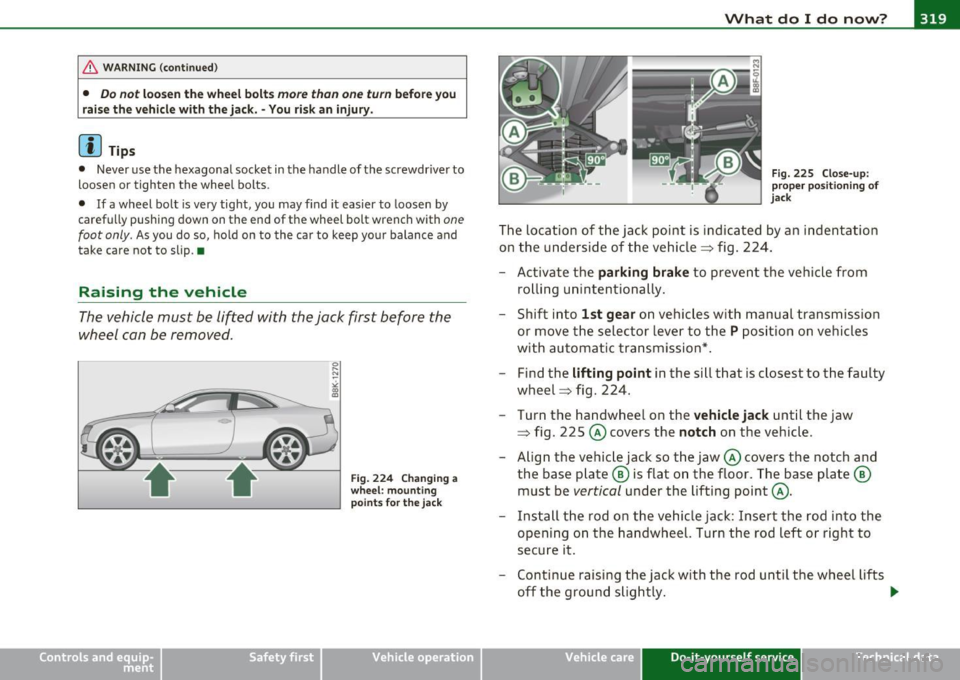
Fig. 224 Changing a
wheel: mounting
points for the jack
Vehicle OP-eration
Fig. 225 Close-up:
proper positioning of
jack
The location of the jack point is indicated by an indentation
on the underside of the vehicle=> fig. 224.
- Activate the
parking brake to prevent the vehicle from
rolling unintentionally.
- Shift into
1st gear on vehicles with manual transmission
or move the selector lever to the
P position on vehicles
with automatic transmission*.
- Find the
lifting point in the sill that is closest to the faulty
wheel => fig. 224.
Turn the handwheel on the
vehicle jack until the jaw
=> fig . 225 @ covers the
notch on the vehicle.
- Align the vehicle jack so the jaw@ covers the notch and
the base plate @ is flat on the floor. The base plate @
must be
vertical under the lifting point@.
- Install the rod on the vehicle jack: Insert the rod into the
opening on the handwheel. Turn the rod left or right to
secure it.
- Continue raising the jack with the rod until the wheel lifts
off the ground slightly. ..,_
Vehicle care Do-it-yourself service iTechnical data
Page 330 of 362
lffll.___E_ m_ e_ r-' g=- e_n_ c=-y _ s_it _ u _ a_t_ i_ o _ n_ s ______________________________________________ _
Emergency situations
General
This chapter is intended for trained emergency crew s and working
pe rsonnel who have the necessary tool s and equipment to perform
the se operation s. •
Starting by pushing or towing
0 Note
Veh icles with an automatic transmission cannot be started by
pushing or towing .•
Starting with jumper cables
If necess ary, the engine can be started b y connectin g it to
t he bat tery of another vehicle.
If the e ng ine shou ld fa il to start because of a discharged or weak
battery, the batte ry can be connected to t he battery of
another
veh icle, us ing a pair of jump er cables to start t he eng ine .
Jumper cables
Use only jumper cables of suffic iently large cross section to carry the
sta rter cur rent s afely . Refer to the m an ufa ct ur er's specificat ions.
Use only j umpe r cab les with
insulated te rmi nal clamps wh ich are
distinct ly marked :
plu s(+) cable i n most cases colored red
minus (-) cable i n most cases colored black .
& WARNING
Batterie s contain el ectricity, acid, and gas . Any of the se can cause
very serious or fatal injury. Follow the inst ructions below for safe
handling of your vehicle 's battery.
• Always shield your eyes and avoid leaning over the battery
whenev er po ssible .
• A discharged battery can freeze at temperatures just below
32 °F (0 °C ). Before connecting a jumper cable, you must thaw the
frozen battery completely, otherwise it could explode.
• Do not allow battery acid to contact eyes or sk in . Flush any
contacted area with water immedi ately .
• Improper use of a booste r battery to start a vehicle may cause
an explosion .
• Vehicle batteries generate e xplosive gases. Keep sparks, flame
and lighted cigarettes away from batterie s.
• Do not try to jump start any vehicle with a low acid level in the
battery.
• The voltage of the booster battery must also have a 12-Volt
rating. The capacity (Ah) of the booster battery should not be
lower than that of the discharged battery . Use of batteries of
different voltage or substantially different "Ah " rating may cau se
an e xplosion and personal injury.
• Never charge a frozen battery . Gas trapped in the ice may cause
an explosion.
• Never charge or use a battery that has been frozen. The battery
case may have be weakened .
• Use of batteries of different voltage or substantially different
capacity (Ah) rating may cause an explosion and injury . The
capacity (Ah) of the booster battery should not be lower than that
of the discharged battery. .,_
Page 344 of 362
__ _:C:::.::: o:..:n..: s :::.: u:.:m..:..:. e=.:.. r...: l:.: n:..:..:. f..:o :.:r~ m..:..:. a=--: t:.:.i o =-=- "-=- ---------------------------------------------
& WA RNING (conti nu ed )
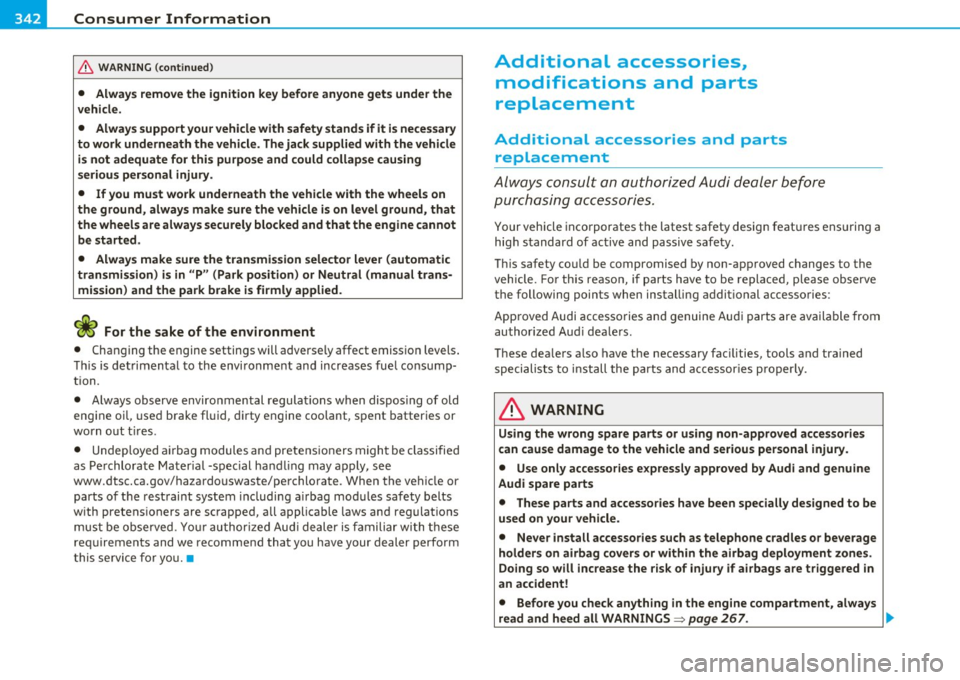
• Always rem ove the ignition key before anyone get s under the
vehicle .
• Always support your vehicle with safety stands if it i s nece ssary
to work underneath the vehicl e. Th e jack supp lied with the vehicle
is not adequate for thi s purpose and could collap se causing
seriou s personal injury .
• If you must work underneath the vehicle with the wheels on
the ground, a lway s make sure the vehicle is on level ground, that
the wheels are alway s securely blocked and that the engine cannot
be started .
• Always make sure the transmi ssion selector lever (automatic
transmission ) is in "P " (Park po sition) or Neutral (manual tran s
mission) and the park brake is firmly applied .
For the sake of the environment
• Changing the engine settings will adversely affect emission levels .
Thi s is det rimenta l to the envi ronme nt and increases fue l co nsump
tion.
• Always observe enviro nmental regulations when disposing of old
engine oi l, used brake fl uid, dirty engine coo lant, spent batteries or
worn out t ires.
• Undep loyed a irbag modules an d pretens ioners migh t be classified
as Pe rchlorate Mater ia l -spec ial handling may apply, see
www.dtsc.ca.gov/hazardouswaste/perchlorate . When the vehicle or
parts of the rest raint system includ ing a irbag modu les safety belts
w ith pretens ioners are scrapped, all applicable laws and regulat ions
must be obse rved. Yo ur author ized Aud i dealer is f amiliar wi th t hese
req uirements and we recommend that you have your dealer perform
t his se rvi ce f or yo u.•
Additional accessories,
modifications and parts
replacement
Additional accessories and parts
replacement
A lways consult an autho riz ed Au di dealer bef ore
purchasing access ories.
Your vehicle incorporates the latest safety desig n featu res ens uring a
hig h standard of active and passive safety .
Th is safety co uld be compromised by non-app roved changes to the
vehicle. Fo r this reaso n, if par ts have to be replaced, p lease observe
the following points when installing addit ional accessories :
Approved Audi accessories and genuine Aud i parts are available from
author ized Aud i dea lers.
T hese dea lers a lso have the necessary fac ilities, tools and tra ined
specialists to i nstall the parts and a ccessor ies p roperly.
& WARNING
Using the wrong spare parts or u sing non-approved acces sorie s
can cause damage to the vehicle and serious personal injury.
• Use only accessories expressly approved by Audi and genuine
Audi spare parts
• These parts and accessories have been specially designed to be
used on your vehicle .
• Never install accessories such as telephone cradles or beverage
holder s on airbag covers or within the airbag deployment zones .
Doing so will increase the r isk of injury if airbags are triggered in
an accident!
• Before you check anything in the engine compartment , always
read and heed all WARNINGS~
page 267. _..
Page 349 of 362
___________________________________________ A_ l::.. p _h _a_ b_ e_t _ic _a_ l_ in_ d _ e_x __ fflll
Audi drive select .. .. .. ...... .. .. . .. . 147
Adaptive dampers ................ 147
Description ............. .. ....... 147
Dynamic steer ing ... ....... ..... .. 147
Sett ing the driv ing mode . .. .. .. .. . 148
Audi Serv ice Repai r Manuals and Litera ture .
340
Auto Lock .. .. ... ..... ... ... ... .. .. .. 46
Auto Safety Hotline ... ... ... . .. ..... 179
Auto-Check Control .... .. ... ...... .. .. 31
Automatic belt retractor .......... .. . 185
Automatic car wash
See Washing ....... .. .... .. .... . 257
Automatic climate control
A/C mode .......... .... .. .... .. .
100
Automatic climate control plus ..... .. . 101
A/C mode .... .......... ...... .. . 107
See also Deluxe automa tic clima te cont rol
plus ..........................
101
Automatic climate control system . ...... 95
See also Deluxe automat ic climate contro l
95
Automatic driving light control ......... 58
Automatic Shift Lo ck (ASL) ......... .. .
153
Automatic transmission .............. 150
Automatic Shift Lock (ASL) ..... .... 153
Driving ...... ...... .. .. .. .. .... . 151
Dynamic shift p rogram . .. .. ... . .. . 154
Eme rgency release ......... .... .. . 156
Fail-safe mode . .. ................ 156
Kick -down ........ .. .... ... .. .. . 154
Manual shift program ..... .... .... 155
Selector lever ............ ... ..... 152
Controls and equip
ment Safety first
Shift buttons
... ...... .. .... ..... 156
Steering wheel with tiptronic ...... . 156
Automatic wipe/wash system .......... 65
Average speed ......... .. .. .......... 24
Avoid damaging the vehicle .... .... ... 247
B
Battery . .. .. .. .. .... ...... ......... 285
Bat tery location inside the luggage
compartment . ........ .... .....
286
Charging ........................ 288
Important warnings when working on the
battery ... .. .. ... ..... .... ... ..
286
Jump start ing . ........... ...... .. 328
Low ... .. .. .. .... .... ........... 243
Replacing the battery .. .. .. ....... 289
State of charge ..... .............
243
Winter operation ... ..... ......... 285
Work ing on the battery .... ... .. .. .
286
Battery voltage .. .... .... .. .. .... ... . 39
Befo re driving ..... .... .. .. .. .. .... .
171
Blended gasoline .. ......... ...... .. 269
Body cavity sealing ..... ....... ...... 262
Booster seats ... .. .... .. ........... 223
Brake assist ... .. ........... ........ 241
Brake booster ... .. ... ... .. ......... 240
Brake fluid
Changing the brake fluid ...........
285
Checking the brake fluid level ....... 284
Reservoir .. .. .. ...... .. .... ..... 284
What is the correct brake fluid level? . 284
What should I do if the brake fluid warning
light comes on? ... .. .. .. ........
284
Brake system . .... .. .. ... .... ... ... . 284
Anti-lock brake system .......... ... 17
Brake fluid .. ...... ............. . 284
Brake fluid specificat ions for refill and
replacement . .... ............. .
285
Brake light defective .... ... .. .. .. .. 39
Brake pads .. .. .... ..... .... .... .
246
Electromechanical parking brake . ... 116
General information ............ .. 239
How does moisture or road salt affect the
brakes? ... .... .. ............. . 239
Malfunction .............. ...... .. 33
Warning/indicator lights ... .. .. .. ..
18
Worn brake pads symbol ........... 38
Braking guard
See Audi braking guard .......... .. 135
Break-in period . .. .. .. .... .......... 246
Brake pads . ... ................ .. 246
Tir es ... ........................ 246
Bulbs . ................ ... .. .. .. ... 327
C
California Proposition 65 Warning .. ... 276
Battery specific .. .. .... ... .... ... 288
Capacities . ......... ... . .... .. .. .. . 339
Car care ... ................ ...... .. 256
Interior ............ .. .... .... .. .
263
Plastic and vinyl ................ .. 260
Weatherstrips ...... ...... .. .. .. . 261
Care of exterior ...... .. .. .. .. .. .. ... 256
Vehicle operation Vehicle care Do-it-yourself service Technical data