check engine light AUDI A5 COUPE 2011 Owner's Manual
[x] Cancel search | Manufacturer: AUDI, Model Year: 2011, Model line: A5 COUPE, Model: AUDI A5 COUPE 2011Pages: 362, PDF Size: 84.88 MB
Page 284 of 362
___ C_h_ e_c _k _i_n -=g :a,__ a_n_ d_ f_ i_ l _li _n _,g;._ __________________________________________ _
0 Note
• Before w inter sets in, have the coolant checked to see if the
coolant additive in your vehicle is sufficient to meet the climate
conditions. This is especially important if yo u live in a region where
the winter is extremely cold.
If necessary, increase the proportion of
coolant additive to 60% .
• When adding coolant additive to your cooling system, remember :
- We recommend using only coolant additive G12++ (check the
label) for your vehicle. This coolant additive is available at autho
r iz ed Audi dealers. Other types of antifreeze can s ignificantly
reduce corrosion protection. The resulting corrosion can cause a
loss of coolant and serious engine damage.
• Do not add any type of radiator leak sealant to your vehicle 's
engine coolant. Adding radiator repair flu id may adversely affect the
function and performance of your cooling system and cou ld result in
damage not covered by your New Vehicle Limited Warranty .•
Checking the engine coolant Level
The engine coolant level can be checked with a quick
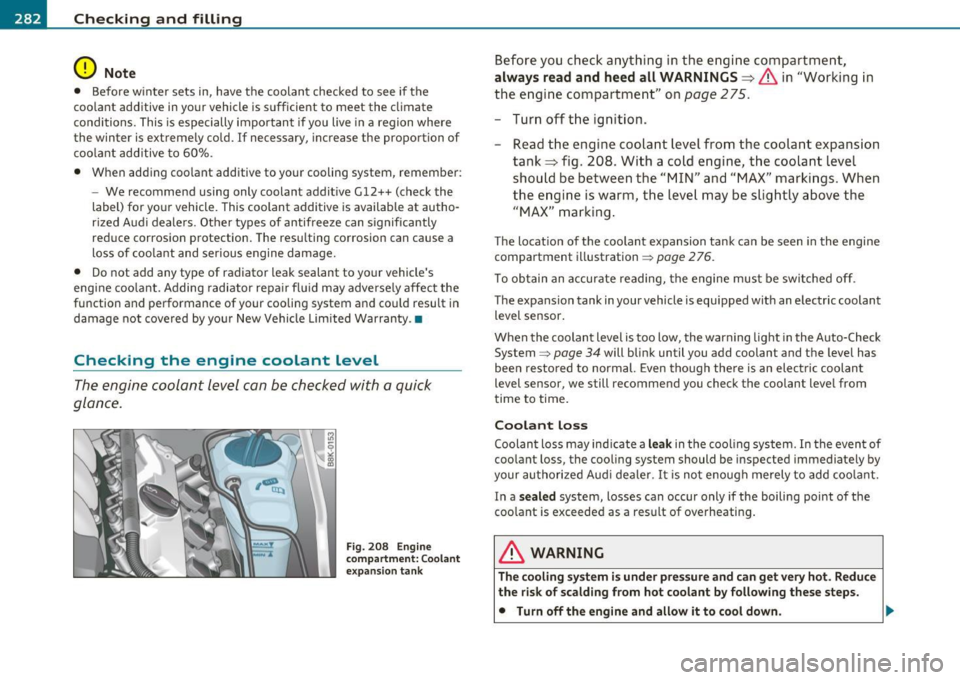
glance.
Fig. 208 Engine
co mpartment : Coolant
expansion tank
Before you check anything in the engine compartment,
always read and heed all WARNINGS~ & in "Working in
the engine compartment" on
page 275.
-Turn off the ignition.
- Read the engine coolant level from the coolant expansion
tank~ fig. 208 . With a cold engine, the coolant level
should be between the "MIN" and "MAX" markings. When
the engine is warm, the level may be slightly above the
"MAX" marking.
The locat io n of the coolant expansion tank can be seen in the engine
compartment illustration~
page 276.
To obtain an accurate reading, the engine must be switched off.
The expansion tank in your vehicle is equipped with an electric coolant level sensor.
When the coolant level is too low, the warning light in the Auto-Check
System =>
page 34 will blink until you add coolant and the level has
been resto red to normal. Even though there is an electric coolant
level sensor, we still recommend you check the coolant level from
time to time.
Coolant loss
Coolant loss may indicate a leak in the coo ling system. In the event of
coolant loss, the cooling system should be inspected immediately by
your authorized Audi dealer. It is not enough merely to add coolant.
In a
sealed system, losses can occur only if the boiling point of the
coo lant is exceeded as a result of overheating .
& WARNING
The cooling system is under pressure and can get very hot. Reduce
the risk of scalding from hot coolant by following these steps.
• Turn off the engine and allow it to cool down.
Page 286 of 362
•--=C:.:.h.:.. e=. c=.:..:: k .:.:in ..:. g ~ a::..:..: n~d .:...:.. f:....:il ..:.li :.:.n.;.: g~ ------------------------------------------
0 Note
• Coolant pollutes the environment and could cause an engine fire.
Excess coolant will be forced out through the pressure relief valve in
the cap when the engine becomes hot .
• If, in an emergency, only water can be added, the correct ratio
between water a nd antifreeze ::::>
page 281 must be restored as soon
as possible.
ci> For the sake of the environment
Drained coolant should not be reused. Always dispose of used coolant
wh ile observ ing all environmental regulations.•
Radiator fan
The radiator fan switches on automatically by itself.
The radiator fan is driven by the engine v ia the V-belt. The viscous
clutch regulates the speed of the fan according to the temperature of
t he coo lant.
An auxiliary electr ic radiator fan* sw itches on and off depending on
coolant temperature and other vehicle operating conditions.
After you switch the engine off, the auxiliary fan can cont inue running
for up to 10 minutes- even with the ignition off. It can even switch on
again later by itse lf::::>
/1 , if
• the temperature of the engine coolant rises due to the heat build
up from the engine in the engine compartment, or
• the engine compartment heats up because the veh icle is parked in
intense sunlight.
& WARNING
• To reduce the risk of personal injury never touch the radiator
fan.
/1 WARNING (continued)
• The auxiliary electric fan is temperature controlled and can
switch on suddenly even when the engine is not running.
• The auxiliary radiator fan switches on automatically when the
engine coolant reaches a certain temperature and will continue to
run until the coolant temperature drops .•
Brake fluid
Checking brake fluid level
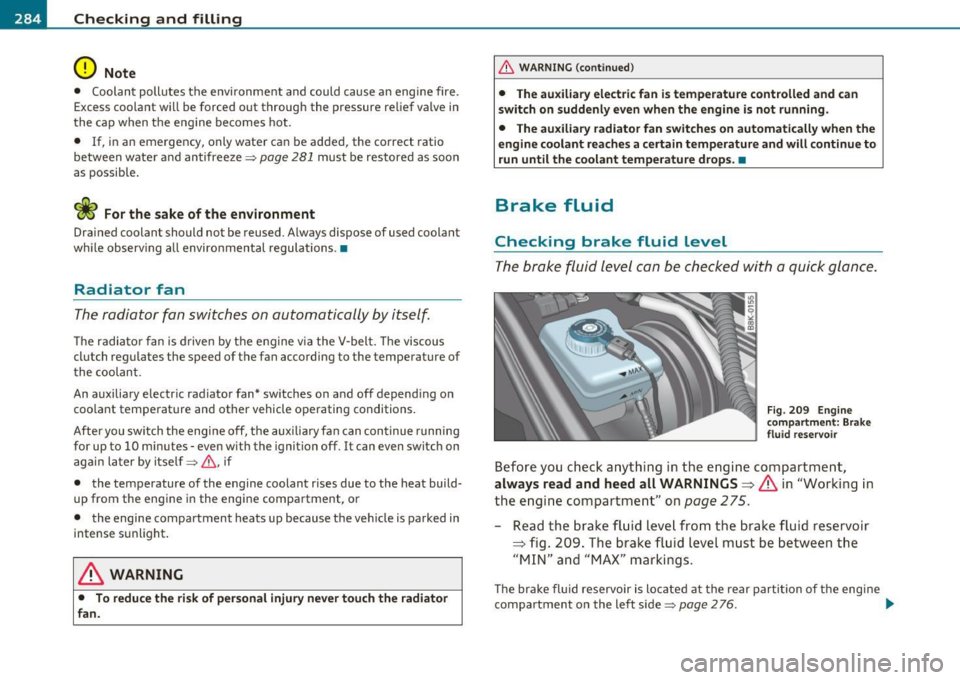
The brake fluid level can be checked with a quick glance.
Fig . 209 Engine
co mpartm ent : Brake
fluid reservoir
Before you check anything in the engine compartment,
always read and heed all WARNINGS=> & in "Working in
the engine compartment" on
page 275.
-Read the brake fluid level from the brake fluid reservoir
=> fig. 209. The brake fluid level must be between the
"MIN" and "MAX" markings.
The brake fluid reservoir is located at the rear partition of the engine
compartment on the left side=>
page 276. .,
Page 288 of 362
___ C_ h_ e_c _k _i _ n _g ~ a_n _d_ f_il _l_in _ g _________________________________________ _
Have the battery checked when you take your vehicle in for service.
You are well advised to replace a battery that is older than 5 years.
With certain types of a irbag deployment, the battery is disconnected
from the vehicle e lectrical system for safety reasons=>
& in "Repair,
care and disposal of the airbags" on
page 204.
Disconnecting the battery terminals
Some vehicle functions (power window regulators, for example) are
lost if the battery terminals are disconnected. These functions have
to be relearned after the battery terminals are connected aga in . To
prevent this, the battery should only be disconnected from the
vehicle electrical system when absolutely necessary for repairs.
Vehicles not driven for long periods
If you do not dr ive your vehicle over a period of several days or weeks,
electrical components are gradually cut back or switched off. This
reduces energy consumption and maintains starting capability over a
longer period=>
page 243.
Take into consideration that when you unlock you r vehicle, some
convenience functions, such as the master key remote function or
power seat adjustment, may not be available. The convenience func
tions will be available again when you turn on the ign ition and start
the engine.
W inter operation
During the w inte r months, battery capacity tends to decrease as
temperatures drop. This is because more power is also consumed
wh ile starting, and the headlights, rear window defogger, etc., are
used more often.
Avoid unnecessary power consumption, particularly in city traffic or
when traveling only short distances. Let your authorized Audi dealer
check the capacity of the vehicle battery before winter sets in
=> page 288. A well charged battery will not only prevent starting
problems when the weather is cold, but will also last longer.
W Tips
If your vehicle is left standing for several weeks at extremely low
temperatures, the vehicle battery should be removed and stored
where it will not freeze. This will prevent it from being damaged and
having to be replaced .•
Working on the battery
Be especially careful when working on or near the
battery.
The battery is located in the luggage compartment under the
floor. Before you check anyth ing in the lu~gage compart
ment,
read and heed all WARNINGS:=>& .
Always heed the safety warnings, when working on the vehicle
battery or the vehicle electrical system to prevent injury .
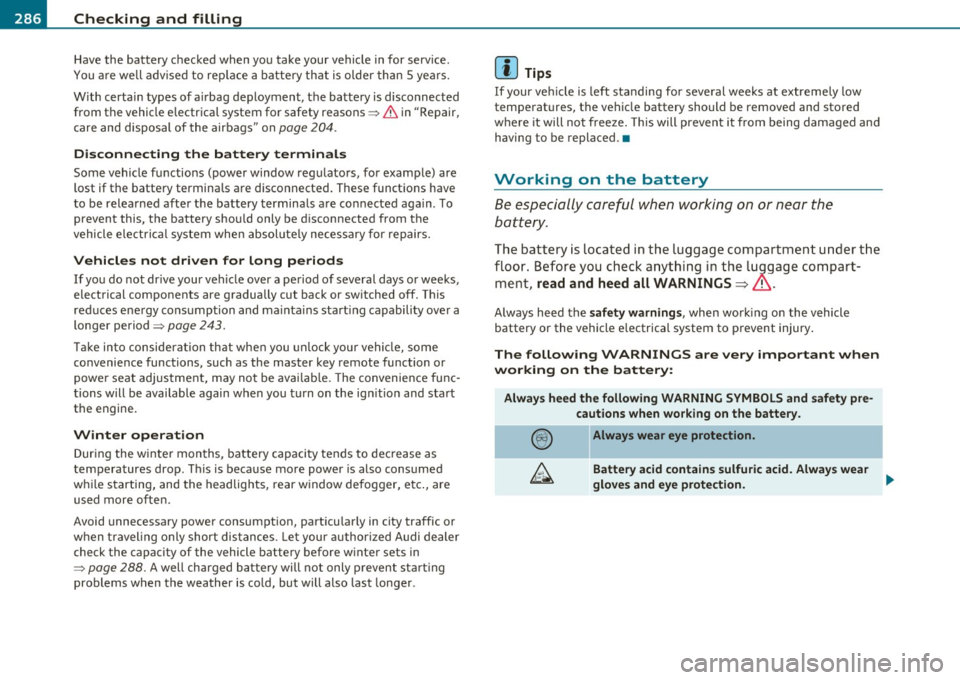
The following WARNINGS are very important when
working on the battery:
Always heed the following WARNING SYMBOLS and safety pre
cautions when working on the battery.
Always wear eye protection.
Battery acid contains sulfuric acid. Always wear
gloves and eye protection . .,,_
Page 289 of 362
Checking and filling "" ------------------~::....::..:..._~---=---
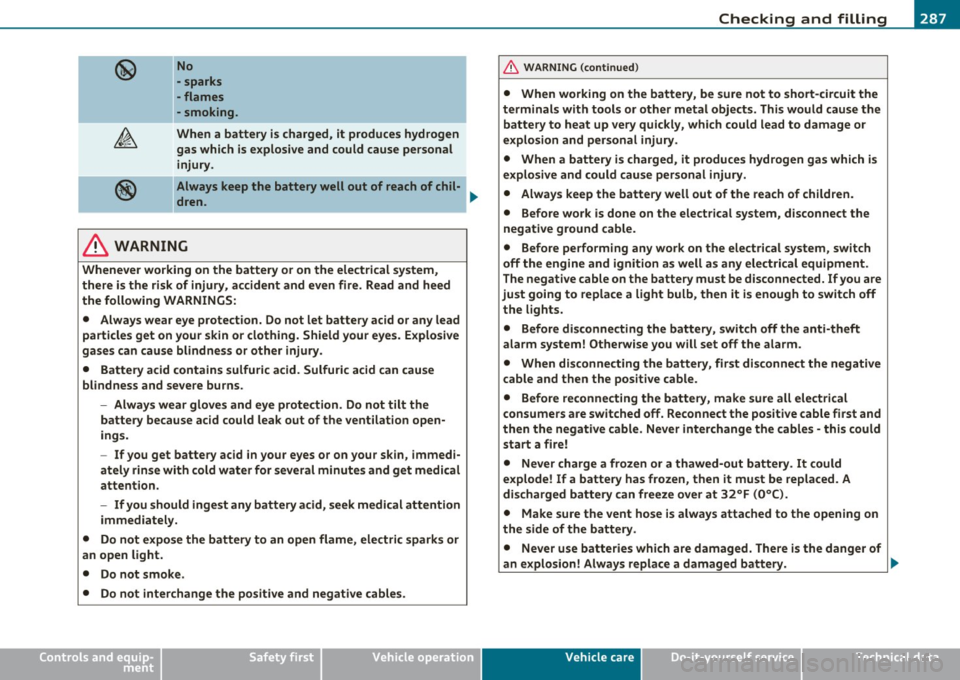
No
- sparks
-flames
- smoking .
When a battery is charged, it produces hydrogen
gas which is explosive and could cause personal
injury.
Always keep the battery well out of rea ch of chil- .,,_
dren .
_& WARNING
Whenever working on the battery or on the electrical system,
there is the risk of injury, accident and even fire. Read and heed
the following WARNINGS:
• Always wear eye protection. Do not let battery acid or any l~ad
particles get on your skin or clothing. Shield your eyes. Explosive
gases can cause blindness or other injury.
• Battery acid contains sulfuric acid. Sulfuric acid can cause
blindness and severe burns.
-Always wear gloves and eye protection. Do not tilt the
battery because acid could leak out of the ventilation open
ings.
- If you get battery acid in your eyes or on your skin, imm~di
ately rinse with cold water for several minutes and get medical
attention.
- If you should ingest any battery acid, seek medical attention
immediately.
• Do not expose the battery to an open flame, electric sparks or
an open light.
• Do not smoke.
• Do not interchange the positive and negative cables.
Safety first
& WARNING (continued)
• When working on the battery, be sure not to short-circuit the
terminals with tools or other metal objects. This would cause the battery to heat up very quickly, which could lead to damage or
explosion and personal injury.
• When a battery is charged, it produces hydrogen gas which is
explosive and could cause personal injury.
• Always keep the battery well out of the reach of children.
• Before work is done on the electrical system, disconnect the
negative ground cable.
• Before performing any work on the electrical system, switch
off the engine and ignition as well as any electrical equipment.
The negative cable on the battery must be disconnected. I! you are
just going to replace a light bulb, then it is enough to switch off
the lights.
• Before disconnecting the battery, switch off the anti-theft
alarm system! Otherwise you will set
off the alarm.
• When disconnecting the battery, first disconnect the negative
cable and then the positive cable.
• Before reconnecting the battery, make sure all electrical
consumers are switched off. Reconnect the positive cable first and
then the negative cable. Never interchange the cables -this could
start a fire!
• Never charge a frozen or a thawed-out battery. It could
explode! If a battery has frozen, then it must be replaced. A
discharged battery can freeze over at 32°F (0°C).
• Make sure the vent hose is always attached to the opening on
the side of the battery.
• Never use batteries which are damaged. There is the danger of
an explosion! Always replace a damaged battery. .,,_
Vehicle care Technical data
Page 292 of 362
___ C_h_ e_c _k _i_n -=g :a,__ a_n_ d_ f_ i_ l _li _n _,g;._ __________________________________________ _
Windshield/headlight* washer
container
Fig. 211 E ngine
compartment: Wind
shie ld and headlight*
washer fluid container
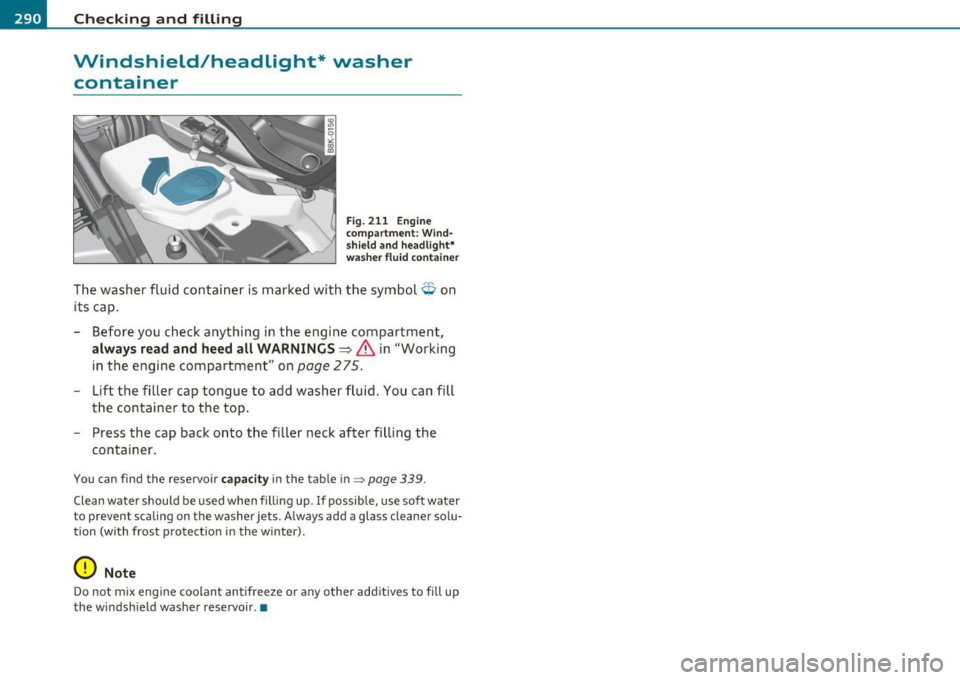
The washer fluid container is mark ed with the symbol¢ on
its cap.
- Before you check anything in the engine compartment,
always read and heed all WARNINGS => & in "Working
in the engine compartment" on
page 275.
- Lift the filler cap tongue to add washer fluid. You can fill
the container to the top.
- Press the cap back onto the filler neck after filling the
container .
You can find the reservoir capacity in the table in:::::::, page 339.
Clean water should be used when filling up. If possible, use soft water
to prevent scaling on the washer jets. Always add a glass cleaner solu tion (with frost protection in the winter) .
0 Note
Do not mix engine coolant antifreeze or any other additives to fill up
the windsh ield washer reservoir .•
Page 350 of 362
___ A_ l_,, p_ h _ a_b_ e_ t_ic _a_ l_ in_ d_e _ x ____________________________________________ _
Cargo area
See Loading the luggage compartment
177
Cargo net .. .. ... ..... .. .. .. .. .. . .. . 84
Catalytic converter .................. 247
Center a rmrest
Adjusting .. .. .................... 82
Sto rage compartment ... ..... ..... 82
Cert ification .. .. .. .. .. .. ... .... .... 343
Changing a flat ti re .. .. .. .. ......... 316
Cha ng ing a wheel ........... .. .. .. .. 316
Chang ing engine oil .. .. ... .......... 280
Chassis Undercoating ... .. .. ...... .... . .. 262
Checking Engine coo lant level ........ .... .. 282
Checking tire pressure ............ ... 297
Child res tra int system anchors ... .. .. . 229
Child restra ints
Dange r of using chi ld restraints in the front
seat ........ ...... ...... .. .. .. 192
Where can I get add itiona l information
a bou t child rest rain ts and t he ir u se? ...
234
Chi ld safety ....... ... ... .. ... ... ... 215
Convertible locking retractor . ... ... 225
Important sa fety instructions for using
child safety seats .... .... ... .. .. 218
Importa nt th ings to know whe n driving
w ith children ................. .. 215
Insta lling a child restraint using the LATCH
system . ... ..... ....... .. .. . .. 231
Lower anchorages . ............. .. 230 Mounting and releas
ing the anchorage Coat hooks ... ... ... .. .. .... ... . ... . 94
hook ........ .. .... ...... ..... 23 1
Cold t ire inflation p ressure .... ... . ... 295
T ethe r anchors .. ... .. .. .. .. .... . 232
T ethe r straps . ....... .. .. ... .. .. . 232 Compact spare tire
........... ....... 314
See also Spare t ire ............... 314
Chi ld safety seats ............ .. .. .. . 221
Booste r se ats .. .. .... .... .. .... . 223
Convert ible chi ld sea ts ......... .. . 222
Convert ib le lock ing retractor . ... ... 225
Dange r of using child restraints in the front
seat .. .. .. .. .. ... ... ... .. ... .. 192 Compass mirror .
.... .. .............. 71
Com pliance . ................. .... .. 343
Consumer Information ... .... ... 179, 340
Contacting N HTSA ....... .. ... .... .. 179
Conven ience closed .. .. .. .. .......... 54
How do I p roperly install a child safety seat Conven
ience key . .. .. .. ............. . 48
in my vehicle? ...... .. .. ... .. .. . 218 START ENGINE STOP button .
.. 114, 115
In fant seats .............. .. ..... 221 Starting engine ..
... ..... .. .. .. .. 114
Insta lling .. .... .. .. .. .. . ... .. ... 225 Switching eng
ine off ...... .. .. .... 115
LATC H system .. ...... ...... ..... 231 Switching on
ignition ........ ... .. 114
Safety instruct ions .. .. .. .. .. .. ... 218 Unlock
ing and lock ing vehi cle ... .... 48
Cigare tte lig hter . ... .... ... . ... .... .. 92 Conven
ience opening . .. .... .......... 54
Cleaning Convert
ible chi ld safety seats .. ... .. .. 2 22
Al canta ra ® (syn the tic sue de) .. .... . 266
Convert ible lock ing retractor
E ngine comp artment ...... .. .. .. . 267
Activat ing .... ........... ... .... 227
E xhaust t ail pipes .... ... . ... .. .. . 263
Deactivating ... ... .... ..... .... . 228
Fabrics an d fabric cove rings ... .... . 263
Using to secu re a child safety seat . . 225,
Instrument panel ..... .. . ... .... . 264 227
Interior .. .. ... .. .. .. .... .. .. .. . 263
Coolant system .. .... .. ............. 28 1
Leathe r ............. .... .. ..... 265
Cooling System
MMI control console ............. . 263
Expansion tank ........... ... ... . 282
M MI display . .. .. ............... . 263
Cornering light .... .. .. .... .......... 61
Plastic and viny l ............... .. 260
Cruise con trol
Plastic parts ........... .. ... ... . 26 4
Safety belts ......... ... .. .. .. .. . 267
Tr im st rips ..... ...... .... .. .. .. . 259
tr im str ips .. .. ........... .. .. .. . 260 Ch
angin g speed .. .. .... ......... 1 20
Prese lect speed ...... .. .. .. .... .. 12 0
Switching off ... .. .. .. .. ... .. .. .. 120
Switching on ... .. .. .. .. ... .. ... . 119
Cleaning and protection ...... .. .. .. . 256
Warning/indicator lights ... .. .. ... . 17
Clo ck ............ ...... ...... .. .. .. 12
Cruis ing range .. ... . .. .... ... ..... .. 24
Page 352 of 362
___ A_ l_. p_ h _ a_b_ e_ t_ic _a_ l_ in_ d_e _ x ____________________________________________ _
Parking ........ ..... .. .. .... ... 117 Hood .. .. .. .. .. .... ... . ... .. .. . 274
Releasing and clos ing .. .. ......... 116 Starting ........... .. .. .. ....... 112
Starting assist ................ ... 117 Sta rting with jumpe rr cab les ........ 328
Starting from rest . .. ...... ..... .. 117 Stopp ing ... .. ..... .... .. .. .. .. . 113
Sta rting off w ith a t railer ... . .. .. .. 118
Engine compartment
W arning/ind icator lights . .......... 18
Safety instruct ions .... .. .. .. .. ... 275
Elect ronic differential lock (EDL) Working the eng ine compartment . . 275
How the system works .... ... .. ... 238
Engine coo lant system . .. ... . ... .... . 281
Warning/ind icator lights . .......... 17
Adding coolant ... .... .. . .. ... .. . 283
Electronic immobilizer .. .. . ... ... .. ... 45
Checking coo la nt level . ..... ..... . 282
Electro nic powe r contro l Checking the engine coo
lant level . .. 282
( E PC) war ning/ indicato r light .. ...... 15 Ma
lfunction ... ................. .. 34
Electronic stabilization program (ESP) Radiator fan ...
...... .. .. .. .. ... 284
How the system works ............ 236 Engine coo
lant temperature
Wa rning/ind icator lights . .......... 15 T
emperat ure gauge . .... . ... .. .. . . 10
Emergency braking ..... .. .. .. .. .. ... 118 Engine data
... ... ...... ... .. .. .. .. . 339
Emergency flasher . . . . . . . . . . . . . . . . . . . 62
Engine hood
W arning/ind icator lights ... .. ... ... 16 Closing ........
...... ...... ..... 275
E mergency key .. ................ .... 42 How to re
lease the hood .......... . 2 7 4
Starting eng ine . .. .... .. ..... ..... 45 Engine oil
.... ..... ..... .... .. .. .. . 277
Emergency locking of the doors . ... .. .. 51 Adding ...
... .... .... .... ... . ... 279
Eme rgency release
Sele ctor leve r ............. .... .. 156 Add
itives ...... .. .. .. ...... .. ... 279
Changing ............ .... .. ..... 280
E mergency starting .. .. ... ....... ... 328
Emergency towing ..... .. .. ..... .... 331
Emergency u nlocking
Ignition key .. .... ............. ... 44
Energy management .......... .... .. 243
Battery power ................... 245
Dr iver not ification ..... .. .. ... .. .. 245 Check o
il level ............ .. .... . 279
Consumption ....... .. .. .. ....... 279
Oil consumption .... .... . ... .. .. . 278
Oi l grades .. ..... ............. .. 277
Specification and viscosity .. .. .. .. . 277
E ngine oil leve l ... .... ............. .. 40
E ngine oil pressure
M al fun ctio n ... ........... ...... .. 35
Engine
Compartment .. .. .. .. . ... ... .. .. 276
Coolant ...... .......... ...... .. 281 Engine oil sensor defec
tive ..... .. .. ... 40
Engine speed limitatiorn . ....... ..... .. 40 Environment
Break-in per iod ......... ... .. .. .. 246
Catalytic converte r ............... 24 7
Disposing of you r vehicl e battery .. .. 289
Dr iv ing at hig h speeds ............ 249
Dr iv ing to mi nimize poll ution and noise ..
248
Fuel .. .. .... ............. ...... 271
Fuel economy .. .... .... ... .. .. .. 248
Leaks under you r vehicle ... .. ... .. 275
Lett ing the vehicle stand and warm up ...
249
Proper disposa l of dra ined brake fluid 285
Proper disposal of d ra ined engine coo lant
283
Proper disposal of drained engine oil 279,
280
Recycl ing used e ng ine o il ... .. .. .. . 279
Unleaded fue l ............ ... .. .. 269
What should I do w it h an old batte ry?
289
E nvironmen tal note
Re ar w indow defogger ...... .. 100, 1 06
Roo f rack . . . . . . . . . . . . . . . . . . . . . . . . 90
EPC See Elect ronic power con tro l ........ 15
ESP See Electronic stabilization program (ESP)
15
Event Data Recorde r (EDR) 236
Exhaust tai l pipes
Cleaning ... .... ... .. . .... .... .. 263
E xp ans ion tank .. .. .. .. ............. 282
Eyeglasses compartment ......... . ... . 94
Page 355 of 362
Alphabetical index -________________ fWI
Loading the luggage compartment .. .. . 177
Locking Luggage compartment lid ...... ... .. 51
Power locking switch ............... SO
Remote control key ................ 47
Using the mechanical key ........... 49
Low beams .. .. ................. .. .. 58
Low-beam headlight Defective .......... ... ... ... . .. .. 3 9
Lower anchorage locator button ....... 230
Lower universal anchorage bars (Canada) ... 229
Lower unive rsal anchorages (Canada) .. . 229
Luggage Stowing .. ............. .. .... ... 177
L uggage compartment ...... .. .... .. .. 83
Cargo net . .. .. ............... ... . 84
Enlarging . . . . . . . . . . . . . . . . . . . . 84, 85
Escape handle ..... ............... 52
Lid ........ ............. .... .... . 51
Loading .. .. .. ... .... ... .. .. ..... 83
Opening and closing .. .. .. .. ....... 51
Sk i sack .......................... 87
T ie-down rings ... .. .. .. ........... 83
Tru nk pass-through .. .. .. .. .. ..... . 88
See also Loading the luggage
compartment .............. .... 177
See also Luggage compartment .... .. 83
M
Maintenance ..... .... ...... .... ... . 340
Malfunction Indicator Lamp (MIL) ... 17, 29
Controls and equip
ment Safety first
Manual transmission
... .......... ... 150 0
Mast er key
Battery rep lac eme nt ............ .. . 43 Occupant seating positions
........... 172
Check light ... .. .................. 43 Octane rating .................... .. 269
Master key with remote control . .. ...... 42 Odometer .................. .. .. .. .. 13
Mechanical emergency closing function
Oil
Panoramic tilting sunroof ........... 56 See Engine oil ........... ... 277,279
Mechanica l key .. ................ .... 44 Oil consumption ............. ....... 279
Memory for driver's seat ............... 78 On-Board Diagnostic System (OBD)
Recalling settings ................ . 79 Data Link Connector (DLC) .......... 29
Storing sett ings ... .. .. .. ... ....... 79 Electronic speed limiter .......... .. 29
Mileage Ma
lfunction Indicator Lamp (MIL) .... 29
Average ............. ........ .... 24 Open door or rear lid warning ......... . 23
Instantaneous ............ .... ... . 24
Operate your vehicle economically and mini-
Mirrors mize pollution
.................. 248
Activating the digita l compass ....... 71 Optional equipment
Adjusting the anti-glare ..... .. .. .. . 68 Marked with an asterisk ............. 6
Automatic dimming for the outside
Other equipment (effic iency program) ... 28
mirrors ................ .. ... .... 70
Outside mirrors ....... ........ ....... 69
Automatically dimming inside mirror . 68
Ins ide rear view mirror ... .......... 68
Inte rior mirror .... ....... ...... .. . 68
Manual glare dimming . .. .. ........ 68 Outside
temperat ure display ........ ... 21
Owner's manual How the Owner's Manual is organized . . 6
Outside mirrors ... ............. ... 69
Monitor ing the Advanced A irbag System 201
p
N
Paint
Touch-up . .. .. .. .. ..... ........ . 260
Natural leather .................. ... 264
New tires and wheels .... ...... .. .. .. 303
NHTSA Paint No .
............ ........ ... ... 336
Panoramic sunroof Convenience opening/closing ........ 54
Contacting . .. .. ........ ......... 1 79
Number of seats .............. .... .. 181
Vehicle operation Vehicle care Do-it-yourself service Technical data