tire pressure AUDI A5 COUPE 2011 Owner's Manual
[x] Cancel search | Manufacturer: AUDI, Model Year: 2011, Model line: A5 COUPE, Model: AUDI A5 COUPE 2011Pages: 362, PDF Size: 84.88 MB
Page 302 of 362
-Tires and wheels
in. WARNING
Overloading a vehicle can cause loss of vehicle control, a crash or
other accident, serious personal injury, and even death.
• Carrying more weight than your vehicle was designed to carry
will prevent the vehicle from handling properly and increase the risk of the loss of vehicle control.
• The brakes on a vehicle that has been overloaded may not be
able to stop the vehicle within a safe distance.
• Tires on a vehicle that has been overloaded can fail suddenly,
including a blowout and sudden deflation, causing loss of control
and a crash.
• Always make sure that the total load being transported -
including the weight of a trailer hitch and the tongue weight of a
loaded trailer -does not make the vehicle heavier than the
vehicle's Gross Vehicle Weight Rating. •
Determining correct load limit
Use the example below to calculate the
total weight of the passengers and luggage
or other things that you plan to transport so
that you can make sure that your vehicle
will not be overloaded.
Steps for Determining Correct
Load Limit
1.Locate the statement "THE COMBINED WEIGHT OF OCCUPANTS AND CARGO
SHOULD NEVER EXCEED XXX KG OR XXX LBS"on your vehicle's placard (tire infla
tion pressure label)==>
page 295J
fig. 212.
2. Determine the combined weight of the driver and passengers that will be riding
in your vehicle.
3. Subtract the combined weight of the driver and passengers from
"XXX" kilo
grams or
"XXX" pounds shown on the
sticker==>
page 295J fig. 212.
4. The resulting figure equals the available amount of cargo and luggage load
capacity. For example, if the
"XXX"
amount equals 1400 lbs. and there will
be five 150 lbs. passengers in your
vehicle, the amount of available cargo
and luggage load capacity is 650 lbs. (1400- 7 SQ (5
X 150) = 650 lbs.) ~
Page 303 of 362
_________________________________________ T_ i_re _ s_a _n_ d_ w_ h_e _e _l_s _ ..... fflll
5. Determine the combined weight of
luggage and cargo being loaded on the
vehicle. That weight may not safely
exceed the available cargo and luggage
load capacity calculated in Step 4.
6. If your vehicle will be towing a trailer,
load from your trailer will be transferred
to your vehicle. Consult this manual to
determine how this reduces the available
cargo and luggage load capacity of your
vehicle.
Check the tire sidewall(~
page 303~
fig. 216) to determine the designated
load rating for a specific tire .•
Vehicle OP-eration
Tire service life
The service life of tires depends on a lot of different
things including proper installation and balancing,
correct tire pressure and driving style .
(-----~
_____ __,,:)
Tread Wear Indicator (TWI)
N
"' 0 9
"" ~
Fig. 214 Tire tread:
tread wear indicators
(TWI)
Fig. 215 Rotating
tires for more even
wear
Th e original tires on your vehicle have 1/16 inch (1.6 mm) high "wear
indicators "~ fig. 214 running across the tread. Depending on the
make, there will be six to eight of them even ly placed around the tire.
Marks on the tire sidewall (for example "TWI" or other symbols) indi
cate the positions of the tread wear indicators. Worn tires must be
rep laced. Different figures may apply in other countries ~
&- .,_
Vehicle care Do-it-yourselt service iTechnical data
Page 304 of 362

-~_T_ i_ re _ s_ a_n _ d_ w_ h _e_ e_ ls _________________________________________________ _
Tire pressure
Incorrect tire pressure causes premature wea r a nd can cause sudden
t ire blow-out. For this reason, ti re p ressure must be checked at least
once a month ~
page 297.
Driving style
Driving fast around curves, heavy acce le ra tion and hard brak ing
increase tire wear .
Rotating tires for more even wear
For all four tires on your veh icle to have the same service life, we
re commend that the fron t and re a r tires are rotate d according to the
tire manufact urer's suggested tire rotation interva ls . Please
remember the fo llow ing:
• Tir e rotat ion inte rvals may differ from t he ve hicl e service intervals
outlined in your Maintenance and War ranty Booklet .
• T he longer one tire is used in one location on the veh icle, the more
it wears at certa in points; therefore, we recommend that you follow
t he t ire m anufac ture r's suggested tire rotation in terva ls.
• V ehicles with front-whee l drive expe rience mo re tread wea r on t he
fron t wheels compa red to all-whee l drive (quattro
® ).
• Please rotate tires as s hown ~fig. 215.
• Extra care must be taken when rotating d irection-specific tires
~ page 321.
Wheel balancing
The w heels on new vehicles are balanced. Howeve r, va rious sit uat io ns
dur ing eve ryday dr iv ing can cause them to become unbalanced,
re su lt ing in v ibr ations yo u can usually fee l throug h the steering
wheel.
Unbalanced wheels must be rebalanced to avoid excessive wea r on
steeri ng, suspension and t ires . A wheel must also be rebalanced
w hen a new tire is installed.
Incorrect wheel alignment
Incorrec t whee l alignment can ca use excessive tire wear, impai ring
t he sa fety of the veh icle . If tires show excess ive wear, have the wheel
alignment checked by an authorized A udi dealer or qualified wo rk
shop .
All wheel drive
Vehicles w ith q uattro ® must always have ti res of the same size,
const ructio n and trea d type. For details see~
page 242 .
& WARNING
Sudden tire failure can lead to loss of control , a crash and serious
personal injury!
• Never drive a vehicle when the tread on any tire is worn down
to the wea r ind icato rs.
• Worn tire s are a safety hazard, they do not grip well on wet
roads and in crease your risk of "hydroplaning" and lo ss of control.
• Always keep chemicals that can cause tire damage, such as
grease , oil , gasoline and brake fluid away from tires.
• Tires age even if they are not being used and can fail suddenly,
especially at high speeds . Tires that are more than 6 years old can
only be used in an emergency and then with special care and at
lower speeds.
• Never mount used tire s on your vehicle if you are not sure of
their "previous history ." Old used tires may have been damaged
even though the damage cannot be seen that can lead to sudden
tire failure and loss of vehicle control. •
Page 305 of 362
________________________________________________ T_ i_ re _ s_ a_ n_d_ w_ h_ e_ e_l _s _ ....... JIII
New tires and replacing tires and wheels
New tires and wheels have to be broken in.
Fig. 21 6 Tire s pecificati on co des on th e sidew all of a tire
No .
©
@
®
©
©
©
Descript ion
Passenger car tire (where applicable)
Nominal width of tire in mil limeters
Ratio of height to width (aspect ratio)
Radial
Rim diameter code
Load index an d speed rating
Vehicle OP-eration
(j)
®
®
@
@
U.S. DOT tire identification number
Audi Orig inal tire
Sever snow conditions
Tire p ly composition and materia ls used
Maximum load rating
@ Treadwear, traction and temperature grades
@ Maximum permissible inflation pressure
T he tires and rims are essential pa rts of the vehicle's design . The tires
and r ims approved by Audi are specially matched to the character is
t ics of the vehicle and can make a major contribut ion to good road
holding and safe handling when in good condition and properly
inflated
=> & .
We recommend that all work on t ires and wheels be performed by an
authori zed Au di deale r. They are fam il ia r with recommended proce
dures and have the necessary special tools and spare parts as well as
the proper facilities for disposing of the o ld tires.
Authorized Aud i dea lers have the necessary info rmation about tech
nical requirements for insta lling or changing tires and rims .
Replacing tires and wheels
Tires should be replaced at least in pa irs and not ind iv idually (for
example both front tires or both rea r tires together) .
Be sure to read and heed the in formation to the tire pressure mon i
t o ring system *=>
page 310.
Always b uy replacement radial tires t hat have the same specificat ions
a s t he tires approved for yo ur ve hicl e by Audi. Re placemen t tires must
always have the same load rating specification as the orig inal eq uip
me nt or approved optiona l tires listed in the table =>
page 295.
Audi -app roved spe cifica tion tires are spec ially ma tched to yo ur
vehicle and its load lim its, and can contrib ute to the important road- _,.
Vehicle care Do-it-yourselt service Technical data
Page 306 of 362
-~_T_ i_ re _ s_ a_n _ d_ w_ h _e_ e_ ls _________________________________________________ _
holding, driving characteristics, and safety of the vehicle . The table
(::::>
page 295) lists specifications of the tires approved for the Audi
models covered by your Owner's Literature.
The tire pressure label (On USA vehicles, the tire pressure label is
located on the driver's side B-pillar. On Canada vehicl es, the tire pres
sure label is located either on the driver's side B-pillar or inside the
fuel filler flap)(=>
page 295, fig. 213) l ists the specifications of the
orig inal equipment tires installed on your vehicle at the time it was
manufactured.
Federal law requires tire manufacturers to place standardized infor
mation on the sidewall of all tires =>
page 303, fig. 216. This infor
mation identifies and descr ibes the fundamental characteristics, the
quality grade of the tire and also provides a tire identification number
for safety standard cert ification and in case of a reca ll.
Tire specifications
Knowledge of tire specifications makes it easier to choose the correct
tires. Radia l tires have the tire specifications marked on the sidewall,
for examp le:
P255 / 35 Rl9 96V XL
This contains the following information:
P Indicates the tire is for passenger cars (where applicable)
255 Nominal tire width in mm of the tire from sidewall edge to side -
wall edge . In general, the larger the number, the wider the tire
35 Height/w idth ratio in percent (aspect ratio)
R Tire construction: Radial
19 Rim diameter code (in inches)
96 Load rating code
Y Speed rating letter code
XL (or "xl", "E XTRA LOAD", or "RF" Indicates that the tire is a"Rein
forced" or an "Extra Load" tire
M+S (or "M/S") Indicates that the tire has some mud and snow capa
bility The tires could a
lso have the information of direction of rotation
=>
page 291 .
Tire manufacturing date
The manufacturing date is also indicated on the tire sidewall
(poss ibly only on the
inner side of the wheel):
"DO T ... 2209 ... "means, for example, that the tire was produced in
the 22nd week of 2009.
Speed rating (letter code)
The speed rating letter code on the wheels ind icates the maximum
permissible road speeds =>
& in "Winter tires" on page 307.
P up to 93 mph (150 km/h)
Q up to 99 mp h (158 km/h)
R up to 106 mph (1 70 km/h)
S up to 110 mph (180 km/h)
T up to 118 mph (190 km/h)
U up to 124 mph (200 km/h) H up to 130 mph (210 km/h)
V up to 149 mph (240 km/h)
3
)
Z over 149 mph (240 km/h)3
)
W up to 168 mph (270 km/h)3
)
Y up to 186 mph (298 km/h)3>
Your vehicle is normally factory equipped with tires, which possess
excellent driving characterist ics and give yo ur Audi optimum driv in g
comfort. An electronic speed limiter=>
page 29 will normally prevent
your vehicle from go ing faster than the tire speed rating::::>
&-
U.S. DOT Tire Identification Number (TIN) and tire
manufacture date
This is the tire's "serial number". It begins with the letters "DOT" and
ind icat es that the tire meets all federal standards. The next two
~
3l For tires w ith a maximum speed capability over 149 mph (240 km/h), t ire
man ufact urer s sometimes use the letters "ZR."
Page 307 of 362
________________________________________________ T_i_re _ s_ a _ n_d_ w_ h_ e_ e_l_s __ _
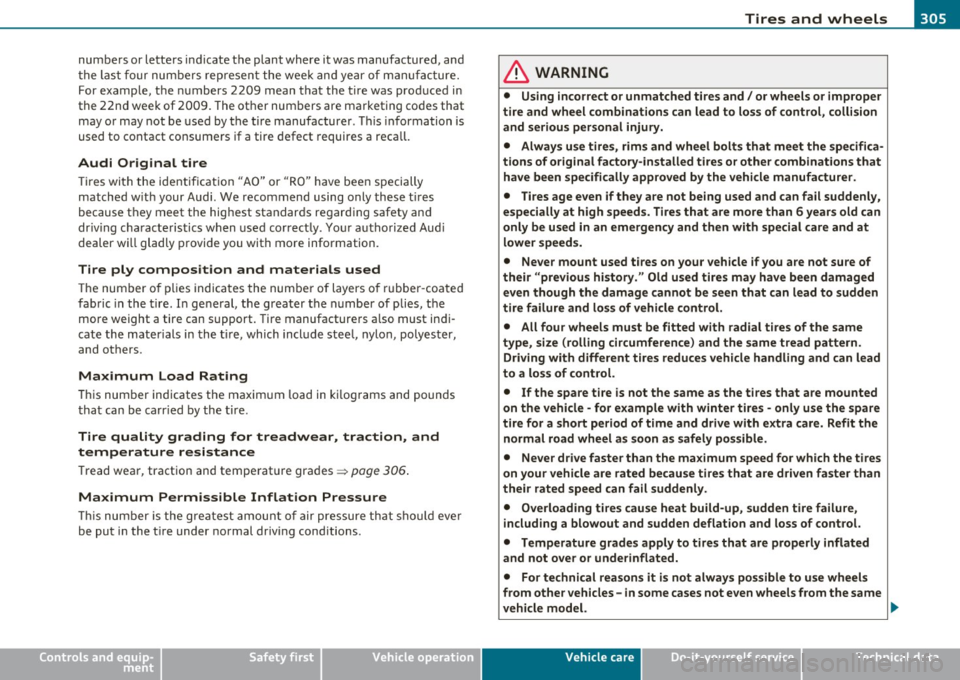
numbers or letters indicate the plant where it was manufactured, and
t he last f our num be rs represen t the wee k an d ye ar of man ufacture.
For examp le, t he numbers 2209 mean that the t ire was prod uced in
the 2 2nd week of 2009. The ot her num bers are marketing co des that
may or may not be used by the t ire manufacturer . Th is information is
used to contact consumers if a tire defect requires a reca ll.
Audi Original tire
Tir es wi th the identifi cat io n "A O" or "RO" have bee n specially
matched w it h your Aud i. W e recommend using only these t ires
because t hey meet the hig hest standards regard ing safety and
driv ing c ha racteris tics when used correct ly . Yo ur aut ho rize d Aud i
dealer wi ll gladly p rovide you with more information.
Tire ply composition and materials used
T he num ber o f plies ind ica tes the numbe r of layers o f rubber -coa ted
fab ric in the tire. I n ge neral, th e greater the n umber of plies, the
more weight a tire can support . Tire manufacture rs a lso must in di
cate the mater ials in the t ire, which incl ude stee l, nylon, polyes ter,
and others .
Maximum Load Rating
This num ber indicates t he maximum load in kilog rams and pounds
tha t can be carr ied by the t ire.
Tire quality grading for treadwear, traction, and
temperature resistance
T read wea r, traction and tempe rat ure gra des => page 306 .
Maximum Permissible Inflation Pressure
This number is the g rea tes t a mou nt o f air pressure th at sh ould ever
be put in the t ire under normal driv ing cond itions.
Safety first
& WARNING
• Using incorrect or unmatched tires and/ or wheels or improper
tire and wheel combination s can lead to loss of control, collision
and serious personal injury.
• Always u se tire s, rim s and wheel bolts that meet the specifica
tions of original factory -installed tires or other combinations that
have been specifically approved by the vehicle manufacturer.
• Tires age even if they are not being used and can fail suddenly,
e specially at high speed s. Tires that are more than 6 years old can
only be used in an emergency and then with special care and at
lower speed s.
• Never mount used tires on your vehicle if you are not sure of
their "previous history ." Old u sed tires may have been damaged
eventhoughthedamage cannotbeseenthatcanleadtosudden
tire failure and loss of vehicle control.
• All four wheels must be fitted with radial t ires of the same
type , size (rolling circumference ) and the same tread pattern .
Driving with different tires reduces vehicle handling and can lead
to a loss of control.
• If the spare ti re is not the same as the t ires that are mounted
on the vehicle -for example with winter tires -only use the spare
tire for a short period of time and drive with extra care. Refit the
normal road wheel as soon as safely possible .
• Never drive faster than the ma ximum speed for which the tires
on your vehicle are rated becau se tire s that are driven faster than
their rated speed can fail suddenly .
• Overloading tire s cau se heat build-up, sudden tire failure,
including a blowout and sudden deflation and loss of control.
• Temperature grades apply to tires that are properly inflated
and not over or unde rinflated.
• For technical reasons it is not always possible to u se wheels
from other vehicles- in some cases not even wheels from the same
vehicle model. ..,_
Vehicle care Technical data
Page 308 of 362
-~_T_ i_ re _ s_ a_n _ d_ w_ h _e_ e_ ls _________________________________________________ _
& WARNING (conti nu ed )
• If you install wheel trim disc s on the vehicle wheels , make sure
that the air flow to the brakes is not blocked . Reduced airflow to
the brakes can them to ove rhe at, increasing stopping distances
and cau sing a collision .
0 Note
• For tech nical reasons, it is not ge ne rally poss ib le to use the wheel
r ims from other vehicles. This can hold true for whee ls of the same
veh icle type.
• If the spare tire is different from the t ires that you have mounted
on yo ur veh icle (for examp le w inte r tir es or wide profile tires), then
use the spare tire for a short per iod of t ime on ly and drive with extra
c are . Replace the fla t ti re wi th t he tire matc hing the o thers on you r
vehicle as soon as possible .
• If you should put differen t wheel s and tires o n yo ur vehicle (e.g.
w inter whee ls and t ires), you must be certa in that the wheels and
ti res are comp atib le with the t ire pressure mon ito ring system*.
Otherwise the system will register a malfu nction and a fau lt message
w ill be displ ayed. Fo r more informa tion, conta ct your au thori zed Au di
dealer.
• N ever drive wi tho ut the valve s tem cap. The valves co uld get
damaged .
Uniform tire quality grading
• Tread wear
• Tr act io n AA A B C
• T emperature A B C Quality grades can be fo
und where app licab le on the tire s ide wall
betwee n tre ad sho uld er and m aximum se ct io n width =>
page 3 03,
fig .216.
Fo r example : Tread wea r 200, Tract ion AA , Temperat ure A.
All passenge r car ti res mus t confo rm to Fe d er al Safety Requireme nts
in addition to these grades.
Tread wear
T he tread wear grade is a comparative rating based on the wear rate
of the t ire whe n tes ted under cont rolle d conditions on a specifie d
government test co urse.
F or example, a tire graded 150 would wear one a nd one hal f (1 1/2)
t imes as well on t he government course as a tire graded 100 .
The relat ive performance o f tires depen ds upon the act ua l conditions
of their use, however, and may de pa rt sign ifican tly from the no rm
due to variat ions in dr iv ing hab its, se rvice practices and differences in
ro ad characte ris tic s and climat e.
Traction
Th e traction grades, from high est to lowest, ar e AA, A, Band C. Those
grades represent the tire's ability to stop on wet pavement as
me asu red under con trolled conditions on spe cifie d gove rnme nt te st
surfaces of asphalt and conc rete . A tire marked C may have poo r trac
ti on perfo rm an ce =>& .
Temperature
The temperature grades a re A (the h ig hest), B, and C, represen ting
the t ire's resistance to the generation of heat and its ab ility to d issi
p ate he at when teste d und er co ntro lled condition s on a s pecifie d
indoor laboratory test wheel.
Susta ined high tempera ture can cause the materi al of the tire to
degenerate and red uce tire life, and excessive te mperature ca n lead
to sudden tire failure=> & .
Th e g ra d e C c orresponds to a level of pe rforman ce which all
passenge r ca r tires must meet under the Federal Motor Veh icle
Page 311 of 362
________________________________________________ T_i_re _ s_ a _ n_d_ w_ h_ e_ e_l_s __ _
wheels are fitted secure ly and that the brake system func tions
cor rectly.
I n certa in circumsta nces, yo u may not use wheel bo lts from a
different vehicle -even if it is the same model =>
page 342 .
& WARNING
Improperly tightened or maintained wheel bolts can become
loose causing loss of control, a collision and serious personal
injury .
• Always keep the wheel bolts and the threads in the wheel hubs
clean so the wheel bolts can turn easily and be properly tightened.
• Never grease or oil the wheel bolts and the threads in the wheel
hubs. They can become loose while driving if greased or oiled, even
if tightened to the specified torque.
• Only use wheel bolts that belong to the rim being installed .
• Never use different wheels bolts on your vehicle.
• Always maintain the correct tightening torque for the wheel
bolts to reduce the risk of a wheel loss. If the tightening torque of
the wheel bolts is too low, they can loosen and come out when the
vehicle is moving. If the tightening torque is too high, the wheel
bolts and threads can be damaged and the wheel can become
loose.
0 Note
The specified torque for the wheel bolts is 90 ft lbs. (120 Nm) wit h a
tol eran ce o f± 7,4 ft lbs.( ± 10 Nm ). Tor qu e wheel bolts di ag on ally.
After chang ing a wheel, the to rque must be checked as soon as
p ossib le wi th a tor qu e wrench - prefer ably by an authorized Audi
dealer or qualified wo rkshop .•
Safety first
Low aspect ratio tires
Your Audi is factory-equipped with low aspect rat io tires. These tires
h ave bee n t horo ugh ly te st ed a nd bee n sele cted spe cifica lly for your
mode l for their supe rb performance, road fee l and hand ling u nder a
v ariety o f dr iv ing co ndi tio ns . Ask your author ized A udi d ealer for
more deta ils.
Th e low as pect rat io of these tires is indicated by a numera l o f
55 or
less
in t he ti re 's s ize des ig nation. The nu meral represen ts the ratio o f
the t ire's si dewall height in relat io n to its tread wi dth expressed in
per ce nta ge. Conve ntiona l t ires h ave a heigh t/w idt h rat io of 60 or
more.
The performance of low-aspect-ratio tires is particularly sensitive to
improper inflation pressure . It is therefore important that low
aspect ratio tires are inflated to the specified pressure and that the
inflation pressure is regularly checked and maintained. Tire pre s
sures should be checked at least once a month and always before a
long trip~ pag e 297, "Ch ecking tire pre ss ur e".
What you can do to avoid tire and rim damage
Low as pect ratio t ires ca n be damaged more easi ly by impact w ith
potholes, curbs, gullies or ridges on the road, pa rtic ularly if t he tire is
unde rinflated.
I n order to minim ize the occurrence of impact damage to the t ires of
your vehicle, we re co mmend that y ou o bserve the f ollowin g pre ca u
tions :
• Always maintai n recommen ded in flation p ressures. Chec k your
tire pressu re e very 2,0 00 m ile s (3,0 00 km) an d add air if n ecess ary .
• D rive ca refu lly on roads with potholes, deep gulli es o r ridges. The
impact from d riving thro ugh or over such obs tacles can damage your
tires. Im pact w it h a cu rb may also cause damage to your tires .
• After a ny impact , immediately inspect you r tir es o r have t hem
inspected by the nea rest author ized Aud i dealer . Replace a damage d
t ire as soon as possib le. _.,
Vehicle care Technical data
Page 312 of 362
-~_T_ i_ re _ s_ a_n _ d_ w_ h _e_ e_ ls _________________________________________________ _
• Inspect your tires every 2,000 miles (3,000 km) for damage and
wear . Damage is not always easy to see. Damage can lead to loss of
air and underinflat ion, which could eventually cause tire failure. If
you believe that a tire may have been damaged, replace the tire as
soon as poss ible .
• Th ese tires may wear more quickly than others.
• Please also remember that, whi le these tires deliver responsive
hand ling, they may ride less comfortably and make more noise than
other choices.
Reduced performance in winter/cold season
conditions
All tires are designed for certain purposes. The low aspect rat io, ultra
high performance tires originally installed on your vehicle are
intended for maxim um dry and wet road performance and handling.
They are not suitable for cold, snowy or icy weather conditions . If you
drive under those circumstances, you should equip your vehicle with
all-season or winter tires, which offer better traction under those
conditions. We suggest you use the recommended snow or all-season
tires specified for your vehicle, or their equivalent.
Refer to=:,
page 307for more detailed information regarding winter
tires .•
Tire pressure monitoring system
Ap plies to ve hicl es : w it h t ire pressur e m onito rin g syst em
General notes
Each tire , including the spare (if provided), shou ld be checked
month ly when cold and inflated to the inflation pressure recom
mended by the veh icle manufacturer on the vehicle placard or t ire
inf lation pressure label. (If your vehicle has t ires of a diffe rent size
than the siz e indicated on the vehicle placard or tire inflation pressure
label, you should determine the proper tire inflation pressure for
those tires). As
an added safety feature, your vehicle has been equipped with a tire
pressure monitoring system (TPMS) that illumi nates a lo w tire pres
sure telltale when one or more of your tires is significantly under
inflated. Accordingly, when the low tire pressure telltale illuminates,
you should stop and check your tires as soon as possible, and inflate
them to the proper pressure. Driving on a significantly under-inflated
tire causes the tire to overheat and can lead to tire failure . Under
inf lation also reduces fuel efficiency and tire tread life, and may
affect the vehicle's handling and stopping ability.
Please note tha t the TPMS is not a substitute for proper tire mainte
nance, and it is the driver's responsibility to maintain correct tire
pressure, even if under-inflation has not reached the level to trigger
illumination of the TPMS low tire pressure telltale.
Your vehicle has also been equipped with a TPMS malfunction indi
cator to indicate when the system is not operating properly. The
TPMS malfunction indicator is comb ined with the low tire pressure
telltale. When the system detects a malfunction, the telltale will
flash for approximately one minute and then remain continuously
illuminated. This sequence will continue upon subsequent vehicle
start-ups as long as the malfunction exists.
When the ma lfunction ind icator is illuminated, the system may not
be able to detect or signal low tire pressure as intended. TPMS
malfunctions may occur for a variety of reasons, including the insta l
lation of replacement or alternate tires or wheels on the veh icle that
prevent the TPMS from functioning properly. Always check the TPMS
malfunction telltale after replacing one or more tires or wheels on
your vehicle to ensure that the replacement or alternate tires and
wheels allow the TPMS to cont inue to function properly. •
Page 313 of 362
Tires and wheels -_____________________ ,,...
Applie s to vehicl es: wi th t ir e pr essure mon itor ing syste m
Tire pressure indicator appears
The tire pressure indicator in the instrument cluster
informs you if the tire pressure is too low or if there is a
system malfunction.
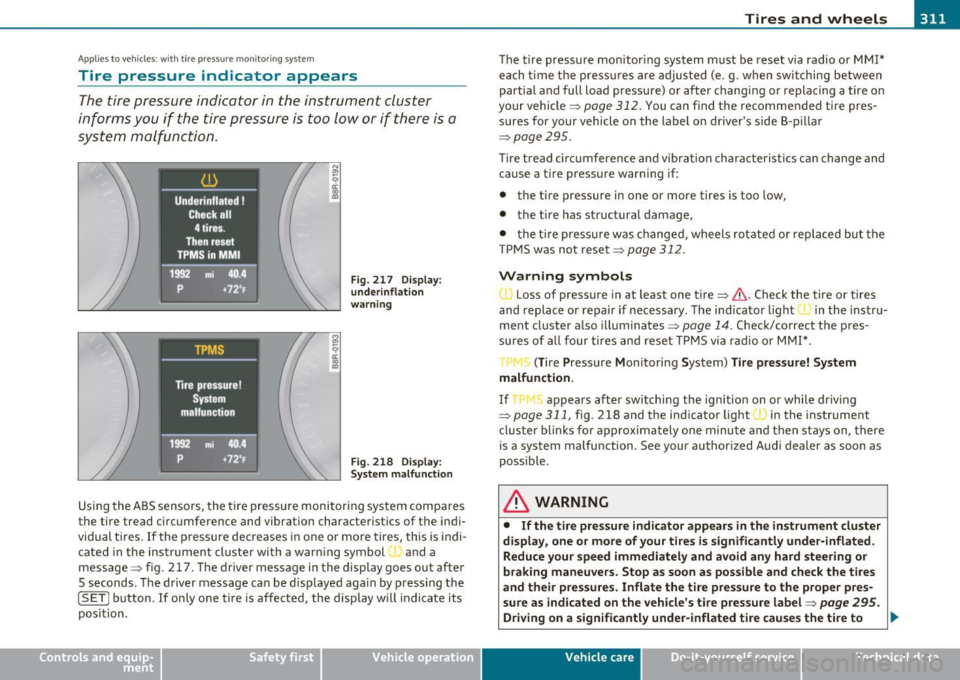
F ig . 217 Displ ay:
un derinfl ation
wa rn ing
Fi g. 218 Disp la y:
S yst em m alf unction
Us ing the A BS sensors, the tire pressure monitor ing system com pa res
the tire tread circumference and vibrat ion characterist ics of the ind i
vidual tires .
If the pressure decreases in one or more tires, this is indi-
cated in the instrument cluster with a warn ing symbol and a
message => fig . 217 . T he driver message in the display goes out after
5 seconds. T he driver message can be d isp layed again by p ressing the
[SETj button. If on ly one tire is affected, the display will indicate its
posi tion.
Vehicle OP-eration T
he tire pressure mon itor ing system must be reset via radio or MMI*
e ach t ime the press ures a re adjus ted (e.g . when switching between
partia l a nd full load pressure) or after chang ing or replacing a tire on
your vehicle =>
page 312. You ca n find the recommended tire pres
sures for your vehicle on the label on dr iver's side B-p illar
=> page 295.
Tir e tread ci rcumference and vibrat ion ch aracterist ics ca n change and
cause a tire pressure warn ing if:
• the tire pressure in one o r more tires is too low,
• the t ire has structura l damage,
• t he ti re pressure w as changed, wheels rotated or replaced bu t the
TP MS was not reset=>
page 312.
Warning symbols
• Loss of pressure in at least one tire => & . Check the tire or tires
and replace or repa ir if necessary . The ind icator light
I in the instru
ment cl uster a lso illuminates =>
page 14. Check/correct the pres
s u res of a ll four tires and reset TPMS via r adio or MM I*.
il (T ire Pressure Monitoring System) Tire pressure! System
malfunction.
If appears after sw itching the ignition on o r while dr iv ing
=> page 311 , fig. 218 and the ind icator light (1 in the instrument
cl uster blinks for a pprox imately one minu te and then s tays on, there
is a system malfunction. See your author ized Audi dealer as soon as
poss ible.
& WARNING
• If the tire pressure indi cator appears in the instrument cluster
display, one or more of your tires is significantly under -inflated.
Reduce your speed immediately and avoid any hard steering or
braking maneuvers . Stop as soon as possible and check the tires
and their pre ssure s. Inflate the tire pre ssure to the proper pre s
sur e as ind icated on the vehicle's tire pres sure label =>
page 295.
Driving on a significantly under-inflated tire causes the tire to _,,.
Vehicle care Do-it-yourselt service iTechnical data