fuel AUDI A5 COUPE 2011 Owner's Guide
[x] Cancel search | Manufacturer: AUDI, Model Year: 2011, Model line: A5 COUPE, Model: AUDI A5 COUPE 2011Pages: 362, PDF Size: 84.88 MB
Page 271 of 362
Fuel supply and filling your fuel tank
Fuel supply and filling your fuel tank
Gasoline
Fuel supply
Using the right fuel helps keep the environment clean and
prevents engine damage .
Fuel recommendation
The fuel recommended for your vehicle is unleaded premium grade
g asoline . See also :::>
page 339, "Da ta ". Aud i recommends using TO P
TIER Detergent Gasoline with a minimum octane ra ting of 91 AKI (95
R O N). For more information on TOP TIE R Detergen t Gasoline, please
go to the official website (www. toptiergas .com) .
Th e recommended gasoline octane ratin g for your engine can also be
found on a labe l located on the ins ide of t he fue l fille r flap. This rating
may be specified as AKI o r RON .
Your vehicle may also be ope rated us ing unleaded reg ular gasoline
with a minim um octane rating of 87 AKI/91 RON. However, us ing 87
AKI/91 RON octane fuel will slig htly reduce engine performance.
Use un leaded ga soline only. U nleaded gaso line is available
throughout the USA, Canada, and in most E uropean co untries. We
recommen d that you do not ta ke your veh icle to areas or co unt ries
where unleaded gasoline may not be available.
F or more in formation on re fueling yo ur vehicle, see:::>
page 270 .
Octane rating
Octane r ati ng indi cat es a gaso line's abi lity to resis t engi ne damag ing
"knock" caused by premature ignition and detonat ion. Therefore,
buying the correc t g rade o f gasol ine is very impo rtan t to help preve nt
possible engine damage and a loss of engine performance .
Gaso line most common ly used in the United States and Canada has
the following octa ne rat ings tha t ca n usually be fou nd on the filler
pump :
Safety first
• Premium Grade: 91 - 96 AKI
• Regular Grade: 87 - 90 AKI
E xplanation of t he abb reviations :
AKI= Anti Knock Index= (R +M)/ 2 = (RON+ MON)/2
RO N= Research Octane Number
M ON= M otor Octane Num ber.
0 Note
• Do not use a ny fue l with octane rat ings lower than 87 AKI o r 91
RO N otherwise expens ive engine damage will occ ur.
• Do
not use leaded gasoline. The use of lea ded gasoline w ill
severely damage your veh icle 's cata lytic converter and its abi lity to
cont rol exhaust emissions .•
Blended gasoline
Use of gasoline containing alcohol or MTBE (methyl
tertiary butyl ether)
Yo u may use unleaded gasoline blended w ith alcoho l or MTBE
( c ommon ly referred to as oxygenates) if the blended mix ture meets
the following criteria:
Blend of ga soline methanol (wood alcohol or methyl alcohol)
• Anti -k nock index m ust be 87 AKI or h igher .
• Bl end must con tain no mo re t han 3% methanol.
• Blend must contain more than 2% co-solvents.
Blend of ga soline and ethanol (grain alcohol or ethyl alcohol)
• Anti-knock index must be 87 AKI o r higher.
• Bl end must no t contain more th an 10% ethanol.
Vehicle care Technical data
Page 272 of 362

Fuel supply and filling your fuel tank
Blend of gasoline and MTBE
• Anti-knock index must be 87 AKI or higher.
• Blend must contain not more than 15% MTBE.
Seasonally adjusted gasoline
Many gasoline grades are blended to perform especially well fo r
winter or summer driving. During seasonal change-over, we suggest
that you fill up at busy gas stat ions where the seasonal adjustment is
more likely to be made in time.
0 Note
• Methano l fuels which do not meet these requirements may cause
corrosion and damage to plastic and rubber components in the fue l
system .
• Do not use fuels that fail to meet the specified criteria in this
chapter .
• If you are unab le to determine whether or not a particu lar fuel
blend meets the spec ifications, ask your serv ice station or its fuel
supplier.
• Do not use fuel for which the contents cannot be identified.
• Fuel system damage and performance problems resulting from
the use of fuels different from those specified are not the responsi
bility of Aud i and are not covered under the New Vehicle or the Em is
sion Control System Warranties.
• If you experience a loss of fuel economy or driveab ility and perfor
mance problems due to the use of one of these fuel blends, we
recommend that you switch to unblended fuel.•
Gasoline additives
A major concern among many auto manufacturers is carbon deposit
build-up caused by the type of gasoline you use. Although gasoline grades differ from one manufacturer to another,
they have certain things
in common. All gaso line g rades contain
substances that can cause deposits to collect on v ital engine parts,
such as fuel injectors and intake valves. A lthough most gasoline
brands include additives to keep eng ine and fuel systems clean, they
are not equally effective.
Audi recommends using TOP TIER Detergent Gasoline. For more
information on TOP TIER Detergent Gasoline, please go to the officia l
webs ite (www.toptiergas.com).
After an extended period of using inadequate fuels, built-up carbon
deposits can rob your engine of peak performance.
0 Note
Damage or malfunction due to poor fuel quality is not covered by the
Audi New Vehicle Limited Warranty. •
Fuel tank
Fuel filler neck
The fuel filler neck is located on the right rear side panel behind the
fuel filler flap .
If the power locking system should fail, you can still open the flap
manually- for detailed instructions see~
page 273.
You can find the fue l tank capacity of your vehicle in Technical Data
~page 339.
The label on the inside of the fuel filler flap tells you the correct fuel
for your ve hicle. For more information about fuel specifications, see
~page 269.
Your vehicle fuel tank has an on-board refue lling vapor recovery
system. This feature helps to prevent fuel vapors from escaping from
the tank and polluting the environment wh ile you refuel your veh icle . ..,_
Page 273 of 362
In order to fill the tank properly while protecting the environment,
please follow this refueling procedure carefully.
& WARNING
Under normal operating conditions, never carry additional fuel
containers in your car. Gas canisters and other containers used to
transport fuel can be dangerous. Such containers, full or empty,
may leak and could cause a fire in a collision. If you must transport
fuel to use for your lawn mower, snow blower, etc., be very careful
and always observe local and state laws regarding the use, trans
portation and storage of such fuel containers. Make certain the
container meets industry standards (ANSI/ASTM F852 -86).
0 Note
Never drive your vehicle until the fuel tank is completely empty . The
irregular supply of fuel can cause misfiring. Gasoline could enter the
exhaust system and damage the catalytic converter. •
Refuelling
Fig. 199 Right rear
vehicle side: Opening
the fuel filler flap
Vehicle OP-eration
Fuel supply and filling your fuel tank
Fig. 200 Fuel filler
flap with attached fuel
cap
When activating the central locking, the fuel filler flap is
automatically unlocked or locked. Refuel the vehicle with the
igni tion turned
off.
Taking the fuel cap off
-Turn off the ignition.
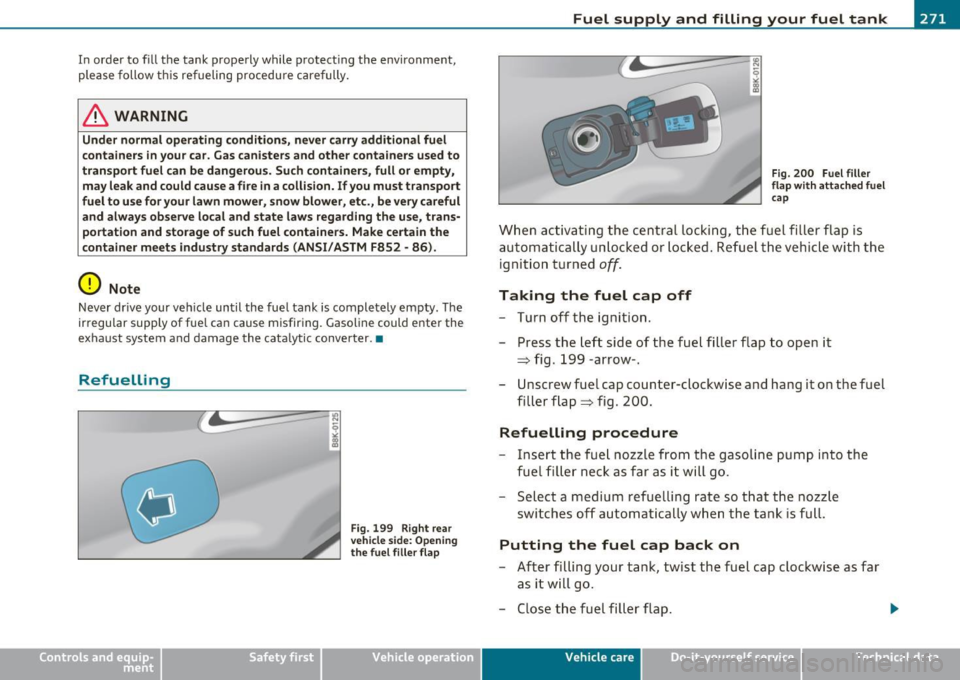
- Press the left side of the fuel filler flap to open it
~ fig. 199 -arrow-.
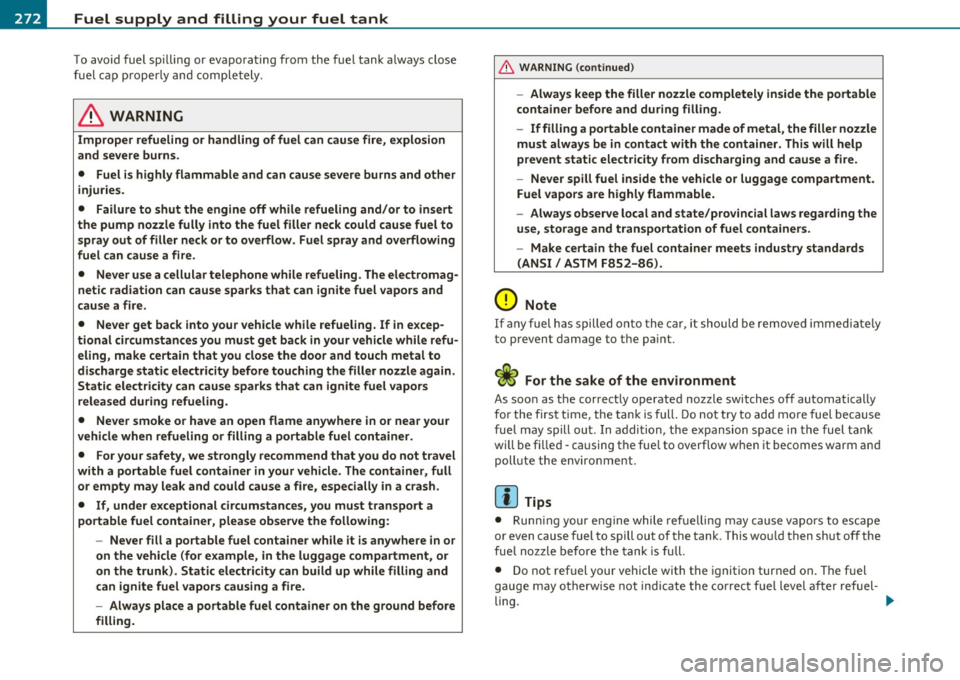
- Unscr ew fuel cap counter-clockwise and hang it on the fuel
filler flap~ fig. 200.
Refuelling procedure
-Insert the fuel nozzle from the gasoline pump into the
fuel filler neck as far as it will go.
- Select a medium refuelling rate so that the nozzle
switches off automatically when the tank is full.
Putting the fuel cap back on
- After filling your tank, twist the fuel cap clockwise as far
as it will go.
- Close the fuel filler flap. .,_,
Vehicle care Do-it-yourselt service iTechnical data
Page 274 of 362
-Fuel supply and filling your fuel tank
P:Vf------=-=----------=-:o..------------
To avoid fu el sp illin g o r evaporat ing from th e fue l tank a lways clos e
fu el cap prop erl y and com plete ly.
& WARNING
Improper refueling or handling of fuel can cause fire, explosion
and severe burns .
• Fuel is highly flammable and can cause severe burns and other
injuries.
• Failure to shut the engine off while refueling and /or to insert
the pump nozzle fully into the fuel filler neck could cause fuel to
spray out of filler neck or to overflow. Fuel spray and overflowing
fuel can cause a fire.
• Never use a cellular telephone while refueling. The electromag
netic radiation can cause sparks that can ignite fuel vapors and
cause a fire.
• Never get back into your vehicle while refueling. If in excep
tional circumstances you must get back in your vehicle while refu eling, make certain that you close the door and touch metal to
discharge static electricity before touching the filler nozzle again.
Static electricity can cause sparks that can ignite fuel vapors
released during refueling.
• Never smoke or have an open flame anywhere in or near your
vehicle when refueling or filling a portable fuel container.
• For your safety, we strongly recommend that you do not travel
with a portable fuel container in your vehicle. The container, full or empty may leak and could cause a fire, especially in a crash .
• If, under exceptional circumstances, you must transport a
portable fuel container , please observe the following:
- Never fill a portable fuel container while it is anywhere in or
on the vehicle (for example, in the luggage compartment, or
on the trunk). Static electricity can build up while filling and
can ignite fuel vapors causing a fire.
- Always place a portable fuel container on the ground before
filling.
& WARNING (co ntinued )
-Always keep the filler nozzle completely inside the portable
container before and during filling .
- If filling a portable container made of metal, the filler nozzle
must always be in contact with the container. This will help
prevent static electricity from discharging and cause a fire.
- Never spill fuel inside the vehicle or luggage compartment .
Fuel vapors are highly flammable.
- Always observe local and state/provincial laws regarding the
use, storage and transportation of fuel containers.
- Make certain the fuel container meets industry standards
(ANSI/ ASTM F852-86).
0 Note
If any fu el ha s sp illed onto t he car , it shoul d be remove d imme diate ly
to p revent damage to the pa int.
fo r the fi rs t time, the tank i s full. D o not try to add mo re fue l because
fu el may spill ou t. In addi tion, t he e xpans ion s pace in the fuel ta nk
w ill b e filled - causing t he fue l to overflow when it becomes warm an d
poll ute the environment .
W Tips
• Runn ing y our e ng in e while ref uellin g m ay caus e vapor s to escape
or
even cause fuel to spill out of the tank . This wo uld then shut of f the
fue l no zzle before the tank is ful l.
• Do not ref uel your vehicle with t he ignition turned on . T h e f uel
g auge may o therwise not indicate the co rrec t fu el level af te r ref uel-
ling . .,_
Page 275 of 362
• The fuel filler flap of your vehicle is not locked when you lock the
vehicle from the inside. •
Unlocking the fuel filler flap by hand
You can open the fuel filler flap by hand if the power
locking system should fail.
N
"' 9 >< 00 a,
F ig . 201 Luggage
compar tme nt:
opening the s ide t rim
Fig. 202 Luggage
compar tment: Erner·
gency open ing of fue l
fi ller flap
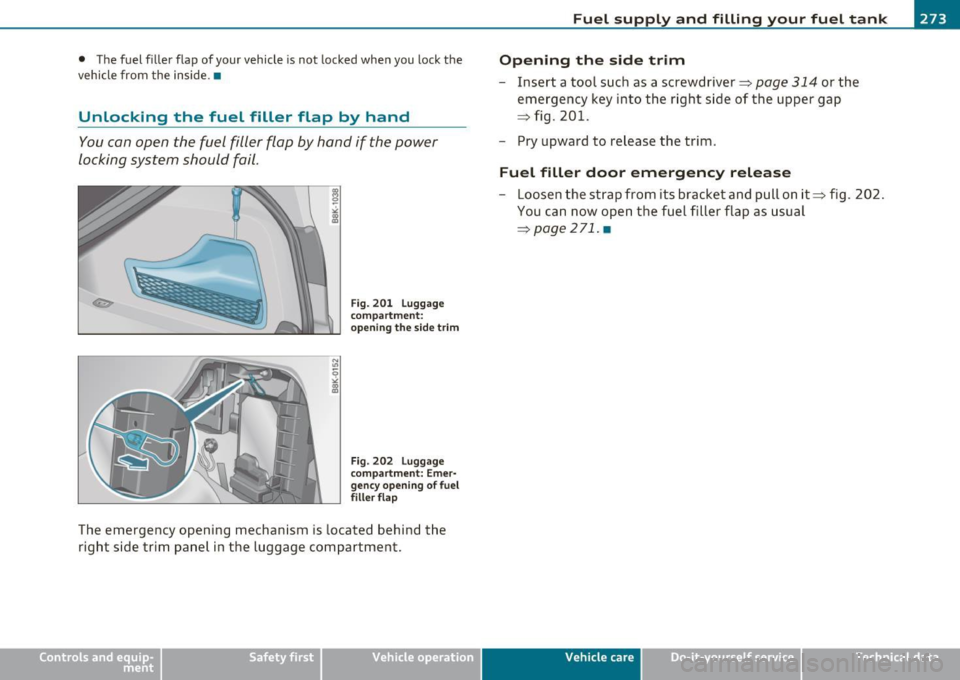
The emergency opening mechanism is located behind the
right side trim panel in the luggage compartment.
Vehicle OP-eration
Fu el supp ly and filling your fuel t ank
Op ening th e side trim
- Insert a tool such as a screwdriver=> page 314 or the
emergency key into the right side of the upper gap
=> fig. 201.
- Pry upward to release the trim.
Fuel fill er door em ergency r ele ase
- Loosen the strap from its bracket and pull on it=> fig. 202.
You can now open the fuel f iller flap as usual
=:>page 271. •
Vehicle care Do-it-yourselt service iTechnical data
Page 277 of 362

Checking and filling Ill
-------------~--
Closing the engine hood
- Pull the hood down until the pressure from the struts is
reduced.
- Let the hood
drop down and latch in place. Do not try to
push it shut;
it may fail to engage=:> &.
& WARNING
A hood that is not completely latched could fly up and block your
view while driving.
• When you close the engine hood, check it to make sure the
safety catch has properly engaged. The hood should be flush with
the surrounding vehicle body parts.
• If you notice while driving that the hood is not secured prop
erly, stop at once and close it. •
Working in the engine compartment
Be especially careful whenever you work in the engine
compartment.
Whenever you must perform any work in the engine compartment,
for example checking and filling different fluids, there is a risk of injury, burns and accidents. To prevent personal injury always
observe the following WARNINGS. The engine compartment of any
vehicle is a hazardous area=>& .
& WARNING
To help avoid injury, before you check anything under the hood:
• Turn off the engine.
• Remove the ignition key.
• Apply the parking brake.
Safety first
& WARNING (continued)
• Move selector lever of automatic transmission to "P" (Park);
put manual transmission in Neutral.
• Always let the engine cool down. Hot components will burn
skin on contact.
• To reduce the risk of being burned, never open the hood if you
see or hear steam or coolant escaping from the engine compart
ment. Wait until no steam or coolant can be seen or heard before
carefully opening the hood.
• Keep children away from the engine compartment.
• Never spill fluids on hot engine components. They can cause a
fire.
• Never touch the radiator fan. The auxiliary electric fan is
temperature controlled and can switch on suddenly.
• Never open the coolant reservoir cap when the engine is still
warm. The coolant system is pressurized and hot coolant could
spray out.
• Protect your face, hands and arm from steam or hot engine
coolant by placing a thick rag over the cap when you open the
coolant reservoir.
• If work on the fuel system or the electrical system is necessary:
-Always disconnect the battery.
- Never smoke or work near heaters or open flames. Fluids in
the engine compartment could start a fire.
- Keep an approved fire extinguisher immediately available.
• To avoid electrical shock and personal injury while the engine is
running or being started, never touch:
-Ignition cables
- Other components of the high voltage electronic ignition
system.
• If you must perform a check or repair with the engine running: ..,
Vehicle care Technical data
Page 280 of 362
-Checking and filling
-------=----- -=-----------------------------------------
For more information about engine oil that has been approved for
your veh icle, please contact either your authorized Audi dealer or
Audi Customer Relations at 1 (800) 822-2834 or visit our web site at
www.audiusa .com or www.audicanada.ca . Here you will also find a
current list of oils (manufacturers, brand names etc.) that conform to
Audi oil standard VW 502 00 .
Changing the engine oil
The engine oil and oil filter must be changed according to the mileage
(kilometers) and time intervals specified in your vehicle's Warranty
&
Maintenance booklet . Do not exceed these intervals - harmful
deposits from o ld engine oil can reduce engine performance and can
lead to expensive engine repa irs.
Changing the oil at the recommended intervals is so very important
because the lubricating properties of oil decrease gradually during
normal vehicle use. If you are not sure when you have your oil
changed, ask your authorized Audi Service Adviso r.
Under some circumstances the engine o il should even be changed
more frequent ly. Change oil more often if you drive mostly short
distances, operate the veh icle in dusty areas or mostly under stop
and-go traffic conditions, or when you use your vehicle where temper
atures stay below freez ing po int for long periods.
Detergent additives in the oil will make fresh oil look dark after the
engine has been running for a short time. This is normal and is not a
reason to change the oil more often than recommended .
Damage or malfunctions due to lack of maintenance
It is essentia l that you change yo ur oil at the recommended intervals
using only engine oil that complies with Audi oil standard
VW 502 00. Your Limited New Vehicle Warranty does not cover
damage or malfunctions due to fa ilure to follow recommended main
tenance and use requirements as set forth in the Audi Owner's
Manual and Warranty
& Maintenance booklet. Your dealer will have
to deny warranty coverage unless you present to the dealer proof in
the form of Service or Repair Orders that all scheduled maintenance
was performed in a timely manner. •
Engine oil consumption
The engine in your vehicle depends on an adequate
amount of oil to lubricate and cool all of its moving parts.
In order to provide effective lubrication and cooling of internal
eng ine components, all inte rnal comb ustion eng ines consume a
certain amount of oil. Oil consumption varies from engine to engine
and may change sign ifican tly over the life of the engine. Typically,
engines with a specified break-in period (see~
page 246) consume
more oil dur ing the break- in period than they consume after oil
consumption has stab ilized.
Under normal conditions, the rate of oil consumption depends on the
quality and viscosity of the oil, the RPM (revolutions per minute) at
which the engine is operated, the ambient temperature and road
conditions. Further factors are the amount of oil dilution from water
condensation or fuel residue and the oxidation level of the oil. As any
eng ine is subject to wear as mileage builds up, the oil consumption
may increase over time until replacement of worn components may
become necessary.
With all these variab les coming into play, no standard rate of oil
consumption can be established or specified . There is no alternative
to regular and frequent checking of the oil level, see
Note .
If the yellow engine oil level warning symbol in the instrument
cluster lights up, you should check the oil level as soon as possible
~ page 279. Top off the oil at your earliest convenience~ page 279.
& WARNING
Before you check anything in the engine compartment , always
read and heed all WARNINGS ~
& in "Working in the engine
compartment" on page
275.
Page 281 of 362
___________________________________________ C_ h _ e_c _k _ i_n -=g ~ a_n _ d_ f_i _ll _i _ n -=g =--- ......J•
0 Note
Dr iv ing with an insufficient oil level is likely to cause severe damage
to the engine .
[ i ] Tips
• The oil pressure warning display~ is not an indicator of the oil
level. Do not rely on it. Instead , check the oil level in your engine at
regular intervals, preferably each time you refuel, and always
before going on a long trip .
• If you have the impression your engine consumes excessive
amounts of oil, we recommend that you consult an authorized Audi
dealer to have the cause of your concern properly diagnosed. Keep in
m ind that the accurate measurement of o il consumption requires
great care and may take some time. An authorized Audi dealer has
instructions about how to measure oil consumption accurately .•
Checking the engine oil level
Fig. 206 MMI Display:
Oil leve l ind icator
Read oil level
-Park your vehicle so that it is horizontally level.
- Shut the engine off when it is at operating temperature.
Vehicle OP-eration
-Wait approx . two minutes.
- Select: Function button
[CAR]> Oil level.
- Read the oil level in the MMI* Display => fig. 206. Add
engine oil if the bar of the oil level indicator is near "Min"
=>
page 279
Depending on the way the vehicle is driven and the operating condi
tions, oil consumpt ion can be up to a 1/2 quart per 600 mi les (0.5
liter per 1,000 km). Consumption may be higher within the first
3,000 miles (5,000 km) .
[ i ] Tips
Th e oil level indicator in the MMI* Display is on ly an information
display.
If the oi l level is too low, a m inimum o il warning appears in
the instrument cluster. Add oil=>
page 2 79. If the hood has been
opened, the current oil level is shown in the instrument cluster the
next time the ignition is switched on .•
Adding engine oil
com partment: Oil filler
cap location
Before you check anything in the engine compartment,
always read and heed all WARNINGS=> & in "Working in
the engine compartment" on
page 275. .,,_
Vehicle care Do-it-yourselt service iTechnical data
Page 297 of 362
________________________________________________ T_ i_ re _ s_ a_ n_d_ w_ h_ e_ e_l _s _ ....... JIII
Occupant loading and distribution for vehicle normal load for various designated seat ing capacities
Designated seating capacity, num- Vehicle normal load , number of Occupant distribution in a nor
mally loaded vehicle
ber
of occupants occupants
4 2 2 in front •
Co ld tire inf lation pressure
Tire pr essur e aff ects the overall handling, performance and safety of a vehicle.
F ig . 2 12 Tire pre ssure
label : loca te d e ithe r on
drive r's s ide B -pillar or
i ns ide th e fuel fille r
flap
Tire pressure generally refers to the amount of air in a tire that it
nee ds it to do its job and safe ly ca rry the combi ned load of t he en tire
vehicle and its contents. Tire pressure is measured in kilopascals
(kPa), the inte rn ational measuri ng un it and in pou nds per square i nch
(PSI) . Tire pressure is based in part on the ve hicle's design and load
limit -the greatest amount of weight that the vehicle can ca rry safe ly
and the t ire size . The proper tire pressure is frequent ly refe rred to as
the "recommended cold t ire inflation pressure ." Air in t he tires
expands when the t ire hea ts up because of i nternal fric tion whe n it
flexes in use . The tire press ure is higher when the ti re has warmed up
t han whe n it is "cold."
It is the inflat io n pr essu re in a "co ld" t ire that
counts. The refore, you sho uld never let air out of a warm t ire to
match "cold ti re infla tion pressure" recommendations . The t ires
would then be under inflated and could fail suddenly.
Vehicle OP-eration
(.
~ ( SEATING CAPACllY JOTAL l:FRONT l:CENTER I )!EAR I )
TIRE AND LOADING INFORMATION
Tot--""'91"dOCC10-,ndQ,gc>"""-"1 ___ "90<- lb$.
TIRE SIZE COW TIRE PRESSURE
FRONT -KPa, - PSI
REAR -KPa, -PSI
Fig . 213 Tire pres sure
label
Ma intain ing proper tire pressure is one of the most important things
you can do to he lp avoid sudde n tir e f ailur e. Under infl ated tires a re a
major cause of sudden tire fa ilure. Keep ing t ires at the rig ht pressure
is a lso important for s afe and responsive vehi cle ha nd ling, tractio n,
braking and load carrying.
Tire pressures are particularly important
when the vehicle is being driven at higher speeds , and then e spe·
cially when heavily loaded even within the permissible load
carrying capacities approved for your vehicle .
The recommended tire pressures for your Audi depend on the kind of
ti res on your vehicle and the numbe r of passengers and/or amou nt of
l u ggage you will be transpo rting .
On USA vehicles, the tire pressure label is located on the d river 's side
8 -pi lla r. O n Ca nada vehi cles, the tire pressure label is located either
on t he driver's side 8- pilla r o r i nside the f uel filler flap . The tire pres ·
s u re labe l lists the recommended co ld tire inflation press ures for the ..,.
Vehicle care Do-it-yourselt service iTechnical data
Page 298 of 362
-~_T_ ir_e_ s_ a_ n_ d_ w_ h_e_ e_ ls _______________________________________________ _
vehicle at its maximum capacity weight and tires that were on your
vehicle at the tim e it was manufactured.
If you wish to improve comfort when operating the vehicle at
normal load (up to 3 occupants) , you can adjust tire pressures to
those specified for normal vehicle load. Before operating the
vehicle at maximum load, you must increase the tire pressures to
those specified for maximum vehicle load
=> &.
Bear in mind that the tire pressure monitoring system* ca n only
monitor the tire pressures you have stored. The system does not
recogn ize the load condit ion of your vehicle.
The effectiveness of the tire pressure monitoring system* wi ll be
impaired if you store normal load pressures but then operate the
vehicle at its maximum load
=> &.
See the illustration => page 295, fig. 212 for the locat ion of the label
either on driver's side B-pillar or inside the fuel filler flap (color of the
actual label and exact location on the vehicle will vary slightly).
Note that the following tab le is accurate at the time of going to press
and is subject to change. In the event of discrepancies, the tire pres
sure label (On USA vehicles, the tire pressure label is located on the
dr iver's side B-pillar. On Canada vehicles, the tire pressure label is
located e ither on the driver's s ide B-pillar or inside the fuel filler flap)
always takes precedence.
The table below lists the recommended cold tire inflation pressures
for the Audi model covered by your Owner's Literature at the vehicle's
capacity weight and the tire sizes installed on the respective models
as origina l equipment, or as a factory option.
Engine
(displace ment in liter) Tire designation
Tire pressure front Tire pressure rear
normal load normal load
condition (up full load condition
(up
full load
to 2 occu- condition to 2 occu- condition pants) pants)
PSI Jl kPA PSI kPA PSI kPA PSI II kPA
4-cylinder 225/50 Rl 7 94H All Season 32 220 33 230 29 200 33 230
2.0
245/45 Rl 7 95H All Season 32 220 33 230 29
200 33 230
245/40 R18
93H All Season 33 230 35 240 29 200 35 240
255/35 R19 96V XL High Performance 32 220 33 230 32 220 33 230
265/30 R20 94Y XL High Performance 30 210
33 230 29 200
33 230
XL=
reinforced or extra load tire. It may also appear as xi, EXTRA LOAD, or RF on the tire sidewall.
The correct tire pressure for the spare wheel is located on a label
either on the driver's s ide B-pillar or inside the fuel filler flap.
Beca use technica l changes may be made to vehicle equipment during
the model year, always compare the tir e s ize designation on the tir e
pressure label on your vehicle with the tires on your vehicle. Make sure that the tire size information on the vehicle label is the same as
the
size of the tires on the vehicle. This is especially important if the
vehicle belongs to someone e lse or you bought the vehicle with
different rims/tires or you bought the veh icle as a previous ly ow ned
vehicle. _.,,