brake AUDI A5 COUPE 2011 Repair Manual
[x] Cancel search | Manufacturer: AUDI, Model Year: 2011, Model line: A5 COUPE, Model: AUDI A5 COUPE 2011Pages: 362, PDF Size: 84.88 MB
Page 258 of 362
-~_C_ le_ a_n_ i_ n_ g=- a_ n_d___. p_ ro_ t_e _c_ t_ i_o _n ___________________________________________ _
Cleaning and protection
General information
Regular care preserves vehicl e val ue.
Any automobile is exposed to industria l fumes, co rrosive road salt,
e tc. A well ca red for Audi c an look lik e new many ye ars after pur cha se.
Regu lar and correct care w ill contribute to mai nta in ing t he bea uty
a nd valu e of your Au di.
Furthermore, good care may be a condition for substantiating a
warranty claim should corrosion damage or paint defects occur.
Yo ur au thori zed Audi d eale r h as a var iety of dedicated vehicle-care
products
and can advise w hich ones to use for clea ning the exterior
a n d inter io r of your ve hicle.
W het her you use products recommended by Aud i or other comme r
cia lly availab le cleaning agents , please make sure yo u appl y them
co rrectly .
& WARNING
• Cleaning agents may be poisonous . Keep them out of the reach
of children.
• Heed all caution labels .
• Always read directions on the container before using any
product. Follow the directions carefully.
• Most chemical cleaners are concentrated and have to be
diluted .
• Use spot removing fluids only in well ventilated areas.
• Do not use gasoline, kero sene , diesel fuel , nail polish remover
or other volatile fluids . They may be toxic, flammable or
hazardous in other ways. Do not wash, wax or dry the vehicle with
the ign ition on or the engine running .
& WARNING (continued )
• Do not clean the under sides of chassi s, fenders , wheel covers,
etc. without protecting your hands and arms. You may cut your
self on sharp-edged metal parts.
• Moisture and ice on brakes may impair braking efficiency
~ page 239, "General information ". Test the brakes carefully
each time you wash the vehicle .
'£> For the sake of the environment
Select only envir onmenta lly fr iendly clea ning produc ts . Leftover
cleaning pro ducts sho uld not dis posed of i n the household waste .•
Care of exterior
Washing
F re quent w ashin g protec ts th e vehicle.
T he best protection aga inst env ironmental influences is frequent
w ashi ng and w ax ing. How oft en thi s is requ ired depen ds on :
• How m uch the vehicle is used
• Whe re the ve hicle is parke d (gar age, in the o pen un der tr ees, etc.)
• The seasona l and weather conditions
• Environ mental influences
T he longer bird droppings , insects , tree resin, road and industria l
gr ime, t ar, soo t, road sa lt and o ther ma ter ia ls remain on t he veh icle
body, the more lasti ng their destructive effects w ill be. H igh temper
atu res cause d by ex pos ure to intense s unlight int ensify the co rrosive
effect, part icu larly when humid ity is high as we ll.
~
Page 264 of 362
-~_C_ le_ a_n_ i_ n_ g=- a_ n_d___. p_ ro_ t_e _c_ t_ i_o _n ___________________________________________ _
- For deep cleaning afterwards, use only a ded icated acid
free cast alloy wheel cleaner .
- Rub a coat of
liquid wax onto the rims every three mont h.
B e s ure to re ach a nd tre at all part s o f the rim .
To preserve the d ecorative ap pea ra nce of the cast alloy whe els, so me
special care is necessary. In a ddition to roa d dirt and sa lt, brake dust
is a lso co rrosiv e. If left on fo r too long, b rake dus t can ca u se p itting .
Use only spec ial
acid-free cleaners formulated for a lloy rims. Safe
pro duct s ar e availa ble at your author iz ed Audi de aler. Neve r leave the
cleaner on the rims longer than spec ified on t he labe l. If not rins ed
off promptly, the acid con tain ed in some cleaners can att ack t he
t hr eads o n the wheel bolts .
N ever us e abrasiv e or metal po lish ing cleaning a gents.
If the protec
t ive co ating has b een ch ipped, e.g. by kick ed up ro ad dir t, to uch it up
as soon as possible.
& WARNING
• Moisture and ice on brakes may affect braking efficiency
=> page 239, "General information" . Test the brakes carefully
each time you wash the vehicle.
• Always read and heed all WARNINGS and other information
=>page 256. •
Body cavity sealing
Th e bo dy cavi ty sealing d oes n ot need to be ch ecked.
All body cav it ies which co uld be affecte d by co rrosion have been tho r
oughly protected at t he factory .
T hi s sea ling does not require any inspection or additiona l treatment.
If any wax s hould seep ou t of the cavi ty when the amb ient temp era
ture is high , it can be removed w it h a plastic sc raper and a suitable
so lvent .
& WARNING
Solvents can be dangerous.
• Benzine is flammable and toxic . If you use benzine for
removing the wax, keep sparks, flame and lighted cigarettes
away . Never dump benzine on the ground, into open streams or
down sewage drains.
• Be sure to observe all safety and environmental regulations.
Follow all instructions on the container.
• Always read and heed all WARNINGS and other information
=:>page 256. •
Chassis
Have th e undercoating c hecke d f or da mage fr om time t o
tim e.
Th e lower body she ll of your A udi is a lso thoro ug hl y protec ted against
co rrosion.
Any damage to the undercoating caused by road haza rds sho uld be
re paire d pr omp tly.
& WARNING
Too much undercoating in the wrong places can caus e a fire.
• Do not apply additional undercoating or ru stproofing on or
near the exhaust manifold, exhaust pipes, catalytic converter or
heat shields. While driving , the substance used for undercoating
could overheat and cause a fire.
• Always read and heed all WARNINGS and other information
=:>page 256 . •
Page 277 of 362

Checking and filling Ill
-------------~--
Closing the engine hood
- Pull the hood down until the pressure from the struts is
reduced.
- Let the hood
drop down and latch in place. Do not try to
push it shut;
it may fail to engage=:> &.
& WARNING
A hood that is not completely latched could fly up and block your
view while driving.
• When you close the engine hood, check it to make sure the
safety catch has properly engaged. The hood should be flush with
the surrounding vehicle body parts.
• If you notice while driving that the hood is not secured prop
erly, stop at once and close it. •
Working in the engine compartment
Be especially careful whenever you work in the engine
compartment.
Whenever you must perform any work in the engine compartment,
for example checking and filling different fluids, there is a risk of injury, burns and accidents. To prevent personal injury always
observe the following WARNINGS. The engine compartment of any
vehicle is a hazardous area=>& .
& WARNING
To help avoid injury, before you check anything under the hood:
• Turn off the engine.
• Remove the ignition key.
• Apply the parking brake.
Safety first
& WARNING (continued)
• Move selector lever of automatic transmission to "P" (Park);
put manual transmission in Neutral.
• Always let the engine cool down. Hot components will burn
skin on contact.
• To reduce the risk of being burned, never open the hood if you
see or hear steam or coolant escaping from the engine compart
ment. Wait until no steam or coolant can be seen or heard before
carefully opening the hood.
• Keep children away from the engine compartment.
• Never spill fluids on hot engine components. They can cause a
fire.
• Never touch the radiator fan. The auxiliary electric fan is
temperature controlled and can switch on suddenly.
• Never open the coolant reservoir cap when the engine is still
warm. The coolant system is pressurized and hot coolant could
spray out.
• Protect your face, hands and arm from steam or hot engine
coolant by placing a thick rag over the cap when you open the
coolant reservoir.
• If work on the fuel system or the electrical system is necessary:
-Always disconnect the battery.
- Never smoke or work near heaters or open flames. Fluids in
the engine compartment could start a fire.
- Keep an approved fire extinguisher immediately available.
• To avoid electrical shock and personal injury while the engine is
running or being started, never touch:
-Ignition cables
- Other components of the high voltage electronic ignition
system.
• If you must perform a check or repair with the engine running: ..,
Vehicle care Technical data
Page 278 of 362

lffll __ C_h_ e_c _k _i_n -=g :a,__ a_n_ d_ f_ i_ l _li _n _,g;._ __________________________________________ _
& WARNING (continued )
-First, fully apply the parking brake , move selector lever of
automatic transmission to "P" (Park); put manual transmi s
sion in Neutral.
- Alway s use extreme caution to prevent clothing, jewelry , or
long hair from getting caught in the radiator fan , V-belts or
other moving part s, or from contacting hot parts. Tie back hair
before starting , and do not wear clothing that will hang or
droop into the engine .
• Minimize expo sure to em is sion and chemical hazards=>& .
& WARNING
California Proposition 65 Warning:
• Engine exhaust , some of its constituents, and certain vehicle
c omponents contain or emit chemicals known to the State of Cali
fornia to cause cancer and birth defects and reproductive harm. In
addition , certain fluid s contained in vehicle s and certain products
of component wear contain or emit chemicals known to the State
of California to cause cancer and birth defects or other reproduc
tive harm.
• Battery posts, terminals and related acces sories contain lead
and lead compounds, chemicals known to the State of California
to cause cancer and reproductive harms. Wash hand s after
handling .
0 Note
When adding fluids, a lways make sure that they are poured into the
proper container or filler opening, otherwise serious damage to
veh icle systems w ill occur.
<£' For the sake of the environment
T o de tect leaks in time, inspect the veh icle floo r pa n from u nder neat h
regu larly. If you see spots from oil or other vehicle fluids, have your
vehicle inspe cted by an au thor ized Aud i dea le r.•
Engine compartment
Engine compartment
These are the most important i tems that y ou can chec k.
Fig. 205 Typ ical layout f or contain ers and engine o il filler cap
(D Jump start poi nt( +) unde r a cover . .... ..... .. .... 288, 3 29
@ Brak e fluid reservo ir ( ) . . . . . . . . . . . . . . . . . . . . . . . . 284
® Engine oil fill er cap(~) . . . . . . . . . . . . . . . . . . . . . . . . 279
© Coolant e xpansion tank (- L ) . . . . . . . . . . . . . . . . . . . . . 282
® Jump start point( -) with hex head screw ........... 288,329.,.
Page 286 of 362
•--=C:.:.h.:.. e=. c=.:..:: k .:.:in ..:. g ~ a::..:..: n~d .:...:.. f:....:il ..:.li :.:.n.;.: g~ ------------------------------------------
0 Note
• Coolant pollutes the environment and could cause an engine fire.
Excess coolant will be forced out through the pressure relief valve in
the cap when the engine becomes hot .
• If, in an emergency, only water can be added, the correct ratio
between water a nd antifreeze ::::>
page 281 must be restored as soon
as possible.
ci> For the sake of the environment
Drained coolant should not be reused. Always dispose of used coolant
wh ile observ ing all environmental regulations.•
Radiator fan
The radiator fan switches on automatically by itself.
The radiator fan is driven by the engine v ia the V-belt. The viscous
clutch regulates the speed of the fan according to the temperature of
t he coo lant.
An auxiliary electr ic radiator fan* sw itches on and off depending on
coolant temperature and other vehicle operating conditions.
After you switch the engine off, the auxiliary fan can cont inue running
for up to 10 minutes- even with the ignition off. It can even switch on
again later by itse lf::::>
/1 , if
• the temperature of the engine coolant rises due to the heat build
up from the engine in the engine compartment, or
• the engine compartment heats up because the veh icle is parked in
intense sunlight.
& WARNING
• To reduce the risk of personal injury never touch the radiator
fan.
/1 WARNING (continued)
• The auxiliary electric fan is temperature controlled and can
switch on suddenly even when the engine is not running.
• The auxiliary radiator fan switches on automatically when the
engine coolant reaches a certain temperature and will continue to
run until the coolant temperature drops .•
Brake fluid
Checking brake fluid level
The brake fluid level can be checked with a quick glance.
Fig . 209 Engine
co mpartm ent : Brake
fluid reservoir
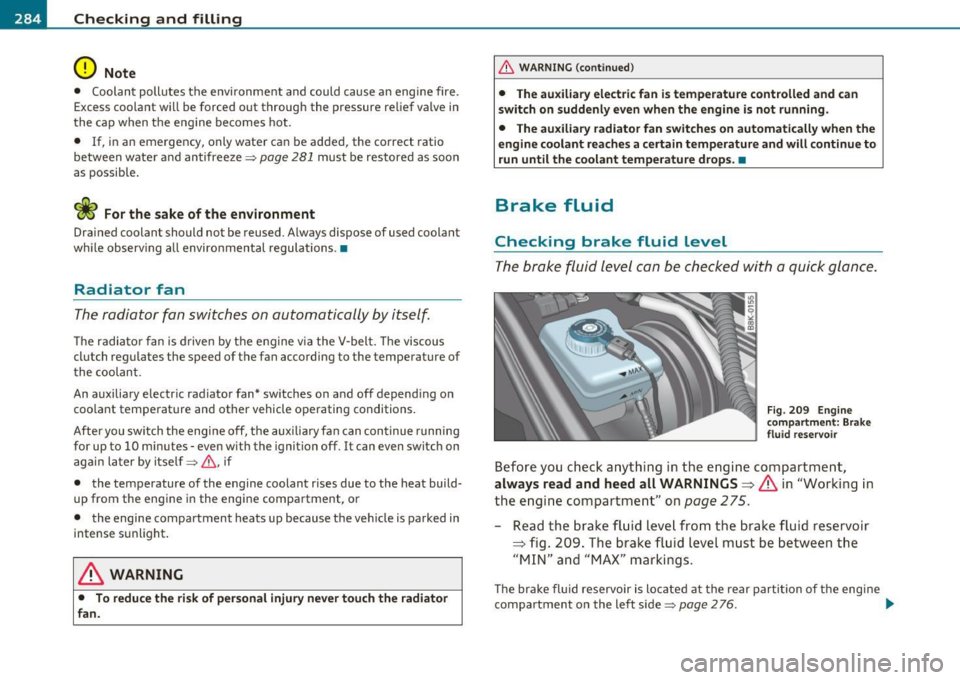
Before you check anything in the engine compartment,
always read and heed all WARNINGS=> & in "Working in
the engine compartment" on
page 275.
-Read the brake fluid level from the brake fluid reservoir
=> fig. 209. The brake fluid level must be between the
"MIN" and "MAX" markings.
The brake fluid reservoir is located at the rear partition of the engine
compartment on the left side=>
page 276. .,
Page 287 of 362
___________________________________________ C_ h_e _c _k_ i_n ~g_ a_n_ d_ f_ i_ll _i_n _g __ _
The fluid level may drop slightly after some time due to the auto
matic adjustment of the brake pads. This is not cause for alarm.
If the brake flu id level falls considerably below the "MIN " mark, the
brake warning/indicator light (U.S. models:
BRAKE , Canadian mode ls:
{(j)) ) will come on=> page 18 and=> page 33. Do not continue to
ope rate the vehicle. The complete brake system should be thorough ly
checked by an authorized Audi dealer or qualified workshop and the
cause corrected. If the brake fluid level is too low, the brake
wa rning/ind icator light will illuminate. Contact an authorized Aud i
dealer
immediately .
[I] Tips
The brake fluid reservoir is located undernea th the cover. •
Changing brake fluid
Hove the broke fluid changed by on experienced techni
Clon.
Brake fluid absorbs moisture from the air. If the water content in the
brake fl uid is too high, corrosion in the brake system may result after
a period of time. The boiling point of the brake fluid will also decrease
considerably and decrease braking performance.
Therefore, the brake flu id must be changed
every two years. Always
use new brake fluid which conforms to Federal Motor Vehicle Stan
dard "FMVSS 116 DOT 4".
The brake fluid reservoir can be difficult to reach, therefore, we
recommend that you have the brake fluid changed by your authorized
Audi dealer. Your dealer has the correct tools, the right brake fluid
and the know-how to do this for you .
& WARNING
• Brake fluid is poi sonous. It must be stored only in the closed
original container out of the reach of children!
Safety first
& WARNING (continued )
• Brake failure can result from old or inappropriate brake fluid.
Observe these precautions:
-Use only brake fluid that meets SAE specification
J 1703 and
conforms to Federal Motor Vehicle Standard 116. Always check
with your authorized Audi dealer to make sure you are using
the correct brake fluid . The correct type of brake fluid is also
indicated on the brake fluid reservoir.
- The brake fluid must be new. Heavy use of the brakes can
cause a vapor lock if the brake fluid is left in the system too
long. This can seriously affect the efficiency of the brakes as
well as your safety. This could result in an accident .
0 Note
Brake fluid will damage the paint of your vehicle.
ffi For the sake of the environment
Because of the prob lem of proper disposal of brake fluid as well as
th e special tools required and the necessary expertise, we recom
mend that you have the brake fluid changed by your author ized Audi
dealer. •
Battery
General information
Under normal operating conditions, the battery in your Audi does not
need any maintenance . With high outside temperatures or long daily
drives we recommend that you have the electro lyte level checked by
an authorized Audi dealer or qualified workshop . The electrolyte leve l
should also be checked each t ime the battery is charged=> page 288.
~
Vehicle care Technical data
Page 293 of 362

__________________________________________________ T_i_ r _e _s_ a_ n_ d_ w_ h_e_ e _ l_s __ _
Tires and wheels
Tires
General notes
Tires may be the least appreciated and most abused
parts of a motor vehicle.
T ir es may be the least appreciated and most abused pa rts of a motor
vehicle . Tires are, however, one of the most important parts of a
vehicle , pa rticul arly conside ring the comparat ive ly small patch of
rubber on eac h tire that assures that all-important contact between
you, your veh icle and the road.
Maintai ning t he cor rect tire pressu re, mak ing su re that your veh icle
and i ts tires do not have to carry more weight t han they can safely
hand le, avoid ing damage from road ha za rds and regularly inspecting
tires for damage includ ing cuts, s lashes irregular wea r and ove rall
condi tion a re the mos t important th ings that you can do to help avoid
sudden t ire failure including tread separation and blowouts.
Avoiding damage
If you have to d rive ove r a cur b or sim ilar obstacle, d rive very slowly
and as close as possible at a rig ht angle to the curb .
Always keep chemicals incl ud ing grease, oil, gaso line and brake f luid
o ff t he t ires .
Ins pect the ti res regularly for damage (cu ts, cracks o r blisters, e tc.) .
Remove any foreign bodies embe dded in the treads.
Storing tires
M ark tires w hen yo u remove t hem to indica te t he d ire ct io n of rota
tion . This ensures you to be ab le to mount them correctly when you
re insta ll them.
Whe n removed, t he wheels or tires should be sto red in a cool, dry and
preferably da rk p lace.
Safety first
Store tires in a v ertica l pos it io n if they a re not mount ed on rims, in a
hor izonta l posit ion if they are mounted on r ims.
New tires
N ew tires have to be broken in~ & .
Th e tre ad d epth of new ti res may v ary, accor ding t o th e type an d
make of t ire and the tread pattern .
Hidden damage
Damage to tires and rims is often not readi ly visible. If yo u notice
unu sual vib ra ti on o r the ve hicle pulls to one side, t his may in dica te
that one of the t ires has been damaged. The tires must be checked
im media tely by an auth oriz ed A ud i d eale r or qual ifie d wor ks hop.
Unidirectional tires
A un id irectional tire can be identified by arrows o n th e sidewall , th at
point in the direct ion the t ire is designed to rotate. You must fo llow
t he s peci fied dire ction o f ro tat io n . This is neces sary so t hat t hese
tires can deve lop their optimum cha racte ristics regard ing g rip, road
noise, we ar an d hy dropl aning res ist an ce. F o r more informat ion
~page 321 .
& WARNING
New tires or tires that are old , worn or damaged cannot provide
maximum control and braking ability.
• New tires tend to be slippery and must also be broken-in . To
reduce the risk of losing control, a collision and serious personal
injuries , drive with special care for the first 350 miles (560 km).
• Driving with worn or damaged tires can lead to loss of control,
sudden tire failure , including a blowout and sudden deflation ,
crashes and serious personal injuries . Have worn or damaged tires
replaced immediately. _..
Vehicle care Technical data
Page 295 of 362
________________________________________________ T_i_re _ s_ a _ n_d_ w_ h_ e_ e_l_s __ _
Groove
means the spa ce between two ad jacen t tread ribs .
Load rating (code)
mea ns the max imu m load th at a tir e is ra te d to c arry fo r a give n infla
tion pressure. You may not find this information on all t ires beca use
i t is no t required by law .
Maximum load rat ing
me ans the load r ati ng for a t ire at th e maxi mum p ermis sib le in flation
pressure for that tire.
Maximum loaded vehicle weight
means the sum of:
(a) Curb weight
(b) Accessory weig ht
(c) Vehicle ca pacity we ight, and
(d) Pro duct ion op tions weigh t
Maximum (permissible) inflation pressure
means the m aximu m cold infla tio n pr essur e to whi ch a t ire may be
inflated . Also called "maximum inflat ion press ure."
Normal occupant weight
means 150 lbs. (68 k ilog rams) times t he num ber of occupants seate d
in t he vehi cle up to the total sea ting cap aci ty of yo ur vehicl e.
Occupant distribution
means d is tribut ion of occ upan ts i n a vehicle.
Outer diameter
means the ove rall d iameter of an inflated new tire.
Overall width
means the linear distance betwee n the exter iors of the s idewalls of
a n in flated tire, in cludi ng eleva tions due to la beling, dec ora tions, o r
protective bands or ribs.
Safety first
Ply
means a layer o f rubbe r-coate d para llel co rds.
Production options we ight
me ans the co m bine d we ight of tho se in stalled regu lar pr oduction
options weighi ng over 5 lbs. (2.3 kg) in excess of t hose standard
i t ems w hic h they replace, not previously considere d in c urb we igh t o r
accessory weight, includ ing heavy duty brakes , ride levelers, roof
rack, heavy duty battery, and s pecial tr im.
Radial ply tire
me ans a pneuma tic tir e in wh ich the pl y cords that extend to t he
beads are laid at substantially 90 degrees to the centerline of the
t rea d.
Recommended inflation pressure
see => page 292, "C old tire in fla tion pr essu re".
Reinforced tire
mea ns a t ire desig n to operate at h ig her loads and at h igher i nflat io n
pressures tha n the corresponding standard tire . Re inforced tires may
be iden tifi ed as " XL", "x l", "E X TR A LOA D", or "RF " on t he sidew all.
Rim
means a metal suppo rt fo r a tire or a tire and tube assemb ly up on
wh ic h the t ire beads are seated.
Rim diameter
means nom inal d iameter of the bead seat . If you change yo ur whee l
si ze, yo u w ill have to purchase new tires to ma tc h the new r im diam
eter .
Rim size designation
means r im diamete r and width.
Rim width
mea ns nom inal dis tance be twee n rim flanges.
Vehicle care Technical data
Page 299 of 362
______________________________________________ T_i_r _e _s _ a _ n_d_ w_ h_e_ e_ ls __ l!'II
Remember, your safety and t hat o f your passengers also depends o n
making sure th at load limit s are not exc ee ded . V ehicle load in cludes
every body and everything in a nd on the veh icl e. These load limits are
tec hnically refer red to as t he ve hicle's G ross Vehicle Weight Rating
("G VWR") . The Gross Axle Weight Rat ing ("GA WR") is th e max imum
load that can be a pplied at each of the ve hicle's two ax les. The Gross
Vehicle Weigh t Rating and the G ross Ax le W eig ht R ating are listed on
the safety comp liance st ic ker label located either on the driver's side
B -pillar or on t he inside of th e f uel fi ller f lap. T he tire press ure label
on yo ur Audi lists the maximum comb ined weig ht of all of the occu
p ants a nd lugg age o r othe r car go tha t t he ve hicl e c an ca rry . Fo r the
location of t he tire pressure label~
page 295, fig. 212.
& WARNING
Overloading a vehicle can cause loss of vehicle control , a crash or
other accident, serious personal injury, and even death .
• Carrying more weight than your vehicle was designed to carry
will prevent the vehicle from handling properly and increase the risk of a loss of vehicle control.
• The brakes on a vehicle that has been overloaded may not be
able to stop the vehicle within a safe distance.
• Tires on a vehicle that has been overloaded can fail suddenly
causing loss of control and a crash.
• Always make sure that the total load being transported -
including the weight of a trailer hitch and the tongue weight of a
loaded trailer -does not make the vehicle heavier than the
vehicle's Gross Vehicle Weight Rating.
& WARNING
• Incorrect tire pressure s and/or underinflation can lead to a
serious or fatal accident .
• Incorrect tire pressures and/or underinflation cause increased
tire wear and can affect the handling of the vehicle .
Safety first
& WARNING (cont inued )
• Incorrect tire pressures and/or underinflation can also lead to
sudden tire failure, including a blowout and sudden deflation,
causing loss of vehicle control. •
Checking tire pressure
The cor rect t ire pres sure fo r the tires o rig inall y installed
on you r veh icle is list ed o n the t ire pr ess ure la bel l ocat ed
e ither on driver's s ide 8-pillar or insi de th e fue l fill er flop.
Th e recommended tire pressure s are on the tire pressur e l abe l and in
the table ~
page 295, "Cold tire inflation press ure" .This means that
t he pressure must be check ed an d a dju sted w hen the tire h as no t
been dr iven for more tha n a cou ple of m iles (k ilometers) at low
s peeds dur ing t he pr evious t hree hour s. Air in the tires ex pands w hen
t he tire heats up as a resu lt of i nterna l fric tion as it flexes in use. The
tire pressu re is hig he r when the t ire has warmed up than when it is
"cold ."
It is the in flation press ure in a "cold" t ire that counts. Therefore, yo u
sh oul d n eve r le t a ir ou t of a warm t ir e to ma tch "C old tire in flatio n
pressure" recommendations~
page 295. The t ires would then be
unde rin flat ed and co uld fail su ddenly.
Th e tire pressu re labe l on yo ur Audi lists t he recommended co ld t ire
inflation pressures at ma ximum capacity fo r th e new, o rigina l equip
me nt t ires that were on yo ur vehicl e at th e time it wa s manuf actured .
For the location of t he label ~
page 295, fig. 212.
M ost t ires lose air natura lly ove r time. T hey c an also lose some air if
you d rive over a potho le or hit a curb while pa rking . It is usually not
poss ible to see whether the radia l ti res used today are unde rinflate d
just by loo king at them .
T he refore, be sure to check t ire pressures at least once a month and
alw ay s before go ing on a lo ng trip. Make sure to take the num ber of
people and the amount of luggage into account whe n ad justing tire .,.
Vehicle care Technical data
Page 302 of 362
-Tires and wheels
in. WARNING
Overloading a vehicle can cause loss of vehicle control, a crash or
other accident, serious personal injury, and even death.
• Carrying more weight than your vehicle was designed to carry
will prevent the vehicle from handling properly and increase the risk of the loss of vehicle control.
• The brakes on a vehicle that has been overloaded may not be
able to stop the vehicle within a safe distance.
• Tires on a vehicle that has been overloaded can fail suddenly,
including a blowout and sudden deflation, causing loss of control
and a crash.
• Always make sure that the total load being transported -
including the weight of a trailer hitch and the tongue weight of a
loaded trailer -does not make the vehicle heavier than the
vehicle's Gross Vehicle Weight Rating. •
Determining correct load limit
Use the example below to calculate the
total weight of the passengers and luggage
or other things that you plan to transport so
that you can make sure that your vehicle
will not be overloaded.
Steps for Determining Correct
Load Limit
1.Locate the statement "THE COMBINED WEIGHT OF OCCUPANTS AND CARGO
SHOULD NEVER EXCEED XXX KG OR XXX LBS"on your vehicle's placard (tire infla
tion pressure label)==>
page 295J
fig. 212.
2. Determine the combined weight of the driver and passengers that will be riding
in your vehicle.
3. Subtract the combined weight of the driver and passengers from
"XXX" kilo
grams or
"XXX" pounds shown on the
sticker==>
page 295J fig. 212.
4. The resulting figure equals the available amount of cargo and luggage load
capacity. For example, if the
"XXX"
amount equals 1400 lbs. and there will
be five 150 lbs. passengers in your
vehicle, the amount of available cargo
and luggage load capacity is 650 lbs. (1400- 7 SQ (5
X 150) = 650 lbs.) ~