engine oil AUDI A5 COUPE 2012 Owner's Manual
[x] Cancel search | Manufacturer: AUDI, Model Year: 2012, Model line: A5 COUPE, Model: AUDI A5 COUPE 2012Pages: 316, PDF Size: 78.59 MB
Page 246 of 316
244 Checking and filling
Engine cooling system
Coolant
The engine coolant performs two functions: it
keeps the engine from overheating and it pro
tects the engine from freezing in the winter .
The cooling system is sealed and generally re
quires little attention .
The cooling system has been filled at the fac tory with a permanent coolant which does not need to be changed. The coolant consists of a
mixture of water and the manufacturer's gly
col-basedcoolant additive G12++ antifreeze
with anticorrosion add itives (SO% for USA
models; 60% for Canadian models). This mix
ture bo th assures the necessary frost protec
tion and protects metal components in the
engine's coo ling system from corrosion and
scaling. It also raises the boiling point of the
coolant.
Do not reduce the concentration of the cool
ant in the summer by adding plain water .
The
proportion of coolant additive must be at
least 50 % but not more than 60%
to main
tain antifree ze protection and cooling efficien
cy. If the coolant frost protection is too low,
the coolant could freeze and damage the vehi
cle heating and engine cooling system .
For year-round driving, antifree ze is added at
the factory for temperatures down to:
- - 31°F (- 35 °C) USA
- -40°F ( - 40°C) Canada.
You can mix the G12 ++ coolant additive with
other additives (G12+ or G12). Always check
with your authorized Audi dealer.
_&. WARNING
Before you check anything in the engine
compartment, always read and heed all
WARNINGS ¢
A in Working in the engine
compartment on page 237.
(D Note
- Before winter sets in, have the coolant
checked to see if the coolant additive in your vehicle is sufficient to meet the cli
mate conditions. This is especia lly impor
tant if you live in a reg ion where the win
ter is extreme ly cold. If necessary, in
crease the proportion of coolant additive
to 60% .
- When adding coolant additive to your
cooling system, remember :
- We recommend using only coolant ad
ditive G12++ (check the label) for your
vehicle . This coolant additive is availa
b le at authorized Audi dealers . Other
types of antifreeze can significant ly re
duce corrosion protection. The result
ing corrosion can cause a loss of cool
ant and serious engine damage.
- Do not add any type of radiator leak seal
ant to your vehicle's engine coolant.
Add ing radiator repair fluid may adverse
ly affect the function and performance of
your cooling system and cou ld resu lt in
damage not covered by your New Vehicle
Limited Warranty.
Checking the engine coolant level
The engine coolant level can be checked with
a quick glance.
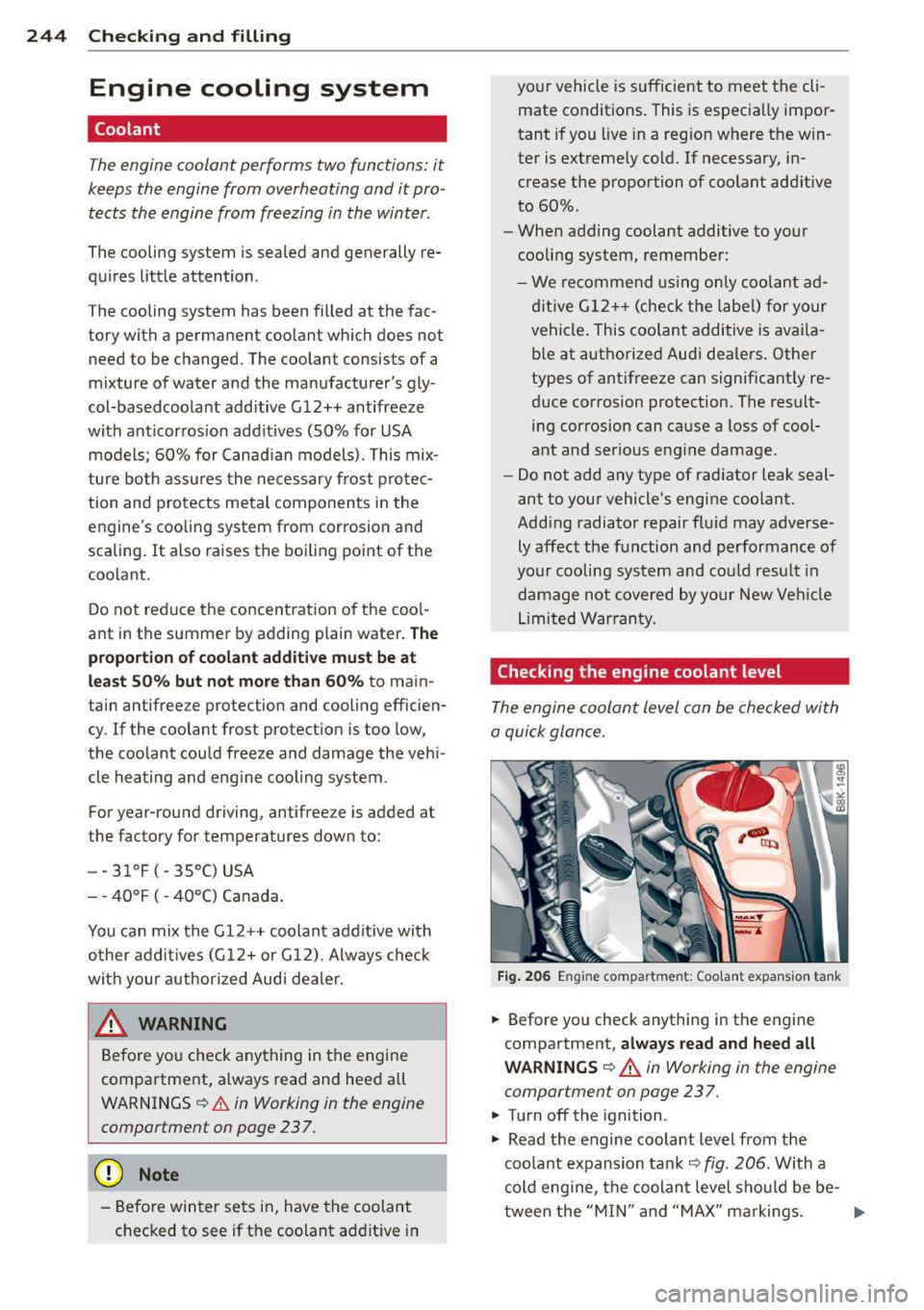
Fig. 206 E ngin e compart men t: Coo lant expans ion tank
.,. Before you check anything in the engine
compartment,
always read and heed all
WARNINGS ¢&. in Working in the engine
compartment on page 23
7.
.,. Turn off the ignition .
.,. Read the engine coolant level from the
coo lant expansion tank¢
fig. 206. With a
cold engine, the coolant level should be be-
tween the "MIN" and "MAX" markings . ..,..
Page 247 of 316

When the engine is warm, the level may be
slightly above the
"MAX" marking.
The location of the coolant expansion tank
can be seen in the engine compartment illus
tration ¢ page 239.
To obtain an accurate reading, the engine must be switched
off.
The expansion tank in your vehicle is equipped
with an electric coolant level sensor.
When the coolant level is too low, the warning
light in the Auto-Check System ¢page
31 will
blink until you add coolant and the level has
been restored to normal. Even though there is
an electric coolant level sensor, we still rec
ommend you check the coolant level from
time to time.
Coolant loss
Coolant loss may indicate a leak in the cooling
system. In the event of coolant loss, the cool
ing system should be inspected immediately
by your authorized Audi dealer.
It is not
enough merely to add coolant.
In a
sealed system, losses can occur only if
the boiling point of the coolant is exceeded as
a result of overheating.
& WARNING
The cooling system is under pressure and
can get very hot. Reduce the risk of scald
ing from hot coolant by following these
steps.
- Turn
off the engine and allow it to cool
down.
- Protect your face, hands and arms from
escaping fluid and steam by covering the
cap with a large, thick rag.
- Turn the cap slowly and very carefully in
a counter-clockwise direction while ap
plying light, downward pressure on the
top of the cap.
- To avoid being burned, do not spill anti freeze or coolant on the exhaust system or hot engine parts. Under certain condi
tions, the ethylene glycol in engine cool
ant can catch fire.
Checking and filling 245
@ Note
Do not add any type of radiator leak seal
ant to your vehicle's engine coolant. Add
ing radiator repair fluid may adversely af
fect the function and performance of your
cooling system and could result in damage not covered by your New Vehicle limited
Warranty.
Adding coolant
Be very careful when adding engine coolant.
Before you check anything in the engine com
partment,
always read and heed all WARN
INGS ¢ & in Working in the engine compart
ment on page 23
7.
.,. Turn off the engine .
.,. let the engine cool down.
.,. Place a thick rag over the coolant expansion
tank ¢ page
244, fig . 206 and carefully turn
the cap counter-clockwise ¢
&_.
.,. Add coolant.
.. Twist the cap on again tightly.
Replacement engine coolant must conform to
exact specifications ¢ page
244, Coolant.
Even in an emergency, if coolant addi-
tive G12++, G12+ or G12 is
not available, do
not use a different additive. Use plain water
instead until you can get the correct additive
and can restore the correct ratio. This should
be done as soon as possible.
If you have lost a considerable amount of
coolant , then you should add cold antifreeze
and cold water only when the engine is cold.
Always use new engine coolant when refilling.
Do not fill coolant above the "MAX" mark. Ex
cess coolant will be forced out through the pressure relief valve in the cap when the en
gine becomes hot.
A WARNING
- The cooling system is under pressure and
can get very hot. Reduce the risk of ...,
•
•
Page 291 of 316
fall f rom a lift if the re is a change in ve
h icle we ight d istr ibut ion and balance.
This might happen, for examp le, when
heavy components such as the engi ne
b lock or transmiss io n are removed .
- Whe n removing heavy components like
these, ancho r vehicle to ho ist o r add cor
r e spond ing w eig hts to ma intai n the cen
te r of g ravity . Othe rwise, the vehicl e
mi ght til t or slip off th e hoi st, causi ng
s er ious perso nal inju ry.
(D Note
- Be awa re of th e f ollowing po in ts b efore
li fting t he vehi cle:
- The vehicle should never be lifted or
jacked up from underneath the engine oil pan, the transmission housing, the
front or rear axle or the body side
members. This could lead to serious
damage .
- To avoid damage to the underbody or
chassis frame, a rubber pad must be
inserted between the floor jack and
the lift points.
- Before driving over a workshop hoist,
check that the vehicle weight does not
exceed the permissible lifting capacity
of the hoist.
- Before driving over a workshop hoist,
ensure that there is sufficient clear ance between the hoist and low parts
of the vehicle .
Emergency situations 289
•
•
Page 294 of 316
292 Data
Data
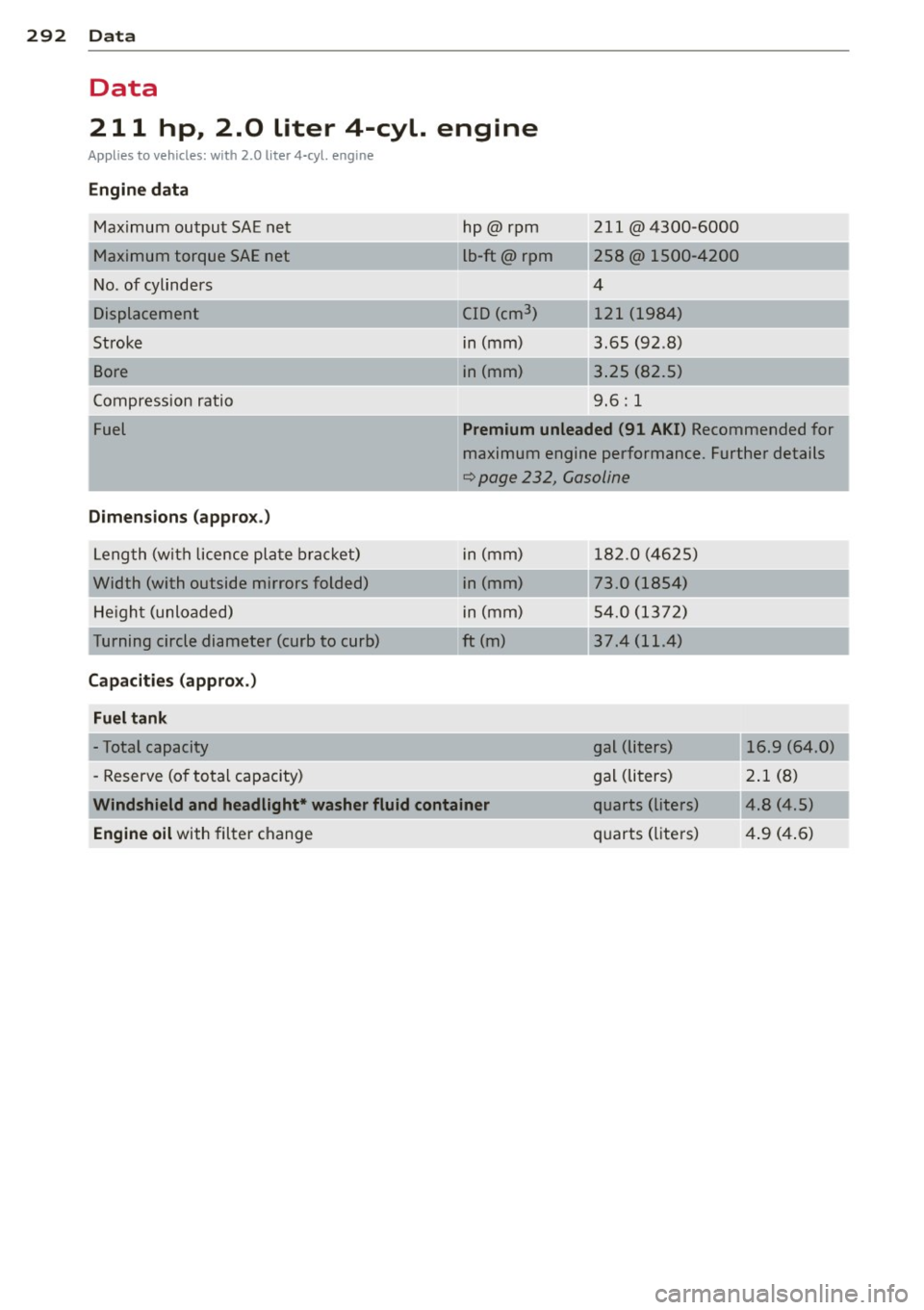
211 hp, 2.0 liter 4-cyl. engine
Applies to vehicles: with 2.0 liter 4-cyl. engine
Engine data
Ma ximum output SAE ne t
M aximum torque SAE net
No . of cylinders
Displacement
Stroke
Bore
C ompress ion ratio
Fuel
Dimensions (approx .)
Leng th (wit h licence pl ate brack et)
Width (with outside mirrors folded) He igh t (unloaded)
T urning circle diameter (curb to curb)
Capacities (appro x.)
Fuel tank
- Total capacity
- Reserve (o f to tal capacity) h
p@rpm
L b-ft@ rpm
C ID (cm
3
)
in (mm)
i n (mm)
-~,
211 @4300-6000
258@ 1500-420 0
4 121 (1984)
3.65 (92 .8 )
3 .25 (82 .5)
9 .6: 1
Premium unleaded (91 AKI) Recommended for
m aximum engine performance . Further details
q page 232, Gasoline
i n (mm) 1 82.0 (4 625)
i n (mm) 73.0 (1854)
i n (mm) 5 4.0 (1 37 2)
ft (m) 37.4 (11.4)
gal (liters) 16.9 (64 .0)
gal (li ters) 2.1
(8 )
Windshield and headlight* washer fluid container quarts (liters) 4.8 (4 .5)
Engine
oil with filter c hange qu
arts (lite rs) 4 .9 (4 .6)
Page 295 of 316
Consumer Information
Warranty coverages
Your Audi is covered by the following war
ranties :
- New Vehicle Limited Warranty
- Limited Warranty Against Corrosion Perfo-
ration
- Emissions Control System Warranty
- Emissions Performance Warranty
- California Emissions Con trol Warranty (USA
vehicles only)
- California Emissions Performance Warranty
(USA vehicles only)
Detailed information regarding your warran
ties can be found in your
Warranty & Mainte
nance booklet .
Operating your vehicle
outside the U.S.A. or
Canada
Government regulations in the United States
and Canada require that automobiles meet
specific emission regulations and safety
standards. Therefore, veh icles built for the
U.S.A. and Canada differ from vehicles sold in
other countries .
If you p lan to take your vehicle outside the
continental limits of the United States or Can
ada, there is the possibility that
- unleaded fuels for vehicles with cata lytic
converter may not be available;
- fuel may have a considerably lower octane
rating . Improper fuel may cause engine
damage ;
- service may be inadequate due to lack of
proper service facilities, tools or testing
equipment ;
- replacement parts may not be readily availa
ble.
- Navigation systems for vehicles built for the
U.S.A. and Canada will not necessari ly work
in Europe, and may not work in other coun
tries outside of North America.
Consumer Information 293
@ Note
Audi cannot be responsible for mechanical
damage that could result from inadequate
fuel, service or parts availab ility.
Audi Service Repair
Manuals and Literature
Audi Offic ial Factory Service Manuals and Lit
erature are published as soon as possible after
model introduction. Service manuals and lit
erat ure are available to order from the Audi
T echnical Literature Ordering Center at:
www.audi.techliterature.com
Maintenance
' General
Your vehicle has been designed to help keep
maintenance requirements to a minimum.
However, a certain amount of regular mainte
nance is still necessary to assure your vehicle's
safety, economy and reliability . For detailed
vehicle maintenance consult your Warranty
&
Maintenance booklet.
Under difficult operating conditions , for ex
ample at extremely low outside temperatures ,
in very dusty regions, when towing a tra iler
very frequently, etc., some serv ice work
shou ld be pe rformed between the intervals
specified. This applies particularly to:
- oil changes, and
- cleaning or replacing the air filter .
® For the sake of the environment
By regularly maintaining your vehicle, you
help make sure that emission standards
are maintained, thus min imizi ng adverse
effects on the environment .
Important considerations for you and
your vehicle
The increasing use of electronics , sophisticat
ed fuel injection and emission contro l sys-
tems, and the genera lly increasing technica l ..,_
•
•
Page 297 of 316
-Always make sure the transm ission se
lector lever (automatic transmiss ion) is
in "P" (Park position) or Neutral (manual
transmission) and the park brake is firm
ly appl ied .
® For the sake of the environment
-Changing the eng ine settings w ill ad
versely affect em ission levels. This is det
rimental to the environment and increas
es fuel consumption .
- Always observe env ironmental regula
tions when d ispos ing of old engine oil,
used brake fluid, dirty engine coolant,
spent batter ies or worn out t ires.
- Undeployed airbag modules and p reten
s ioners might be classified as Perchlo
rate Material -special handling may ap
ply, see www.dtsc.ca .gov/hazardous
waste/perch lorate . When the veh icle or
parts of the restraint system including
airbag modules safety belts with preten
s ioners are scrapped, all applicable laws
and regulations must be observed. Your
authorized Audi dealer is familiar w ith
these requirements and we recommend
that you have your dealer perform this
serv ice for you .
Additional accessories,
modifications and
parts replacement
Additional accessories and parts
replacement
Always consult on authorized Audi dealer be
fore purchasing accessories.
Your veh icle incorporates the latest safety de
sign featu res ensu ring a high standard of ac
tive and passive safety.
This safety could be compromised by non-ap
proved changes to the veh icle. For this reason ,
if parts have to be replaced, p lease observe
the following points when installing addition
al accessories:
Con sumer In formation 295
Approved Audi accessories and genuine Audi
parts are available from authorized Audi deal
ers.
T hese dea lers a lso have the necessary facili
ties, tools and trained specialists to install the
parts and accessories proper ly.
A WARNING
Using the wrong spare parts or using non
approved accessories can cause damage to
the vehicle and serious persona l injury.
- Use on ly accessories express ly approved
by Audi and genuine Audi spare parts
- These parts and accessories have been
specially designed to be used on your ve
hicle.
- Never install accessories such as tele
phone cradles or beverage holders on air
bag covers or within the airbag deploy
ment zones . Do ing so will increase the
risk of injury if a irbags are triggered in an
accident!
- Before you check anything in the engine
compartment, always read and heed all
WARNINGS ~
page 230.
(D Note
-If items other than genuine Audi spare
parts, add-on equipment and accessory
items are used or if repair work is not
performed accord ing to specified meth
ods, this can result in severe damage to
your vehicle's engine and body (such as
corrosion) and adversely affect your vehi
cle's warranty .
- If emergency repairs must be performed
elsewhere, have the vehicle examined by
an authorized Audi dealer as soon as
possible.
- The manufacturer cannot be held liable
for damage wh ich occurs due to failure
to comply with these stipulations.
•
•
Page 300 of 316
298 ~l :..:.: nd ~e ~x :._ ______________________________ _
A
A/C mode 83,88
Accessories .. ....... ...... ... ... .. . 295
Adaptive cruise control . . . . . . . . . . . . . . . 102
Changing speed . . . . . . . . . . . . . . . . . . . 105
Driver information . . . . . . . . . . . . . . . . . 107
Driver intervention prompt . .. .. .. .. . 111
Driving in traffic . . . . . . . . . . . . . . . . . . . 103
Driving program . ........... .. .. .. . 111
Error messages .......... .... .... . 109
Open road .. ............. .. .. .. .. . 103
Override ... ................ ..... . 103
Request for driver to assume contro l . . 103
Save speed ............... ... .... . 104
Setting distance . . . . . . . . . . . . . . . . . . . 106
Settings . . . . . . . . . . . . . . . . . . . . . . . . . 111
Setting time interval .......... .... . 106
Special driving situations ...... .. .. . 112
Status messages ... ...... .. .. .. .. . 109
Switching on and off .... .. .. .. .. ... 104
System limits . ........... .... .... . 112
Temporarily turning off .. .. .. .. .. .. . 105
Warning/indicator lights ............ 108
Adaptive dampers . .......... ... .. .. . 124
Adaptive light ............. .. .. ......
52
defective ................ .... .... .. 36
Adding
Engine coolant ............ ... .... .
245
Engine oi l .. ................ ..... . 242
Windshield washer fluid ... .. .. .... . 251
Addit ional accessories
Addit ives 295
Eng ine oil .. ................ ... .. . 242
Adjusting
Steering column manually . .. .. .... ..
92
Adj usting front seats ....... .. .. .. .. . . 61
Airbag system . . . . . . . . . . . . . . . . . 162, 181
Advanced Airbag System ....... .. ... 166
Advanced Airbag System components . 169
Care ... .. ............... .. .. .... . 175
Children . .... ........... .. .. .. .. . 187
Child restraints .............. ..... . 188
Components (front airbags) . ... .... . 169
Danger of fitting a child safety seat on
the front passenger seat . . . . . . . . . . . .
163
Disposal . ................. .. .... . 175
Front airbags . . . . . . . . . . . . . . . . 166, 167
How do the front airbags work? ... ... 171
How many airbags does my vehicle
have? ... ... .. .. .. .............. .
169
How the Advanced Airbag System com-
ponents work together ......... ....
170
Important safety instructions on the
knee airbag system ...... ...... .. ..
179
Important things to know .......... . 162
Indicator light . ... ............ .. .. 173
Knee airbags ..... ... .......... .... 177
Monitoring . ..... ................ . 173
PASSENGER AIR BAG OF F light . . . . . . . 173
Repairs .......................... 175
Safety instructions ............. .... 175
Side airbags ... .. ............. .... 180
Side curtain airbags ............ .... 182
Weight-sensing mat ............... 187
When must the system be inspected? 173
All-wheel drive
Winter tires ... .. ... .......... ....
267
Alloy wheels .. .. . .. ............ .. .. 225
All wheel drive 210
Alternator
Malfunction ... ... ................ .
30
Anti-freeze
refer to Engine coolant system ....... 244
Anti-lock brake system
How the ABS system works ..........
208
Warning/indicator lights ............ . 16
Anti-Slip Regulation System (ASR)
How the system works ............. .
206
Anti-theft systems
Electronic immobilizer ...............
39
Ashtray .. .. .. .. .. .... ......... .... . 75
ASR
How the Anti -Slip Regulation System
works
Asterisk
206
What does it mean when something is marked with an asterisk? . . . . . . . . . . . . . . 6
Audi braking guard ................. .
113
Error messages .................. . 115
Settings .. .... .. ............. .... 115
Status messages ... ........... .. .. 115
Switching on and off ........... .... 115
Page 304 of 316

302 Index
Efficiency program . . . . . . . . . . . . . . . . . . . 24
Fuel economy messages . . . . . . . . . . . . . 26
Memory leve ls . . . . . . . . . . . . . . . . . . . . . 23
Other equipment . . . . . . . . . . . . . . . . . . . 25
Shift indicator . . . . . . . . . . . . . . . . . . . . . 25
Electrical seat adjustment
refer to Seat adjustment ........... . . 63
E lectromechan ical park ing brake
E mergency braking . . . . . . . . . . . . . . . . . 98
Malfunction . . . . . . . . . . . . . . . . . . . . . . . 99
Operation . . . . . . . . . . . . . . . . . . . . . . . . . 96
Parking .... ................ ..... .. 97
Releasing and closing ............. . . 96
Starting assist ........... .. .. .. .. .. 98
Starting from rest .......... .. .... .. 98
Starting off with a trailer . . . . . . . . . . . . . 98
Warning/ indicator lights .... ..... .. .. 17
Electronic differential lock (EDL) How the system works ....... .. .... . 205
Warning/indicator lights ... .. .. .. .. . . 16
Electronic immobilizer . . . . . . . . . . . . . . . . 39
Electronic power control
(EPC) warn ing/ indicator light ... .. .. . . 15
Electronic stabili zation program (ESP)
How the sys tem works ....... .. .. .. . 204
Warning/indicator lights ....... .. .. .. 15
Emergency braking . . . . . . . . . . . . . . . . . . . 98
E mergency flasher . . . . . . . . . . . . . . . . . . . 52
Warn ing/ indicator lights ..... .. .. .. . . 16
Emergency key . . . . . . . . . . . . . . . . . . . . . . 3 7
Start ing engine ........... ... .. ... . 39
Emergency locking of the doors ..... .. .. 44
E mergency release
Selector lever ............ .. .. .... . 132
E mergency starting ......... ... .. .. . 284
Emergency towing .......... ... .... . 286
E mergency unlocking
I gnition key ........... .. .. .. .. .. .. 39
Energy management ..... .. .... .. .. . 211
Battery power ............... .. ... 212
Driver notification . ......... .. .. .. . 212
E ngine
Compartment . ........... .. .. .... . 239
Coolant .. .. ............... .. .... . 244
H ood .. .. .. ................ ... .. . 237
Starting ... ... .... ...... .. .. .. .. .. 92 Starting
with jumper cables ....... .. 284
Stopping . ..... .. .. .............. .. 94
Engine compartment Safety instructions ............. .. .. 23 7
Working the engine compartment .... 237
Engine coolant system ............ ... 244
Adding coolant . .. ................ . 245
Checking coolant level ............ .. 244
Checking the engine coolant level ..... 244
Malfunction . . . . . . . . . . . . . . . . . . . . . . . 31
Radiator fan ..... ................ . 246
Engine coolant temperature
T emperature gauge . ........... .. .. . 10
Engine data . .... .. ............. .... 292
Engine hood
Closing . . . . . . . . . . . . . . . . . . . . . . . . . . 23 7
How to release the hood . . . . . . . . . . . . 23 7
Engine oil ...... .. ............. .... 239
Adding . .. .. .. .. ............. .. .. 242
Additives . ... .. .. .. .............. . 242
Changing ..... .. .. .............. . 243
Check oil level ... ............. .... 242
Consumption .. .. ............. .. .. 242
Oil consumption .. ... .......... .. .. 241
Oil grades . .... ................... 239
Specification and viscosity ........ ... 239
Engine oil level .... ................ .. 36
Engine oil pressure
Malfunction . . . . . . . . . . . . . . . . . . . . . . . 31
Engine oil sensor defective . . . . . . . . . . . . 36
Engine speed limitation . . . . . . . . . . . . . . . 36
Environment Break-in period . .. ............. .... 213
Catalytic converter ............. .... 214
Disposing of your vehicle battery ..... 251
Driving at high speeds .............. 215
Driving to minimize pollution and noise 215
Fuel .. .. .. .. .. .. ............. .. .. 234
Fuel economy .. .. ... .......... .. .. 215
Leaks under your vehicle .......... .. 23 7
Letting the vehicle stand and warm up. 216
Proper d isposal of drained brake fluid . 247
Proper disposal of drained engine cool-
ant .. .. .. .... .. ............. .... 245
Proper disposal of drained engine
oi l . . . . . . . . . . . . . . . . . . . . . . . . . 242, 243
Recycling used engine oil ............ 242
Page 309 of 316

Index 307
-----------------------------------.......
R
Radiator fan ... .... .. .... ... .. .. ... 246
Ra in sensor .. .. ........ ... .. .. .. .. .. 55
Rain sensor defective ....... .... .. .. .. 34
Reading lights
Fr ont .. .. .. ............. .. .. .. .. .. 53
Rear . ..... .. .. ... . .... ... .. .. .... 54
Rear fog lights . . . . . . . . . . . . . . . . . . . . . . SO
Rear lid
refer to Luggage compartment 44, 68, 150
Rear light Defective . . . . . . . . . . . . . . . . . . . . . . . . . 3 5
Rear view camera Park ing mode 1
P ark ing mode 2 137
138
Rear view mirror . . . . . . . . . . . . . . . . . . . . . 58
Rear window defogger . . . . . . . . . . . . 83, 88
Rear window sun shade . . . . . . . . . . . . . . . 54
Recirculation mode De luxe automatic climate control . . . . . . 82
De luxe automatic climate control plus . . 87
Red symbols ... .... .. .... ... .. .. .... 29
Refill engine oil ............ .... .. .. .. 3 2
Refuelling . .. .... ......... .... .. .. . 234
Release lever for hood ... ... .. .. .. .. . 23 7
Remote control garage door opene r
( H ome link ®) . . . . . . . . . . . . . . . . . . . . . . . 140
Remote control key Unlock ing and locking ..... .. .. .. .. .. 41
Remote rear lid release .. ... .. .. .. .. .. 44
R epa ir manua ls ......... ...... .... .. 293
Repairs Airbag system ........... .. .. .. .. . 175
Replacing bulbs . .. ..... ... .. .. .. .. . 283
Replacing t ires and wheels ... .. .. .. .. . 264
Replacing w indshield wiper blades .. .. .. 56
Report ing Safety Defects .... .. .. .. .. . 152
Reset button ... ........ ... .. .. .. .. .. 12
Retractor . . . . . . . . . . . . . . . . . . . . . . . . . . 15 7
R ims
Cast alloy .. .... ......... .. .. .. .. . 22 5
Roof luggage rack
Mounting po ints .......... ... ... ... 74 Roo
f rack . . . . . . . . . . . . . . . . . . . . . . . . . . . 73
Roof load ... .. .... . ... ...... ... .. . 74
also refer to Roof luggage rack . . . . . . . . 73
s
Safe driving habits ... . .. .. ..... ... .. 144
Safety Wa rning/ind icator lights ............ . 15
Safety be lt pos ition . . . . . . . . . . . . . . . . . 158
Safety be lts worn by pregnant women . 159
Safety be lt pretensioner .. ..... ... .. .. 160
Serv ice and disposa l .... .... ... .. .. 161
Safe ty be lts . . . . . . . . . . . . . . . . . . . . . . . . 15 7
Cleaning .. .. .. .. ... .. .......... .. 230
Danger to passengers who do not wear a
safety belt . ....... . .. .. ..... ... .. 155
F astening ....... .. . .. .. ..... ... .. 157
Improper ly worn . ................. 160
Not worn ... .. ...... ............. 155
Safety be lt pos ition . ... ... ... .. .. .. 158
Safety instructions ................. 157
Securing child safety seats ......... . 195
Spec ial considerations for pregnant
women ... .. .. .. .... ............. 159
Unf astening . .. .. ............... .. 159
Warning/ind icator light . ..... ... .. .. 154
Why YOU MUST wear them ... ... .. .. 154
Worn properly ... .. .. ... ..... ... .. 156
Safety be lt warning ligh t . . . . . . . . . 16, 15 4
Safety compliance sticker ............ 290
Safety eq uipment .... . .. .. ..... ... .. 144
Safety featu res for occ upant rest raint and
prote ction . . . . . . . . . . . . . . . . . . . . . . . . . 144
Safety gu idelines
Seat adjustment .. .. . .. .... .... .. .. . 61
Safety instr uctions
Engine compartment . ... .... ... .. .. 237
for side curtain airbags ......... .... 184
for using ch ild safety seats ........ .. 189
for using safety belts .......... .... . 157
Moni to ring the Advanced Airbag Sys -
tem .. .. .. .. .. .. .. . .. .... .... .... 175
Seat adjustment Driver's seat . . . . . . . . . . . . . . . . . . . . . . . 61
Easy entry funct io n . . . . . . . . . . . . . . . . . 64
Easy entry manua l function ......... .. 63
Fo r-and-aft manua lly ... .. .. ... ... .. . 62
•
•