roof AUDI A5 COUPE 2013 Owner's Manual
[x] Cancel search | Manufacturer: AUDI, Model Year: 2013, Model line: A5 COUPE, Model: AUDI A5 COUPE 2013Pages: 294, PDF Size: 73.84 MB
Page 179 of 294
-Forward-facing child safety seats or in
fant carriers installed on the front pas
senger's seat may interfere with the de ployment of the airbag and cause serious
injury to the child.
- It is safer to install a forward-facing
child safety seat on the rear seat .
- Always read and heed all WARNINGS
whenever using a child restrained in ave
hicle is being used
c:::;, page 166 . Special
precautions apply when installing a child
safety seat on the front passenger seat
c:::;, page 143, Child restraints on the front
seat -some important things to know.
A WARNING
-
Always take special precautions if you
must install a forward or rearward-facing
child restraint on the front passenger's
seat in exceptional situations:
- Whenever a forward or rearward-facing
child restraint is installed on the front
passenger seat, the
PASSENGER AIR
BAG OFF light must come on and stay on
whenever the ignition is switched on.
- If the
PASSENGER AIR BAG OFF light
does not come on and stay on, perform
the checks described
c> page 153, Moni
toring the Advanced Airbag System .
-Take the child restraint off the front pas
senger seat and install it properly at one
of the rear seat positions if the
PASSEN
GER AIR BAG OFF
light does not stay on
whenever the ignition is switched on.
- Improper installation of child restraints
can reduce their effectiveness or even
prevent them from providing any protec
tion.
- An improperly installed child restraint
can interfere with the airbag as it de
ploys and seriously injure or even kill the
child.
- Always carefully follow the manufactur
er's instructions provided with the child
safety seat or carrier.
- Never place additional items on the seat
that can increase the total weight regis-
Child Safety 177
tered by the weight-sensing mat and can
cause injury in a crash.
A WARNING
Forward-facing child restraints:
- Always make sure the forward-facing
seat has been designed and certified by
its manufacturer for use on a front seat
with a passenger front and side airbag.
- Never put the forward-facing child re
straint up, against or
very near the in
strument panel.
- Always
move the passenger seat into its
rearmost position in the seat 's fore and
aft adjustment range, as far away from
the airbag as possible before installing
the forward-facing child restraint . The
backrest must be adjusted to an upright
position.
- Make sure that the
PASSENGER AIR BAG
OFF
light comes on and stays on all the
time whenever the ignition is switched
on.
A WARNING ...==-
Rearward-facing child restraints:
-A child in a rearward-facing child safety
seat installed on the front passenger
seat will be seriously injured and can be
killed if the front airbag inflates -
even
with an Advanced Airbag System.
- The inflating airbag will hit the child
safety seat or infant carrier with great
force and will smash the child safety seat
and child against the backrest, center
armrest, door or roof .
- Always be especially careful if you must
install a rearward facing child safety seat
on the front passenger seat in exception
al circumstances .
- A tight tether strap on a rearward-facing
child restraint attached to the front pas
senger seat can put too much pressure
on the weight-mat in the seat and regis
ter a heavier weight in the Advanced Air
bag System. The heavier weight regis
tered can make the system work as •
•
Page 196 of 294
194 Driving and en vironm ent
8_ WARNING
After driving through water, mud, slush,
etc ., the brakes may be slow to take effect
because of wet brake rotors and pads. Dry
the brakes first by braking carefully to re
store the full braking effect.
CD Note
Vehicle components such as the engine,
transmiss ion, suspension or electrical sys
tem can be severely damaged by driving
through wate r.
@ Tips
- Check the depth of the water before dr iv
i ng through it.
- Do not stop the veh icle, dr ive in reverse
or switc h the engine off when driving
t hr ough water.
- Keep in mind that oncoming vehicles
may c reate waves that raise the water
l evel and make it too deep fo r you r vehi
cle to dr ive through safely.
-
- Avoid dr iving thro ugh salt water because
i t can ca use corrosion.
Catalytic converter
It is very important that your emission con
trol system (catalytic converter) is function
ing properly to ensure that your vehicle is run
ning in on environmentally sound manner.
,,. Always use lead-free gasoli ne¢ page 211,
Fuel supply .
,,. Never run the tank down a ll the way to
empty.
,,. Never put too much motor oil in your en-
gine ¢
page 221, "t':::r. Adding engine oil.
,,. Never t ry to push- o r tow-start your veh icle.
The catalytic converter is an effic ient "clean
up" device built into the exhaust system of
the vehicle. The catalytic converter burns
many of the polluta nts in the exhaust gas be
fore they are released into the atmosphe re. The exclusive
use of unleaded f uel is critica lly
important for the life of the catalytic convert
er and proper funct ion ing of the eng ine .
A WARNING
= -
-Do not park or operate the vehicle in
areas where the hot exhaust system may
come in co ntact with dry grass, brush,
fuel spill or other material wh ich can
cause a fire .
- Do not app ly additional undercoating or
r u stp roofing on or nea r the exhaust
manifold, exhaust pipes, cataly tic con
ver ter or heat shields. Dur ing driv ing, the
substance used for under coa ting co uld
overhea t and cause a fire.
CD Note
- Be aware that just o ne tank filling with
leaded fu el w ill already ser io usly de
gr ad e the per form ance o f the catalytic
c onverte r.
- Do not ex ceed t he corre ct engine oil level
r:;!) page 2 21.
- Do not drive until the fuel tank be co m es
completely emp ty. The engine co uld mis
fire . Unburned fuel could also get in to
the exhaust system and this co uld cause
the cata lytic converter to overheat .
- Do not turn off the igni tion whi le the ve
hicle is mov ing.
- Do not contin ue to ope rate your veh icle
unde r these conditions, as otherwise fuel
can reach the catalyt ic converte r. T his
co uld resu lt in overheating of the con
verter, requir ing its replacement.
- To assure efficient operation of the Emis
sion Control System:
- H ave you r vehicle maintained p rope rly
and in accordance w ith the se rvi ce rec
ommen dat ions in yo ur Warranty &
M ain tenance boo klet.
- L ack of prope r maintenan ce as we ll as
i mprope r use of t he ve hicl e wi ll impair
the func tion of the em ission cont ro l
system and could lea d to damage .
Ill>
Page 203 of 294
Automatic car wash
The vehicle can be washed in almost any
modern automatic car wash .
The vehicle paint is so durable that the vehicle
can normally be washed without problems in
an automatic car wash. However, the effect on
the paint depends to a large extent on the de
sig n of the fac ility, the filte ring of the wash
water, the type of wash and care mater ial , etc.
If the paint has a dull appearance afte r go ing
through the car wash or is scratched, bring
this to the attention of the operator immedi
ately. If necessary, use a different car wash.
Before going through a ca r wash, be s ure to
take the usual precautions such as closing the
windows and the roof . Factory installed an
tennas must not be removed.
If you have installed additional accessories on
the vehicle -such as spoilers, roof rack, etc. -
it is best to ask the car was h operator if these
should be removed .
A WARNING
Always read and heed a ll WARNINGS and
other information
¢ page 200.
(D Note
Before washing the vehicle in an automatic
car wash, p lease make sure to retract the
exterior m irrors to prevent them from be
ing damaged.
Washing the vehicle by hand
A lot of water is needed when washing a vehi
cle by hand.
~ Before you start washing, make sure yo u
have read and understood the WARNINGS
¢ A in General information on page 200 .
~ First soak all dried dirt until it is soft, then
rinse it off .
~ As you clean your veh icle, start with the
roof and work your way down to the bottom,
us ing a sponge , a sponge glove o r a clean
brush.
Cleaning and protec tion 20 1
~ Rinse the sponge or the sponge g love often,
flushing it clean eac h time .
~ Use spec ia l car shampoo only for very per
sistent d irt .
~ Rinse the car thoroughly with water.
~ Use a chamois leather to gently w ipe the ex-
ter ior d ry .
U se a separate sponge for cleaning the
whee ls, door sills and other regions exposed
to road dirt . In this way, you w ill not scratch
the pa int wit h coarse particles imbedded in
the sponge the next time you wash the car.
&_ WARNING
- Do not clean the underside of the chas
sis, fenders, wheel covers, or o ther ha rd
to reach pa rts without protect ing you r
hands and arms. You may cut yourself on
sharp-edged metal parts .
-Always read and heed a ll WARNINGS and
other information
¢ page 200.
(D Note
- N ever try to remove dirt, mud or dust if
the s urface o f the veh icle is dry . Never
use a dry cloth or sponge, since this
co uld scratch your vehicle's paint or win
dows.
- Never wash your car in bright s unlight .
Drops of wate r act as magnifying lenses
and may damage yo ur paint .
- When you wash yo ur car in the winter: if
you rinse yo ur vehicle with a hose, be
careful not to aim the stream of water
directly at locks, or at door or hatch
openings -they can freeze shut .
- Never use sponges designed to
remove
insects, or any k itche n scou ring sponges
or s imilar products. They can damage
your paint finish .
- You should remove debris (such as in
sects) from the headlight lenses on a
regu lar bas is, for exampl e w hen refuel
ing your veh icle . Never use a dry cloth o r
sponge to clean t he headlights. On ly use
wet cloths o r sponges to prevent
scratches. It is best to use soapy water.
-
•
•
Page 206 of 294
204 Cleaning and protec tio n
If a spot starts to rust, however, a simple
touch-up job will not be enough . The affected
surface must be sanded smooth and coated
with an anti-rust pr imer before the pa inted
f inish can be restored.
The number for the origina l vehicle paint can
be found on the vehicle ident ificat ion labe l
c::>page269.
A WARNING
Always read and heed all WARNINGS and
other information
c::> page 200.
Windows
Clear vision to all sides.
C lean a ll windows regularly to remove road
fi lm and car wash wax b uildup.
"' Remove snow from windows using a brush.
"' Use a plast ic ice scraper to remove ice from
windows and mirrors .
"' Remove other residue on the windows with
a spray •on glass cl eaner .
"' Wipe the windows dry with a clean p iece of
cloth or kitchen paper towel.
The best way to remove snow from windows
and mirrors is to use a brush . Use a non-abra
sive
pla stic ice sc raper -better still, a spray
de icer -to remove
ic e from windows and mir
rors .
The windows must not be cleaned with insect remover or wax s ince these can interfere with
the function of the windshield wiper blades (chatter) .
O il, grease, or silicone residue can be removed
with
g lass clea ner or silicone remo ver . How
ever, wax residue requires the use of a special ly formulated solvent . Please contact your au
thor ized Audi dealer for adv ice on safe prod
ucts for wax removal.
W indows should also be cleaned on the inside
at regular intervals .
Never dry w indows with the same chamois
that you use to dry painted surfaces . Wax resi- due on the chamois can impai
r vision through
the windows.
A WARNING
-- Always read and heed all WARNINGS and
other information
c::> page 200.
-The windshield must not be treated with
water-repellent materials. They can in
crease glare under poor v is ibility condi
tions such as wetness, darkness, or when
the sun is low on the hor izon. In addi
tion, they can cause the w indshield w ip
ers to chatter.
(D Note
- Never use warm or hot water to remove
snow and ice from windows and mirrors .
Th is could cause the glass to crack .
- To prevent damage to the wires of the
rear defogger, do not place any adhesive
st ickers on the ins ide of the rear window
over the wires .
- To help prevent dirt from scratching the
window, always sc rape in a forward di
rection -pushing the sc raper away from
yo u -never bac k and fort h.
- Wate r lea king from the ins ide of the rear
w indows may damage sens it ive elec trical
components located ei ther under the
rear parcel shelf or in the rear trunk area .
Always ensure that water never leaks
through the body section of the vehicle.
You can do this by using waterproof pro
tection over the vehicle's electrical com
ponents (e .g. when installing window
tinting) .
- Damage or malfunction of electrical
components due to water damage or any
other outside infl uence is not covered by
the Audi New Veh icle Limited Warranty.
See you r Wa rranty
& M ain tenance book
le t for addit ional deta ils abou t your war
ranty.
Page 207 of 294
Cast (light) alloy wheels
Cast (light) alloy wheels require special care.
~ Wash the wheels with a sponge or hose
brush every other week.
~ For deep cleaning afterwards, use only a
dedicated
aci d-fr ee cast alloy wheel cleaner.
~ Rub a coat of liqui d wax onto the r ims every
t hr ee month. Be sure to reach and treat a ll
parts of the r im.
To preserve the decorat ive appearance of the
cast alloy whee ls, some special care is neces
sary. I n add it ion to road d ir t and sa lt, b rake
dust is a lso cor ros ive. If left on for too long,
b rake dus t ca n cause pitting.
Use only specia l
acid-free cleaners formulated
fo r alloy rims. Safe products are available at
your author ized Audi dealer. Never leave the
cleane r on the rims longer than specif ied on
the label. If not rinsed
off promptly, the acid
contained in some cleaners can attack the
threads on the whee l bolts.
Never use abras ive or metal polishing clean
ing agents.
If the protective coating has been
chipped, e .g. by kicked up road dirt, touch it
up as soon as possib le.
A WARNING
- Moisture and ice on brakes may affect
braking efficiency
q page 188. Test the
brakes carefully each time you wash the
vehicle .
- Always read and heed all WARNINGS and
other information
q page 200.
Body cavity sealing
-
The body cavity sealing does not need to be
checked.
All body cavities which co uld be affected by
corrosion have been thoro ughly protected at
the factory.
This sea ling does not require any inspection or
addit ional treatment . If any wax should seep
out of the cav ity when the ambient tempera-
Cleaning and protec tion 205
ture is high, it can be removed with a p lastic
scraper and a suitable solvent.
A WARNING
Solvents can be dangerous.
- Benzine is flammab le and toxic. If you
use benzine fo r removing the wax, keep
sparks, flame and lighted cigarettes
away. Never dump benz ine on the
ground, i nto open streams or down sew
age drains.
- Be sure to observe all safety and environ
mental regulations. Follow all instruc
tions on the container.
- Always read a nd heed all WARNINGS and
other information
q page 200.
Chassis
Have the undercoating checked for damage
from time to time.
The lower body she ll of your Audi is also thor
oughly protected against corros ion.
Any damage to the unde rcoat ing caused by
road hazards sho uld be repaired prompt ly .
A WARNING
Too much undercoating i n the wrong p la
ces can cause a fire.
- Do not apply additiona l undercoating or
r u stproof ing on or near the exhaust
manifold, exhaust pipes, catalytic con
verter or heat shields. While driving, the substance used fo r undercoating could
overheat and cause a fire.
- Always read and heed all WARNINGS and
other information
q page 200.
Exhaust tail pipes
Road salt and other co rrosive materials w ill
damage the mate rial in the exhaust tail pipes
i f th ey a re not clea ned regularly. Do not clea n
the tail pipes with wheel cleane r, pa int polish,
c h rome pol ish or o ther ab ras ive cleane rs .
Clean the tail pipes with ca r care products
that are suitable fo r stainless steel. •
•
Page 222 of 294
220 Check ing and filling
temperatures stay below freezing point for
long periods.
Detergent addit ives in the o il w il l make fresh
oil look dark after the eng ine has been run
ning for a short time . This is norma l and is not
a reason to change the oi l more often than
recommended.
D am age or m alfunc tions du e to lack of
m ainten ance
It
is essential that you change your oil at the
recommended in tervals using only engine o il
that complies with Audi oi l standard
VW 502 00. Your Limited New Vehicle War
ranty does not cover damage or malfunctions
due to fail ure to fo llow recommended mainte
nance and use requ irements as set forth in
the Audi Owner's Manual and Warranty
&
Maintenance book let . Your dealer will have to
deny warranty coverage unless you present to
the dea ler proof in the form of Service or Re
pa ir Orders that all scheduled ma intenance
was performed in a t imely manner.
Eng ine oil consumption
The engine in your vehicle depends on an ade
quate amount of oil to lubricate and cool all
of its moving parts.
In order to provide effective lubrication and
cool ing of internal engine components, a ll in
ternal combustion eng ines consume a certa in
amount of oil. O il consumption varies from
engine to engine and may change significantly
over the life of the engine. Typica lly, engines
with a specif ied break-in period (see
¢
page 193) consume more oil during the
break-in period than they consume after oil
consumption has stabilized.
Under norma l conditions, the rate of oil con
sumption depends on the quality and viscosity
of the oil, the RPM (revolutions per minute) at
which the engine is operated, the ambient
temperature and road condit ions . Further fac
tors are the amount of oil d ilution from water
condensat ion or fuel residue and the ox ida
tion level of the oi l. As any engine is subject to wear as mi
leage builds up, the oil consump
tion may increase over time until replacement
of worn components may become necessary.
With a ll these variab les coming into play, no
standard rate of oil consumption can be es
tablished or specified. There is no alternative
to regu lar and frequent check ing of the o il lev
el, see
Note .
If
the yellow engine oil leve l warning symbo l
I! in the instrument cluster lights up, you
shou ld check the oil leve l as soon as possib le
¢
page 221. Top off the oil at your earliest
convenience ¢
page 221.
A WARNING '"---
Before you check anythi ng in the engine
compartment, always read and heed all
WARNINGS¢
A in Working in the engine
compartment on page 216.
(D Note
Driving w ith an insufficient o il level is like
ly to cause severe damage to the engine .
(D Tips
-The oil pressu re warn ing display . is
not an indic ator of the oil l evel. Do not
r el y on it . In stea d, check th e oil l eve l in
y our engin e at regular inter val s, pref
erably ea ch time you r efu el, and alwa ys
before go ing on a long trip .
-If you have t he impression yo ur engine
consumes excessive amoun ts of o il, we
recommend that you consu lt an author
ized Aud i dea ler to have the cause of
your concern properly diagnosed. Keep in m ind that the accurate measu rement of
oil consumption requ ires great care and
may take some time. An authorized Aud i
dealer has instructions about how to
measu re oil consumption accurately.
-
Page 235 of 294
Maximum loaded vehicle weight
means the sum of:
(a) Curb weight
(b) Accessory weight
(c) Vehicle capacity weight, and
(d) Production options weight
Maximum (permissible) inflation pressure
means the maximum cold inflation pressure
to which a tire may be inflated. Also called
"maximum inflation pressu re."
Normal occupant weight
means 150 lbs . (68 k ilograms) times the
number of occupants seated in the vehicle up
to the total seating capacity of your vehicle .
Occupant distribution
means distribution of occupants in a vehicle .
Outer diameter means the overall diameter of an inflated new
tire.
Overall width
means the linear distance between the exteri
ors of the sidewalls of an inflated tire, includ
ing e levations due to labeling, decorations, or
protective bands or ribs.
Ply
means a layer of rubber-coated para llel cords.
Production options weight
means the comb ined weight of those installed
regular production options weighing over 5
lbs . (2 .3 kg) in excess of those standard items
which they replace, not previously considered
in curb weight or accessory weight, including
heavy duty brakes, r ide leve lers, roof rack,
heavy duty battery, and specia l trim .
Radial ply tire
means a pneumatic t ire in which the p ly cords
that extend to the beads are laid at substan
tially 90 degrees to the centerline of the
tread.
Tires and wheels 233
Recommended inflation pressure
see~
page 232, Cold tire inflation pressure.
Reinforced tire
means a t ire design to operate at higher loads
and at higher inflation pressures than the cor
responding standard tire. Reinforced tires
may be identified as "XL" , "x l", " EXTRA LOAD",
o r "R F" on the sidewall.
Rim
means a metal support for a tire or a t ire and
tube assembly upon which the tire beads are
seated.
Rim diameter
means nom inal d iameter of the bead seat. If
you change your wheel s ize, you w ill have to
purchase new tires to match the new r im di
ameter.
Rim size designation
means r im diameter and width.
Rim width
means nom inal distance between rim fla nges.
Sidewall
means that portion of a tire between the
tread and bead.
Speed rating (letter code)
means the speed at which a tire is designed to
be driven for extended periods of time. The
ratings range from 93 mph (150 km/h) to
186 mph (298 km/h)
~ page 243 . You may
not find this information on all tires because
it is not requ ired by law.
The speed rating letter code, where applica
ble, is molded on the tire sidewall and indi
cates the max imum pe rm issib le road speeds
~ .&. in Winter tires on page 247 .
Tire pressure monitoring system*
means a system that detects when one or
more of a veh icle's tires are underinflated and
illuminates a low tire pressure warning tell
tale.
•
•
Page 262 of 294
260 Fuses and bulb s
No.
5 Sound actuator/exhaust sound
tuning
6 Headlight range control sys
tem/cornering light
7
8
Headlight (corner ing light)
Control modules (electrome
chanical parking brake, shock
absorber, quattro sport, trailer
hitch), DCDC converter
9 Adaptive cruise contro l
10 Shift gate
1 1 Side ass ist
Headlight range control, park
ing system
13 Airbag
14 Rear wiper (allroad)
15 Auxiliary fuse (instrument pan
el)
1
16
Auxiliary fuse terminal 15 (en
gine area)
Fu se pane l @ (b row n)
2 Brake light sensor
5
6
7
Left seat heating with/w ithout
seat venti lation
ESC Horn
Front left door (window regula-
8 tor, central locking, mirror, switch, lighting)
9 Wiper motor
10 ESC Two-door models: rear left win
dow regulator, Fo ur-door mod-
11 els: rear left door (window regu lator, central locking, switch,
lighting)
12 Rain and light sensor
F u se p anel© (red )
3
4 Dynamic steer ing
Amps
5/15
5/7,5 7,5
5
5
5
5
5
5
15
10
40
5
25
15/30
5
15
30
30
25
30
-No . Consumer Amps
6
Windshield washer system,
35
headlight washer system
7
Vehicle e lectrical system control
20
module 1
8
Vehicle electrical system control
30
module 1
9 Sunroof 20
10 Vehicle electrical system control
30
module
1
11 Sun shade motor 20
-
12 Anti-theft alarm warning sys-
tern 5
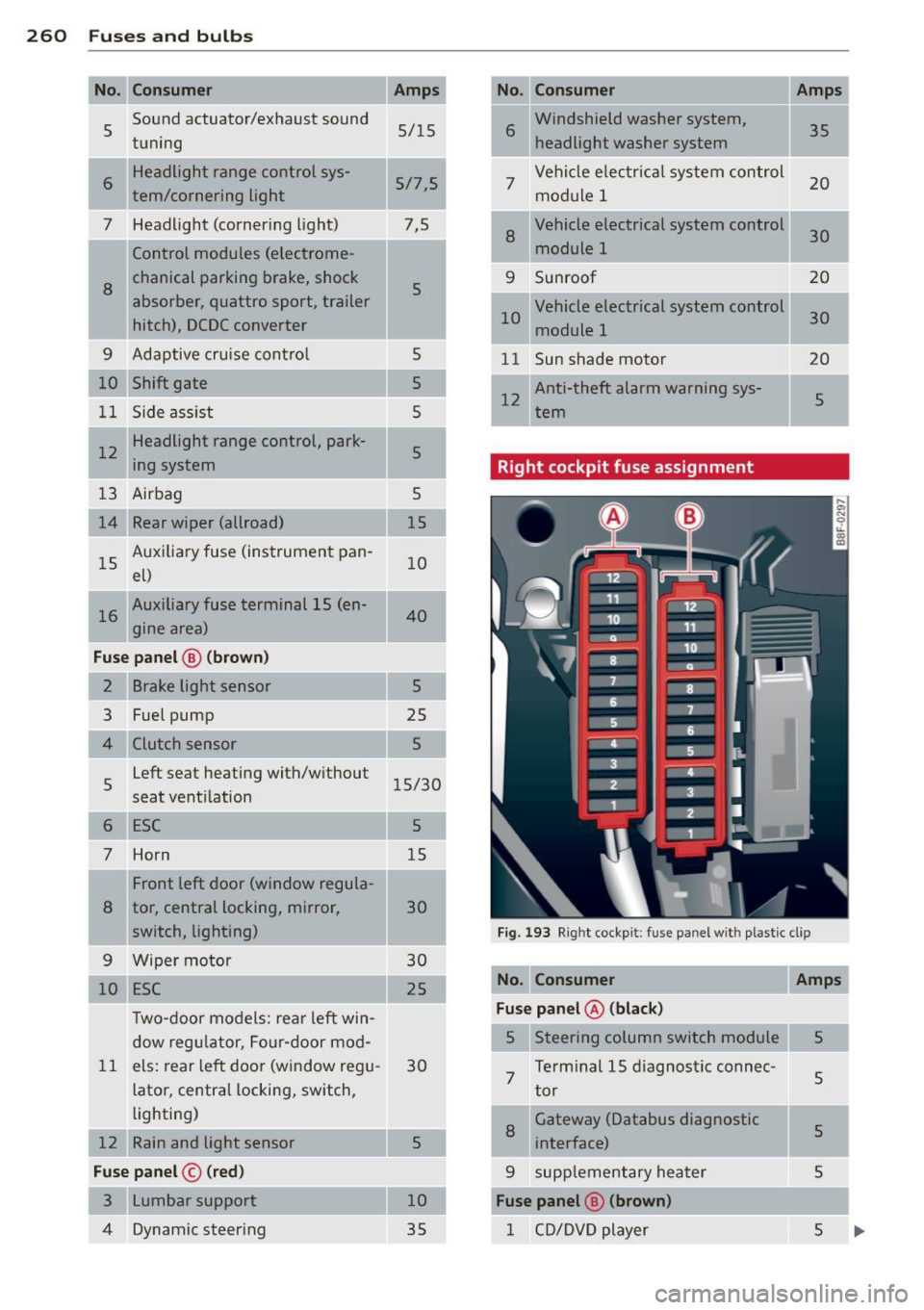
Right cockpit fuse assignment
Fig.
193 Right cockpit : fuse panel wit h plastic cl ip
No. Consume r
Fuse pane l@ (black )
..
5 Steering column switch module
7
8
Terminal 15 diagnostic connec
tor
Gateway (Databus diagnostic interface)
9 supp lementary heater
Fuse pan el@ (bro wn)
1 CD/DVD player
Amp s
5
5
5
5
5
•
I
Page 272 of 294
2 70 General information
designated seating position) and luggage
weight ¢.&, .
Gross Axle Weight Rating
The Gross Axle Weight Rating is the maximum
lo ad that can be applied at each axle of the
vehicle ¢Lr!, .
Vehicle capacity weight
The vehicle capac ity we ight (max. load) is list
ed on the driver's side 8-p illar.
Roof weight
The maximum permissible roof weight is 165
lbs. (75 kg). The roof weight is made up of
the we ight of the roof rack system and the
weight of the object be ing transported
¢ page 62, Loading the roof rack .
.&_ WARNING
- T he actual Gross Axle Weight Rating at
the front and rear axles should not ex
ceed the permissible weights, and their
combination must not exceed the Gross
Vehicle Weight Rating .
- Exceeding permissib le weight ratings can
result in vehicle damage, accidents and
persona l injury.
(D Note
- The vehicle capacity weight figures apply
when the load is distributed evenly in the
vehicle (passengers and luggage). When
transporting a heavy load in the luggage
compartment, carry the load as near to
the rear axle as possible so that the vehi
cle's handling is not impaired .
- Do not exceed the maximum permissible
axle loads or the maximum gross vehicle
weight . Always remember that the vehi
cle's handling will be affected by the ex
tra load . Therefore, adjust your speed ac
cordingly.
- Always observe loca l regu lations .
.
Dimensions
The specifications refer to the basic model.
Differences may occur depending on the mod
el type and options ordered, for example, tire
sizes.
~ Note
When driving up steep ramps, on rough
roads, over curbs, etc. it is important to re
member that some parts of your vehicle,
such as spo ilers or exhaust system compo
nents, may be close to the ground . Be
careful not to damage them .
Page 276 of 294
274 Con sum er Inf ormation
comp lexity of today's automobi les, have
steadi ly reduced the scope of maintenance
and repairs which can be carried out by vehicle
owners.
Also, s afety an d e nvir onm ent al con
cerns place very strict limits on the nature of repairs and adjustments to engine and trans
miss ion pa rts which an owner can perform .
Maintenance, adjustments and repa irs usua lly
require special tools, testing devices and oth
er equipment avai lab le to specially trained
workshop personnel in order to assure proper
performance, reliab ility and safety of the vehi
cle and its many systems .
Improper ma intenance, adjustments and re
pa irs can impair the operation and reliab ility
of your vehicle and even void your vehicle war ranty. Therefo re , proof of servici ng in accord
ance w it h the ma intenance sched ule may be a
condition for upholding a poss ible warranty
claim made within the warran ty period.
Above all, operational safety can be adve rsely
affected, creating unnecessary risks for you
and your passengers.
If in doubt about any serv icing, have it done
by your author ized Audi dealer or any other
p roperly equipped and qualified workshop .
We strong ly urge you to give your authorized
Audi dealer the opportunity to perform all
schedu led maintenance and necessary repairs .
Your dea ler has the facilities, or iginal parts
and tra ined spec ialists to keep your vehicle
running properly .
Performing lim it e d m aint en anc e y ourself
The fo llowing pages describe a limited num
ber of procedures which can be performed on
you r vehicle with ordinary too ls, shou ld the
need arise and trained personnel be unavaila
ble. Before performing any of these proce
dures, always thoroughly read all of the app li
cable text and ca refully follow the instruc
tions given. Always rigorously obse rve the
WARNINGS p rovided .
Before you ch eck anything in th e engin e
compartme nt, alway s read an d heed all WARNINGS
¢ & a
nd ¢ & in Working in the
engine comportment on page 216 .
A WARNING
--Serious personal in jury may occur as a re-
sult of improperly performed mainte nance, adjustments or repa irs.
- Always be extremely careful when work
ing on the vehicle. Always follow com
monly accepted safety pract ices and gen
eral common sense. Never r isk personal
in jur y.
- Do not attempt any of the maintenance,
checks or repairs descr ibed o n the fol
lowing pages if you are not fu lly fam iliar
with these or other procedures with re spect to the vehi cle, or are uncerta in how
to proceed .
- Do not do any work withou t the proper
too ls and equipment . Have the necessary
work done by your authorized A udi deal
er or anothe r properly equipped and
qualified workshop.
- The engine compar tment o f any motor
vehicle is a potentially hazardous area. Never reach into the area around or
touch the rad iator fan. It is temperature
control led and can sw itch on suddenly -
even when the engine is off and the igni
tion key has been removed. The rad iator
fan switches on automatically when the coo lant reaches a certai n tempera ture
and will cont inue to run until the coo lant
temperature drops .
- Always remove the ign ition key befo re
anyone gets under the veh icle.
- Always support your veh icle with safety
s tands if it is necessary to work under
neath the vehicle. The jack s upplied with
the vehicle is not adequate for this pur
pose and co uld co llapse causing serio us
personal injury.
- If you must work unde rneath the vehicle
wit h the wheels on the ground, a lways
make sure the vehicle is on leve l ground,
that the wheels are always secure ly
blocked and that the engine cannot be
started.