warning lights AUDI A5 COUPE 2013 Owner's Guide
[x] Cancel search | Manufacturer: AUDI, Model Year: 2013, Model line: A5 COUPE, Model: AUDI A5 COUPE 2013Pages: 294, PDF Size: 73.84 MB
Page 203 of 294
Automatic car wash
The vehicle can be washed in almost any
modern automatic car wash .
The vehicle paint is so durable that the vehicle
can normally be washed without problems in
an automatic car wash. However, the effect on
the paint depends to a large extent on the de
sig n of the fac ility, the filte ring of the wash
water, the type of wash and care mater ial , etc.
If the paint has a dull appearance afte r go ing
through the car wash or is scratched, bring
this to the attention of the operator immedi
ately. If necessary, use a different car wash.
Before going through a ca r wash, be s ure to
take the usual precautions such as closing the
windows and the roof . Factory installed an
tennas must not be removed.
If you have installed additional accessories on
the vehicle -such as spoilers, roof rack, etc. -
it is best to ask the car was h operator if these
should be removed .
A WARNING
Always read and heed a ll WARNINGS and
other information
¢ page 200.
(D Note
Before washing the vehicle in an automatic
car wash, p lease make sure to retract the
exterior m irrors to prevent them from be
ing damaged.
Washing the vehicle by hand
A lot of water is needed when washing a vehi
cle by hand.
~ Before you start washing, make sure yo u
have read and understood the WARNINGS
¢ A in General information on page 200 .
~ First soak all dried dirt until it is soft, then
rinse it off .
~ As you clean your veh icle, start with the
roof and work your way down to the bottom,
us ing a sponge , a sponge glove o r a clean
brush.
Cleaning and protec tion 20 1
~ Rinse the sponge or the sponge g love often,
flushing it clean eac h time .
~ Use spec ia l car shampoo only for very per
sistent d irt .
~ Rinse the car thoroughly with water.
~ Use a chamois leather to gently w ipe the ex-
ter ior d ry .
U se a separate sponge for cleaning the
whee ls, door sills and other regions exposed
to road dirt . In this way, you w ill not scratch
the pa int wit h coarse particles imbedded in
the sponge the next time you wash the car.
&_ WARNING
- Do not clean the underside of the chas
sis, fenders, wheel covers, or o ther ha rd
to reach pa rts without protect ing you r
hands and arms. You may cut yourself on
sharp-edged metal parts .
-Always read and heed a ll WARNINGS and
other information
¢ page 200.
(D Note
- N ever try to remove dirt, mud or dust if
the s urface o f the veh icle is dry . Never
use a dry cloth or sponge, since this
co uld scratch your vehicle's paint or win
dows.
- Never wash your car in bright s unlight .
Drops of wate r act as magnifying lenses
and may damage yo ur paint .
- When you wash yo ur car in the winter: if
you rinse yo ur vehicle with a hose, be
careful not to aim the stream of water
directly at locks, or at door or hatch
openings -they can freeze shut .
- Never use sponges designed to
remove
insects, or any k itche n scou ring sponges
or s imilar products. They can damage
your paint finish .
- You should remove debris (such as in
sects) from the headlight lenses on a
regu lar bas is, for exampl e w hen refuel
ing your veh icle . Never use a dry cloth o r
sponge to clean t he headlights. On ly use
wet cloths o r sponges to prevent
scratches. It is best to use soapy water.
-
•
•
Page 204 of 294
202 Cleaning and protec tio n
@ For the sake of the environment
In the interest of the environment, the ve
hicle should on ly be washed in special
wash bays.
Washing your vehicle with a power
washer
Cleaning the exterior of your car with a high
pressure power washer is safe as long as you
observe a few simple rules .
~ Before using the power washer, make sure
you have read and understood the WARN
INGS
c::> A in General information on
page 200 .
~ Always follow the operating instructions for
the power washer.
~ Make sure that the jet on the spray hose
produces a "fan shaped spray".
~ Do not ho ld the spray nozzle too close to
soft materials.
When cleaning the vehicle with a power wash
er
always follow the operating instructions .
This applies particularly to the
o per atin g
p re ss u re
and the s p rayin g distance . Maintain
a sufficient d istance to soft materials such as
rubber hoses and sound/vibrat ion deadening
materials (part icularly on the underside of the
engine hood). Do not use a jet wh ich sprays
water in a
dire ct st ream or one that has a ro
ta ting
jet.
Water temperature should not exceed 140 °F
(60 °() .
A WARNING
Never wash tires w ith a je t that sprays wa
ter in a direc t stream. This cou ld cause in
visib le damage to the tires and weake n
t hem, even if the spray is from a relatively
long distance and for a short time . Dam
aged and weakened t ires can fai l and cause
accidents and persona l injury.
([) Note
To avoid damag ing your vehicle, always
make sure that there is sufficient distance between the spray head and soft materia
ls
like rubber hoses, plastic parts and sound
deaden ing mater ials. Never aim the spray
head at the same point for a long time.
This also applies to cleaning headlights
and painted bumpers. Remember: the
closer the nozzle is to the surface of the
mater ial, the greater the stress on the ma
terial.
Sensors and camera lenses
- Remove snow with a hand brush and remove
ice with a de -icing spray that does not con
tain so lvents.
- Clean the sensors (adaptive c ruise control*,
parking system *) with a cleaning so lution
that does not contain so lvents and a soft
cloth.
(D Note
- If you wash your vehicle with a pressure
washer,
- make sure there is enough distance to
sensors in the rear bumper.
- do not clean the camera lenses and the
area around them with the p ressure
washer.
- Never use warm or hot water to remove snow o r ice from the camera lens. This
could cause the lens to crack.
- Never clean the camera lens with abra
sive products .
Waxing and Polishing
Waxing
A good wax coating prot ects the vehicle paint
to a la rge extent against the envi ronmental
factors lis ted under
c::> page 200, Washing and
even against s light scra tches .
You can use a liquid car wax to protect you r
paint as soon as one wee k afte r you r vehicle
has been delivered.
Even if you regularly use a
wa xing process in
automat ic car washes, we recommend that
you manually apply a coat of wax to g ive the
1111>
Page 222 of 294
220 Check ing and filling
temperatures stay below freezing point for
long periods.
Detergent addit ives in the o il w il l make fresh
oil look dark after the eng ine has been run
ning for a short time . This is norma l and is not
a reason to change the oi l more often than
recommended.
D am age or m alfunc tions du e to lack of
m ainten ance
It
is essential that you change your oil at the
recommended in tervals using only engine o il
that complies with Audi oi l standard
VW 502 00. Your Limited New Vehicle War
ranty does not cover damage or malfunctions
due to fail ure to fo llow recommended mainte
nance and use requ irements as set forth in
the Audi Owner's Manual and Warranty
&
Maintenance book let . Your dealer will have to
deny warranty coverage unless you present to
the dea ler proof in the form of Service or Re
pa ir Orders that all scheduled ma intenance
was performed in a t imely manner.
Eng ine oil consumption
The engine in your vehicle depends on an ade
quate amount of oil to lubricate and cool all
of its moving parts.
In order to provide effective lubrication and
cool ing of internal engine components, a ll in
ternal combustion eng ines consume a certa in
amount of oil. O il consumption varies from
engine to engine and may change significantly
over the life of the engine. Typica lly, engines
with a specif ied break-in period (see
¢
page 193) consume more oil during the
break-in period than they consume after oil
consumption has stabilized.
Under norma l conditions, the rate of oil con
sumption depends on the quality and viscosity
of the oil, the RPM (revolutions per minute) at
which the engine is operated, the ambient
temperature and road condit ions . Further fac
tors are the amount of oil d ilution from water
condensat ion or fuel residue and the ox ida
tion level of the oi l. As any engine is subject to wear as mi
leage builds up, the oil consump
tion may increase over time until replacement
of worn components may become necessary.
With a ll these variab les coming into play, no
standard rate of oil consumption can be es
tablished or specified. There is no alternative
to regu lar and frequent check ing of the o il lev
el, see
Note .
If
the yellow engine oil leve l warning symbo l
I! in the instrument cluster lights up, you
shou ld check the oil leve l as soon as possib le
¢
page 221. Top off the oil at your earliest
convenience ¢
page 221.
A WARNING '"---
Before you check anythi ng in the engine
compartment, always read and heed all
WARNINGS¢
A in Working in the engine
compartment on page 216.
(D Note
Driving w ith an insufficient o il level is like
ly to cause severe damage to the engine .
(D Tips
-The oil pressu re warn ing display . is
not an indic ator of the oil l evel. Do not
r el y on it . In stea d, check th e oil l eve l in
y our engin e at regular inter val s, pref
erably ea ch time you r efu el, and alwa ys
before go ing on a long trip .
-If you have t he impression yo ur engine
consumes excessive amoun ts of o il, we
recommend that you consu lt an author
ized Aud i dea ler to have the cause of
your concern properly diagnosed. Keep in m ind that the accurate measu rement of
oil consumption requ ires great care and
may take some time. An authorized Aud i
dealer has instructions about how to
measu re oil consumption accurately.
-
Page 229 of 294
Have the battery checked when you take your
vehicle in for service. Yo u are well advised to
replace a battery that is older than 5 years.
W ith certa in types o f airbag deployment, the
battery is disconnec ted from the vehicle elec
trica l system for safety reasons
c::> &. in Re
pair, care and disposal of the airbags on
page 156.
Di sconn ecting the battery t erminal s
Some vehicle functions (power w indow regu
l ators, for example) are lost if the battery ter
minals are disconnected . These functions have
to be re learned after the battery terminals are
connec ted again. To prevent this, the battery
should only be disconnected from the vehicle
e lectrical system when absolutely necessary
for repairs .
Vehicl es not driven for long p eriod s
If you do not drive your vehicle over a period
of several days or weeks, electrical compo
nents are gradually cu t back or switched off .
This reduces energy consumption and main
tains starting capability over a longer per iod
c::> page 191.
Some of the conven ience functions may not
operate, such as the inter ior lights or the
power seat adjustment. The conven ience
functions will be ava ilable again whe n you
turn on the ignition and sta rt the eng ine.
Winter operation
During the winter months, battery capacity
tends to decrease as temperatures drop . This
i s because more powe r is also consumed while
start ing , and the head lights, rea r window de
fogger, etc., are used more often .
Avo id unnecessary power consumption, par
ticularly in c ity t raffic or when t rave ling on ly
short d istances. Let you r authorized Audi
dea le r che ck t he capacity of the vehicle bat
t ery before w inte r sets in
c::> page 229. A well
cha rged batte ry w ill no t only p revent sta rting
p rob lems when the weathe r is cold, b ut will
a lso last longer.
Checkin g and fillin g 22 7
(D Tips
If your vehicle is left standing for seve ral
weeks at extremely low temperatures, the
vehicle battery shou ld be removed and
stored where it w ill not freeze. This will
prevent it from be ing damaged and having
to be replaced .
Working on the battery
Be especially careful when working on or near
the battery.
The battery is located in the l uggage compart
ment under the floor. Before you check any
th ing in the luggage compartment,
read and
h eed all WARNINGS
c::> &_ .
Always heed the safety warnings , when work
ing on the vehicle battery or the vehicle e lec
trical system to prevent injury.
The following WARNINGS are very
important when working on the battery:
Al ways heed the follo wing WARNING SYM
BOLS and safety precautions when working on the battery.
® Always wear eye protection .
/).. Batte ry acid contains sulfuric acid . Al
~ ways w ear glov es and ey e protection .
IC No
\!!51 -sparks
-flames
- smoking.
A Wh en a battery i s charged , it produces
~ hydrogen g as which i s explosive and
could cau se per sonal injur y.
~ Always keep the battery well out of
'if!:11 reach of children .
_&. WARNING
Whenever working on t he battery o r on
the electrical system, there is the risk of
injury, accident and even fire . Read and
heed the following WARNINGS:
-
•
•
Page 230 of 294
228 Checking and filling
-Always wear eye protection. Do not let
battery acid or any lead particles get on
your skin or clothing . Shield your eyes .
Explosive gases can cause blindness or
other injury .
- Battery acid contains sulfuric acid . Sulfu
ric acid can cause blindness and severe
burns .
- Always wear gloves and eye protection.
Do not tilt the battery because acid
could leak out of the ventilation open
ings.
- If you get battery acid in your eyes or
on your skin, immediately rinse with
cold water for several minutes and get
medical attention .
- If you should ingest any battery acid,
seek medical attention immediately.
- Do not expose the battery to an open
flame, electric sparks or an open light.
- Do not smoke.
- Do not interchange the positive and neg-
ative cables.
= When working on the battery , be sure
not to short-circuit the terminals with
tools or other metal objects. This would cause the battery to heat up very quickly,
which could lead to damage or explosion
and personal injury.
- When a battery is charged, it produces hydrogen gas which is explosive and
could cause personal injury .
- Always keep the battery well out of the
reach of children .
- Before work is done on the electrical sys tem, disconnect the negative ground cable .
- Before performing any work on the elec
trical system, switch
off the engine and
ignition as well as any electrical equip
ment . The negative cable on the battery
must be disconnected . If you are just go
ing to replace a light bulb, then it is
enough to switch
off the lights.
- Before disconnecting the battery, switch
off the anti-theft alarm system! Other
wise you will set off the alarm. -
When disconnecting the battery, first
disconnect the negative cable and then
the positive cable.
- Before reconnecting the battery, make
sure all electrical consumers are switch
ed off. Reconnect the positive cable first
and then the negative cable . Never inter
change the cables - this could start a fire!
- Never charge a frozen or a thawed-out
battery .
It could explode! If a battery has
frozen , then it must be replaced . A dis
charged battery can freeze over at 32°F
(QOC).
- Make sure the vent hose is always attach
ed to the opening on the side of the bat
tery .
- Never use batteries which are damaged.
There is the danger of an explosion! Al
ways replace a damaged battery.
A WARNING
California Proposition 6S Warning:
- Battery posts, terminals and related ac
cessories contain lead and lead com
pounds, chemicals known to the State of
California to cause cancer and reproduc
tive problems. Wash hands after han
dling.
(D Note
- Do not disconnect the vehicle battery
when the ignition is switched on or when the engine is running, otherwise, you will
damage electronic components in the
electrical system.
- If your vehicle is going to stand for a
long period of time without being driven,
protect the battery from "freezing", oth
erwise it will be damaged and will then
have to be replaced .
Page 264 of 294
262 Fuses and bulb s
Bulbs
Replacing bulbs
For your safety, we recommend that you have
your authorized Audi dealer replace any bulbs
for you .
It is becoming increasingly more and more
difficult to replace vehicle light bulbs since in
many cases, other parts of the car must first
be removed before you are able to get to the
bu lb . Thi s appl ies especial ly to the light bulbs
in the front of your car which you can only
reach through the engine compartment .
Sheet metal and bulb holders can have sharp
edges that can cause ser ious cuts, parts must
be correctly taken apart and then properly p ut
back together to help prevent breakage of
parts and long term damage from water that
can enter housings that have not been proper
ly resealed.
F or your safety, we recommend that you have
your authorized Audi dealer replace any bulbs
for you, since your dealer has the proper tools,
the correct bu lbs and the expertise.
Gas di scharg e lamps (Xenon lights)*:
Due to the high electrical vo ltage, have the
bu lbs rep laced by a qualified technician.
H eadlights with Xenon light are identified by
the high voltage sticker.
A WARNING
Changing Xenon lamps without the neces
sary equipment can cause serious personal
injury.
- Bulb s are pressurized and can exp lode
when being changed . Potential risk of in
jury!
- On vehicles equipped with gas discharge
bulbs (Xenon light)* life-threatening in
jur ies can result from improper handling
of the high-voltage portions of such
lamps!
- Only your authorized Aud i dealer or a
qualified workshop shou ld change the
bulbs in gas d ischarge lamps. There are parts with sharp edges
on the openings
and on the bulb holders that can cause
serious cuts. If you are uncertain about
what to do, have the work performed by
an author ized Audi dealer or other quali
fied workshop . Ser ious personal injury
may resu lt from improperly performed
wo rk.
@ Tips
- If you st ill prefer to replace the light
bulbs yourself, be aware that the engine
compartment is a hazardous area to
work in
~ page 209, Engine compart
ment~ ,&..
-It is best to ask your authorized Audi
dealer whenever yo u want to change a
bulb .
Page 266 of 294
264 Emergency situations
@ Tips
The discharged battery must be properly
connected to the vehicle's electrical sys
tem. When jump starting or charging the
battery, never connect the negative
ground cable to the battery negative post
because the batte ry manager system must
be able to detect the battery 's state of
charge. Always connect the negative
ground cab le to the negative ground post
of the battery manager control unit.
Use of jumper cables
Make sure to connect the jumper cable
clamps in exactly the order described below!
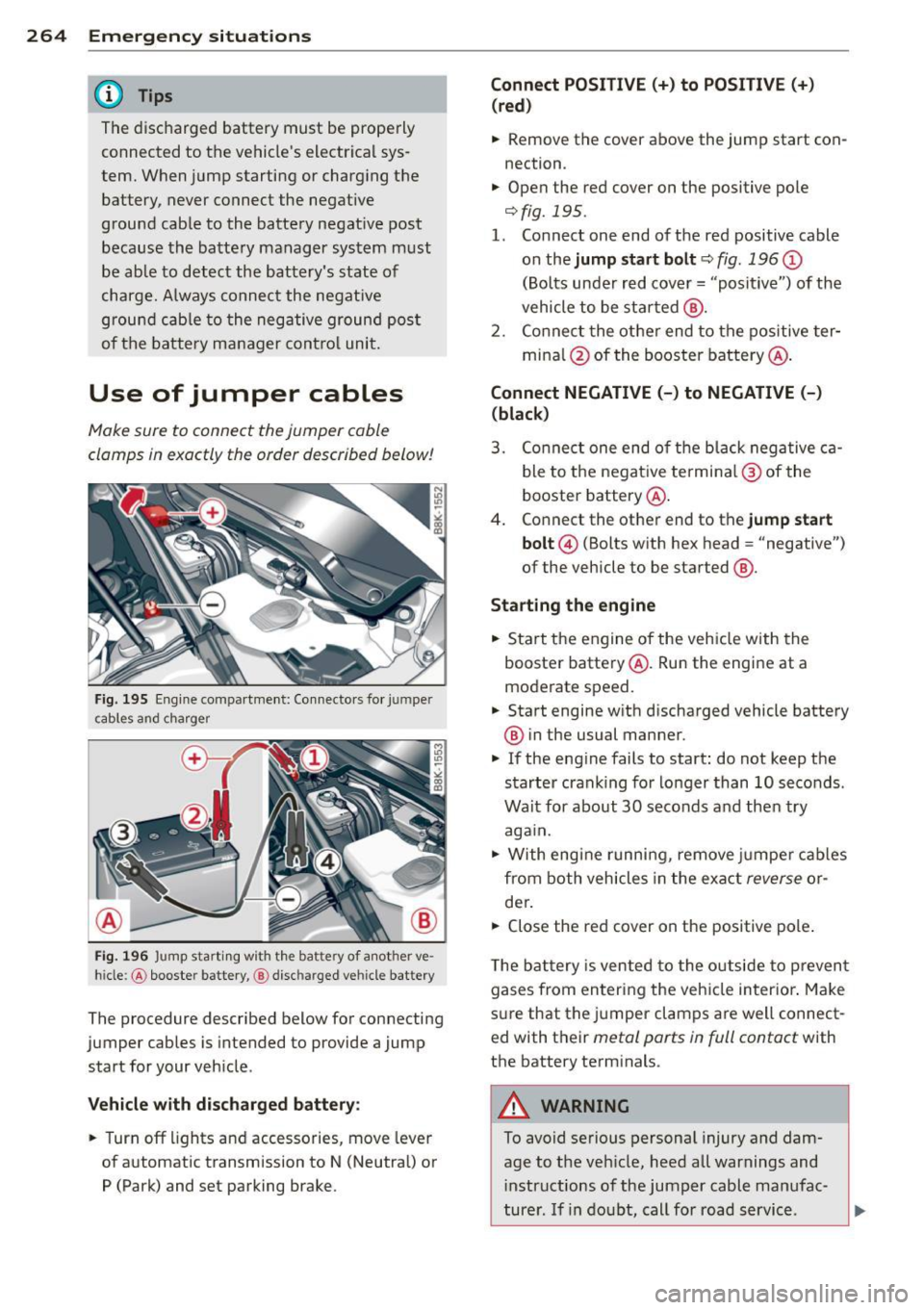
Fig. 195 Engine compartment: Connecto rs fo r jum per
cables and charger
Fig. 196 Jump sta rting wi th the battery of anot her ve ·
h ide :@ booster battery, @ disc harged vehicle battery
The procedure described below for connecting
jumper cables is intended to provide a jump
start for your vehicle .
Vehicle with discharged battery:
.. Turn off lights and accessories, move lever
of automatic transmission to N (Neutral) or
P (Park) and set parking brake .
Connect POSITIVE(+) to POSITIVE(+)
(red)
.. Remove the cover above the jump start con
nection .
.. Open the red
cover on the positive pole
¢fig. 195.
1. Connect one end of the red positive cable
on the
jump start bolt c::> fig. 196 @
(Bolts under red cover= "positive") of the
vehicle to be started @.
2. Connect the other end to the positive ter-
mina l@ of the booster battery@.
Connect NEGATIVE (-) to NEGATIVE (-)
(black)
3. Connect one end of the b lack negative ca
ble to the negative terminal @of the
booster battery @.
4. Connect the other end to the
jump start
bolt @
(Bolts with hex head= "negative")
of the vehicle to be started ®·
Starting the engine
.. Sta rt the engine of the vehicle with the
booster battery@. Run the engine at a
moderate speed.
.. Start engine with discharged vehicle battery
® in the usual manner .
.. If the eng ine fails to start: do not keep the
starter cranking for longer than 10 seconds .
Wait for about 30 seconds and then try
again .
.. With engine running, remove jumper cables
from both vehicles in the exact
reverse or
der .
.. Close the red
cover on the positive pole .
T he battery is vented to the outside to prevent
gases from entering the vehicle interior . Make
sure that the jumper clamps are well connect
ed with their
metal parts in full contact with
the battery terminals.
A WARNING
--
To avoid serious personal injury and dam
age to the veh icle, heed all warnings and
i nstructions of the jumper cable manufac-
turer . If in doubt, call for road service . ..,.
Page 280 of 294
278 Index
A
Accessories ... .. .. ..... ... .. .. .... . 275
AC (automatic cl imate control) ... .. .. . . 68
adapt ive cruise control
Vehicles with manual transmission . . . . 97
Adap tive cr uise con trol ................ 95
C leaning sensors/camera . ... .. .... . 202
M essages . . . . . . . . . . . . . . . . . . . . . . . . 103
Request for dr iver intervention . ..... . 10 1
Sett ing th e driving program .. .. .. ... 100
A dapt ive dampers .......... .... .... . 109
Adapt ive light ................ ... .... 43
Ada ptive Light (defective) ... .. .. .... .. 22
Adding Eng ine coolan t .................... 224
E ng ine oil . .... .. ..... ... .. .. .... . 22 1
Windshie ld washer fl uid ... .. .. .... . 230
Addit ional accessories
Addit ives 275
Eng ine oil .. ............. .. .. .. .. . 221
Ad justa ble s teer ing column . ... .. .... .. 71
Ad justing
A ir dist ribution (automatic climate con -
trol) . .. .. .. ............. .. .. .... .. 69
I ns trumen t illum ina tion . .. .. .. .. .. . . 46
Steer ing column .. ..... ... .. .. .... .. 71
Tempe rature (automatic climate control) 69
A irbag
War ning/ indica to r ligh ts ... .... .... .. 20
A irbag system . . . . . . . . . . . . . . . . . 142, 161
Advanced Airbag System ........ .... 146
Advanced Airbag System compone nts . 149
Ca re . .. .. ... ....... ........ ..... . 155
C hil dren . ............... .. .. .. .. . 167
C hil d restr aints ........... .. .. .. .. . 16 8
Componen ts (front airbags) .. .... .. . 1 49
D anger of fitting a child safety seat on
the front passenger seat . . . . . . . . . . . . 143
Disposal . .... ........... .. .. .... . 155
Front airbags . . . . . . . . . . . . . . . . 146, 147
H ow do the front airbags work? . .. .. . 151
H ow ma ny airbags does my vehicle
have? .... ................... ... . 14 9
H ow t he Advan ced Airbag System com-
p o nents wo rk toge ther ............. 150
I mpor tan t safety instru ctions on the
knee ai rbag system .. ... .. .. .. .... . 159 Important things to know ....
.... . .. 14 2
In dicator light ... .. ... ..... ... .. .. 153
Knee airbags ... .. ... .. ..... ... .. .. 157
Monitoring .... .. ............. .... 153
PASSENGER AIR BAG OFF light ....... 153
Repairs ......... .. .............. . 155
Safety instr uctions ..... ....... ... .. 155
S ide a irbags . .. ................... 160
S ide cu rtain airbags ............ .. .. 162
We igh t-sensing m at ........... .. .. 16 7
When m ust the sys tem be inspected? . 153
all-wheel d rive .. .. .. ... ....... ... .. 190
Alloy wheels .... .. ... .. ..... .... . .. 205
All w heel drive
W inter tires ... .. ............. .... 246
An ti- freeze
refer to Eng ine coolant system ....... 223
Anti -lock b raking system . . . . . . . . . . . . . 185
Warning/ind icator lights ............ . 19
An ti- slip reg ulation . .. .. ..... ... .. .. 185
An ti-theft ala rm wa rning system ........ 32
Anti -theft systems
E lectronic immob ilizer .......... .... . 38
Armres t ............................ 56
Asht ray ....... ... .. .............. .. 58
Aste risk
What does it mean when something is
marked with an aster isk? . . . . . . . . . . . . . . 6
A udi braking guar d
refer to braking guard ....... ... .. .. . 95
Audi dr ive select . ................... 109
Adaptive dampers ... .......... .. .. 109
D es cription .. .. .. ............. .. .. 109
D ynam ic steer ing .............. .... 109
Setting the dr iv ing mode ..... ... .. .. 110
Spo rt differential .... .. ..... ... .. .. 109
Audi Se rv ice Repair Manuals a nd Litera-
tu re ... .. .. .. .. .. .... ......... .... 273
A UTO
Automa tic cl imate contro l . . . . . . . . . . . . 69
Automa tic headlights ......... ... .. . 43
Auto Lock .. .. .. .. ............. .. .. . 32
A ut oma tic be lt retra ctor ............. 137
Automat ic car wash
refer to Washing .................. 201
Page 281 of 294
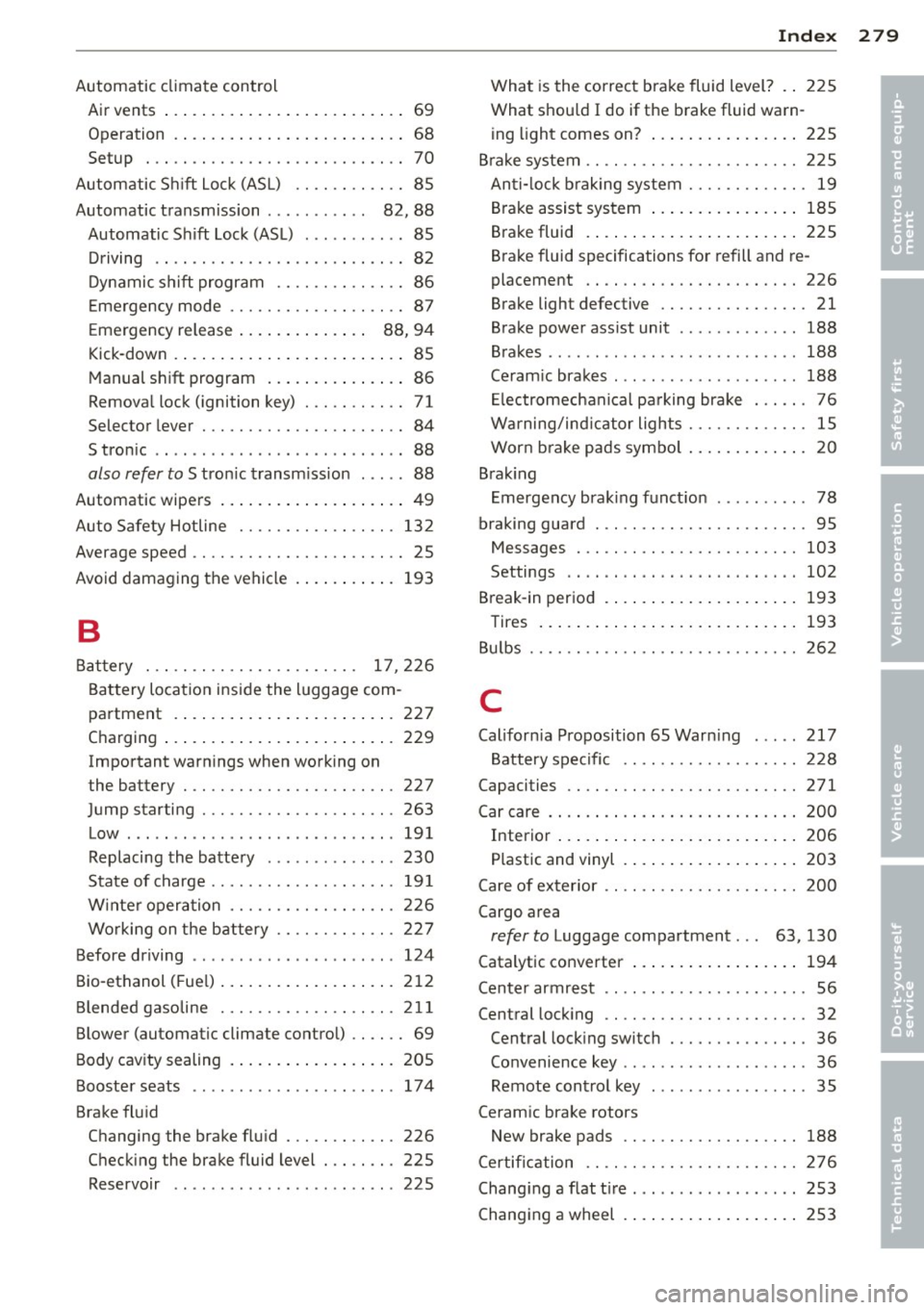
Automatic climate control Air vents ... ................ ... .... 69
Operation . . . . . . . . . . . . . . . . . . . . . . . . . 68
Setup ... .. ................. .. .... 70
Automatic Shift Lock (ASL) . . . . . . . . . . . . 85
Automatic transmission . . . . . . . . . . . 82, 88
Automatic Shift Lock (ASL) . . . . . . . . . . . 85
Driving .. .. ............. .... .. .. .. 82
Dynamic shift program . . . . . . . . . . . . . . 86
Emergency mode . . . . . . . . . . . . . . . . . . . 87
Emergency release . . . . . . . . . . . . . . 88, 94
Kick -down . . . . . . . . . . . . . . . . . . . . . . . . . 85
Manual shift program . . . . . . . . . . . . . . . 86
Removal lock (ignition key) . .. .. .. .. .. 71
Selector lever . . . . . . . . . . . . . . . . . . . . . .
84
S tronic .. ..... ........... ... ... ... 88
also refer to S tronic transmission ..... 88
Automatic wipers ................ .. .. 49
Auto Safety Hotline ........ .. .. .. .. . 132
Average speed . . . . . . . . . . . . . . . . . . . . . . . 25
Avoid damaging the vehicle ... ... .. .. . 193
B
Battery . . . . . . . . . . . . . . . . . . . . . . . 17,226
Battery location inside the luggage com-
partment .. ................ ... ... 227
Charging ... ................ ... ... 229
Important warnings when working on
the battery . ............. .... .. ... 227
Jump starting ............ .... .. ... 263
Low ..... ... ...... ............. .. 191
Replacing the battery ..... .. .. .. .. . 230
State of charge ........... .... .. .. . 191
W inter operation ......... .. .. .. .. . 226
Working on the battery .... .. .. .. .. . 227
Before driving . . . . . . . . . . . . . . . . . . . . . . 124
Bio-ethanol (Fuel) ................ .. . 212
Blended gasoline .......... .. .. .. .. . 211
Blower (automatic climate control) . . . . . . 69
Body cavity sealing ............ ... .. . 205
Booster seats .............. ... ... .. 174
Brake fluid Changing the brake fluid ... .. .. .. .. . 226
Checking the brake fluid level ... .. .. . 225
Reservoir .. ... .. .. ...... .. .. .. .. . 225
Index 279
What is the correct brake fluid level? . . 225
What should I do if the brake fluid warn- ing light comes on? ............... . 225
B rake system .. .. .. .... ........... .. 225
Anti- lock b raking system ........ .. .. . 19
Brake assist system ............... . 185
Brake fluid . ..... ................. 225
Brake fluid specifications for refill and re-
placement .. .. .. .... ........... .. 226
Brake light defective ............... . 21
Brake power assist unit ............. 188
Brakes .. .. .. .. .. .. . .. .... ........ 188
Ceramic brakes ... .. ............... 188
Electromechanical parking brake ..... . 76
Warning/ind icator lights ........ .. .. . 15
Worn brake pads symbol . . . . . . . . . . . . . 20
Braking Emergency braking function .......... 78
braking guard . .. .. .... ............. . 95
Messages . .. .. .. .. ............... 103
Settings .. .. .. .. .... ... .... .... .. 102
Break-in period . ..... ............... 193
Tires ........... .. ............... 193
Bu lbs .......... .... ............... 262
C
California Proposition 65 Warning ... .. 217
Battery specific ...... ......... .. .. 228
Capacities .. .. .. .. .... ........... .. 271
Car care ..... ... .... ............... 200
Interior ..... .... .. ............... 206
Plastic and vinyl .... .............. . 203
Care of exterior .. .. .... ........... .. 200
Cargo area
refer to Luggage compartment. . . 63, 130
Catalytic converter . . . . . . . . . . . . . . . . . . 194
Center armrest . . . . . . . . . . . . . . . . . . . . . . 56
Central locking .. .. ............... .. . 32
Central locking switch .......... .... . 36
Convenience key . . . . . . . . . . . . . . . . . . . . 36
Remote control key .... ....... .... .. 35
Ceramic brake rotors New brake pads .. ................. 188
Certification .. .. .. ... ............ .. 276
Changing a flat tire ................. . 253
Changing a wheel .... .............. . 253
•
•
Page 283 of 294
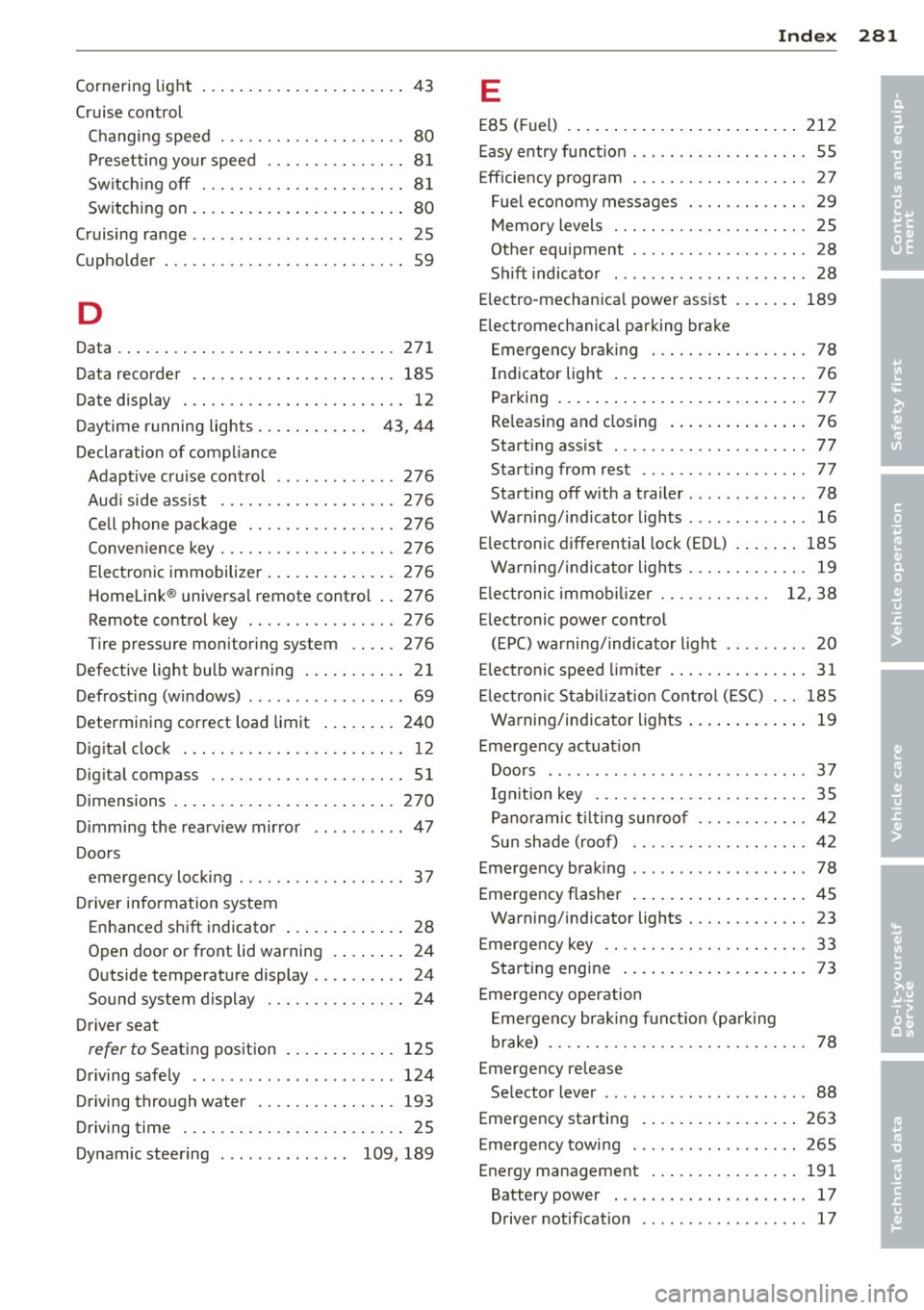
_______________________________ I~ n~ d:::: e~x 281
Cornering light ..... .... ... .. .. .. .... 43
Cruise control Changing speed . . . . . . . . . . . . . . . . . . . . 80
Pr esetting your speed ..... .. .. .. .. .. 8 1
Sw itching off . ........... .. .. .. .... 8 1
Sw itching on . ... .. .... ... .. .. .. .... 80
Cruising range . . . . . . . . . . . . . . . . . . . . . . . 25
(upho lder . . . . . . . . . . . . . . . . . . . . . . . . . . 59
D
D ata .. .. .. .. .. ... .. ..... ... .. .. ...
Data recorder 271
185
Date display . ............. .... .. .... 12
D ay time r unning lights. . . . . . . . . . . . 4 3, 44
Declaration of comp liance
Adapt ive cruise control ........ . ... . 276
A d' 'd . u I s1 e assist .......... .. .. .. .. . 276
Cell phone package ....... .. .. .. .. . 276
Conve nience key .......... .. .. .. .. . 276
Elect ronic immobilize r .. ... .. .. .. .. . 27 6
Homelink ® universal remote contro l .. 276
Remote control key ....... .. .. .. .. . 276
Tire pressure monitoring system .. .. . 276
D efect ive light bulb warning . . . . . . . . . . . 2 1
Defrosting (w indows) .......... .. .... . 69
Determining cor rect load limit ... .. .. . 240
Di gita l cl ock . .... ......... .. .. .. .. .. 12
Dig ita l compass ........... .. .. .. .. .. 51
D imensions .. .. .. .. .... ... .. .. .. ... 270
Dimming the rearview mir ro r .. .. ... ... 4 7
Doors emergency locking ........ .. .. .. .. .. 37
D river information system
En hanced s hift indicator ... .. .. .. .. .. 28
Open doo r or front lid warning . . . . . . . . 24
Outside temperature display .. .. .. .. .. 24
Sound system display . . . . . . . . . . . . . . . 24
D river seat
refer to Seat ing position ... .. .. .. .. . 125
Dr iving safely .. ........ ...... .... .. 124
Driving through water ...... .. .. .. .. . 193
D riving time . . . . . . . . . . . . . . . . . . . . . . . . 25
Dynamic steering . . . . . . . . . . . . . . 109, 189
E
E85 (Fuel) . ....... ... .. .. ..... ... .. 2 12
Easy entry funct io n . . . . . . . . . . . . . . . . . . . 55
Eff ' .
1c1ency program . .. ........... .... . 27
Fuel economy messages . . . . . . . . . . . . . 29
Memory levels . . . . . . . . . . . . . . . . . . . . . 25
Other equipment ................. .. 28
S hi ft indicato r ... .. . .. .... .... .. .. . 28
E lectro-mechan ica l power ass ist ... .. .. 189
El ec tromechani ca l pa rking brake
E mergency bra king ................ . 78
Ind icator light ... .. . ... ...... ... .. . 76
Parking ... .. .... .. . .. .. ..... ... .. . 77
Re leas ing and closing ... .... ... .. .. . 76
Starting ass ist . . . . . . . . . . . . . . . . . . . . . 77
Starting from rest . . . . . . . . . . . . . . . . . . 77
Starting off w ith a trailer .. .. ... ... .. . 78
Warning/ind icator lights ........... .. 16
E lectronic differential lock (EDL) ... .. .. 185
Warning/ind icator lights ............ . 19
E lectronic immob ilizer . . . . . . . . . . . . 12, 38
E lectronic power control
(EPC) warning/ indicator light ... ... .. . 20
E lectronic speed limiter .............. . 31
El ec tronic Stab iliz at ion Con tro l (E SC) . .. 185
Warning/ind icator lights ..... ... .. .. . 19
Emergency ac tuat ion
Doors ...... .. .... .......... ...... 37
Ig nition key . .. .. ................. . 35
Pano ram ic t ilting sunro of ....... .. .. . 42
Sun shade (roo f) . ............. .. .. . 42
Emergency brak ing ................. .. 78
Emergency flasher .... .. ..... ... .. .. . 45
Warning/ind icator lights ........ .... . 23
E mergency key . . . . . . . . . . . . . . . . . . . . . . 33
Star ting engine .... . .. .. ..... ... .. . 73
Emergency operation Em ergency bra king funct ion (park ing
brake) .... .. .. .. .. .. ........... .. . 78
Emergency release Se lector lever . . . . . . . . . . . . . . . . . . . . . . 88
Emergency starti ng . .. .. ..... ... .. .. 263
E merge ncy towing . .. ........... .... 265
Energy management ............ .. .. 191
Battery power . . . . . . . . . . . . . . . . . . . . . 17
Driver notif ication . . . . . . . . . . . . . . . . . . 17
•
•