belt AUDI A5 COUPE 2013 Repair Manual
[x] Cancel search | Manufacturer: AUDI, Model Year: 2013, Model line: A5 COUPE, Model: AUDI A5 COUPE 2013Pages: 294, PDF Size: 73.84 MB
Page 186 of 294
184 Child Saf ety
and child against the backrest, ce nter
arm rest, or door .
- A tight tether or other strap on a rear
ward -fac ing child restra int attached to
the front passenger seat can put too much pressure on the weight-mat in the
seat and register a heavier weight in the
Adva nced Airbag System. The heav ier
we ight registe red can make th e system
wor k as th ough an adu lt were on the seat
and dep loy the Advan ced Airbag when i t
must be suppressed ca using se rious or
even fatal injury to the child.
- If you mus t install a rearwar d fa cing
child safety seat on the front passenger
seat because of exceptional circ umstan
ces and the
PASSENGER AIR BAG OFF
light does not come on and stay on, im
med iate ly install the rearward-facing
child safety seat in a rear seat ing pos i
t io n and have the airbag system inspect
ed by you r authorized Audi dea le r.
Additional Information
Sources of information about child
restraints and their use
There are a number of sources of additional
information about ch ild restrai nt select ion, in
stallat io n and use:
NHTSA advises that the best child safety seat
is the one that fits your child and fits in your
ve hicle, and that you w ill use cor rectly and
consistently.
Try before you buy!
U.S National Highway Traffic Safety Admin
istration
Te l.: 1-888-327-4236 (TTY : 1-800-424-9153)
www .nhtsa.gov
National SAFE KIDS Campaign
Te l.: (202) 662-0600
www .safekids.org
Safety BeltSafe U.S.A
T el.: (800) 74S-SAFE (English)
Tel.: (800) 747 -SANO (Span is h)
www.carseat .org
Transport Canada Information Centre
T el.: 1-800-333-0371 or ca ll
1-6 13-998-86 16 if yo u are in the Ottawa area
http://www .tc.gc.ca/eng/roadsafety/
menu. htm
Audi Cu stomer Relations
Tel.: (800) 822-2834
Page 187 of 294
Intelligent technology Notice about data
recorded by vehicle
control modules
Your vehicle is not equipped with an Event Da
ta Recorder (EDR), installed by some manu
facturers for the express purpose of capturing
data for retrieval after an accident or crash
event. EDR's are sometimes called "crash re
corders".
Some state laws restrict the retr ieval or down
loading of data stored by EDR's that were in
stalled in a vehicle for the express purpose of
retrieving data after an accident or crash
event without the owner's consent.
Although your vehicle is not equipped with an
EDR, it is equipped with a number of electron
ic control modules for various vehicle systems
such as, for examp le, engine function, emis
sion control, as well as for the airbags and
safety belts.
These electronic control modules also record
vehicle-related data during norma l vehicle op
eration for diagnostic and repair purposes.
The recording capacity of the electronic con
trol modules is limited to data (no sound is re
corded) and only a small amount of data is ac
tually recorded over a very limited period of
time and stored when a system fault or other
condition is sensed by a control unit. Some of
the data then stored may relate to vehicle
speed, direction, braking as we ll as restraint
system use and performance in the event of a
crash or other condition. Stored data can only be read and downloaded with special equip
ment.
Electronic Stabilization
Control (ESC)
Description
ESC helps to improve road holding and vehicle
dynamics to help reduce the probability of
skidding and loss of veh icle control. It works
only when the engine is running. ESC detects
Intelligent technology 185
certain difficult driving situations, including
when the vehicle is beginning to spin (yaw)
out of control and helps you to get the veh icle
back under control by se lectively braking the
wheels, and/or reducing engine power and
providing steering ass istance to help hold the
vehicle on the driver's intended course. The in
dicator light
JjJ in the instrument cluster
blinks when ESC is taking action to help you
control the vehicle.
ESC has limitations .
It is important to remem
ber that ESC cannot overcome the laws of
physics.
It will not always be able to help out
under all conditions you may come up against.
For example, ESC may not always be able to
help you master situations where there is a
sudden change in the coefficient of friction of
the road surface. When there is a section of dry road that is suddenly covered with water,
slush or snow, ESC cannot perform the same
way it would on the dry surface. If the vehicle
hydroplanes (rides on a cushion of water in
stead of the road surface), ESC will not be
able to help you steer the vehicle because con
tact with the pavement has been interrupted
and the vehicle cannot be braked or steered .
During fast cornering, particularly on winding
roads, ESC cannot always deal as effectively
with difficult driving situations than at lower
speeds. When towing a trailer, ESC is not able
to help you regain control as it would if you
were not tow ing a trailer.
A lways adjust your speed and driving style to
road, traffic; and weather conditions. ESC can
not override the vehicle's physical limits, in
crease the available traction, or keep a vehicle
on the road if road departure is a result of
driver inattention. Instead, ESC improves the
poss ibility of keeping the vehicle under con
trol and on the road dur ing extreme maneu
vers by using the driver's steering inputs to
help keep the vehicle going in the intended di
rection. If you are traveling at a speed that
causes you to run off the road before ESC can
provide any assistance, you may not experi
ence the benefits of ESC.
•
•
Page 210 of 294
208 Cleaning and protection
-To keep your leather from bleaching out,
do not a llow it to be exposed to bright
sunlight for long periods of time. If you
have to leave the vehicle parked outside
for long periods, cover the leather to
protect it from direct exposure to sun
li ght.
- Sharp objects on clothing, such as zip pers, rivets or sharp pieces on belts can
l eave pe rmanent scratches or scrape
marks on the surface of the leather.
@ Tips
-After each time you clean the leather and
at regular intervals, use a leather preser
vat ive cream that contains UV-blockers
and that works into the leather. This
cream will nourish and moistur ize the
l eather, helping it to breathe and stay
supple. It also helps to build up a protec
tive coating on the surface.
- Clean the leather every 2 -3 months,
and clean any areas that get soiled.
- Remove fresh marks made by ballpoint
pens, ink, lipst ick, shoe polish, etc . as
soon as possible.
- Preserve the color of the leather as need
ed by using a special colored leather care
cream to touch up areas of uneven color.
Cleaning and caring for leather
upholstery and trim
App lies to vehicles: with nat ura l leather
Natural leather requires special care and at
tention.
Normal cleaning
.. Clean soi led areas wit h a slightly moistened
cotton or woo len cloth.
More stubborn dirt
.. More stubborn dirt can be removed using a
cloth saturated with a mild soap so lution (2
tablespoons mi ld liquid soap) . ..
Never allow the soap solution to saturate
the leather, and make certain that no water
soaks into the seams.
.. Wipe off the soap so lution with a soft, dry
cloth.
Cleaning spots
.. Remove fresh water-based spots (such as
coffee, tea, juices, blood) with an absorbent
cloth or paper towel.
.. Remove fresh
grease or oil-based spots
(such as butter, mayonnaise, chocolate) with
an absorbent cloth or pape r towel, or use
the cleaner from the leather care k it if the
spot has not yet penetrated into the surface
of the leathe r.
.. Use an oil/grease dissolving spray, if
oil/
grease spots have dried on.
.. Remove specific kinds of spots (ballpoint
pen, fe lt marker, fingernai l polish, water
based paint, shoe polish, etc.) with a spot
remover specifically formulated for leather.
Leather care
.. Every half year use an approved leather care
product (available from your authorized
Audi dea ler) to care for the leather .
.. App ly the product very spar ingly.
.. Wipe it off with a damp cloth.
If you have any questions about cleaning and
caring for the leather in your vehicle, it is best
to contact your authorized Audi dealer, who
will be glad to help you and tell you about our
full range of leather care products, such as :
- Leather cleaning and care kit
- Creams to care for colored leather
- Spot removers for ballpoint pens, shoe pol-
ish, etc .
- Oil/grease dissolving spray
- New and upcom ing products.
,&. WARNING
Always read and heed all WARNINGS and
other information
~page 200.
Page 211 of 294
CD Note
-Never use chemical solvents (e.g . lighter
flu id, turpentine), waxes, shoe polish or
s imilar products on the leather surfaces
in your Audi.
- To avoid damage, have stubborn stains removed by a commerc ial cleaning spe
cialist .
Cleaning Alcantara ® (synthetic suede)
App lies to vehicles: with Alcantara® upholstery
Rem oving dus t and dirt
.,. Moisten a cloth, squeeze out excess water
and wipe down the seat surfaces .
Rem ov ing sta in s
.,. Moisten a cloth with lukewarm water or
with diluted
e th yl (rubb ing ) a lcohol.
.,. Dab at the stain. Start at the outside and
work inwards .
.,. Once the stain is no longer visible, use a
soft dry cloth or t issue to soak up the mois
tu re.
Do not use leather cleaning products on Al
cantara ®.
You may use a suitable shampoo for removing
dust and dirt. Dust and grit in the pores and seams can
scratch and damage the surface. If the car is
left standing in the sun for long periods, the
Alcantara ® should be protected against direct
sunlight to prevent it from fad ing . Slight color
variations will develop in normal use and are
not an indication of material deterioration.
CD Note
- Never use chemical solvents (e.g . lighter
flu id, turpentine), waxes, shoe polish or
s imilar products on Alcantara ® surfaces.
- To avoid damage, have stubborn stains
removed by a commerc ial cleaning spe
cia list .
- Do not use brushes, st iff sponges or s im
i larly abrasive cleaning aids .
Cleaning and protec tion
Safety belts
Only well-maintained safety belts work relia
bly when needed .
.,. Keep belts clean.
.,. For cleaning, use a mild soap and water so l
ution . Let belts dry thoroughly and away
from d irect sunlight .
.,. Do not allow inertia ree l safety belts to re
tract befo re they are completely dry.
.,. Check the condition of your safety bel ts
reg
ularly .
Heavi ly so iled safety be lts may not ret ra ct
properly.
A WARNING
-Damaged safety belts can break in a crash .
- Anyth ing that might damage yo ur safety
be lts could mea n that you and your pas
sengers would not be adequate ly pro
tected in an accident .
- Safety belt performance depends on cor
rect insta llation. Never remove be lts
from the vehicle to clean them.
- Do not use chemical clean ing agents,
bleach or dyes. They have corrosive prop
erties which wea ken the webbing.
- When clean ing you r safety be lts, inspect
them for damage . If you discover dam
age, see yo ur authorized Audi dealer .
- Always read and heed a ll WARNINGS and
other information
¢ page 200.
Engine compartment
Be especially careful when cleaning the en
gine compartment.
Alway s swit ch off th e ign ition befor e clean
ing the engine
¢ ,&. .
Plenum panel
Remove leaves from the plenum panel in front
of the windshield under the eng ine hood . This
prevents t he wate r drain holes from becomi ng
blocked, and it p revents deb ris from enter ing
the ve hicl e interio r th ro ugh the heating and
ventilat ion duc ts . .,..
209
•
•
Page 219 of 294
-Apply the parking brake.
- Move selector lever of automatic trans-
mission to "P" (Park); put manual trans
mission in Neutral.
- Always let the engine cool down . Hot
components will burn skin on contact.
- To reduce the risk of being burned, never
open the hood if you see or hear steam
or coolant escaping from the engine
compartment . Wait until no steam or
coolant can be seen or heard before care
fully opening the hood .
- Keep children away from the engine com
partment .
- Never spill fluids on hot engine compo
nents. They can cause a fire.
- Never touch the radiator fan. The auxili
ary electric fan is temperature controlled
and can switch on suddenly.
- Never open the coolant reservoir cap
when the engine is still warm. The cool
ant system is pressurized and hot cool ant could spray out .
-Protect your face, hands and arm from
steam or hot engine coolant by placing a
thick rag over the cap when you open the
coolant reservoir .
- Do not remove the engine cover under
any circumstances. This increases the
risk of burns.
- If work on the fuel system or the electri
cal system is necessary:
- Always disconnect the battery.
- Never smoke or work near heaters or
open flames. Fluids in the engine com
partment could start a fire.
- Keep an approved fire extinguisher im
mediately available.
- To avoid electrical shock and personal in
jury while the engine is running or being
started, never touch:
- Ignition cables
- Other components of the high voltage
electronic ignition system.
-If you must perform a check or repair
with the engine running:
Checking and filling 217
- First, fully apply the parking brake,
move selector lever of automatic trans
mission to "P" (Park); put manual
transmission in Neutral.
- Always use extreme caution to prevent
clothing, jewelry, or long hair from get
ting caught in the radiator fan, V -belts
or other moving parts, or from contact ing hot parts. Tie back hair before
starting, and do not wear clothing that
will hang or droop into the engine.
- Minimize exposure to emission and
chemical hazards~,& .
.8, WARNING
California Proposition 65 Warning:
- Engine exhaust, some of its constituents,
and certain vehicle components contain
or emit chemicals known to the State of
California to cause cancer and birth de
fects and reproductive harm. In addition,
certain fluids contained in vehicles and
certain products of component wear con
tain or emit chemicals known to the
State of California to cause cancer and
birth defects or other reproductive harm.
- Battery posts, terminals and related ac
cessories contain lead and lead com
pounds, chemicals known to the State of
California to cause cancer and reproduc
tive harms. Wash hands after handling.
(D Note
When adding fluids, always make sure that
they are poured into the proper container
or filler opening, otherwise serious dam
age to vehicle systems w ill occur.
@ For the sake of the environment
To detect leaks in time, inspect the vehicle
floor pan from underneath regularly. If
you see spots from oil or other veh icle flu
i ds, have your vehicle inspected by an au
thorized Audi dealer . •
•
Page 241 of 294
(D Note
Driving without valve stem caps can cause
damage to the t ire va lves. To prevent this,
always make sure that factory installed
valve stem caps on all wheels are securely
mounted on the valve .
@) For the sake of the environment
Underinflated tires will also increase the
fue l consumption .
Tires and vehicle load limits
There are limits to the amount of load or
weight that any vehicle and any t ire can carry .
A vehicle that is overloaded w ill not handle
well and is more difficult to stop. Overload ing
can not on ly lead to loss of vehicle contro l,
but can a lso damage important pa rts of the
ve hicle and can lead to sudden tire failure, in
cluding a blowout and sudd en d eflation that
c a n cause the veh icle to crash.
Your safety and that of yo ur passenge rs a lso
depends on making sure that load limits are
not exce eded . Vehicl e load includes ev erybody
and everyth ing in and on the vehicle. These
load limi ts are techn ically referred to as the
vehicle's
Gross Vehicl e W eight Rat ing
("GVWR ").
The "GVWR" includes the we ight of the basic
vehicle, all fac tory installed accessories, a full
tank of fuel, oil, coolant and other fluids plus
maximum load . The maximum load includes
the number of passengers that the vehicle is
i ntended to ca rry ("seating capacity") with an
assumed weight of 150 lbs . (68 kg) for each
passenger a t a des igna ted seat ing pos ition
and the tota l weight of any l uggage in the ve
h icle. If you tow a trailer, the weig ht of the
trailer hitch and the tongue we ight of the
loaded traile r must be included as part of the
vehicle load .
The
Gro ss Axle Weight Rating ("GAWR") is
the maximum load that can be applied at each
of the vehicle's two axles.
Tire s an d wheel s 239
The Gross Vehicle Weight Rat ing and the
Gross Axle Weight Rating are listed on th e
safety comp liance sticker label located on the
driver's side B-pillar. Audi has 4 seat ing pos i
tions, 2 in the front and 2 in the rear for total
seat ing capac ity of 4. Each seating position
has a seat belt ¢
page 134, Safety belts .
The fact that there is an upper limit to your
vehicle's Gross Vehicle Weight Rating means
that the total weight of whatever is being car ried in the vehicle ( includ ing the weight of a
trailer hitch and the tongue we ight of the
loaded tra ile r) is lim ited. The more passen
gers in the vehicle or passe ngers w ho are
heavier than the standard we ights assumed
mean that less weight can be carried as lug
gage.
T he tire pressure label on your Aud i also lis ts
t h e maximum combined weight of a ll of the
occupants and l uggage or other cargo that
the ve hicle can carry. For the location of the
l abel ¢
page 235, fig. 176.
A WARNING
Overloading a vehicle can cause loss of ve
h icle contro l, a crash or other accident , se
rious personal injury, and even death .
- Carrying more we ight than your veh icle
was des igned to carry will prevent the
ve hicle from handling properly and in
crease the risk of the loss of vehicle con
trol.
- The brakes on a vehicle that has been
overloaded may not be able to stop the
ve hicl e with in a safe distance .
- Tires o n a vehicle that has been overload
ed can fail suddenly, incl uding a blowout
a nd sudden defla tion, causing loss of
control and a crash .
- Always ma ke sure t hat the to tal load be
i n g transpo rted - incl udi ng t he weight of
a trailer hitch and the tongue we igh t of a
loaded trailer -does not make the vehi
cle heavier than the vehicle's Gross Vehi
cle Weight Rating.
•
•
Page 277 of 294
-Always make sure the transm ission se
lector lever (automatic transmiss ion) is
in "P" (Park position) or Neutral (manual
transmission) and the park brake is firm
ly appl ied .
® For the sake of the environment
-Changing the eng ine settings w ill ad
versely affect em ission levels. This is det
rimental to the environment and increas
es fuel consumption .
- Always observe env ironmental regula
tions when d ispos ing of old engine oil,
used brake fluid, dirty engine coolant,
spent batter ies or worn out t ires.
- Undeployed airbag modules and p reten
s ioners might be classified as Perchlo
rate Material -special handling may ap
ply, see www.dtsc.ca .gov/hazardous
waste/perch lorate . When the veh icle or
parts of the restraint system including
airbag modules safety belts with preten
s ioners are scrapped, all applicable laws
and regulations must be observed. Your
authorized Audi dealer is familiar w ith
these requirements and we recommend
that you have your dealer perform this
serv ice for you .
Additional accessories,
modifications and
parts replacement
Additional accessories and parts
replacement
Always consult on authorized Audi dealer be
fore purchasing accessories.
Your veh icle incorporates the latest safety de
sign featu res ensu ring a high standard of ac
tive and passive safety.
This safety could be compromised by non-ap
proved changes to the veh icle. For this reason ,
if parts have to be replaced, p lease observe
the following points when installing addition
al accessories:
Con sumer In formation 275
Approved Audi accessories and genuine Audi
parts are available from authorized Audi deal
ers.
T hese dea lers a lso have the necessary facili
ties, tools and trained specialists to install the
parts and accessories proper ly.
A WARNING
Using the wrong spare parts or using non
approved accessories can cause damage to
the vehicle and serious persona l injury.
- Use on ly accessories express ly approved
by Audi and genuine Audi spare parts
- These parts and accessories have been
specially designed to be used on your ve
hicle.
- Never install accessories such as tele
phone cradles or beverage holders on air
bag covers or within the airbag deploy
ment zones . Do ing so will increase the
risk of injury if a irbags are triggered in an
accident!
- Before you check anything in the engine
compartment, always read and heed all
WARNINGS ~
page 209.
(D Note
-If items other than genuine Audi spare
parts, add-on equipment and accessory
items are used or if repair work is not
performed accord ing to specified meth
ods, this can result in severe damage to
your vehicle's engine and body (such as
corrosion) and adversely affect your vehi
cle's warranty .
- If emergency repairs must be performed
elsewhere, have the vehicle examined by
an authorized Audi dealer as soon as
possible.
- The manufacturer cannot be held liable
for damage wh ich occurs due to failure
to comply with these stipulations.
•
•
Page 282 of 294
28 0 Index
Changing engine o il
Chass is 222
Unde rcoat ing . ........... .... .... . 205
Checking
Eng ine coolant leve l .... ... .. .. .. .. .
223
Checking tire pressure . ... .. .. .. .. .. . 237
Ch ild restra ints
Da nger of us ing ch ild restra ints in the
front seat . . . . . . . . . . . . . . . . . . . . . . . .
143
Where can I get additional information
about child restraints and their use? ..
184
Ch ild restra int system anchors . .. .. .. . 180
Ch ild safety .. .. . .......... .. .. .... . 166
Convertible locking retractor . . . . . . . . . 176
Important safety instructions for us ing
ch ild safety seats .. ..... .. .. .. .. .. .
169
Important th ings to know when dr iving
with ch ildren . ............. .. .... .
166
Ins tall ing a chi ld restraint using the
L A T C H system .. ... .... ... .. .. .... .
181
Lower anchorages ..... ... .. .. .... . 181
Mounti ng and releasing the ancho rage
hook .. .. .. ............. .. .. .. ...
181
Tether anchors . . . . . . . . . . . . . . . . . . . . 182
Tether straps . . . . . . . . . . . . . . . . . . . . . 182
Chil d safety seats .. ..... ... .. .. .... . 172
Booste r seats .. .. ..... ... .. .. .... . 174
Convertible child seats .... .. .. .... . 173
Convertible locking retractor .. .. ..... 176
Danger of us ing ch ild restra ints in the
front seat . . . . . . . . . . . . . . . . . . . . . . . .
143
H ow do I properly install a child safety
seat in my vehicle? ............ .. ...
169
Infant seats ............. .. .. .. .. . 172
Ins tall ing .. ... .......... .. .. .. .. . 176
LA T CH system .. .. ..... ... .. .. .... . 181
Safety instructions ..... ... .. .. .... . 169
Unused safety belts on the rear seat . . 17 1
Cigare tte lig hte r . . . . . . . . . . . . . . . . . . . . . 59
C leaning
A lcantara ® (synthetic suede) .. .. .. .. .
209
Eng ine compartment .......... .. ... 209
Exhaust tail p ipes ...... .... ... .. .. . 205
Fab rics and fabr ic coverings .. .. ..... 206
Instrument panel ....... .. .. .. .. .. . 207
In ter ior .. ... ............ .. .. .. .. . 206
Leather ..... .. .. ..... ... .. .. .... . 208
MMI disp lay/controls . ... .. .. .... .. . 206
Plastic and vinyl . .... .. ..... .... . .. 203
Plastic parts ..... .. ... ..... ... .. .. 207
Safety be lts ... .. ... .. ..... ... .. .. 209
Tr im strips .... .. ............. .... 203
Cleaning and p rotection .......... .... 2 00
Cl imate controls ... ..... ........... .. 67
Climate control system
Automatic recircu lation ......... .... .
70
synchroni zing .. .. ............. .. .. . 70
Clock . . . . . . . . . . . . . . . . . . . . . . . . . . . . . . 12
Closing
Panoramic t ilting sunroof ........ ... .
41
Power w indows ... ............ .. .. . 40
Su n blind ..... .. .. ........... .... . 41
Closing/opening
at the lock cylinder . . . . . . . . . . . . . . . . . . 3 7
by remote control ..................
35
with the centra l locki ng switch ... .... . 36
with the conven ien ce key ........ .. .. . 36
Co ld tire inflation pressure . ........... 235
Coming home ..... ... .. ..... ... .. .. . 44
Compact spare tire . .. .. ...... ... .. .. 252
also refer to Spare ti re .......... .... 252
Compartments . . . . . . . . . . . . . . . . . . . . . . 60
Compass in the mirror . .. ..... ... .. .. .
51
Compliance . ...... .. .............. . 276
Consumer Information . . . . . . . . . . 132, 273
Contacting NHTSA . ... .......... .. .. 132
Convenience key
Indicator lights .. ... .. .. ... ..... .. .
75
Start ing engine (S TART E NGIN E STOP
button) ... .... ................... .
74
Stopping the eng ine (START ENG IN E
STOP b utton) .... .. .... .... ... .. .. .
75
Switching on ignition . .. ..... .... . .. . 74
unlocking/locking . .... ..... ... .. .. . 36
Co nvenience openi ng/clos ing ... .. .... . 40
Convertib le child safety seats ..... .... 173
Convertib le locking retractor
Activating ..... .. .. ... ..... ... .. ..
178
Deact ivat ing ... .. .. .... .... ... .. .. 178
Using to secure a child safety seat l.76, 178
Coolant system .. .. ... .......... .. .. 223
Cooling mode (automat ic cl imate co ntrol) 68
Cooling System
Expansion tank . .. ............. .. ..
223
Page 285 of 294
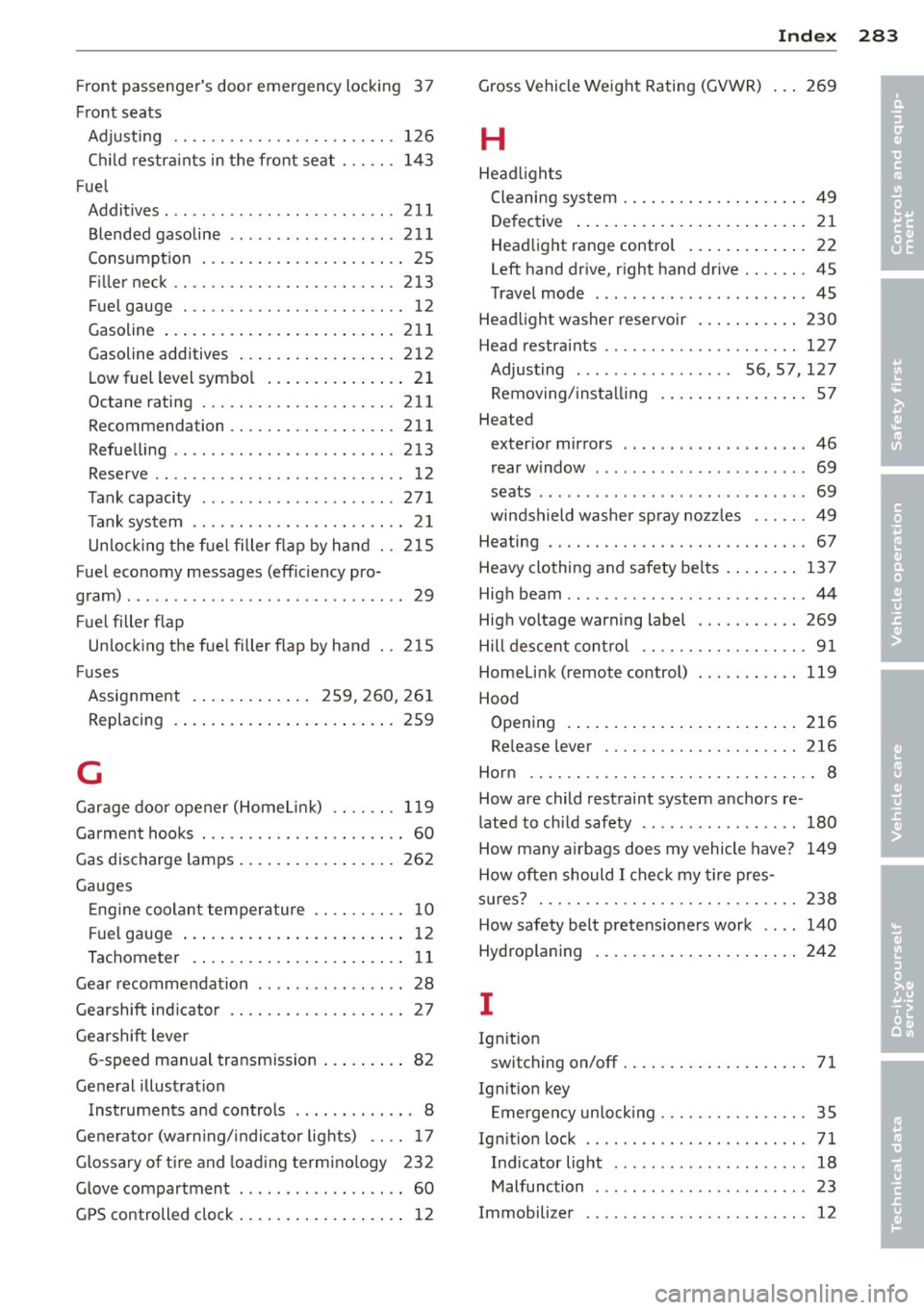
Front passenger's door emergency locking 3 7
Front seats Adjusting .. ............. .... .. ... 126
C hi ld restra ints in the front seat . .. .. . 14 3
Fue l
Addit ives . ..... ........... ... ... .. 211
Blended gasoline .............. .... 211
Consumpt ion . . . . . . . . . . . . . . . . . . . . . . 25
Fill er ne ck .. .. ........... .. .. .. ... 2 13
Fu el gauge . ............. .. .. .. .. .. 12
Gasoline ... .... ...... ... .. .. .. ... 211
Gasoline additives ..... ... .. .. .. .. . 2 12
L ow fuel level symbo l . . . . . . . . . . . . . . . 21
Octane rating ............ .... .. .. . 211
Recommendation . . . . . . . . . . . . . . . . . . 211
Refue lling ..... ........... ... ... .. 213
Reserve .. ..... ........... ... ... ... 1 2
Tank capacity ............... ... ... 271
Tank system ............. .... .. .. .. 2 1
Un loc king the f ue l filler fl ap by hand . . 215
Fuel economy messages (eff iciency pro-
gram) ..... ... ...... ............. ... 29
F ue l filler flap
Unlock ing the fue l filler f lap by hand 215
F uses
Assignment . . . . . . . . . . . . . 2 59 , 26 0, 26 1
Replacing . ... .... .... ... .. .. .. ... 259
G
Garage door opener (Home Link) .. .. .. . 119
Garment hooks . . . . . . . . . . . . . . . . . . . . . . 60
Gas discharge lamps ..... ... .. .. .. .. . 262
Gauges Eng ine coolan t temper ature .. .. .. .. .. 10
Fu el gauge ... .. .. .... ... .. .. .... .. 12
Tac hometer . . . . . . . . . . . . . . . . . . . . . . . 11
Gea r recommendat ion . . . . . . . . . . . . . . . . 28
Gearshift ind icator ......... .. .. .. .. .. 27
Gea rshift lever
6 -speed manual transmission ... .. .. .. 82
Ge ne ral illustra tion
I nstruments and controls . . . . . . . . . . . . . 8
Generator (warn ing/indicator lights) .. .. 17
Glossa ry o f tir e and load ing te rm ino logy 232
Glove compartment . . . . . . . . . . . . . . . . . . 60
GPS controlled clock ..... ... .. .. .. .. .. 1 2
Inde x 283
Gross Vehicle Weight Rating (GVW R) ... 269
H
Head lights
C leaning sys tem . ... .. .. ...... ... .. . 49
De fective . . . . . . . . . . . . . . . . . . . . . . . . . 21
Head light range control ..... ... .. .. . 22
Left hand drive, r ight hand drive .. .. .. . 4S
Travel mode . . . . . . . . . . . . . . . . . . . . . . . 45
Head light washer rese rvoir .... ... .. .. 2 30
Head restraints .. .. .. ... ....... .... . 127
Adjusting ....... .. ........ 56, 57, 127
Remov ing/ instal ling .. ......... .. .. . 57
Heated exter ior mirro rs .. .... ... .... .... .. . 46
r ear w indow ..... .. ..... ........... 69
seats ........ ... .. ..... ........... 69
windshield washer sp ray no zzles . .. .. . 49
Heating ...... .. ...... ............. . 67
Heavy clothing and safety be lts . ... .. .. 137
Hig h beam .. .. .. .. .. . .. .... .... .. .. . 44
Hig h voltage warning label ......... .. 269
Hill des cent con tro l .. .. ......... .. .. . 91
Homelink (remote control)
Hood 119
Opening . ... .. .... . ... ...... ... .. 216
Re lease lever .. .. ............. .... 216
Horn ...... .. .. .. ................... 8
How are child rest raint system anchors re -
lated to ch ild safety .. .. .. ...... .... . 180
How many a irbags does my vehicle have? 149
How ofte n should I che ck my tire pres -
s ur es? ..... .. .. .. ... ............ .. 238
How safety belt pretens ioners work .... 140
Hydrop laning ..... ... .. .. ..... ... .. 242
I
Ign it ion
switching on/off .. .. . ... ...... ... .. . 71
Ig nition key
E mergen cy un lo ck ing ........... .. .. . 35
Ig nition lock .. .. .. .. ............... . 71
Ind icator light ... .. . .. .... .... .. .. . 18
Malfunction . . . . . . . . . . . . . . . . . . . . . . . 23
Immobilizer . . . . . . . . . . . . . . . . . . . . . . . . 12
•
•
Page 286 of 294
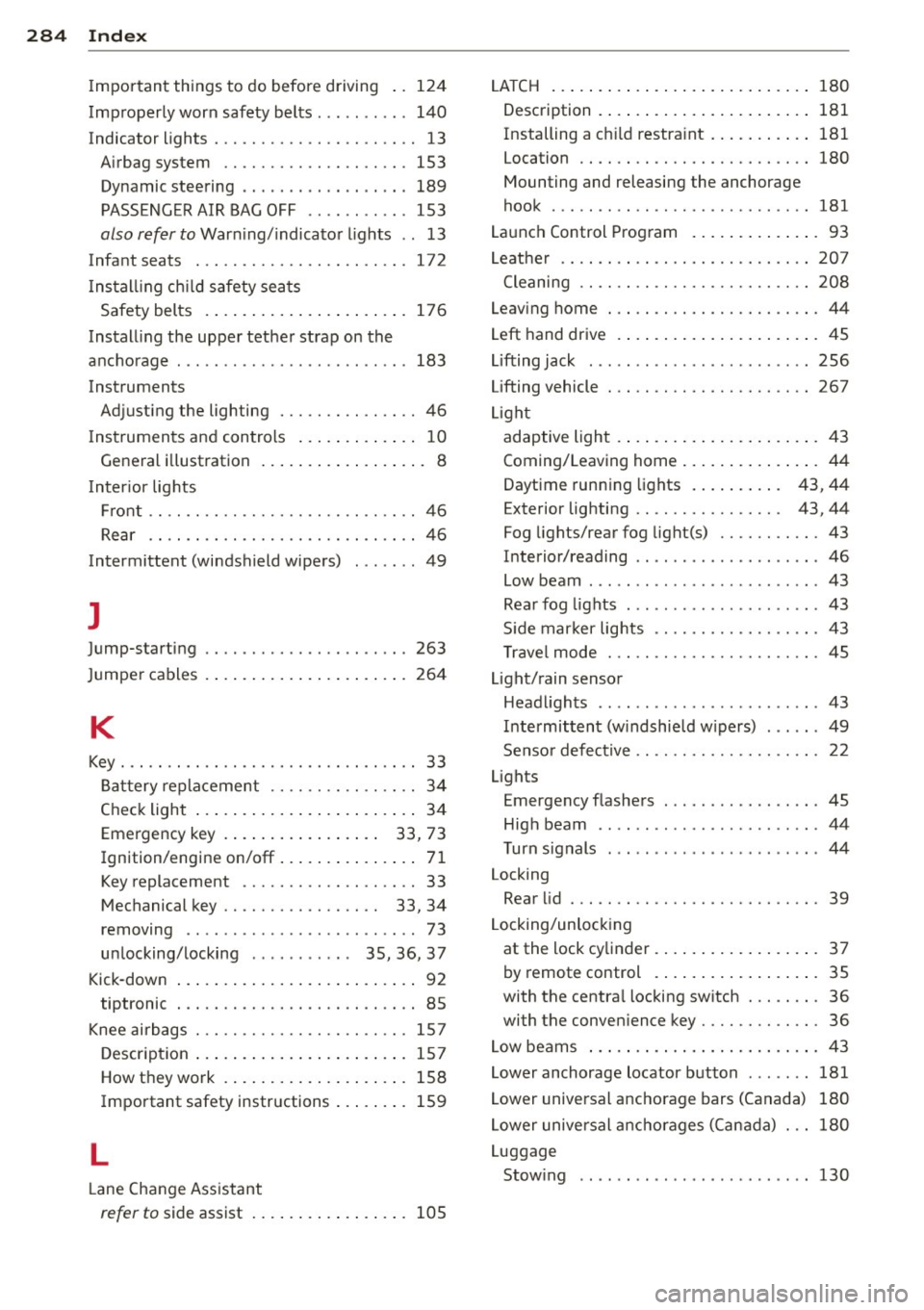
284 Index
Important things to do before driving .. 124
Improperly worn safety belts ..... .. ... 140
Indicator lights ............ .. .. .. .. .. 13
Airbag system ............. .. .... . 153
Dynamic steering ...... ... .. .. .. .. . 189
PASSENGER AIR BAG OFF ........ .. . 153
also refer to Warn ing/ indicator l ights .. 13
Infant seats ... ............. .. .... . 172
I nstall ing child safety seats
Safety belts ..... ....... ... .. .... . 176
Installing the upper tethe r strap on the
anchorage . .. ................ ... .. . 183
Instruments Adjusting the lighting ..... .. .. .. .. .. 46
I nstruments and controls ............. 10
General illustration ........ ..... .. ... 8
I nter ior lights
Fr ont .. .. .. .. . .......... .. .. .. .. .. 46
Rear .. .. .... ............. .. .... .. 46
Intermittent (windshield wipers) . .. .... 49
l
Jump- starting 263
Jumper cables . ............... ..... . 264
K
Key ... .. .. .. ............. .... .... .. 33
Battery replacement . . . . . . . . . . . . . . . . 34
Check light . . . . . . . . . . . . . . . . . . . . . . . . 34
Emergency key . . . . . . . . . . . . . . . . . 33, 73
Ignition/engine on/off . . . . . . . . . . . . . . . 71
Key replacement ........... .. .... .. 33
Mechanical key . . . . . . . . . . . . . . . . . 33, 34
removing . . . . . . . . . . . . . . . . . . . . . . . . . 73
unlocking/locking . . . . . . . . . . . 3S, 36, 37
Kick-down . . . . . . . . . . . . . . . . . . . . . . . . . . 92
tiptronic . . . . . . . . . . . . . . . . . . . . . . . . . . 85
Knee airbags .... .......... .. .. .. .. . 157
Description ................. ..... . 157
How they work .............. ..... . 158
Important safety instructions . . . . . . . . 159
L
Lane Change Assistant
refer to side assist ......... ... .... . 105 LATCH .....
.... .. ............. .... 180
Description . ..... ................ . 181
Installing a ch ild restra int ........ ... 181
Location .. .... .. ............. .... 180
Mounting and releasing the anchorage
hook ........ ... ................ . 181
Launch Control Program ......... .. .. . 93
Leather .. .. .. .. .. ... .......... .. .. 207
Cleaning .. .... .. ............. .... 208
Leaving home ... .. ... .......... .... . 44
Left hand drive .... ................ .. 45
Lifting jack ..... .. .......... ...... . 256
Lifting vehicle ... .. ... .......... .... 267
Light adaptive light .... ................ .. 43
Coming/Leaving home ............... 44
Daytime running lights . . . . . . . . . . 43, 44
Exterior lighting . . . . . . . . . . . . . . . . 43, 44
Fog lights/rear fog lig ht(s) . . . . . . . . . . . 43
I nterior/reading .. ..... ........... .. 46
Low beam ..... .. ..... ........... .. 43
Rear fog lights . .. ................ .. 43
S ide marker lights ... .......... .. .. . 43
T rave l mode . .. .. ............. .. .. . 45
Light/rain sensor Headlights .. .. .. .......... ...... .. 43
Intermittent (w indshield w ipers) ..... . 49
Sensor defective .. ... .......... .. .. . 22
Lights Emergency flashers . . . . . . . . . . . . . . . . . 45
High beam ...... ................ .. 44
Turn signals . .. .. ..... ........... .. 44
Locking Rear lid . . . . . . . . . . . . . . . . . . . . . . . . . . . 39
Locking/unlocking at the lock cylinder ................ .. 3 7
by remote control ............. ..... 35
with the centra l locking switch . .. .. .. . 36
with the convenience key ........ .. .. . 36
Low beams ..... .. ................ .. 43
Lower anchorage locator button ....... 181
Lower universal anchorage bars (Canada) 180
Lower universal anchorages (Canada) ... 180
Luggage Stow ing ...... .. .......... ...... . 130