air condition AUDI A5 COUPE 2014 User Guide
[x] Cancel search | Manufacturer: AUDI, Model Year: 2014, Model line: A5 COUPE, Model: AUDI A5 COUPE 2014Pages: 286, PDF Size: 70.99 MB
Page 182 of 286
180 Intellige nt tec hno logy
Intelligent technology
Notice about data
recorded by veh ic le
control modules
Your vehicle is not equipped with an Event Da
ta Recorder (EDR), installed by some manu
facturers fo r the express purpose of capturing
data for retrieval after an accident or crash
event . EDR's are sometimes called "crash re
corders".
Some state laws restrict the retrieval or down
loading of data stored by EDR's that were in
stalled in a vehicle for the express purpose of
retrieving data after an accident or crash
event without the owner's consent.
A lthough your vehicle is not equipped with an
EDR, it is equipped with a number of electron
ic control modules for various vehicle systems
such as, for example, engine function, emis
sion control, as well as for the airbags and
safety belts.
These electronic control modules also record
vehicle-related data during normal vehicle op
eration for diagnostic and repair purposes.
The recording capacity of the electronic con
trol modules is limited to data (no sound is re
corded) and only a small amount of data is ac
tually recorded over a very limited period of
time and stored when a system fault or other
condition is sensed by a control unit. Some of
the data then stored may relate to vehicle
speed, direction, braking as well as restraint
system use and performance in the event of a
crash or other condition. Stored data can only
be read and downloaded with special equip
ment.
Electronic Stab ilization
Control (ESC)
Description
ESC helps to improve road holding and vehicle
dynamics to help reduce the probability of
skidding and loss of vehicle control. It works
only when the engine is running. ESC detects certain difficult driving situations, including
when the vehicle is beginning to spin (yaw)
out of control and helps you to get the vehicle back under control by selectively braking the
wheels, and/or reducing engine power and
providing steering assistance to help hold the
vehicle on the driver's intended course. The in
dicator light
J.i) in the instrument cluster
blinks when ESC is taking action to help you
control the vehicle.
ESC has limitations.
It is important to remem
ber that ESC cannot overcome the laws of
physics. It will not always be able to help out
under a ll cond itions you may come up against.
For example, ESC may not always be able to
help you master situations where there is a
sudden change in the coefficient of friction of
the road surface. When there is a section of dry road that is suddenly covered with water,
slush or snow, ESC cannot perform the same
way it would on the dry surface . If the vehicle
hydroplanes (rides on a cushion of water in
stead of the road surface), ESC will not be
able to help you steer the vehicle because con
tact with the pavement has been interrupted
and the vehicle cannot be braked or steered.
During fast cornering, particularly on winding
roads, ESC cannot always deal as effectively
with difficult driving situations than at lower
speeds. When towing a trailer, ESC is not able
to help you regain control as it would if you
were not towing a trailer.
Always adjust your speed and driving style to road, traffic and weather conditions. ESC can
not override the vehicle's physical limits, in
crease the available traction, or keep a vehicle
on the road if road departure is a result of
driver inattent ion. Instead, ESC improves the
possibility of keeping the vehicle under con
trol and on the road during extreme maneu
vers by using the driver's steering inputs to
help keep the vehicle going in the intended di
rection . If you are traveling at a speed that
causes you to run off the road before ESC can
provide any assistance, you may not experi
ence the benefits of ESC.
Page 192 of 286
190 Driving and en vironm ent
- Have your vehicle main tained properly
and in accordance with the service rec
ommendations in your Warranty
&
Ma intenance booklet.
- Lack of proper maintenance as well as
improper use of the vehicle will impair
the function of the emission control
system and cou ld lead to damage.
@ For the sake of the environment
Even when the Emission Contro l System is
operating properly, the exhaust gas can have a sulfur-like exhaust gas smell under
some operating states. This depends on
the sulfur content of the fuel being used.
Using a different brand of fuel may help,
or filling the tank w it h lead-free super
grade gasoline.
Shutting down vehicle
If you wou ld like your veh icle to remain inop
e rat ive for a longer period of time, con tact an
Aud i or other specialized dealer. They can ad
vise you on necessary precautions e .g. corro
sion prevention, maintenance and storage. Pay attention to add itiona l information con
cerning the battery. Refer to
c:> page 217.
Operate your vehicle
economically and minimize pollution
General
Your personal style of driving will determine
the economy of your vehicle, as well as ex
haust and noise levels .
Fuel economy, environmental impact, and
wear on your engine, brakes and t ires largely
depend on three factors:
- yo ur persona l dr iving style
- operating conditions
- tec hnic al lim itations
If you anticipate what you need to do next and
d rive economically, you can eas ily cut your
f u el cons umption by 10 -15 pe rcen t. T his sec- t
ion w ill give you some tips on how you can
help the environment and your pocketbook .
(D Tips
The cons umption estima tes as published
by ENVIRONME NTAL PROTEC TION AGENCY
(EPA) and Transport Canada may not corre
spond to your actual consumption on the road, which will va ry depending upon vehi
cle load and speed, road and weather con
dit ions, trip length, etc.
Drive smoothly and keep a lookout
ahead
Vehicles use the most fuel when they are ac
celerating .
.. Avo id u nnecessary accelerating and brak ing.
Vehicles use the most fue l when they are ac
ce lerat ing. If you ant icipate what is going to
happen next, you wi ll need to brake less and,
t h us, acce lerate less . Let the veh icle coast
whenever possible -for example when you see
that the next t raff ic light is red.
Avoid full throttle
Driving at moderate speeds saves fuel and
improves your mileage.
.. Try and keep well below your car's maximum
speed.
Acce lerat ing gently red uces fue l cons ump
t ion, eng ine wear, and does not disturb the
environment .
Fuel consumption, exhaust emissions and en
gine noise increase disproportionate ly at h igh
speeds. If you drive at approximately three quarters of top speed, fuel consumption w ill
be reduced by one half. Never drive faster
than the posted speed limit and weathe r con
ditions pe rm it.
Page 193 of 286
Reducing unnecessary idling
Even when your car is just idling it burns up
fuel.
11-Shut the engine off when you are not driving
the vehicle.
11-Do not warm up the vehicle by letting the
engine run at idle .
It makes sense to shut
off the engine in traffic
jams, when waiting for trains to pass at rail road cross ings, or at traffic lights that have
long wa its on red. Turning the engine
off for
just 30-40 seconds saves more fue l than is
burned s tarting the eng ine again.
It takes a long time for the engine to warm up
fully when it is running at idle . However, wear
and nox ious em issions are especially high
when the engine is warming up. So you should
drive away as soon as you start the engine and
avoid running at high rpms while the engine is
still warming up .
(D Note
Do not leave engine idling unattended af
ter starting . If warning lights should come
on to indicate improper operation, they
wou ld go unheeded. Extended idling also
produces heat, which cou ld result in over
heating or other damage to the vehicle or
other property .
Regular maintenance
A badly tuned engine unnecessarily wastes a lot of fuel .
11-Have your vehicle serviced at regular inter-
vals.
By having your vehicle regular ly serviced by an
authorized Audi dealer he lps to ensure that it
runs properly and economically. The condition
of your vehicle not only affects its safety and
ab ility to hold its value, it also affects fuel
co nsumpt ion .
Ch eck you r oil each time you fill you r ta nk .
Dri vin g and en vironm ent 191
The amount of oi l used is re lated to engine
load and speed.
It i s normal for the oil consumption of a new
engine to reach its lowest value after a certa in
mileage has been driven.
You must drive your veh icle about 3,000 m iles
(S,000 kilometers) before yo u can properly
assess oil consumpt ion.
Th is also app lies to fue l consumption and en
gine output.
(D Note
- Have your veh icle ma inta ined properly
and in accordance with the service rec
ommendations in your Wa rranty
& Ma in
t enance book let. Lack of p roper mainte
nance as well as improper use of the ve
hicle will impair the function of the
emission cont ro l system and could lead
to damage.
- Do not alter or remove any component of
the Emission Control System unless ap
proved by the manufacturer.
- Do not alter or remove any device, such
as heat shie lds, switches, ignition wires,
valves, which are designed to protect
your vehicle's Emission Control System and other important vehicle compo
nents.
Fewer short trips
Fuel consumption will always be relatively
high on short trips .
11-Try to avoid driving short distances w ith a
cold engine.
T he engine and cata lytic converter have to
reach their optimal opera ting temp era ture to
reduce fuel consumpt ion and noxious em is
s ions effectively .
Just after starting, a co ld engine in a mid-size
car on ly achieves a fuel economy of 6-8 mi les
per gallon (30-40 l/100 km). After about a
half a mile, fuel economy climbs to 12 mpg
(20 l/100 km). After about
2 .5 miles (4 km), liJI,
•
•
Page 196 of 286
194 Trailer towing
Tire pre ss ure
When towing a trai le r, inflate the t ires of your
vehicle to the co ld tire pressure listed under
"Full load" on the label located on the driver 's
side B-pillar (visible when the door is open).
Inflate trailer tires to trailer and tire manufac
turers' specifications.
Light s
The headlight settings should be checked with
the trailer attached before dr iving off. Check
to make sure both vehicle and tra iler lights
are working properly.
Saf ety chains
Be sure tra iler sa fe ty cha ins a re p roperly con
nected from the trailer to the hitch on the ve
hicle. Leave eno ugh slack in the chains to per
mit turning corners. When you install safety
cha ins, make sure they w ill not drag on the
road when you are driving.
The chains shou ld cross under the trai ler
tongue to prevent it from dropping in case of
separation from the hitch.
Driving instructions
Driving with a trailer always requires extra
care and consideration.
To obtain the best possible handling o f vehicle
and trai ler, p lease note the following:
.,. Do no t tow a lo aded tra ile r when your car it
self is no t loaded .
.,. Be especia lly carefu l when passing other
vehicles .
.,. Observe speed lim its .
.,. Do not drive at the maximum permissible
speed.
.,. Always apply brakes early.
.,. Monitor the temperature gauge.
Weight di stribution
Towing a loaded trai ler with an empty car re
sults in a highly unstable distribution of
weight . If this cannot be avo ided, drive at very
low speeds only to avoid the risk of losing
steering control. A "ba
lanced" rig is easier to operate and con
tro l. This means that the tow vehicle should
be loaded to the extent possible and permissi
ble, while keep ing the trai ler as light as possi
ble under the c ircumstances. Whenever poss i
ble, transfer some ca rgo to the luggage com
partment of the tow veh icle while obse rv ing
tongue load requ irements and vehicle load ing
co nsiderations.
Speed
The higher the speed, the more d iff icu lt it be
comes for the driver to control the rig. Do not
drive at the maximum permissible speed. Re
duce your speed even more if load, weather or
wind conditions are unfavorable -pa rtic ularly
whe n goi ng downhill.
Reduce veh icle speed
imm ediately if the trail
er shows the slightest s ign of sway ing.
Do not
try t o sto p th e swaying by a ccelerating .
Observe speed limits . In some areas, speeds
fo r vehicles tow ing tra ile rs a re lower than for
regular veh icles .
Always apply brakes early. When driving downh ill, shift into a lower gear to use the en
gine braking effect to slow the vehicle . U se of
the b rakes alone can cause them to overheat
and fail.
Coolant tempe rature
The coo lant temperature gauge c> page 10
must be observed carefu lly. If the need le
moves close to the upper end of the scale, re
duce speed immediately and/or turn off the
air condi tioner.
If the coolant temperature warning light •
i n t he i nstrument cluster starts flashing, pull
off the road, stop and let the engine
idle for
abo ut two min utes to prevent heat build-up .
_& WARNING
Anyone not proper ly restra ined in a mov
i ng vehicle is a t a much greater risk in an
accident . Never let anyone ride in yo ur car
who is not p roper ly wea ring the rest raints
prov ided by A udi.
-
Page 201 of 286
Vehicle care and cleaning 199
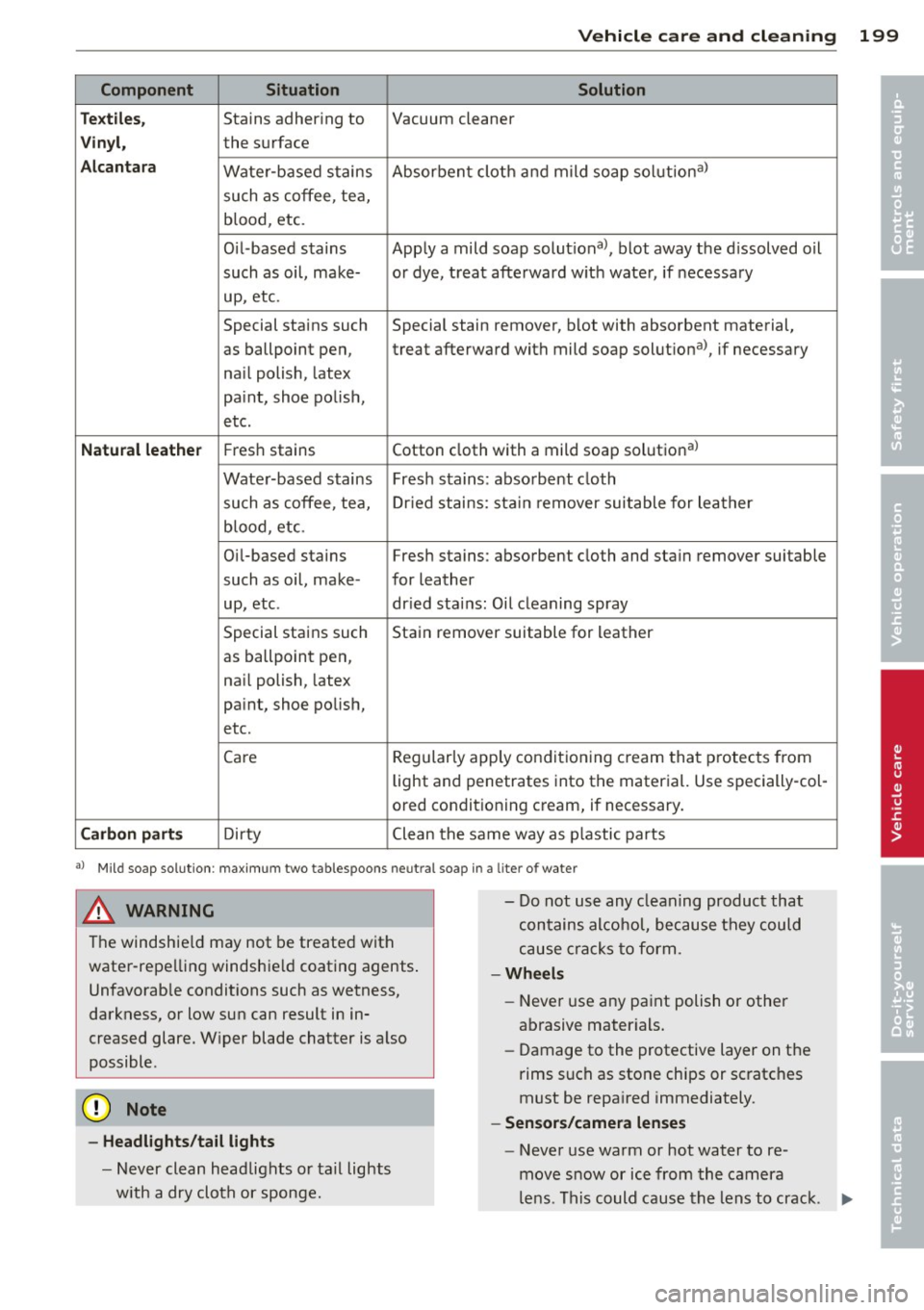
Component Situation Solution
Te xtile s,
Stains adhering to Vacuum cleaner
Vinyl, the surface
Alcantara Water-based stains Absorbent cloth and mild soap solutiona>
such as coffee, tea, blood, etc.
Oil-based stains Apply a mild soap solutiona>, blot away the d issolved oil
such as oil, make- or dye, treat afterward w ith water, if necessary
up, etc.
Special stains such Special stain remover, blot with absorbent material,
as ballpoint pen, treat afterward with mild soap solutiona>, if necessary
na il polish, latex
pa int, shoe polish,
etc.
Natural leather Fr es h stains Cotton cloth with a mild soap solutiona)
Water-based stains Fresh sta ins: absorbent cloth
such as coffee, tea, Dr ied stains: sta in remover suitable for leather
blood, etc.
Oil-based stains Fresh sta ins: absorbent cloth and stain remover suitable
such as oil, make- for leather
up, etc . dried sta ins: Oil cleaning spray
Special stains such Stain remover suitable for leather
as ballpo int pen,
na il polish, latex
pa int, shoe polish,
etc .
Care Regularly
apply conditioning cream that protects from
light and penetrates into the material. Use specially-col-
ored conditioning cream, if necessary.
Carbon parts Dirty Clean the same way as plastic parts
al Mild soap solution: maximum two tablespoons neut ral soap in a liter of water
& WARNING
The windshie ld may not be treated with
water-repelling windshie ld coating agents .
Unfavorab le conditions such as wetness,
darkness, or low sun can result in in
creased glare. W iper blade chatter is also
possible.
- Headlights/tail lights
- Never clean headlights or tail lights
w ith a dry cloth or sponge. -
Do not use any cleaning product that
contains alcohol, because they could
cause cracks to form .
-Wheels
-Never use any paint polish or other
abrasive mater ials.
- Damage to the protective layer on the
rims such as stone chips or scratches
must be repaired immediately.
- Sensors/camera lenses
- Never use warm or hot water to re-
move snow or ice from the camera
len s. This could cause the lens to crack .
IJII>
•
•
Page 211 of 286
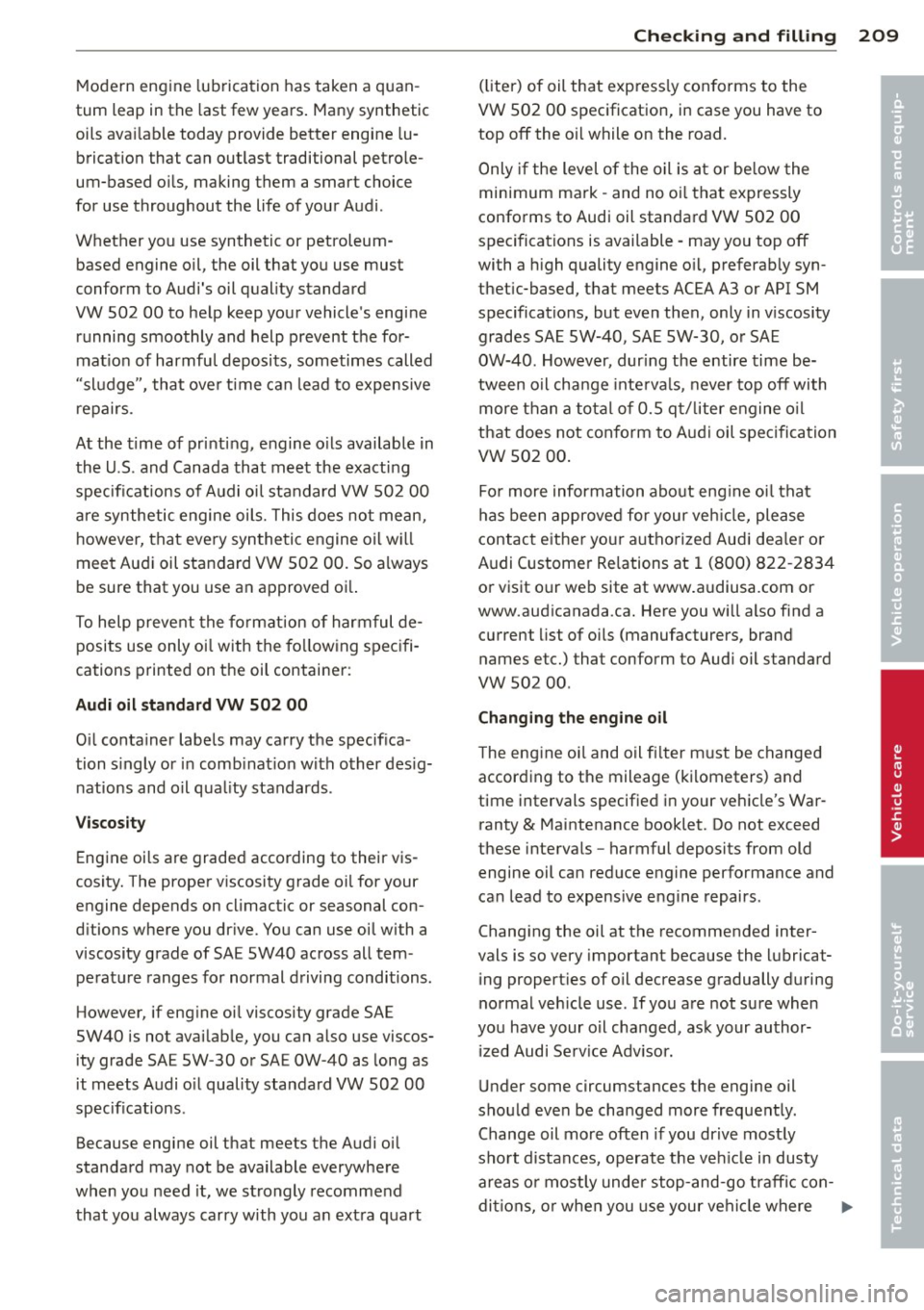
Modern eng ine lubrication has taken a quan
tum leap in the last few years . Many synt hetic
oils ava ilable today provide better engine lu
brication that can outlast traditional petrole
um-based o ils, making them a smart choice
for use throughout the life of your Audi.
Whether you use synthetic or petroleum based engine oil, the oil that you use must
conform to Audi's oil quality standard
VW 502 00 to help keep your vehicle's engine running smoothly and help prevent the for
mat ion of harmfu l deposits, sometimes called
"sludge", that ove r time can lead to expensive
r epairs.
At the t ime of pri nting, engine o ils available in
the U.S . and Canada that meet the exacting
specifications of Audi oi l standard VW 502 00
are synthetic engine oils. This does not mean, h owever, that every synthetic engine oil w ill
meet Audi oil standard VW 502 00. So always
be sure that you use an approved oi l.
To help preve nt the format ion of harmful de
posits use only oi l with the fo llowing spec ifi
cations printed on the oil container:
Audi oil standard VW 502 00
O il conta iner labels may carry the specif ica
tion s ingly or in comb inat ion w ith other des ig
nations and oil qua lity standards.
Viscos ity
Engine oi ls are graded according to their vis
cosity. The proper v iscosity grade oi l for your
engine depends on cl imactic or seasonal con
d itions where you dr ive. You can use oil with a
viscosity grade of SAE SW40 across all tem
pe rature ranges for normal d riving conditions .
However, if eng ine oi l viscosity grade SAE
SW40 is not avai lab le, you can also use viscos
ity grade SAE SW-30 or SAE OW-40 as long as
it meets Audi o il quality standard VW 502 00
specifications.
Because engine oil that meets the Audi oil
standard may not be available everywhere
when you need it, we st rongly recomme nd
that you always carry with you a n ext ra quart
Checkin g and fillin g 209
(li ter) of oil that exp ress ly con forms to the
VW 502 00 specificatio n, in case you have to
top
off the o il while on the road.
Only if the level of the o il is at or be low the
minimum mark -and no oi l that expressly
confo rms to Audi oil standard VW 502 00
spec ifications is available -may you top
off
with a h igh quality engine o il, preferab ly syn
thet ic-based, that meets ACEA A3 or API SM
spec ifications, but even then, only in v iscosity
grades SAE SW-40, SA E SW-30, o r SAE
OW- 40. However, dur ing the entire time be
tween o il cha nge inte rva ls, never top
off with
more than a tota l of 0. 5 q t/liter engine o il
that does not con form to A udi oil specification
vw 502 00.
Fo r more information abo ut eng ine oi l tha t
has been approved for your veh icle, ple ase
contac t eit h er yo ur autho rized Aud i dea le r or
Audi C ustomer Re lations at 1 (800) 822 -2834
or visit our web site at www .a u diusa.com or
www.aud icanada.ca. Here you w ill also find a
current list of oils (manufacturers, brand
names etc.) that conform to Audi oil standard
vw 502 00.
Changing the engine oil
T he eng ine oi l and o il f ilter m ust be changed
according to the mileage (kilometers) and
time intervals specified i n your ve hicle's War
ranty
& Maintenance booklet. Do not exceed
these interva ls - harmful deposits from old
engine oil can reduce engine performance and
can lead to expensive engine repairs.
Changi ng the oil at the recommended inter
vals is so very important beca use the lubricat
ing propert ies of oil decrease gradually during
norma l veh icle use. If you a re not sure when
yo u have your o il cha nged, ask your author
ized Audi Se rv ice Adv isor.
Under some circumstances the engine oil
shou ld eve n be changed more frequent ly.
Change oil more often if you dr ive most ly
sho rt distances, operate the ve hicle in dusty
areas o r most ly under stop-and -go traff ic con-
di tions, o r when you use your vehi cle where .,..
•
•
Page 215 of 286
Engine cooling system
Coolant
The engine coolant performs two functions: it
keeps the engine from overheating and it pro tects the engine from freezing in the winter .
The cooling system is sealed and generally re
quires little attention.
The cooling system has been filled at the fac
tory with a permanent coolant which does not
need to be changed. The coolant consists of a
mixture of specially conditioned water and the
manufacturer's glycol-based coolant addi-
tive G13 antifreeze with anticorrosion addi tives (50% for USA models; 60% for Canadian models). This mixture both assures the neces
sary frost protection and protects metal com
ponents in the engine's cooling system from
corrosion and scaling.
It also raises the boil
ing point of the coolant.
Do not reduce the concentration of the cool
ant in the summer by adding plain water.
The
proportion of coolant additive must be at
least 50% but not more than 60%
to main
tain antifreeze protection and cooling efficien
cy. If the coolant frost protection is too low,
the coolant could freeze and damage the vehi cle heating and engine cooling system.
For year-round driving, antifreeze is added at
the factory for temperatures down to:
- -31°F(-35°C)USA
- -40 °F ( - 40 °C) Canada.
If you must add coolant, use a mixture of wa
ter and coolant additive. Mixing the coolant
additive with distilled water is recommended.
& WARNING
Before you check anything in the engine
compartment, always read and heed all
WARNINGS¢ .&.
in Working in the engine
compartment on page 206.
(D Note
- Before winter sets in, have the coolant
checked to see if the coolant additive in
Checking and filling 213
your vehicle is sufficient to meet the cli
mate conditions. This is especially impor
tant if you live in a region where the win
ter is extremely cold. If necessary, in
crease the proportion of coolant additive
to 60%.
- When adding coolant additive to your
cooling system, remember:
- We recommend using only coolant ad
ditive G12++ or G13 for your vehicle.
This coolant additive is available at au
thorized Audi dealers. Other types of
antifreeze can significantly reduce cor
rosion protection. The resulting corro
sion can cause a loss of coolant and se rious engine damage.
- Do not add any type of radiator leak seal
ant to your vehicle's engine coolant.
Adding radiator repair fluid may adverse
ly affect the function and performance of
your cooling system and could result in
damage not covered by your New Vehicle
Limited Warranty.
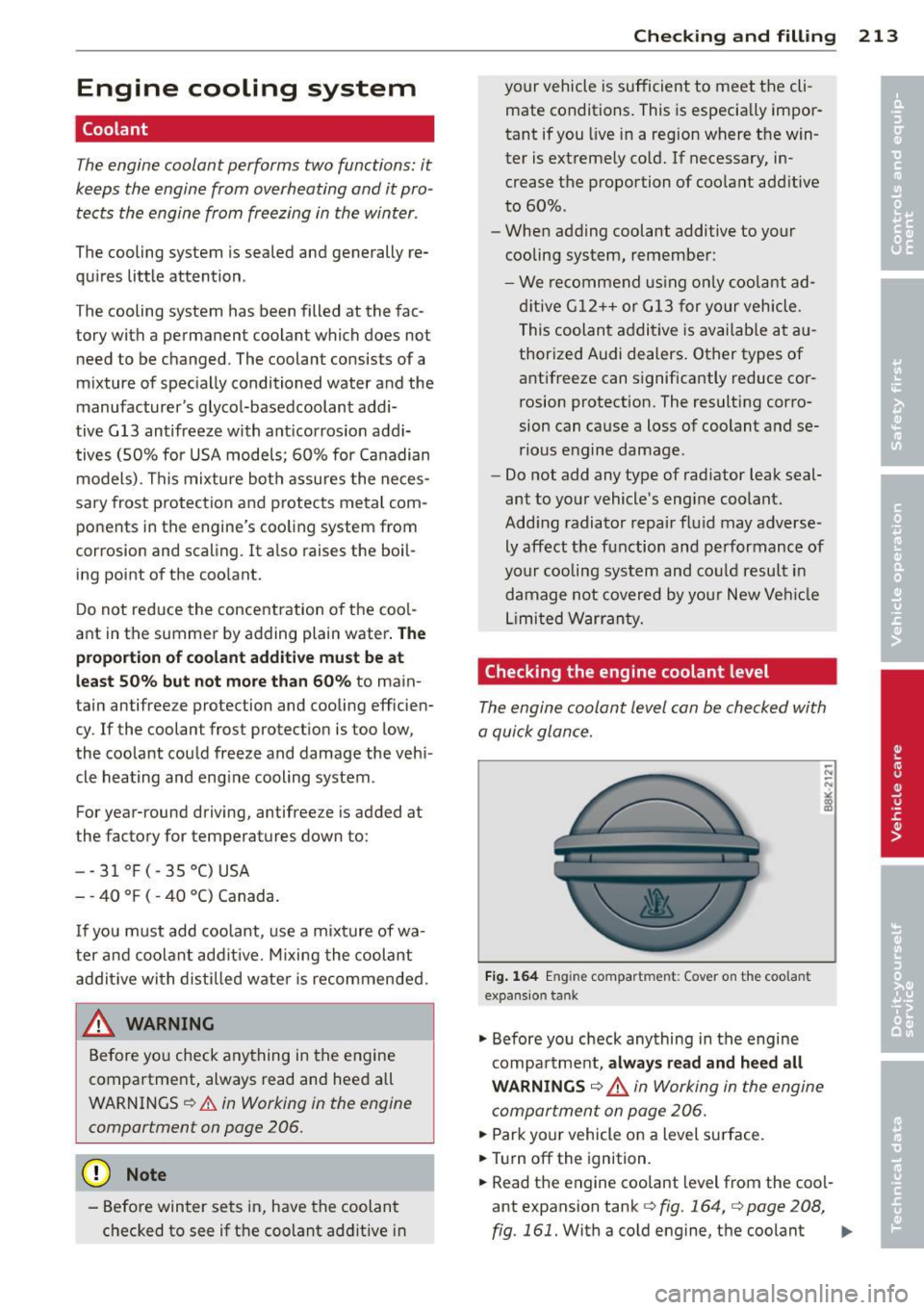
Checking the engine coolant level
The engine coolant level can be checked with
a quick glance.
Fig. 164 Eng ine compartment: Cover on the coolant
expansion tank
"' Before you check anything in the engine
compartment,
always read and heed all
WARNINGS ¢ .&, in Working in the engine
compartment on page 206.
"'Park your vehicle on a level surface .
.,. Turn off the ignition.
.,. Read the engine coolant level from the cool
ant expansion tank ¢
fig. 164, ¢ page 208,
fig. 161.
With a cold engine, the coolant Iii>
Page 217 of 286
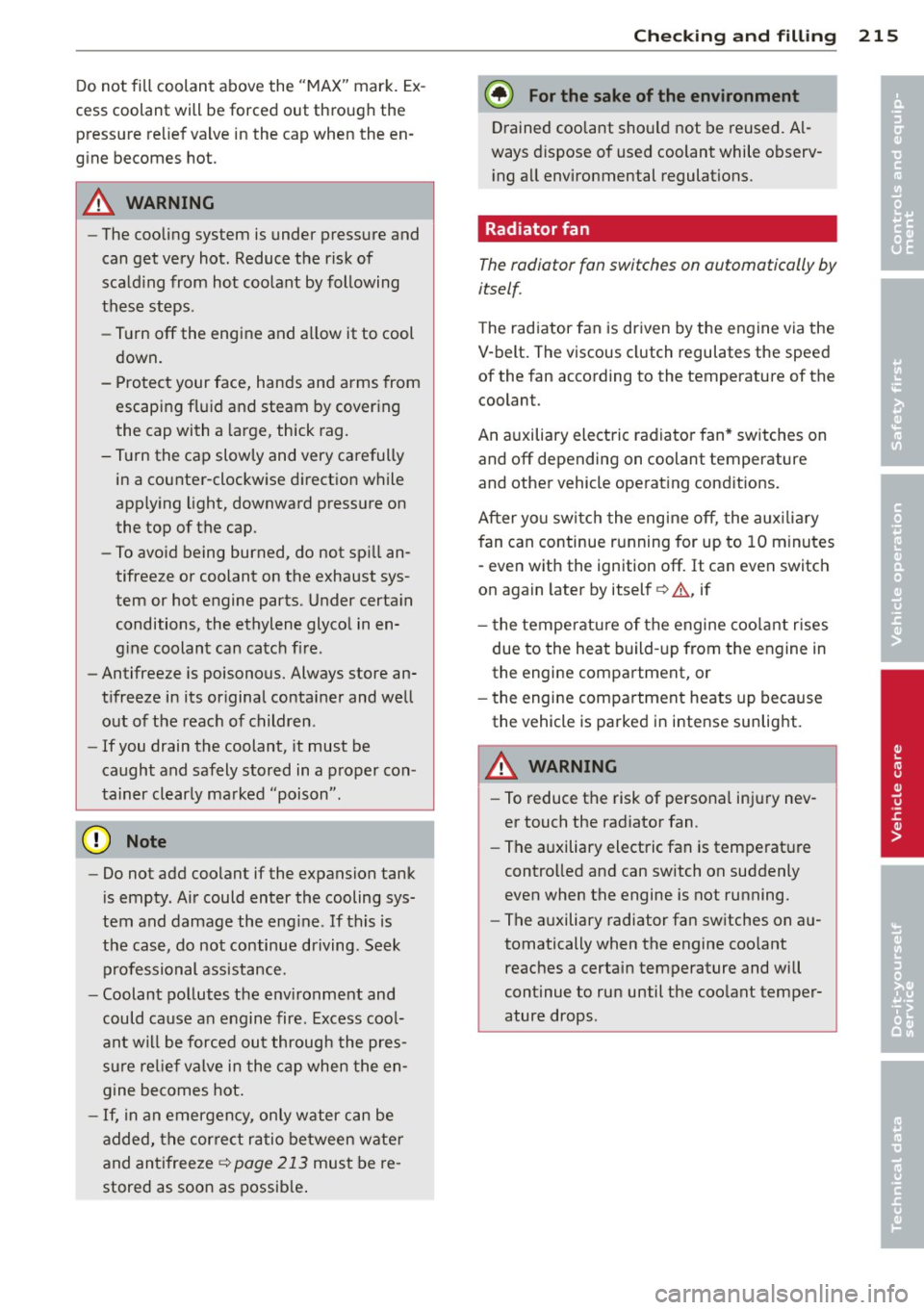
Do not fill coolant above the "MAX" mark. Ex
cess coolant will be forced out through the pressure relief valve in the cap when the en
gine becomes hot .
_& WARNING
-The cooling system is under pressure and
can get very hot. Reduce the risk of
scalding from hot coolant by following
these steps .
- Turn
off the engine and allow itto cool
down.
- Protect your face, hands and arms from escaping fluid and steam by covering
the cap with a large, thick rag.
- Turn the cap slowly and very carefully in a counter-clockwise direction while
applying light, downward pressure on
the top of the cap .
- To avoid being burned, do not spill an
tifreeze or coolant on the exhaust sys
tem or hot engine parts . Under certain
conditions, the ethylene glycol in en
gine coolant can catch fire.
- Antifreeze is poisonous. Always store an
tifreeze in its original container and well
out of the reach of children.
- If you drain the coolant, it must be
caught and safely stored in a proper con
tainer clearly marked "poison".
(D Note
- Do not add coolant if the expansion tank
is empty. Air could enter the cooling sys
tem and damage the engine. If this is
the case, do not continue driving . Seek
professional assistance.
- Coolant pollutes the environment and
could cause an engine fire . Excess cool
ant will be forced out through the pres
sure relief valve in the cap when the en
gine becomes hot.
- If, in an emergency, only water can be
added, the correct ratio between water
and antifreeze
¢ page 213 must be re
stored as soon as possible.
Checking and filling 215
'
@) For the sake of the environment
Drained coolant should not be reused. Al
ways dispose of used coolant while observ
ing all environmental regulations.
Radiator fan
The radiator fan switches on automatically by
itself .
The radiator fan is driven by the engine via the
V-belt. The viscous clutch regulates the speed
of the fan according to the temperature of the coolant.
An auxiliary electric radiator fan* switches on
and
off depending on coolant temperature
and other vehicle operating conditions.
After you switch the engine
off, the auxiliary
fan can continue running for up to 10 minutes
- even with the ignition
off. It can even switch
on again later by itself ¢.&. , if
- the temperature of the engine coolant rises
du e to the h eat build-up from th e engin e in
the engine compartment, or
- the engine compartment heats up because
the vehicle is parked in intense sunlight.
_& WARNING ~
-To reduce the risk of personal injury nev-
er touch the radiator fan .
- The auxiliary electric fan is temperature
controlled and can switch on suddenly
even when the engine is not running.
- The auxiliary radiator fan switches on au
tomatically when the engine coolant reaches a certain temperature and will
continue to run until the coolant temper
ature drops. •
•
Page 219 of 286
@ For the sake of the environment
Because of the pr oblem of proper d isposa l
of brake flu id as we ll as the special tools
requ ired and the necessary expert ise, we
recommend that you have the brake fluid
changed by your author ized Audi dealer .
Battery
General information
Under normal operating conditions, the bat
tery in your Audi does not need any mainte
nance. With
high outside temperatures or
long daily dr ives we recommend that you have
the electro lyte level checked by an authorized
Aud i dealer or qualified workshop . The elec
trolyte leve l should also be checked each time
the battery is charged ¢
page 219.
Have the battery checked when you take your
ve hicle in for service . Yo u are well adv ised to
replace a battery that is older than 5 yea rs .
W ith certa in types of a irbag deployment, t he
b attery is d isconnected from the vehicle elec
tr ica l system for safety reasons¢.&.
in Re
pair, care and disposal of the airbags on
page 150.
Disconnecting the battery terminals
Some vehicle functions (power w indow regu
lators , for example) are lost if the battery ter
m inals a re d isconnected. These func tions have
to be re lea rned after the batte ry term inals a re
connected agai n. T o prevent this , the bat tery
should only be d isconnec ted from the vehicle
e lec tric al system when absolu tely necessa ry
for repairs .
Vehicles not driven for long periods
If you do not drive you r vehicle over a period
of severa l days or weeks, elec trical compo
nen ts are gr adually cut b ack o r swi tched off .
This redu ces energy cons umption and main
tains starting capab ility over a longer per io d
¢ page 186.
Some o f the conven ience f unctions m ay not
ope rate, su ch as the in ter ior lig hts or t he
Checkin g and fillin g 217
power seat adjus tment. The convenience
funct io ns w ill be available again when yo u
turn o n the ign ition and start the engine.
Winter operation
D ur ing the w inte r mon ths, bat tery capa city
tends to dec rease as tempera tures drop . This
is beca use more power is a lso consumed wh ile
starting, and the headlights, rear window de
fogge r, etc., are used more often.
Avoid unnecessary powe r consumpt ion, pa r
ticular ly in city traffic or when traveling only
sho rt distances. Let yo ur authorized A udi
dealer check the capacity of the vehicle bat
tery before w inter sets in
¢ page 219. A well
charged battery will no t on ly prevent star tin g
problems w hen the weather is cold, but w ill
also last longer .
@ Tips
If your vehicle is left standing for seve ral
weeks at extremely low temperatures, the
vehicle battery s hou ld be removed and
stored where it will not freeze . This will
p revent it from be ing damaged and having
to be repla ced .
Working on the battery
Be especially careful when working on or near
the bat tery.
The battery is located in the luggage compar t
ment under the floor . B efo re you che ck any
thi ng in the luggage compartment,
read and
heed all WARNINGS
¢ ,&. .
Always heed the safety warnings , when work
i ng on the veh icle batte ry or t he vehicle e lec
t rical sys tem to p reven t inju ry.
The following WARNINGS are very
important when working on the battery:
Always heed the following WARNING SYM· BO LS and safety precautions when working
on the battery .
®
Always wear eye protection.
•
•
Page 229 of 286
you have stored. The system does not recog
nize the load condition of your vehicle.
The effectiveness of the tire pressu re monitor
ing system* will be impaired if you store nor
mal load pressures but then operate the vehi
cle at its maximum load¢,&.
See the illustration ¢
fig. 168 for the location
of the label on driver's side B-pillar (color of
the actual labe l and exact location on the ve
hicle will vary slig htly) .
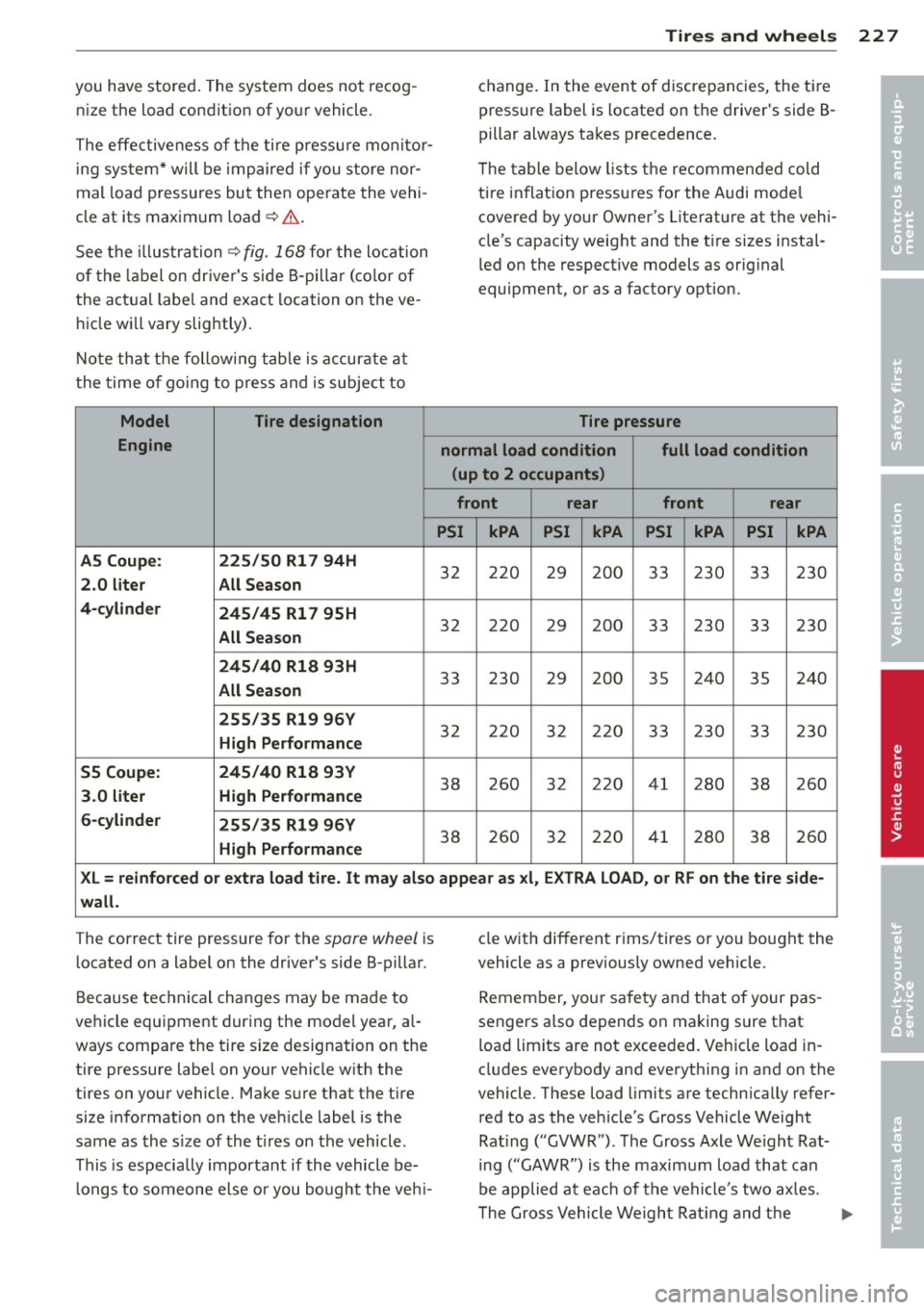
Note that the following table is accurate at
the time of go ing to press and is subject to
Model Tire designation
Engine
AS Coupe: 225/50 Rl 7 94H
2.0 liter All Season
4-cylinder 245/45 R17 95H
All Season
245/40 R18 93H
All Season
255/35 R19 96V High Performance
SS Coupe: 245/40 R18 93V
3.0 liter High Performance
6-cylinder 255/35 R19 96V
High Performance
Tires and wheels 22 7
ch ange. In the event of discrepancies, the tire
pressure label is located on the driver's side B
pillar always takes precedence.
T he table below lists the recommended cold
ti re inflation pressures for the Audi mode l
covered by your Owner's Literature at the vehi
cle's capacity weight and the tir e sizes instal
l ed on the respective models as orig inal
equipment, or as a factory option.
Tire pressure
normal load condition full load condition (up to 2 occupants)
front rear front rear
PSI kPA PSI kPA PSI kPA PSI kPA
32 220 29 200 33 230 33 230
32 220 29 200 33 230 33 230
33 230 29 200 35 240 35 240
32 220 32 220 33 230 33 230
38 260 32 220 41 280
38 260
38 260 32 220 41 280 38 260
•
•
XL= reinfo rced or extra load tire. It may also appear as xl, EXTRA LOAD, or RF on the tire side-
wall.
The correct tire pressure for the spare wheel is
lo cated on a label on the driver's side B-pillar.
Because technical changes may be made to
vehicle equipment during t he model year, al
ways compare the tire size designation on the
tire pressure label on your vehicle w ith the
tires on your vehicle. Make sure that the tire
size information on the veh icle label is the
same as the size of the tires on the vehicle.
This is especially important if the vehicle be
l ongs to someone else or you bought the vehi- cle
with different rims/tires or you bought the
vehicle as a previously owned vehicle.
Remember, your safety and that of your pas
sengers also depends on making sure that
l oad lim its are not exceeded. Vehicle load in
cludes everybody and everything in and on the
vehicle. These load limits are techn ically refer
red to as the veh icle's Gross Vehicle Weight
Rat ing ("GVWR"). The Gross Axle Weight Rat
ing ("GAWR") is the maximum load that can
be applied at each of the vehicle's two axles .
T he Gross Vehicle Weight Rating and the .,,.