brakes AUDI A5 COUPE 2014 Owner's Manual
[x] Cancel search | Manufacturer: AUDI, Model Year: 2014, Model line: A5 COUPE, Model: AUDI A5 COUPE 2014Pages: 286, PDF Size: 70.99 MB
Page 218 of 286
216 Checking and filling
Brake fluid
Checking brake fluid level
The brake fluid level can be checked with a
quick glance .
N N ~ N
" (X) (0
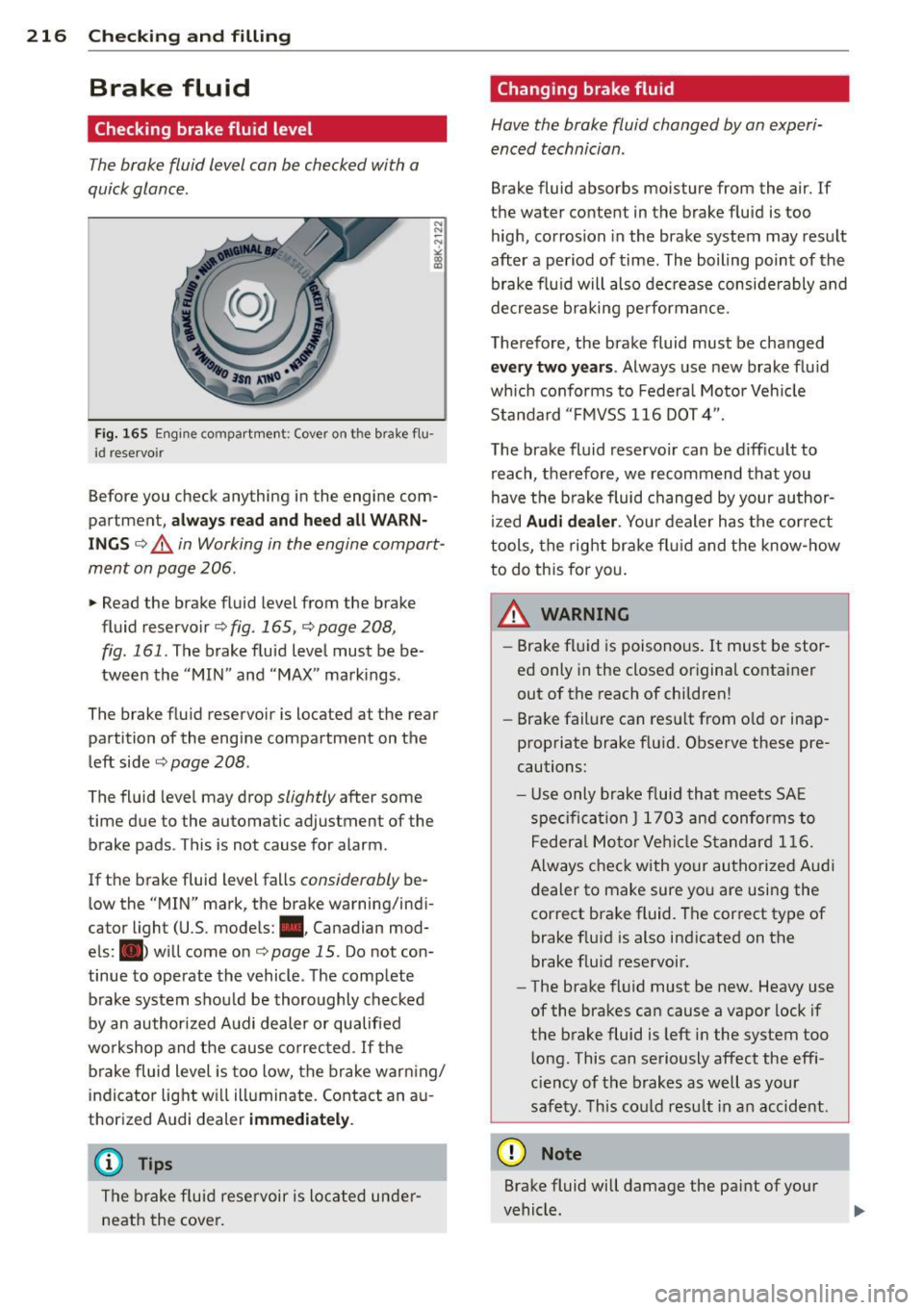
Fig. 165 Engine compartme nt: Cover on the brake flu ·
id reservo ir
Before you check anything in the engine com
partment,
always read and heed all WARN·
INGS ¢ .&._ in Working in the engine compart
ment on page 206 .
.. Read the brake fluid level from the brake
fluid reservoir ¢
fig. 165, ¢ page 208,
fig. 161.
The brake fluid level must be be ·
tween the "MIN" and
"MAX" markings.
The brake fluid reservoir is located at the rear
partition of the engine compartment on the
left side ¢
page 208 .
The fluid level may drop slightly after some
time due to the automatic adjustment of the
brake pads . This is not cause for alarm.
If the brake fluid level falls
considerably be
low the "MIN" mark, the brake warning/indi
cator light (U.S. models: ., Canadian mod
els: .) will come on¢
page 15. Do not con
tinue to operate the vehicle . The complete
brake system should be thoroughly checked
by an authorized Audi dealer or qualified
workshop and the cause corrected.
If the
brake fluid level is too low, the brake warning/
indicator light will illuminate. Contact an au
thorized Audi dealer
immediately .
@ Tips
The brake fluid reservoir is located under
neath the cover.
Changing brake fluid
Have the brake fluid changed by an experi
enced technician .
Brake fluid absorbs moisture from the air. If
t he water content in the brake fluid is too
high, corrosion in the brake system may result
after a period of time . The boiling point of the
brake fluid will also decrease considerably and
decrease braking performance.
Therefore, the brake fluid must be changed
every two years . Always use new brake fluid
which conforms to Federal Motor Vehicle
Standard "FMVSS 116 DOT 4".
The brake fluid reservoir can be difficult to reach, therefore, we recommend that you
have the brake fluid changed by your author
ized
Audi dealer. Your dealer has the correct
tools, the right brake fluid and the know-how
to do this for you .
A WARNING
- Brake fluid is poisonous. It must be stor
ed only in the closed original container
out of the reach of children!
- Brake failure can result from old or inap
propriate brake fluid. Observe these pre
cautions:
- Use only brake fluid that meets SAE
specification
J 1703 and conforms to
Federal Motor Vehicle Standard 116.
Always check with your authorized Audi
dealer to make sure you are using the
correct brake fluid. The correct type of
brake fluid is also indicated on the
brake fluid reservoir.
- The brake fluid must be new. Heavy use
of the brakes can cause a vapor lock if
the brake fluid is left in the system too
long . This can seriously affect the effi
ciency of the brakes as well as your
safety. This could result in an accident.
(D Note
Brake fluid will damage the paint of your
vehicle.
Page 225 of 286
-Never mount used tires on yo ur vehicle if
yo u are not sure of their "previous histo
ry." Old used tires may have been dam
aged even though the damage cannot be
seen that can lead to sudden tire failure
and loss of vehicle control.
- If you notice unusual vibration or if the
vehicle pulls to one side when d riving, al
ways stop as soon as it is safe to do so
and check the wheels and tires for dam
age .
(D Note
-Please note that summer and winter
tires are designed for the cond itions that
are typ ic al in those seasons. Aud i recom
mends using w inter t ires du ring the win-
Glossary of tire and loading terminology
Accessory weight
means the comb ined weight (in excess of
those standard items which may be replaced)
of automatic tra nsmission, power steering,
power brakes, power windows, power seats,
radio, and heater, to the extent that these
items are availab le as factory-installed equip
ment (whether installed or not) .
Aspect ratio
means the ratio of the height to the width of
the tire in percent . Numbers of 55 or lower in
d icate a low sidewall for improved steering re
sponse and better overall handling on dry
pavement .
Bead
means the pa rt of the ti re that is made of
steel wires, wrapped or reinforced by ply cords
and that is shaped to fit the rim.
Bead s eparation
means a b reakdown of the bond between
components in the bead.
Cord
means the strands forming the plies in the
tire.
Tire s an d wheel s 223
ter months . Low temperatu res signifi
cantly decrease the elastic ity of summer
t ires, which affects traction and braking
ability. If summer tires are used in very
co ld temperatures, cracks can form on
the tread bars, res ulting in permanent
ti re damage that can cause loud drivi ng
noise and unbalanced tires. Aud i is not
responsib le for this type of damage.
- Burn ished, polished or chromed rims
must not be used in winter weather. Th e
surfa ce of the rims does not have suffi
c ien t cor rosion pro te cti on for this and
c o ul d be pe rmanen tly damaged by road
salt or similar substances. This damage
is not covered by warranty.
Cold tir e inflation pressure
me ans the t ire press ure re commended by the
vehicle manufacturer fo r a tire o f a des igna ted
size that has not bee n driven for more than a
couple of miles (k ilomete rs) at low speeds in
the three hour pe riod before the tire p ress ure
is measured or adjusted.
Curb weight
means the weight o f a motor vehicle with
standard equipment including the maximum
capacity of fuel, o il, and coolant, air cond i
tion ing and additional weight of optiona l
equipment.
E xtra load tire
means a tire design to operate at higher loads
and at higher inflation pressures than the cor
responding standard tire. Extra load tires may
be identified as "XL", "xl", "EXTRA LOAD", or
"RF" on the sidewall.
Gross Axle Weight Rating ("GAWR")
means the load-carrying capacity of a single
axle system, measured at the tire-ground in-
ter~ces .
~
•
•
Page 226 of 286
224 Tires and wheels
Gross Vehicle Weight Rating ("GVWR" )
means the maximum total loaded weight o f
the vehicle.
Groove
means the space between two adjacent tread
ribs.
Load rating (code)
means the maximum load that a tire is rated
to carry for a given inflat ion pressure. You
may not find this informat ion on all tires be
cause it is not requ ired by law .
Ma ximum load rating
means the load rating for a t ire at the maxi
mum permissible inflation pressure for that
tire .
Maximum loaded vehicle weight
means the sum of:
(a) Curb weight
(b) Accessory weight
(c) Vehicle capacity we ight, and
(d) Production opt ions weight
Maximum (permissible) inflation pressure
means the maximum cold inflation pressure
to which a tire may be inflated . Also called
"maximum inflation pressure."
Normal occupant weight
means 150 lbs. (68 kilog rams) times the
number of occupants seated in the vehicle up
to the tota l seating capacity of your vehicle.
Occupant distribution
means dist ribution of occupants in a veh icle.
Outer diameter
means the overall diameter of an inflated new
tire.
Overall width
means the linear distance between the exteri
ors of the sidewalls of an inflated tire, includ
ing elevations due to labeling, decorations, or
protective bands or ribs .
Ply
means a layer of rubbe r-coated parallel cords.
Production options weight
means the combined weight of those installed
regular production opt ions we ighing over 5
lbs. ( 2.3 kg) in excess of those standa rd items
wh ich they replace, not previously cons idered
in curb weight or accessory weight, including
heavy duty brakes, ride levelers, roof rack,
heavy duty battery, and special tr im.
Radial ply tire
means a pneumat ic tire in which the ply cords
that extend to the beads are laid at substan
tially 90 deg rees to the center line of the
tread.
Recommended inflation pressure
see c:::> page 223, Cold tire inflation pressure .
Reinforced tire
means a tire design to operate at higher loads
and at higher inflation pressures than the cor
responding standard tire. Reinforced tires
may be identified as "XL", "xl", "EXTRA LOAD",
or "RF" on the sidewall.
Rim
means a metal support for a tire or a t ire and
tube assembly upon which the tire beads are
seated .
Rim diameter
means nominal diameter of the bead seat. If
you change your wheel s ize, you w ill have to
purchase new tires to match the new rim di
ameter .
Rim size designation
means rim diameter and width.
Rim width
means nom inal distance between rim flanges.
Sidewall
means that portion of a tire between the
tread and bead .
Page 230 of 286
228 Tire s and wheel s
Gross Axle Weight Rating are listed on the
safety compliance sticker labe l located on the
driver's side B-p illar. The tire pressure label on
your Audi lists the maximum combined weight of all of the occupants and luggage or
other cargo that the vehicle can carry. For t he
locat io n of the tire pressure label
r:::;, fig. 168.
A WARNING
Overl oading a vehicle can cause loss of ve
hicle control, a cras h or other accident, se
r ious personal inju ry, and even death.
- Carry ing more weight than yo ur vehicle
was designed to ca rry will p reven t the
vehicle from hand ling properly and in
crease the risk of a loss of veh icle con
t ro l.
- T he brakes on a veh icle that has been
overloaded may not be able to stop the
vehicle within a safe distance .
- T ires on a vehicle that has been overload
ed can fail suddenly causing loss of con
tro l and a crash.
- Always make sure that the tota l load be
ing transported -including the weight of
a tra iler hitch and the tongue weight of a
loaded trailer -does not make the veh i
cle heav ier than the veh icle's Gross Vehi
cle Weight Rating.
A WARNING
- Incorrect tire pressures and/or underin flation can lead to a serious o r fatal acci
dent.
- Incorrect tire pressures and/or underin
flation cause increased tire wea r and can
affect the handling of the vehicle.
- Incorrect tire pressures and/or underin
flation ca n also lead to sudden tire fa il
ure, including a blowo ut and sudden de
fla tion, causing loss of vehicle con trol.
-
Checking tire pressure
The correct tire pressure for the tires original
ly installed on your vehicle is listed on the tire
pressure label located on driver's side 8-pil lar.
The recommended tire pressures are on the
t ir e p ressu re label a nd in the table
r::::;, page 226, Cold tire inflation pressure. This
means tha t the pressu re must be che cked and
adjus ted whe n the t ire has not been dr iven fo r
more than a couple of miles (kilometers) at
l ow speeds d uring the previous t hree ho urs.
Air in the tires expands when the tire heats up as a result of interna l frict ion as it flexes in
use. The tire pressure is higher when the tire
has warmed up than when it is "cold."
It is the inflation pressure in a "co ld" t ire that
counts. Therefore, you should never let a ir o ut
of a warm tire to match "Cold t ire inflat ion
pressure" recommendat io ns
r:::;, page 226 . The
t ires wou ld then be unde rinflated and could
fail suddenly .
The tire pressure label on your Audi lists the recommended co ld tire inflation pressures at
maximum capacity for the new, or ig inal
equipment tires that were on your vehicle at
t h e time it was ma nufactu red. Fo r the loca
t ion of the labe l
r:::;, page 226, fig. 168.
Most t ires lose air naturally over t ime . They
can a lso lose some air if you d rive over a pot
hole or hit a curb while par king. It is usually
not poss ible to see whethe r the rad ial tires
u sed today are underinfla ted just by loo king
at them .
T he refore, be sure to check t ire p ressu res at
l east on ce a mo nth and a lways befo re going
o n a long trip. M ake s ure to ta ke the n umbe r
of peop le and the amount of luggage into ac
count when adjusting tire pressure for a trip -
even one that yo u wo uld not consider to be
"long." Seer:::;,
page 230, Tires and vehicle
load limits
for more important information.
Always use an accurate tire press ure ga uge
when checking and ad justing inflat ion pres
s u res. Check all of the tires and be sure not to ..,.
Page 233 of 286
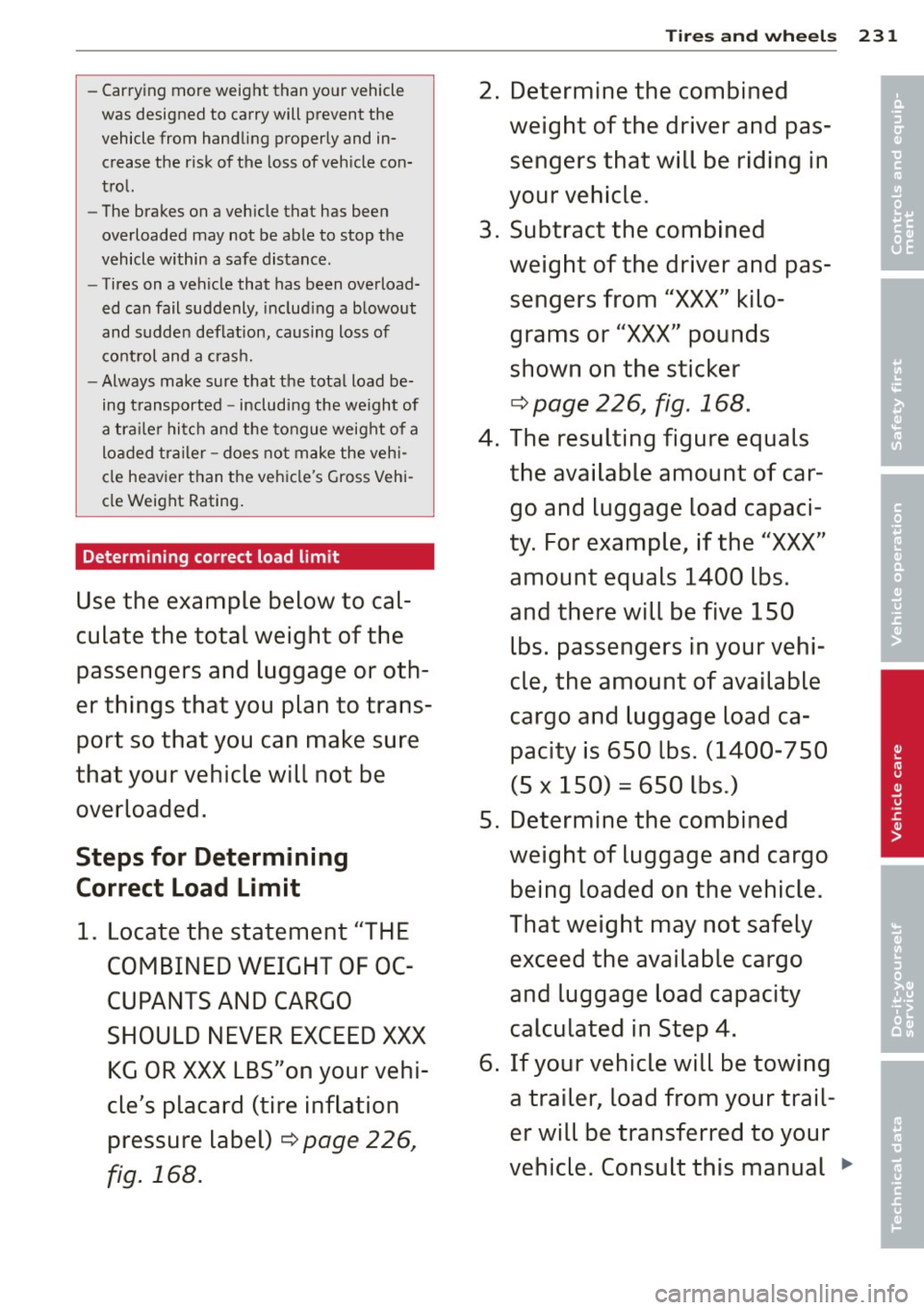
-Carrying more weight than your vehicle
was designed to carry will prevent the
vehicle from handling properly and in
crease the risk of the loss of vehicle con
trol.
- The brakes on a vehicle that has been
overloaded may not be able to stop the
vehicle within a safe distance.
- Tires on a vehicle that has been overload
ed can fail suddenly, including a blowout
and sudden deflation, causing loss of
control and a crash.
- Always make sure that the total load be
ing transported -including the weight of
a trailer hitch and the tongue weight of a
loaded trailer - does not make the vehi
cle heavier than the vehicle's Gross Vehi
cle Weight Rating.
Determining correct load limit
Use the example below to cal
culate the total weight of the
passengers and luggage or oth
er things that you plan to trans
port so that you can make sure
that your vehicle will not be
overloaded.
Steps for Determining Correct Load Limit
1. Locate the statement "THE
COMBINED WEIGHT OF OC
CUPANTS AND CARGO
SHOULD NEVER EXCEED XXX KG OR XXX LBS"on your vehi
cle's placard (tire inflation
pressure label)
c::> page 226,
fig. 168.
Tires and wheels 231
2. Determine the combined weight of the driver and passengers that will be riding in
your vehicle.
3. Subtract the combined weight of the driver and passengers from
"XXX" kilo
grams or
"XXX" pounds
shown on the sticker
c::> page 226, fig. 168.
4. The resulting figure equals the available amount of car
go and luggage load capaci
ty. For example, if the
"XXX"
amount equals 1400 lbs.
and there will be five 150
lbs. passengers in your vehi
cle, the amount of available
cargo and luggage load ca pacity is 650 lbs. (1400-7 50
(5
X 150) = 650 lbs.)
5. Determine the combined weight of luggage and cargo being loaded on the vehicle.
That weight may not safely
exceed the available cargo
and luggage load capacity
calculated in Step 4.
6. If your vehicle will be towing
a trailer, load from your trail
er will be transferred to your
vehicle. Consult this manual ..,.
•
•
'
Page 238 of 286
236 Tire s and whee ls
- All four wheels must be fitted with radia l
t ires of th e same ty pe, size (r olling c ir
cumfe rence) and the same tread pattern.
Dr iv in g with different tires reduces veh i
cle handling and can lead to a loss of
c o ntrol.
- If the spare tire is not the same as the
t ires that are mounted on the veh icle -
for example with winter tires - on ly use
the spare tire for a short period of time
and dr ive with extra care. Refit the no r
ma l road whee l as soon as safely possi
ble.
- Never drive faster than the maxim um
speed for which the tires on your vehicle
are rated because tires that are driven
faster than their rated speed can fail
sudden ly.
- Overloading ti res cause heat build-up,
sudden tire failure, including a blowout
and sudden deflation and loss of control.
- Temperature grades app ly to tires that
are properly inflated and not over or un
derinflated.
- For technical reasons it is not a lways
poss ible to use wheels from other
vehicles -in some cases not even wheels
from the same vehicle model.
- If you install wheel tr im discs on the ve
hicle whee ls, make sure that the air flow
to the brakes is not blocked . Reduced air
flow to the brakes can them to overheat,
increasing stopping d istances and caus
ing a collision.
- Run flat t ires may on ly be used on
vehicles that we re eq uipped w ith them
at the factory. The vehicle must have a
chassis des igned for r un flat t ires and a
factory-installed tire press ure monito r
ing system * that indicates a loss of tire
pressure. Incorrect use of run flat tires
can lead to vehicle damage or accidents.
Check with an authorized Audi dea ler or
t ire spec ialist to see if you r vehicle can be
equipped with run flat tires .
If run flat
t ires a re used, they must be insta lled on
all four wheels. M ixing tire types is not
permitted.
(D Note
- For technical reasons, it is not generally
poss ible to use the wheel rims from oth
er veh icles. T his can hold tr ue for wheels
of the same vehicle type.
- If the spare tire is different from the tires that you have mounted on your ve
hicle (for example winter tires or wide
profi le tires), then use the spare tire for a
short period of time only and drive w ith
extra care. Replace the flat tire w it h the
ti re mat ching the othe rs on your vehicle
as soon as possi ble.
- Never d rive without the valve stem cap.
The v alves co uld get damaged.
@ For the sake of the environment
Dispose of o ld tires in accordance w ith the
l ocal requirements.
Uniform tire quality grading
- Tread wear
- Tra ction AA A B (
- Temperature ABC
Quality grades can be found where applicable
on the t ire s ide wall between tread shoulder
and maximum section width
c> page 233,
fig . 172 .
For e xample: Tread wear 200 , Traction AA ,
Temperature A .
All passenger car ti res must conform to Feder
al Safety Requirements in add ition to these
grades .
Tread w ear
The tread wear g rade is a comparative rating
based on the wear rate of the tire when tested
u nder contro lled conditions on a specified
government test course.
F o r example, a tire graded 1S0 wo uld wear
one and one ha lf (11/2) times as well on the
government course as a ti re graded 100. ..,_
Page 272 of 286
270 Index
Automatic climate control Ai r vents ... ... . ...... ... .. .. .... .. 69
Operation . . . . . . . . . . . . . . . . . . . . . . . . . 68
Setup . .. ............... .. .. .... .. 70
Autom atic S hift Lock (ASL) . . . . . . . . . . . . 8 4
Automatic transmission . . . . . . . . . . . . . . . 82
Automatic Sh ift Lock (ASL) . . . . . . . . . . . 84
D riving .. ... ............ .. .. .. .. .. 84
E mergency mode . . . . . . . . . . . . . . . . . . . 8 8
E mergency release . . . . . . . . . . . . . . . . . . 89
K ick -dow n . . . . . . . . . . . . . . . . . . . . . . . . . 87
M anual s hift program ... .. .. .... .. . . 86
Remova l lock (ignition key) ... .. .... . . 71
Selector lever . . . . . . . . . . . . . . . . . . . . . . 83
Autom atic wi pers .......... .... .... .. 49
Auto Safety Hotline ............ .. ... 127
Average speed . . . . . . . . . . . . . . . . . . . . . . . 2S
Avoid damaging the vehicle .. .... .... . 188
B
Battery ... .. ...... ............ 17,217
B attery locat io n in side the luggage com-
pa rtment ................. .. .... . 217
C ha rging . ............... .. .. .... . 219
I mpor tan t war nings when wo rking on
the battery . . . . . . . . . . . . . . . . . . . . . . . 217
Jump starting .. .. ..... ... .. .. .... . 255
Low . .. .. .. ............. .. .. .. ... 186
Replacing the battery ..... .. .. .. .. . 220
State of charge . . . . . . . . . . . . . . . . . . . . 186
W inter operation . . . . . . . . . . . . . . . . . . 217
Wo rking on the battery . . . . . . . . . . . . . 217
Before driving .. ........... .. .. .... . 119
B io-e thanol ( Fue l) .......... .. .. .. .. . 202
Blended gasoline ... ... .. .. .. .. .. .. . 201
Blower (automatic climate control) . . . . . . 69
B ooste r seats ............. .. .. .. .. . 169
Brake fl uid
C hanging the brake fl uid ..... .. .... . 216
Check ing the brake fluid level ..... .. . 216
Reservoir .. .......... ...... ... .. . 216
What is the cor rect brake fl uid leve l? .. 2 16
What should I do if the bra ke flui d warn-
i ng light comes on? ....... .. .. .. .. . 216
Brake system .... ... .... ... .. .. .. .. . 216
Anti-lock braking system ....... .. .... 19
B rake ass ist system ..... .. .. .. .. .. . 180 B
rake fluid .... .. ... .. ..... ... .. .. 216
B rake fluid specifications for refill and re-
placement . ... .. ... .. ..... ... .. .. 216
Brake light defective ........... .... . 21
B rake power ass ist unit ......... .... 183
Brakes ....... ... .. .............. . 183
Ceram ic brakes ... ... .. .. ... ..... .. 183
El ectromechanical pa rking brak e ..... . 76
Wa rning/ind icator lights ...... .. .. .. . 15
Worn b rake pads symbo l ........ .. .. . 20
B rak ing
E mergency brak ing funct ion ... .. .. .. . 78
braking guard ..... ... .. ..... .... . .. . 90
Messages . .. .. .. .. ........... .... . 98
Settings .. .... .. ............. .... . 97
Break-in per iod .... .. ... ..... ... .. .. 188
T ires ... .. .... .. .. ... ..... ... .. .. 188
Bul bs .. .. .. .. .. .. .. .. ...... ... .. .. 253
C
Californ ia Proposition 65 Warn ing .... . 207
Battery specific .. ..... ........... . 218
Capacities .. .... .. ............. .... 262
Carbon p arts
Cleaning . . . . . . . . . . . . . . . . . . . . 198, 199
Care ........ ... .. .. ... ........... . 196
Cargo area
refer to Luggage compartment. . . 63, 125
Ca talyt ic co nve rter . . . . . . . . . . . . . . . . . . 189
Center armrest .. .. ................ .. 56
Central locking .... ... .. ..... .... . .. . 32
Central lock ing switch .......... .. .. . 36
Convenience key . . . . . . . . . . . . . . . . . . . . 36
Remote contro l key .............. .. . 35
Ceramic brake rotors New brake pads . ... .... .... ... .. .. 183
Ce rtifi cation .. .. .. ... .......... .. .. 267
Chang ing a f lat t ire . ............. .... 244
Chang ing a wheel . ... .... .... ... .. .. 244
Chang ing engine oil ..... .. ... ..... .. 212
Checking Engine coolant level . ........... .. .. 213
Checking t ire press ure . ... .... ... .. .. 228