instrument cluster AUDI A5 COUPE 2014 Owner's Manual
[x] Cancel search | Manufacturer: AUDI, Model Year: 2014, Model line: A5 COUPE, Model: AUDI A5 COUPE 2014Pages: 286, PDF Size: 70.99 MB
Page 141 of 286
Even though your vehicle is equipped with an
Advanced Airbag System, make certain that
all ch ildren, especially those 12 years and
younger, a lways ride in the back seat properly
restrained for their age and size. The airbag
on the passenger side makes the front seat a
potentially dangerous place for a child to ride.
The front seat is not the safest place for a
child in a forward-facing child safety seat.
It
can be a very dangerous place for an infant or
a child in a rearward-facing seat.
The Advanced Airbag System in your veh icle
has been certified to comply w ith the Requ ire
ments of United States Federa l Motor Vehicle
Safety Standard 208 as applicable at the time
your vehicle was manufactured.
The Standard requires the front ai rbag on the
passenger side to be turned off ("sup
p ressed") if a ch ild up to about one year of
age restrained in one of the rear-facing or for
ward -facing infant restraints listed in Federal
Motor Vehicle Safety Standard 208 with wh ich
the Advanced Airbag System in your vehicle
was certified has been installed on the front passenger seat . For a listing of the child re
straints that were used to certify compliance
with the US Safety Standard
Q page 163.
The PASSENGER AIR BAG OFF light in the in
strument panel tells you when the front Ad
vanced A irbag on the passenger side has bee n
turned off by the electronic control unit.
Each t ime you turn on the ignition, the
PAS
SENGER AIR BAG OFF
light will come on for a
few seconds and :
- will stay on if the front passenger seat is not
occupied,
- will stay on if there is a small child or child restraint on the front passenger seat,
- will go off if the front passenger seat is oc
cupied by an adult as registered by the
weight-sensing mat
Q page 147, Monitor
ing the Advanced Airbag System .
The PASSENGER AIR BAG OFF light comes on
when the control un it detects a total weight
on the front passenger seat that requires the
front airbag to be turned off.
Airbag system 139
If the total weight on the front passenger
seat is more than that of a typical 1 year-o ld
c hild but less than the weight of a small
adult, the front airbag on the passenger side
can deploy (the
PASSENGER AIR BAG OFF
light does not come on). If the PASSENGER
AIR BAG OFF
light does not come on, the
front a irbag on the passenger side has not
been turned off by the electronic con trol unit
and can deploy if the contr ol unit senses an
impact that meets the cond itions stored in its
memory .
For example, the airbag may deploy if:
-a small ch ild that is heav ie r than a typical 1
year-old ch ild is o n the front passenger seat
(regard less of whether the child is in one of
the child safety seats listed
Q page 163), or
- a child who has outgrown child restraints is
on the front passenger seat.
If the front passenger airbag is turned off, the
PASSENGER AIR BAG OFF light comes on in
the instrument cluster and stays on.
The front airbag on the passenger side may
not deploy (the PASSENGER AIR BAG OFF
light does not illum inate and stay lit) even if a
small adult or teenager, or a passenger who is
not sitting uprig ht with their back against a
non-reclined backrest w ith their feet on the
vehicle floor in front of the seat is on the front
passenger seat
~ page 120, Proper seating
position for the driver.
If the front passenger airbag deploys, the
Federal Standard requires the airbag to meet
the "low risk" deployment criteria to reduce
the risk of injury thro ugh interaction with the
airbag . "Low risk" deployment occ urs in those
crashes that take place at lower dece lerat ions
as defined in the electronic control unit
Q page 148, PASSENGER AIR BAG OFF light .
Always remember, a child safety seat or infant
carr ier installed on the front seat may be
struck and knocked out of posit ion by the rap
idly inflating passenger's airbag in a frontal
collision . The airbag could greatly reduce the
effectiveness of the child restraint and even
seriously injure the child during inflation. •
•
Page 146 of 286
144 Airbag sys tem
-Always move the passenger seat into its
rearmost position in the seat's fore and
aft adjustment range, as far away from
the a irbag as poss ible, before insta lling
the forward-facing child restraint. The backrest must be adjusted to an upr ight
posit io n.
- Make sure that the
PASSENGER AIR BAG
OFF
light comes on and stays on all the
t ime w henever the ignition is switched
on.
Advanced Airbag System components
The fron t passenger sea t in your vehicle h as a
lot of very important par ts of the Advanced
Airbag System in it. These parts include t he
weight -sensing mat, sensors, wiring, brack
ets, and more. The function of the system in
the front passenger seat is checked by the
e lectronic control u nit when the ignit ion is on.
The control unit mo nitors the Advanced Air
bag System and turns the airbag indicator
l ight on when a ma lfunction in t he system
components is detected. The func tion of the
a ir bag ind icator light is described in greater
detai l be low . Because the front passenger
seat contains important parts of the Ad
vanced A irbag System, you m ust take care to
prevent it from be ing damaged. Damage to
the seat may prevent the Advanced Airbag for
the front passenger seat from doing its job in
a crash .
The front Advanced Airb ag Sy stem
consists of the following:
- Crash sensors in the front of the veh icle that
measure veh icle acceleration/deceleration
to provide information to the Advanced Air
bag System abou t the seve rity of the crash.
- An electron ic co ntrol unit, with integ rated
crash sensors for front and side impacts .
T he cont ro l unit "dec ides " w het her to fire
the front airbags based on the information
received from the crash senso rs . The contro l
unit a lso "decides" whethe r the safety be lt
pretensioners should be activated . -
An Advanced A irbag w ith gas generator and
cont ro l valve for the d river inside the steer
ing wheel h ub.
- An Advanced A irbag with gas ge nerator and
contro l valve inside the instrument pane l for
the front passenger.
- A weight-sensing mat under the up ho lstery
pad ding of the front passenger seat cushion
that measures the total weight on the seat.
The informat ion registered is sent continu
ously to the electronic contro l unit to regu
late deployment of the front Advanced Air bag on the passenger side .
- An airbag monitor ing system and i ndicator
light in the i nstr ument cluster ~
page 147 .
-A sensor in each front seat registers the dis
tance between the respective seat a nd the
steer ing whee l o r i ns trument panel. The i n
formation registered is sent cont inuo usly to
t he ele ctr onic cont ro l uni t to regula te de
p loyment o f the front Advance d Airbags .
- The
PASSENGER AIR BAG OFF ligh t comes
on and st ays on in the cen ter o f the instr u
ment panel~
page 148, fig . 135 and tells
you whe n the front Advanced Airbag on the
passenger side has been tu rned off .
- A sensor below the safety be lt latch for the
front seat passenger to measure the tension on the safety be lt . The tension on the safety
be lt and the weight registered by the
weight-sensing mat he lp the control unit
"decide" whether the front airbag for the
front passenger seat should be turned off or
not
~ pag e 138, Child restraints on the
front seat -some important things to
know.
- A senso r in the safety belt latch fo r th e d riv
er and fo r the front sea t passenger tha t
senses w het he r th at safety bel t is latched or
not and transmi ts this information to the
electronic control unit.
A WARNING
Damage to the front passenger seat can
p revent the front airbag from work ing
properly.
-
Page 151 of 286
make certain that the PASSENGER AIR BAG
OFF
light stays on continuous ly whenever the
i gnit ion is on. If the
PASSENGER AIR BAG
OF F
light does not appear and not stay on all
the t ime, stop as soon as it is safe to do so
and
- react ivate the system by turning the ignition
off and then turning it on again;
- remove and reinstall the child restraint .
Make sure that the child restraint is properly
installed and that the safety belt for the
front passenger seat has been correct ly
routed around the child restraint as descr i
bed in the child restraint manufacturer's in
structions;
- make sure that the convertible locking fea
ture on the safety be lt for the front passen
ger seat has been activated and that the
safety belt has been pulled tight. The belt
must not be loose o r have loops of slack so
that the sensor below the safety belt latch on the seat can do its job ¢
page 171.
-make sure that things that may increase the
weight of the chi ld and child safety seat are
not being transported on the front passen
ger seat;
- make sure that the safety belt tension sen
sor is not b locked. Shake the safety belt
latch on the front passenger seat back and
forth;
- If a strap or tether is being used to tie the child safety seat to the front passenger
seat, make sure that it is not so tight that it
causes the we ight-sensing mat to measure
more we ight than is actually on the seat.
If the PA SSEN GER A IR B AG OFF light st ill
do es not come o n
and does not stay on con
tinuously (when the ignition is switched on),
- take the chi ld restraint off the front passen-
ger seat and install it properly at one of the
rear seat pos itions . Have the a irbag system
inspected by your author ized Audi dealer
i mmediately .
- move the ch ild to a rear seat posit io n and
make sure that the child is properly restrain
ed in a child restraint that is appropriate for
its size and age.
A irbag system 149
The PAS SENGER AIR BAG OFF light should
NOT come on when the ignitio n is on and an
adult is s itting in a proper seating position on
the front passenger seat. If the
PAS SENGER
AIR B AG OFF
light comes on and stays on or
flashes for about 5 seconds wh ile driving, un
der these c ircumstances, make sure that:
- the adult on the front passenger seat is properly seated on the center of the seat
cushion with his or her back up aga inst the
backrest and the backrest is not recl ined
¢ page 120, Proper occupant seating posi
tions,
- the adult is not tak ing weight off the seat by
holding on to the passenger assist handle
above the front passenger door or support
ing their weight on the armrest,
- the safety belt is being properly wo rn and
tha t the re is not a lot of s lack in the safety
be lt webbing,
- accessory sea t covers or cushions o r other
things that may cause an incorrect reading
or impression on the weight-sensing mat
under the upho lstery of the seat have been
removed from the front passenger seat,
- a safety belt extender has not been left in the safety be lt latch for the front passenger
seat.
In add ition to the
PA SSENGER AIR BAG O FF
light in the center of the instrument panel,
the message
PASSENGER A IR BAG OFF or
PASSENGER AIR BAG ON will briefly appear
in the instrument cluster disp lay. This is to in
form the dr iver of the current front passenger
airbag status.
Important safety instructions on
monitoring the Advanced Airbag System
A WARNING
An airbag system that is not functioning
properly cannot provide supplemental pro
tection in a frontal crash.
- If the airbag ind icator light
¢ page 20
comes when the veh icle is being used,
have the system inspected immediately
by your authorized Audi dealer.
It i s
-
•
•
Page 157 of 286
Side airbags
Description of side airbags
The airbag system can provide supplemental
protection to properly restrained occupants.
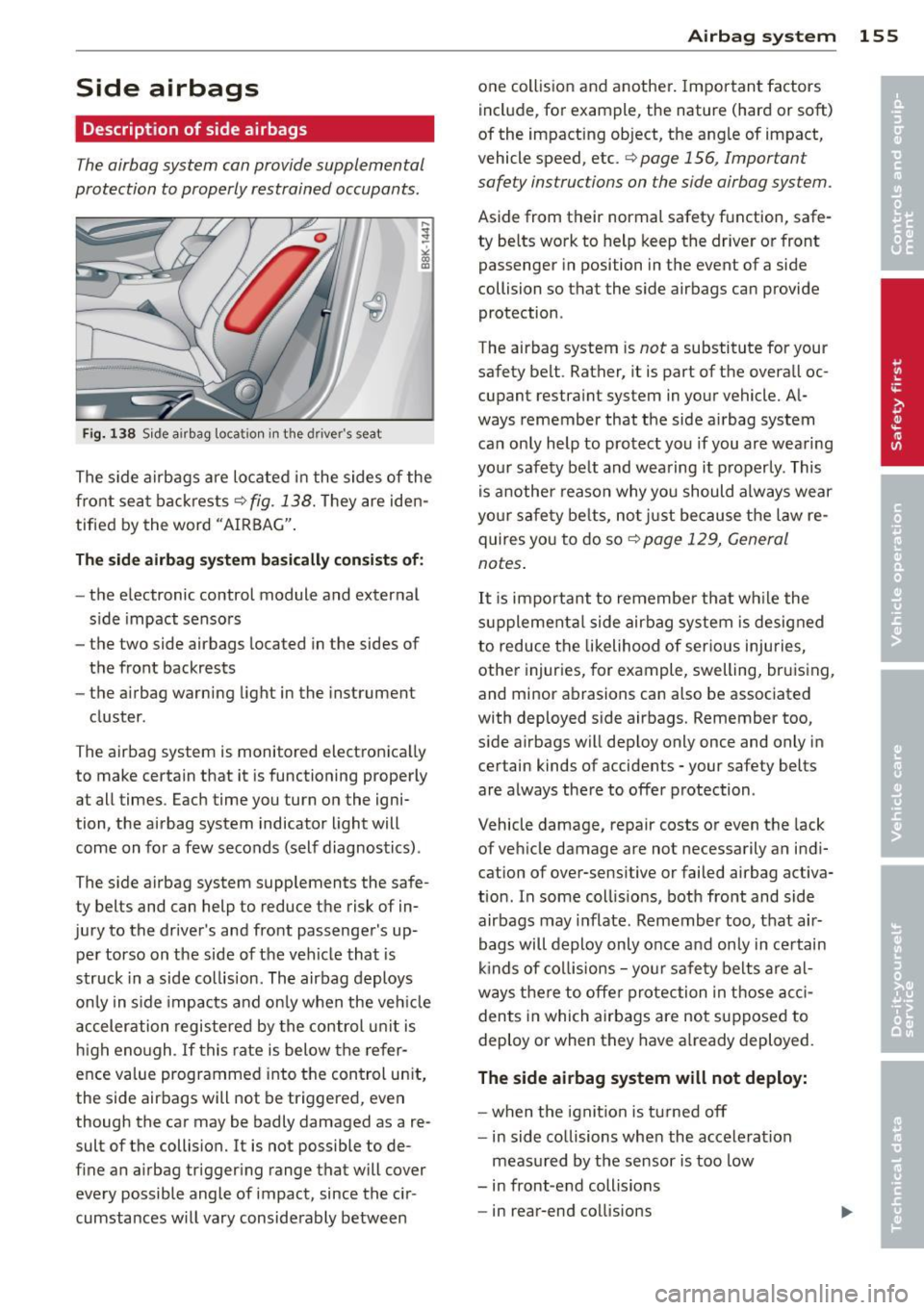
Fi g. 1 38 S ide a irbag location i n the driver 's seat
The s ide a irbags are located in the sides of the
front sea t backrests ¢
fig . 138. They are iden
tified by the word "AIRBAG" .
The side airbag system ba sicall y consis ts of :
-the electronic control module and external
side impact senso rs
- the two side airbags located in the sides of
the front backrests
- the a irbag warning light in the instrument
cluster .
The airbag system is monitored electronica lly
to make certain that it is functioning properly at all times . Each time you turn on the igni
tion, the airbag system indicator light will
come on for a few seconds (self diagnostics) .
The s ide a irbag system supplements the safe
ty belts and can help to reduce the risk of in
jury to the dr iver's and front passenge r's up
pe r torso on the side of the veh icle that is
struck in a side co llision . The airbag deploys
on ly in side impacts and on ly when the vehicle
acceleration registered by the control u nit is
hi gh eno ugh . If this rate is below the refer
ence va lue programmed i nto the con trol un it,
the side airbags will not be triggered, even
though the car may be badly damaged as a re
sult of the collision. It is not possible to de
fine an airbag trigger ing range that will cover
eve ry possible angle of impact, since the ci r
cumstances wi ll vary conside rably between
A irba g sy stem 155
one collis ion and anothe r. Important factors
incl ude, for example, the nature (hard or soft)
of the impacting object, the ang le of impact,
vehicle speed, etc. ¢
page 156, Important
safety instructions on the side airbag system .
Aside from their normal safety function, safe
ty belts work to help keep the driver or front
passenger in position in the event of a side
collision so that the side airbags can provide protection .
The airbag system is
not a substitute for your
safety belt. Rather, it is part of the overall oc
cupant restra int system in your vehicle. Al
ways remember that the side airbag system can only help to protect you if you are wearing
you r safety be lt and wea ring it p roperly. This
is anothe r reason why you should a lways wear
yo ur safe ty be lts, no t ju st because the law re
quires you to do so¢
page 129, General
notes .
It is important to remembe r that wh ile the
s u pplementa l side airbag system is designed
to reduce the likelihood of ser ious inju ries,
other injur ies, for example, swelling, br uising,
and minor abrasions can also be associated
with deployed side airbags. Remember too,
s ide airbags will deploy only once and only in
certain kinds of accidents -your safety belts
are always the re to offer protection .
Vehicle damage, repair costs or
even the lack
of ve hicle damage are not necessarily a n indi
cation of over-sensitive or failed airbag activa
tion. In some coll is io ns, both front and side
airbags may inflate. Remember too, that air
bags will deploy only once and only in certain
k inds of co lli sions -you r safe ty be lts are al
w ays the re to offe r protection in those ac ci
dents in whi ch airbags are not s upposed to
deploy or when they have a lready deployed .
The side airbag system will not deploy:
-when t he ignit io n is tu rned off
- in side collisions whe n the acceleration
meas ured by the sensor is too low
- in front-e nd collisions
- in rear-end collis ions
Page 182 of 286
180 Intellige nt tec hno logy
Intelligent technology
Notice about data
recorded by veh ic le
control modules
Your vehicle is not equipped with an Event Da
ta Recorder (EDR), installed by some manu
facturers fo r the express purpose of capturing
data for retrieval after an accident or crash
event . EDR's are sometimes called "crash re
corders".
Some state laws restrict the retrieval or down
loading of data stored by EDR's that were in
stalled in a vehicle for the express purpose of
retrieving data after an accident or crash
event without the owner's consent.
A lthough your vehicle is not equipped with an
EDR, it is equipped with a number of electron
ic control modules for various vehicle systems
such as, for example, engine function, emis
sion control, as well as for the airbags and
safety belts.
These electronic control modules also record
vehicle-related data during normal vehicle op
eration for diagnostic and repair purposes.
The recording capacity of the electronic con
trol modules is limited to data (no sound is re
corded) and only a small amount of data is ac
tually recorded over a very limited period of
time and stored when a system fault or other
condition is sensed by a control unit. Some of
the data then stored may relate to vehicle
speed, direction, braking as well as restraint
system use and performance in the event of a
crash or other condition. Stored data can only
be read and downloaded with special equip
ment.
Electronic Stab ilization
Control (ESC)
Description
ESC helps to improve road holding and vehicle
dynamics to help reduce the probability of
skidding and loss of vehicle control. It works
only when the engine is running. ESC detects certain difficult driving situations, including
when the vehicle is beginning to spin (yaw)
out of control and helps you to get the vehicle back under control by selectively braking the
wheels, and/or reducing engine power and
providing steering assistance to help hold the
vehicle on the driver's intended course. The in
dicator light
J.i) in the instrument cluster
blinks when ESC is taking action to help you
control the vehicle.
ESC has limitations.
It is important to remem
ber that ESC cannot overcome the laws of
physics. It will not always be able to help out
under a ll cond itions you may come up against.
For example, ESC may not always be able to
help you master situations where there is a
sudden change in the coefficient of friction of
the road surface. When there is a section of dry road that is suddenly covered with water,
slush or snow, ESC cannot perform the same
way it would on the dry surface . If the vehicle
hydroplanes (rides on a cushion of water in
stead of the road surface), ESC will not be
able to help you steer the vehicle because con
tact with the pavement has been interrupted
and the vehicle cannot be braked or steered.
During fast cornering, particularly on winding
roads, ESC cannot always deal as effectively
with difficult driving situations than at lower
speeds. When towing a trailer, ESC is not able
to help you regain control as it would if you
were not towing a trailer.
Always adjust your speed and driving style to road, traffic and weather conditions. ESC can
not override the vehicle's physical limits, in
crease the available traction, or keep a vehicle
on the road if road departure is a result of
driver inattent ion. Instead, ESC improves the
possibility of keeping the vehicle under con
trol and on the road during extreme maneu
vers by using the driver's steering inputs to
help keep the vehicle going in the intended di
rection . If you are traveling at a speed that
causes you to run off the road before ESC can
provide any assistance, you may not experi
ence the benefits of ESC.
Page 213 of 286
Checking the engine oil level
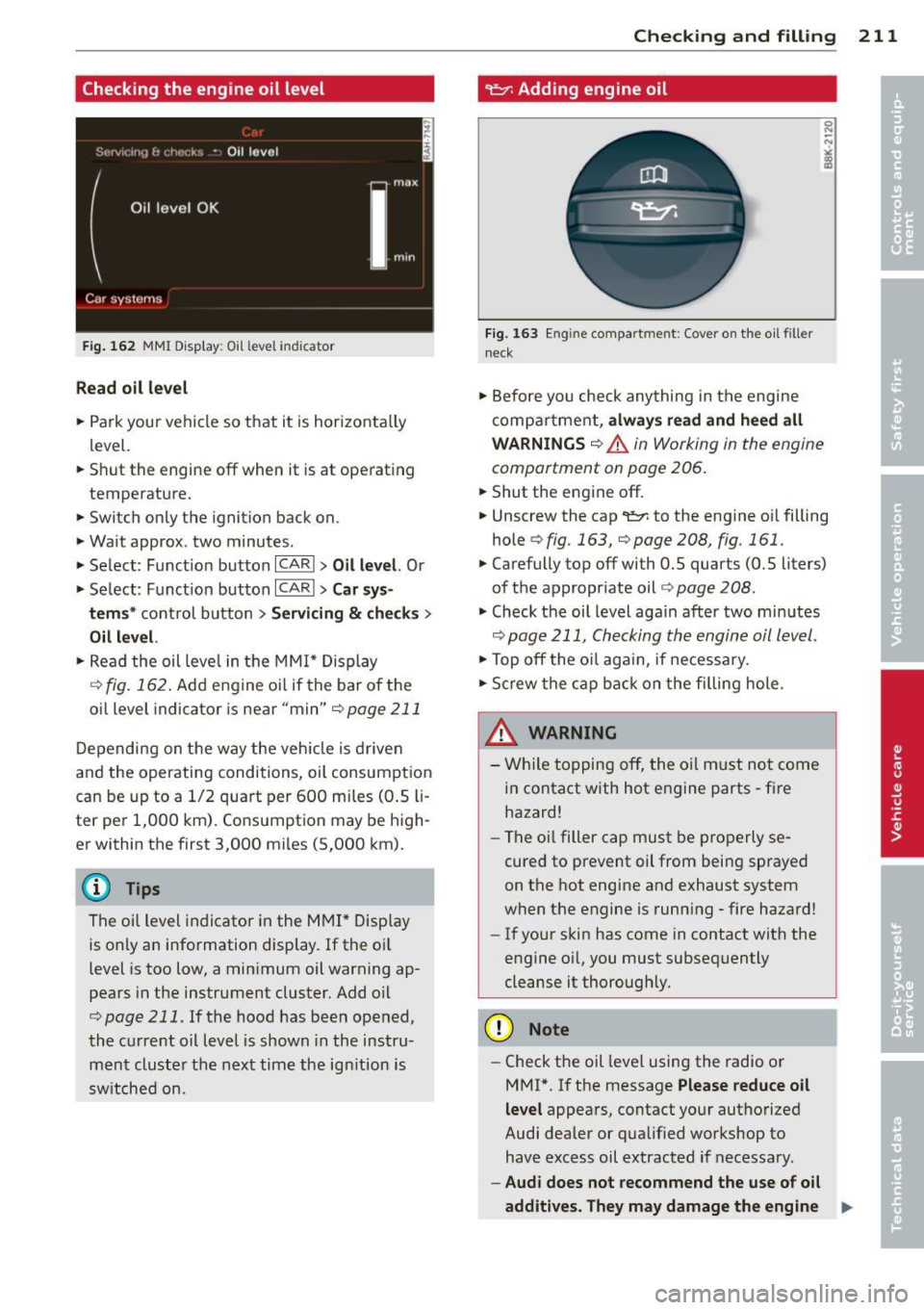
Fig . 162 MMI Disp lay: Oil l eve l ind icator
Re ad oil le vel
.,. Park your vehicle so that it is horizonta lly
level.
.,. Shut the engine off when it is at operating
temperature .
.,. Switch only the ignition back on .
.,. Wait approx . two minutes .
.,. Select: Function button
ICARI > Oil l evel. Or
.,. Se lect: Funct ion button
ICARI > C ar sys-
tem s*
cont rol button > S ervicing & ch e ck s >
Oil level.
.,. Read the oil leve l in the MMI* Display
¢
fig . 162 . Add engine oi l if the bar o f the
oi l level ind icator is near "min"
c::> page 211
Depending on the way the veh icle is driven
and the operating conditions, oil consumption
can be up to a 1/2 quart per 600 miles (0 .5
li
ter per 1,000 km) . Consumption may be high
er within the first 3,000 m iles (S,000 km).
@ Tips
The oil level indicator in the MMI* Disp lay
is only an information display.
If the oi l
level is too low, a min imum oil warning ap
pears in the instrument cluster. Add oil
c::> page 211 . If the hood has been opened,
the current oil level is shown in the instru
ment cluster the next time the ign ition is
sw itched on.
Checkin g and fillin g 211
~ Adding engine oil
Fig. 163 Eng in e compart men t: Cove r on the oil filler
n eck
.,. Before yo u check anything in the engine
compa rtment,
alwa ys rea d and h eed all
WARNING S ¢.&. in Working in the engine
compartment on page 206 .
.,. Shut the engine off.
.,. Unscrew the cap~ to the engine oi l filling
hole
r:!> fig. 163, r:!>page 208, fig. 161 .
.,. Carefully top off with 0.5 quarts (0.5 liters)
of the appropriate oil¢
page 208.
"' Check the oil level again after two minutes
r:!> page 211, Checking the engine oil level .
"'Top off the o il aga in, if necessary .
"' Screw the cap back on the filling hole .
_&. WARNING
- While topping off, the oil must not come
in contact with hot e ngine parts -fir e
hazard!
- The oil filler cap must be properly se
cured to prevent oil from being sprayed
on the hot engine and exhaust system
when the engine is runn ing -fire hazard!
- If your skin has come in contact with the
engine o il, you must subsequently
cleanse it thoroughly.
(D Note
- Check the oil level using the radio or
M MI*. If the message
Plea se redu ce oil
le vel
appears, contact yo ur authorized
Audi dealer or qua lified workshop to
have excess oil extracted if necessary .
-Audi does not recommend the u se of o il
additiv es. They m ay damage the engine .,.
Page 243 of 286
When the malfunction indicator is illuminat
ed, the system may not be able to detect or
signal low tire pressure as intended. TPMS
malfunctions may occur for a variety of rea
sons, including the installation of replace
ment or alternate tires or whee ls on the veh i
cle that prevent the TPMS from funct io ni ng
p roperly . Always check the T PMS malfunct ion
tellta le afte r replacing one o r more t ires or
wheels on your veh icle to ensure that the re
p lacemen t or a lternate tires and wheels allow
the TPMS to continue to function properly .
Tire pressure indicator appears
Applies to vehicles: with tire pressure monitoring system
The tire pressure indicator in the instrument
cluster informs you if the tire pressure is too
low or if there is a system malfunction.
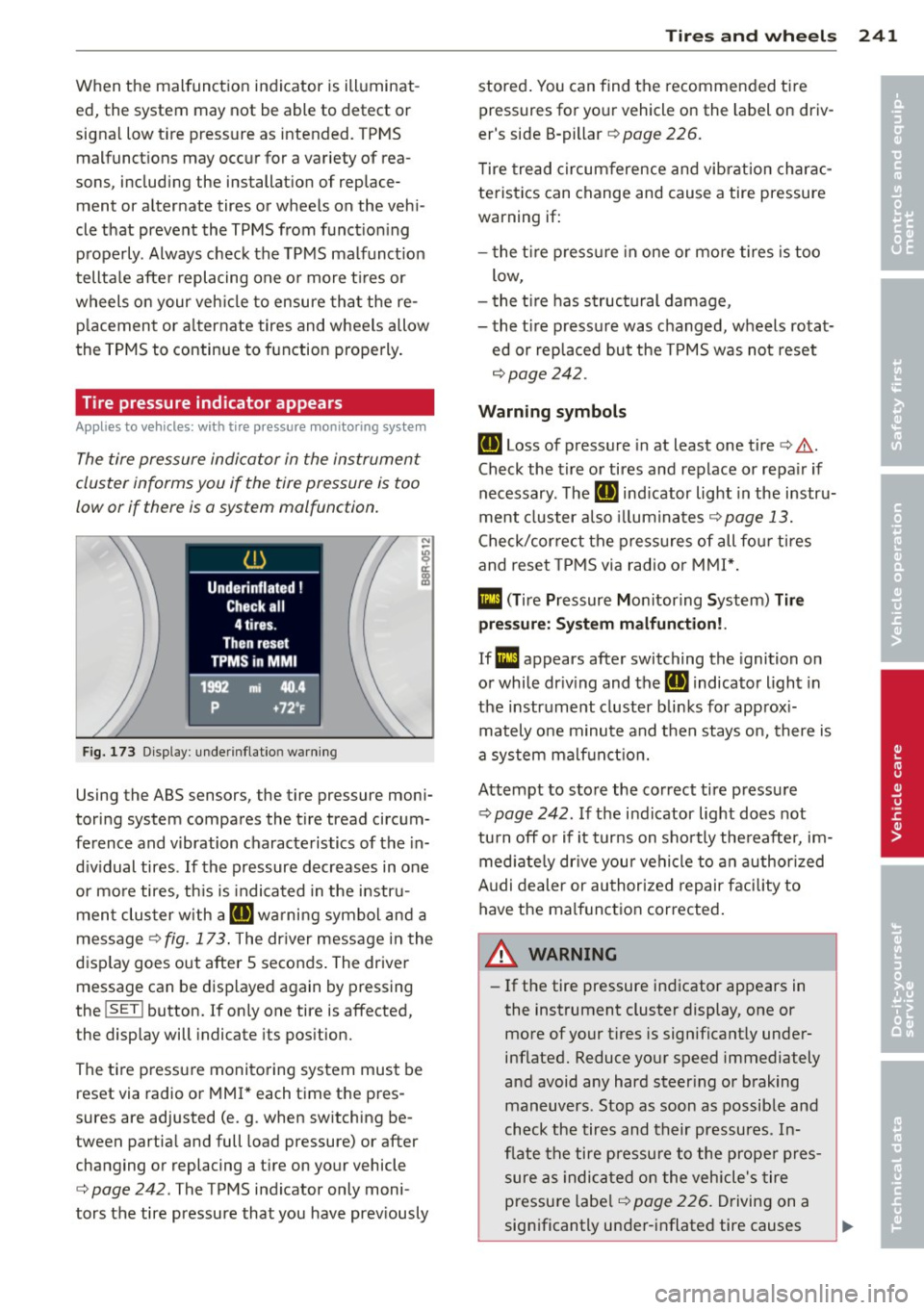
Fig. 173 Display : underinflatio n warning
Using the ABS sensors, the tire pressure moni
toring system compares the t ire tread circum
ference and vibration characteristics of the in
d iv idual tires . If the pressure decreases in one
or mo re tires, th is is indica ted in the instru
ment clus ter with a
RE wa rning symbol and a
message¢
fig. 173 . The driver message in the
disp lay goes out after 5 seconds . The driver
message can be displayed again by pressing
the
! SET ! button. If only one tire is affected,
the display will indicate its pos ition.
The ti re pressu re monitoring system must be
reset via radio or MMI* each time the pres
sures are adjusted (e.g . when switching be
tween partia l and full load pressure) or after
changing or replacing a t ire on your vehicle
¢
page 242 . The TPMS indicator only moni
tors the tire pressure that you have prev iously
Tire s an d wheel s 241
stored . You can find the recommended t ire
pressures for yo ur vehicle on the label on driv
er's side 8-pillar ¢
page 226.
T ire tread circum ference and vibration charac
teristics can change and cause a tire pressure
warning if:
- t he t ire p ress ure in one or more tires is too
low,
- t he t ire has s tructural damage,
- the t ire pressure was changed, wheels rotat-
ed or replaced but the TPMS was not reset
¢ page 242.
Warning symbo ls
RE Loss of pressure in at least one tire c> & .
Check the tire or tires and replace or repa ir if
necessary. The
RE ind icator light in the instru
ment cluster a lso illuminates
c::!;> page 13.
Check/correct the press ures of all fou r tires
and reset TPMS via radio or MMI*.
Ill (T ir e Pressure Monitor ing System) Tire
press ure: Syst em malfun ction!.
If II! appears after switching the ignition on
o r while dr iv ing and the
RE i ndicator light in
the instr ume nt cluster blinks for app rox i
mately o ne minute and t hen stays o n, there is
a system malf unct ion.
Attempt to store the co rrect tire pressure
¢ page 242 . If the ind icator light does not
tu rn off o r if it turns on sho rtly the reafter, im
med iate ly dr ive your vehicle to a n author ized
Audi dealer or au thorized repair faci lity to
have the malfunc tion corrected .
A WARNING
-=
-If the tire pressure indicator appears in
the instrument cluster display, one or
more of your t ires is significant ly under
inflated. Reduce your speed immediately
and avoid any hard steer ing or b raking
maneuvers. Stop as soon as possib le and
check the tires and their pressures. In
flate the tire pressure to the prope r pres
sure as indicated on the vehicle's tire
pressu re labe l
¢page 226. Driving on a
significantly under-inflated tire causes
•
•