transmission AUDI A5 COUPE 2014 Owner's Manual
[x] Cancel search | Manufacturer: AUDI, Model Year: 2014, Model line: A5 COUPE, Model: AUDI A5 COUPE 2014Pages: 286, PDF Size: 70.99 MB
Page 90 of 286
88 Transmi ssion
when sport mode is sw itched on,
especially when the road is slippery.
- Once you have accelerated, yo u should
switch sport mode
off by pressing the
I ~ OFF I button.
@ Tips
- The transmission temperat ure may in
crease significantly after using the Launch Control Program. If that hap
pens, the program may not be available
fo r a few minutes . It will be availab le
again afte r a cool-down period .
- When accelerating using t he Launch
Control program, all vehicle parts are
subject to heavy loads. This can res ult in
i nc reas ed wea r.
Transmission malfunction
Applies to vehicles: with S tronic/tiptronic
DI Transmi ssion : Pr ess brake pedal and se
le ct gear again .
Press the brake pedal and se lect the des ired
se lecto r lever posit io n aga in. You can then
con tinue dr iv ing .
DI Transmi ssion overheating: Pleas e drive
conservatively .
The transmission temperature has increased
significantly due to the sporty driving ma nner .
Drive in a less sporty manner unt il the tem
pe rat ure retu rns to the no rmal range a nd the
i ndicator light sw itches of.
DI Transmiss ion malfunct ion: You can con
tinue driving
There is a system ma lf u nction in the transmis
sion. You may continue driving. Drive to your
author ized Audi dealer or qualified repair fa
cility soon to have the malfunction corrected.
DI Transmission malfunction: Limited driv
ing funct ionality
There is a system ma lf u nction in the transmis
sion. The transmission is switching to emer
gency mode. Th is mode only shifts into cer
tain gears or will no longer shift at a ll. The en- gine may sta
ll. Drive to your a uthorized Audi
dealer or qualified repair facility immediately
to have the mal function cor rected .
[O] lit Transmis sion malfunction : No reverse
You can continue driving
S t roni c tra nsmission: The re is a system mal
f unc tion in the transm ission. The t ransmis
s io n is swi tching to emerge ncy mode. This
mode only shifts into ce rtain gea rs or will no
l o nger shift at a ll. The engine may stall. You
cannot engage the reverse gear . Dr ive to your
autho riz ed Aud i dea ler or qualified repa ir fa
c ili ty immediately to have the malfunction
cor rected .
DI Transmission malfunction: Stop vehicle
and shift to park.
Do not continue dr iving. Se lect the P selector
lever positio n and see your authorized A udi
dealer or qualif ied repai r facility for assis
tance.
(D Note
If the transmission switches to emergency mode, yo u should ta ke the vehicle to an
a uth ori zed Audi dea lership as so on as pos
s ible to have the condition corrected.
Page 91 of 286
Selector lever emergency release
Applies to vehicles: with S tronic/tiptronic
If the vehicle's power supply fails, the selec
tor lever can be released in an emergency.
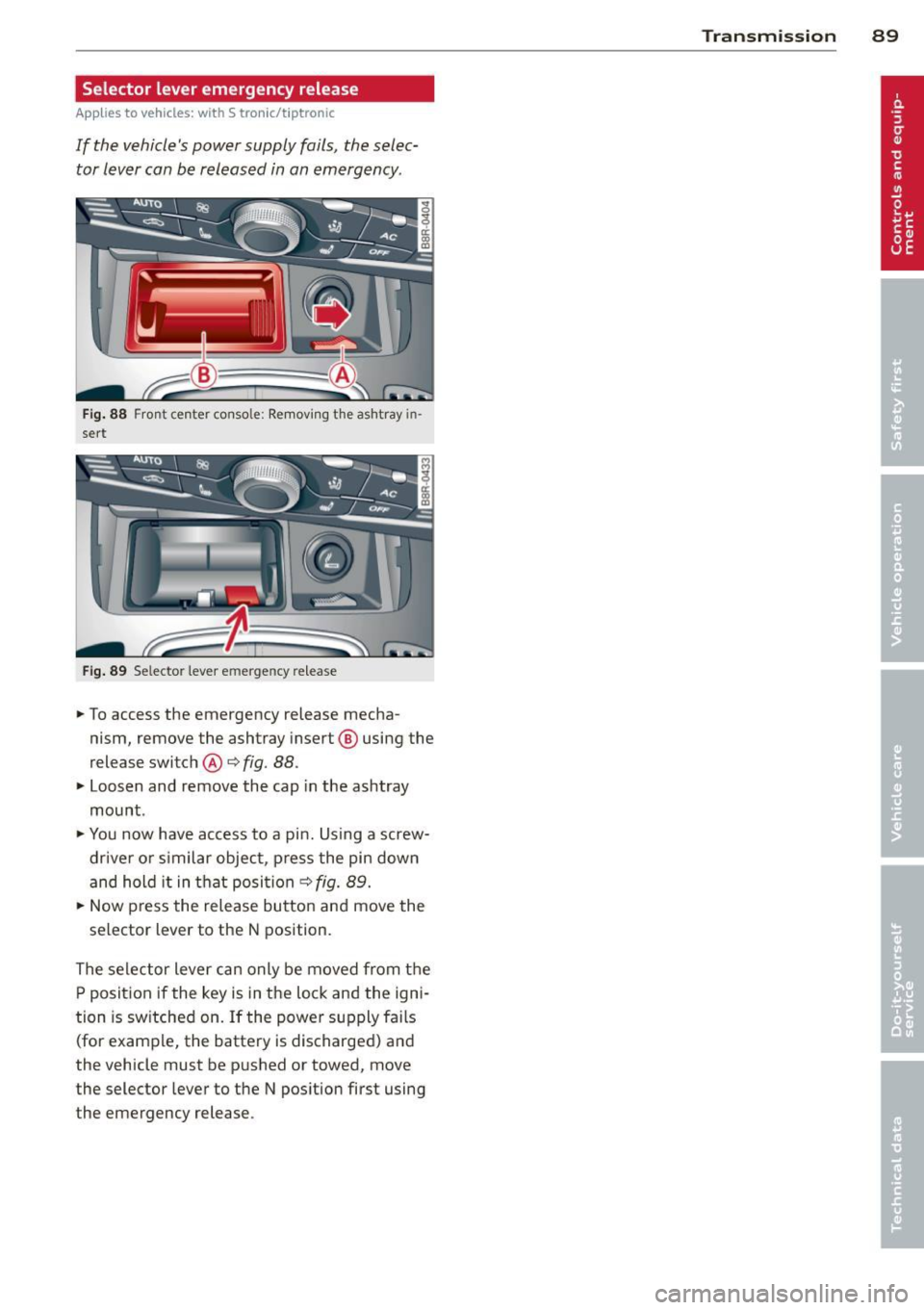
Fig . 88 Front ce nter console: Removing the ashtray in
sert
Fig. 89 Selector lever emergency release
.. To access the emergency release mecha
nism, remove the ashtray insert @ using the
release switch @
q fig. 88 .
.. Loosen and remove the cap in the ashtray
mount .
.. You now have access to a pin. Using a screw
driver or similar object, press the pin down
and hold it in that position
q fig. 89 .
.. Now press the release button and move the
selector lever to the N position.
The selector lever can only be moved from the
P position if the key is in the lock and the igni
tion is switched on.
If the power supply fails
(for example, the battery is discharged) and
the vehicle must be pushed or towed, move
the selector lever to the N position first using
the emergency release.
Transmission 89
Page 94 of 286
92 Audi adaptive cruise control and bra king guard
Vehicles with manual transmission
Ap plies to vehicles: with Audi adaptive cruise co ntrol
Th e adaptive cruise co ntro l i s ava ila bl e from
the 2nd ge ar throug h the 6th ge ar in the cus
tom ary RPM .
When the adapt ive cr uise control is t urned on,
you mus t press the clutch to shift gea rs (as
usu al). W he n shift ing normally or when press
ing the cl utch, the adap tive c ruise control re
mains tu rned on.
Afte r you have eng aged the gea r, you do
not
need to pre ss the g as peda l. The ad aptive
cr uise con trol accelera tes a utoma tica lly if ne c
essary.
I f you p ress dow n on the clu tch fo r too long or
sh ift/ coup le improperly, the adaptive cruise
con trol may tur n off a utomat ic a lly.
(D Tips
Yo u ca nn ot tur n on the ad apt ive cr uise
con tro l dur ing a s hifting o per ation.
Audi adaptive cruise
control
Description
A ppl ies to vehicles: with Audi adaptive cruise co ntrol
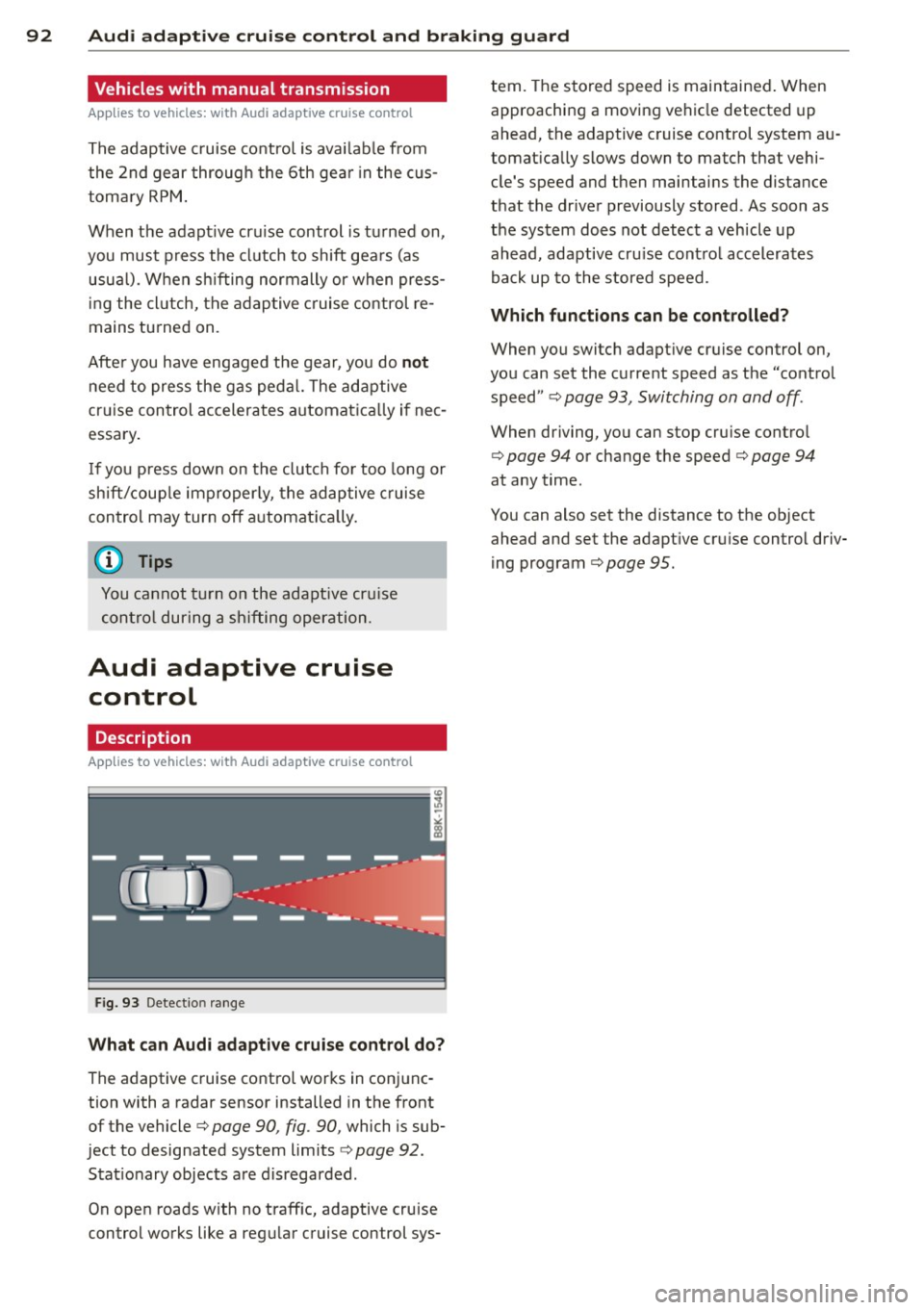
F ig. 9 3 Detec tion range
What can Audi adapt ive crui se cont rol do?
The adaptive c ruise contro l wor ks in con junc
tion with a radar sensor installed in the front
of the vehicle¢
page 90 , fig . 90, which is sub
ject to designated system limits
r=> page 92.
Stat ionary objects a re d is regarded .
On open roads w ith no traff ic, adaptive cruise
control works like a reg ular cruise control sys- tern.
The sto red speed is maintained . When
approaching a moving vehicle detected up
ahead, the adaptive c ruise control system a u
tomat ica lly s lows down to match that vehi
cle's speed and then maintains the distance
t h at the dr ive r previously stored . As soon as
the sys tem does not detec t a ve hicle up
ah ead, adaptive cru ise cont ro l accelerates
back up to the stored speed.
Which functions can be controlled?
When you switc h adapt ive cru ise control on,
yo u can set the c urrent speed as the ''control
speed " ¢
pag e 93, Switching on and off .
When driving, yo u can stop cru ise contro l
r:=> page 94 or change t he speed¢ page 94
at any time.
You can also set the distance to the object
ahead and set the adapt ive cr uise contro l driv
ing program
¢ page 95.
Page 100 of 286
98 Audi adaptive cruise control and braking guard
-If you restrict or switch off the ESC, the
braking guard also switches itself off
r=;,page 182.
-Switch braking guard off when you are
loading the vehicle onto a vehicle carrier,
train, ship or other type of transporta
tion. This can prevent undesired warn ings from the braking guard system.
Messages
Applies to vehicles: with Audi adaptive cruise co ntro l
Braking guard: Off
This driver message appears if the system is
turned off via the radio/MM!*. Otherwise, if
the system is turned off, the information ap pears every time shortly after the start of the
trip.
The driver message also appears if the system is not available due to a malfunction or if the
ESC is not switched on
r=;, page 182 . If this is
the case, the system will not provide warnings
about a possible collision.
Braking guard: Activated
This driver message appears if sharp brake
pressure was applied due to an acute warning.
•••
Three white dots appear if a setting cannot be
selected with the operating lever. For exam
ple, this happens if you want to raise/lower
the speed even though there was no previous
ly saved speed .
ACC: Deactivation
The driver message appears in vehicles with
manual transmission . If the clutch pedal was
pressed down for too long, the adaptive cruise
control turns off. A chime sounds as a remind
er .
ACC: Sensor blocked
This message appears if the sensor view is ob
structed, for example by leaves, snow, heavy
spray or dirt. Clean the sensor
r=;, page 90,
fig. 90 .
ACC: not available
The driver message appears if there is a mal
function. The adaptive cruise control turns off.
A chime sounds as a reminder. Have the sys
tem checked by an authori zed Audi dealer or
authorized Audi Service Facility.
ACC: unavailable
The driver message appears if, for example,
the brake temperature is too high. The adap
tive cruise control is temporarily unavailable.
A chime sounds as a reminder.
Engine speed!
This driver message appears in vehicles with
manual transmission if the driver had not up
shifted or downshifted in time while using
adaptive cruise control braking or accelerat
ing, causing the vehicle to exceed or not reach
the permitted limit speed. The adaptive cruise control turns off. A chime sounds as a remind
er .
Shift lever position!
Vehicles with an automatic transmission: the
driver message appears if the selector lever is
shifted to the N position. The adaptive cruise
control is not available while in this position.
Vehicles with manual transmission: the driver
message appears for vehicles with manual
transmission if there is no forward gear en
gaged, meaning if the reverse gear or the 1st
gear is engaged or if the selector lever is in
the neutral position. The adaptive cruise con
trol is not available while in this position.
Stabilization control (ESC)
This message appears if the electronic stabili
zation control (ESC) is taking action to stabi
lize the vehicle. The adaptive cruise control
turns off . A chime sounds as a reminder .
Speed too low
This message appears if the current speed is
too low
to set or to maintain the desired
speed .
The speed being saved must be at least
20 mph (30 km/h). The cruise control is
turned off for speeds lower than 12 mph
Page 106 of 286
104 Audi drive select
Audi drive select
Driving settings
Introduction
App lies to vehicles: with Audi drive select
Drive select provides the possib ility to exper i
e nce diffe ren t types of vehi cle sett ings in o ne
ve hicl e. For ins tance, us ing t he three
Com
fort , Auto and Dynamic modes, the driver can
switch from a sporty to a comfortab le drivi ng
mode with the press of a b utton.
A ddit ionally, in veh icles wi th MM I*, the vehi
cle setup for
Individual* mode can be c us
tom ized by you . This makes it possib le to
comb ine settings such as a sporty engine tun
ing with comfortable steering.
A WARNING
Improper use of the A udi drive select can
cause collisions , ot her acc idents and se ri
ous pe rsonal injury .
Description
Applies to vehicles: with Audi drive select
The vehicle setup in each mode depends on
the veh icle's features . However, the engin e,
automa tic t ransmissio n* and steer ing are al
ways involved.
-
Engine and automatic transmission*
Depending on the mode , the e ngine and the
automatic t ransm ission respond quicke r or i n
a mo re ba la nced manne r to a cce le rator pedal
move ments. In t he sporty dynam ic mode, the
a utom atic t ra nsm ission shifts at h igher R PMs.
Steering
The stee ring adapts in terms of stee ring effort
and st eering ra tios . Ind ir e ct steer ing that
moves easi ly, l ike the stee ring in comfort
mode, is bes t su ite d to long dr ives on a high
way. In co ntr ast, dynam ic mo de p rov ides
sporty, direct steerin g.
Th e fo llow ing applies to vehicl es with dynam ic
s teer ing*: the stee ring rati o changes based on
ve hicl e spee d in order to main ta in op timum stee
ring effort for the drive r at all times . This
sets the stee ring to be less sens itive at higher
speeds in order to provide improved vehicle
control. At reduced speeds, however, steer ing
is more d irect in order to keep the steering ef
fort as minima l as poss ible when the drive r is
mane uveri ng the veh icle . At low and ave rage
spe eds, dynamic steering add itiona lly pro
vides more responsive stee ring pe rforma nce.
Adaptive dampers*
The adaptive dampers* use se nsors to record
i nforma tion regard ing st eer ing movements,
braking and acceleration o perations by the
drive r, road surfac e, d riv ing speed, and load.
T his makes it poss ible to adapt damp ing to
t h e dr iving si tua tion v irtu ally in real t ime.
Dr ive sele ct also makes i t possib le to sa tisfy
t h e desi re fo r spo rty suspension ( Dynamic)
and comfortab le suspension (Comfort) with
o ut giving up ba lanced tuning (Auto) .
Sport differential*
As a compone nt of t he all whee l dr ive sys tem
(quat tro)
~ page 185, t he spo rt differential *
dist ributes the driving power to the rear ax le
depen ding on the sit uat io n. The distrib ution
of power var ies depending on the mode se
lected. The goal is a high level of agility and
ability to accelerate on curves . T he ve hicle is
very res pons ive to steering .
Audi adaptive crui se control*
The behav ior when accelerating can be adjust
ed from comfortab le to sporty, depending on
t h e drive select mode. Adaptive cr uise control
also responds to the driv ing behavior of the
vehicle ahead in a mo re conservative o r spo rty
man ner.
Engine sound*
The sound of the eng ine is adapted to these
lected mode and ranges from subtle to sporty.
(!) Tips
- In s ome models, the maximum vehicle
spee d can only be reached in the
Auto
and Dynamic modes.
Page 107 of 286
-For vehicles with an automatic transmis
sion, selecting the
Dynamic mode re
su lts in sporty shifting characteristics .
The
5 gear posit ion engages automati
cally.
- In vehicles that have dynamic steering*,
operating noise is heard when starting or
stopping the eng ine. Th is does not ind i
cate a problem .
Selecting the driving mode
Applies to vehicles: with Audi drive select
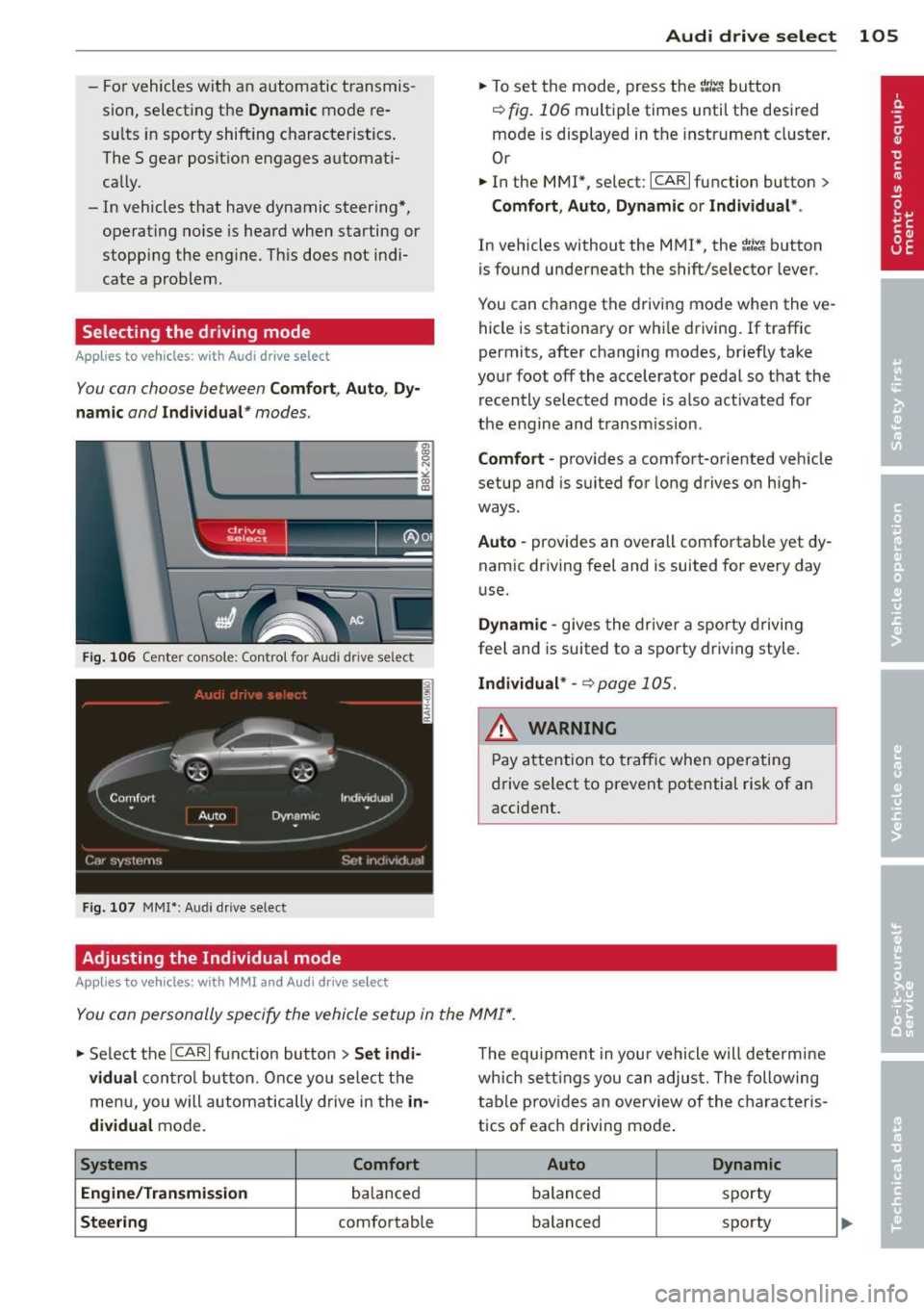
You con choose between Comfort, Auto, Dy
namic and Individual* modes.
drive I I fi el•ct _ ~-=
Fig. 106 Center console ; Con trol for Aud i dr ive se lect
Fig. 107 MMI *: Aud i drive select
Adjusting the Individual mode
Applies to vehicles: with MMI and Aud i d rive select
Audi drive select 105
.. To set the mode, press the 1.:il'.'l button
r=> fig. 106 multiple times until the desired
mode is displayed in the instrument cluster .
Or
.. In the MMI*, select: ICARlfunction button>
Comfort, Auto , Dynamic or Individual* .
In vehicles without the MMI*, the ~:/~c1 button
is found underneath the shift/selector lever.
You can change the driving mode when the ve
hicle is stationary or whi le driving.
If traffic
permits, after changing modes, briefly take
your foot off the accelerator pedal so that the recently selected mode is also activated for
the engine and transmission.
Comfort -provides a comfort-oriented vehicle
setup and is suited for long drives on high
ways.
Auto -provides an overall comfortable yet dy
namic driving feel and is suited for every day
u se.
Dynamic -gives the driver a sporty driving
feel and is suited to a sporty driving style .
Individual* -~ page 105.
& WARNING ~
Pay attention to traffic when operating
drive select to prevent potential risk of an
accident .
You con personally specify the vehicle setup in the MMI* .
.. Select the ICARI function button > Set indi
vidual
control button. Once you select the
menu, you will automatically drive in the
in
dividual
mode.
Systems Comfort
Engine/Transmission
ba lanced
Steering comfortable The
equipment in your vehicle will determine
which settings you can adjust. The following
table prov ides an overview of the characteris
tics of eac h driving mode .
Auto Dynamic
balanced spo
rty
balanced sporty
Page 186 of 286
184 Intelligent technology
At higher speeds and with the windshield wip
ers turned on, the brake pads press against
the brake rotors for a short amount of time .
This occurs at regular intervals without the
driver noticing and provides for better brake
response time under wet condit ions .
The effectiveness of the brakes can be reduced
when the vehicle is dr iven on a salt-covered
road and the brakes are not used . Likew ise,
you clean
off accumulated sa lt coating from
brake discs and pads with a few caut ious ap
plications of the brake¢&. .
Cor ro sion
There may be a tendency for dirt to build up
on the brake pads and corrosion to form on
the discs if the car is not dr iven regularly or
only for short trips with l ittle use of the
brakes .
If the brakes are not used frequently , or if cor
rosion has formed on the discs, it is advisable
to clean
off the pads and discs by brak ing
firm ly a few times from a moderately high
speed ¢,& .
Fa ults in the brake system
If you should notice a sudden increase in
brake pedal travel, then one of the two brake
circu its may have failed¢&. .
Low brake fluid le vel
Malfunct ions can occur in the brake system if
the brake fluid level is too low. The brake fluid
leve l is monitored electronically .
Brake boost er
The brake booster increases the pressure that
you generate w ith the brake pedal. It works
only when the eng ine is running .¢ &.
Brake lining w ear status
Brake lining wea r may be checked by vis ual in
spection of the condition of the brake pads
through the openings in the whee l. If neces
sary, the whee l may be removed for this in
spection
¢ page 244, Changing a wheel.
_& WARNING
-New brake pads don't have the best stop
ping power and must be "broken -in" dur
ing the initial 100 to 150 miles (150 to
200 kilometers) of normal c ity driving .
You can compensate for this by pressing the brake pedal more firmly . T his also
applies later when new pads are instal led.
- You shou ld perform braking maneuvers
for the purpose of cleaning the brake system only if road conditions permit .
Othe r road users must not be put at risk -
you may ca use an accident!
- Before descend ing a steep grade, reduce
speed and sh ift transmission into a lower
gear or lower dr iving range. Do not ride
the brakes or hold the pedal down too
long o r too often . This could cause the
brakes to get hot and diminish braking
efficiency.
- Do not "ride the brakes" by rest ing you r
foot on the pedal when you do not intend
to b rake. This may cause the brakes to
overheat, p remature wear and increased
s topping distance.
- Unde r ce rtain cl imatic and ope rat ing
conditions such as passing thro ugh wa
ter, dr iving in heavy rain o r after washing
the vehicle, the effectiveness of the brakes can be reduced. In winter, ice can
accumu late on the brake pads, linings,
d iscs and drums. Carefully apply brakes
for a test. Brakes will dry and ice coat
ings will be cleaned
off after a few care
fu l brake applicat ions .
- Driving for an extended period of t ime on
salt-covered roads without using your brakes can a lso affect braking efficiency .
Clean
off accumulated salt coating from
b rake discs and pads wi th a few ca reful
b rake applications.
- I f you damage the front spoiler, or if you
install a different spoiler, be sure the a ir
flow to the front brakes is not obstruct-
ed . Otherwise the brake system could
~
Page 190 of 286
188 Driving and environment
Driving and
environment
The first 1,000 miles
(1,500 km) and
afterwards
New engine
The engine needs to be run-in during the first
1,000 miles (1,500 km).
For the fir st 600 miles (1,000
kilometers ):
.,. Do not use full throttle.
... Do not d rive at engine speeds that are more
than 2/3 of the max imum permitted RPM.
From 600 to 1,000 miles (1 ,000 to
1,500 kilometers):
.,. Speeds can gradually be increased to the
max imum pe rm iss ible road or eng ine speed .
During and after break-in period
... Do not rev the eng ine up to high speeds
when it is cold. Th is app lies whether the
transmission is in N (Neutra l) or in gear.
After the break- in period
... Do not exceed max imum engine speed un
der any circumstances .
... Upshift into the next higher gear before
reaching the red area at the end of the tach
ometer scale¢ page 10.
During the first few hours of driving, the en
g ine's inter na l friction is higher than later
when all the moving parts have been broken
i n. How well this break- in process is done de
pends to a conside rable extent on the way the
ve hicl e is driven du ring the first 1,000 miles
(1, 500 kilome ters).
(D Note
E xtremely high engi ne speeds are auto
mat ica lly r educ ed. However, t hese rpm
lim its are programme d for a n engine well
r u n- in, not a new eng ine.
{® For the sake of the environment
Do not d rive with unnecessarily high en
g ine speeds - upshifting ear ly saves fuel,
reduces no ise and protects the environ
ment.
, New tires
If your vehicle is runni ng on new tires, drive
very carefully for the first 350 miles (500 ki lo
meters) after fitting.
_& WARNING
N ew tires tend to be slip pery a nd mus t al
so be "b roken -in" . Be s ure to remembe r
this dur ing the fi rst 350 mi les ( 500 kilo
meters) . Brake gently . Avoid fo llow ing
closely behind other vehicles or other sit
uations that m ight require sudden, hard
braking.
Avoid damaging the
vehicle
When you a re d rivi ng on poo r roads, or over
cu rbs, ste ep ramps, etc., ma ke certai n that
low- ly ing parts s uch as spoile rs and ex ha ust
s ystem parts do not bot tom o ut and get dam
aged.
T his is espec ially true for veh icles with low
s lu ng chassis (s por ts chassis)* and fully load
ed vehicles.
Driving through water
on roads
Note th e following to avoi d ve hicle damage
whe n driving through water, for examp le on
flooded roads:
- The wa ter must not be any hig he r th an the
bottom of the vehicle bo dy.
- Do not dr ive faste r than wal king speed.
Page 197 of 286
Trailer towing tips
Important to know
Yo ur veh icle hand les different ly when tow ing
a trailer because o f the addit ional weight and
d iffe ren t weight distribution . Safety, perform
ance and economy w ill greatly depend on how
caref ully you load your trailer and operate
your rig.
B efore you actua lly tow your trailer, pr actice
turning, stopp ing and bac king up in an area
away from traffic. Keep practicing until you have become comp lete ly fam iliar with the way
your veh icle-trailer comb ination behaves and
responds.
Backing up is d ifficu lt a nd requires practice .
Backing up with a tra iler genera lly requires
steer ing action opposite to that when backing
up your vehicle without a trailer.
M aintain a g reater distance betwee n your ve
h icle and the one in front o f you . You will need
mo re room to stop. To compensate for the
trailer, you will need a larger than normal
turning radius .
W hen pass ing, remember that yo u cannot ac
celerate as fast as yo u normally wo uld be
cause of the added load. Make sure you have
e nough room to pass . After passing , allow
p lenty o f room fo r your tra iler before chang
in g la nes aga in .
Avoid jerky starts, sharp turns or rap id lane
changes.
(D Tips
- Do not tow a tra iler during the break-in
period of you r vehicle.
- If you tow a trailer, your A udi may re
quire more frequent maintenance due to
the extra load
o page 264.
Trailer towin g 195
Parking on a slope
Do not park on a slope with a trailer . If it can
not be avoided, do so only after doing the fol lowing:
When parking:
.. App ly the foot brake.
.. Have someone p lace chocks under both the
veh icle and the tra iler wheels .
.,. With chocks in place, slowly release t he
bra kes unt il t he whee l choc ks absorb the
load .
.. Tu rn the whee ls towards the curb.
.,. App ly the par king b rake .
.. Place an a utomatic transm ission* in P, re
spectively a manual transmission in first or
reverse gear.
When restarting after parking:
.,. App ly th e foot br ake .
.. Start t he en gine.
.. Move the selector lever to D/S, respect ively
a man ual transmiss ion in first gea r.
.. Release the parking bra ke and s low ly pull
out and away from the wheel chocks .
.. Stop and have someone retr ieve the wheel
chocks.
@ Tips
If you move the selector leve r of the auto
matic transmissio n* to P before applying
the pa rking brake and before blocking the
whee ls, you may hav e to use mor e forc e
l ater to move the le ver out of the P posi
tion.
•
•
Page 209 of 286
-To reduce the r isk of being burned, never
open the hood if you see or hear steam
or coolant escaping from the engine
compartment . Wait until no steam or
coolant can be seen or heard before ca re
fully opening the hood .
- Keep children away from the engine com
partment.
- Never spill flu ids on hot engine compo
nents. They can cause a fire .
- Never touch the radiator fan. The aux ili
ary e lectr ic fan is temperature controlled
and can switch on suddenly .
- Never open the coolant reservoir cap
when the eng ine is still warm . The cool
ant system is pressur ized and hot coo l
ant could spray out.
- Protect your face, hands and arm from
steam or hot eng ine coolant by placing a
thic k rag over the cap when you open the
coolant reservoir.
- Do not remove the engine cover under
any c ircumstances. Th is increases the
risk of bu rns.
- If wo rk on the fuel system or the electri
cal sys tem is ne cessary:
- Always disconnect the battery.
- Never smoke or work near heaters or
open flames . Fluids in the engine com
partment co uld start a fire.
- Keep an approved fire extinguisher im
mediately ava ilable.
- To avoid electrical s hock and persona l in
jury while the engine is running or being
started, never touch:
- Ignition cables
- Other components of the high voltage
electronic ignition system.
- If you must perform a check or repa ir
with the engine running:
- Fir st, fully apply the parking brake,
move se lector lever of a utomatic trans-
Checkin g and fillin g 207
mission to "P" (Park); put manual
transmission in Neutral.
- Always use extreme caution to prevent
clothing, jewe lry, or long hair from get
ting caught in the radiator fan, V-be lts
or other moving parts, or from contact i ng hot parts . Tie back hair before
starting, and do not wear clothing that
will hang o r droop into the engine .
- Minimize exposure to emission and
chemical hazards~&. .
A WARNING
California Proposition 65 Warning:
- Engine exhaust, some of its const ituents,
a nd certain vehicle components contain
or emit chemicals known to the State of
Ca lifornia to cause cance r and birth de
fects and reproductive harm. In addition, certain fl uids contained in veh icles and
certain products of component wear con
tain or emit chemica ls known to the
State of California to cause cancer and
birth defects or other reproductive harm.
- Battery posts, terminals and related ac
cessories conta in lead and lead com
pounds, chemicals known to the State of
California to cause cancer and reproduc
tive harms. Wash hands afte r handling.
Q) Note
When adding f lu ids, always make sure that
they are poured into the proper conta iner
or f iller opening, otherwise serious dam
age to vehicle systems w ill occur .
@ For the sake of the environment
To detect leaks in time, inspect the vehicle
floor pan from underneath regular ly . If
you see spots from oil or other veh icle flu
i ds, have your vehicle inspected by an au
thorized Audi dealer. •
•