warning light AUDI A5 COUPE 2014 Repair Manual
[x] Cancel search | Manufacturer: AUDI, Model Year: 2014, Model line: A5 COUPE, Model: AUDI A5 COUPE 2014Pages: 286, PDF Size: 70.99 MB
Page 166 of 286
164 Child Saf ety
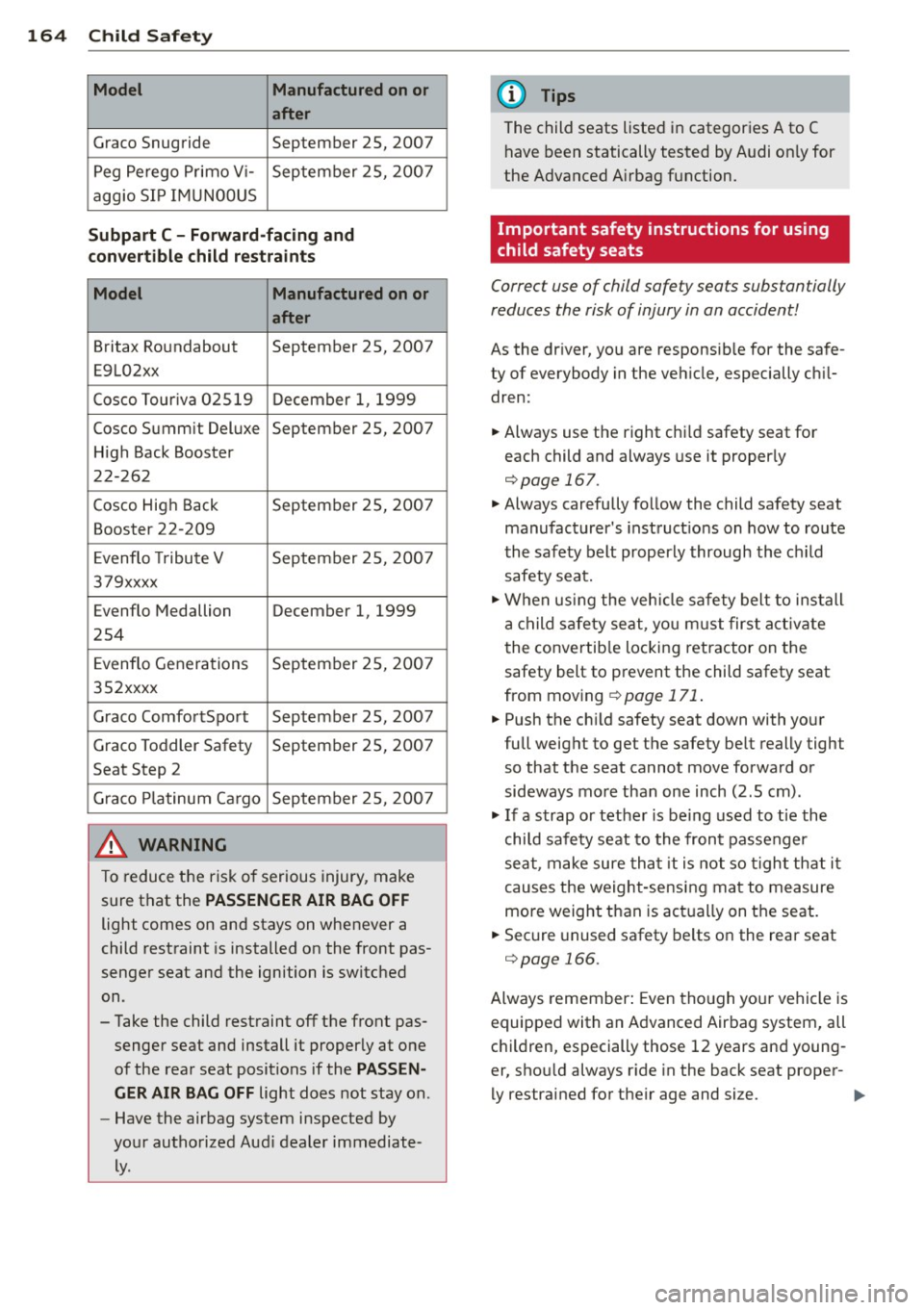
Model Manufactured on or
a fter
Graco Snugride September 2S, 2007
Peg Perego Primo V i- September 25, 2007
aggio SIP IMUN00US
Subpart C -Forward -facing and
con vertibl e child r estra in ts
Model Manufactured on or
after
Britax Roundabout September 25, 2007
E9L02xx
Cosco Tour iva 02519 December 1, 1999
Cosco Summit Deluxe September 2S, 2007
High Back Booster
22-262
Cosco Hig h Back September 25, 2007
Booster 22-209
Evenflo Tribute V September 25, 2007
379xxxx
Evenflo Medallion December 1, 1999
254
Evenflo Generations September 25, 200
7
352xxxx
Graco ComfortSport September 25, 2007
Graco Toddler Safety September 25, 2007
Seat Step 2
Graco P latinum Ca rgo September 25, 2007
_&. WARNING
T o reduce the risk of serious injury, make
sure that the
PASSENGER AIR BAG OFF
light comes on and stays on whenever a
child restraint is installed on the front pas
senger seat and the ignition is switched
on.
- Take the child restraint off the front pas senger seat and install it properly at one
of the rear seat positions if the
PASSEN
G ER AIR BAG OFF
light does not stay on.
- Have the airbag system inspected by
your authorized Aud i dealer immediate
ly.
(!) Tips
The child seats listed in categories A to C have been statically tested by Audi on ly for
the Advanced A irbag function.
Important safety instructions for using
child safety seats
Correct use of child safety seats substantially
reduces the risk of injury in an accident!
As the driver, you are responsib le for the safe
ty of everybody in the veh icle, especially ch il
dren:
... Always use the right ch ild safety seat for
each child and always use it properly
c::;,page 167 .
... Always carefully follow the child safety seat
manufacturer's instruct ions on how to route
the safety belt properly through the child
safety seat.
... When usi ng the veh icle safety belt to install
a child safety seat, you m ust first activate
the convertib le locking retractor on the
safety belt to prevent the child safety seat
from moving
¢ page 171.
... Push the ch ild safety seat down with your
full weight to get the safety belt really tight
so that the seat cannot move forwa rd or
sideways mo re than one inch (2.5 cm) .
... If a strap or tether is be ing used to t ie the
child safety seat to the front passenger
seat, make sure tha t it i s n ot so tight th at i t
causes the weight -sensing mat to measure
more weight than is act ually on the seat.
... Sec ure unused safety belts o n the rear seat
c::;, page 166 .
Always remember : Even tho ugh yo ur vehicle is
equipped with an Advanced Airbag system, all
chi ldren, especially those 12 years and young
er, shou ld always r ide in the back seat proper-
ly restrained for their age and size. .,.
Page 168 of 286
166 Child Safet y
range, and as far away from the airbag
as possible before installing the child
restra int.
- Always make sure that nothing pre
vents the front passenger's seat from be ing moved to the rearmost position
in its fore and aft adjustment range.
- Always make sure that the backrest is
in the upright position .
- Always buck le the child safety seat firmly
in place even if a child is not s itting in it.
A loose ch ild safety seat can fly around
dur ing a sudden stop or in a coll is ion.
- Always read and heed all WARNINGS
whenever using a child restrained in ave
hicle is being used
c::> page 129, Safety
belts, c::>page 137, Airbag system
and
c::> page 161, Child Safety.
.,&. WARNING
To reduce the risk of serious injury, make
sure that the
PAS SENGER AIR B AG OFF
light comes on and stays on whenever a
child restraint is installed on the front pas
senger seat and the ignition is switched
on.
- Take the child rest raint off the front pas
senger seat and install it proper ly at one
of the rear seat positions if the
PASSEN
GER AIR BAG OFF
light does not stay on.
- Have the airbag system inspected by
your authorized Audi dealer immediate
ly.
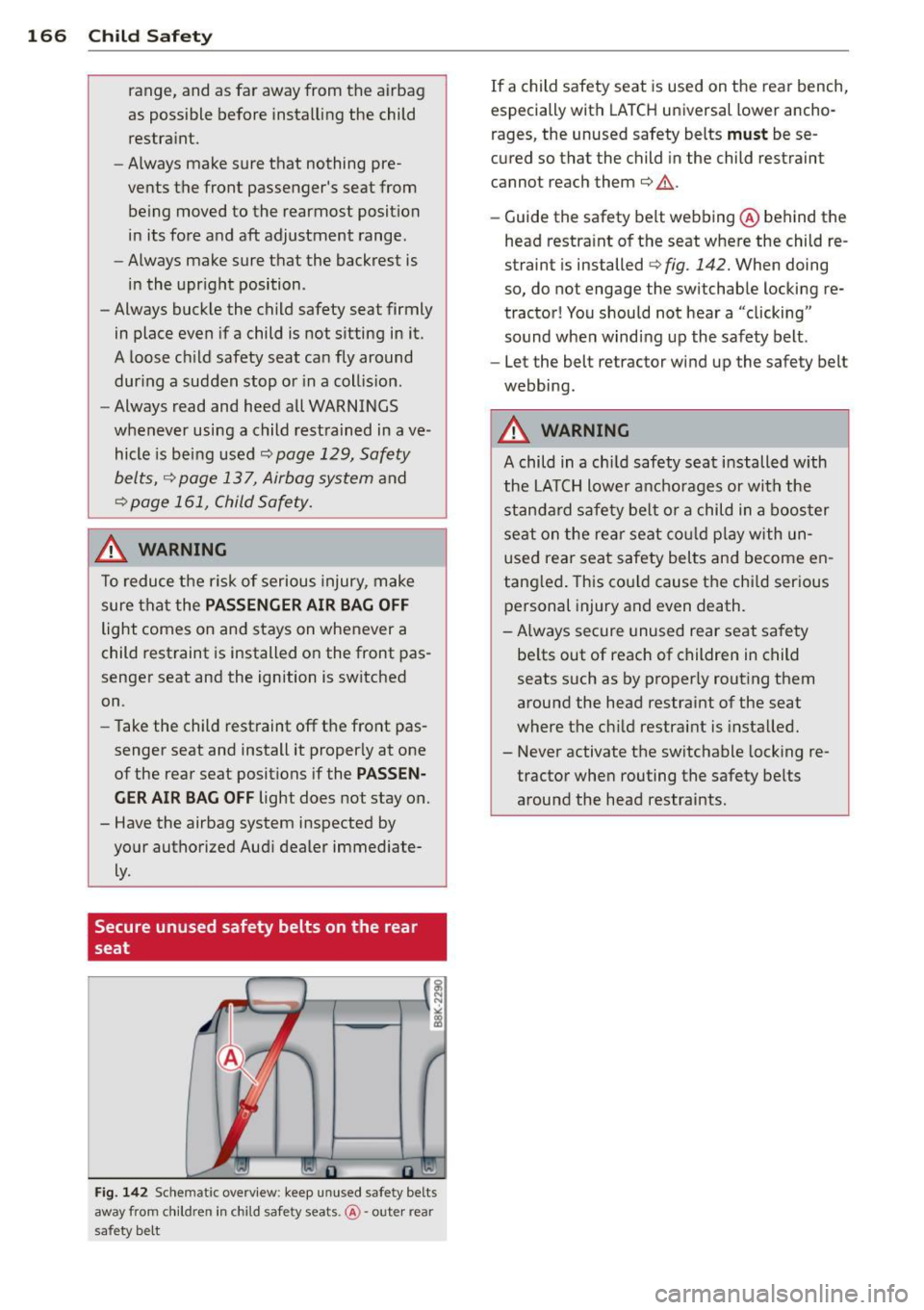
Secure unused safety belts on the rear
seat
Fig. 1 42 Schematic overview: keep unused safety belts
away from chil dren in child safety seats. @· outer rear
sa fety be lt
.
If a child safety seat is used on the rear bench,
especially with LATCH universal lower ancho
rages, the unused safety belts
must be se
cured so that the child in the child restraint
cannot reach them
c::> &.
-Guide the safety belt webbing @ behind the
head restra int of the seat where the child re
straint is installed
c::> fig . 142. When doing
so, do not engage the switchable locking re
tractor! You should not hear a "clicking"
sound when winding up the safety belt.
- Let the belt retractor wind up the safety belt
webbing.
.,&. WARNING
-A child in a chi ld safety seat installed with
the LA TCH lower a nchorages or with the
standard safety be lt or a child in a boos ter
seat on the rear seat co uld p lay with un
used rear seat safety belts and become en
tang led . This co uld cause the chi ld ser ious
personal injury and even death.
-Always secure unused rear seat sa fety
be lts out of reach of children in child
seats such as by proper ly routing them
around the head restraint of the seat
where the ch ild restraint is installed.
- Never activate the switchable locking re
tractor when routing the safety belts
around the head restraints.
Page 169 of 286
Child safety seats
Infant seats
Babies and infants up to about one year old
and 20 lbs. or 9 kg need special rearward -fac
ing child restraints that support the back,
neck and head in a crash.
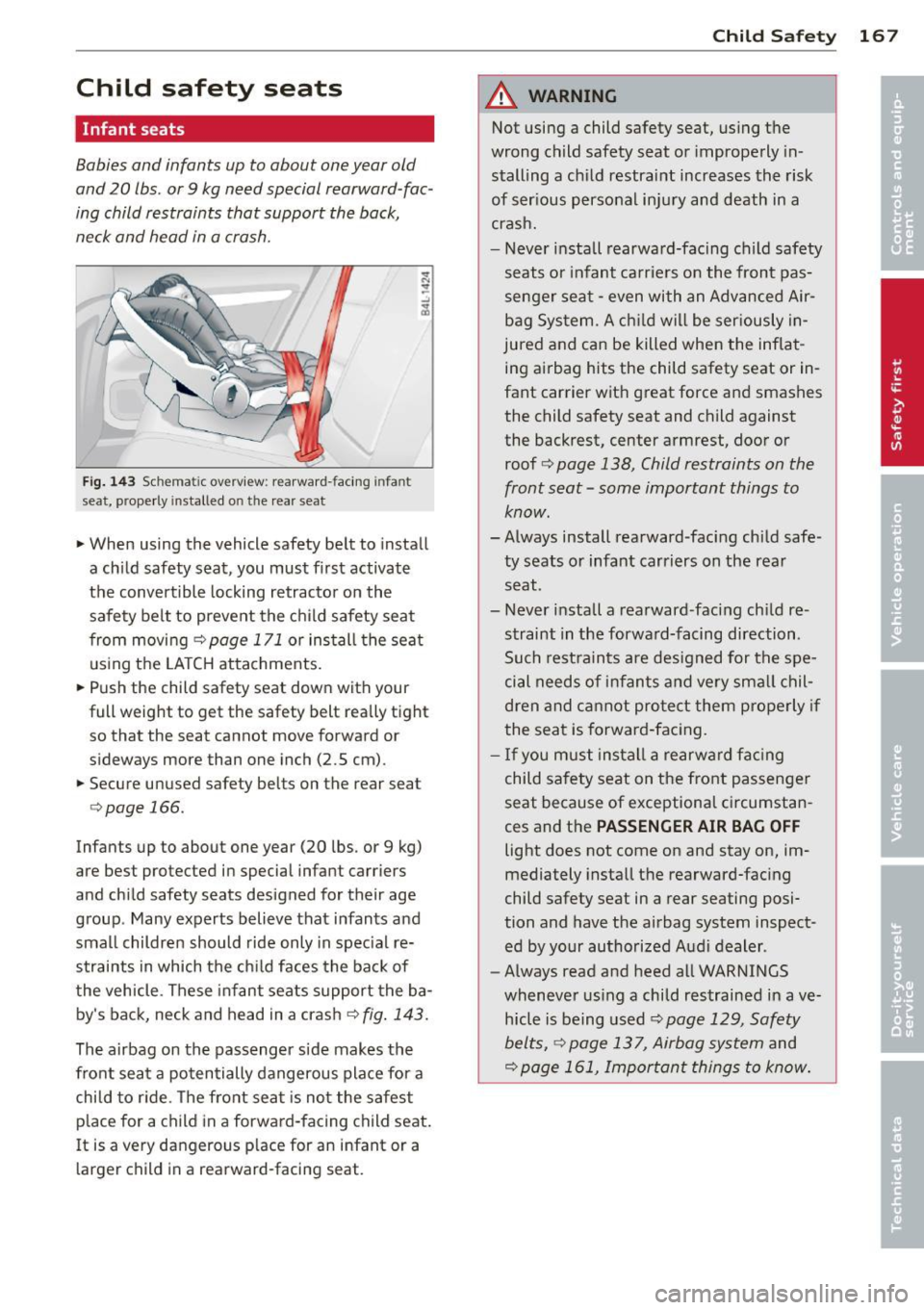
Fig . 143 Sche matic overv iew: rearward-fac ing infant
seat, properly installed o n the rear seat
.,. When using the vehicle safety belt to install
a child safety seat, you must first activate
the convertible locking retractor on the
safety belt to prevent the child safety seat
from moving
¢ page 171 or install the seat
using the LA T CH attachments.
.,. Push the child safety seat down with your
full weight to get the safety belt rea lly tight
so that the seat cannot move forward or
sideways more than one inch (2.5 cm).
.,. Secure unused safety belts on the rear seat
¢page 166.
Infants up to about one year (20 lbs . or 9 kg)
are best protected in special infan t carriers
and child safety seats designed for their age
group . Many experts believe that infants and
small children should ride only in spec ial re
straints in which the ch ild faces the back of
the vehicle. These infant seats support the ba
by's back, neck and head in a crash
¢ fig . 143.
The airbag on the passenger side makes the
front seat a po tentially dangerous place for a
child to r ide . The front seat is not the safest
p lace for a child in a forward -facing child seat.
It is a very dangerous p lace for an infant or a
l arger child in a rearward-facing seat.
Child Safety 16 7
A WARNING
Not using a child safety seat, using the
wrong child safety seat or improperly in
stall ing a ch ild restraint increases the risk
of ser ious personal injury and death in a
crash.
- Never install rearwa rd-facing child safety
seats or infant ca rrie rs on the front pas
senger seat -even with an Advanced Air
bag Sys tem. A ch ild will be ser iously in
jured and can be killed when the inflat
ing airbag hits the child safety seat or in
fant carrier with great force and smashes the child safety seat and child against
the backrest, center armrest, door or
roof ¢
page 138, Child restraints on the
front seat- some important things to
know .
-Always install rearward -facing chi ld safe
ty seats or infant carriers on the rear seat .
- Never install a rearward -facing ch ild re
straint in the forward-facing direction .
Such rest ra ints are designed for the spe
cial needs of infants and ve ry sma ll chil
dren and cannot pro tect them properly if
the seat is forward -facing.
- If you must insta ll a rearwa rd fac ing
child safety seat on the front passenger
seat because of exceptional c ircumstan
ces and the
PASSENGER AIR BAG OFF
light does not come on and stay on, im
mediately install th e rearward-facing
child safety seat in a rear seating posi
tion and have the airbag system inspect ed by your authorized Audi dealer .
- Always read and heed all WARNINGS
wheneve r us ing a child restrained in ave
h icle is being used ¢
page 129, Safety
belts,
Q page 13 7, Airbag system and
¢ page 161, Impor tan t things to know .
Page 170 of 286
168 Child Safet y
Convertible child safety seats
Properly used convertible child safety seats
can help protect toddlers and children over
age one who weigh between
20 and 40 lbs. (9
and 18 kg) in a crash.
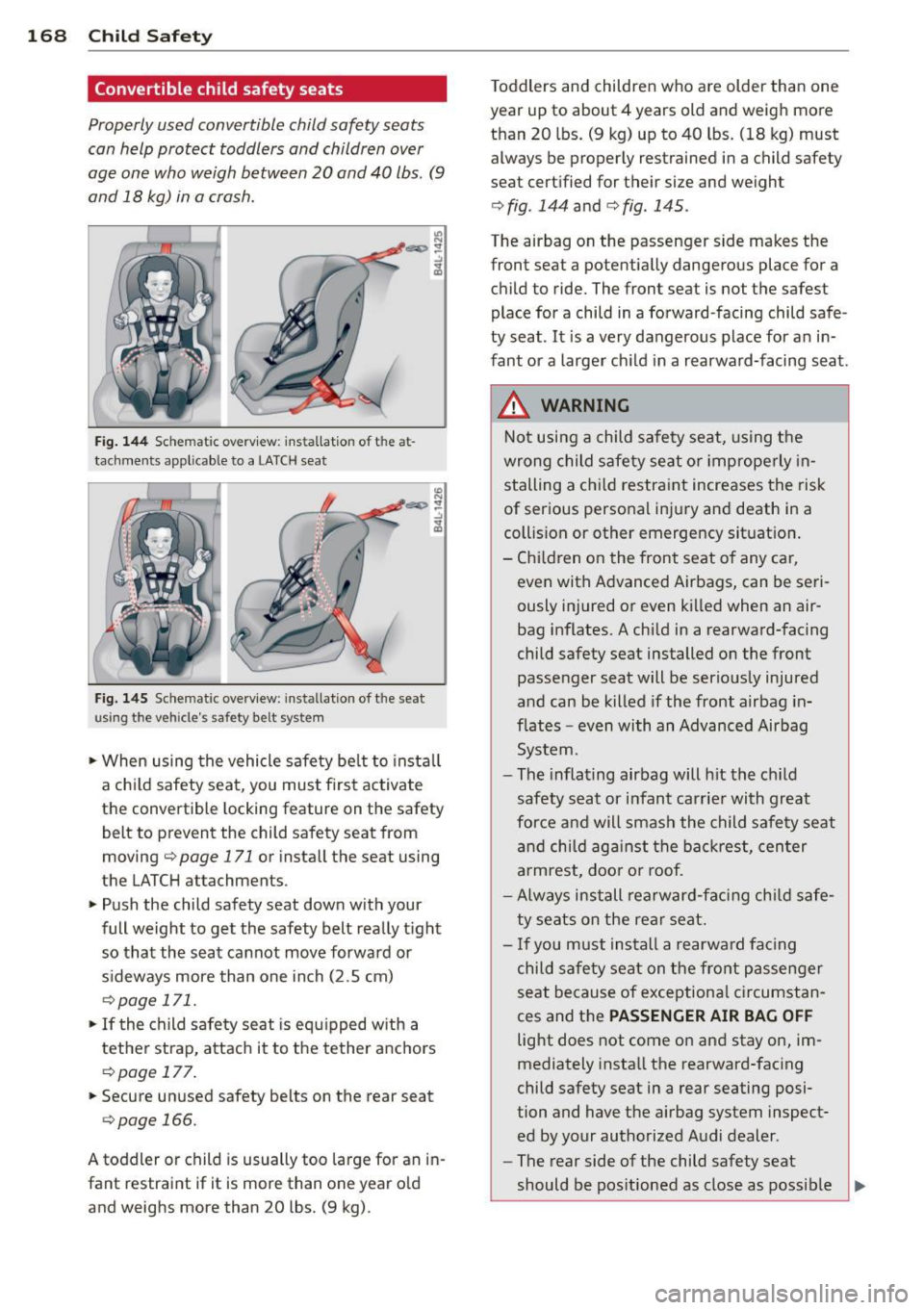
Fig . 144 Schematic overv iew: installat ion of the at
t a chments appl icable to a LA TCH seat
Fig. 145 Schematic overview: in stalla tion of t he sea t
using the vehicle's safety be lt system
.. When using the vehicle safety be lt to insta ll
a chi ld safety seat, you must f irst activate
the convertible locking feature on the safety
belt to prevent the child safety seat from
moving
c::> page 171 or insta ll the seat using
the LATCH attachments.
.. Push the child safety seat down with your
full weight to get the safety belt really t ight
so that the seat cannot move forwa rd or
s ideways more than one inch (2.5 cm)
c::> page 171.
.. If the child safety seat is eq uipped w ith a
tether strap, attach it to the tether anchors
¢ page 177.
.. Secure unused safety belts on the rear seat
c::> page 166.
A toddler or child is usually too large for an in
fant restra int if it is more than one year o ld
and weighs more than 20 lbs. (9 kg) . T
oddlers and children who are older than one
year up to about 4 years old and weig h more
than 20 lbs. (9 kg) up to 40 lbs. (18 kg) must
always be properly restrained in a child safety
seat certified for their size and weight
c::>fig . 144 and c::> fig . 145 .
The airbag on the passenger side makes the
front seat a potentia lly dangerous place for a
child to ride. The front seat is not the safest
place for a child in a forward-facing child safe
ty seat . It is a very dangerous place for a n in
fant or a larger ch ild in a rearward-facing seat.
_&. WARNING
No t using a child safety seat, us ing t he
wrong child safety seat o r imprope rly in
stalling a chi ld restraint increases the risk
of serious personal injury and death in a
collision or other emergency situat ion .
- Chi ldren on the front seat of any ca r,
-
even with Advanced Airbags, can be seri
ously injured or even killed when an air
bag inflates . A ch ild in a rearward-facing
child safety seat installed on the front
passenger seat will be serious ly injured
and can be killed if the front airbag in
f lates -even with an Advanced Airbag
System .
- The inflating airbag will h it the ch ild
safety seat or infant carrie r with great
force and will smash the child safety seat and child aga inst the backrest, center
armrest, doo r or roof.
- Always ins tall rearward-fac ing ch ild safe
ty seats on the rear seat.
- If you must insta ll a rearwa rd fa cing
child safe ty seat on the fro nt passenger
seat because of exceptiona l circumstan
ces and the
PA SSENGER AIR BAG OFF
light does not come on and stay on, im
mediately insta ll the rearward-facing
child safety seat in a rear seating posi
tion and have the airbag system inspect
ed by your authorized Audi dealer .
- The rear side of the child safety seat
should be pos itioned as close as possib le ..,.
Page 171 of 286
to the backrest on the veh icle seat. Ad
just or remove the rear seat head restraint if it is diff icult to install t he
child seat w ith the head restraint in place
¢ page 57. Install the head restraint
again immed iate ly once the child seat is
removed. Driving without head rest raints
o r with he ad restraints that are not prop
erly adjusted increases the risk of serious
or fatal neck injury dramatica lly.
- Always read and heed all WARN INGS
whenever using a child rest rained in ave
hicle is being used
¢page 129, Safety
belts,
¢ page 13 7, Airbag system and
¢ page 161, Important things to know.
A WARNING
If except ional circumstances requ ire the
use of a forward-facing child restra int on
the front passenger's seat, the ch ild's safe
ty and well-being require that the follow
ing special precautions be taken:
- Make sure the forward-fac ing seat has
been designed and certified by its manu
factur er for use on a front seat with a
passenge r fron t and side airbag.
- Always follow the manufact urer's in
st ruct ions provided with the child safety
sea t or infan t carrier.
- Always mov e the front passenge r sea t in
to the rearmost posit io n of the passen
ger seat's fore and aft ad justment r ange,
and as far away from the airbag as possi
ble before instal ling the child restraint.
- Always make sure that noth ing prevents
the front passenger's seat from bei ng
moved to the rearmost position in its
fore and aft adjustment range .
- Always make sure the backrest is in an upr ight position.
- Make su re that the
PASSENGER AIR BAG
OFF
light comes on and stays on all the
time whenever the ignition is switched
on.
- If the light does not stay on, perform the
checks¢
page 147, Monitoring the Ad
vanced Airbag System.
-
Child S afety 169
- Ta ke the chi ld restraint
off the front pas
senger seat and install it properly at one
of the rear seat positions if the
PASSEN
G ER AIR BAG OFF
light does not stay on
whenever the ignit ion is switched on.
Booster seats and safety belts
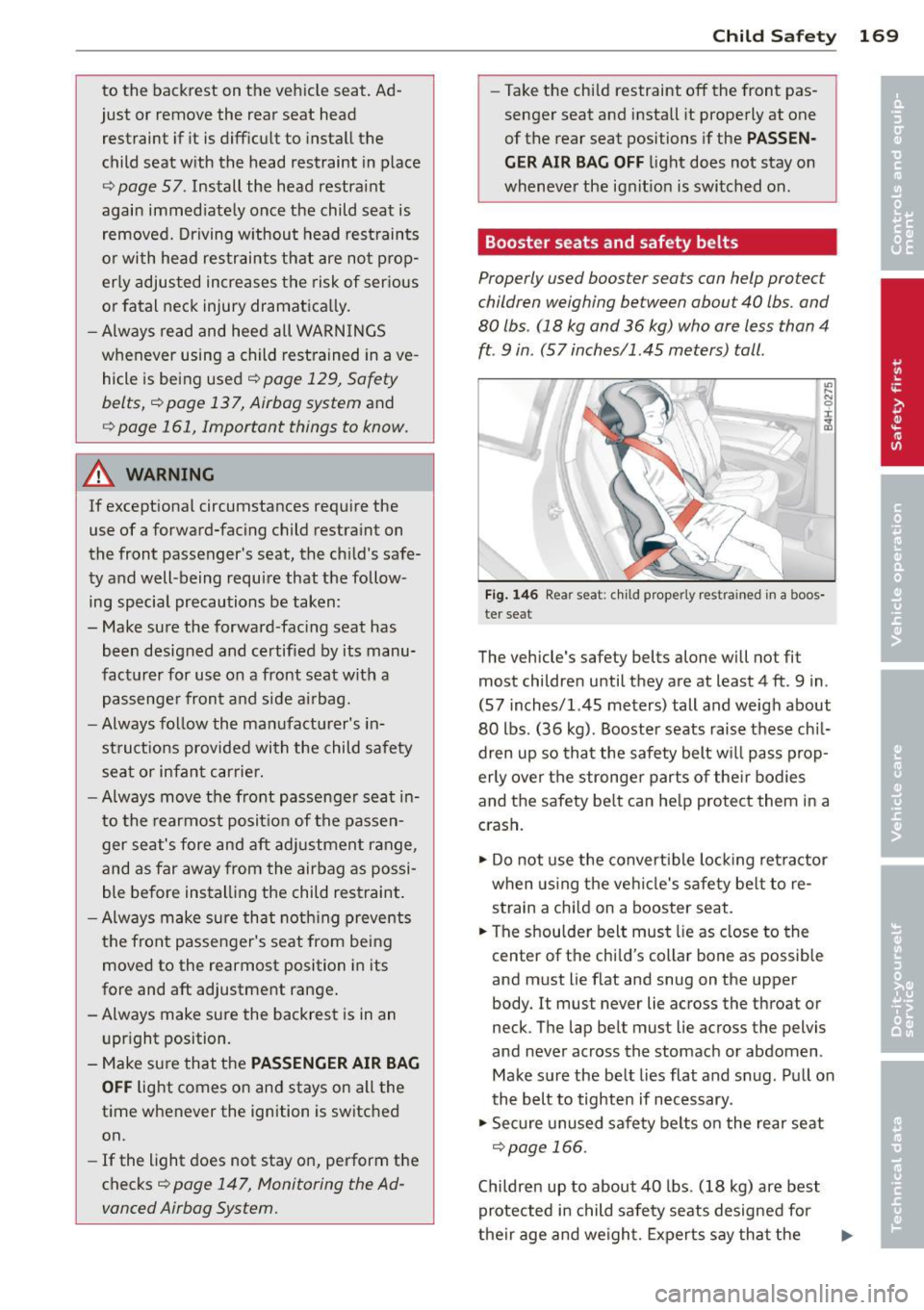
Properly used booster seats con help protect
children weighing between about 40 lbs. and
80 lbs . (18 kg and 36 kg) who are less than 4
ft.
9 in . (57 inches/1 .45 meters) tall.
In .... N 0 ±
~
Fi g. 14 6 Rear seat: ch ild properly res trained in a boos
ter seat
The vehicle's safety belts alone w ill not fit
most children until they are at least 4
ft. 9 in .
(57 inches/1.45 me ters) tall and weigh about
80 lbs .
(36 kg). Booster seats rais e these chi l
dren up so tha t the safety belt w ill pass p rop
erly over the stronger parts of the ir bodies
and the safety be lt can he lp protect them in a
crash.
.,. Do not use the convert ible lo cki ng ret ra ctor
when using the ve hicl e's s afety be lt to re
s train a ch ild on a booster seat.
... The shoulde r belt must lie as close to the
center of the ch ild's collar bone as possible
and must lie flat and snug on the upper
body. It must never lie across the throat or
neck . The lap be lt must lie across the pelvis
and never across the stomac h or abdomen .
Make s ure the belt lies flat and sn ug. Pull on
th e belt to tighten if necessary.
.,. Se cure unused safety belts o n the rear seat
¢page 166.
Children up to about 40 lbs . (18 kg) are best
protected in child safe ty seats designed for
their age and we igh t. Experts say th at the
Page 173 of 286
-Never let a child ride in the cargo area of
your vehicle.
- Always remember that a chi ld leaning
forward, sitting sideways or out of posi
t ion in any way during an acc ident can be
struck by a deploying airbag. This will re
sult in serious personal injury or death.
- If you must install a booster seat on the
front passenger seat because of excep
t ional circumstances the
PASSENGER
AIR BAG OFF
light must come on and
stay on, whenever the ignition is switch
ed on.
- If the
PASSENGER AIR BAG OFF light
does not come on and stay on, perform
the checks described
¢ page 147, Moni
toring the Advanced Airbag System.
- Ta ke the child rest rain t off the fron t pas
senger seat and ins tall it proper ly a t one
of the rear seat posi tions if the
PASSEN
GER AIR BAG OFF
light does not stay on
whenever the ignition is switched on .
- Always read and heed all WARNINGS
whenever using a child restrained in ave
hicle is being used
¢page 129, Safety
belts,¢ page 137, Airbag system
and
¢ page 161, Important things to know.
Installing a child safety
seat
Securing a child safety seat using a
safety belt
Safety belts for the rear seats and the front
passenger's seat can be locked with the con
vertible locking retractor to properly secure
child safety seats .
The safety belts emergency lock ing retractors
for the rear seats safety belts and for the
fro nt passenger's seat safety belt have a con
vertible locking retracto r fo r child restra ints .
The safety belt must be locked so that belt
webbi ng cannot unreel. The retracto r can be
activ ated to lock t he safety be lt and p revent
t he safe ty belt webbing from loosening up
d uring normal driving . A child sa fety seat can
only be properly installed when the safety belt
Child Sa fet y 1 71
is loc ked so that the chi ld and child sa fety
seat wi ll stay in place.
A lw ays remember: Even tho ugh yo ur vehicle is
equipped with an Advanced Airbag system, all
c hi ldren, especially those 12 years and young
er, sho uld always ride in the back seat prope r
l y restrained for the ir age and we ight .
A WARNING
Imp roperly installed chi ld safety seats in
crease the risk of serious personal injury
and deat h in a co llision.
- Always make sure that the safety belt re
tracto r is locked when insta lling a child
safety seat. An unlocked safety belt re
trac to r cannot hold the child safety seat
in place dur ing norma l dr iving o r in a
crash.
- Always buckle the child safety seat firmly
in place even if a ch ild i s not si tt ing in it.
A loose child safe ty seat can fly aroun d
du ring a sudden stop or in a collision.
- If the backrest is not securely la tched,
the child and the child re5traint will be
thrown forward togethe r with the bac k
rest and will strike parts of the vehicle
interior. The child can be se riously in
jured or killed.
- Never install rearwa rd-facing child safety
seats or infant ca rrie rs on the front pas
senger seat. A child will be serio usly in
jured and can be killed when the passen
ge r airbag inflates .
- The inflating airbag will h it the ch ild
safety seat or infant carrie r with great
force and will smash the child safety seat and child against the bac krest, center
armrest, doo r or roof.
- Always install rearward-facing chi ld safe
ty seats or infant carriers on the rea r
s eat .
- Forwa rd-facing child safety seats o r in
fa nt car riers installed on the front pas
s enger's seat may in terfere with the de
ployme nt of t he ai rb ag and cause serious
in jury to the child. ..,_ •
•
Page 174 of 286
172 Child Safety
-It is safer to install a forward-facing
child safety seat on the rear seat.
- Always read and heed all WARNINGS
whenever using a child restrained in ave
hicle is being used
c::;, page 161. Special
precautions apply when installing a child
safety seat on the front passenger seat
c::;, page 138, Child restraints on the front
seat -some important things to know.
A WARNING
Always take special precautions if you
must install a forward or rearward-facing
child restraint on the front passenger's
seat in exceptional situations:
- Whenever a forward or rearward-facing
child restraint is installed on the front
passenger seat, the
PASSENGER AIR
BAG OFF
light must come on and stay on
whenever the ignition is switched on.
- If the
PASSENGER AIR BAG OFF light
does not come on and stay on, perform
the checks described
c::;, page 147, Moni
toring the Advanced Airbag System.
- Take the child restraint off the front pas
senger seat and install it properly at one
of the rear seat positions if the
PASSEN
GER AIR BAG OFF
light does not stay on
whenever the ignition is switched on .
- Improper installation of child restraints
can reduce their effectiveness or even
prevent them from providing any protec
tion.
- An improperly installed child restraint
can interfere with the airbag as it de
ploys and seriously injure or even kill the
child.
- Always carefully follow the manufactur
er's instructions provided with the child
safety seat or carrier.
- Never place additional items on the seat
that can increase the total weight regis
tered by the weight-sensing mat and can
cause injury in a crash.
A WARNING
Forward-facing child restraints: -
Always make sure the forward-facing
seat has been designed and certified by
its manufacturer for use on a front seat
with a passenger front and side airbag .
- Never put the forward-facing child re
straint up, against or very near the in
strument panel.
- Always move the passenger seat into its
rearmost position in the seat's fore and
aft adjustment range, as far away from
the airbag as possible before installing
the forward-facing child restraint. The
backrest must be adjusted to an upright
position.
- Make sure that the
PASSENGER AIR BAG
OFF
light comes on and stays on all the
time whenever the ignition is switched
on.
A WARNING ~
Rearward-facing child restraints:
- A child in a rearward-facing child safety
seat installed on the front passenger
seat will be seriously injured and can be
killed if the front airbag inflates - even
with an Advanced Airbag System.
- The inflating airbag will hit the child
safety seat or infant carrier with great
force and will smash the child safety seat
and child against the backrest, center
armrest, door or roof.
- Always be especially careful if you must
install a rearward facing child safety seat
on the front passenger seat in exception
al circumstances .
- A tight tether strap on a rearward -facing
child restraint attached to the front pas
senger seat can put too much pressure
on the weight-mat in the seat and regis
ter a heavier weight in the Advanced Air
bag System. The heavier weight regis
tered can make the system work as
though an adult were on the seat and de
ploy the Advanced Airbag when it must
be suppressed causing serious or even
fatal injury to the child.
Page 175 of 286
-Make sure that the PASSENGER AIR BAG
OFF
light comes on and stays on all the
time whenever the ignition is switched on.
- If the
PASSENGER AIR BAG OFF light
does not come on and stay on, immedi
ately install the rearward -facing child
safety seat in a rear seating position and
have the airbag system inspected by your
authorized Audi dealer.
Activating the convertible locking retractor
Use the convertible locking retractor to se
cure a child restraint .
Always heed the child safety seat manufactur
er's instructions when installing a child re
straint in your vehicle. To activate the conver
tible locking retractor :
.,. Place the child restraint on a seat, prefera
bly on the rear seat.
.,. Slowly pull the belt
all the way out.
.,. Route it around or through the child re
straint belt path¢.&_ .
.,. Push the child safety seat down with your
full weight to get the safety belt really tight.
.,. Inser t the belt tongue into the buckle for
that sea ting position .
.,. Guide the safety belt back into the retractor
until the belt lies flat and snug on the child
safety seat .
.,. You should hear a "clicking " noise as the
belt winds back into the inertia reel. Test the
convertible locking retractor by pulling on
the belt . You should no longer be able to
pull the belt out of the retractor. The con
vertible locking retractor is now activated.
.,. Make sure that the red release button is fac
ing away from the child restraint so that it
can be unbuckled quickly .
.,. Pull on the belt to make sure the safety belt
is properly tight and fastened so that the
seat cannot move forward or sideways more
than one inch (2.5 cm).
Child Safety 173
A WARNING
Using the wrong child restraint or an im
properly installed child restraint can cause
serious personal injury or death in a crash .
- Always make sure that the safety belt re-
tractor is locked when installing a child
safety seat. An unlocked safety belt re
tractor cannot hold the child safety seat in place during normal driving or in a
crash.
- Always buckle the child safety seat firmly
in place even if a child is not sitting in it.
A loose child safety seat can fly around
during a sudden stop or in a crash.
- Always make sure the seat backrest to
which the child restraint is installed is in
an upright position and securely latched
into place and cannot fold forward. Oth
erwise, the seatback with the child safety
seat attached to it could fly forward in
the event of an accident or other emer gency situation.
- Always read and heed all WARNINGS
whenever using a child restrained in ave
hicle is being used ¢
page 161. Special
precautions apply when installing a child
safety seat on the front passenger seat
¢ page 138, Child restraints on the front
seat -some important things to know.
-
Deactivating the convertible locking
retractor
The conv ertibl e locking retractor for child r e
straints will be deactivated automatically when the belt is wound all the way back into
the retractor.
.,. Press the red button on the safety belt buck
le . The belt tongue will pop out of the buck
le .
.,. Guide the s afety belt all the way back into
i t s s towed position .
Always let the safety belt retract completely
into its stowed position. The safety belt can
now be used as an ordinary safety belt with
out the convertible locking retractor for child
restraints.
•
•
Page 180 of 286
1 78 Child Safety
-Never attach a tether strap to a tie-down
hook in the luggage compartment .
- Never use child restraint tether ancho
rages to secure safety belts or other
kinds of occupant restraints.
- Never secure or attach any luggage or
other items to the LATCH lower ancho
rages or to the tether anchors.
- If a tether or other strap is used to at
tach a child restraint to the front passen
ger seat, make sure that it is not so
tight, that it causes the weight-sensing
mat to measure more weight than is ac
tually on the seat.
- The heavier weight registered can make
the Advanced Airbag System work as
though an adult were on the seat and de
ploy the Advanced Airbag when it must
be suppressed causing serious or even
fatal injury to the child.
-If you must install a rearward facing
child safety seat on the front passenger
seat because of exceptional circumstan
ces and the
PASSENGER AIR BAG OFF
light does not come on and stay on, im
mediately install the rear-facing child
safety seat in a rear seating position and
have the airbag system inspected by your
authorized Audi dealer.
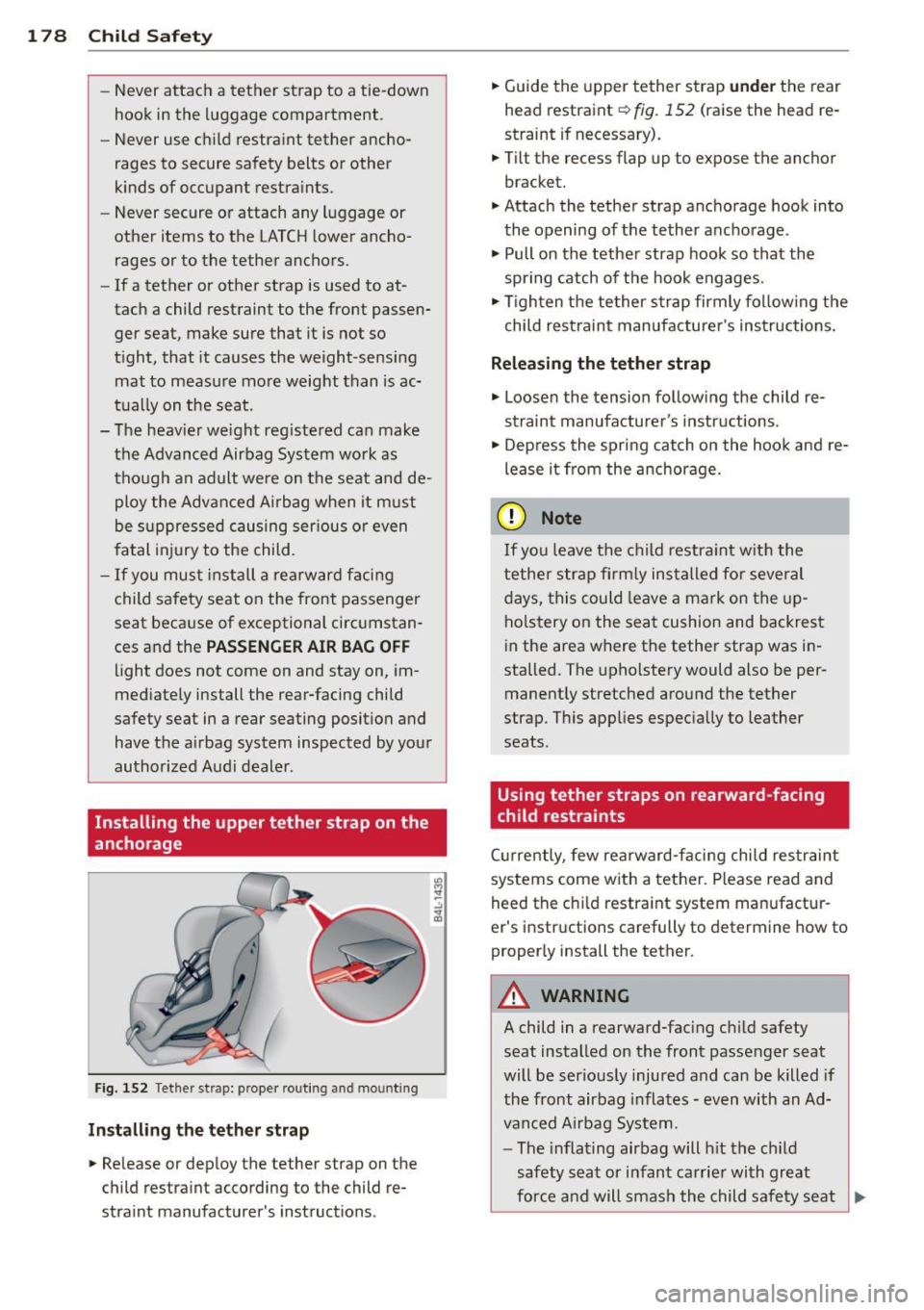
Installing the upper tether strap on the
anchorage
Fig. 1S2 Tethe r strap: prope r routing and mounting
Installing the tether strap
.,. Release or deploy the tether strap on the
child restraint according to the child re
straint manufacturer's instructions. .,.
Guide the upper tether strap
under the rear
head restraint co
fig. 152 (raise the head re
straint if necessary).
.,. Tilt the recess flap up to expose the anchor
bracket.
.,. Attach the tether strap anchorage hook into
the opening of the tether anchorage.
.,. Pull on the tether strap hook so that the
spring catch of the hook engages .
.,. Tighten the tether strap firmly following the
child restraint manufacturer's instructions.
Releasing the tether strap
.,. Loosen the tension following the child re
straint manufacturer's instructions.
.,. Depress the spring catch on the hook and re
lease it from the anchorage.
(D Note
If you leave the child restraint with the
tether strap firmly installed for several
days, this could leave a mark on the up
holstery on the seat cushion and backrest
in the area where the tether strap was in
stalled. The upholstery would also be per
manently stretched around the tether
strap. This applies especially to leather
seats .
Using tether straps on rearward-facing
child restraints
Currently, few rearward-facing child restraint
systems come with a tether. Please read and
heed the child restraint system manufactur
er's instructions carefully to determine how to
properly install the tether .
A WARNING ~ -
A child in a rearward-facing child safety
seat installed on the front passenger seat
will be seriously injured and can be killed if
the front airbag inflates -even with an Ad
vanced Airbag System.
- The inflating airbag will hit the child
safety seat or infant carrier with great
force and will smash the child safety seat ..,.
Page 185 of 286
Intelligent technology 183
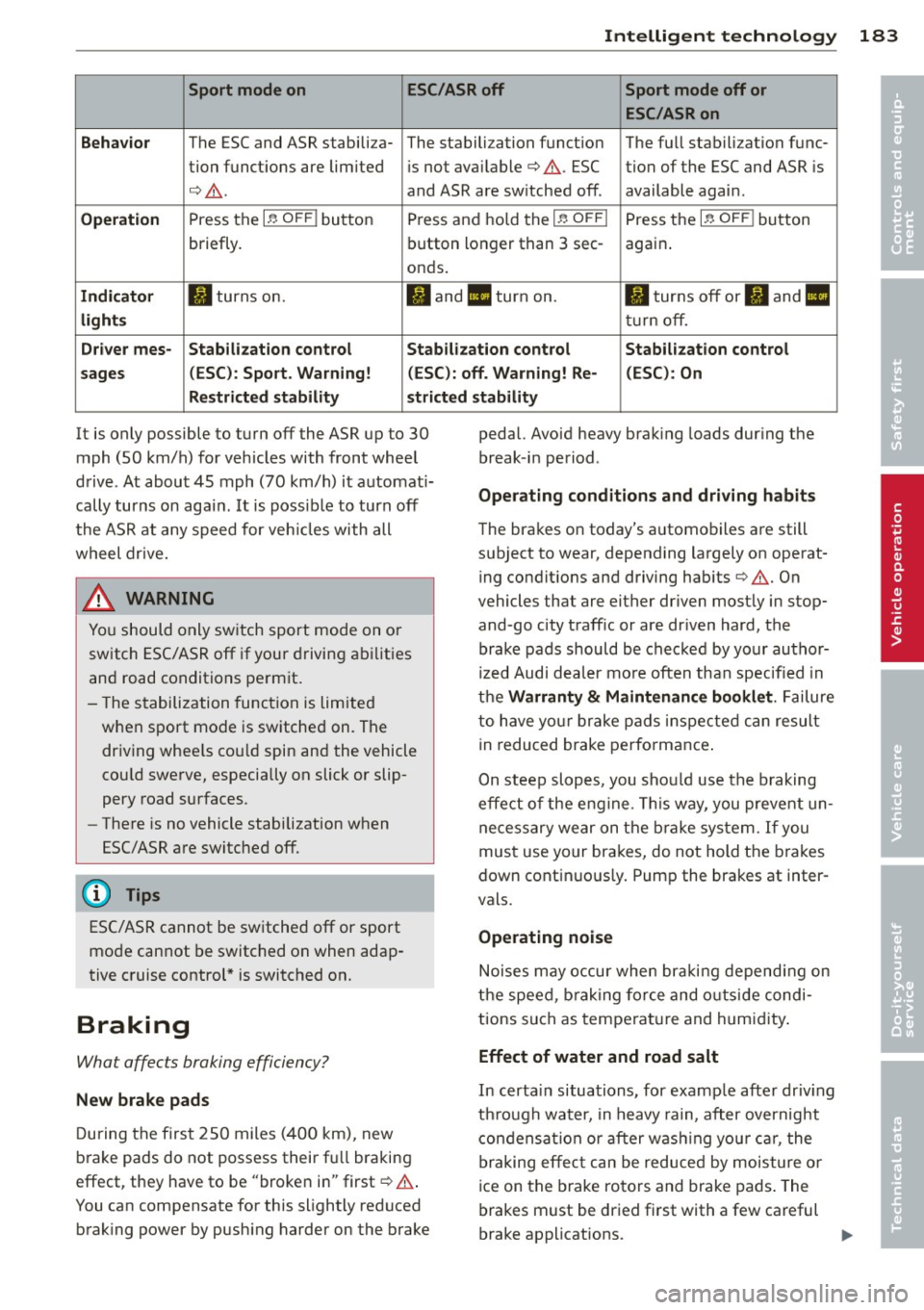
Sport mode on ESC/ASR off Sport mode off or
ESC /ASR on
Behavior
The ESC and ASR stabiliza- The stalbilization f unct ion T he fu ll stabilization f unc-
tion funct ions are lim ited is not available¢ .&,.. ESC tion of the ESC and ASR is
¢ .&,. .
and ASR are switched off . available agai n.
Operation Press the I~ OFF I button Press and ho ld the I~ OFFI Press t he I~ OF FI button
briefly. bu
tton lo nger than 3 sec-
again.
onds .
Indicator II turns on. II and 1/1 turn on. II tur ns off or fl and II
lights tur n off.
Driv er mes -Stab ilization control Stabilization control Stabilization control
sages (ESC ): Sport. Warning! (ESC ): off. Warning! Re- (ESC) : On
Restricted stability stricted stability
It is only possible to t urn off the ASR up to 30
mph (SO km/h) for vehicles with front whee l
d rive . At abou t
45 mph (70 km/h) it a utomat i
cally turns on aga in .
It is poss ible to turn off
the ASR a t any speed for veh icles with all
wheel drive.
_& WARNING
f--------- -
You should o nly sw itch sport mode on o r
switch ESC/ASR off if you r drivin g abili ties
and road conditions pe rm it .
- The s tabilization func tion is lim ited
w hen sport mode is sw itche d on. T he
dr iv ing whee ls co uld spin an d the vehicle
cou ld
swe rve, especially on slick or slip
pery road surfaces.
- The re is n o vehicle stabilization when
ESC/ASR a re switc hed off.
(D Tips
ES C/ASR cannot be sw itche d off or sport
mo de cannot be switc hed on when adap
t ive c ruise control * is switched on.
Braking
What affects braking efficiency?
New brake pads
During the firs t 250 miles (40 0 km), new
b ra ke pads do not possess their f ull braking
effect, they have to be "broke n in" first ¢.&,. .
You can compensate for th is slightly reduced
brak ing power by push ing harder on the brake pedal. Avoid heavy brak
ing loads dur ing the
break -in period .
Operating conditions and driving habits
The bra kes o n today's a utomo biles a re still
s u bject to wear, depend ing largely on operat
ing condit ions and driving habits ¢.&,. . On
vehicles that are either driven m ost ly in stop
and-g o city traff ic or are dr iven hard, the
brake pads should b e chec ked by your au tho r
iz ed Audi dea ler mo re often than specified in
the
Warranty & Maintenance booklet . Failure
to h ave yo ur bra ke pads insp ect ed ca n result
in reduced brake pe rfo rmance .
On steep slop es, you sho uld use the b raking
effe ct o f the e ngine. This way, you prevent un
ne ce ss ary wear on the br ake sys tem.
If you
mus t use your brakes, do not hold the b ra kes
down cont in uou sly. Pump the brakes at inter
vals.
Operating noise
N ois es m ay o ccur when br akin g depend ing on
th e speed, brak ing fo rce and o uts ide condi
ti ons such as tem pera ture and hum idity.
Effect of water and road salt
In certa in situa tions, for examp le afte r dr iv ing
t hr ough wa ter, in heavy rain, after overnight
c on den sat ion or after w ashin g your car , the
braking e ffec t ca n be reduce d by mois ture o r
ice on the b rake ro to rs and brake pads . The
brakes m ust be dr ied first with a few careful
brake ap plications .
•
•