automatic transmission AUDI A5 COUPE 2016 Owner's Manual
[x] Cancel search | Manufacturer: AUDI, Model Year: 2016, Model line: A5 COUPE, Model: AUDI A5 COUPE 2016Pages: 264, PDF Size: 66.92 MB
Page 104 of 264
Audi drive select
Audi drive select
Driving settings
Introduction
Applies to vehicles: with Audi drive select
Drive select provides the poss ibility to experience
d ifferent types of vehicle settings in one veh icle.
F or instance, using the three
Comfort, Auto and
Dynamic modes, the driver can switch from a
sporty to a comfortable driving mode with the
press of a button.
Addit ional ly, in vehicles with MM I*, the vehicle
setup for
Individual* mode can be customized by
you. This makes it possible to combine settings such as a sporty engine tuning with comfortable
steering .
A WARNING
-
Improper use of the Audi drive select can
cause collisions, other accidents and serious
personal injury .
Description
Applies to vehicles: with Audi drive select
The vehicle setup in each mode depends on the
veh icle's features . However, the engine, auto
mat ic transmission* and steering are always in
volved.
Engine and automatic transmission*
Depending on the mode, the engine and the au
tomatic transmission respond quicker or in a
more balanced manner to accelerator pedal
movements . In the sporty dynamic mode, the au
tomatic transmission shifts at higher RPMs.
Steering
The steering adapts in terms of steering effort
and steering ratios. Indirect steer ing that moves
easi ly, like the steering in comfort mode, is best
suited to long drives on a highway. In contrast,
dynamic mode provides sporty, direct steering.
The follow ing applies to vehicles with dynam ic
steer ing*: the stee ring rat io changes based on
veh icle speed in orde r to ma inta in optim um
steer ing effort for the driver at all times. This
102
sets the steering to be less sensitive at higher
speeds in order to provide improved vehicle con
tro l. At reduced speeds, however, steering is
more direct in order to keep the steering effort as
minimal as possible when the driver is maneuver
ing the vehicle . At low and average speeds, dy
nam ic steering addit ionally prov ides more re
spons ive steering perfo rmance .
Adaptive dampers*
The adaptive dampers* use sensors to record in
formation regarding steering movements, brak
ing and acceleration operations by the driver,
road surface, driving speed, and load . This makes
i t possible to adapt damping to the driving situa
tion virtua lly in real time . Drive select also makes
i t possible to satisfy the desire for spor ty suspen
sion (Dynamic) and comfortable suspension
(Comfort) without giving up balanced tuning (Au
to).
Sport differential*
As a component of the all wheel dr ive system
(quattro)
r=;, page 174, the sport differential* dis
tributes the driving power to the rear axle de
pending on the situation. The distribution of
power varies depending on the mode selected.
The goal is a high level of ag ility and ability to ac
ce lerate on curves. The vehicle is very respons ive
to steering.
Audi adaptive cruise control*
The behavior when accelerating can be adjusted
from comfortable to sporty, depending on the
drive select mode. Adaptive cruise control also responds to the driving behavior of the vehicle
ahead in a more conservative or sporty manner .
Engine sound*
The sound of the engine is adapted to the select
ed mode and ranges from subtle to sporty.
@ Tips
- In some models, the maximum vehicle
speed can only be reached in the
Auto and
Dynamic modes.
- For vehicles with an automatic transmis-
sion, se lecting the
Dynamic mode resu lts in ..,_
Page 185 of 264
Trailer mode notes
Important to know
Your vehicle handles different ly when tow ing a
trailer because of the additional weight and d if
ferent weight distr ibution. Safety, perfo rmance
and economy will greatly depend on how careful
ly you load your trailer and operate your rig .
Before you actually tow your trailer, practice
turning, stopping and backing up in an area away
from traffic. Keep practicing until you have be
come completely familiar with the way your vehi
cle-trailer combination behaves and responds.
Backing up is difficult and requires pract ice.
Backing up with a trailer generally requires steer
ing action opposite to that when backing up your
vehicle without a trailer.
Maintain a greater distance between your vehicle
and the one in front of you. You will need more
room to stop. To compensate for the trailer, you
will need a larger than normal turning radius.
When pass ing, remember that you cannot accel
erate as fast as you normally would because of
the added load. Make sure you have enough room
to pass. After passing, allow plenty of room for
your trai ler before changing lanes again.
Avoid jerky starts, sharp turns or rapid lane
changes.
(D Tips
- Do not tow a trailer during the break-in peri
od of your vehicle.
- If you tow a trailer, your Audi may require
more frequent maintenance due to the ex
tra load
c::> page 244.
Parking on a slope
Do not pork on a slope with a trailer. If it cannot
be avoided, do so only ofter doing the following:
When parking:
;::; .. Apply the foot brake.
0 ~ .. Have someone place chocks under both the ve-
~ hicle and the trailer wheels. Lil ,...., v:, ,....,
Trailer mode
.. With chocks in place, slowly release the brakes
until the wheel chocks absorb the load.
.. Turn the wheels towards the curb .
.. Apply the parking brake.
.. Place an automatic transmission* in P, respec
tively a manual transmission in first or reverse
gear .
When restarting after parking:
.. App ly the foot brake.
.. Start the engine .
.. Move the selector lever to D/S, respectively a
manual transmission in first gear .
.. Release the parking brake and slowly pull out
and away from the wheel chocks.
.. Stop and have someone retrieve the wheel
chocks.
(D Tips
If you move the selector leve r of the automat
ic transmission* to P before applying the
parking brake and before blocking the wheels,
you may have to use more force later to move
the lever out of the P position.
183
Page 193 of 264
,-1 N
0 1-CX)
,-1 I.Cl U"I
,-1 I.Cl ......
Checking and Filling Hood
Releasing and opening the engine hood
The engine hood is released from inside the vehi
cle.
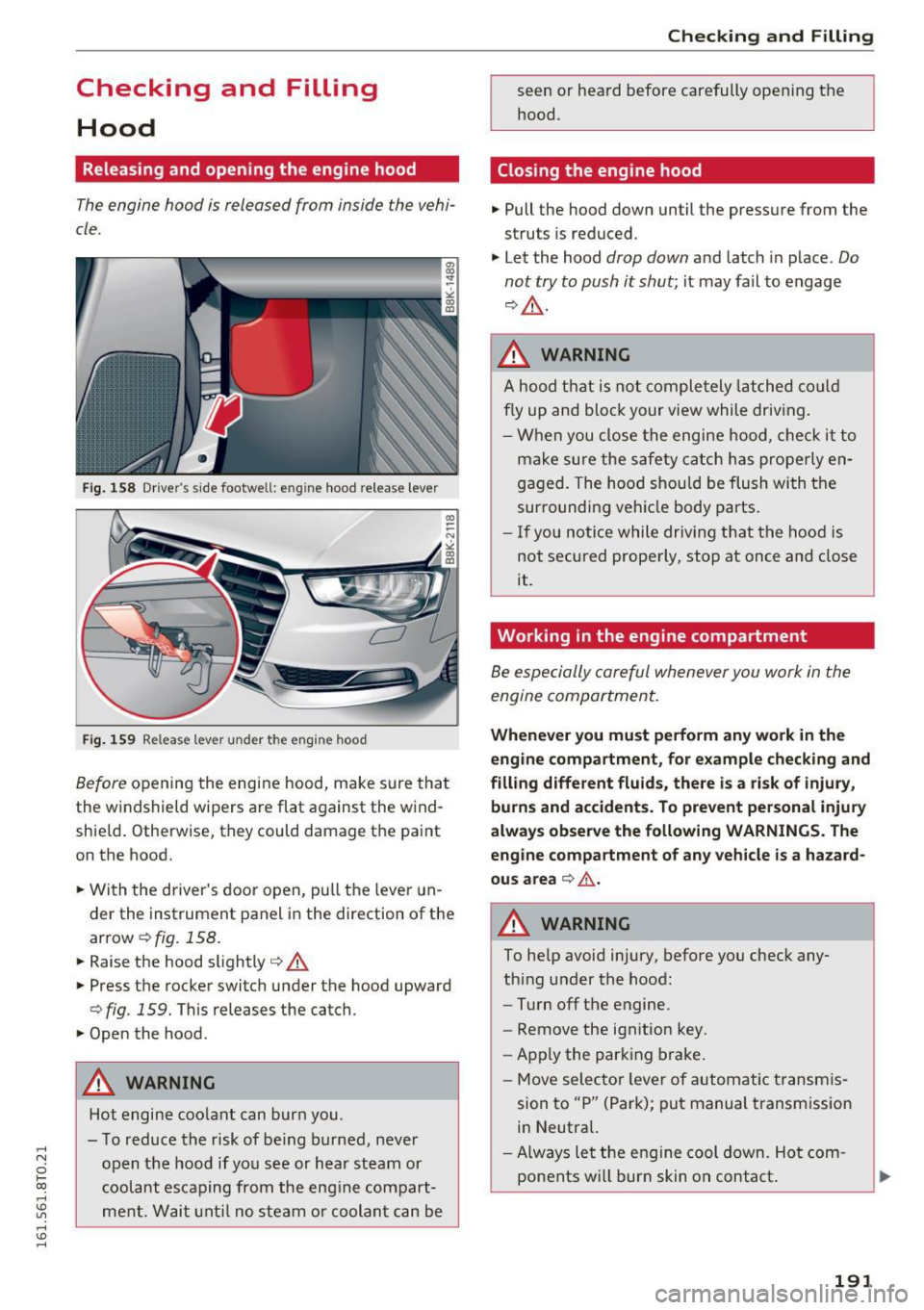
Fig. 158 Driver's side footwell: engine hood re lea se lever
Fig. 159 Release lever under the engine hood
Before opening the engine hood, make sure that
the windshield wipers are flat against the wind
shield. Otherwise, they could damage the paint
on the hood.
.. With the driver's door open, pull the lever un
der the instrument panel in the direction of the
arrow
¢ fig. 158.
.. Raise the hood slightly¢&.
.. Press the rocker switch under the hood upward
¢fig . 159. This releases the catch.
.. Open the hood.
A WARNING
Hot engine coolant can burn you.
- To reduce the risk of being burned, never
open the hood if you see or hear steam or
coolant escaping from the engine compart
ment. Wait until no steam or coolant can be
Checking and Filling
seen or heard before carefully opening the
hood.
Closing the engine hood
.. Pull the hood down until the pressure from the
struts is reduced .
.,. Le t the hood
drop down and latch in place. Do
not try to push it shut;
it may fail to engage
¢&, .
A WARNING
A hood that is not completely latched could
fly up and block your view while driving.
- When you close the engine hood, check it to
make sure the safety catch has properly en
gaged. The hood should be flush with the
surrounding vehicle body parts.
- If you notice while driving that the hood is
not secured properly, stop at once and close
it.
Working in the engine compartment
Be especially careful whenever you work in the
engine compartment.
-
Whenever you must perform any work in the
engine compartment, for example checking and
filling different fluids, there is a risk of injury, burns and accidents. To prevent personal injury
always observe the following WARNINGS. The
engine compartment of any vehicle is a hazard
ous area
¢ .&. .
A WARNING
-~
To help avoid injury, before you check any
thing under the hood:
- Turn off the engine.
- Remove the ignition key .
- Apply the parking brake.
- Move selector lever of automatic transmis-
sion to "P" (Park); put manual transmission
in Neutral.
-Always let the engine cool down. Hot com
ponents will burn skin on contact.
191
Page 194 of 264
Checking and Filling
-To reduce the risk of being burned, never
open the hood if you see or hear steam or
coolant escaping from the engine compart
ment . Wait until no steam or coolant can be
seen or heard before carefully opening the hood.
- Keep children away from the engine com partment.
- Never spill fluids on hot engine compo
nents. They can cause a fire.
- Never touch the radiator fan. The auxiliary
electric fan is temperature controlled and
can switch on suddenly .
- Never open the coolant reservoir cap when
the engine is still warm. The coolant system is pressurized and hot coolant could spray
out.
- Protect your face, hands and arm from
steam or hot engine coolant by placing a
thick rag over the cap when you open the coolant reservoir.
- Do not remove the engine cover under any
circumstances. This increases the risk of
burns.
- If work on the fuel system or the electrical
system is necessary:
- Always disconnect the battery.
- Never smoke or work near heaters or open
flames. Fluids in the engine compartment could start a fire.
- Keep an approved fire extinguisher imme
diately available.
- To avoid electrical shock and personal injury
while the engine is running or being started,
never touch:
- Ignition cables
- Other components of the high voltage
electronic ignition system .
- If you must perform a check or repair with
the engine running:
- First, fully apply the parking brake, move
selector lever of automatic transmission
192
to "P" (Park); put manual transmission in
Neutral.
- Always use extreme caution to prevent
clothing, jewelry, or long hair from get
ting caught in the radiator fan, V-belts or
other moving parts, or from contacting hot parts . Tie back hair before starting,
and do not wear clothing that will hang or
droop into the engine.
- Minimize exposure to emission and chemi
cal hazards
c::> /.1. .
A WARNING
California Proposition 65 Warning:
- Engine exhaust, some of its constituents, and certain vehicle components contain or
emit chemicals known to the State of Cali
fornia to cause cancer and birth defects and
reproductive harm . In addition, certain flu
ids contained in vehicles and certain prod
ucts of component wear contain or emit
chemicals known to the State of California
to cause cancer and birth defects or other
reproductive harm.
- Battery posts, terminals and related acces
sories contain lead and lead compounds,
chemicals known to the State of California
to cause cancer and reproductive harms .
Wash hands after handling.
(D Note
When adding fluids, always make sure that
they are poured into the proper container or
filler opening, otherwise serious damage to
vehicle systems will occur.
@ For the sake of the environment
To detect leaks in time, inspect the vehicle
floor pan from underneath regularly . If you
see spots from oil or other vehicle fluids, have
your vehicle inspected by an authorized Audi
dealer.
Page 228 of 264
Emergency assistance
Using the spare tire (compact spare tire)
The compact spare tire is only intended for emer
genc ies until you can reach a repair shop. Repla ce
it as qu ickly as possible with a standard wheel
and tir e.
There are some restrictions on the use of the
compact spare tire. The compact spare tire has
been designed specifically for yo ur type of vehi
cle. It must not be swapped with a compact
spare tire from another type of vehicle.
Snow chains
F or technica l reasons, the use of snow chains on
the compact spare tire is
not permitted .
If you do have to dr ive with snow cha ins and a
front tire fails, mo unt the spare wheel with t ire
instead of a rear tire. Install the snow chains on
the rear tire and use it to rep lace the defective
front tire .
A WARNING
-Never use the spare tire if it is damaged or if
it is worn down to the tread wear indicators.
-If the spare tire is more than 6 years o ld,
use it only in an emergency and with ex
treme caution and carefu l dr iving .
- The spare tire is intended on ly for tempora
ry and short-term use. It shou ld be replaced
as soon as possible with the normal wheel
and t ire.
- After mounting the compact spare t ire, the
t ir e pressure must be checked as soon as
poss ible. The tire pressure of the compact
spare tire must be 4.2 bar; otherwise, you
risk having an accident .
- Do not drive faster than SO mph (80 km/h).
You risk hav ing an accident.
- Avoid full-throttle accelerat ion, heavy brak
ing, and fast cornering. You risk having an
acc ident.
- Never drive using more than one spare
wheel and tire. You risk having an accident .
- Normal summer or winter tires must not be
mounted on the compact spare wheel rim .
- For technical reasons, the use of tire chains
on the spare tire is not perm itted . If it is
226
necessary to drive with tire chains, the spare
wheel must be mounted on the front axle in
the event of a flat in a rear tire. The newly
ava ilable front wheel must then be installed
in place of the rear wheel w ith the flat tire.
Installing the tire chain before mounting
the wheel and tire is recommended.
- Loose items in the passenger compartment
can cause serious personal injury during
ha rd braking or in an accident. Never store
the spare tire or jack and tools in the pas
senger compartment.
Replacing wheels
· Before changing a wheel
Observe the following precautions for your own
and your passenger's safety when changing a wheel.
.,. After you experience a tire failure, pull the car
well away from moving traffic and try to reach
level ground before you stop¢ A_.
.,. All passengers should leave the car and move
to a safe location (for instance, behind the
guardrail) ¢
&_.
.,. Engage the parking brake to prevent your vehi
cle from rolling unintentionally ¢
A_.
.,. Shift into 1st gear on vehicles with manua l
transmission, or move the
selector lever to the
P position
on vehicles with automatic transmis
sion.
.,. If you are towing a trailer: unhitch the trailer
from your vehicle.
.,. Take the
jack ¢ page 225 and the spare tire
¢ page 225 out of the luggage compartment .
A WARNING
You or your passengers could be injured while
changing a whee l if you do not follow these
safety precaut ions:
- If you have a flat tire, move a safe distance
off the road. Turn off the engine, turn the
emergen cy flashers on and use other warn
ing devices to alert other motorists.
Page 238 of 264
Emergency situations
Emergency situations
General
This chapter is intended for trained emergency crews and working personnel who have the nec
essary tools and equipment to perform these
operations.
Starting by pushing or
towing
CD Note
Vehicles with an automatic transmission
cannot be started by pushing or towing.
Starting with jumper
cables
If necessary, the engine con be started by con
necting it to the battery of another vehicle.
If the engine should fail to start because of a dis
charged or weak battery, the battery can be con
nected to the battery of
another vehicle, using a
pair of jumper cables to start the engine.
Jumper cables
Use only jumper cables of sufficiently largecross
section
to carry the starter current safely. Refer
to the manufacturer's specifications.
Use only jumper cables with
insulated terminal
clamps which are distinctly marked :
plus(+) cable in most cases colored red
minus(-) cable
in most cases colored black.
A WARNING
Batteries contain electricity, acid, and gas.
Any of these can cause very serious or fatal in
jury. Follow the instructions below for
safe
handling of your vehicle's battery.
-Always shield your eyes and avoid leaning
over the battery whenever possible.
-A discharged battery can freeze at tempera
tures just below 32 °F (0 °C). Before con
necting a jumper cable, you must thaw the
236
frozen battery completely, otherwise it could explode.
- Do not allow battery acid to contact eyes or
skin. Flush any contacted area with water immediately.
- Improper use of a booster battery to start a
vehicle may cause an explosion.
- Vehicle batteries generate explosive gases.
Keep sparks, flame and lighted cigarettes
away from batteries.
- Do not try to jump start any vehicle with a
low acid level in the battery.
- The voltage of the booster battery must also
have a 12-Volt rating. The capacity (Ah) of
the booster battery should not be lower
than that of the discharged battery. Use of
batteries of different voltage or substantial
ly different "Ah" rating may cause an explo
sion and personal injury.
- Never charge a frozen battery. Gas trapped in the ice may cause an explosion.
- Never charge or use a battery that has been
frozen . The battery
case may have be weak
ened .
- Use of batteries of different voltage or sub
stantially different capacity (Ah) rating may
cause an explosion and injury. The capacity
(Ah) of the booster battery should not be
lower than that of the discharged battery.
- Before you check anything in the engine
compartment, always read and heed all
WARNINGS
~page 191.
CD Note
-Applying a higher voltage booster battery
will cause expensive damage to sensitive
electronic components, such as control
units, relays, radio, etc.
- There must be no electrical contact between
the vehicles as otherwise current could al
ready start to flow as soon as the positive
(+) terminals are connected.
@ Tips
The discharged battery must be properly con-
nected to the vehicle's electrical system. .,..
Page 239 of 264
,-1 N
0 1-CX)
,-1 I.Cl U"I
,-1 I.Cl ......
When jump starting or charging the battery,
never connect the negative ground cable to
the battery negative post because the battery
manager system must be able to detect the
battery's state of charge . Always connect the
negative ground cable to the negat ive ground
post of the battery manager control unit .
Use of jumper cables
Make sure to connect the jumper cable clamps in
exactly the order described below!
Fig. 185 Engine compa rtment: Connectors for jumper ca
b les and cha rge r
Fig. 186 Jump start ing with the battery of another vehicle:
@ boos te r ba ttery, ® d ischarged veh icle ba ttery
The procedure described below for connecting
jumper cables is intended to provide a jump start
for your vehicle.
Vehicle with discharged battery:
.. Turn off lights and accessories, move lever of
automatic transmission to N (Neutral) or P
(Park) and set parking brake .
Connect POSITIVE(+) to POSITIVE(+) (red)
.,. Remove the cover above the jump start connec
t ion.
.,. Open the cover on the positive pole¢
fig. 185.
Emergency situations
1. Connect one end of the red positive cab le on
the
jump start bolt¢ fig. 186 (D (Bolts un
der cover= "positive") of the vehicle to be
started @.
2. Connect the other end to the positive termi- nal@of the booster battery @.
Connect NEGATIVE (-) to NEGATIVE (- )
(black)
3. Connect one end of the black negative cable
to the negative terminal @ of the booster
battery @.
4 . Connect the other end to the
jump start bolt
@(Bolts with hex head= "negative") of the
vehicle to be started @.
Starting the engine
.. Start the engine of the vehicle with the booster
battery @. Run the eng ine at a moderate
speed .
.,. Start engine w ith discharged vehicle battery @
in the usual manner.
.,. If the engine fails to start: do not keep the
starter cranking for longer than 10 seconds.
Wait for about 30 seconds and then try again .
.. With engine running, remove jumper cables
from both vehicles in the exact
reverse order .
.. Close the cover on the positive pole.
The battery is vented to the outside to prevent gases from entering the vehicle interior . Make
sure that the jumper clamps are well connected
with their
metal parts in full contact with the
battery term inals .
A WARNING
To avoid ser ious personal injury and damage
to the vehicle, heed all warnings and instruc
tions of the jumper cable manufacturer.
If in
doubt, call for road service.
- Jumper cables must be long enough so that
the vehicles do not touch .
- When connecting jumper cables, make s ure
that they cannot get caug ht in any moving
parts in the engine compartment.
- Do not bend over the batteries -danger of
chemical bu rns!
237
Page 247 of 264
.... N
0 I-co ....
scope of maintenance and repairs which can be
carried out by vehicle owners.
Also, safety and
environmental
concerns place very strict limits
on the nature of repairs and adjustments to en
gine and transmission parts which an owner can perform .
Maintenance, adjustments and repairs usually re
quire special tools, testing devices and other
equipment available to specially trained work
shop personnel in order to assure proper per
formance, reliability and safety of the vehicle and its many systems.
Improper maintenance, adjustments and repairs
can impair the operation and reliability of your
vehicle and even void your vehicle warranty .
Therefore, proof of servicing in accordance with
the maintenance schedule may be a condition for upholding a possible warranty claim made within
the warranty period.
Above all , operational safety can be adversely af
fected, creating unnecessary risks for you and
your passengers.
If in doubt about any servicing, have it done by
your authorized Audi dealer or any properly equipped and qualified workshop. We strongly urge you to give your authorized Audi dealer the
opportunity to perform all scheduled mainte nance and necessary repairs. Your dealer has the
facilities, original parts and trained specialists to keep your vehicle running properly .
Performing limited maintenance yourself
The following pages describe a limited number of
procedures which can be performed on your vehi
cle with ordinary tools, should the need arise and
trained personnel be unavailable. Before per
forming any of these procedures, always thor
oughly read all of the applicab le text and careful
ly follow the instructions given . Always rigorously
observe the
WARNINGS provided .
Before you check anything in the engine com
partment, always read and heed all WARNINGS
c::> .&. and c::> .&. in Working in the engine compart
ment on page 191 .
Consumer information
A WARNING
-Serious personal injury may occur as a result
of improperly performed maintenance, ad
justments or repairs .
- Always be extremely careful when working
on the vehicle. Always follow commonly ac
cepted safety practices and general com
mon sense. Never risk personal injury.
- Do not attempt any of the maintenance,
checks or repairs described on the following pages if you are not fully familiar with these
or other procedures with respect to the ve hicle, or are uncertain how to proceed.
- Do not do any work without the proper tools
and equipment. Have the necessary work
done by your authorized Audi dealer or any
properly equipped and qualified workshop.
- The engine compartment of any motor vehi
cle is a potentially hazardous area. Never
reach into the area around or touch the radi
ator fan. It is temperature controlled and
can switch on suddenly - even when the en
gine is off and the ignition key has been re
moved. The radiator fan switches on auto
matically when the coolant reaches a certain
temperature and will continue to run until
the coolant temperature drops.
- Always remove the ignition key before any
one gets under the vehicle.
-Always support your vehicle with safety
stands if it is necessary to work underneath
the vehicle . The jack supplied with the vehi
cle is not adequate for this purpose and
could collapse causing serious personal in
jury.
- If you must work underneath the vehicle
with the wheels on the ground, always make
sure the vehicle is on level ground, that the
wheels are always securely blocked and that
the engine cannot be started.
- Always make sure the transmission selector
lever (automatic transmission) is in "P"
(Park position) or Neutral (manual transmis-
sion) and the park brake is firmly applied . ..,.
245
Page 250 of 264
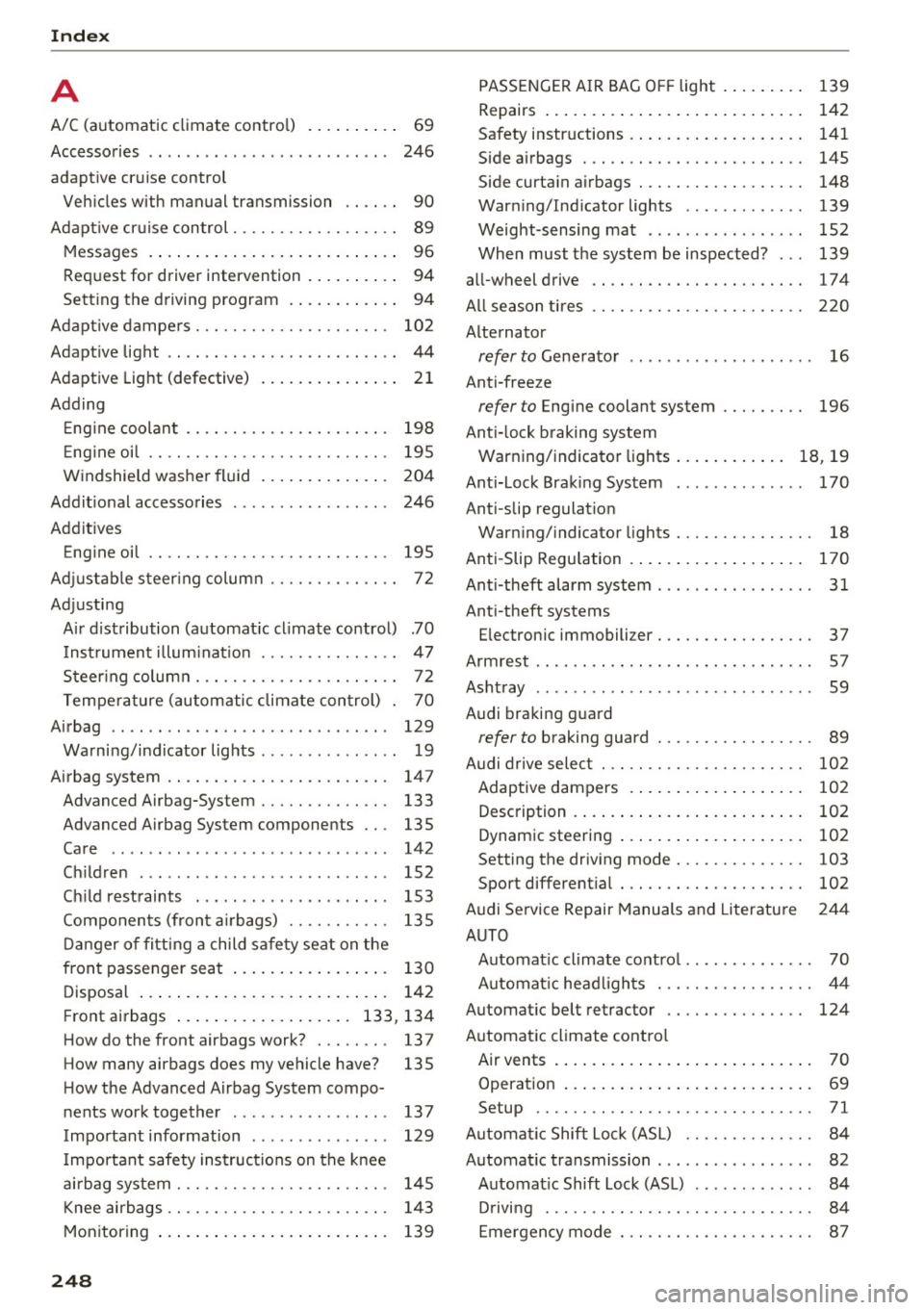
Index
A
A/C (automatic climate control) . . . . . . . . . . 69
Accessories . . . . . . . . . . . . . . . . . . . . . . . . . . 246
adaptive c ruise control
Vehicles with manual transmission . . . . . . 90
Adaptive cruise control. . . . . . . . . . . . . . . . . . 89
Messages . . . . . . . . . . . . . . . . . . . . . . . . . . . 96
Requ est for driver interv ention . . . . . . . . . . 94
Setting the driving program . . . . . . . . . . . . 94
Adaptive dampers . . . . . . . . . . . . . . . . . . . . . 102
Adaptive light . . . . . . . . . . . . . . . . . . . . . . . . .
44
Adaptive Light (defective) . . . . . . . . . . . . . . . 21
Adding Engine coolant . . . . . . . . . . . . . . . . . . . . . . 198
Engine oil . . . . . . . . . . . . . . . . . . . . . . . . . . 195
Windshield washer fluid . . . . . . . . . . . . . . 204
Additional accessories
Add itiv es 246
Engine oil . . . . . . . . . . . . . . . . . . . . . . . . . . 195
Adjustable steering column . . . . . . . . . . . . . . 72
Adjusting Air distribution (automat ic climate control) .70
Instrument illuminat ion . . . . . . . . . . . . . . . 47
Steering column . . . . . . . . . . . . . . . . . . . . . . 72
Temperature (automatic climate control) . 70
Airbag . . . . . . . . . . . . . . . . . . . . . . . . . . . . . . 1 29
Warning/indicator lights . . . . . . . . . . . . . . . 19
Airbag system . . . . . . . . . . . . . . . . . . . . . . . . 147
Adv anced Airb ag-Sys tem . . . . . . . . . . . . . . 133
Advanced Airbag System components . . . 135
Care . . . . . . . . . . . . . . . . . . . . . . . . . . . . . . 142
Children . . . . . . . . . . . . . . . . . . . . . . . . . . . 152
Child restraints . . . . . . . . . . . . . . . . . . . . . 153
Components (front a irbags) . . . . . . . . . . . 135
Danger of fitting a child safety seat on the
front passenger seat . . . . . . . . . . . . . . . . . 130
Disposal . . . . . . . . . . . . . . . . . . . . . . . . . . . 142
F ront airbags . . . . . . . . . . . . . . . . . . . 133, 134
How do the front ai rbags work? . . . . . . . . 137
How many airbags does my vehicle have? 135
How the Advanced Airbag System compo-
nents work together . . . . . . . . . . . . . . . . . 137
Important information ........... ... .
Important safety instructions on the knee
airbag system . ............... .... .. .
Knee airbags .. .. .. . .......... .. .. .. .
Monitoring
248
129
145
143
139 PASSENGER AIR BAG
OFF light . . . . . . . . . 139
Repairs . . . . . . . . . . . . . . . . . . . . . . . . . . . . 142
Safety instructions . . . . . . . . . . . . . . . . . . . 141
Side airbags . . . . . . . . . . . . . . . . . . . . . . . . 14S
Side curtain airbags . . . . . . . . . . . . . . . . . . 148
Warning/Indicator lights . . . . . . . . . . . . . 139
Weight-sensing mat . . . . . . . . . . . . . . . . . 152
When must the system be inspected? . . . 139
all-wheel drive 174
All season tires . . . . . . . . . . . . . . . . . . . . . . . 220
Alternator
refer to Generator . . . . . . . . . . . . . . . . . . . . 16
Anti-free ze
refer to E ngine coolant system . . . . . . . . . 196
Ant i-lock braking system
Warning/indicator lights . . . . . . . . . . . . 18, 19
Anti-Lock Braking System . . . . . . . . . . . . . . 170
Anti-slip regulation
Warning/indicator lights . . . . . . . . . . . . . . . 18
Anti-Slip Regulation . . . . . . . . . . . . . . . . . . . 170
Anti-theft alarm system . . . . . . . . . . . . . . . . . 31
Anti-theft systems Electronic immobili ze r .............. ... 37
Armrest . . . . . . . . . . . . . . . . . . . . . . . . . . . . . . 57
Ashtray . . . . . . . . . . . . . . . . . . . . . . . . . . . . . . 59
Audi braking guard
refer to braking guard . . . . . . . . . . . . . . . . . 89
Audi drive select . . . . . . . . . . . . . . . . . . . . . . 102
Adaptive dampers . . . . . . . . . . . . . . . . . . . 102
Description . . . . . . . . . . . . . . . . . . . . . . . . . 102
Dynamic steering . . . . . . . . . . . . . . . . . . . . 102
Setting the driving mode . . . . . . . . . . . . . . 103
Sport differential . . . . . . . . . . . . . . . . . . . . 102
Audi Se rvice Repair Manuals and Literature 244
AUTO Automatic climate control . . . . . . . . . . . . . . 70
Automat ic headl ights . . . . . . . . . . . . . . . . . 44
Automatic belt retrac tor . . . . . . . . . . . . . . . 124
Automatic climate control Air vents . . . . . . . . . . . . . . . . . . . . . . . . . . . . 70
Operation . . . . . . . . . . . . . . . . . . . . . . . . . . . 69
Setup . . . . . . . . . . . . . . . . . . . . . . . . . . . . . . 71
Automat ic Shift Lock (ASL) . . . . . . . . . . . . . . 84
Automatic transmission . . . . . . . . . . . . . . . . . 82
Automatic Shift Lock (ASL) . . . . . . . . . . . . . 84
Driving . . . . . . . . . . . . . . . . . . . . . . . . . . . . . 84
Emergency mode . . . . . . . . . . . . . . . . . . . . . 87
Page 257 of 264

.... N
0 I-co ....
by remote control . . . . . . . . . . . . . . . . . . . . 34
with the central locking switch . . . . . . . . . . 35
with the convenience key . . . . . . . . . . . . . . . 34
Other equipment (efficiency program) . . . . . 27
Outside temperature display . . . . . . . . . . . . . 23
Owner's Literature
5
p
Paint No. . . . . . . . . . . . . . . . . . . . . . . . . . . . . 241
Panorama roof . . . . . . . . . . . . . . . . . . . . . . . . 40
Panoramic tilting sunroof Convenience opening/closing . . . . . . . . . . . 39
E mergency closing . . . . . . . . . . . . . . . . . . . . 40
Sun blind . . . . . . . . . . . . . . . . . . . . . . . . . . . 40
Tilting and closing . . . . . . . . . . . . . . . . . . . . 40
Parcel she lf . . . . . . . . . . . . . . . . . . . . . . . . . . . 66
Parking . . . . . . . . . . . . . . . . . . . . . . . . . . . . . . 78
Automatic transmission . . . . . . . . . . . . . . . 84
Valet parking . . . . . . . . . . . . . . . . . . . . . . . . 40
Parking brake . . . . . . . . . . . . . . . . . . . . . . . . . 77
also refer to Electromechanical
parking brake . . . . . . . . . . . . . . . . . . . . . . . . 77
Parking system . . . . . . . . . . . . . . . . . . . . . . . 105
Parking System . . . . . . . . . . . . . . . . . . . . . . . 105
Parking system (rear)
Adjusting the warning tones . . . . . . . . . . . 106
Parking system (rear, with rear view camera) Parking mode 1 . . . . . . . . . . . . . . . . . . . . . 109
Parking mode 2 . . . . . . . . . . . . . . . . . . . . . 110
Safety precautions . . . . . . . . . . . . . . . . . . . 107
Switching on/off . . . . . . . . . . . . . . . . . . . . 108
Switching rear view ca mer a on/ off . . . . . . 111
Parts replacement . . . . . . . . . . . . . . . . . . . . 246
Pass-through . . . . . . . . . . . . . . . . . . . . . . . . . 65
PASSENGER AIR BAG OFF l ight . . . . . . . . . . 139
Pedals . . . . . . . . . . . . . . . . . . . . . . . . . . . . . . 117
Physical principles of a frontal collision 122
Pollutant filter (automatic A/C system) . . . . 68
Power seat adjustment . . . . . . . . . . . . . . . . . . . . . . 55
Windows .. .. .... .... ..... ... ... .. .. 38
Power locking system
Emergency locking . . . . . . . . . . . . . . . . . . . . 36
Panoramic tilting sunroof . . . . . . . . . . . . . . 39
Index
Power windows . . . . . . . . . . . . . . . . . . . . . . 39
Rear lid . . . . . . . . . . . . . . . . . . . . . . . . . . . . . 37
Selective unlock feature . . . . . . . . . . . . . . . 36
Settings . . . . . . . . . . . . . . . . . . . . . . . . . . . . 36
Power steer ing
refertoElectro-mechanicalpowerassist . 174
Power window Convenience open ing/closing . . . . . . . . . . . 39
Powe r windows
Malfunc tions . . . . . . . . . . . . . . . . . . . . . . . . 39
Pregnant women Special considerations when wearing a safe-
ty belt . . . . . . . . . . . . . . . . . . . . . . . . . . . . . 126
Pressure (tires) . . . . . . . . . . . . . . . . . . . . . . . 223
Proper occupant seating positions . . . . . . . 113
Proper safety be lt position . . . . . . . . . . . . . . 125
Proper seating position
Front passenger . . . . . . . . . . . . . . . . . . . . . 114
Occupants . . . . . . . . . . . . . . . . . . . . . . . . . . 113
Rear passengers . . . . . . . . . . . . . . . . . . . . . 115
Q
Quartz clock . . . . . . . . . . . . . . . . . . . . . . . . . . 12
quattro
refer to all -wheel drive ............... 174
Question What happens to unbelted occupants? 122
R
Radiator fan 199
Rain/light sensor Headl ights . . . . . . . . . . . . . . . . . . . . . . . . . . 44
Intermittent (windsh ield wipers) . . . . . . . . 50
Sensor defective . . . . . . . . . . . . . . . . . . . . . . 21
Raising the vehicle . . . . . . . . . . . . . . . . . . . . 240
Reading lights . . . . . . . . . . . . . . . . . . . . . . . . . 47
Rear fog lights . . . . . . . . . . . . . . . . . . . . . . . . 44
Rear lid Escape handle . . . . . . . . . . . . . . . . . . . . . . . 38
Open ing and closing . . . . . . . . . . . . . . . . . . 37
Rear light Defective . . . . . . . . . . . . . . . . . . . . . . . . . . . 21
Rear parking system . . . . . . . . . . . . . . . . . . . 105
Rear parking system with rearview camera . 106
255