tires AUDI A5 COUPE 2016 Owner's Manual
[x] Cancel search | Manufacturer: AUDI, Model Year: 2016, Model line: A5 COUPE, Model: AUDI A5 COUPE 2016Pages: 264, PDF Size: 66.92 MB
Page 217 of 264
_,
through curves and when braking, which increases the risk of
an accident.
Tire pressure
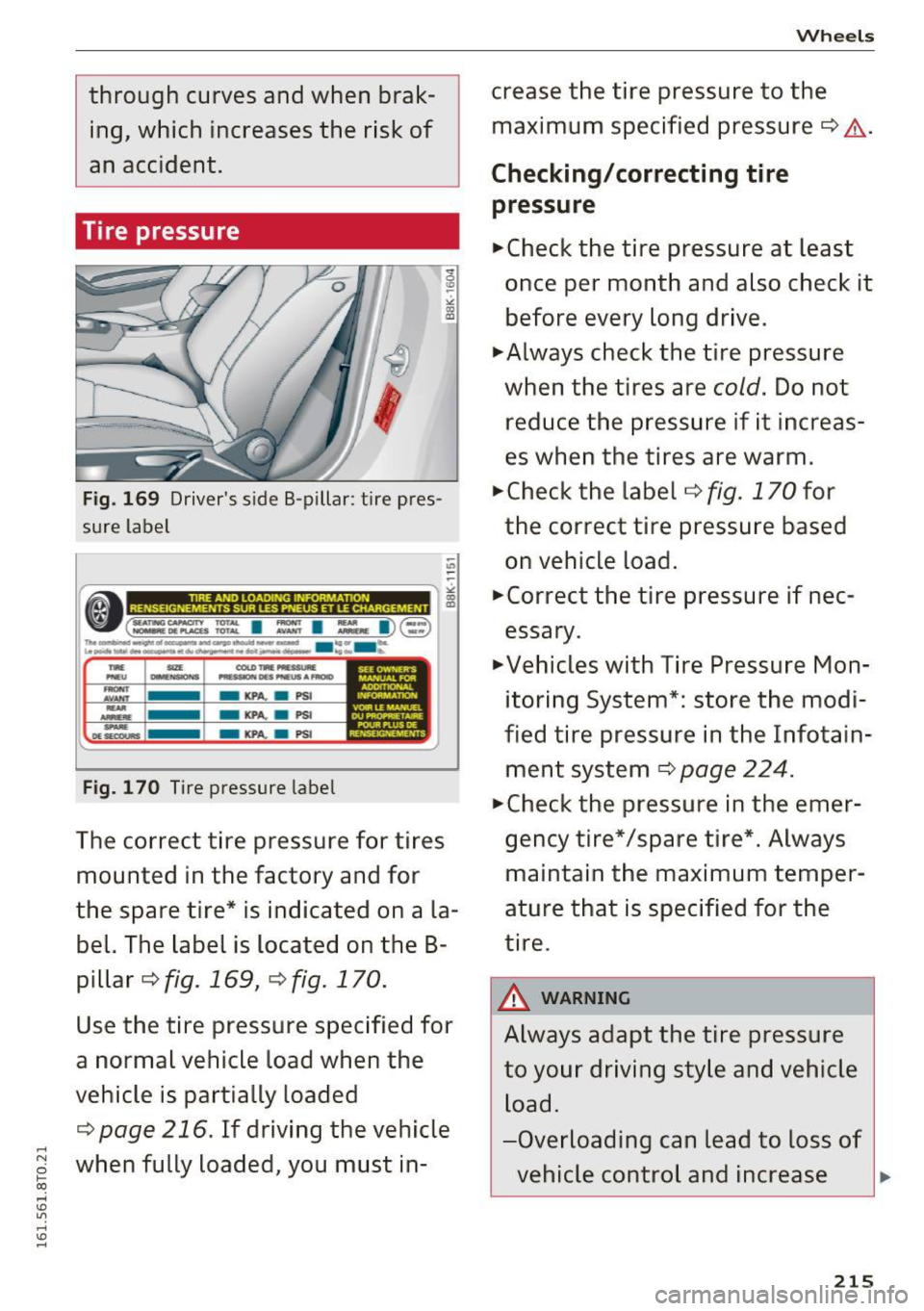
Fig. 169 Driver 's sid e B-pillar : tir e pres
sure label
"' -
-~-------------------,£
tM£. IIZl COLO tlllf fllllESSt.lW. PNfU Nl:4fN$IOM$ "IIISaoN OE$ PMEU$ A FROID
-AYIJff -KPA, a PSI
Fig. 170 Tire pressure label
The correct tire pressure for tires
mounted in the factory and for
the spare t ire* is indicated on a la
bel. The label is located on the B
pillar
¢ fig . 169, ¢ fig. 170.
Use the tire pressure specified for
a normal vehicle load when the
vehicle is partially loaded
¢
page 216. If driving the vehicle
ci when fully loaded, you must in-,_ CX) ... \D Ln _, \D _,
Wheels
crease the tire pressure to the
maximum specified pressure¢&.-
Checking/correcting tire
pressure
.,,.Check the tire pressure at least
once per month and also check it before every long drive .
.,,.Always check the tire pressure
when the tires are
cold. Do not
reduce the pressure if it increas
es when the tires are warm .
... check the label ¢
fig. 170 for
the correct tire pressure based on vehicle load.
.,,.Correct the tire pressure if nec
essary.
... vehicles with Tire Pressure Mon
itoring System*: store the modi
fied tire pressure in the Infotain
ment system
¢ page 224.
.,,.Check the pressure in the emer
gency tire*/spare t ire*. Always
maintain the maximum temper
ature that is specified for the
tire .
_& WARNING
Always adapt the tire pressure
to your driving style and vehicle
load.
-Overloading can lead to loss of vehicle control and increase ...
215
Page 218 of 264
Wheels
the risk of an accident. Read and follow the important safe
ty precautions in r=:> page 217,
Tires and vehicle load limits.
-The tire must flex more if the tire pressure is too low or if
the vehicle speed or load are
too high. This heats the tire up
too much. This increases the
risk of an accident because it
can cause the tire to burst and
result in loss of vehicle con
trol.
- Incorrect tire pressure in
creases tire wear and has a
negative effect on driving and
Tire pressure table
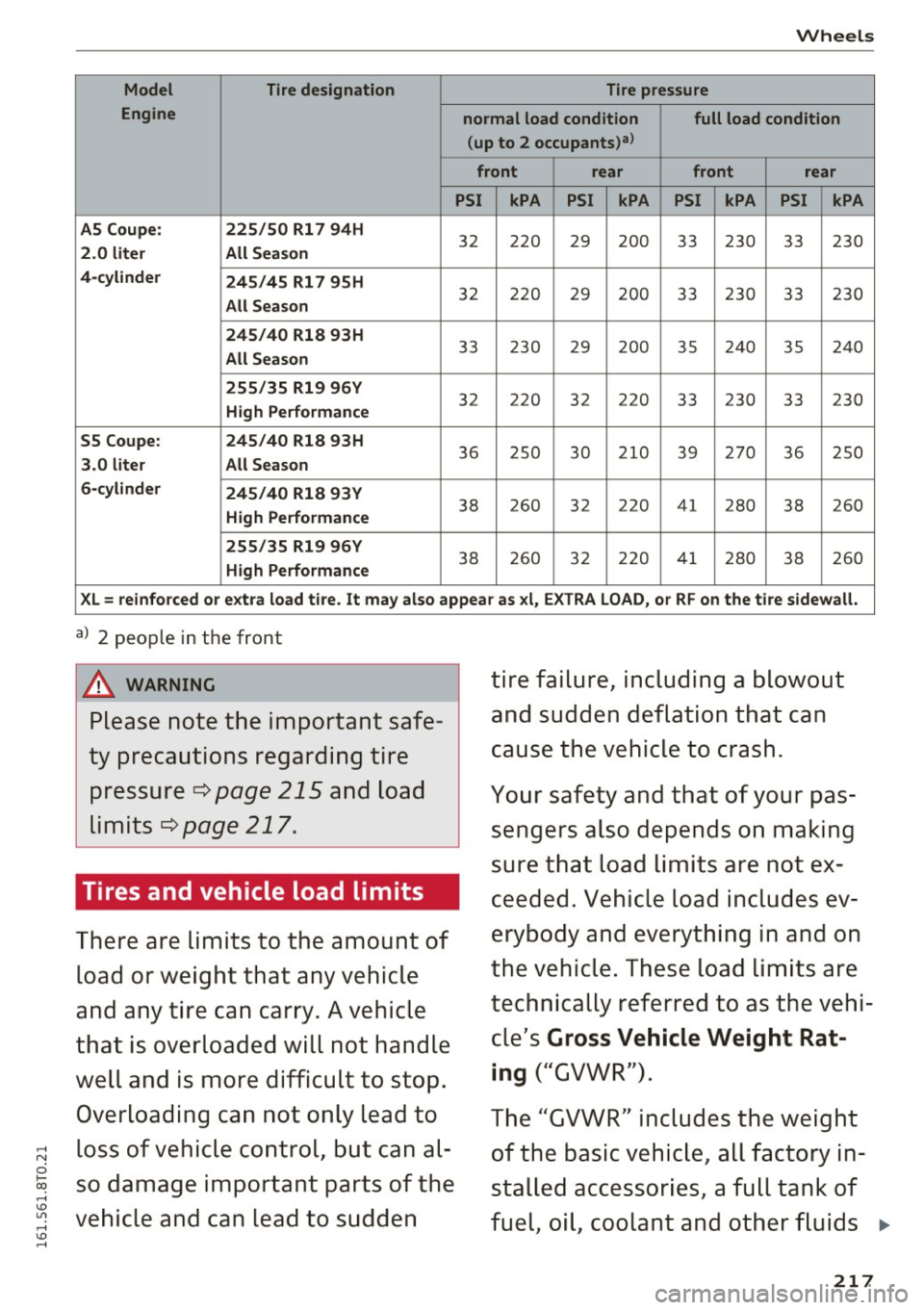
Please note that the information
contained in the following table
was correct at the time of print
ing, and the information is sub
ject to change. If there are differ ences between this information
and the tire pressures specified
on the label on the driver's side 8-pillar, always follow the specifica
t ion on the 8-pillar label
r=:> page215, fig.169.
216
braking behavior, which in
creases the risk of an accident.
(D Note
Replace lost valve caps to re
duce the risk of damage to the
tire valves.
@ For the sake of the environment
Tire pressure that is too low in
creases fuel consumption.
(D Tips
Audi recommends using the
tire pressure specified for a normal load
r=:> page 216 or for
a full load when the vehicle is
part ially loaded .
Make sure that the tire designa
tion on your tire matches the des ignation on the tire pressure label
and the tire pressure table.
The following table lists recom mended tire pressures in cold
tires according to the load and the size of the tires installed.
Page 219 of 264
.... N
0 Ico ....
Model Tire designation Tire pressure
Engine normal load condition full load condition
(up to 2 occupants)a)
front rear front rear
PSI kPA PSI kPA PSI kPA PSI kPA
AS Coupe: 225/50 Rl
7 94H
32 220 29 200 33 230 33 230 2.0 liter All Season
4-cylinder 245/45 Rl
7 95H
All Season
32 220 29 200 33 230 33 230
245/40 Rl8 93H 33 230 29 200 35 240 35 240
All Season
255/35 Rl9 96Y
3 2 22 0 32 22 0 33 230 33 230 High Performance
55 Coupe: 245/40 Rl8 93H
36
250 30 210 39 270 36 250 3.0 liter All Season
6-cylinder
245/40 Rl8 93Y
High Performance
38 2
60 3 2 22 0 41 280
38 2
60
255/35 Rl9 96Y
38 260 32 220 41
280 38 260 High Performance
XL= reinforced or extra load tire. It may also appear as xl, EXTRA LOAD, or RF on the tire sidewall.
a) 2 people in the front
_& WARNING
Please note the important safe
ty precautions regarding tire pressure
¢page 215 and load
limits¢
page 217.
Tires and vehicle load limits
There are limits to the amount of
load or weight that any vehicle
and any tire can carry. A vehicle
that is overloaded will not handle
well and is more difficult to stop.
Overloading can not only lead to
loss of vehicle control, but can al
so damage important parts of the
vehicle and can lead to sudden tire failure, including a blowout
and sudden deflation that can
cause the vehicle to crash.
Your safety and that of your pas
sengers also depends on making
sure that load limits are not ex
ceeded. Vehicle load includes ev
erybody and everything in and on
the vehicle. These load limits are
technically referred to as the vehi cle's
Gross Vehicle Weight Rat
ing
("GVWR").
The "GVWR" includes the weight
of the basic vehicle, all factory in
stalled accessories, a full tank of
fuel, oil, coolant and other fluids ..,
217
Page 220 of 264
Wheels
plus maximum load . The maxi
mum load includes the number of
passengers that the vehicle is in
tended to carry ("seat ing capaci
ty") with an assumed weight of
150 lbs. (68 kg) for each passen
ger at a designated seating posi
tion and the total weight of any luggage in the vehicle. If you tow
a trailer , the weight of the trailer
hitch and the tongue weight of
the loaded trailer must be includ
ed as part of the vehicle load .
The
Gross Axle Weight Rating
( " GAWR") is the maximum load
that can be applied at each of the
vehicle 's two axles.
The fact that there is an upper limit to your vehicle's Gross Vehi
cle Weight Rating means that the
total weight of whatever is being
carried in the vehicle (including
the weight of a trailer hitch and
the tongue weight of the loaded
trailer) is limited . The more pas
sengers in the vehicle or passen
gers who are heavier than the
standard weights assumed mean
that less weight can be carried as
luggage.
The Gross Vehicle Weight Rating and the Gross Axle Weight Rating
218
are listed on the safety compli
ance sticker label located on the
driver's side B-pillar
~ page 215,
fig . 169 .
& WARNING ~ -
Overloading a vehicle can cause
loss of vehicle control, a crash
or other accident, serious per
sonal injury, and even death.
-Carrying more weight than your vehicle was designed to
carry will prevent the vehicle
from handling properly and increase the risk of the loss of
vehicle control.
-The brakes on a vehicle that
has been overloaded may not
be able to stop the vehicle
within a safe distance .
-Tires on a vehicle that has been overloaded can fail sud
denly, including a blowout and
sudden deflation, causing loss
of control and a crash .
-Always make sure that the to tal load being transported -
including the weight of a trail
er hitch and the tongue
weight of a loaded trailer -
does not make the vehicle
heavier than the vehicle 's
Gross Vehicle Weight Rating.
Page 222 of 264
Wheels
and a special procedure. You must not repair or
disassemble them¢&. .
A WARNING
Wheel bolts that are tightened or repaired in
correctly can become loose and result in loss
of vehicle control, which increases the risk of
an accident. For the correct t ightening specifi
cation, refer to ¢
page 22 7, After changing a
wheel .
-Always keep the wheel bolts and the
threads in the wheel hub clean and free of
grease.
- Only use wheel bolts that fit the rim .
- Always have damaged rims repaired by an
authorized Audi dealer or authorized Aud i
Service Facility . Never repair or disassemble
rims yourself, because this inc reases the risk
of an accident.
Winter tires
Winter tires s ignificantly improve the vehicle's
handling when driving in winter conditions . Be
cause of their construction (width, compound,
tread pattern), summer tires provide l ess trac
tion on ice and snow.
.,. Use winter tires on all four wheels.
.,. Only use winter tires that are approved for your
vehicle.
.,. Please note that the maximum permitted
speed may be lower with winter tires
q .&,. . An
authori zed Audi dealer or authori zed Audi Serv
ice Facility can inform you about the maximum
permitted speed for your tires .
.,. Check the tire pressure after install ing wheels
q page 215.
The effectiveness of winter tires is reduced great
ly when the tread is worn down to a depth of
0 .157 in (4 mm). The characteristics of winter
tires also decrease greatly as the tire ages, re
gardless of the remaining tread.
A WARNING
- Never drive faster than the maximum per
mitted speed for your tires. This could cause
the tires to heat up too much. This increases
220
-
the risk of an accident because it can cause
the tire to burst.
- Always adapt your driving to the road and
traffic conditions . Drive carefully and reduce
your speed on icy or slippery roads . Even
winter tires can lose traction on black ice .
@ For the sake of the environment
Reinstall summer tires at the appropriate
time, because they prov ide better handling
when roads are free of snow and ice. Summer
tires cause less road noise, tire wear and fuel
consumpt ion .
(D Tips
You can also use all season tires instead of
winter tires. Please note that in some coun
tries where winter tires are required, only
winter tires w ith the ~ symbol may be per
mitted.
Snow chains
Snow chains improve traction in the snow .
.,. Only install snow chains on the front wheels.
This applies also to vehicles with all wheel
drive* .
.,. Check and correct the seating of the snow
chains if necessary after driving a few feet. Fol
low the instructions from the manufacturer.
.,. Note the maximum permitted speed when dr iv
ing with snow chains. Do not exceed 30 mph (SO km/h).
Snow cha ins not only improve the
driving in win
ter road conditions, but also the
braking .
Use of snow chains is only permitted with certain
rim/tire combinat ions due to technical reasons .
Check with an author ized Audi dealer or author
ized Audi Service Facility to see if you may use
snow chains.
Use
fine-mesh snow chains. They must not add
more than 0.53 inch (13.5 mm) in height, includ
ing the chain lock.
You must remove the chains when driving on
roads that are
free of snow . When roads are free ..,.
Page 223 of 264
.... N
0 Ico ....
damage the t ires, and t he chains will quickly b e
destroyed.
A WARNING
Using incorrect snow chains or installing snow
chains incorrect ly can result in loss of vehicle
co ntrol, which increases the risk of an acc i
dent .
Snow chains can damage the r ims/wheel cov
ers* if the chains come into d irect contact
w ith them . Remove the wheel covers* first.
Use coated snow chains .
@ Tips
When driving with snow cha ins, it may help to
switch on sport mode¢
page 171.
Low aspect ratio tires
Your Aud i is factory-equipped with low aspect ra
t io ti res. These t ires have been tho rough ly tested
a n d been se lected specifically fo r yo ur model for
t he ir superb performance, road feel and handling
under a variety o f driving conditions. Ask your au
thor ized Audi dealer for more details .
The low aspect ratio of these t ires is indicated by
a numera l of
55 or l ess in the tire 's size designa
tion . The numera l represents the rat io o f the
tire's sidewall height in relat ion to its tread width
expressed in pe rc e ntage. Conventional t ir e s hav e
a height/w idth rat io of 60 or more.
The performan ce of low- aspect- ratio tire s is par
ticularl y sensiti ve to imp roper inflat ion pres
sure . It is therefore import ant that low a spect
ratio tires are infl ated to the specified pressure
and that the inflation pre ssure is regularl y
checked and mainta ined . Tire pre ssure s shoul d
be checked at least once a month and alwa ys
befor e a long t rip
¢ page 215.
What you can do to avoid tire and rim
damag e
Low aspect rat io tires can be damaged more easi
ly by impact with potho les, curbs, gull ies or
Wh eel s
ridges on the road, particular ly if the tire is un
deri nflated.
In orde r to min imi ze the occurrence of imp act
damage to the tires of yo ur vehicle , we recom
mend that you observe the following preca u
tions:
- Always ma intain recommended inflat io n pres
sures. Check yo ur ti re pressure every 2,000
miles (3,000 km) and add air if necessary .
- Dr ive ca refully on roads w ith po tholes, deep
gullies or ridges . The impac t from dr iving
through or over such obstacles can damage
your tires. Impact with a curb may a lso cause
damage to your tires.
- After any impact, immediate ly inspect your
tires or have th em inspected by th e nearest au
thorized Audi dealer. Replace a damaged tire as
soon as possible.
- Inspect you r tires every 2,000 m iles (3,000 km)
for damage and wear. Damage is not a lways
easy to see . Damage can lead to loss of air and
underinflation, wh ic h could eventually cause
tire fa ilure. If you believe that a tire may have
been damaged , replace the tire as soon as pos
sib le.
- These tires may wear more quickly than others .
- Please also remember that, while these tires
delive r responsive ha ndling, they may ride less
comfortably a nd make more noise than other
choi ces.
Reduced perfo rmance in winter /cold se ason
conditions
All tires are des igned for certai n purposes. The
low aspect ratio, ultra high performance tires
o rigi na lly installed o n your veh icle are intended
f or maximum dry and wet road per formance and
handling . They are not suitable for co ld, snowy or
icy weather conditions . If you drive under those
c ircumstances, you should equip your vehicle
with all-season or winter tires, which offer better
tract ion under those condi tions. We suggest you
use the recommended snow or all-season tires
spec ified for your veh icle, or their equiva lent .
Refer to¢
page 220 for more detailed informa
t ion regarding winter tires .
221
Page 224 of 264
Wheels
Uniform tire quality grading
- Tread wear
- Traction AA A B C
- Temperature ABC
Quality grades can be found where applicable on
the tire side wall between tread shoulder and maximum section width
c::> page 205, fig. 167.
For example: Tread wear 200, Traction AA, Tem
perature
A.
All passenger car tires must conform to Federal
Safety Requirements in addition to these grades .
Tread wear
The tread wear grade is a comparative rating
based on the wear rate of the tire when tested
under controlled conditions on a specified gov
ernment test course.
For example, a tire graded 150 would wear one
and one half (11/2) times as well on the govern
ment course as a tire graded 100.
The relative performance of tires depends upon
the actual conditions of their use, however, and may depart significantly from the norm due to
variations in driving habits, service practices and
differences in road characteristics and climate.
Traction
The traction grades, from highest to lowest, are
AA, A, Band
C. Those grades represent the tire's
ability to stop on wet pavement as measured un
der controlled conditions on specified govern
ment test surfaces of asphalt and concrete. A tire
marked C may have poor traction performance
¢ &. .
Temperature
The temperature grades are A (the highest), B,
and C, representing the tire's resistance to the
generation of heat and its ability to dissipate
heat when tested under controlled conditions on
a specified indoor laboratory test wheel.
Sustained high temperature can cause the mate
rial of the tire to degenerate and reduce tire life,
and excessive temperature can lead to sudden
tire failure
c::> .&. .
222
The grade C corresponds to a level of perform
ance which all passenger car tires must meet un
der the Federal Motor Vehicle Safety Standard
No . 109 . Grades Band A represent higher levels
of performance on the laboratory test wheel than
the minimum required by law.
A WARNING -
The traction grade assigned to this tire is
based on straight-ahead braking traction
tests, and does not include acceleration, cor
nering, hydroplaning or peak traction charac
teristics.
A WARNING , ~ -
The temperature grade for this tire is estab
lished for a tire that is properly inflated and
not overloaded. Excessive speed, underinfla
tion, or excessive loading, either separately or
in combination, can cause heat buildup and
possible tire failure.
A WARNING
Temperature grades apply to tires that are
properly inflated and not over or underinflat
ed.
Tire pressure monitoring system
(l) General notes
App lies to vehicles : wit h tire pressure mo nitori ng syste m
Each tire, including the spare (if provided),
should be checked monthly when cold and inflat
ed to the inflation pressure recommended by the
vehicle manufacturer on the vehicle placard or
tire inflation pressure label. (If your vehicle has
tires of a different size than the size indicated on
the vehicle placard or tire inflation pressure la
bel, you should determine the proper tire infla
tion pressure for those tires) .
As an added safety feature, your vehicle has been
equipped with a tire pressure monitoring system
(TPMS) that illuminates a low tire pressure tell
tale when one or more of your tires is significant- ly under-inflated. Accordingly, when the low tire
pressure telltale illuminates, you should stop and ""
Page 225 of 264

.... N
0 Ico ....
them to the proper pressure. Driving on a signifi
cantly under-inflated tire causes the tire to over
heat and can lead to t ire failure. Under-inflation
a lso reduces fuel efficiency and tire tread life,
and may affect the vehicle 's handling and stop
p ing ability .
Please note that the TPMS is not a substitute for
proper tire maintenance, and it is the driver's re
sponsib ility to ma intain correct tire pressure,
even if under-inflation has not reached the level
to tr igger illum inat ion of the TPMS low tire p res
sure telltale.
Your veh icle has also bee n eq uipped w ith a TPMS
malfunct ion indicator to indicate when the sys
tem is not operat ing properly . The TPMS ma l
function ind icator is combined w ith the low tire
p ressure tellta le. Whe n the system detects a
malfunct ion, the te lltale will flash fo r approx i
mately one mi nute and then remain continuo usly
illuminated. This sequence will continue upon
subseq uent veh icle start-ups as long as the ma l
function ex ists .
When t he malfunction indicator is ill uminated,
the system may not be ab le to detect or signal
l ow tire press ure as intended. TPMS ma lf u nctions
may occur for a var iety of reasons, including the
installation of replacement or alternate t ires or
wheels on the vehicle that prevent the TPMS
from functioning properly . Always c heck the
TPMS malfunction telltale afte r rep lacing one o r
mo re t ires o r whee ls on your ve hicl e to e nsur e
th at t he replacement or al tern ate tir es and
wheels a llow the TPMS to con tinue to function
p roperly .
Wheel s
If the Tire Pressure Monitoring System
indicator appears
Applies to vehicles: with tire pressure monitor ing system
The tire pressure indicator in th e instrument
cluster informs you if the tire pressure is too low
or if there is a sys tem malfunction.
Fi g. 17 1 Instrumen t cl uster: indicator lig ht w ith mess age
U sing the ABS sensors, the t ire pressure monito r
ing system compares the tire tread c ircumfer
ence and v ibration characterist ics of the ind iv idu
al tires. If the press ure changes in one or more
t ir es, th is is indicated in the instrument cluster
display with an indica to r li ght
HE and a message.
If only one tire is affected, the loc ation of tha t
t ir e will be indicated.
T he t ire press ures mus t be stored in the Infota in
me nt system again each time t he pr essures
c h ange (switching between parti al and full load
pressure) or afte r changing or replac ing a tire on
yo ur vehicle ¢
page 224 . The tire p ressure moni
toring system on ly monitors the tire pressure you
have stored. Re fer to the t ire pressure label for
the recommended t ire pressure for yo ur vehicle
r=> page 215, fig . 170.
T ire tread c irc umference and vibration character
istics can change and ca use a tire press ure warn
ing if :
- the tire pressure in one or more tires is too low.
- t he t ire h as str uctural damage.
- t he t ire w as re pla ce d or the t ire pressu re was
ch anged and it was no t stored ¢
page 224 .
- the spare tire* is i nstalled .
Indicator lights
HE Loss of pressure in at least one tire¢.& .
Check the tires and replace or repair if necessary .
IJJ,,
223
Page 226 of 264

Wheels
Check/correc t the p ress ures o f all four tires and
store the pressure again in the Infotainment sys
tem
¢ page 224.
mm (Ti re Pressure Moni to ring System) Tire
pressure: S ystem malfunction !.
Ifm:im appears
after switc hing the ignition on or whi le driving
and the
RI] i ndicator light in the instrument cl us
ter blinks for approximate ly one minute and then
stays on, there is system malfunction. Try to
store the correct tire pressures¢
page 224 . If
the ind icator light does tur n off or turns on again
after a short period of t ime, dr ive to an a uthor
ized Audi dealer o r autho rized Aud i Service Faci li
ty immedia tely to have the malfunct ion corre ct
ed .
A WARNING
- If the ti re pressu re indicator appears in the
display, reduce your speed immediate ly and
avoid any hard steering or braking maneu
vers. Stop as soon as possib le and check the
t ires and t heir pressure.
- The driver is responsib le for maintaining the
correct tire pressure. You must check the
t ire pressure regu larly .
- Under certain conditions (such as a sporty
dr iv ing style, winter cond itions or unpaved
roads), the pressure mon itor indicator may
be delayed.
- Do not use run-flat tires on your vehicle. Us
ing them when not permitted can lead to
vehicle damage or accidents.
(D Tips
- The t ire pressure monitoring system can al
so stop work ing when there is an ESC mal
funct ion.
- Using snow chains may result in a system
malfunction.
- The t ires with the identification "AO" or
"RO" ¢
page 212 have been matched with
your Audi tire pressure monitoring system .
We recommend that you use these t ires.
224
· Storing tire pressures
Applies to vehicles: with tire pressure mo nitoring system
If the tire pressure changes or a tire is replaced,
it must be confirmed in the Infotainment sys
tem .
.,. Make sure before stor ing that the t ire pressures
of all four tires meet the specified values and
are adapted to the load
¢ page 215.
.,. Sw itch on the ign ition .
.,. Sele ct: the
I CARI fu nct ion button > Tire pres·
s ure monitoring
cont rol button. O r
.,. Select: the
I CAR I fun ct ion but ton > Car Sys
tem s*
control b utton > Serv icing & checks >
Tire pressure mon itoring .
(D Tips
Do not store the tire pressures if snow chains
are installed .
Page 228 of 264
Emergency assistance
Using the spare tire (compact spare tire)
The compact spare tire is only intended for emer
genc ies until you can reach a repair shop. Repla ce
it as qu ickly as possible with a standard wheel
and tir e.
There are some restrictions on the use of the
compact spare tire. The compact spare tire has
been designed specifically for yo ur type of vehi
cle. It must not be swapped with a compact
spare tire from another type of vehicle.
Snow chains
F or technica l reasons, the use of snow chains on
the compact spare tire is
not permitted .
If you do have to dr ive with snow cha ins and a
front tire fails, mo unt the spare wheel with t ire
instead of a rear tire. Install the snow chains on
the rear tire and use it to rep lace the defective
front tire .
A WARNING
-Never use the spare tire if it is damaged or if
it is worn down to the tread wear indicators.
-If the spare tire is more than 6 years o ld,
use it only in an emergency and with ex
treme caution and carefu l dr iving .
- The spare tire is intended on ly for tempora
ry and short-term use. It shou ld be replaced
as soon as possible with the normal wheel
and t ire.
- After mounting the compact spare t ire, the
t ir e pressure must be checked as soon as
poss ible. The tire pressure of the compact
spare tire must be 4.2 bar; otherwise, you
risk having an accident .
- Do not drive faster than SO mph (80 km/h).
You risk hav ing an accident.
- Avoid full-throttle accelerat ion, heavy brak
ing, and fast cornering. You risk having an
acc ident.
- Never drive using more than one spare
wheel and tire. You risk having an accident .
- Normal summer or winter tires must not be
mounted on the compact spare wheel rim .
- For technical reasons, the use of tire chains
on the spare tire is not perm itted . If it is
226
necessary to drive with tire chains, the spare
wheel must be mounted on the front axle in
the event of a flat in a rear tire. The newly
ava ilable front wheel must then be installed
in place of the rear wheel w ith the flat tire.
Installing the tire chain before mounting
the wheel and tire is recommended.
- Loose items in the passenger compartment
can cause serious personal injury during
ha rd braking or in an accident. Never store
the spare tire or jack and tools in the pas
senger compartment.
Replacing wheels
· Before changing a wheel
Observe the following precautions for your own
and your passenger's safety when changing a wheel.
.,. After you experience a tire failure, pull the car
well away from moving traffic and try to reach
level ground before you stop¢ A_.
.,. All passengers should leave the car and move
to a safe location (for instance, behind the
guardrail) ¢
&_.
.,. Engage the parking brake to prevent your vehi
cle from rolling unintentionally ¢
A_.
.,. Shift into 1st gear on vehicles with manua l
transmission, or move the
selector lever to the
P position
on vehicles with automatic transmis
sion.
.,. If you are towing a trailer: unhitch the trailer
from your vehicle.
.,. Take the
jack ¢ page 225 and the spare tire
¢ page 225 out of the luggage compartment .
A WARNING
You or your passengers could be injured while
changing a whee l if you do not follow these
safety precaut ions:
- If you have a flat tire, move a safe distance
off the road. Turn off the engine, turn the
emergen cy flashers on and use other warn
ing devices to alert other motorists.