brake light AUDI A5 COUPE 2016 Owner's Guide
[x] Cancel search | Manufacturer: AUDI, Model Year: 2016, Model line: A5 COUPE, Model: AUDI A5 COUPE 2016Pages: 264, PDF Size: 66.92 MB
Page 201 of 264
,-1 N
0 1-CX)
,-1 I.Cl U"I
,-1 I.Cl ......
-To avoid being burned, do not spill anti
freeze or coolant on the exhaust system or hot engine parts. Under certain condi
tions, the ethylene glycol in engine cool ant can catch fire.
- Antifreeze is poisonous. Always store anti
freeze in its original container and well out
of the reach of children.
- If you drain the coolant, it must be caught
and safely stored in a proper container
clearly marked "poison".
(D Note
-Do not add coolant if the expansion tank is
empty . Air could enter the cooling system
and damage the engine.
If this is the case,
do not continue driving. Seek professional
assistance.
- Coolant pollutes the environment and could
cause an engine fire. Excess coolant will be
forced out through the pressure relief valve
in the cap when the engine becomes hot.
-If, in an emergency, only water can be add
ed, the correct ratio between water and an
tifreeze c::>
page 196 must be restored as
soon as possible.
@) For the sake of the environment
Drained coolant should not be reused. Always
dispose of used coolant while observing all
environmental regulations.
Radiator fan
The radiator fan switches on automatically by it
self.
The radiator fan is driven by the engine via the V
belt . The viscous clutch regulates the speed of
the fan according to the temperature of the cool
ant.
An auxiliary electric radiator fan* switches on and
off depending on coolant temperature and other
vehicle operating conditions.
After you switch the engine off, the auxiliary fan
can continue running for up to 10 minutes -even
Checking and Filling
with the ignition off. It can even switch on again
later by itself c::>
&, if
- the temperature of the engine coolant rises due
to the heat build-up from the engine in the en
gine compartment, or
- the engine compartment heats up because the
vehicle is parked in intense sunlight.
A WARNING
-To reduce the risk of personal injury never
touch the radiator fan.
- The auxiliary electric fan is temperature
controlled and can switch on suddenly even
when the engine is not running.
- The auxiliary radiator fan switches on auto
matically when the engine coolant reaches a
certain temperature and will continue to run
until the coolant temperature drops.
Brake fluid
Checking brake fluid level
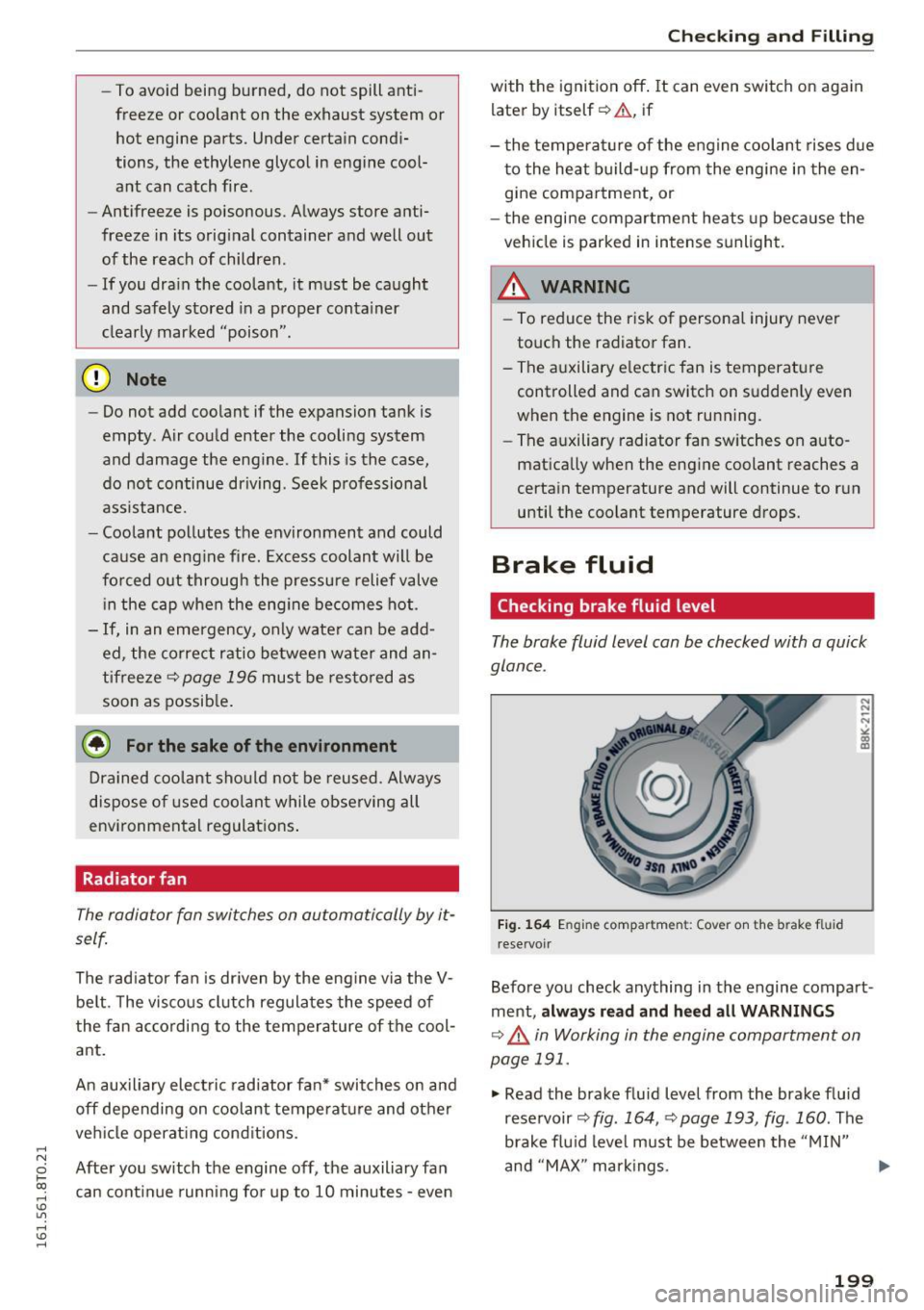
The broke fluid level con be checked with o quick
glance .
Fig. 164 Engine compartmen t: Cover on the brake flui d
re servoir
Before you check anything in the engine compart
ment,
always read and heed all WARNINGS
c::> _.& in Working in the engine comportment on
page 191.
.,. Read the brake fluid level from the brake fluid
reservoir c::>fig.164,
c::>poge 193, fig .160 . The
brake fluid level must be between the "MIN"
and "MAX" markings.
199
Page 202 of 264
Check ing and F illing
The brake fluid rese rvoir is located at the rear
partition of the engine compartment on the l eft
side
c!,> pag e 193 .
The fl uid level may drop slightly after some time
due to the automatic adjustment of the brake
pads . This is not cause for alarm.
If th e b rake fl uid level fa lls considerably be low
the "M IN" mark, the b rake warning/ind icator
lig ht ( U.S. mode ls :
1111 , Canadian models:. )
will come on
c!,> page 15 . Do not contin ue to oper
ate the vehicle . T he comp lete brake system
should be thoroughly checked by an authori zed
Aud i dealer or qualified workshop and the cause
corrected . If the brake flu id level is too low, the
b rake warning/indicator light will i llum inate.
Contact a n author ized Audi dealer
immediately .
{D) Tips
The brake fluid reservoir is located under
neath the cover .
Changing brake fluid
Have the brake fluid changed by an experienced
technician .
Brake fluid absorbs mo isture from the air. If the
water content in the b rake fluid is too high, cor
rosion in the brake system may resu lt afte r ape
riod of t ime. The boiling poi nt of the brake flu id
will also decrease cons iderably and decrease
b raking perfo rman ce.
Therefore, the brake fluid must be changed
every
two year s.
Always use new brake fluid wh ic h con
forms to Fede ral Motor Veh icle Standard "FMVSS
1 16 DO T 4".
The brake fluid reservoir can be diff icult to reach,
therefore, we recommend that yo u have the
brake fl uid changed by yo ur autho rized
Audi
dealer .
Your dealer has t he corre ct tools, t he
right brake fluid and the know-how to do this for
you.
A WARNING
- Brake fluid is poisonous. It must be stored
only in the closed orig inal container out of
the reach of chi ldren!
200
- Bra ke fa ilure ca n result from old or inapp ro
priate brake fluid . Observe these precau
tions:
- Use only brake fluid t hat meets SA E speci
fi ca ti on
J 170 3 and con forms to Federa l
Motor Ve hicle Standard 116 . Always check
wi th yo ur autho rized Audi dea le r to make
s ur e yo u are using the correct brake fluid .
The correct type of brake flu id is also ind i
cated on the b rake fluid reservo ir .
- The brake fluid m ust be new . Heavy use of
the brakes can cause a vapo r lock if the
brake fluid is left in the system too long .
This can se riously affect the efficiency of
the b rakes as well as your safety . This
could resu lt in an accident .
(D Note
Brake fluid will damage the paint of your veh i
cle.
@ For the sake of the environment
Because of the problem o f proper d isposa l o f
brake fluid as well as the spec ial too ls re
q ui red a nd the necessary expertise, we rec
omme nd that you have the bra ke f luid
changed by yo ur autho rized Aud i dea le r.
Battery
, General information
U nder normal operating condit ions, the battery
i n your Audi does not need any maintenance.
With
high outside temperatures or long daily
drives we recommend that you have the elect ro
lyte level c hecked by an au thorized Aud i dealer o r
qualified workshop. The electro lyte level shou ld
a lso be che cked each time the battery is c ha rged
c:!,> page 202.
Have the batte ry chec ked when you take yo ur ve
hicle in for service. You are we ll adv ised to re
pla ce a battery tha t is older than 5 yea rs.
With certain types of airbag deployment, t he
batte ry is d iscon nected from the ve hicle electri
ca l system for safety reasons
c!,> .&. in Repair, care
and disposal of the airbags on page 1 42. .,.
Page 229 of 264
.... N
0 Ico ....
place away from the vehicle and well away
from the road and traffic.
- To help prevent the vehicle from moving
suddenly and possibly slipping off the jack,
always fully set the parking brake and block
the wheel diagonally opposite the wheel be
ing changed with the folding chocks or oth
er objects. When one front wheel is lifted
off the g round, plac ing the Automatic
T ransmission in "P" (Park) will
not prevent
the vehicle from moving .
- Before you change a wheel, be su re t he
ground is level and firm. If necessary, use a
stu rdy board under the jack.
- Always sto re the veh icle tool k it, the jac k*
and the replaced tire in the luggage com
partment ¢
page 118 .
(1) Note
If you are cha nging the whee l on a steep in
cline, use a rock or similar objec t to block the
opposi te whee l to prevent the veh icle from
moving.
@ Tips
Obey all laws .
Changing a wheel
When you change a wheel, follow the sequence
described below step-by-step and in exactly that
order.
1. Remove the deco rative wheel cover * or the
whe el bolt cap s*. For more deta ils see also
¢ page 228, Decorative wheel covers or
¢ page 228, Wh eels with wh eel bolt caps.
2. Loosen the wheel bol ts ¢ page 228.
3 . Locate the proper mounting point for the
jack and align the jack below that point
¢ page 229.
4. Lift the car with the jack¢ page 229.
5 . Remove the
whe el with the flat tir e and then
insta ll the
s pare tire ¢ page 230 .
6. Tighten all wheel bo lts lightly.
7 .
Low er th e ve hicle w it h the ja ck .
Em ergenc y ass is tanc e
8. Use the wheel bolt wrench and firmly tighten
all wheel bo lts in a crisscross pattern
¢ page 228.
9. Replace the deco rati ve w heel co ver* or the
wheel bolt caps* .
A WARNING
Always read and follow all WARNINGS and in
fo rmation
¢ .&. in Raising the vehicle on
page229and ¢page 231.
After changing a wheel
A wheel change is not complete without the do
ing the following .
.,. Always store the vehicle too l kit, the jack*, and
the replaced tire in the luggage compartment
¢ page 118 .
.,. Check the tire pres sure of the spare tire as soon
as poss ible.
.,. As soon as poss ib le, have the
tigh tening tor
qu es
on a ll wheel bolts checked with a torque
w rench. The correct tightening torque is
90 ft
lbs.
(120 Nm) .
.,. Hav e the flat tire
repl aced as soon as possible .
(D Tips
-If you notice that the wheel bo lts are co r
roded and difficult to turn while changing a
tire, they shou ld be replaced before you
check the tightening torque.
- Drive at reduced speed unti l yo u have the
tightening torques checked.
227
Page 232 of 264
Emergency assistance
-Make sure that passengers wait in a safe
place away from the vehicle and well away
from the road and traff ic.
- Make sure jack position is correct, adjust
as necessary and then cont inue to raise
the jack.
(D Note
Do not lift the vehicle by the sill. Position the
vehicle jack only at the designated lifting points on the sill. Otherwise, your vehicle will
be damaged.
Taking the wheel off /installing the spare
tire
Follow these instructions step-by-step for chang
ing the wheel .
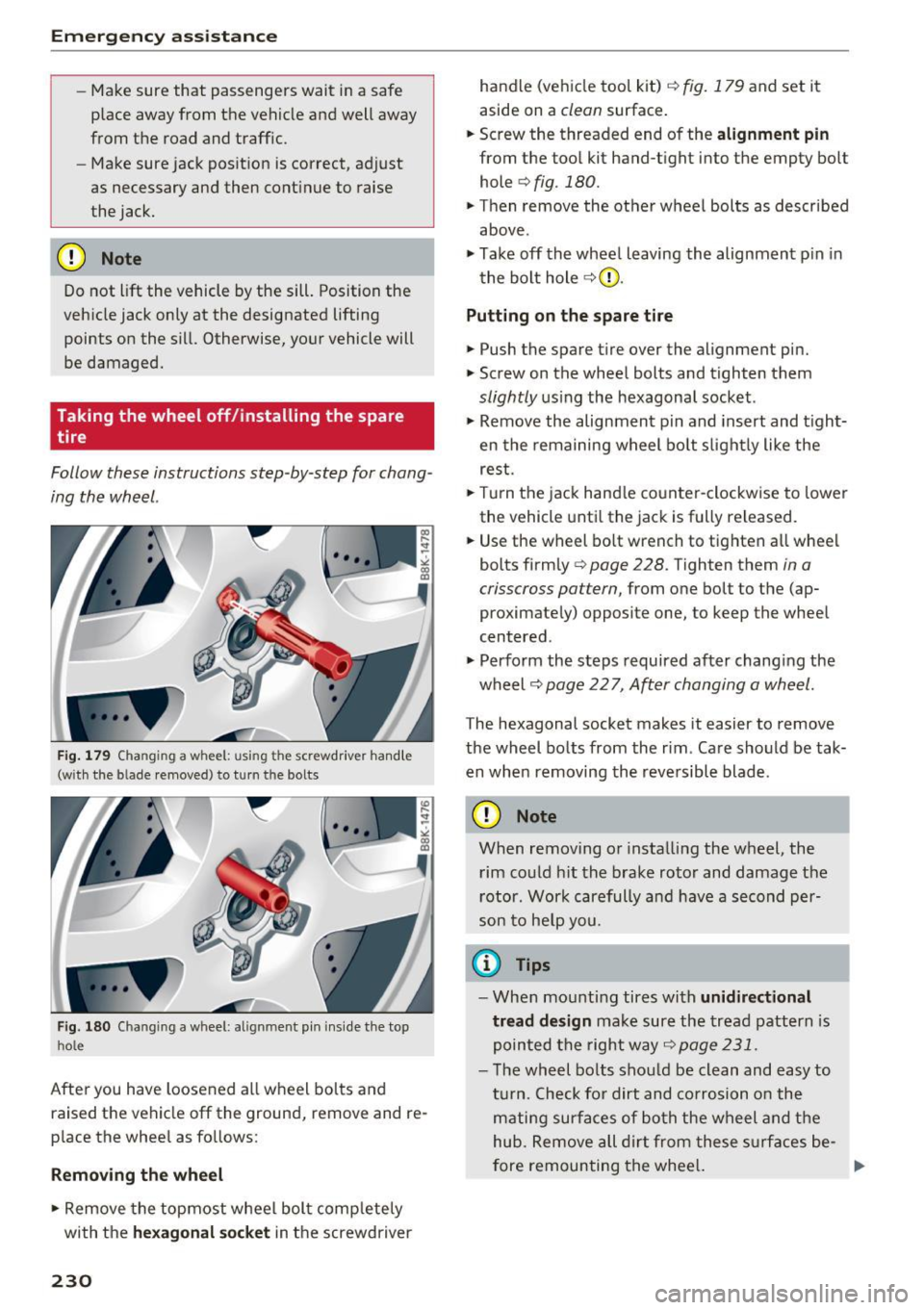
Fig. 179 Changing a wheel: using the screwdriver handl e
(with the blade removed) to turn the bolts
Fig. 180 Changing a wheel: alignment pin insid e the top
hole
After you have loosened all wheel bolts and raised the vehicle off the ground, remove and re
place the whee l as follows:
Removing the wheel
• Remove the topmost wheel bolt comp letely
with the
hexagonal socket in the screwdriver
230
handle (vehicle tool kit) ¢ fig. 179 and set it
aside on a
clean surface.
• Screw the threaded end of the
alignment pin
from the tool kit hand-tight into the empty bolt
hole ¢
fig. 180.
• Then remove the other wheel bolts as described
above.
• Takeoff the whee l leaving the alignment pin in
the bolt hole¢ (!).
Putting on the spare tire
• Push the spare tire over the alignment pin.
• Screw on the wheel bolts and tighten them
slightly using the hexagonal socket.
• Remove the alignment pin and insert and t ight
en the remaining wheel bolt slightly like the
rest.
• Tur n the jack hand le counter-clockw ise to lower
the vehicle until the jack is fully released.
• Use the wheel bolt wrench to tighten a ll wheel
bolts firmly ¢
page 228. Tighten them in a
crisscross pattern,
from one bolt to the (ap
proximately) opposite one, to keep the wheel
centered.
• Perform the steps required after chang ing the
wheel¢
page 227, A~er changing a wheel.
The hexagonal socket makes it easier to remove
the wheel bo lts from the rim . Care should be tak
en when removing the reversible blade.
(D Note
When removing or installing the wheel, the
rim could hit the brake rotor and damage the
rotor . Work carefully and have a second per
son to help you.
(D Tips
-When mounting tires with unidirectional
tread design
make sure the tread pattern is
pointed the right way¢
page 231.
-The wheel bolts should be clean and easy to
turn. Check for dirt and corrosion on the
mating surfaces of both the wheel and the
hub. Remove all dirt from these surfaces be
fore remounting the wheel.
Page 235 of 264

..... N
0 1-CX)
rl I.Cl U"I
..... I.Cl ......
Fuse panel @ (black)
No . Consumer
1 Dynamic steering
2 Electronic Stabilization Cont rol (mod ule)
A/C system press ure sensor, elect rome -
chan ica l park ing brake , Homelink, auto-
3 mat
ic dimming interior rear v iew mirror,
air q uality/outside a ir sensor, Electronic
Stabili zation Cont rol (button)
5 Sound actuator
6 Headlight range control/
headlight (cor-
ne ring light)
7 Headlight (corner ing light)
Con trol modules (e lectrom echan ica l par k-
8 ing brake , s hock ab so rbe r, q uattro s port),
DCDC converter
9 Adapt ive cru ise control
1 0 Shift ga te/clu tch se nsor
1 1 Side assist
12 Headlight range control
, p arkin g sys tem
13 Airbag
14 Rear wiper (a
llroad)
1 5 Auxiliary fuse (instrument panel)
1 6 Auxiliary fuse terminal 15 (engine area
)
Fuse panel@ (brown)
No . Consumer
2 Brake light senso r
3 Fuel pump
4 Clutch sensor
5
Left seat heating w it h /w it h out seat venti-
l a tion
6 Electronic Stabili zation Cont rol (e lectr ic)
7 Ho rn
8
F ront left door (window regulator, central
locki ng, mirror, switch, lig hting)
9 Windshield wiper moto r
10 Electronic Stabilization Cont rol (va lves)
Fuses and bulbs
No . Consumer
Two-door mode ls: rear left w indow reg ula-
1 1 tor; Four-door mode
ls: rear left door (w in-
dow regu lator, central locking, switch,
li ght ing)
1 2 Rain and
light sensor
Fuse panel © (red)
No . Consumer
3 Lumbar support
4 Dynam ic steering
5 Inter
io r ligh ting ( Cabr io let)
6 W
indshie ld washer system, headlight
wash er system
7 Vehicle e lectrica l system control module 1
8 Ve hicl e e lec trica l sy stem con trol module 1
9
Left rear window regu lator motor (Cabr io-
l et)/s unroof
1 0 Vehicle e lec tric al system con trol module 1
1 1 R
ight rear window regulator (Cabriolet)/
su n shade motor
1 2 A
nti- theft alarm warning system
Right cockpit fuse assignment
Fig. 183 R ig h t cockp it : f use pane l wit h plast ic cl ip
233
Page 236 of 264
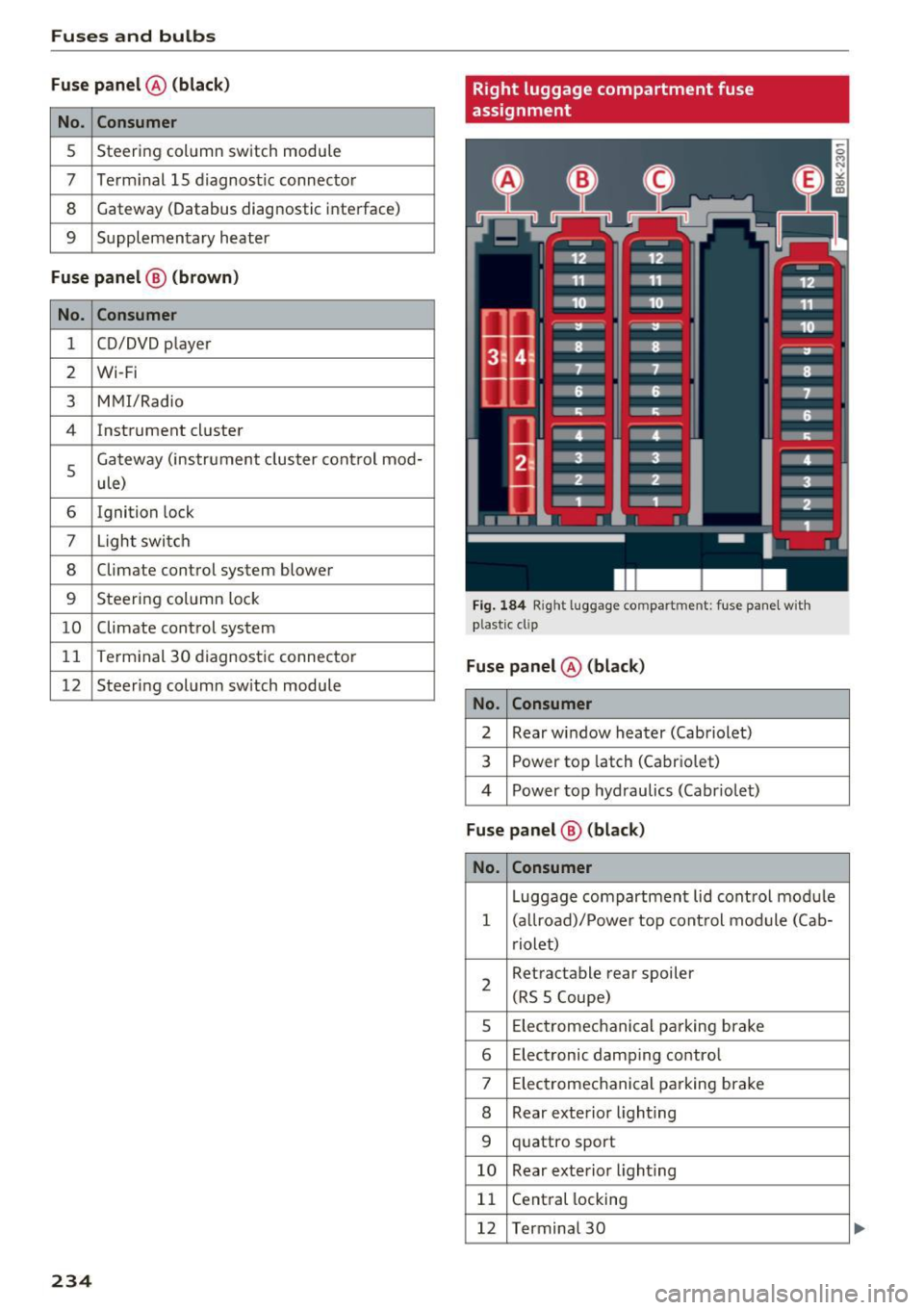
Fuses and bulbs
Fuse panel @ (black )
No. Consume r
5 Steering column switch module
7 Term inal 15 diagnostic connec to r
8 Gateway (Databus diagnostic interface)
9 S upplementary heater
Fuse panel @ (brown)
No. Consumer
1 C D/D VD p laye r
2 Wi-Fi
3 M MI/Radio
4 Instrument cluster
5
Ga teway (instrument cluster cont rol mod -
ule)
6 Ignition lock
7 Ligh t swi tch
8 Climate control system blower
9 Steering col umn lock
10 Climate control system
1 1 Te
rm inal 30 diagnos tic connec to r
12 Steer ing column sw itch module
234
Right luggage compartment fuse
assignment
Fig. 184 Right lu ggage compartment: fuse panel wit h
plast ic cl ip
Fuse panel @ (black)
No . Consumer
2 Rear wi ndow heater (Cabriolet)
3 Power top latch (Cabr io let)
4 P ower top hyd raulics (Cabr io let)
Fuse panel @ (black)
No . Consumer
Luggage compartment lid cont rol mo dule
1 (all road)/ Power top cont rol mod ule (Ca b-
r iolet)
2 Retractable rear
spoiler
(RS 5 Coupe)
5 E
lec tromec hanical p arking brake
6 Electronic damping contro l
7 Elec tromec hanical pa rking brake
8 Rear exte rior light ing
9 q uattro sport
10 Rear exterior lighting
1 1 Cent
ral locking
12 Terminal 30
...
Page 237 of 264
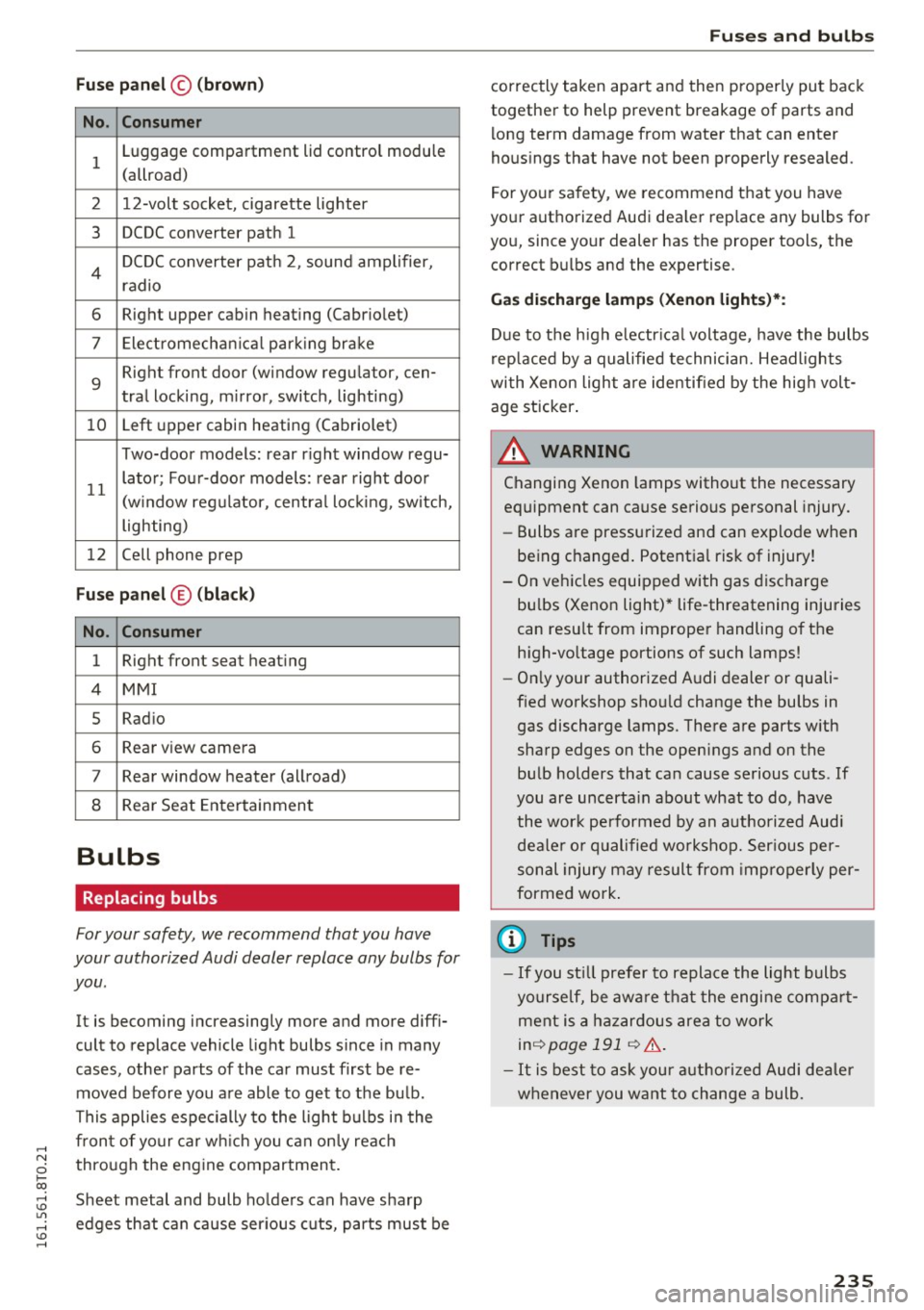
.... N
0 Ico ....
No . Consumer
1 Luggage compartment lid control module
(allroad)
2 12-volt socket, cigarette lighter
3 DCDC converter path 1
4 DCDC converter path 2, sound amplifier,
radio
6 Right upper cabin heating (Cabriolet)
7 Elect romechan ical park ing brake
9
Right front door (window regulator, cen-
tral locking, m irror, switch, lighting)
10 Left
upper cabin heating (Cabriolet)
Two-door models: rear r ight window regu-
11 lator; Four-door models:
rear right door
(w indow regulator, central locking, switch,
lighting)
12 Cell phone prep
Fuse panel ® (black )
No . Consumer
1 Right front seat
heating
4 MMI
5 Radio
6 Rear view camera
7 Rear window heater (allroad)
8 Rear Seat Entertainment
Bulbs
Replacing bulbs
For your safety, we recommend that you have
your authorized Audi dealer replace any bulbs for
you .
It is becoming increasingly more and more diffi
cult to replace vehicle light bulbs since in many
cases, other parts of the car must first be re
moved before you are able to get to the bu lb.
This applies especially to the light bulbs in the
front of your car which you can only reach
through the eng ine compartment.
Sheet metal and bulb ho lders can have sharp
edges that can cause serious cuts, parts must be
Fuses and bulbs
correctly taken apart and then properly put back
together to help prevent breakage of parts and
long term damage from water that can enter
hous ings that have not been properly resealed.
For your sa fety, we recommend that you have
your authorized Audi dea ler replace any bulbs for
you, since your dealer has the proper tools, the
correct bulbs and the expertise.
Gas discharge lamps (Xenon lights)*:
Due to the high e lectr ica l voltage, have the bulbs
replaced by a qualified technician. Headlights
with Xenon light are identified by the high volt
age sticker .
A WARNING
Changing Xenon lamps without the necessary
equipment can cause serious personal injury.
- Bulbs are pressurized and can explode when
being changed . Potential risk of injury!
- On vehicles equipped with gas discharge
bu lbs (Xenon light)* life-threatening injuries
can resu lt from improper handling of the
high -vo ltage portions of such lamps!
- Only your authorized Audi dealer or quali
fied workshop shou ld change the bulbs in
gas discharge lamps. There are parts w ith
sharp edges on the openings and on the bulb holders that can cause serious cuts . If
you are uncerta in about what to do, have
the wor k performed by an authorized Audi
dealer or qualified workshop. Serious per
sonal injury may result from improperly per
formed work.
(D Tips
- If you st ill prefer to replace the light bulbs
yourself, be awa re that the engine compa rt
ment is a hazardous area to work
inq page191 q &_ .
-It is best to ask your authorized Audi dealer
whenever you want to change a bulb.
235
Page 239 of 264
,-1 N
0 1-CX)
,-1 I.Cl U"I
,-1 I.Cl ......
When jump starting or charging the battery,
never connect the negative ground cable to
the battery negative post because the battery
manager system must be able to detect the
battery's state of charge . Always connect the
negative ground cable to the negat ive ground
post of the battery manager control unit .
Use of jumper cables
Make sure to connect the jumper cable clamps in
exactly the order described below!
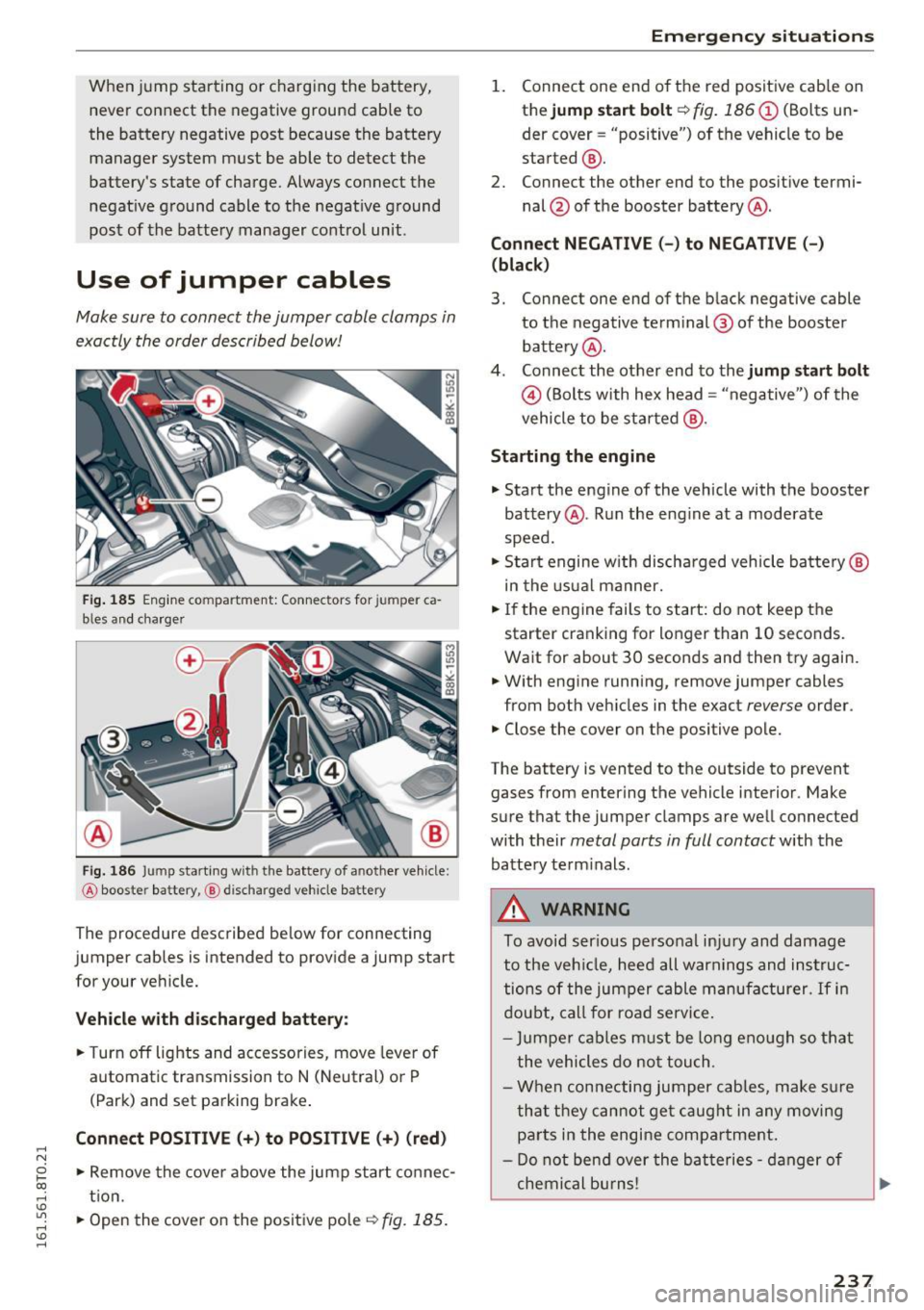
Fig. 185 Engine compa rtment: Connectors for jumper ca
b les and cha rge r
Fig. 186 Jump start ing with the battery of another vehicle:
@ boos te r ba ttery, ® d ischarged veh icle ba ttery
The procedure described below for connecting
jumper cables is intended to provide a jump start
for your vehicle.
Vehicle with discharged battery:
.. Turn off lights and accessories, move lever of
automatic transmission to N (Neutral) or P
(Park) and set parking brake .
Connect POSITIVE(+) to POSITIVE(+) (red)
.,. Remove the cover above the jump start connec
t ion.
.,. Open the cover on the positive pole¢
fig. 185.
Emergency situations
1. Connect one end of the red positive cab le on
the
jump start bolt¢ fig. 186 (D (Bolts un
der cover= "positive") of the vehicle to be
started @.
2. Connect the other end to the positive termi- nal@of the booster battery @.
Connect NEGATIVE (-) to NEGATIVE (- )
(black)
3. Connect one end of the black negative cable
to the negative terminal @ of the booster
battery @.
4 . Connect the other end to the
jump start bolt
@(Bolts with hex head= "negative") of the
vehicle to be started @.
Starting the engine
.. Start the engine of the vehicle with the booster
battery @. Run the eng ine at a moderate
speed .
.,. Start engine w ith discharged vehicle battery @
in the usual manner.
.,. If the engine fails to start: do not keep the
starter cranking for longer than 10 seconds.
Wait for about 30 seconds and then try again .
.. With engine running, remove jumper cables
from both vehicles in the exact
reverse order .
.. Close the cover on the positive pole.
The battery is vented to the outside to prevent gases from entering the vehicle interior . Make
sure that the jumper clamps are well connected
with their
metal parts in full contact with the
battery term inals .
A WARNING
To avoid ser ious personal injury and damage
to the vehicle, heed all warnings and instruc
tions of the jumper cable manufacturer.
If in
doubt, call for road service.
- Jumper cables must be long enough so that
the vehicles do not touch .
- When connecting jumper cables, make s ure
that they cannot get caug ht in any moving
parts in the engine compartment.
- Do not bend over the batteries -danger of
chemical bu rns!
237
Page 251 of 264
....
Emergency release . . . . . . . . . . . . . . . . . . . . 88
Kick -down . . . . . . . . . . . . . . . . . . . . . . . . . . . 87
Manual shift program . . . . . . . . . . . . . . . . . 86
Removal lock (igni tion key) . . . . . . . . . . . . . 72
Selector lever . . . . . . . . . . . . . . . . . . . . . . . . 83
Automatic wipers . . . . . . . . . . . . . . . . . . . . . . 50
Auto Safety Hotline . . . . . . . . . . . . . . . . . . . 119
Average speed . . . . . . . . . . . . . . . . . . . . . . . . 24
Avoid damaging the vehicle . . . . . . . . . . . . . 177
B
Battery . . . . . . . . . . . . . . . . . . . . . . . . . . . . . . 16
Battery location inside the luggage compart-
ment .. .. .. .. .... . .......... .. .. .. . 201
Charge level . . . . . . . . . . . . . . . . . . . . . . . . 175
Charging . . . . . . . . . . . . . . . . . . . . . . . . . . . 202
Energy manag ement . . . . . . . . . . . . . . . . . 17 5
Important w arnings when working on the
batte ry . . . . . . . . . . . . . . . . . . . . . . . . . . . . 201
Jump starting . . . . . . . . . . . . . . . . . . . . . . . 236
Replacing the battery . . . . . . . . . . . . . . . . 203
Work ing on the battery . . . . . . . . . . . . . . . 201
Befo re driving . . . . . . . . . . . . . . . . . . . . . . . . 112
Belt tensioners . . . . . . . . . . . . . . . . . . . . . . . 127
Bio -ethanol (Fuel) . . . . . . . . . . . . . . . . . . . . . 187
Blended gasoline . . . . . . . . . . . . . . . . . . . . . 186
Blower (automatic climate control) . . . . . . . . 70
Booster seats . . . . . . . . . . . . . . . . . . . . . . . . 159
Brake fluid
Changing the brake fluid . . . . . . . . . . . . . . 200
Checking the brak e fluid level . . . . . . . . . . 199
Brake system
Anti-lock braking system . . . . . . . . . . . . . . . 19
Brake fluid specifications for refill and re
p lacement . . . . . . . . . . . . . . . . . . . . . . . . . 200
Brake light defective . . . . . . . . . . . . . . . . . . 21
B rake power assist unit . . . . . . . . . . . . . . . 17 2
Br akes. .. .. .. .... ........... .. .. .. . 172
Ceramic brakes . . . . . . . . . . . . . . . . . . . . . . 172
E lectromechanical parking brake . . . . . . . . 77
Warning/indicator lights . . . . . . . . . . . . . . . 15
Worn brake pads symbol . . . . . . . . . . . . . . . 20
Braking
"' Brake assist . . . . . . . . . . . . . . . . . . . . . . . . 170
0
~ Emergency braking function . . . . . . . . . . . . 79 ....
braking guard . . . . . . . . . . . . . . . . . . . . . . . . . 89
Messages . . . . . . . . . . . . . . . . . . . . . . . . . . . 96
Settings . . . . . . . . . . . . . . . . . . . . . . . . . . . . 96
Break-in period
Brake pads . . . . . . . . . . . . . . . . . . . . . . . . . 172
T ires . . . . . . . . . . . . . . . . . . . . . . . . . . . . . . 177
Breaking in . . . . . . . . . . . . . . . . . . . . . . . . . . 177
New t ires . .. .. .. .. ............. .. .. 212
Bulbs . . . . . . . . . . . . . . . . . . . . . . . . . . . . . . . 235
C
California Proposition 65 Warning . . . . . . . 192
Battery specific . . . . . . . . . . . . . . . . . . . . . 202
Capacities . . . . . . . . . . . . . . . . . . . . . . . . . . . 242
Engine oil . . . . . . . . . . . . . . . . . . . . . . . . . . 193
Care . . . . . . . . . . . . . . . . . . . . . . . . . . . . . . . . 184
Cargo a rea
refer to Luggage compartment ...... 64, 118
Catalytic converter . . . . . . . . . . . . . . . . . . . . 178
Center armrest . . . . . . . . . . . . . . . . . . . . . . . . 5 7
C entral locking . . . . . . . . . . . . . . . . . . . . . . . . 31
Central locking switch . . . . . . . . . . . . . . . . . 35
Convenien ce key . . . . . . . . . . . . . . . . . . . . . . 34
Remote control key . . . . . . . . . . . . . . . . . . . 34
Ceramic brake rotors New brake pads . . . . . . . . . . . . . . . . . . . . . 172
Certification . . . . . . . . . . . . . . . . . . . . . . . . . 247
Changing engine oil . . . . . . . . . . . . . . . . . . . 196
Checking Engine coolant level . . . . . . . . . . . . . . . . . . 197
Child restra ints
Danger of using child restraints in the front
seat.. .... .. .. .. .. ............... .. 130
Where can I get additional information
about child restraints and their use? . . . . 168
Child restra int system anchors . . . . . . . . . . 164
Child safety . .. .. .. .. ...... ......... .. 151
I mpor tan t safety ins truc tions for using child
safety seats . . . . . . . . . . . . . . . . . . . . . . . . 154
Installing a child restraint using the LATCH
system . . . . . . . . . . . . . . . . . . . . . . . . . . . . 165
Lower anchorages . . . . . . . . . . . . . . . . . . . 165
Mounting and releas ing the anchorage
hook . . . . . . . . . . . . . . . . . . . . . . . . . . . . . . 165
Tether anchors . . . . . . . . . . . . . . . . . . . . . . 166
Tether straps . . . . . . . . . . . . . . . . . . . . . . . 166
249
Page 253 of 264
.... N
0 Ico ....
Dr iving throug h wate r . . . . . . . . . . . . . . . . . 177
Driving time . . . . . . . . . . . . . . . . . . . . . . . . . . 24
D ust filte r
re fer to Po llutant filter (au toma tic A/C sys -
tem) . . . . . . . . . . . . . . . . . . . . . . . . . . . . . . . 68
D ynamic stee ring . .......... .. 102,170 ,174
E
E85 (F ue l) . . . . . . . . . . . . . . . . . . . . . . . . . . . 187
Easy entry function . . . . . . . . . . . . . . . . . . . . . 56
E ff iciency p rogra m . . . . . . . . . . . . . . . . . . . . . 26
Fu el economy mess ages . . . . . . . . . . . . . . . 28
M emory levels . . . . . . . . . . . . . . . . . . . . . . . 24
Othe r equipment . . . . . . . . . . . . . . . . . . . . . 27
Shift indicator . . . . . . . . . . . . . . . . . . . . . . . 27
E lect ro-mechan ica l powe r ass ist . . . . . . . . . 17 4
Electromechanical parking brake
Emergency braking . . . . . . . . . . . . . . . . . . . 79
Indicator light . . . . . . . . . . . . . . . . . . . . . . . 77
Pa rking . . . . . . . . . . . . . . . . . . . . . . . . . . . . . 78
Re leas ing and closing . . . . . . . . . . . . . . . . . 77
St arting assis t . . . . . . . . . . . . . . . . . . . . . . . 78
S tarting from rest . . . . . . . . . . . . . . . . . . . . 78
S tarting off w ith a t railer . . . . . . . . . . . . . . . 78
Warning/indicator lights . . . . . . . . . . . . . . . 16
E lec tronic d ifferential lock
Wa rn in g/i ndic ator lig hts . . . . . . . . . . . . . . . 18
Electronic Differential Lock . . . . . . . . . . . . . 170
Electronic differential lock (EDL)
Wa rning/i ndicator lig hts.. ... .. .. .... .. 1 9
E lec tronic im mob iliz er . . . . . . . . . . . . . . . 12 , 37
Electronic power control (EPC) warning/ind icator light . . . . . . . . . . . 20
Elect ronic speed limiter . . . . . . . . . . . . . . . . . 29
E lect ronic stab iliz at io n cont rol
Sport mode . . . . . . . . . . . . . . . . . . . . . . . . 17 1
Electronic Stabilization Control . . . . . . . . . . 170
Electronic Stabilization Control (ESC) Wa rning/indicator lights . . . . . . . . . . . . . . . 1 8
E me rge ncy ac tuati on
D oors . . . . . . . . . . . . . . . . . . . . . . . . . . . . . . 36
I gnition key . . . . . . . . . . . . . . . . . . . . . . . . . 34
P ano ram ic tilting sunroo f . . . . . . . . . . . . . . 4 0
Sun shade (roof) . . . . . . . . . . . . . . . . . . . . . 4 0
E me rge ncy brak ing . . . . . . . . . . . . . . . . . . . . . 79
Index
E mergency flasher . . . . . . . . . . . . . . . . . . . . . 46
War ning/indicator lights . . . . . . . . . . . . . . . 22
E mergency key . . . . . . . . . . . . . . . . . . . . . . . . 32
Start ing engi ne . . . . . . . . . . . . . . . . . . . . . . 74
Emergency ope ration
Emergency braking function (parking brake) .7.9
Emergency start ing . . . . . . . . . . . . . . . . . . . 236
E nergy manage men t . . . . . . . . . . . . . . . . . . 175
B attery power . . . . . . . . . . . . . . . . . . . . . . . . 16
Drive r notification . . . . . . . . . . . . . . . . . . . . 16
E ngine
Compartment . . . . . . . . . . . . . . . . . . . . . . . 193
Coo la nt . . . . . . . . . . . . . . . . . . . . . . . . . . . . 1 96
Hood . . . . . . . . . . . . . . . . . . . . . . . . . . . . . . 191
Sta rt ing . . . . . . . . . . . . . . . . . . . . . . . . . 72 , 75
Start ing wi th ju mpe r cables . . . . . . . . . . . 236
Stopping . . . . . . . . . . . . . . . . . . . . . . . . . 7 4, 76
En gine compartment . . . . . . . . . . . . . . . . . . 193
Safety i nstr uctions .. ............. .. .. 191
Wo rking the engine compa rtment . . . . . . 191
E ngine coolant
I n dicator light . . . . . . . . . . . . . . . . . . . . . . . 17
Engine coolant system . . . . . . . . . . . . . . . . . 196
Adding coolant . . . . . . . . . . . . . . . . . . . . . . 198
Checking coolant level . . . . . . . . . . . . . . . . 197
Checking the engine coo lant level. . . . . . . 197
Radiator fan . . . . . . . . . . . . . . . . . . . . . . . . 199
Engine coolant temperature
Temperature gauge . . . . . . . . . . . . . . . . . . . 10
E ngine hood
Closing . . . . . . . . . . . . . . . . . . . . . . . . . . . . 191
How to release the hood . . . . . . . . . . . . . . 191
E ngine oil . . . . . . . . . . . . . . . . . . . . . . . . . . . 1 93
Adding . . . . . . . . . . . . . . . . . . . . . . . . . . . . 195
Addi tives. ... .. .. .. ... .. ..... ... .. .. 195
Changing . . . . . . . . . . . . . . . . . . . . . . . . . . 196
Check oil level . . . . . . . . . . . . . . . . . . . . . . 195
Cons umption . . . . . . . . . . . . . . . . . . . . . . . 195
Indicator light . . . . . . . . . . . . . . . . . . . . 17, 20
Oil consumpt io n . . . . . . . . . . . . . . . . . . . . . 194
Pressure malfunct ion . . . . . . . . . . . . . . . . . 17
Senso r defect ive . . . . . . . . . . . . . . . . . . . . . . 20
Spec ificatio n and viscosity . . . . . . . . . . . . . 193
Engine speed limitation . . . . . . . . . . . . . . . . . 20
E nv ironmen t
C atalytic converter . . . . . . . . . . . . . . . . . . . 178
Dispos ing of your veh icle battery . . . . . . . 203
251