warning AUDI A5 COUPE 2016 Service Manual
[x] Cancel search | Manufacturer: AUDI, Model Year: 2016, Model line: A5 COUPE, Model: AUDI A5 COUPE 2016Pages: 264, PDF Size: 66.92 MB
Page 64 of 264
Sea ts and stor age
The coat hooks are designed only for light
weight cloth ing . Never hang any clothing
with hard, pointed or heavy objects in the
pockets on the coat hooks . Dur ing sudden
braking or in an accident - especia lly if the
airbag is dep loyed - these objects could in
jure any passengers inside the vehicle.
- To reduce the risk of pe rsonal inj ury in an
acc ident or sudden stop, always keep the
glove compa rtment closed while d riving .
- Read and follow all WARNINGS
q page 147, Important safety instructions
on the side airbag system.
- Hang clothes in such a way that they do not
impa ir the d rive r's v ision.
- The coat hooks must only be used for light
weight clot hing . Do not leave any heavy or
sharp edged obje cts in the pocke ts which
may in terfere w ith the side c urtain airbag
dep loyment and can cause pe rsonal injury in
a crash.
- Do not use coat hangers for hanging clo th
ing on the coat hooks as this can interfere
with prope r deployment of the side curtain
airbags in an accident.
- Do not hang heavy objects on the coat
hooks, as they could cause personal injury in
a sudden stop.
- Always keep the compartment above the
rearview mirror closed wh ile driving to re
duce the risk of injury in the event of sudden
braking maneuvers or a collision.
(D Note
Objects located on the rear shelf that r ub
against the rear window could damage the
heating wires for the rear window defogger.
(D Tips
- A vent slot is located between the shelf and
the rear w indow . Do not b lock the vent with
any items you may place on the rear window
shelf.
- Do not place bulky items on the rear window shelf as they could restr ict or block the driv
er's vision in t he rear view mirror .
62
Roof rack
Description and mounting locations
Additional cargo can be carried with a roof lug
gage rack.
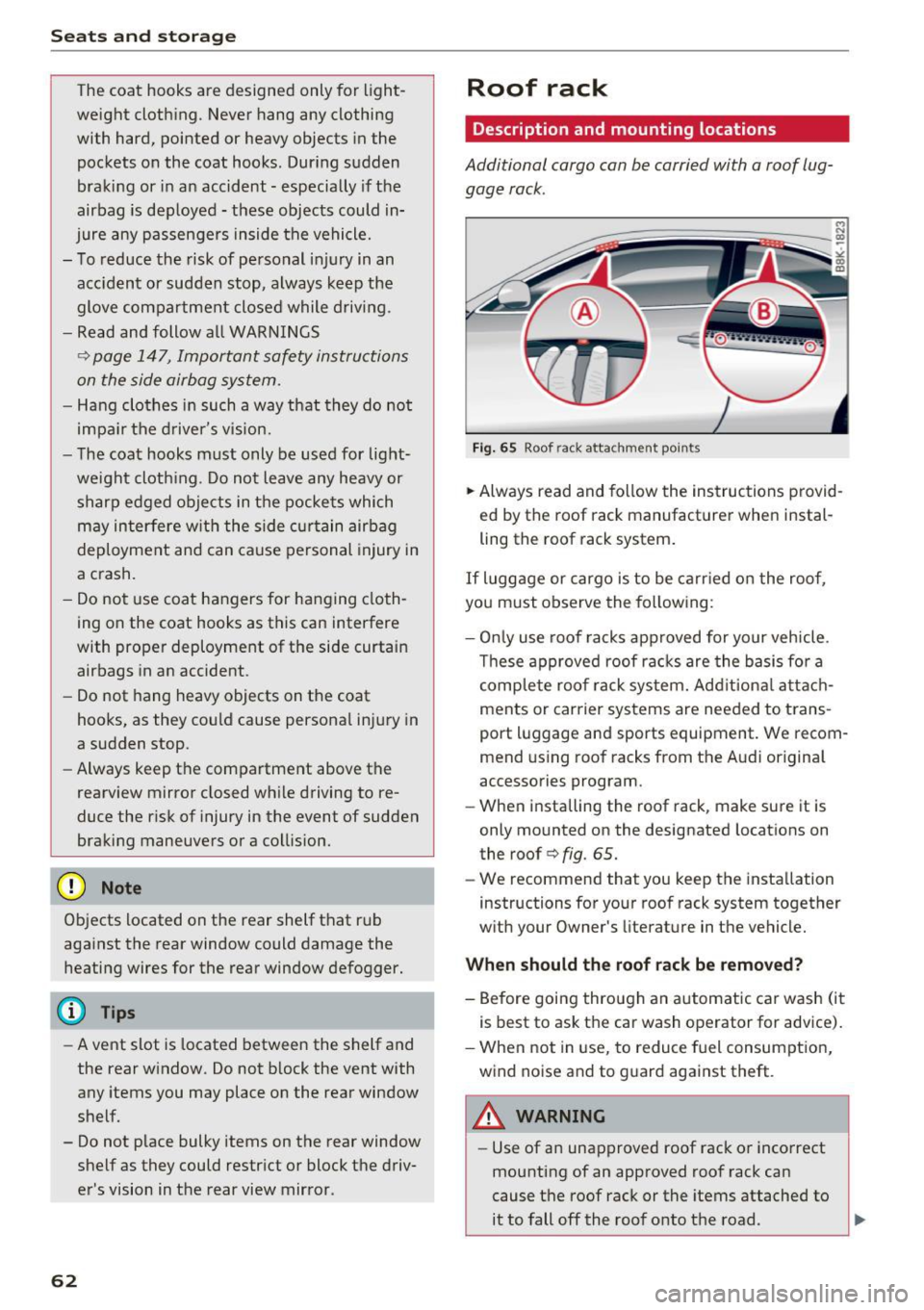
Fig. 65 Roof rack atta chment po in ts
.. Always read and fo llow the instruc tions provid
ed by the roof rack manufact urer when instal
ling the roof rack system .
If luggage or cargo is to be ca rried o n the roof,
you must observe the fo llowing :
- Onl y use roof racks approved for your veh icle .
Th ese approved roof racks are the basis fo r a
c omp le te roo f rack system. Add it iona l attach
ments or carrier systems are needed to trans
port luggage and sports equipment. We recom
mend us ing roof racks from the Audi original
accessories program .
- When installing the roof rack, make sure it is
only mounted on the designated locations on
the roof
q fig . 65.
- We recommend that you ke ep the installation
instructions for your roof rack system together
w ith your Owner 's literature in the vehicle.
When should th e roof rac k be remo ved?
- Before goi ng through an automatic ca r wash (it
i s best to ask the car wash operator for advice).
- When not in use, to reduce f uel consumption,
wind noise and to g uard against theft .
A WARNING
-Use of an unapproved roof rack or incorrect
mounting of an approved roof rack can
cause the roof rack or the items attached to it to fall off the roof onto the road . ...
Page 65 of 264
.... N
0 Ico ....
cause a crash and personal injury.
- Only mount the roof rack on the designated
locations on the roof
c:> fig . 65.
- The roof rack system must be installed ex
act ly according to the instructions provided .
- When driving with a roo f rack system,
changes to the center of gravity and wind
resistance can change the vehicle handling
and lead to a collision. Always adapt your
dr iv ing and your speed to the current condi
t ions .
- Your vehicle warranty does not cover any
damages to the vehicle caused by using roof
racks or mounting structures not approved
by Audi for your vehicle . The same applies to
damage result ing from incorrect roof rack
i nstallation .
-Always check the roof rack mount ings and
hardware before each t rip and dur ing a tr ip
to make sure everyt hing is securely tight
ened.
If necessary, ret igh ten the mo unt ings
and c hec k the en tire system from time to
time.
- After mounting a roof rack system, or when
you transport objects on the roof of your ve
hicle, the height of the vehicle is naturally
increased . Be careful when driving under
l ow bridges or in parking garages for exam
ple. This could cause damage to the load
and even the vehicle itself.
- Make s ure that the open rear lid and the
sunroof do not come into contact with ob
jects on the roof .
Loading the roof rack
Always distribu te loads evenly. Make sure any
thing on the roof rack is securely tied down.
~ Always distribute th e loads on the roof rack
evenly .
~ Always attach items to the roof rack securely
before you drive off .
T he maximum perm iss ible roof weight is
165 lb
( 75 kg ). The roof weight is the total of the
Seat s and sto rage
weight o f the roof rack, the attachments and the
cargo you ar e carrying. You must a lso not exceed
the max imum load weight for the roof rack you
are using.
When using a roo f rack system which has a lower
load carry ing capacity, you must not use up the
total max imum permissible load carry ing capac i
ty specified above. Instead, you should load the
roof rack sys tem only to the maximum capacity
specified by the manufacturer of the roof rack
system .
A WARNING
= -Weak, damaged or imprope r straps used to
secure items to the roof rac k can fail d uring
hard brak ing o r in a co llision and cause seri
ous persona l injury.
- Make sure the roof r ack is installed exactly
as specified above
c:> page 62.
- Always use suitable mounting straps fo r se
cur ing items to the roof rac k to he lp prevent
items from shifting o r flying forward .
- Items on the roof rack mus t always be se
curely mounted.
- The use of a roof rack can negative ly affect
the w ay a vehicle hand les . Cargo tha t is
large, heavy, b ulk y, long or flat wi ll have a
grea ter negat ive infl uence on the vehicle's
aerodynamics, center of gravity and overa ll
handling. Always drive slowly, avoid sudden
braking and maneuvers when transporting
cargo on the roof of your vehicle.
- Never exceed the max imum permissib le
load carrying capacity of the roof of your ve
h icle, the permiss ible axle weights and the
perm iss ible total we ight of your vehicle
c:> page 241, Weights .
@ For the sake of the environment
As a result of the increased wind res istance
created by a roof rack, your vehicle is using
fuel unnecessarily . So remove the roof rack
after using it .
63
Page 66 of 264
Sea ts and stor age
Luggage compartment
General information
A WARNING
Read and follow the important safety p recau
tions on
~ page 118, Storing cargo correctly.
Enlarging the luggage compartment
A pp lies to veh icles: w ith fol ding rear seatback
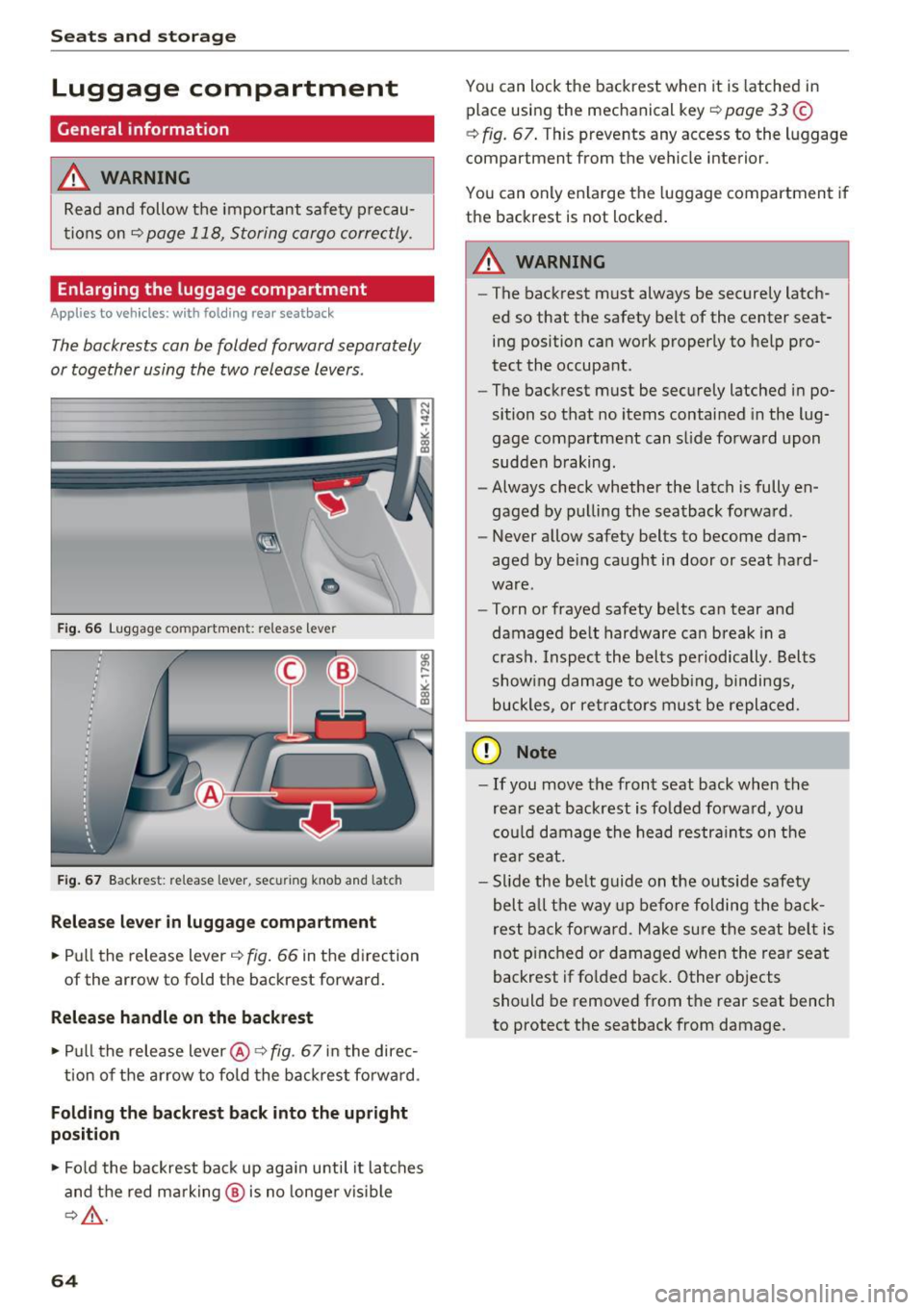
The backrests can be folded forward separately
or together using the two release levers .
•
Fig . 66 Luggage compartment: release lever
Fig . 67 Backrest: re lease lever, secu ring knob and latch
Rel eas e lev er i n lug gage compartment
.. Pull the release lever c:> fig . 66 in the direction
of the arrow to fold the backrest forward .
Release handle on the backrest
.. Pull the release lever@¢ fig. 67 in the direc-
tion of the a rrow to fold the backrest forward.
Folding the backre st back into the upright
posit ion
.. Fo ld the backrest back up again until it latches
and the red marking @ is no longe r vis ible
~ A .
64
You can lock the backrest when it is latched in
place using the mechanical key
i::> page 33 ©
~ fig. 67 . This prevents any access to the luggage
compartment from the vehicle interior.
You can only enla rge the luggage compartment if
the backrest is not locked.
A WARNING
-The backrest must always be securely latch
ed so that the safety belt of the center seat
ing position can work properly to help pro
tect the occupant.
- The backrest must be securely latched in po
sition so that no items contained in the lug
gage compartment can slide fo rward upon
sudden b raking.
- Always check whether the latch is fully en
gaged by pulli ng the seatback forward .
- Never allow safety belts to become dam
aged by be ing caught i n door or seat hard
ware.
- Torn or frayed safety belts can tear and
damaged belt hardware ca n break in a
crash . Inspect the belts pe riodically. Belts
show ing damage to webbing, bindings,
buckles, or ret rac tors must be repla ced.
(D Note
- If you move the front seat back when the
rea r seat backrest is fo lded fo rward, you
cou ld damage the head restra ints on the
rear seat.
- Slide the be lt g uide on the outs ide safety
bel t all the way up be fore folding the back
rest b ack fo rward. Make s ure the seat belt is
not p inched or damaged when the rear seat
backrest if fo lded back . Other objects
should be removed from t he rear seat bench
to protect the seatback from damage .
Page 67 of 264
,-1 N
0 1-CX)
rl I.Cl U"I
,-1 I.Cl ......
Tie-downs and cargo net
Applies to vehicles: with cargo net
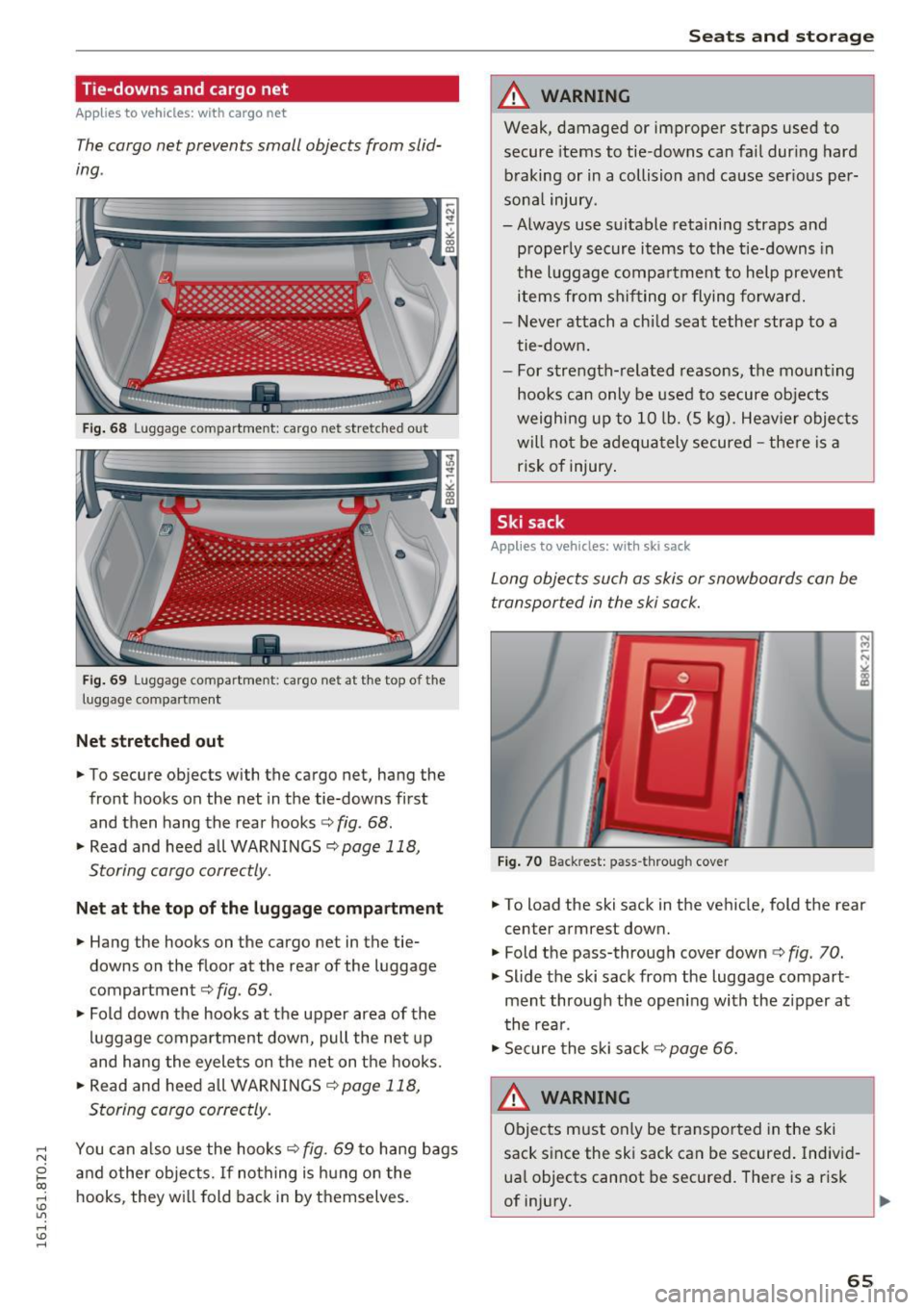
The cargo net prevents small objects from slid
ing .
Fig. 68 Luggage compartment: cargo net stretched out
Fig. 69 Luggage compartment: cargo net at the top of the
luggage compartment
Net stretched out
.,. To secure objects with the cargo net, hang the
front hooks on the net in the tie-downs first
and then hang the rear hooks ¢
fig. 68 .
.,. Read and heed all WARNINGS ¢page 118,
Storing cargo correctly.
Net at the top of the luggage compartment
.,. Hang the hooks on the cargo net in the tie
downs on the floor at the rear of the luggage
compartment
¢fig. 69.
.,. Fold down the hooks at the upper area of the
luggage compartment down, pull the net up
and h ang the eyele ts on the net on the hooks .
.,. Read and heed all WARNI NGS
¢page 118,
Storing cargo correctly.
You can a lso use the hooks¢ fig. 69 to hang bags
an d o ther objects. If nothing is hung on the
hooks, they w ill fold bac k in by themselves.
Seats and storag e
A WARNING
--
Weak, damaged or improper straps used to
secure items to tie-dow ns can fai l dur ing hard
b raking or in a collision and ca use ser ious per
sona l injury.
-Always use suitable retaining straps and
proper ly secure i tems to the t ie-downs in
the l uggage compa rtme nt to help prevent
items from sh ifting o r flying forwar d.
- Never attach a ch ild s eat tether strap to a
tie-down.
- For strength- rela ted reasons, t he mo unt ing
hooks can only be used to secure objects
weighing up to 10 lb. (S kg). He avier objects
will no t be ad equ ately secured -the re i s a
ris k of injury .
Ski sack
Applies to vehicles: with ski sack
Long objects such as skis or snowboards can be
transported in the ski sack.
Fi g. 70 Backrest: pass-through cover
.,. To load the ski sack in the ve hicle, fold the rear
center armrest down .
.,. Fold the pass-through cover down ¢
fig. 70.
.,. Slide the ski sac k from the luggage compart
men t through the opening with the zipper at
t he rea r.
.,. Sec ure the s ki sack¢
page 6 6.
A WARNING
O bjects m ust only be tra nspor ted in the ski
sack since the sk i sack can be secured. Individ
ua l objects can not be secured. The re is a r isk
of injury.
-
65
Page 68 of 264
Seats and storage
@ Tips
-You can open the pass-through from the
luggag e compartment. Push the release
button down and push the cover forward.
- You can lock or unlock the pass-through us
ing the mechanical key. This prevents any
access to the luggage compartment from
the vehicle interior.
Securing the ski sack
Appl ies to veh icles: w ith s ki sac k
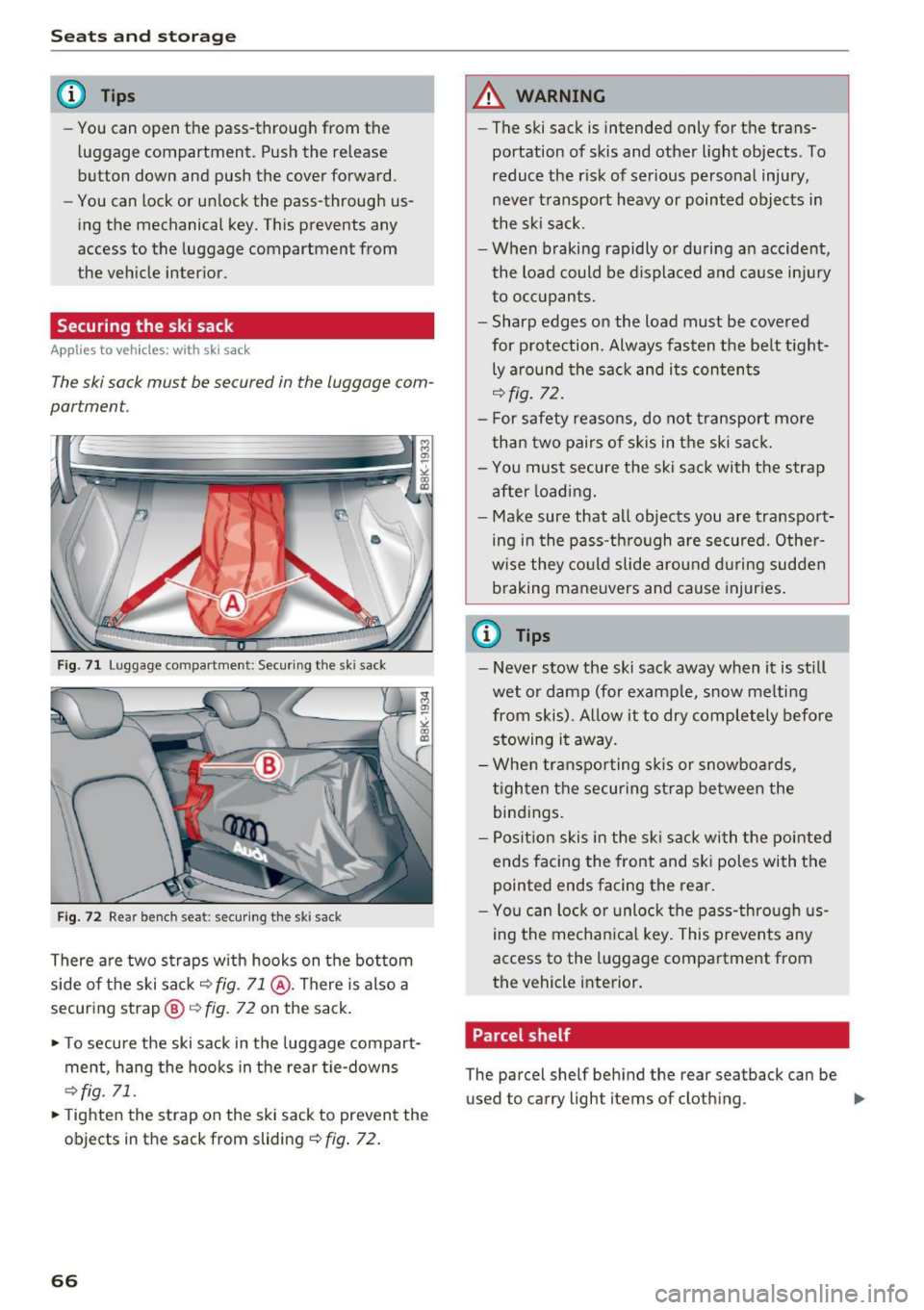
The ski sack must be secured in the luggage com
partment.
Fig. 71 Luggage compartme nt: Secur ing the ski sack
Fig. 72 Rear bench sea t: secu ring the ski sack
There are two straps with hooks on the bottom
side of the ski sack
~ fig. 71 @ . There is also a
securing strap@~
fig. 72 on the sack.
.. To secure the ski sack in the luggage compart
ment, hang the hooks in the rear tie-downs
~fig. 71.
.. Tight en the strap on the ski sack to prevent the
objects in the sack from sliding
~ fig. 72.
66
A WARNING
-The ski sack is intended only for the trans
portation of skis and other light objects . To
reduce the risk of serious personal injury,
never transport heavy or pointed objects in
the ski sack.
- When braking rapidly or during an accident,
the load could be displaced and cause injury to occupants.
- Sharp edges on the load must be covered
for protection . Always fasten the belt tight
ly around the sack and its contents
~fig . 72.
- For safety reasons, do not transport more
than two pairs of skis in the ski sack.
- You must secure the ski sack with the strap
after loading.
- Make sure that all objects you are transport
ing in the pass-through are secured. Other
wise they could slide around during sudden braking maneuvers and cause injuries.
@ Tips
-Never stow the ski sack away when it is still
wet or damp (for example, snow melting
from skis). Allow it to dry completely before stowing it away.
- When transporting skis or snowboards,
tighten the securing strap between the
bindings.
- Position skis in the ski sack with the pointed
ends facing the front and ski poles with the
pointed ends facing the rear.
- You can lock or unlock the pass-through us
ing the mechanical key. This prevents any
access to the luggage compartment from
the vehicle interior.
. Parcel shelf
The parcel shelf behind the rear seatback can be
used to carry light items of cloth ing. ..,.
Page 69 of 264
.... N
0 Ico ....
No heavy or hard objects should be placed on
the parcel shelf . They are a hazard to the vehi
cle occupants d uring sudden braking. The is a
r isk of injury.
(D Note
Please make sure that the heating wires for
the rear window defogger a re not damage by
abrasive objects.
(D Tips
To ensure problem-free ventilat ion, the venti
lation slots between the rear window and the
parcel she lf m ust not be covered .
Seat s and sto rage
67
Page 70 of 264
Warm and cold
Warm and cold
Climate control system
Description
The climate control system warms, cools and
adds humidity to the air in the veh icle inter ior. It
is the most effective when the windows and sun
roof are closed. If there is a build-up of heat in
side the vehicle, ventilation can help to speed up
the cooling process.
I n all heating mode functions except
defrost, the
b lower only switches to a higher speed once the
engine coolant has reached a certain tempera
ture .
Condensat ion from the cooling system can drip
and form a puddle of water under the veh icle.
This is normal and does not mean there is a leak.
P ollutant filt er
The pol lutant filte r removes pollutants such as
dust and pollen from the a ir.
The air pollutants filter must be changed at the intervals specif ied in your Warranty
& Mainte
nance booklet, so that the a ir cond it ione r can
properly work.
If you drive your vehicle in an area with high air pollut ion, the filter may need to be changed
more frequently than specified i n your Aud i War
ranty
& Maintenance booklet. If in doubt, ask
your author ized Audi Service Advisor for advice.
Ke y cod ed setting s
The climate control settings are automatically
stored and assigned to the remote control key
that is in use .
.8, WARNING
Reduced visib ility is dangerous and can ca use
accidents.
- For safe dr iv ing it is very impo rtan t that all
windows be free of ice, snow and condensa
t ion .
68
-Complete ly familiarize yourself with the
proper use and function of the heating and
ventilation system and espec ially how to de
fog and defrost the wi ndows .
- Never use the windshield wiper/washer sys
tem in freezing weather until you have
warmed the windshield first, using the heat ing and vent ilation system. The washer solu
tion may freeze on the windshield and re
duce visibi lity.
(D Note
- If you suspect that the air conditioner has
been damaged, sw itch the system off to
avoid further damage and have it inspected
by a q ualified dealership.
- Repa irs to the Aud i air cond itioner requ ire
special techn ica l know ledge and spec ial
tools. Contact an a uthorized Audi dealer fo r
assistance.
@ For the sake of the environment
By reduc ing the amo unt of fuel you use, you
also reduce the amount of pollutants emitted
into the a ir.
(D Tips
- Keep t he a ir intake slots (in front of the
windshield) free from ice, snow and debr is
in orde r to maintain the prope r funct ion of
the climate control system .
- The energy management sys tem may sw itch
the seat heating* o r rea r window defroster
off temporarily. These systems are available
again as soon as the energy balance has
been restored.
- Air escapes through vents under the rear
window. When placing items of clothing on
the luggage compartment cover, ensure
that the openings are not covered.
Page 72 of 264
Warm and cold
1- 1 Switching recirculation mode on/off
In r ecirculation mode, the air inside the vehicle is
circu lated and filtered. This prevents the unfil
tered air outside the vehicle from entering the
ve hicl e interior. We recommend switching recir
culation mode on when driving through a tunnel
or when sitting in traffic¢.&,.
The
IAUTOI button or l
IAUTO I Switching automatic mode on
Automatic mode maintains a constant tempera
ture inside the vehicle. Air temperature, airflow
and air distribution are controlled automatically.
Adjusting the temperature
Temperatures between 60 °f (+16 °C) and 84 °f
( + 28 °C) can be set. Outside of this range,
LO or
HI will appear in the climate control system dis
p la y. At both of these settings, the climate con
trol system runs continuously at maximum cool
ing or heating power. There is no temperature
regulation.
~ Adjusting the airflow
You can adjust the airflow manually to suit your
needs. To have the airflow regulated automati
cally, press the
IAU TO I button.
~ Adjusting the air distribution
You can manually select the vents where the air
will flow. To have the air dist ribution regulated
automatically , press the
IAU TO I button.
QJ Adjusting seat heating*
Pressing the button switches the seat heating on
at the highest setting (level 3) . The LEDs indicate
the temperature level. To reduce the tempera
ture, press the button aga in. To switch the seat
heating off, press the button repeated ly until the
L ED turns off.
After 10 minutes, the seat heating automatically
switches from level 3 to level 2.
~ Adjusting seat ventilation*
Pressing the button switches the seat vent ilation
on at the highest setting (level 3). The LEDs indi-
70
cate the ventilation level. To reduce the venti la
tion level, press the button again. To switch the
seat ventilation off, press the button repeatedly
until the LED turns off.
I@ FRONT I Switch the defroster on/off
The windshield and side windows are defrosted
or cleared of condensation as quick ly as possible.
The maximum amount of air f lows mainly from
the vents below the windshield. Recirculation
mode switches off. The temperature should be
set to 72 °f (22 °C) or higher. The temperature is
controlled automatically.
The
! AU TOI button switches the defroster off.
lliil REAR I Switching rear window heater on/
off
The rear window heater only operates when the
engine is running. It switches off automatically
after a few m inutes, depending on the outside
temperature.
To prevent the rear window heater from switch
ing off automatica lly, press and hold the
loo REARI
button for more than 2 seconds. T his remains
stored until the ignition is sw itched off.
Air vents
You can open and close the center and rear air
vents using the thumbwheels. The levers adjust
the direction of the airflow from the vents.
In vehicles with a 3-zone deluxe automatic cli
mate contro l system*, you can adjust the air tem
perature in the rear by turning the thumbwheel
toward the red side to make it warmer or toward
the blue side to make it cooler.
A WARNING
- Do not use the rec irculat ion for extended
periods of time. The windows could fog up
since no fresh air can enter the vehicle . If
the windows fog up, press the air recircula
tion button again immediate ly to switch off
the air recirculat ion function or select de
frost.
- Individuals with reduced sensitiv it y to pain
or temperature could develop burns when
using the seat heating function. To reduce
-
Page 74 of 264
Driving
Driving
Steering
Manually adjustable steering wheel
The steering wheel position is fully adjustable up
and down and forward and back .
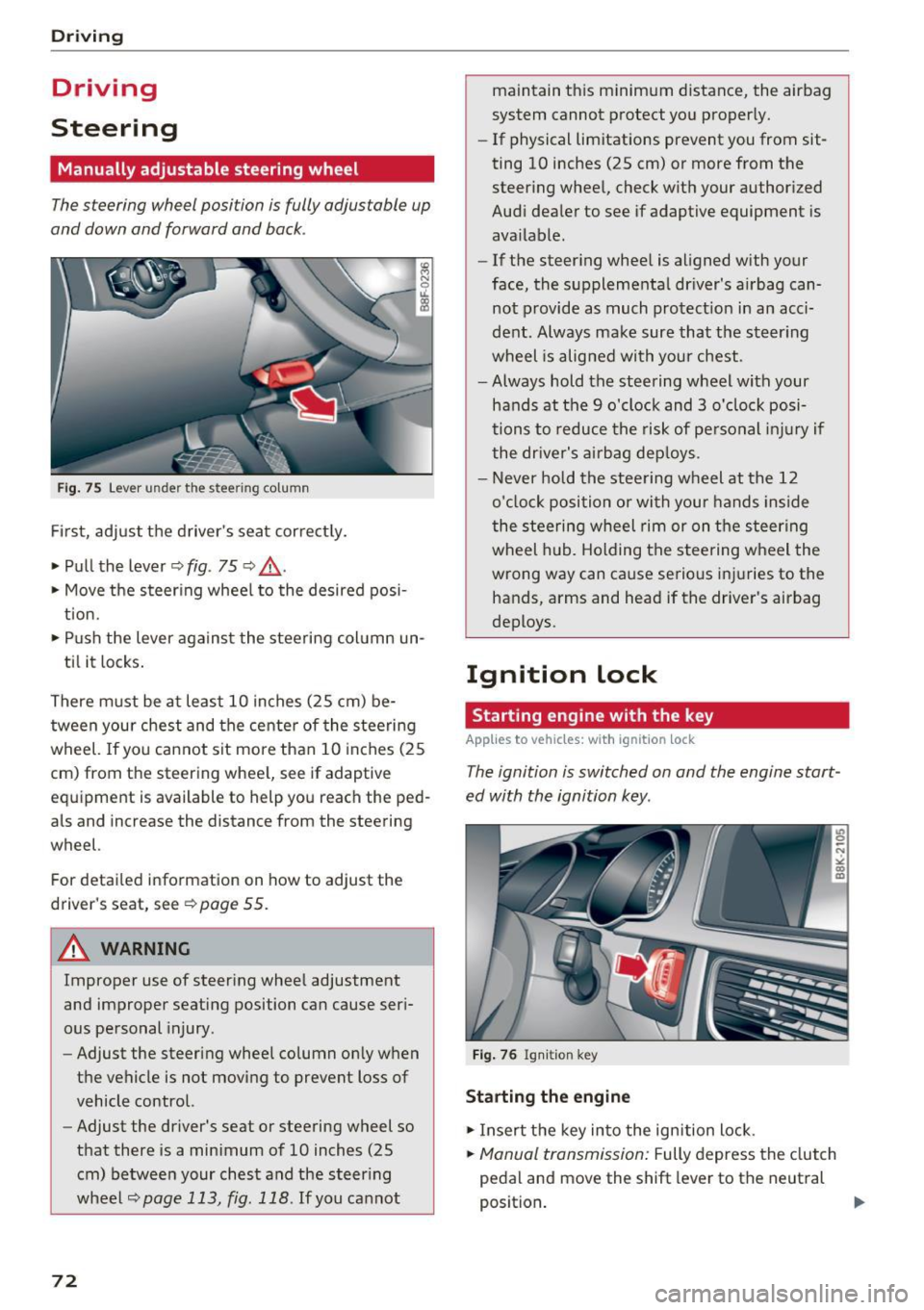
Fig. 75 Lever under the steering column
First, adjust the driver's seat correctly.
• Pull the lever¢
fig. 75 ¢ .&_ .
• Move the steering wheel to the desired posi
tion.
• Push the lever against the steering column un-
til it locks.
There must be at least 10 inches (25 cm) be tween your chest and the center of the steering
wheel. If you cannot sit more than 10 inches (25
cm) from the steering wheel, see if adaptive
equipment is available to help you reach the ped
als and increase the distance from the steering
wheel.
For detailed information on how to adjust the
driver's seat, see
¢page 55.
A WARNING
Improper use of steering wheel adjustment
and improper seating position can cause seri
ous personal injury.
- Adjust the steering wheel column only when
the vehicle is not moving to prevent loss of
vehicle control.
- Adjust the driver's seat or steering wheel so
that there is a minimum of 10 inches (25
cm) between your chest and the steering
wheel
¢page 113, fig. 118 . If you cannot
72
maintain this minimum distance, the airbag
system cannot protect you properly.
- If physical limitations prevent you from sit
ting 10 inches (25 cm) or more from the
steering wheel, check with your authorized
Audi dealer to see if adaptive equipment is
available.
- If the steering wheel is aligned with your
face, the supplemental driver's airbag can
not provide as much protection in an acci
dent. Always make sure that the steering
wheel is aligned with your chest.
- Always hold the steering wheel with your
hands at the 9 o'clock and 3 o'clock posi
tions to reduce the risk of personal injury if
the driver's airbag deploys.
- Never hold the steering wheel at the 12
o'clock position or with your hands inside
the steering wheel rim or on the steering
wheel hub. Holding the steering wheel the
wrong way can cause serious injuries to the
hands, arms and head if the driver's airbag
deploys.
Ignition lock
Starting engine with the key
Applies to vehicles: wit h ignition lock
The ignition is switched on and the engine start
ed with the ignition key .
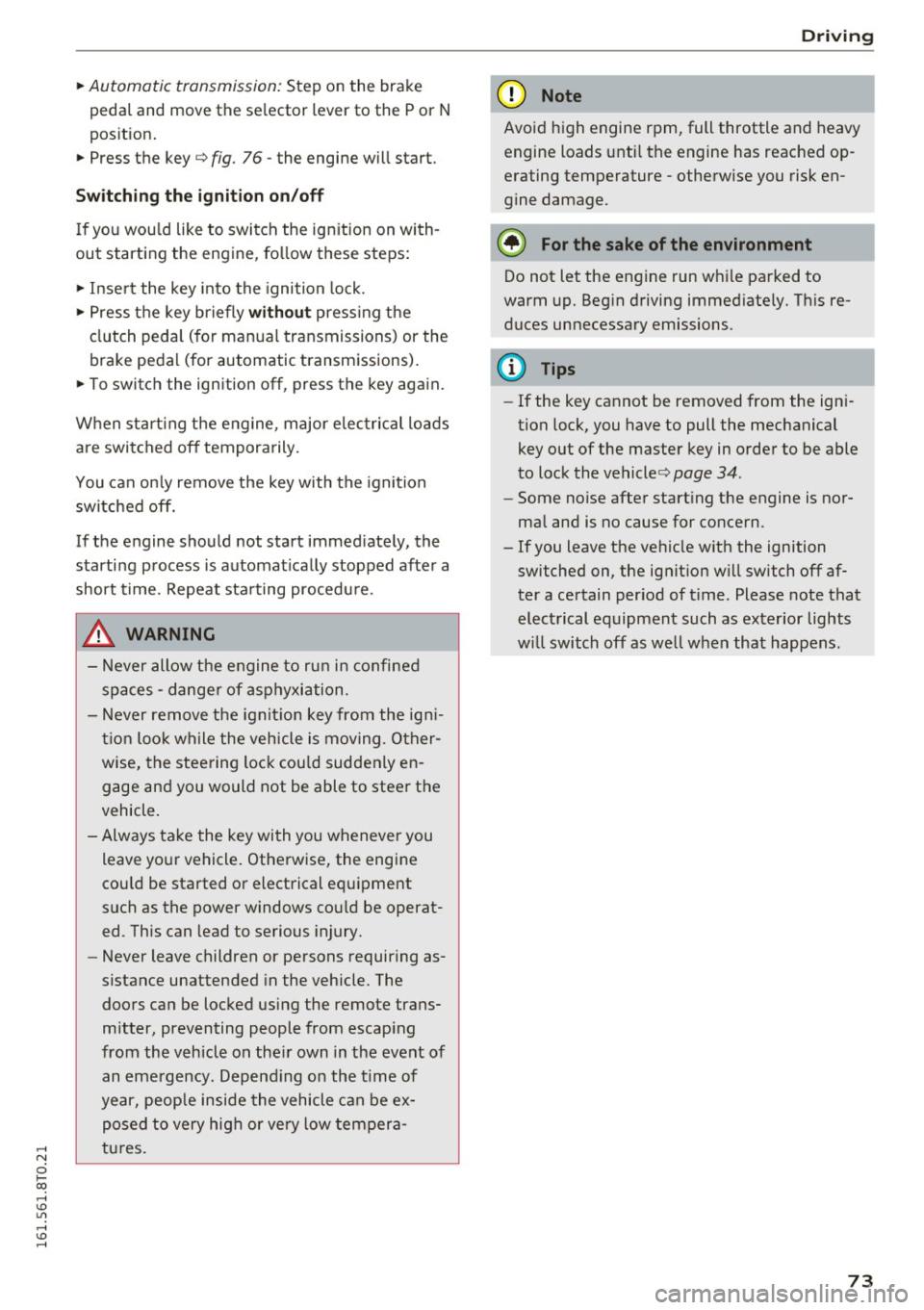
Fig. 76 Ignition key
Starting the engine
• Insert the key into the ignition lock.
• Manual transmission: Fully depress the clutch
pedal and move the shift lever to the neutral
position. ..,.
Page 75 of 264
.... N
0 I-co ....
peda l and move the se lector lever to the P or N
pos ition .
~ Press the key c::> fig. 76 - the engine will start.
Switchi ng the ignition on /off
If you wou ld like to switch the ig nition on with
out starting the engine , fo llow these steps :
~ Insert the key into the ignition lock.
~ Press t he key briefly withou t pressing the
clutch peda l (for manual transmissions) or the
brake pedal (for automatic transmissions).
~ To switch the ignition off, press th e key again .
When start ing t he engine, major elec trical loads
are switched off tempora rily.
You can on ly remove the key with the ignition
switched off.
If the engine should not start immed iately, the
starting process is automat ically stopped after a
short time. Repeat sta rting procedu re .
_& WARNING
- Never allow the e ngine to ru n in confined
spaces - danger of asp hyxiation .
- Never remove the ign it io n key from the ig ni
t ion look while the vehicle is moving . O ther
wise, the stee ring lock cou ld suddenly en
gage and you would not be able to steer t he
vehicle .
- Always take the key wi th you whenever you
leave your vehicle . Otherwise, the engine
cou ld be started or electrical equipment
such as the power windows cou ld be operat
ed . This can lead to serious injury.
- Never leave children or persons requiring as
sistance unattended in the vehicle. The
doors can be locked using the remote trans
mitter, preventing people from escap ing
from the vehicle on the ir own in the event of
an eme rgency . Depend ing on the t ime of
year, peop le inside the vehicle can be ex
posed to very hig h or very low tempera
tures .
-
D riv ing
(D Note
Avoid high engine rpm, full throttle and heavy
engine loads unti l the engine has reached op
erating temperature - otherwise you risk en
gine damage.
@ For the sake of the environment
Do not let the engine run w hile parked to
warm up. Beg in driving immed iate ly. Th is re
duces unnecessary emissions.
(D Tips
- If the key cannot be removed from the ign i
tion lock, you have to pull the mechanical
key out of the master key in order to be able
to lock the vehicle c::>
page 34.
-Some noise after starting the engine is nor
mal and is no cause for concern.
- If you leave the vehicle w ith the ignition
switched on, the ignit ion w ill switch off af
ter a certain per iod of t ime . Please note that
electrical equipment such as exterior lights
w ill switch off as we ll w hen that happens.
73