maintenance AUDI A5 COUPE 2016 Owners Manual
[x] Cancel search | Manufacturer: AUDI, Model Year: 2016, Model line: A5 COUPE, Model: AUDI A5 COUPE 2016Pages: 264, PDF Size: 66.92 MB
Page 3 of 264
.... N
0 Ico ....
2016 Audi 55 Coupe
Foreword
Thank you for choosing an Audi -we value your trust in us.
Your new Audi will allow you to experience the best in groundbreaking technolo
gy and premium quality equipment a vehicle has to offer. We recommend that
you read your Owner's Manual thoroughly so that you quickly become acquaint
ed with your Audi and make use of all of its features .
In addition to explaining how the different features work, we provide many use
ful tips and information concerning your safety, how to care for your vehicle and
how to maintain your vehicle's value. We also give you useful tips and informa
tion on how to drive your veh icle more efficiently and in an environmentally
friendly manner .
In the Owner's Manual, you will also find the Operating Manual for your Info
tainment system and the vehicle maintenance schedule.
We hope you enjoy driving your Audi and we wish you safe and pleasant motor
ing.
AUDIAG
Page 6 of 264
Table of contents
Audi Service Repair Manuals and
Lit erature . . . . . . . . . . . . . . . . . . . . . . . . . . 244
Maintenance . . . . . . . . . . . . . . . . . . . . . . . . 244
Accessories and technical changes . . . . . . 246
Declaration of Compliance,
Telecommun ications and Electro nic
Systems . . . . . . . . . . . . . . . . . . . . . . . . . . . 247
Index ... .. .. .. ... .. ..... ... .. .. .. . 248
4
Page 7 of 264
.... N
0 Ico ....
comes with the
- MMI Operat ing Instructions
- Warranty
& Maintenance booklet.
If you are missing one of these publications, or if
you believe that the information is not complete,
contact your author ized Audi dealer for assis
tance.
MMI Operating Instructions
contain detailed description of the Aud i Mu lti
Media Interface (MMI) includ ing the nav igation
system, the sound system and the hand held
phone.
The Warranty & Maintenance booklet
explains how you can keep your Audi in top driv ing condition by having it serviced regu larly and
contains detailed information about the warran
ties covering your Aud i. Always have the booklet
with you when you take your veh icle to an author
iz ed A udi dealer for serv ice. Your Audi Serv ice Ad
visor w ill record each scheduled service and can
answer any questions you may have regarding
h ow to maintain your vehicle.
In Canada,
the vehicle literature is also available in French.
To obtain a copy, co nta ct you r dealer or write to:
Au Canada, on peut se procurer un exemplaire en
frarn;ais de ce document aupres du concession
naire ou de:
Aud i Canada
Client Assistance
Assistance a la Clientele
777 Bayly Street, West,
Ajax, Ontario LlS 7G7
If you sell your Audi
all literature should be left in the vehicle to make
the Warranty terms as well as all operating, safe
ty and maintenance informat ion ava ilable to the
next owner .
Owner 's Literature
If you change your address or if you bought
this Audi used
be sure to send in a "Notice of Address Change" I
"Not ice of Used Car Purchase" post card. This
card can be found in the Warranty
& Mainte
nance booklet or obtained from your authorized
Audi dealer.
It is in your own interest that we are able to
contact you should the need arise.
5
Page 34 of 264
Opening and clo sin g
- If the power locking system should fail, you
can still open the fuel tank flap in an emer
gency ¢
page 190.
-You are well advised not to keep val uables
inside an unatte nded vehicle, v is ible or not.
Even a properly locked vehicle cannot pro
v ide the security of a safe.
- If the LED in the upper edge of the driver's
door panel comes on for about 30 seconds
after t he vehicle is locked, there is a mal
funct ion in the power lock ing or the anti
theft warning system . Have the malf unct io n
cor rected by an authorized Audi dealership
or q ualified repair facility.
Key set
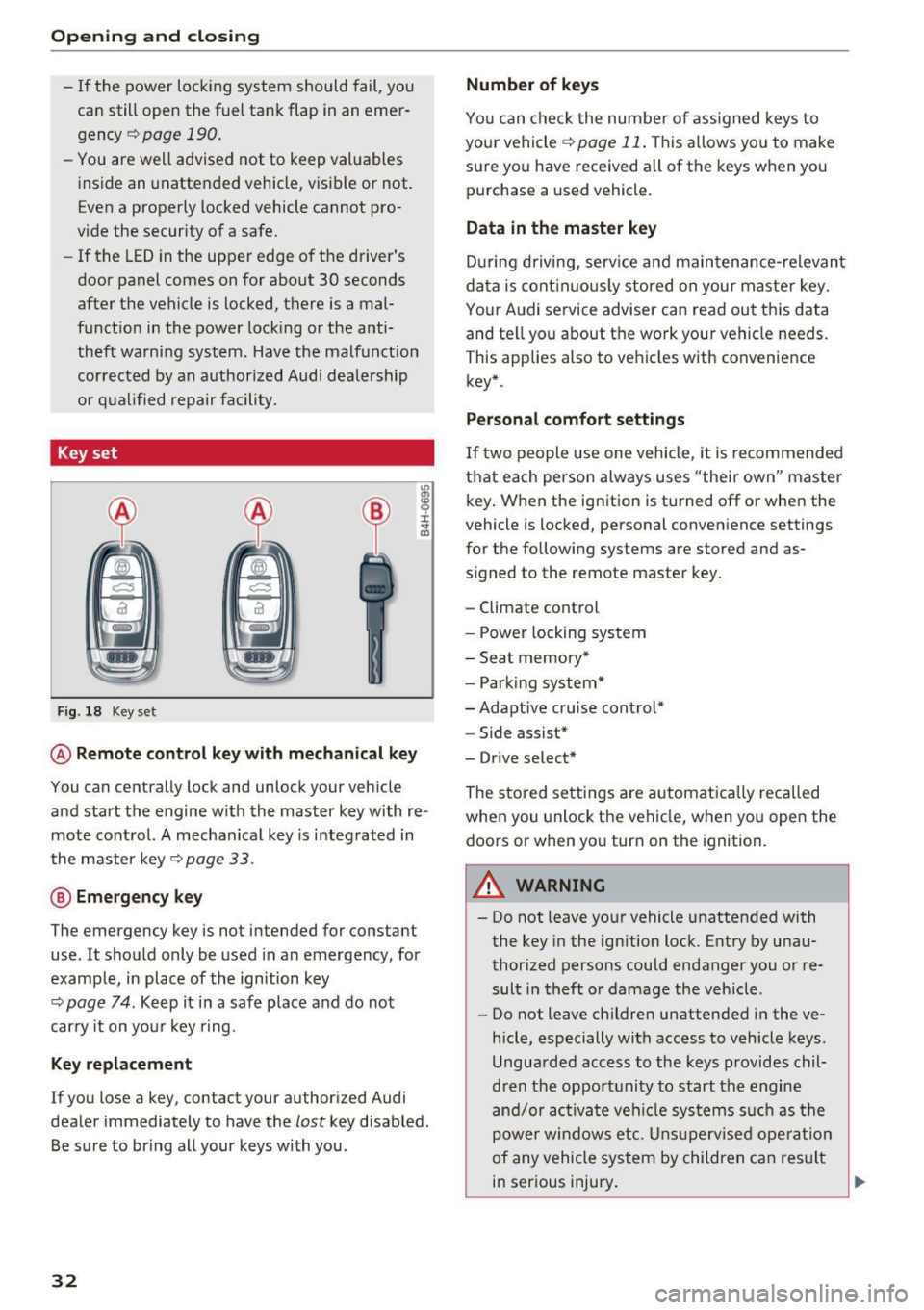
F ig . 18 Key set
m 0 ±
~
@ Remote control key with mechanical key
You can centrally lock and unlock your veh icle
and start the engine w it h the master key with re
mote cont rol. A mecha nical key is i nteg rated in
the master key ¢
page 33.
@ Eme rgency key
The emergency key is not intended for constant
use . It shou ld only be used in an emergency, for
example, in place of the ign ition key
¢
page 74 . Ke ep it in a safe place and do not
car ry it on yo ur key r ing.
Key replacement
If you lose a key, contact your author ized Audi
dealer immediately to have the
lost key disab led .
Be s ure to bring all your keys with you .
32
Number of keys
You can chec k the number of assigned keys to
your vehicle
r=;, page 11 . This a llows yo u to make
sure yo u have received all of the keys when you
purchase a used vehicle .
Data in the master key
During driving, serv ice and maintenance-re levan t
da ta is cont inuo usly stored on your master key.
You r A udi service adviser can read out this data
and te ll yo u about the work you r vehicle needs.
This applies also to veh icles with convenience
key* .
Personal comfort settings
If two people use one vehicle, it is recommended
that each person always uses "their own" maste r
k ey . W hen the ignit ion is turned off or when the
vehicle is loc ked, personal conven ience settings
for the following systems are stored and as
signed to the remote master key.
- Climate control
- Power locking system
- Sea t memory *
- Park ing system*
-Adaptive cr uise control*
- Side assist*
- Drive select*
The stored settings are a utomat ica lly rec alled
when you unlock t he vehicle, when yo u ope n the
doo rs or when yo u turn on the ignition.
A WARNING
- Do not leave you r vehicle unattended with
the key in the ignition lock. Entry by una u
thor ized persons could endanger you or re
sult i n theft o r damage the vehicle .
- Do not leave childre n unattended i n the ve
hicle, especially with access to vehicle keys .
Ungua rded access to the keys provides chil
dren t he oppor tunity to start the engine
an d/or activa te ve hicl e sys tems s uch as the
powe r windows etc. Unsupervised ope ration
of any vehicle system by children c an res ult
in ser ious injury.
.
Page 70 of 264
Warm and cold
Warm and cold
Climate control system
Description
The climate control system warms, cools and
adds humidity to the air in the veh icle inter ior. It
is the most effective when the windows and sun
roof are closed. If there is a build-up of heat in
side the vehicle, ventilation can help to speed up
the cooling process.
I n all heating mode functions except
defrost, the
b lower only switches to a higher speed once the
engine coolant has reached a certain tempera
ture .
Condensat ion from the cooling system can drip
and form a puddle of water under the veh icle.
This is normal and does not mean there is a leak.
P ollutant filt er
The pol lutant filte r removes pollutants such as
dust and pollen from the a ir.
The air pollutants filter must be changed at the intervals specif ied in your Warranty
& Mainte
nance booklet, so that the a ir cond it ione r can
properly work.
If you drive your vehicle in an area with high air pollut ion, the filter may need to be changed
more frequently than specified i n your Aud i War
ranty
& Maintenance booklet. If in doubt, ask
your author ized Audi Service Advisor for advice.
Ke y cod ed setting s
The climate control settings are automatically
stored and assigned to the remote control key
that is in use .
.8, WARNING
Reduced visib ility is dangerous and can ca use
accidents.
- For safe dr iv ing it is very impo rtan t that all
windows be free of ice, snow and condensa
t ion .
68
-Complete ly familiarize yourself with the
proper use and function of the heating and
ventilation system and espec ially how to de
fog and defrost the wi ndows .
- Never use the windshield wiper/washer sys
tem in freezing weather until you have
warmed the windshield first, using the heat ing and vent ilation system. The washer solu
tion may freeze on the windshield and re
duce visibi lity.
(D Note
- If you suspect that the air conditioner has
been damaged, sw itch the system off to
avoid further damage and have it inspected
by a q ualified dealership.
- Repa irs to the Aud i air cond itioner requ ire
special techn ica l know ledge and spec ial
tools. Contact an a uthorized Audi dealer fo r
assistance.
@ For the sake of the environment
By reduc ing the amo unt of fuel you use, you
also reduce the amount of pollutants emitted
into the a ir.
(D Tips
- Keep t he a ir intake slots (in front of the
windshield) free from ice, snow and debr is
in orde r to maintain the prope r funct ion of
the climate control system .
- The energy management sys tem may sw itch
the seat heating* o r rea r window defroster
off temporarily. These systems are available
again as soon as the energy balance has
been restored.
- Air escapes through vents under the rear
window. When placing items of clothing on
the luggage compartment cover, ensure
that the openings are not covered.
Page 144 of 264
Airbag system
(D Tips
If the weight-sensing mat in the front passen
ger seat detects an empty seat, the front air
bag on the passenger side will be turned off,
and
PASSENGER AIR BAG OFF will stay on.
Repair , care and disposal of the airbags
Parts of the airbag system are installed at many
different places on your Audi. Installing , remov
ing, servicing or repairing a part in an area of the
vehicle can damage a part of an airbag system and prevent that system from working properly in a collision.
There are some important things you have to
know to make sure that the effectiveness of the
system will not be impaired and that discarded
components do not cause injury or pollute the
environment.
A WARNING
Improper care, servicing and repair proce
dures can increase the risk of personal injury
and death by preventing an airbag from de
ploying when needed or deploying an airbag
unexpectedly:
-
- Never cover, obstruct, or change the steer
ing wheel horn pad or airbag cover or the in
strument panel or modify them in any way .
- Never attach any objects such as cupholders
or telephone mountings to the surfaces cov
ering the airbag units.
- For cleaning the horn pad or instrument panel, use only a soft, dry cloth or one mois
tened with plain water. Solvents or cleaners could damage the airbag cover or change
the stiffness or strength of the material so
that the airbag cannot deploy and protect properly.
- Never repair, adjust , or change any parts of
the airbag system.
- All work on the steering wheel, instrument
panel, front seats or electrical system (in
cluding the installation of audio equipment,
cellular telephones and CB radios, etc.)
must be performed by a qualified technician
142
who has the training and special equipment necessary.
- For any work on the airbag system, we
strongly recommend that you see your au
thorized Audi dealer or qualified workshop .
- Never modify the front bumper or parts of
the vehicle body.
- Always make sure that the side airbag can
inflate without interference:
- Never install seat covers or replacement
upholstery over the front seatbacks that
have not been specifically approved by
Audi .
- Never use additional seat cushions that
cover the areas where the side airbags in
flate.
- Damage to the original seat covers or to
the seam in the area of the side airbag
module must always be repaired immedi
ately by an authorized Audi dealer .
- The airbag system can be activated only
once . After an airbag has inflated, it must
be replaced by an authorized Audi dealer or
qualified technician who has the technical
information, training and special equipment
necessary.
- The airbag system can be deployed only
once . After an airbag has been deployed, it
must be replaced with new replacement
parts designed and approved especially for
your Audi model version. Replacement of complete airbag systems or airbag compo
nents must be performed by qualified work
shops only. Make sure that any airbag serv
ice action is entered in your Audi Warranty
& Maintenance booklet under AIRBAG RE
PLACEMENT RECORD.
- In accidents when an airbag is deployed, the
vehicle battery separates the alternator and
the starter from the vehicle electrical sys
tem for safety reasons with a pyrotechnic
circuit interrupter.
- Work on the pyrotechnic circuit interrupt
er must only be performed by a qualified
dealer - risk of an accident!
- If the vehicle or the circuit interrupter is
scrapped, all applicable safety precautions
must be followed.
llll-
Page 181 of 264
.... N
0 Ico ....
tion, maintenance and storage . Pay attention to
addit ional information concerning the battery .
Refer to¢
page 200 .
Economical and environ
mentally-friendly driving
General
Your personal style of driving will determine the
economy of your vehicle, as well as exhaust and
noise levels.
F ue l economy, environmenta l impact, and we ar
on your engine, brakes and tires la rgely depend
on three factors :
- you r persona l dr iving sty le
- operating conditions
- technical lim itations
If you anticipate what you need to do next and
drive economically, you can eas ily cut your fue l
consumption by
10-15 percen t. This section will
g ive you some tips on how you can help the envi
ronment and yo ur pocketbook .
(!) Tips
The consumpt ion estimates as published by
ENVIRONMENTAL PROTECTION AGENCY (EPA) and Transport Canada may not cor re
spond to your actual consumption on the
road, which will va ry depending upon vehicle
load and speed, road and wea ther condi tions,
t rip length, etc.
Drive smoothly and keep a lookout ahead
Vehicles use the most fuel when they are acceler
ating.
" Avoid unnecessary accelerating a nd braking .
Veh icles use the most fuel when they are acceler
ating . If you anticipate what is going to happen
next , you will need to brake less and, thus, accel
e rate less . let the vehicle coast wheneve r possi
b le -fo r example when yo u see that the next traf
fic light is red .
Driving and the envir onment
Avoid full throttle
Driving at moderate speeds saves fuel and im
proves your mileage .
"Try and keep well below your car 's maximum
speed.
Acce lerating gently reduces fuel consumption,
engine wear, and does not disturb the environ
ment.
Fuel consumption, exhaust emissions and engine
noise increase disproport ionately at high speeds.
If you drive at approximately three quarters of
top speed, fuel consumption will be reduced by
one half. Never drive faster than the posted
speed limit and weather cond itions permit .
Reducing unnecessary idling
Even when your car is jus t idling it burns up fuel.
" Shut the eng ine off when you are not driving
the vehicle.
" Do not warm up the vehicle by lett ing the en-
gine run
at idle.
It makes sense to shut off the engine in traffic
jams, when waiting for trains to pass at railroad cross ings, or at traff ic lights that have long waits
on red . Turning the engine off for just
30 -40 sec
onds saves more f uel than is burned starting the
. . engine again.
It takes a long time for the eng ine to warm up
fully when it is running at idle . However, wear
and noxious emissions are especially h igh when
the engine is warming up . So yo u should dr ive
away as soon as you start the eng ine and avoid
runn ing at high rpms w hile the engine is st ill
warming up .
(D Note
Do not leave eng ine idling unattended after
s tart ing. If wa rning lights sho uld come on to
i ndicate improper operation, they would go
unheeded . Extended idling also prod uces
heat, which could resu lt in overheating or
other damage to the vehicle or other proper
ty.
179
Page 182 of 264
Driving and th e en vironm ent
Regular maintenance
A badly tuned engine unnecessarily wastes a lot
of fuel.
.,. Have your vehicle serviced at regular intervals.
By having your vehicle regu larly serviced by an
author ized Audi dealer he lps to ensure that it
runs properly and econom ically . The condition of
your veh icle not only affects its safety and ability
to hold its value, it also affects
fu el consump
tion .
C he ck your oil e ach t ime you fill you r ta nk .
The amount of oil used is re lated to engine load
and speed.
It is normal for the oil consumpt ion of a new en
g ine to reach its lowest val ue afte r a certa in mile
age has been driven .
You must d rive you r vehicle about 3 ,000 miles
(5,000 k ilome ters) before you can p roperly as
sess o il cons umption .
This a lso applies to fuel consumption and engine
outpu t.
(D Note
- Have your vehicle maintained properly and
in accordance with the service recommenda
tions in you r Warranty
& Maintenance book
l et . La ck of p roper main tenance as well as
i mproper use of the vehicle will impa ir the
f u nct ion of the emission control system and
could lead to damage.
- Do not al ter or remove any component of
the Emission Control System unless ap proved by the manufacturer.
- Do not a lter or remove any device, such as
heat shie lds, switches, ignition wires,
valves, which are designed to protect your
vehicle's Emission Control System and other i mportant vehicle components.
180
· Fewer short trips
Fuel consumption will always be relatively high
on short trips .
.,. Try to avoid driving short distances with a cold
eng ine .
T he eng ine and catalytic converter have to reac h
their opt imal
operating temper atu re to reduce
fuel consumpt ion and noxious emiss ions effec
tively .
Just after start ing, a cold engine in a mid-size car
on ly achieves a fuel economy of 6-8 miles per
gallon (30-40 l/100 km) . After about a half a
mile, fuel economy climbs to 12 mpg (20 l/100
km) . After about
2 .5 m iles (4 km), the engine is
at its proper operating temperatu re and fuel
economy has reached a no rma l level. So you can
see that you should avoid sho rt tr ips wheneve r
possible .
The
out sid e temperatur e is also cr it ica l in th is re
gard. Your car cons umes more fue l in the winter
than in the summer.
Page 185 of 264
Trailer mode notes
Important to know
Your vehicle handles different ly when tow ing a
trailer because of the additional weight and d if
ferent weight distr ibution. Safety, perfo rmance
and economy will greatly depend on how careful
ly you load your trailer and operate your rig .
Before you actually tow your trailer, practice
turning, stopping and backing up in an area away
from traffic. Keep practicing until you have be
come completely familiar with the way your vehi
cle-trailer combination behaves and responds.
Backing up is difficult and requires pract ice.
Backing up with a trailer generally requires steer
ing action opposite to that when backing up your
vehicle without a trailer.
Maintain a greater distance between your vehicle
and the one in front of you. You will need more
room to stop. To compensate for the trailer, you
will need a larger than normal turning radius.
When pass ing, remember that you cannot accel
erate as fast as you normally would because of
the added load. Make sure you have enough room
to pass. After passing, allow plenty of room for
your trai ler before changing lanes again.
Avoid jerky starts, sharp turns or rapid lane
changes.
(D Tips
- Do not tow a trailer during the break-in peri
od of your vehicle.
- If you tow a trailer, your Audi may require
more frequent maintenance due to the ex
tra load
c::> page 244.
Parking on a slope
Do not pork on a slope with a trailer. If it cannot
be avoided, do so only ofter doing the following:
When parking:
;::; .. Apply the foot brake.
0 ~ .. Have someone place chocks under both the ve-
~ hicle and the trailer wheels. Lil ,...., v:, ,....,
Trailer mode
.. With chocks in place, slowly release the brakes
until the wheel chocks absorb the load.
.. Turn the wheels towards the curb .
.. Apply the parking brake.
.. Place an automatic transmission* in P, respec
tively a manual transmission in first or reverse
gear .
When restarting after parking:
.. App ly the foot brake.
.. Start the engine .
.. Move the selector lever to D/S, respectively a
manual transmission in first gear .
.. Release the parking brake and slowly pull out
and away from the wheel chocks.
.. Stop and have someone retrieve the wheel
chocks.
(D Tips
If you move the selector leve r of the automat
ic transmission* to P before applying the
parking brake and before blocking the wheels,
you may have to use more force later to move
the lever out of the P position.
183
Page 187 of 264
.... N
0 Ico ....
dents.
- To reduce the risk of cuts, protect yourself
from sharp metal components when wash
ing the underbody or the inside of the wheel
housings .
- After washing the vehicle, the brak ing effect
may be delayed due to mo isture on the
brake rotors or ice in the w inter . The brakes
must be dried first w ith a few careful brake
applica tions .
- If you wash the vehicle in an automatic car
wash, yo u m ust fold the exterior m irrors i n
to reduce the risk of damage to the mirrors.
Power folding exte rior m irrors* must on ly
be fo lded in a nd out using the power folding
funct ion.
- To p revent paint damage, do not wash the
vehicle i n direct sunlight.
- To reduce the risk of damage to the surface,
do no t use insect remov ing s ponges, kit chen
spo nge s or similar i tems .
- M atte fi nish pa inted vehicle components :
- To red uce the risk of damage to the s ur-
face, do not use polishing agents or hard
wax.
- Never use protect ive wax .
It can dest roy
the matte finish effect.
- Do not place any stickers o r magnet ic
signs on vehicle pa rts pa inted with matte
fin is h pa int. The paint could be damaged
when the stickers or magnets are re moved .
@ For the sake of the environment
Only wash the vehicle in facilities specially de
signed for that purpose. This will reduce the r isk of dirty water contaminated with oil from
entering the sewer system .
Placing your vehicle out
of service
I f you wou ld like to ta ke your vehicle o ut of se rv
i ce for a lo nger time, co nta ct you r authorized
Ca re and cleaning
Audi dealer or qualified repa ir facility . They will
advise you of important measures, such as corro
s ion protection, maintenance and storage p roce
dures. Also follow the info rmation about the bat
tery ¢
page 200.
185