height AUDI A5 COUPE 2018 User Guide
[x] Cancel search | Manufacturer: AUDI, Model Year: 2018, Model line: A5 COUPE, Model: AUDI A5 COUPE 2018Pages: 409, PDF Size: 67.63 MB
Page 313 of 409
Child safety
Booster seats and safety belts
Properly used booster seats can help protect
children weighing between about 40 lbs . and
80 lbs. (18 kg and 36 kg) who are less than 4
ft.
9 in . (57 inches/1.45 meters) tall.
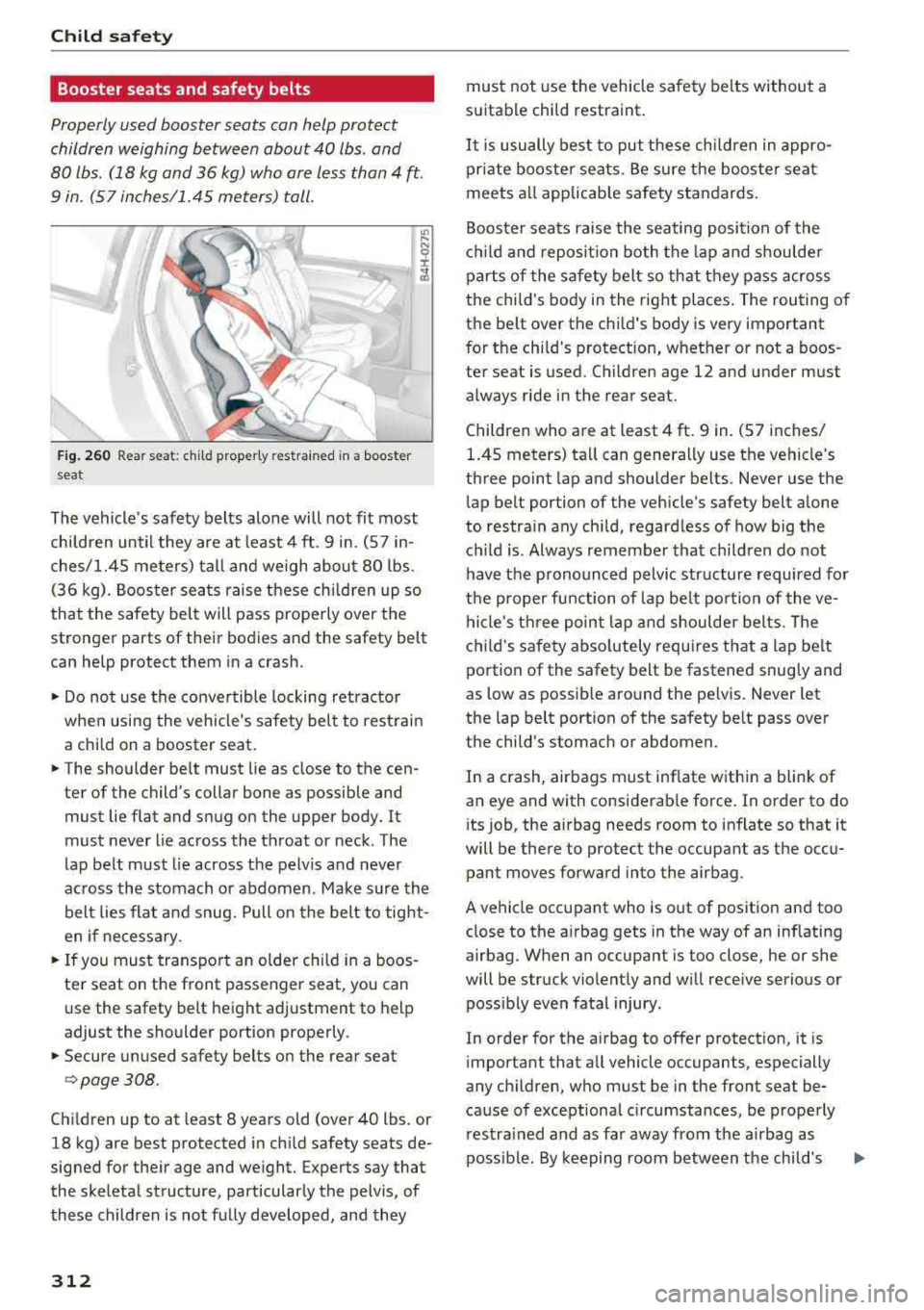
Fig. 260 Rear seat: ch ild proper ly restrained in a booster
seat
The vehicle's safety belts alone will not fit most
children until they are at least 4
ft . 9 in. (57 in
ches/1.45 meters) tall and weigh about 80 lbs .
(36 kg). Booster seats raise these child ren up so
that the safety belt will pass properly
over the
stronger parts of their bodies and the safety belt
can help protect them in a crash.
• Do not use the convertible locking retractor
when using the vehicle's safety belt to restrain
a chi ld on a booster seat.
• The shoulder be lt must lie as close to the cen
ter of the child's collar bone as possible and
must lie flat and snug on the upper body. It
must never lie across the throat or neck. The
lap belt must lie across the pelv is and never
across the stomach or abdomen . Make sure the
belt lies flat and snug. Pull on the belt to tight
en if necessary .
• If you must transport an older child in a boos
te r seat on the front passenger seat, you can
use the safety belt height adj ustment to help
adjust the shoulder portion properly .
• Secure unused safety belts on the rear seat
qpage308.
Children up to at least 8 years old (over 40 lbs . or
18 kg) are best protected in child safety seats de
signed for their age and weight. Experts say that
the skeletal structure, particularly the pelvis, of
these children is not fully developed, and they
312
must not use the vehicle safety belts without a
suitable child restraint.
It is usually best to put these children in appro
pr iat e booster seats. Be sure the booster seat
meets all applicable safety standards.
Booster seats raise the seating position of the
child and reposition both the lap and shoulder
parts of the safety belt so that they pass across
the child's body in the right places. The routing of
the be lt
over the chi ld's body is very important
for t he child's protection, whether or not a boos
ter seat is used. Children age 12 and under must
always ride in the rear seat.
Children who are at least 4 ft. 9 in. (57 inches/
1.45 meters) ta ll can generally use the vehicle's
three point lap and shoulder belts. Never use the
lap belt portion of the vehicle's safety belt alone
to restrain any child, regard less of how big the
c hil d is. Always remember that children do not
have the p ronounced pelvic structure required for
the proper function of lap be lt portion of the
ve
hicle's three point lap and shoulder belts. The
c hild' s safety abso lutely requ ires that a lap belt
portion of the safety belt be fastened snugly and
as low as possible around the pe lvis. Never let
the lap belt portion of the safety belt pass over
the chi ld 's stomach or abdomen.
In a crash, airbags must inflate within a blink of
an eye and with considerab le force . In order to do
i ts job, the airbag needs room to inflate so that it
will be there to protect the occupant as the occu
pant
moves forward into the airbag.
A vehicle occupant who is out of position and too
close to the a irbag gets in the way of an inflating
airbag. When an occupant is too close, he or she
will be struck violently and will receive serious or
possibly even fatal injury.
In order for the a irbag to
offer protection, it is
important that all vehicle occupants, especially
any ch ildren, who must be in the front seat be
cause of exceptional c ircumstances, be properly
r estra ined and as far away from the a irbag as
possible. By keeping room between the child's
.,..
Page 343 of 409
Wheels
(D Tires for passenger vehicles
(if applicable)
"P" indicates a tire for a passenger
vehicle. "T" indicates a tire desig
nated for temporary use.
@ Nominal width
Nominal width of the tire be
tween the sidewalls in millime
ters. In general: the larger the
number, the wider the tire.
@ Aspect ratio
Height/width ratio expressed as a
percentage.
@ Tire construction
R indicates a radial tire.
® Rim diameter
Size of the rim diameter in inches.
@ Load index and speed rating
The load index indicates the tire's
load-carrying capacity.
The speed rating indicates the maximum permitted speed
¢ & in
Winter tires on page 357 .
"EXTRA LOAD", "xl" or "RF" indi
cates that the tire is reinforced or
is an Extra Load tire.
Speed rat- Maximum permitted speed
ing
p
u p to 93 mph (150 km/h)
Q up to 99 mp h (1 60 km/h )
342
Speed rat- Maximum permitted speed
Ing
R
up t o 106 mph (1 70 km /h)
s up to 110 mph (180 km/h)
T up to 1 18 m ph (190 km /h)
u up to 124 mph (200 km/h)
H up to 130 m ph (2 10 km /h)
V up to 149 mph (240 km/h) al
z a bove 14 9 mph ( 240 km /h) al
w up to 168 mph (270 km/h) al
y up to 186 mph (300 km /h)a l
a) For tires above 149 mph (240 km/h ),
tire manufacturers sometimes use the
code
"ZR ".
(j) US DOT number (TIN) and
manufacture date
The manufacture date is listed on
the tire sidewall (it may only ap
pear on the inner side of the tire):
DOT ... 2216 ...
means, for example, that the tire
was produced in the 22nd week of
the year 2016.
@ Audi Original Tires
Audi Original equipment tires
with the designation "AO" have
been specially matched to your
Audi. When used correctly, these
tires meet the highest standards
for safety and handling. An au
thorized Audi dealer or author
ized Audi Service Facility will be
able to provide you with more in
formation.
Page 344 of 409
® Mud and snow capability
"M/5" or "M+S" indicates the tire
is suitable for driving on mud and
snow. £ indicates a winter tire.
@Composition of the tire cord
and materials
The number of plies indicates the
number of rubberized fabric lay
ers in the tire . In general: the
more layers, the more weight a
tire can carry. Tire manufacturers must also specify the materials
used in the ti re . These inc lude
stee l, nylon, polyester and other
materials.
@ Maximum permitted load
This number indicates the maxi
mum load in kilograms and
pounds that the tire can carry.
@ Un iform tire quality grade
standards for treadwear,
traction and temperature resistance
Treadwear, traction and tempera
ture
ranges¢ page 359.
@ Running direction
T he arrows indicate the running
direction of unidirectional tires.
You must always follow the speci
fied running direction
¢page 374.
~ Maximum permitted
inflation pressure
Wheels
T his number indicates the maxi
mum pressure to which a tire can
be inflated under normal operat
ing condit ions .
Glossary of tire and loading
terminology
Accessory weight
means the combined weight (in
excess of those standard items
which may be replaced) of auto matic t ransmission, power steer
ing, power brakes, power win
dows , powe r seats, radio, and
heater, to the extent tha t these
items are avai lab le as factory- in
stalled equipment (whether in
s t alled or not).
Aspect ratio
means the ratio of the height to
the w idth of the tire in percent.
Numbers of 55 or lower indicate a
low sidewall for improved steer
ing response and better overall
handling on dry pavement .
Bead
means the part of the tire that is
made of steel wires, wrapped or
reinfo rced by ply cords and that is
shaped to fit the rim.
...
3 4 3
Page 359 of 409
Wheels
@ For the sake of the environment
Reinstall su mmer tires at the appropriate
time, because they pro vide better handling
when roads are free of snow and ice. Summer tires cause less road noise, tire wear and fuel
consumption.
@ Tips
You can also use all season tires instead of
w inter t ires. Please note that in some coun
tries where w inter tires are required, only
w inter t ires with the
& symbol may be per
m itted.
Snow chains
Snow chains not only imp rove the dr iving in w in
ter ro ad conditions, b ut also the brak ing .
.,. Only install snow chains o n the front wheels .
.,. Check and cor rect the seating of the snow
c h ains after dr iv ing a few feet, if ne cessa ry . Fo l
low the ins tructions from the m anufactu rer.
.,. Note the maximum permit ted speed when driv
ing with snow chains. Do not exceed 30 mp h
(SO km/h) .
Use of snow chains is o nly pe rmitted with certain
rim/tire combinations due to technical reasons .
Check with an authorized A udi dealer or author
ized Audi Service Fac ility to see if you may use
snow chains.
Use fine-mesh snow chain s. They must not add
more t han 0.53 in (13 .5 mm) in height, includ ing
the chain lock .
You mus t remove the snow chains on roads w it h
out snow . Otherwise, you could impai r dr iving
abi lity and damage the tires .
A WARNING
Us ing inco rrect snow chains or insta lling snow
chains incorrectly can result in loss of vehicle
control, which increases t he risk of an acc i
dent .
358
(D Note
Snow chains can damage the rims/whee l cov
ers * if the c ha ins come into direct contact
with them . Remove the whee l cove rs* first.
Use coated snow chains.
(D Tips
When using snow chains, it may be usefu l to
switch on sport mode
r=> page 152.
Low-profile tires
App lies to: vehicles with low-profi le tires
Your vehicle is equipped with low-profile t ires* at
the factory. Compared to other tire/r im combina
t ions, low-profi le tires offer a w ider t read surface
and a la rger r im diamete r with shorter tire side
walls. This results in an agile dr iv ing style. How
ever, i t may reduce the leve l of com fort and in
crease road noise whe n driving on roads in poo r
condition .
Low-p rofile ti res ca n become damaged mo re
q uickl y than st andar d tires when dr iv ing ove r
l a rge bumps, potholes, manhole covers, speed
b u mps and curbs . Therefore, it is particularly im
portant to maintain the correct tire pressure
r::> page 3 51.
To reduce the risk of damage to the tires and
rims, drive very caref ully on poor roads.
Check your wheels regu larly eve ry 2,000 m i
( 3 ,00 0 km) for d amage. For ex am ple, c heck for
bulges/crac ks on the tires or deformations/
c racks on the rims.
Af ter a heavy imp act o r damage, have the tires
and rims i nspected or replaced immedia tely by
an a uthorized Audi dea le r or authorized Audi
Service Facility .
Low-p rofile ti res c an wear out f aster than stand
a rd tires.
Summer tires are not suitable fo r cold weather,
snow or black ice. If yo u are d rivi ng in these con
d it ions, use wi nter or a ll season tires
r=> page 357.
Page 364 of 409
<( a, .... N ,....
N .... 0 \0
3 a,
A WARNING ,~
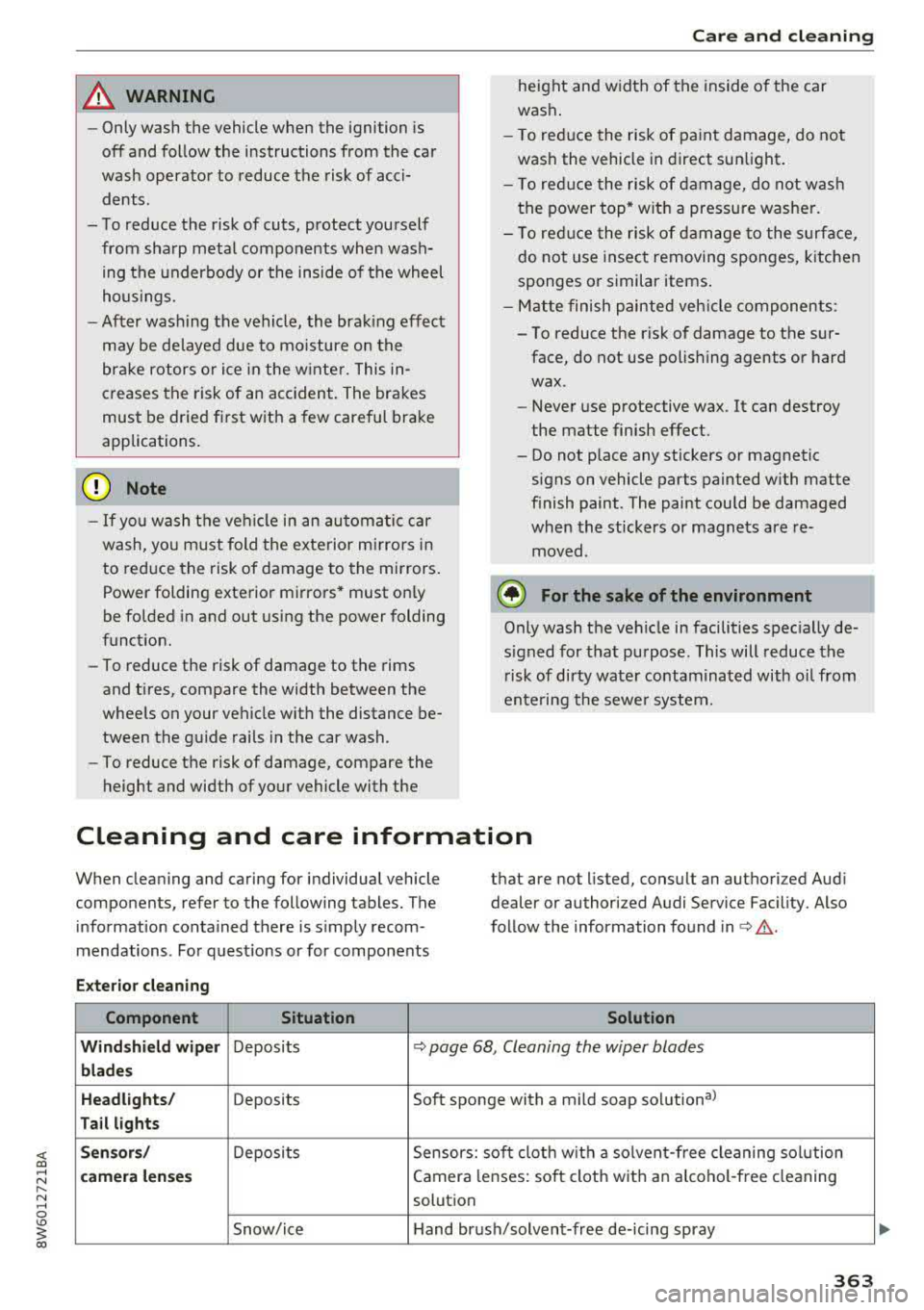
- Only wash the vehicle when the ignition is
off and follow the instructions from the car
wash operator to reduce the risk of acci dents .
- To reduce the risk of cuts, protect yourself from sha rp metal components when wash
ing the underbody or the inside of the wheel
housings .
- After washing the vehicle, the bra king effect
may be de layed due to mo isture on the
bra ke rotors or i ce in the w inte r. This in
cre ases the risk of an ac ciden t. T he bra kes
must be dried first with a few careful brake
applications .
(D Note
-If yo u wash t he ve hicl e in an au tom atic c ar
wash, yo u m ust fold the exterior m irrors in
to reduce the risk of damage to the mirrors .
Power folding exterior mirrors * must on ly
be fo lded in and out using the power folding
funct ion.
- To reduce the risk of damage to the rims
and tires, compare the width between the
whee ls on your vehicle w it h the distance be
tween the g uide rails in the car wash .
- To reduce the risk of damage, compare the
height and width of your vehicle with the
-
Ca re and cleaning
height and w idth of the inside of the ca r
was h.
- T o red uce the risk of pa int damage, do not
was h the vehicle in d irect sun light .
- T o re duce the risk of d am age, do not w ash
t he power top * w ith a pressu re washe r.
- T o re duce the risk of d amage to the surf ace,
do not use insect removing sponges, k itche n
sponges or s imilar items .
- Ma tte finish painted veh icle components :
- To reduce the risk of damage to the sur-
face, do not use polishing agents or hard
wax .
- Never use protective wax. It can destroy
the matte finish effect .
- Do not place any stickers or magnetic
signs on vehicle parts painted with matte
finish paint . The paint could be damaged
when the stickers or magne ts are re
moved .
@ For the sake of the environment
Only wash t he vehicle in facilities spec ially de
s igned for that p urpose. This will reduce the
risk of dirty wate r contamina ted with o il from
ente ring the sewe r sys tem.
Cleaning and care information
When cleaning and caring for individual vehicle
components, refer to the following tables. The information conta ined there is s imply recom
mendations . Fo r quest ions or for components that are not
listed, cons ult an autho riz ed Aud i
dealer or authorized Audi Service Fac ility. Also
follow the information fo und
in <=> ,& .
Exter io r cleaning
Component Situation Solution
Wind shield wiper
Deposits <=> page 68, Cleaning the wiper blades
blades
Headlights /
Deposits Soft sponge with a mild soap so lution a)
Tail lights
Sen sors /
Deposits Sensors: soft cloth wit h a solven t-free cleaning sol ution
camera lenses Camera lenses: soft clot h w ith an alcoho l-free cleaning
solution
Snow/ice Hand brush/solven t-free de-icing spray
363
...
Page 388 of 409
<( a, .... N ,....
N .... 0 \0
3 a,
Weights
Gross Vehi cle We ight Rating
The G ross Veh icle Weight Rating (GVWR), and
the Gross Axle Weight Rating (GAWR) for front
and rear are listed on a sticker on the front end of
the driver's door.
The G ross Veh icle Weight Rating includes the
weight of the basic vehicle p lus full fuel tank, oi l
and coolant, plus maximum load, which includes
passenger weight (150 lbs/68 kg per designated
seating position) and luggage weight
c:> A .
Gross Axle Weight Rating
The Gross Axle We ight Rating is the max imum
l oad that can be applied at each axle of the vehi
cle
c:> A .
Vehicle capacity weight
The vehicle capac ity we ight (max. load) is listed
on the front end of the dr iver's door.
& WARNING
-
- T he act ual Gross Ax le Weight Rating at the
front and rear axles sho uld not exceed the
permissible weights, and their combination
must not exceed the Gross Vehicle We ight
Rating.
- Exceedi ng perm iss ible weight ratings can
result in vehicle damage, acc idents and per
sonal injury.
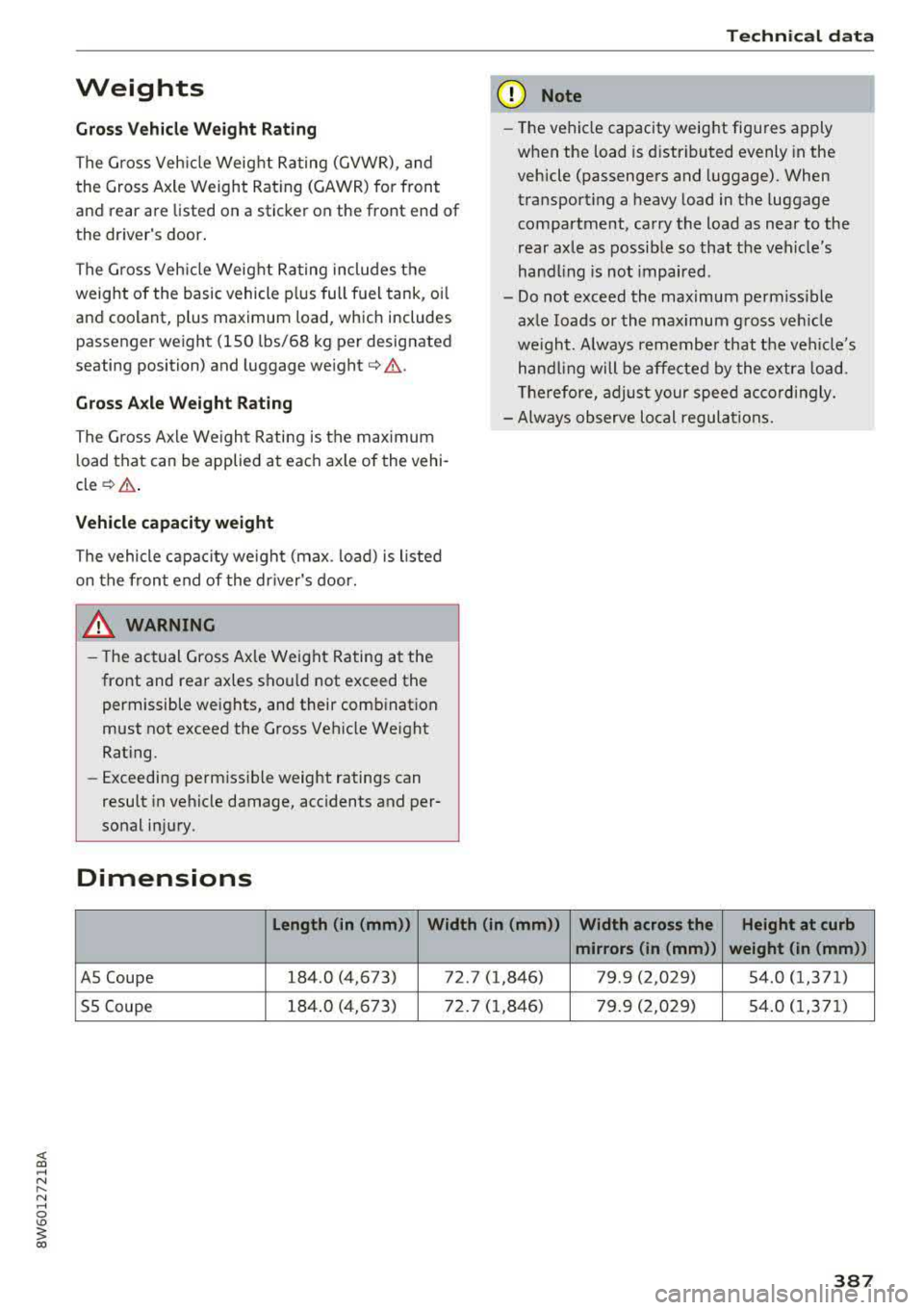
Dimensions
Techn ical data
(D Note
- The vehicle capacity weig ht figures apply
when the load is d istributed evenly in the
vehicle (passengers and luggage). When
transport ing a heavy load in the luggage
compartment, carry the load as near to the
rear axle as possible so that the vehicle's
hand ling is no t impa ired.
- Do not exceed the maximum perm iss ible
ax le loads or the maximum g ross ve hicle
we igh t. A lways remember that the vehi cle's
hand ling will be affected by the extra load.
T he refore, adjust your speed acco rd ingly.
- Always observe lo cal regulations.
Length (in (mm)) Width (in (mm ))
Width across the Height at curb
mirrors (in (mm )) weight (in (mm))
AS Coupe 184.0 (4,673) 72. 7 (1,846) 79.9 (2,029) 54 .0 (1,371)
55 Coupe 184
.0 (4,6 73) 72 .7 ( 1,846) 79 .9 (2,029) 54 .0 (1 ,37 1)
387
Page 403 of 409
Index
Refueling . . . . . . . . . . . . . . . . . . . . . . . . . . . . 324
Fuel filler door emergency release . . . . . . 326
Remote control
refer to Remote control key . . . . . . . . . . . . 38
Remote control key . . . . . . . . . . . . . . . . . . . . 38
Remote control operation
Garage door opener (Homelink) . . . . . . . . . 51
Remote lock ing and unlocking
Aud i connect vehicle control . . . . . . . . . . . 202
Removing the caps (wheel bolts) ........ . 371
Repair manuals . . . . . . . . . . . . . . . . . . . . . . . 389
Repairs
A ' b tr ag system . . . . . . . . . . . . . . . . . . . . . . 292
Replacement key . . . . . . . . . . . . . . . . . . . . . . 38
Replacing Light bulbs
380
Replacing wiper blades . . . . . . . . . . . . . . . . . 68
Reporting Safety Defects . . . . . . . . . . . 266, 267
Reset
refer to Restart (MMI) . . . . . . . . . . . . . . . . 256
Reset button (trip odometer) . . . . . . . . . . . . 12
Resetting the trip odometer . . . . . . . . . . . . . 12
Residual heat (automatic climate control) . . 84
Restart (MMI) . . . . . . . . . . . . . . . . . . . . . . . . 256
Retractor . . . . . . . . . . . . . . . . . . . . . . . . . . . . 272
Reverse gear . . . . . . . . . . . . . . . . . . . . . . . . . . 96
Rewinding (audio/video file) . . . . . . . . . . . . 239
Right control button . . . . . . . . . . . . . . . . . . . . 14
Rims ...... ... .. ................ ... . 357
Clean ing . . . . . . . . . . . . . . . . . . . . . . . . . . . 364
Ringtone settings . . . . . . . . . . . . . . . . . . . . . 188
Roaming
refer to Data connection . . . . . . . . . . . . . . 198
Rollbar
refer to Active rollover protection system 265
Roof rack . . . . . . . . . . . . . . . . . . . . . . . . . . . . . 80
Roof load . . . . . . . . . . . . . . . . . . . . . . . . . . . 80
also refer to Roof rack . . . . . . . . . . . . . . . . . 80
Route criteria . . . . . . . . . . . . . . . . . . . . . . . . 216
Route guidance
refer to Navigation . . . . . . . . . . . . . . . . . . . 207
Running direction (tires) . . . . . . . . . . . . . . . 374
s
Safe driving habits . . . . . . . . . . . . . . . . . . . . 258
402
Safety
Airbag system ... .. .. .............. .
Be lts
........ ... .. .. ...............
Cargo
Correct seating position ............ . .
Pedal area ........ ... .............. .
Telephone .... ... .. .. ........ ..... . .
Safety belt h eight adjustment .......... .
Safety belt microphone . .. ........... . .
Safety belt position .. .. ............. . .
Safety belt height adjustment ........ .
Safety belts worn by pregnant women . . .
Safety be lt pretensioner 277
268
263
259
263
178
274
189
273
274
274
Service and disposal. . . . . . . . . . . . . . . . . . 276
Safety be lts . . . . . . . . . . . . . . . . . . . . . . 268, 272
Belt positioners . . . . . . . . . . . . . . . . . . . . . 272
Cleaning . . . . . . . . . . . . . . . . . . . . . . . . . . . 365
Danger to passengers who do not wear a
safety belt . . . . . . . . . . . . . . . . . . . . . . . . . 270
Fastening . . . . . . . . . . . . . . . . . . . . . . . . . . 272
Improperly worn . . . . . . . . . . . . . . . . . . . . 275
Not worn .................. ........ 270
Safety be lt position . . . . . . . . . . . . . . . . . . 273
Safety instructions . . . . . . . . . . . . . . . . . . . 271
Securing child safety seats ............ 313
Special considerations for pregnant wom-
en . . . . . . . . . . . . . . . . . . . . . . . . . . . . . . . . 274
Unfastening . . . . . . . . . . . . . . . . . . . . . . . . 274
Warning/indicator light . . . . . . . . . . . . . . 268
Worn properly . . . . . . . . . . . . . . . . . . . . . . 270
Safety belt warning light . . . . . . . . . . . . . . . 268
Safety instructions for side curtain airbags . . . . . . . . . . . . . . . 300
for us ing child safety seats . . . . . . . . . . . . 306
for using safety belts . . . . . . . . . . . . . . . . . 271
Monitoring the Advanced Airbag System 291
Saving fuel Energy consumers . . . . . . . . . . . . . . . . . . . . 18
R t· ecu per a ton . . . . . . . . . . . . . . . . . . . . . . . . 17
Scan (radio) . . . . . . . . . . . . . . . . . . . . . . . . . . 226
Screen
refer to Display . . . . . . . . . . . . . . . . . . . 13, 16
Screwdriver . . . . . . . . . . . . . . . . . . . . . . . . . . 368
SD card reader (MMI) . . . . . . . . . . . . . . . . . . 231
sos
refer to Voice recognition system . . . . . . . 170
Search area (point of interest) . . . . . . . . . . . 210