brakes AUDI A5 COUPE 2018 Owner's Manual
[x] Cancel search | Manufacturer: AUDI, Model Year: 2018, Model line: A5 COUPE, Model: AUDI A5 COUPE 2018Pages: 409, PDF Size: 67.63 MB
Page 139 of 409
-The display brightness for the exit warning
system cannot be adjusted.
-The system is not available when towing a
trailer.
Rear cross-traffic assist
A ppl ies to: ve hicles with rear c ross-tra ffic ass ist
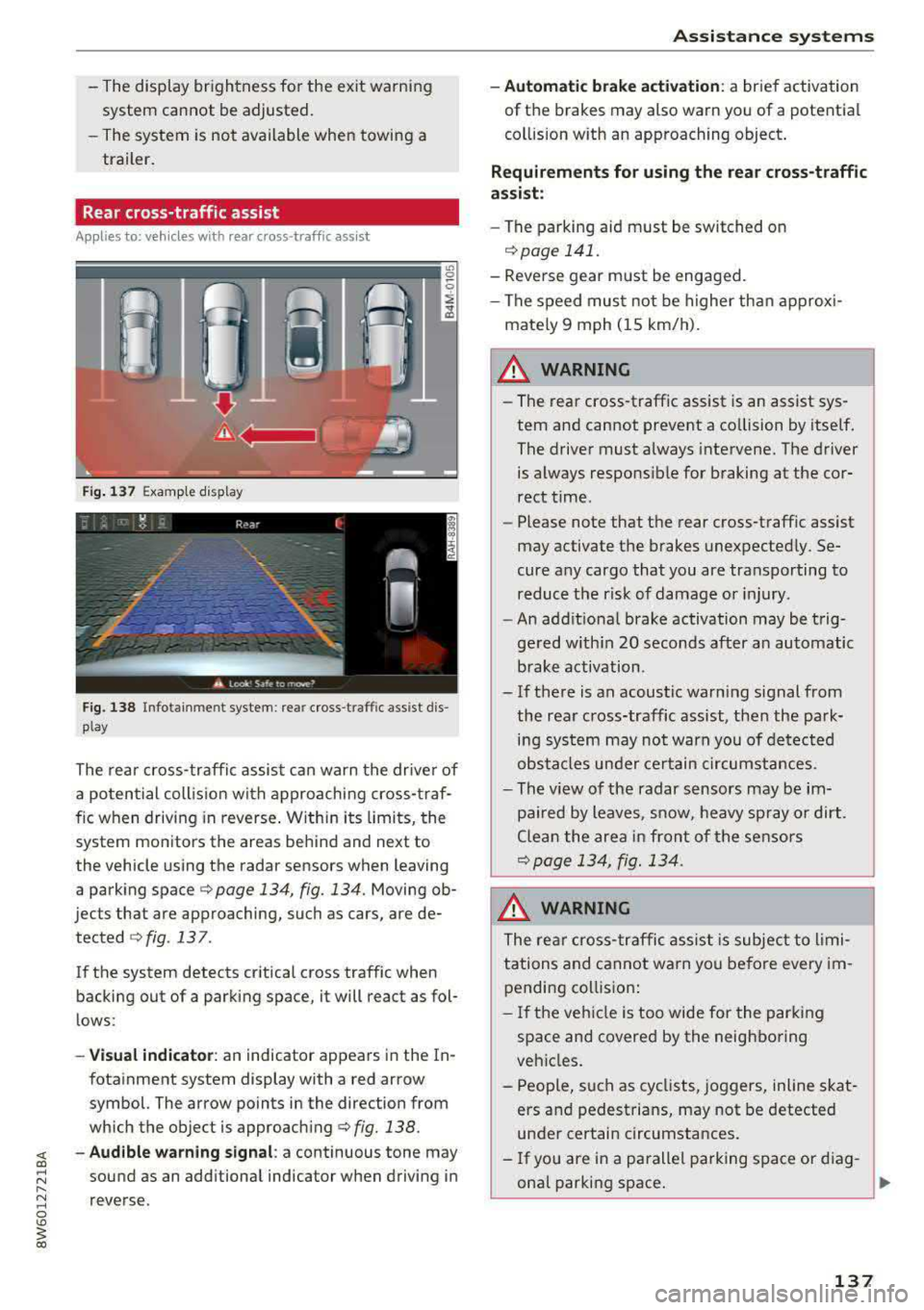
F ig. 137 Example display
Fig. 138 Infotai nme nt system : rea r cross-t raffic ass ist dis
p lay
The rear cross-traffic assist can warn the driver of
a po tential collis ion with approaching cross-traf
fic when driving in reverse . Within its limits, the
system monitors the areas behind and next to
the vehicle using the radar sensors when leaving
a parking space
c:;, page 134, fig. 134. Moving ob
jects that are approaching, such as cars, are de· tected
c:;, fig . 137 .
If the system detects critical cross traffic when
backing out of a parking space, it will react as fol
l ows:
-Vi su al indicator : an indicator appears in the In·
fotainment system display with a red arrow
symbol. The arrow points in the direction from
which the object is approach ing
c:;, fig. 138.
~ - Aud ibl e w arning signal : a continuous tone may
sound as an add itional indicator when driving in
reverse.
A ss is ta nce syst ems
-Automat ic brak e acti vation : a brief activation
of the brakes may also warn you of a potential
col lision with an approaching object .
Requirements for using the rear cross -traffic
a ssi st :
-The parking aid m ust be switched on
r=;, page 141.
-Reve rse gear must be engaged.
-The speed must not be h igher than approx i-
mately 9 mph (15 km/h).
_& WARNING
-The rear cross -traffic assist is an assist sys
tem and cannot prevent a co llision by itself .
The driver must always intervene. The driver is always respons ible for braking at the cor·
rect time.
-Please note that the rear cross-traff ic assist
may activate the brakes unexpected ly. Se
cure any cargo that you are transporting to reduce the risk of damage or injury .
-An addit iona l brake activation may be trig
gered w ith in 20 seconds after an automatic
brake activation .
-If there is an acoustic warn ing signal from
the rear c ross-traffic assist, then the park
ing system may not warn you of detected
obstacles under certain circumstances.
-The v iew of the radar sensors may be im
pa ired by leaves, snow, heavy sp ray o r dirt .
Clea n the area i n front of the sensors
¢page 134, fig. 134.
.8_ WARNING
The rear cross -traffi c assist is subjec t to limi
tations and cannot warn yo u before every im
pending coll ision:
-If the ve hicle is too wide for the par king
space and covered by the neighboring
vehicles.
-P eop le, such as cycl ists, joggers, inline skat
ers and pedestrians, may not be detected
under certain circumstances.
-I f you are in a parallel parking space or d iag
onal parking space .
137
Page 153 of 409
Intelligent Technology Electronic stabilization
control (ESC)
Description
Ele ctronic stabilization control (ESC) supports
driver safety . It reduces the risk of slipping and
improves d riving stability. ESC detects critica l sit
uations such as when the vehicle is oversteering
and understeering or the wheels are spinn ing.
T he vehicle is stabilized by applying the brakes or
reducing eng ine torq ue. When the ESC engages,
the
J;,j ind icator light blinks in the instrument
cluste r.
T he follow ing systems are integrated in the ESC:
Ant i-loc k bra king s ystem (ABS)
ABS prevents the whee ls from locking when brak
ing. The vehicle can still be steered even during
hard brak ing. Apply steady pressure to the brake
pedal. Do not pump the pedal. A pulsing in the
b rake pedal indicates that the system is act ing to
stabilize the vehicle .
Br ake a ssist s ystem
The brake assist system can decrease braking dis
tance. It increases brak ing power when the driver
presses the brake pedal quickly in emergency sit
uations . You must press and hold the brake pedal
unti l the dangerous sit uat io n is ove r. In veh icles
with adaptive cr uise contro l*, the bra ke assist
system is more sensitive if t he d istance detec ted
to the veh icle dr iv ing ahead is too small.
Anti-Slip Regulation (ASR )
ASR red uces eng ine power when the drive wheels
begin spinning and adapts the force to the road
conditions . This makes it easie r to sta rt, acceler
ate and dr ive up hill s.
Electronic differenti al lock (EDL )
EDL applies the brakes to a wheel that starts
spi nning and t ransfers t he drive powe r to the
;;§ other driving wheels. This f unct ion is not availa-....
~ b lea t higher speeds.
N .... 0 \0
3
In extreme cases , ED L automat ica lly switches off
to keep the brake o n the braked wheel from over
heating. The veh icle is still working correct ly. ED L
will switch on again automatically when condi
tions have returned to normal.
Ste ering recommendation
The ESC he lps to stabilize the vehicle by changing
the steering torque.
In veh icles wi th dynamic steer ing*, ESC also
helps to stab ilize the steer ing in crit ica l sit ua
tions.
Selective wheel torque control
Se lective w heel to rque con trol is used w hen d riv
i ng on curves. Bra king is targeted towa rd t he
whee ls on the inside of the cu rve as needed. This
allows mo re precise driving in curves .
Automatic post -collision braking system
The "automat ic post-collision braking system "
can help to reduce the risk of sliding and of addi
tiona l co llisions after an acciden t. If the a irbag
contro l
module detects a co llision, the veh icle is
braked by the ESC.
T he veh icle does not bra ke automatically if:
- the dr iver presses the acce lerator pedal, or
- the ESC, the brake system or the veh icle elect ri-
cal system are not functioning.
A WARNING
=
- The ESC and its integrated systems cannot
overcome the lim its imposed by natural
phys ica l laws. This is especially important
on slippery or wet roads. If the systems be
gin acting to s tabilize yo ur vehicle, you
should immediately alter your speed to
match the road and traffic conditions. Do
not let the inc reased safety provided tempt
you into taking risks. This could increase
your r isk of a coll is ion.
- Please note the ris k of a collis ion increases
when dr iv ing fast, especially through curves
and on slippery or wet roads, and when dr iv-
ing too close to objects ahead . The ESC and
~
151
Page 155 of 409
<( a, .... N ,....
N .... 0 \0
3 a,
A WARNING
You should only switch sport mode on or switch ESC/ASR off if your driving abilities
and road conditions permit .
- The stabilization function is limited when
sport mode is sw itched on . T he driving
wheels co uld spin and the vehicle cou ld
swerve, espec ially on s lick o r sli ppery roa d
surf aces.
- T here is no vehicle stabilization when ESC/
ASR a re swi tched off .
Brakes
New brake pads
New brake pads do not ac hieve the ir full b raking
effect during the first 250 mi (400 km) . They
must be "broken
in " fi rst . However, you can com
pensate for the slightly reduced bra king fo rce by
pr ess ing firmly o n the bra ke pe dal. Avoid heavy
b ra king dur ing t he b reak -in per io d .
Wear
Brake pad wear depends largely o n the way the
ve hicl e is driven and on operat ing cond it ions .
This is especially t rue if you are d riving freque ntly
in t he c ity and on curves o r wi th a sporty driving
s tyle.
Operating noise
Noises may occur when braking depend ing o n the
speed , braking force and ou ts ide cond it ions such
as te m pe ra ture and humi dity .
Wet conditions or road salt
In certain situations, for example after driving
through water, in heavy ra in or after washing
your car, the braking ef fect may be reduced due
to mo isture or ice on the b rake roto rs and b rake
pads. The b rakes mus t be
"dried" firs t wi th a few
care ful bra ke app lic at ions.
At higher speeds and with t he windsh ie ld wipers
turned o n, the brake pads press against the bra ke
rotors for a s ho rt amoun t of time. This ac tion,
whi ch is not felt by the driver , happens at regul ar
i nte rvals an d ens ures a better reac tion time fo r
the brakes in wet weat her.
Intellig ent Technology
The brak ing effec t can a lso be reduced if yo u are
driving on salted roads and yo u do not app ly the
bra kes for long per iods o f time. The layer of sa lt
on the brake rotors and pads m ust be worn off
first whe n the brakes are applied .
Corrosion
Leaving t he vehi cle pa rked for long periods o f
time, low mileage and avoiding heavy b raking
can contrib ute to corros ion on the b rake roto rs
and to dirty brake pads.
If you usu a lly avoid heavy bra king or if there is
cor rosion prese nt, occasiona l heavy braking at
high speeds is recommended to clean the brake
roto rs and pads
c> ,& .
Brake system malfunction
If you notice that the bra ke pedal trave l has sud
denly in crease d, then a brake circuit in the dua l
circuit b rake system may have malfunctioned.
Drive to an authorized A udi dealer or authorized
Audi Se rvice Facility immed iate ly to have the
problem corrected. On the way there, d rive w ith
reduced speed and keep in mind that you will
need a longer distance to stop and you will need
to press the bra ke ped al ha rder.
Low brake fluid level
When the bra ke fluid level is low, malfu nctions in
the b rake system may occur . T h e brake fluid level
is e lec tron ically moni tored.
Brake booster
The brake booster ampli fies t he p ressure you ap
ply to the brake pedal.
A WARNING
- On ly app ly the brakes for the purpose of
cleaning the brake system when road and
traffic cond itions permi t. You must not en
da nger other road users. This inc reases the
ris k of an a ccid en t.
- Never let the vehicle roll while the engine is
sto pped bec ause t his increases the risk of an
a ccident.
153
Page 156 of 409
Intelligent Technology
CJ) Note
- Neve r let the brakes "rub" by pressing the
pedal light ly when bra king is not actually
necessary. This causes the brakes to over
heat and increases braking d istance and
causes wear .
- Before driv ing downhill a long distance on a
steep hi ll, decrease your speed and select a
l ower gear. This makes use of the engine
b raking effect and re lieves the brakes . If
you need to b rake additionally , brake in in
te rvals and n ot co nti nu ously .
(J) Tips
-If the b rake booster is no t wo rking, you
must press the brake pedal with much more
fo rce th an norma l.
- If you re trofit you r vehicle with a fron t spoil
e r, whee l cove rs o r similar items, ma ke sure
th at t he ai r flow to the fron t wheels is not
i nte rr upt ed . Ot he rw ise the bra ke sys tem
ca n become too hot.
Electromechanical
steering, Dynamic
steering
The elec trome chanical steering supp orts the
driver 's steering movemen ts.
P owe r stee ring adapts electronically based on
t he vehicle speed.
Indicator lights and messages
• Steering: malfunction! Please stop vehicle
If th is indicator light t urns o n and stays on and
this message appears, the power steer ing may
have fa iled.
Stop the vehicle in a safe location as soon as pos
sib le. Do
not continue driving. See an author ized
Aud i dea ler or a uthori zed Aud i Serv ice Facility fo r
assistance .
E£4 Steering: malfunction! You may continue
dri ving
If t he i nd ic ator lig ht tur ns on and the message
a ppears, the stee ring wheel may be more diff i-
154 cu
lt to move o r mo re sensitive than usu a l. The
steering wheel may also be at an ang le when
driv ing straight.
Drive slowly to an au thorized Audi de aler or au
thorized Audi Service Facili ty to have t he mal
funct ion correcte d.
f:$JI Dynamic steering: correcting steering wheel
po sition
If the indica tor ligh t turns on and this message
appears, the dynamic steering* is re in it ia liz ing.
The steer ing whee l will be easy to move afte r
sta rt ing t he engine . Reinitiali zation might be
necessary if the steering wheel was moved while
the engine was switched off. The disp lay turns
off if the initialization was successf ul.
(D Tips
-If the . or ':r,y indica to r light only stays on
for a sho rt time, you may cont inue driving .
- T he dynamic steering s tability sys tems
q page 151 are not ava ila bl e in the event of
a system malfunction .
- For add itio na l information o n dynamic
steeri ng, see
c:;, page 138.
ALL-wheel drive (quattro)
General information
In all whee l drive, the dr iv ing power is dis trib ut
ed betwee n all fou r whee ls w hen needed . This
happe ns automatically depending on your driving
behavior as we ll as the c urrent road con ditions.
A lso see
c:;, page 151, Electronic stabili zation
control (ESC) .
The all-whee l dr ive system distr ibutes the dr iving
power va riably to the front and rear axle. It works
together with selective wheel torq ue control,
which act ivates when dr iv ing through c urves
q page 151. With the sport d ifferent ial*, power
distribution to the rear wheels is var iable and can
be adjusted using the drive select
q pag e 139 .
The all wheel drive concept is designed for high
engine power . Your vehicle is except iona lly pow
erfu l and has excellent driving characteristics
bot h unde r normal d riving conditions and on
IJII>
Page 344 of 409
® Mud and snow capability
"M/5" or "M+S" indicates the tire
is suitable for driving on mud and
snow. £ indicates a winter tire.
@Composition of the tire cord
and materials
The number of plies indicates the
number of rubberized fabric lay
ers in the tire . In general: the
more layers, the more weight a
tire can carry. Tire manufacturers must also specify the materials
used in the ti re . These inc lude
stee l, nylon, polyester and other
materials.
@ Maximum permitted load
This number indicates the maxi
mum load in kilograms and
pounds that the tire can carry.
@ Un iform tire quality grade
standards for treadwear,
traction and temperature resistance
Treadwear, traction and tempera
ture
ranges¢ page 359.
@ Running direction
T he arrows indicate the running
direction of unidirectional tires.
You must always follow the speci
fied running direction
¢page 374.
~ Maximum permitted
inflation pressure
Wheels
T his number indicates the maxi
mum pressure to which a tire can
be inflated under normal operat
ing condit ions .
Glossary of tire and loading
terminology
Accessory weight
means the combined weight (in
excess of those standard items
which may be replaced) of auto matic t ransmission, power steer
ing, power brakes, power win
dows , powe r seats, radio, and
heater, to the extent tha t these
items are avai lab le as factory- in
stalled equipment (whether in
s t alled or not).
Aspect ratio
means the ratio of the height to
the w idth of the tire in percent.
Numbers of 55 or lower indicate a
low sidewall for improved steer
ing response and better overall
handling on dry pavement .
Bead
means the part of the tire that is
made of steel wires, wrapped or
reinfo rced by ply cords and that is
shaped to fit the rim.
...
3 4 3
Page 346 of 409
Maximum (permissible )
inflat ion pressure
means the maximum cold infla
tion pressure to wh ich a t ire may
be inflated . Also called "maxi
mum inflation pressure ."
Normal occupant weight
means 150 lbs . (68 kilograms)
times the numbe r of occupants
seated in the veh icle up to the to
tal seating capacity of your vehi
c le .
Occupant distribution
means distribution of occupants
in a vehicle .
Outer diameter
means the overall diameter of an
inflated new tire .
Overall width
means the linear dis ta n ce be
tween the exteriors of the side
walls of an inflated tire, inc luding
e levations due to labeling, deco
rations, or protect ive bands or
ribs.
Ply
means a layer of rubber-coated
parallel cords .
Wheels
Production options weight
means the combined weight of
those installed regular production
options weighing over 5 lbs. (2.3 kg) in excess of those standard
items which they replace, not pre
viously considered in curb weight
or accessory weight, including
heavy duty brakes, ride levelers,
roof rack , heavy d uty ba tte ry , and
special trim .
Radial ply tire
means a pneumatic tire in which
the ply cords that extend to the
beads are laid at substantia lly 90
degrees to the centerline of the
tread .
Recommended inflation
pressure
see ¢ page 34 4, Cold tire infla
tion pressure .
Reinforced tire
means a tire designed to operate
at higher loads and at higher in
fl at ion pressures than the corre
sponding standard tire. Rein
forced tires may be identified as
"X L", "x l", "EXTRA LOA D", or "RF"
on the s idewa ll.
..,
3 45
Page 357 of 409
Wheels
A WARNING
Overloading a vehicle can cause
loss of vehicle control, a crash
or other accident, serious per
sonal injury, and even death.
-Carrying more weight than your vehicle was designed to carry will prevent the vehicle
from handling properly and
increase the risk of the loss of
vehicle control.
-The brakes on a vehicle that
has been overloaded may not
be able to stop the vehicle
within a safe distance.
-Tires on a vehicle that has
been overloaded can fail sud
denly, including a blowout and
sudden deflation, causing loss
of control and a crash.
-Always make sure that the to
tal load being transported
-
includ ing the weight of a trail
er hitch and the tongue
weight of a loaded trailer
-
does not make the vehicle
heavier than the vehicle's
Gross Vehicle Weight Rating.
Determining correct load
limit
Use the example below to calcu
late the total weight of the pas -
356
sengers and luggage or other
things that you plan to transport so that you can make sure that
your vehicle will not be overload
ed.
Steps for Determining Correct Load Limit
1. Locat e the statement "THE
COMBINED WEIGHT OF OCCU
PANTS AND CARGO SHOULD
NEVER EXCEED XXX KG OR XXX
LBS" on your vehicle's placard
(tire inflation pressure label)
Q page 351, fig. 285.
2.
Determine the combined
weight of the driver and pas
sengers that will be riding in
your vehicle.
3. Subtract the combined weight
of the driver and passengers
from
"XXX" kilograms or "XXX"
pounds shown on the stick
erQ page 351, fig. 285.
4. The resulting figure equals the
available amount of cargo and luggage load capacity. For ex
ample, if the "XXX" amount
equals 1400 lbs . and there will
be five 150 lbs. passengers in
your vehicle, the amount of
available cargo and luggage load capacity is 650 lbs.
.,.