battery AUDI A6 2012 Owner's Manual
[x] Cancel search | Manufacturer: AUDI, Model Year: 2012, Model line: A6, Model: AUDI A6 2012Pages: 298, PDF Size: 74.43 MB
Page 233 of 298
Have the battery checked when you take your
vehicle in for service. Yo u are well advised to
replace a battery that is older than 5 years .
W ith certa in types o f airbag deployment, the
battery is disconnec ted from the vehicle elec
trica l system for safety reasons
c::> &. in Re
pair, care and disposal of the airbags on
page 158.
Disconn ecting the battery terminal s
Some vehicle functions (power w indow regu
l ators, for example) are lost if the battery ter
minals are disconnected . These functions have
to be re learned after the battery terminals are
connec ted again. To prevent this, the battery
should only be disconnected from the vehicle
e lectrical system when absolutely necessary
for repairs .
Vehicles not driven for long period s
If you do not drive your vehicle over a period
of several days or weeks, electrical compo
nents are gradually cu t back or switched off .
This reduces energy consumption and main
tains starting capability over a longer per iod
c::> page 194. Some of the convenience func
tions may not operate, s uch as the inte rior
lights o r power seat adjus tme nt. The conven
i ence functions will be ava ilable again when
you switch on the ignition and start the en gine.
Winter operation
D uring the winter months, ba ttery capaci ty
t ends to decrease as tempe rat ures d rop . This
is because more powe r is also consumed while
starting , and the headlights, rear window de
fogger, etc., are used more often.
Avoid unnecessary power cons umption, par
ticularly in c ity t ra ff ic or when t raveling on ly
short distances. Let your a uthorized Audi
dealer check the capac ity of the vehicle bat
tery before winter sets inc::>
page 233. A well
charged battery w ill not only prevent starting
problems whe n the weather is cold, but will
also last longer .
Checkin g and fillin g 231
(D Tips
If your vehicle is left standing for seve ral
weeks at extremely low temperatures, the
vehicle battery shou ld be removed and
stored where it w ill not freeze. This will
prevent it from be ing damaged and having
to be replaced .
Working on the battery
Be especially careful when working on or near
the battery.
The battery is located in the l uggage compart
ment under the floor. Before you check any
th ing in the luggage compartment,
read and
h eed all WARNINGS
c::> &_ .
Always heed the safety warnings , when work
ing on the vehicle battery or the vehicle e lec
trical system to prevent injury.
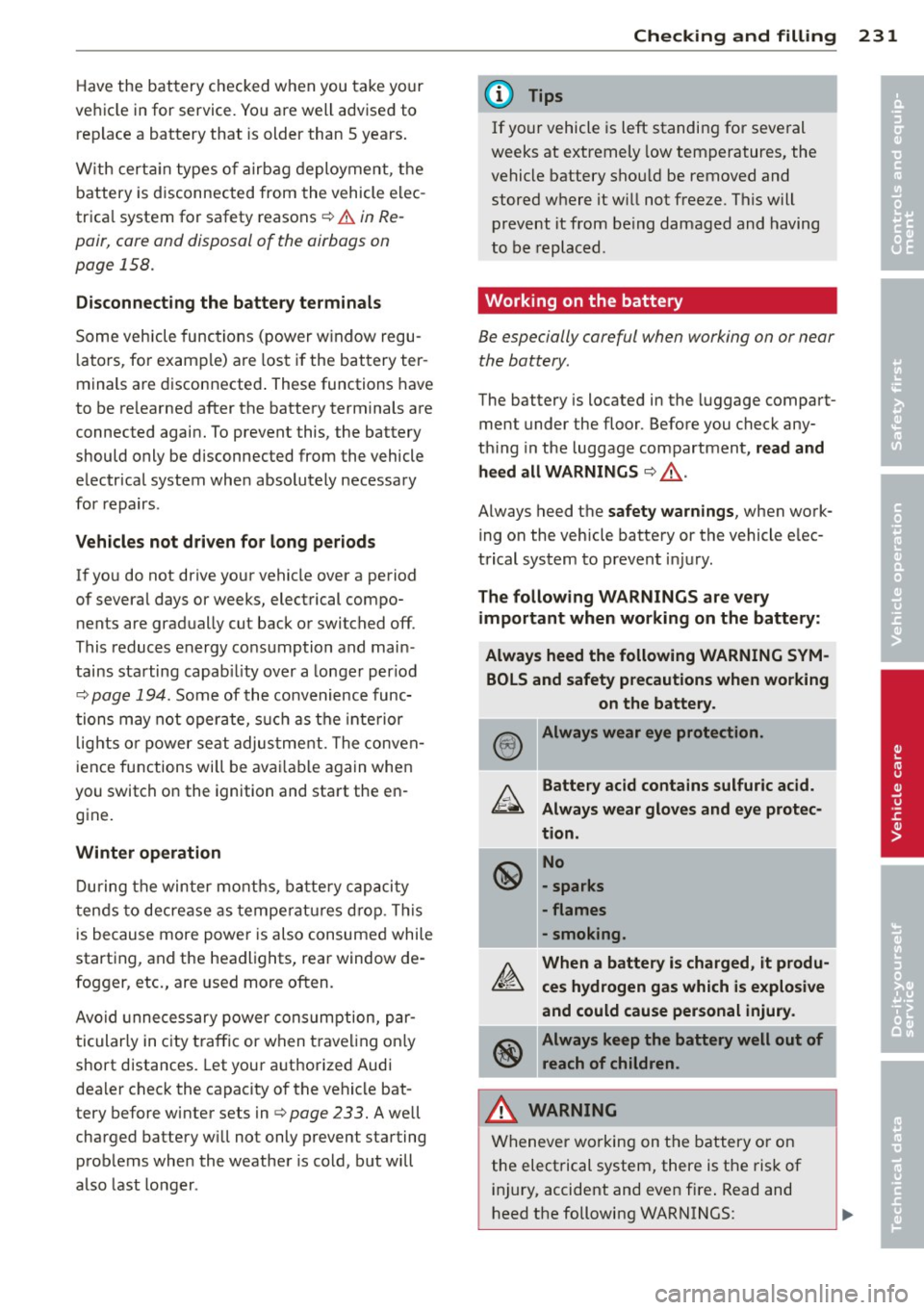
The following WARNINGS are very
important when working on the battery:
Alw ays heed the follo wing WARNING SYM
BOLS and safety precautions when working on the battery.
@
®
Always wear eye protection.
Battery acid contains sulfuric acid.
Always w ear gloves and eye prot ec
tion .
No
- sparks
-flames
- smoking .
When a battery i s charged, it produ
ce s hydrogen gas wh ich is e xplosive
and could cause per sonal injury .
Always keep the battery well out of ]
reach of children .
_& WARNING ~
Whenever working on the battery o r on
the electrical system, there is the risk of injury, accident and even fire . Read and
heed the following WARNINGS:
•
•
Page 234 of 298

232 Checking and filling
-Always wear eye protection. Do not let
battery acid or any lead particles get on
your skin or clothing . Shield your eyes .
Explosive gases can cause blindness or
other injury .
- Battery acid contains sulfuric acid . Sulfu
ric acid can cause blindness and severe
burns .
- Always wear gloves and eye protection.
Do not tilt the battery because acid
could leak out of the ventilation open
ings.
- If you get battery acid in your eyes or
on your skin, immediately rinse with
cold water for several minutes and get
medical attention .
- If you should ingest any battery acid,
seek medical attention immediately.
- Do not expose the battery to an open
flame, electric sparks or an open light.
- Do not smoke.
- Do not interchange the positive and neg-
ative cables.
= When working on the battery , be sure
not to short-circuit the terminals with
tools or other metal objects. This would cause the battery to heat up very quickly,
which could lead to damage or explosion
and personal injury.
- When a battery is charged, it produces hydrogen gas which is explosive and
could cause personal injury .
- Always keep the battery well out of the
reach of children .
- Before work is done on the electrical sys tem, disconnect the negative ground cable.
- Before performing any work on the elec
trical system, switch
off the engine and
ignition as well as any electrical equip
ment . The negative cable on the battery
must be disconnected . If you are just go
ing to replace a light bulb, then it is
enough to switch
off the lights.
- Before disconnecting the battery, switch
off the anti-theft alarm system! Other
wise you will set off the alarm. -
When disconnecting the battery, first
disconnect the negative cable and then
the positive cable.
- Before reconnecting the battery, make
sure all electrical consumers are switch
ed off. Reconnect the positive cable first
and then the negative cable . Never inter
change the cables - this could start a fire!
- Never charge a frozen or a thawed-out
battery .
It could explode! If a battery has
frozen, then it must be replaced . A dis
charged battery can freeze over at 32 °F
(0 °C) .
-Make sure the vent hose is always attach
ed to the opening on the side of the bat
tery .
- Never use batteries which are damaged.
There is the danger of an explosion! Al
ways replace a damaged battery.
A WARNING
California Proposition 6S Warning:
- Battery posts, terminals and related ac
cessories contain lead and lead com
pounds, chemicals known to the State of
California to cause cancer and reproduc
tive problems. Wash hands after han
dling.
(D Note
- Do not disconnect the vehicle battery
when the ignition is on or when the en gine is running, otherwise, you will dam
age electronic components in the electri
cal system.
- If your vehicle is going to stand for a
long period of time without being driven,
protect the battery from "freezing", oth
erwise it will be damaged and will then
have to be replaced .
Page 235 of 298

Battery charging
Starting the engine requires a well charged battery .
Fig. 176 Eng ine compartment : connectors for a charg
er and jump sta rt cab les
A lwa ys re ad and heed all WARNING S below
c:> &. and c:> &. in Working on the battery on
page 231 .
.. Switch off the ignit ion and all electrical con
sumers .
.. Make sure the area is well ventilated when
you charge the battery .
.. Open the engine hood
c:> page 220 .
.. Open the red cove r on the posit ive pole
c:>fig. 176.
.. Connect the charger connectors accord ing
to the instructions to the
jump start b olts .
(Bolts under the red cover= "positive", Bolts
with hex head= "negative").
.. Only now plug the mains lead for the charg
ing equipmen t into the wall outlet and turn
it on
c:> 8_ .
.. Ma ke sur e t he charging rat e is not over
30 amp s/14 .8 Vol t.
.. When the batte ry is fully charged: Turn the
charging eq uipment off a nd remove the
ma ins lead from the wall outlet .
.. Now remove the clamps for the charging
equipment.
.. Close the red cover on the positive pole.
.. Close the hood
c:> page 2 21.
A discharged battery can free ze at tempera
tures of on ly 32 F
0 (0 °C). A llow a frozen bat
tery to thaw completely before attempt ing to
charge it
c:> .&. . However, we recommend not
using a thawed battery again because the bat-
Checkin g and fillin g 233
tery casing can be cracked due to ice forma
tion and can leak battery acid.
Battery charging (Maximum charging rate
of 30 amps /14.8 Volt )
When charging at low voltages (e.g. with a
trickle cha rger ), the battery cables do not
have to be disconnected f irst . The battery
caps should
not be opened when charging a
battery.
It is not necessary to remove the battery from
the luggage compartment, and it is also not
necessary to disconnect the cables.
Fast ch arging the batte ry (charging rat e
a bove 14.8 Volt s)
For technica l reasons do not use a battery
charger that uses voltage greater than 14.8
Volts to charge your vehicle's battery .
A WARNING
-
Charging a battery can be dange rous .
- Always follow the operating instructions
provided by the battery charger manu
facturer when charg ing your battery .
- Never charge a frozen battery. It may ex
plode because of gas trapped in the ice .
Allow a frozen battery to thaw out first.
- Do not reuse batteries wh ic h were fro
zen. The battery housing may have
cracked and weakened when the battery
froze.
- Cha rge the battery in a well ventilated
area . Keep away from open flame or elec
trical spar k. Do not smo ke. Hyd rogen gas
generated by the bat tery is explos ive.
- To reduce the danger of explosion, never
connect or d isconnect charger cab les
while the charger i s ope rat ing.
- Fast cha rging a batte ry is dange rous and
should only be at tempted by a compe
tent techn ician wi th the prope r equip
ment .
- Ba ttery acid that may spi ll dur ing charg
ing should be washed off with a solution
of warm water and baking soda to neu
tralize the ac id.
Page 236 of 298

234 Checking and filling
(D Note
Never use a fast charger as a booster to
start the engine. This will seriously dam
age sensitive electronic components, such
as control units, relays, radio, etc., as well
as the battery charger.
Battery replacement
The new battery must have the same specifi
cations and dimensions as the original equip
ment battery.
Intelligent energy management in your vehi
cle is responsible for distributing the electri
cal energy throughout your vehicle
~ page 194. The intell igent energy manage
ment system will keep the engine battery
charged better than vehicles without this sys
tem. To make sure the additional electrica l en
ergy is available once again after you have
changed the battery, we recommend that you install batteries of the same type and manu
facture only (the same as those installed at
the time your vehicle was delivered). Specifi
cations are listed on the battery housing. Your
author ized dealer must code the battery in
the energy management system to enable you
to use the energy management funct ions cor
rectly after replacing the battery .
The new battery must have the same capacity,
voltage (12 volts), amperage, construct ion
and plug sealing.
When installing the battery, make sure the ig
nition and all electr ical consumers are switch
ed off.
(D Note
Make sure the ventilation hose on the side
of the battery is connected, otherwise
fumes or battery ac id can leak out.
@ For the sake of the environment
Because of the problem of proper disposal
of a battery, we recommend your author
ized Audi dealer change the battery for
you . Batteries contain su lfuric acid and l
ead and must always be disposed of prop
erly in compliance with all environmental
regulations. Disposing of vehicle batter ies
i mproperly is very dangerous to the envi
ronment.
Windshield/head Light
washer container
Fig. 177 En g in e compart men t: w inds hield and head
lighr washer fluid reservoir
The washer fluid conta iner is marked w ith the
symbol~ on its cap.
"' Before you check anything in the engine
compartment,
always read and heed all
WARNINGS ~.&. in Working in the engine
compartment on page 220.
"' Lift the filler cap tongue to add washer flu
id. You can fill the container to the top.
"' Press the cap back onto the filler neck after
fi lling the container.
You can find the reservoir
capacity in the table
in
~ page 2 76.
Clean water should be used when filling up. If
possible, use soft water to prevent scaling on
washer jets. Always add a glass cleaner solu
tion (with frost protection in the winter).
@ Note
Do not mix engine coolan t ant ifreeze or
any other additives to fill up the wind
shield washer reservoir .
Page 239 of 298
Maximum loaded vehicle weight
means the sum of:
(a) Curb weight
(b) Accessory weight
(c) Vehicle capacity weight, and
(d) Production options weight
Maximum (permissible) inflation pressure
means the maximum cold inflation pressure
to which a tire may be inflated. Also called
"maximum inflation pressu re."
Normal occupant weight
means 150 lbs. (68 k ilograms) times the
number of occupants seated in the vehicle up
to the total seating capacity of your vehicle.
Occupant distribution
means distribution of occupants in a vehicle .
Outer diameter means the overall diameter of an inflated new
tire.
Overall width
means the linear distance between the exteri
ors of the sidewalls of an inflated tire, includ
ing e levations due to labeling, decorations, or
protective bands or ribs.
Ply
means a layer of rubber-coated para llel cords.
Production options weight
means the comb ined weight of those installed
regular production options weighing over 5
lbs . (2 .3 kg) in excess of those standard items
which they replace, not previously considered
in curb weight or accessory weight, including
heavy duty brakes, r ide leve lers, roof rack,
heavy duty battery, and specia l trim .
Radial ply tire
means a pneumatic t ire in which the p ly cords
that extend to the beads are laid at substan
tially 90 degrees to the centerline of the
tread.
Tires and wheels 237
Recommended inflation pressure
see~
page 236, Cold tire inflation pressure.
Reinforced tire
means a t ire design to operate at higher loads
and at higher inflation pressures than the cor
responding standard tire. Reinforced tires
may be identified as "XL ", "x l", "E XTRA LOAD",
o r "R F" on the sidewall.
Rim
means a metal support for a tire or a t ire and
tube assembly upon which the tire beads are
seated.
Rim diameter
means nom inal d iameter of the bead seat. If
you change your wheel s ize, you w ill have to
purchase new tires to match the new r im di
ameter.
Rim size designation
means r im diameter and width.
Rim width
means nom inal distance between rim fla nges.
Sidewall
means that portion of a tire between the
tread and bead.
Speed rating (letter code)
means the speed at which a tire is designed to
be driven for extended periods of time. The
ratings range from 93 mph (150 km/h) to
186 mph (298 km/h)
~ page 247 . You may
not find this information on all tires because
it is not requ ired by law.
The speed rating letter code, where applica
ble, is molded on the tire sidewall and indi
cates the max imum pe rm issib le road speeds
~ .&. in Winter tires on page 251.
Tire pressure monitoring system*
means a system that detects when one or
more of a veh icle's tires are underinflated and
illuminates a low tire pressure warning tell
tale.
•
•
Page 268 of 298
266 Fuses a nd bulb s
Fuse panel @ (black )
No . Equ ipment Amps
=
8
Headlight range adjustment/
5/7,5
adaptive lighting system
10 Left headlight (headlight with
7,5
adaptive light)
Fuse p anel
@ (brown )
No .II Equ ipm ent
II Amp s
1 Climate control 10
2 Climate control system blower 40
3 Diagnostic connector 10
4 Electrical ignition lock 5
5 Power steering column adjust-
ment
5
Steering column switch module 10
7 Power steer
ing column adjust-
ment 25
8 Light switch
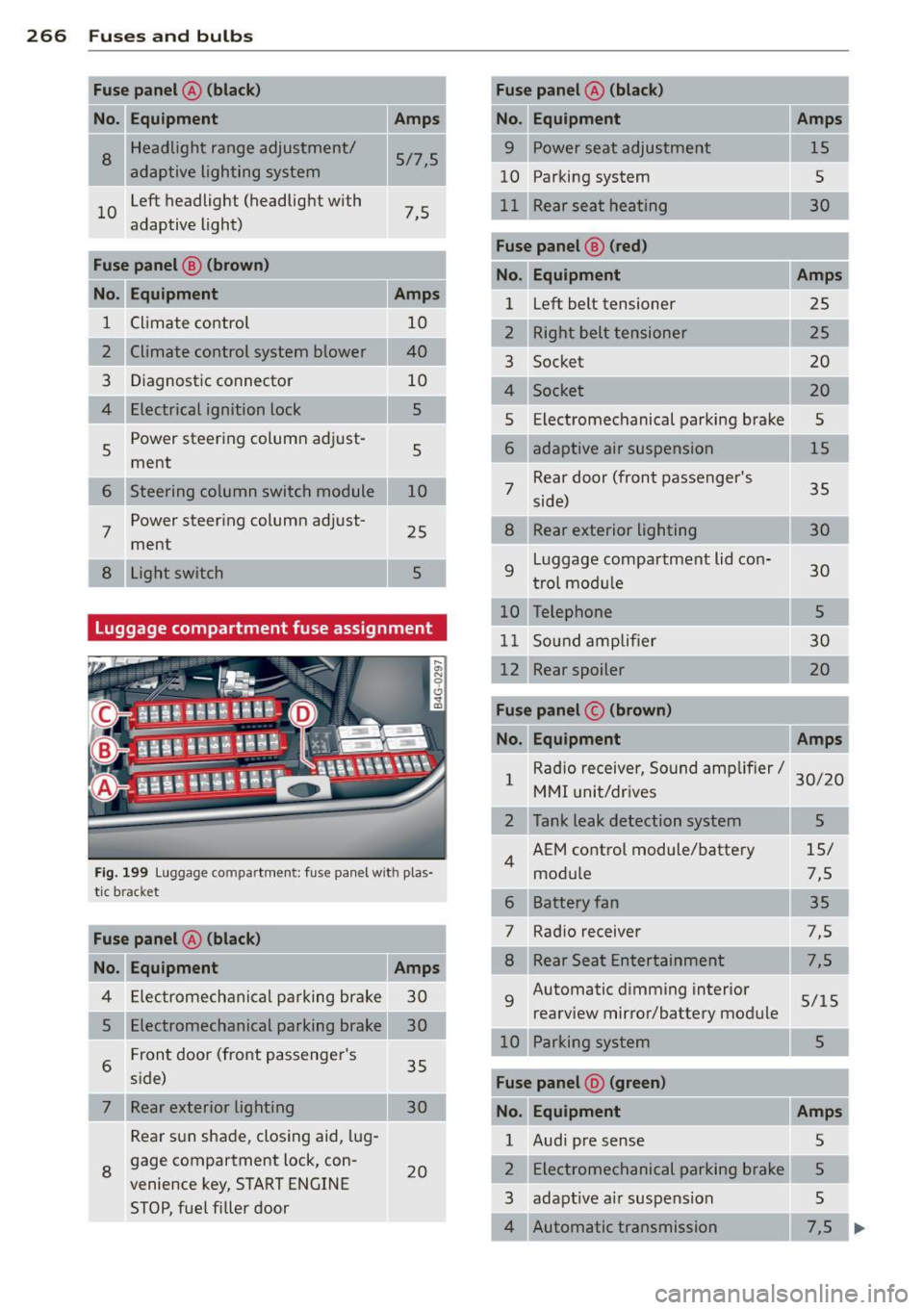
Luggage compartment fuse assignment
Fig. 199 Luggage compartment: fuse panel with plas·
tic bracket
Fuse panel @ (bl ack )
No. II Equipment
I[ Amp s
4 E lectromechanical parking brake 30
5 Electromechanical parking brake 30
6 Front door (front passenger's
35
side)
7 Rear exterior lighting Rear sun shade, closing aid, lug
s gage compartment lock, con
venience key, START ENGINE
STOP, fuel filler door 30
20
-Fuse pane
l@ (blac k) I
No. Equipm ent Amps
=· 9 Power seat adjustment 15
10 Parking system
s
30
Fus e pane l
B (red)
No . Equipment Amps
1 Left belt tensioner
25
Right belt tensioner 25
3 Socket 20
20
Electromechanical parking brake
5
adaptive air suspension 15
7 Rear door (front passenger's
35
side)
Rear exterior lighting 30
9
Luggage compartment lid con-
30
t rol module
10 Telephone 5
11 Sound amp lifier 30
12 Rear spoiler 20
Fuse pane l c (b rown )
No. Equipment Amps
1 Rad
io receiver, Sound amplif ier/
30/20
MMI unit/dr ives
2 Tank leak detection system 5
AEM control module/battery 15/
4
module 7,5
6 Battery fan 35
Rad io receiver
7,5
7,5
9
Automatic dimming interior
5/15
rearview mirror/battery module
Parking system 5
Fu se pan el o (gre en)
No. Equipment Amps
1 Audi pre sense 5
2 Electromechanical parking brake 5
3 adaptive a
ir suspension
5
Automatic transmission 7,5
...
Page 270 of 298

268 Emergency situations
Emergency situations
General
This chapter is intended for trained emer
gency crews and working personnel who
have the necessary tools and equipment to
perform these ope rations.
Starting by pushing or
towing
Q;) Note
Vehicles w ith an automatic transmission
cannot be started by pus hing o r tow ing.
Starting with jumper
cables
If necessary, the engine can be started by
connecting it to the battery of another vehi
cle.
If the engine should fail to start because of a
discharged or weak battery, the battery can be
connected to the battery of
another vehicle,
using a
pair of jumpe r cables to start the en
g ine .
Jumper cables
Use only jumper cables of sufficiently large
cross section to carry the starter current safe
ly. Refer to the manufacturer's specif ications.
Use only jumper cables with
insulated termi
na l clamps which are distinctly marked:
plus(+) cable in most cases colored red
minu s(-) cable
in most cases colored black .
A WARNING
Batteries contain electricity, acid, and gas.
Any of these can cause very serious or fatal
inju ry. Follow the instructions below for
safe handling of your veh icle's battery.
- Always shield you r eyes and avoid lean
ing over the battery whenever possible.
- A discharged battery can freeze at tem
peratures just be low 32 °F (0 °C). Before connecting a
jumper cable, you must
thaw the frozen battery complete ly, oth
erwise it could explode.
- Do not allow battery acid to contact eyes
or skin. Flush any contacted area with
water immediately.
- Improper use of a booster battery to start a vehicle may cause an explosion.
- Vehicle batteries generate explosive gas
es. Keep sparks, flame and lighted ciga
rettes away from batteries.
- Do not try to jump start any vehicle with a low acid level in the battery.
- The vo ltage of the booster battery must
also have a 12-Volt rating. The capacity
(Ah) of the booster battery should not be
lower than that of the discharged bat
tery . Use of batteries of d ifferent voltage
or substantially different "Ah" rating
may cause an exp losion and personal in
jury.
- Never charge a frozen batte ry. Gas trap
ped in the ice may cause an explosion.
- Never charge or use a battery that has
been frozen. The battery case may have
be weakened.
- Use of batter ies of different voltage or
substantially different capacity (Ah) rat
ing may cause an exp losion and injury.
The capacity (Ah) of the booster battery
should not be lower than that of the dis
charged battery.
- Before you check anything in the engine
compartment, always read and heed a ll
WARNINGS¢
page 214, Engine com
partment.
«I) Note
-Applying a higher voltage booster bat
tery will cause expensive damage to sen
sitive electronic components, such as
contro l units, relays, rad io, etc.
- There must be no electrical contact be
tween the vehicles as otherwise current
could already start to flow as soon as the
positive(+) terminals are connected. ..,_
Page 271 of 298
@ Tips
The disc harged battery must be properly
connected to the vehicle's electrical sys
tem. When jump starting or charg ing the
battery, never connect the negative
ground cable to the batte ry negat ive post
because the ba tte ry manager system must
be ab le to detect the battery's state of
charge. Always connect the negative
g round cab le to the negative ground pos t
of t he battery manager cont ro l unit.
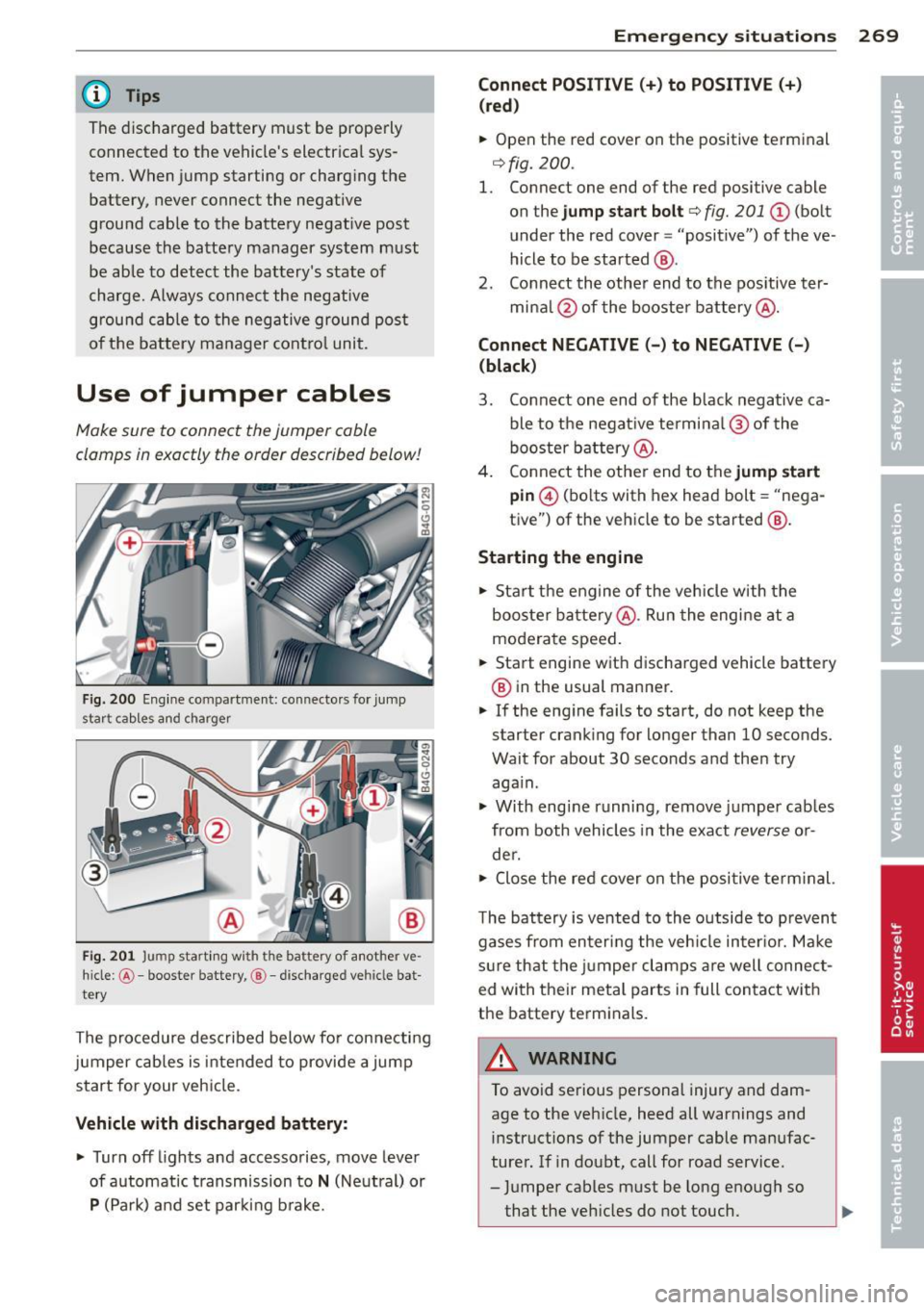
Use of jumper cables
Make sure to connect the jumper coble
clomps in exactly the order described b elow!
Fi g. 200 Eng ine co mpar tment: connecto rs for jum p
s tar t cab les and ch arg er
F ig. 201 Jump start in g w ith t he ba ttery of a not her ve ·
hi cle :
@-booster battery, ®-di sc harged ve hicle bat
te ry
The procedure des cribed below fo r connecti ng
jumper cables is intended to provide a jump
start for your veh icle.
Vehicle with discharged battery :
• Turn off ligh ts and accessories, move leve r
of automatic t ransmission to
N (Ne utral) or
P (Park) and set par king b rake.
Emergenc y situ ation s 269
Connect POSI TIVE(+) to POSITIVE(+ )
(red )
• Open the red cover on the positive terminal
¢fig. 200 .
1. Connect one end of the red positive cable
on the jump sta rt bolt ¢
fig. 201 (D (bolt
under the red cover = "positive") of the ve
hicle to be started @.
2 . Connect th e othe r end to the pos itive ter-
mi na l@ of the booster battery @.
Connect NEGATIVE( -) to NEGATIVE(-)
(black )
3. Connect one end of the black negative ca ble to the negat ive termi na l@ of the
booster b attery @.
4. Connect the othe r end to the jump start
pin @ (bo lts w ith hex head bolt = "nega
tive") of the vehicle to be started @.
Starting the engine • Sta rt the engine of the veh icle w ith the
booste r ba tte ry @ . Ru n the engi ne at a
modera te speed.
• Start engine wit h discha rged vehicle battery
@ in the usual manner.
• If the eng ine fails to sta rt, do not keep the
starter c ranking for longer than 10 seconds.
Wait for about 30 seco nds a nd the n try
aga in .
• With eng ine runni ng , remove j umper cab les
from both vehicles in the exact
reverse o r
de r.
• Close the red cover on the posi tive term inal.
T he battery is v ented to th e outside to p rev ent
gases from en ter ing the veh icle in ter io r. Ma ke
s ur e th at the jumper clamps are well connec t
ed with their meta l parts in full con ta ct w ith
the battery term inals.
,8. WARNING
To avoid se rious personal injury and dam
age to the veh icle, heed all warnings and
instructions of the jumper cable man ufac
ture r. If in doubt, call for road service .
- Ju mpe r cables m ust be long enough so
that the veh icles d o not touch.
-
Page 272 of 298

2 70 Emergency situations
-When connecting jumper cables, make
sure that they cannot get caught in any
moving parts in the engine compart
ment.
- Before you check anything in the engine
compartment, always read and heed all
WARNINGS c:>
page 214, Engine com
partment.
(D Note
Improper hook-up of jumper cables can ru
in the generator.
-Always connect POSITIVE(+) to POSI TIVE(+), and NEGATIVE( -) to NEGATIVE
( - ) ground post of the battery manager
control unit.
- Check that all screw plugs on the battery
cells are screwed in firmly . If not, tighten
plugs prior to connecting clamp on nega
tive battery terminal.
- Please note that the procedure for con
necting a jumper cable as described
above applies specifically to the case of
you r vehicle being jump started. When
you are giving a jump start to another ve
hicle, do
not connect the negative(-) ca
ble to the negative(-) terminal on the
discharged battery@c:>
fig. 201. In
stead, securely connect the negative(-)
cable to either a solid metal component
that is firmly bolted to the engine block
or to the engine block itself. If the bat
te ry that is being charged does not vent
to the outside, escaping battery gas
could ignite and explode!
Emergency towing
with commercial tow
truck
General hints
Your Audi requires special handling for tow
tng.
The follow ing information is to be used by
commercia l tow truck operators who know
how to operate their equipment safely.
-Never tow your Audi. Towing will cause
damage to the engine and transmission .
- Never wrap the safety chains or winch ca
bles around the brake lines.
- To prevent unne cessary damage , your Audi
must be transported with a flat bed truck.
- To load the vehicle on to the flat bed, use
the towing loop found in the vehicle tools
and attach to the front or rear anchorage
c:>page 270 and c:>page 271.
.&_ WARNING
=
A vehicle being towed is not safe for pas-
-
sengers. Never allow anyone to ride in a
vehicle be ing towed, for any reason.
Front towing loop
Only install the front towing loop when it is
needed.
Fig. 202 Front bumpe r: cove r
Fig. 203 Front bumper: installing the towing loop
There are threads located behind the right
s ide of the front bumper where a towing loop
can be installed. The threads are located be
hind a cover.
.,. Remove the tow ing loop from the vehicle
tool kit.
Page 286 of 298
28 4 Index
Automatic transmission . . . . . . . . . 10 1, 106
Automatic Shift Lock (ASL) . . . . . 103, 109
Driving . . . . . . . . . . . . . . . . . . . . . 101, 107
Dynamic shift program . . . . . . . . 104, 110
Emergency mode . . . . . . . . . . . . . 106, 111
Emergency release . . . . . . . . . . . . 106, 112
Kick-dow n . . . . . . . . . . . . . . . . . . . 104, 109
M anual sh ift program . . . . . . . . . 105, 1 10
Selec to r l eve r . . . . . . . . . . . . . . . . 102 , 108
Shift b uttons . . . . . . . . . . . . . . . . 105, 1 11
Steer ing whee l w ith mu lti tronic ... .. . 105
Steering whee l with tiptronic ....... . 11 1
Automatic wipe rs ........... ... .. ... . 46
Auto Safety Hotline . . . . . . . . . . . . . . . . . 131
Average consumption ....... .. .. .... .. 24
Average speed . . . . . . . . . . . . . . . . . . . . . . . 24
Avoid damaging the vehicle . ... ... ... . 197
B
Battery ..... .. . .. ..... ... .. .. .... . 230
Charging .... .. .. ..... ... .. .. .... . 233
Important warnings . ... .. .. ... ... . 23 1
Jump starting .............. .. .... . 268
Locat ion . ............... .. .. .... . 231
low . .. .. .. ... .. ..... ... .... .. .. . 194
Replacing the battery ......... .. ... 234
State of charge ..... ...... .. .. .. .. . 194
W inter operation ......... .. .. .. .. . 230
Wo rking on the battery .... .. .. .. .. . 231
Before driving . . . . . . . . . . . . . . . . . . . . . . 123
Blended gasoline .. ..... ... .. .. .... . 215
Blower (automatic climate cont rol) .. .. .. 67
Blower (climate control) . . . . . . . . . . . . . . . 64
Body cav ity sealing ....... .. .. .. .. .. . 209
Booster seats .............. ... .. .. . 177
Brake fl uid
Changing the brake fl uid ... .. .. .... .
230
Check ing the brake fluid level . .. ..... 229
What is the correct brake flu id leve l? .. 229
What should I do if the brake fluid warn -
ing light comes on? ........ ..... .. .
229
Brake system
Anti-lock braking system ... .... .... ..
19
Brake ass ist system ....... .. .. .. .. . 189
Brake booster .. .... ...... .. .. .. .. . 192
Brake fl uid . ..... ......... ... .. ... 229
B rake fluid specifications fo r r efill and re -
placement . ..... .. ... ..... ... .. ..
230
Brake light defective . . . . . . . . . . . . . . . . 21
Brake pads .... .. ............. .... 196
Electromechanical parking brake . .... . 73
Fluid reservo ir . .. ................ . 229
How does moisture or road salt affect the
brakes? ....... .. .. ........ ...... .
191
Warning/ind icator lights ...... .. .. .. . 14
Worn b rake pads symbo l ........ .. .. . 20
braking guard . .. .. .......... ...... .. 78
Messages ... .. .. .. ... .. ... ..... .. . 85
Settings . . . . . . . . . . . . . . . . . . . . . . . . . . 85
Break -in period .. .. ... .......... .. .. 196
Brake pads .... .. ............. .... 196
Tires ...... ... .. .. ... ........... . 196
Bulbs . ... .. .... .. .. ... ..... ... .. .. 267
C
Cali forn ia Proposition 65 Warn ing . .... 221
Battery specific . ... ... ..... ... .. .. 232
Capac,t,es ...... .. .. ... ........... . 276
Engine oil . .. .. .. ............. .. .. 2 22
Car care .... .... .. ............. .... 204
Exterior . .. .. ... ... ... .. ... ... .. .. 204
Interior ...... ... .. .............. . 210
Cargo area ...... .. ... .. .. ... .... . .. 129
Cargo ne t ... .. .. .. .. ........... .... . 61
Catalytic converter . ............. .. .. 197
Center armrest
Cockpit ... .... .. .. .... . ... ... .. .. .
51
Central lock ing .. .. ............. .. ... 32
E mergency loc king ............... .. . 36
Certification ...... ............... .. 281
Changing a wheel . ... ... ..... ... .. .. 258
Changi ng engine oil ................ . 226
Chassis (undercoat ing) ............. .. 209
Checking
Engine coolant level ..... .... ... .. ..
227
Tire pressure ..... ... .. ..... .... . .. 241
Child rest raints
Danger of using child rest rain ts in t he
fron t seat . . . . . . . . . . . . . . . . . . . . . . . .
144
Where can I get additional in format ion
about child restraints and their use? . .
186
Child rest raint system a nchors .. .. .. .. 182