flat tire AUDI A6 2012 Owner's Manual
[x] Cancel search | Manufacturer: AUDI, Model Year: 2012, Model line: A6, Model: AUDI A6 2012Pages: 298, PDF Size: 74.43 MB
Page 254 of 298
252 Tire s and wheel s
Where snow chains are mandatory oncer
tain roads, this normally also applies to ve
hicles with all-wheel drive.
Wheel bolts
Wheel bolts must always be tightened to the
correct torque .
The design of whee l bolts is matched to the
factory insta lled rims . If different rims are fit
ted, the correct wheel bolts with the r ight
length and correctly shaped bolt heads must
be used. This ensures that wheels are fitted
securely and that the brake system functions
correctly .
In certain circumstances, you may not use
wheel bolts from a different vehicle -even if it
is the same model
r=> page 280.
A WARNING
Imprope rly tightened o r maintained wheel
bolts can becom e loose ca using loss of
c ont ro l, a co llision and serious persona l in
Jury .
- Always keep the w heel bolts an d the
threads in the wheel hubs clean so the
w heel bolts can turn easily and be p rop
er ly tigh tened .
- N ever grease or oil the wheel bo lt s an d
the threads in the w heel hubs. They can
become loose while d riving if greased or
oi led, even if tightened to the specified
torq ue.
- Only use wheel bolts that belong to the
rim being installed.
- N ever use different whee ls bolts on your
vehicle.
- Alw ays maintain the co rrec t tighten ing
torq ue fo r th e wheel bo lts to reduce the
risk of a wheel loss . If the tightening tor
que of the wheel bo lts is too low, they
can loosen and come out w hen the veh i
cle is moving. If the tighteni ng torque is
too high, the whee l bolts and threads can be damaged and the whee
l can be
come loose.
@ Note
The specified torque for the whee l bolts is
90 ft lb (120 Nm) with a tolerance of± 7,4
ft lb(± 10 Nm) . Torque whee l bolts diago
nally. After changing a whee l, the torque
must be checked as soon as possible with a
torque w rench -preferably by an author
i zed Audi dealer or qualified workshop .
Low aspect ratio tires
Your A udi is facto ry-eq uipped w it h low aspect
ra tio tires. These tires have been tho roughly
tested and been se lected specific ally fo r your
model fo r their superb perfo rmance, road fee l
and hand ling under a variety of d riving condi
t ions . Ask your author ized A udi dealer for
more details.
T he low aspect ratio of these tires is ind icated
by a numera l of
55 or less in the tire's s ize
designation. The n umera l represents the ratio
of the tire's sidewa ll height in relation to its
tread width expressed in percentage. Conven
t iona l tires have a he ight/w idth rat io of 60 or
more .
The performance of low-aspect -ratio tires is
particularly sens iti ve to imp roper inflation
pressure. It is therefore important that low
a spect ratio tires are inflated to the specified
pre ssure and that the inflation pressure i s
regularly ch ecked and maintain ed. Tire pre s·
sure s should be checked at lea st once a
month and always before a long trip
r=> page 241, Checking tire pressure .
What you can do to avoid tire and rim
damage
Low aspect ra tio tires can be d amage d more
easily by impact w it h potholes, curbs, g ull ies
or ridges on t he road, particularly if the tire is
u nd eri nflated.
Page 255 of 298
In o rder to minimize the occurrence o f impact
damage to the tires of your vehicle, we recom mend that you observe the following precau
tions :
- Always maintain recommended inflation
pressures. Check your tire pressure every
2,000 miles (3,000 km) and add a ir if neces
sary.
- Drive carefu lly on roads with potholes, deep
gullies or ridges. The impact from driving
through or over such obstacles can damage
your tires. Impact with a curb may also cause damage to your tires .
- After any impact, immediately inspect your
tires or have them inspected by the nearest
authorized Aud i dealer . Replace a damaged
t ire as soon as poss ible .
- In spect your t ires every 2,000 miles (3,000
km) for damage and wear . Damage is not al
ways easy to see. Damage can lead to loss of
air and unde rinflation, wh ic h could eventu
ally cause ti re fail ure.
If yo u be lieve that a
ti re may have been damaged , replace the
tire as soon as possible.
- These tires may wear more quick ly than oth
ers.
- Please a lso remembe r that, whi le these t ires
deliver respons ive handling, they may ride
less comfortably and make more noise than
other c hoices.
Reduced p erformance in winter /cold
s ea son condit ion s
All ti res are designed for certain purposes .
The low aspect ratio, ultra hig h performance
tires originally installed on your veh icle are in
tended for max imum dry and wet road per
formance and handling . They are not suitable
for cold, snowy or icy weather cond it ions . If
you dr ive under those circumstances, you
should equip your vehicle with all-season or
winter tires, whi ch offe r better traction under
those cond it ions . We suggest you use the rec
ommended snow or all -season tires specified
for your ve hicle, or their equiva lent .
Refe r to ~
page 250 for mo re deta iled info r
mat io n regarding w in ter t ires.
Tire s an d wheel s 253
Tire pressure
monitoring system
ill General notes
App lies to vehicles : wi th tire p ress ure mo nito rin g system
Each tire, incl uding the spare (if provided),
shou ld be checked monthly when co ld and in
flated to the inflation pressure recommended
by the veh icle manufacturer on the veh icle
placard or tire inflation pressure label. (If your
vehicle has tires of a d ifferent size than the
s iz e indicated on the vehicle placard or tire in
flat io n pressu re labe l, you shou ld dete rmine
the p roper t ire inflation p ress ure fo r those
t i r es).
As an added safety feature, your veh icle has
been equipped with a tire pressure monitoring
system ( TPMS) that illum inates a low ti re
pressure te lltale whe n one or more o f your
ti res is significant ly under -inflated . According
ly, when the low tire pressure te lltale i llumi
nates, you shou ld stop and check your tires as
soon as possib le, and inflate them to the
proper pressure. Driving on a sign ificantly un
der- inflated t ire causes the tire to overheat
and can lead to tire fa ilure . Under-inflation al
so reduces fuel effic iency and tire tread life,
and may affect the vehicle 's hand ling and
stopp ing abil ity.
Please note that the TPMS is not a subst itute
fo r proper tire ma intenanc e, and it is the d riv
er's respo nsibility to maintain co rrect tire
pressure, even if under-inflation has not
reached the leve l to tr igger illum inat ion of the
T PMS low ti re p ressu re tellta le .
You r vehicle has also been equipped with a
T PMS ma lf u nction indicator to ind icate w hen
the sys tem is not operating prope rly . T he
T PMS ma lfunction indicator is combined w ith
the low tire pressure te lltale. When the sys
tem detects a malfunction, the telltale wi ll
flash for approximate ly one min ute and then
rema in con tinuously i llum inated . T hi s se
quence will continue upon subsequent vehicle
start-ups as long as the malfunct ion exists . ..,.
•
•
Page 256 of 298

254 Tires and wheels
When the malfunction indicator is illuminat
ed, the system may not be able to detect or
signal low tire pressure as intended . TPMS
malfunctions may occur for a variety of rea
sons, including the installation of replace ment or alternate tires or wheels on the vehi
cle that prevent the TPMS from funct ioning
properly . Always check the TPMS malfunction
telltale after replacing one or more t ires or
wheels on your veh icle to ensure that the re
placement or alternate tires and wheels allow
the TPMS to continue to function properly.
Tire pressure indicator appears
Applies to vehicles: with tire p ressure mo nitoring syste m
The tire pressure indicator in the instrument
cluster informs you if the tire pressure is too
low or if there is a system malfunction.
Fig. 183 Display : underinflatio n warning
Fig. 184 Display : Syste m mal functio n
Using the ABS sensors, the tire pressure moni
toring system compares the tire tread circum
ference and vibration characteristics of the in
d ividual tires. If the pressure decreases in one
or more tires, th is is indicated in the instru
ment cluster with a warning symbol
'9] and a
message
<=>fig . 183.
The tire pressure monitoring system must be
reset via MMI each time the pressures are ad- justed
(e.g. when switching between partial
and full load pressure) or after changing or re
placing a tire on your vehicle <=>
page 255. You
can find the recommended tire pressures for
your vehicle on the label on driver' s side B-pil
lar
<=> page 239 .
Tire tread circumference and vibration charac
teristics can change and cause a tire pressure
warning if:
- the tire pressure in one or more tires is too
low,
- the tire has structural damage,
- the tire pressure was changed, wheels rotat -
ed or replaced but the TPMS was not reset
<=> page 255.
Warning symbols
'9] Loss of pressu re in at least one t ire r=> & .
Check the tire or tires and replace or repa ir if
necessary. The indicator light
'9] in the instru
ment cluster also illuminates
<=>page 12 .
Check/correct the pressures of all four tires
and reset TPMS via MMI.
••MIS, ( Ti re Pressure Monitoring System) Tire
pressure! System malfunction .
If IIMIS, appears after switching the ignition
on or while driving
r::!> fig. 184 and the indica
tor light
'9] in the instrument cluster blinks
f or approximately one minute and then stays
on, there is a system malfunction . See your
authorized Audi dealer as soon as possible .
A WARNING
--If the tire pressure indicator appears in
the instrument cluster display, one or more of your tires is significant ly under
inflated. Reduce your speed immediately
and avoid any hard steer ing or braking
maneuvers. Stop as soon as possible and
check the tires and their pressures. In
flate the tire pressure to the proper pres
sure as indicated on the vehicle's tire
pressure label
<=>page 239. Driving on a
significantly under- inflated tire causes
the tire to overheat and can lead to tire
failure. Under-inflation also is likely to
Page 257 of 298
impair the vehicle's handling and stop
ping ability.
- The driver is responsible for maintaining
the correct tire pressures. You must
check the tire pressures regularly.
- Under certain conditions (such as a spor
ty driving style, winter conditions or un paved roads), the pressure monitor indi
cator may be delayed.
- Ask your authorized Audi dealer if run
flat tires may be used on your vehicle.
Your vehicle registration becomes invalid
if you use these tires when not permit
ted. Damage to your vehicle or accidents could also result.
(0 Tips
- The tire pressure monitoring system stops working when there is an ESP/ABS malfunction.
- Using snow chains may result in a system malfunction .
- To ensure a proper TPMS function use
AUDI Original Tires which are marked
with "AO" or "RO" on the tire sidewall.
¢page 246.
-The tire pressure monitoring system on
your Audi was syntonized using tires with
the "AO" or "RO " identification. We rec
ommend using these tires.
Reset tire pressure monitoring system
Applies to vehicles: with tire pressure monito ring system
If the tire pressure is adjusted, wheels are ro
tated or changed, the TPMS must be reset via
MMI.
"' Switch on the ignition.
"' Select in the MMI: !CAR !function button>
Car systems control button > Servicing &
checks > Tire pressure monitoring > Store
tire pressures> Yes, store now.
@ Tips
Before resetting the TPMS, the current
pressures of all four tires must correspond
to the specified values. Adjust the tire
Tires and wheels 255
pressure and reset the pressure in the tire
pressure monitoring system according to
the load you are carrying
c::!;> page 239.
- Do not store the tire pressures if you are
driving with snow chains. Otherwise , a
system malfunction may occur.
•
•
Page 260 of 298
258 What do I do no w?
• Unhook the ca rgo floor before closing the
rear lid.
Securing the replaced tire
• The fault whee l will not fit inside the spare
wheel wel l. Sto re it in the luggage compart
ment and sec ure it so that it does not slide
¢ page 59.
• Unhook the cargo floor before closing the
rear lid.
U sing the spar e tire (compact spare tir e)
The compact spare tire is on ly intended for
emergencies until you can reach a repair shop.
Replace it as quickly as possible with a stand
ard wheel and tire.
There are some restrictions on the use of the
compact spare tire. The compact spare tire
has been designed specifically for your type of
vehicle. It must not be swapped with a com pact spare t ire from another type of veh icle.
Snow chain s
For technical reasons, the use of snow chains
on the compact spare tire is not permitt ed .
I f you do have to dr ive w ith snow cha ins and a
front tire fails, mo unt the spare wheel w ith
tire instead of a rear t ire. Install the snow
cha ins on the rear tire and use it to rep lace
the defective front tire .
A WARNING
-Never use the spare tire if it is damaged
or if it is worn down to the tread wear in
dicators.
- If the spare tire is more than 6 years o ld,
use it only in an emergency and w ith ex
treme caution and careful driving.
- The spare tire is intended only for tem
porary and short-term use. It should be
replaced as soon as possible w ith the
normal wheel and t ire.
- After mounting the compact spare tire,
the tire pressure must be checked as
soon as poss ible. The tire pressure of the
compact spare tire must be 4.2 bar; oth
erwise, you risk hav ing an accident. -
Do not drive faster than 50 mph (80 km/
h). Yo u risk having an accident.
- Avoid full-thrott le acceleration, heavy
braking, and fast cornering. You risk hav
ing an accident.
- Never drive using more than one spare
wheel and tire. You r isk having an acci
dent.
- Normal summer or winter tires must not
be mounted on the compact spare wheel
rim.
- For technical reasons, the use of tire
chains on the spare tire is not permitted.
If it is necessary to drive with tire chains,
the spare wheel must be mounted on the
front ax le in the event of a flat in a rear
tire. The new ly available front wheel
m ust then be instal led in place of the
rear whee l w ith the flat tire. Installing
the tire chain be fore mounting the whee l
and tire is recommended.
- Loose items in the passenger compart
ment can cause serious personal injury
during hard brak ing or in an accident.
- Never store the inflatable spare t ire or
jack and too ls in the passenger com
partment.
- Always store all jacking equipment,
tools, and the inflatable spare t ire in
the luggage compartment.
- Tighten the knurled retai ning screw for
the inflatable spare tire securely .
Changing a wheel
Before changing a wheel
Observe the following precautions for your
own and your passenger's safety when chang
ing a wheel .
• After you experience a t ire failure, pu ll the
car we ll away from moving traffic and try to
reach level ground before you stop
¢ ,& .
• All passengers should lea ve the car and
move to a safe location (for instance, behind
the guardrail)¢ ,&.
• Engage the parking brake to prevent your
veh icle from rolling unintentionally¢,& . ..,
Page 261 of 298
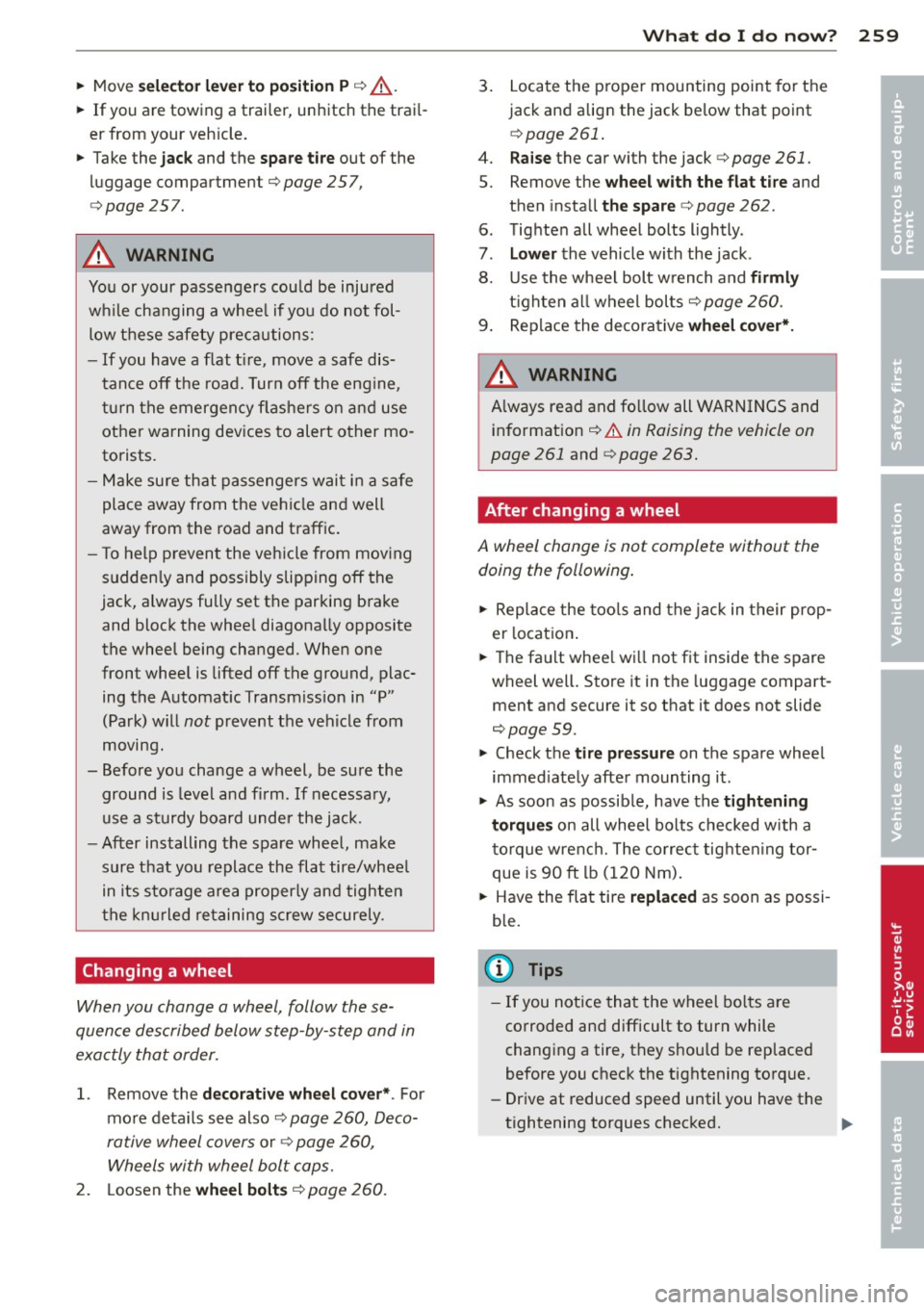
• Move select or lever to p osition P q ,& .
• If you are towing a trailer, unhitch the trail
er from your veh icle.
• Take the
jack and the spare t ir e out of the
luggage compartment
q page 257,
q page 257.
A WARNING
You or your passengers cou ld be injured
while changing a whee l if you do not fol
low these safety precautions:
- If you have a f lat t ire, move a safe dis
tance off the road. Turn off the eng ine,
turn the emergency f lashers on and use
other warning devices to alert o ther mo
torists.
- Make su re that passengers wait in a safe
pla ce away from the ve hicle and well
away from the road and traffic.
- T o help preven t the veh icle from mov ing
sudden ly and possibly slipping off the
jack, always fully set the parking brake
and block the whee l diagonally opposite
the wheel being changed . When one
front wheel is lifted off the ground, plac
ing the Automat ic Transm iss ion in "P"
(Park) will
not prevent the vehicle from
moving.
- Before you change a wheel, be sure the ground is level and fi rm. If necessa ry,
use a sturdy board under the jack.
- After installing the spa re wheel, make
sure that you replace the flat tire/whee l
in its sto rage area properly and tighten
the kn u rled re taining screw securely.
Changing a wheel
When you change a wheel, follow the se
quence described below step-by-step and in
exa ctly that order .
-
1. Remove the decorati ve wheel cov er* . For
mo re deta ils see also
Q page 260, Deco
rative wheel covers
o r q page 260,
Wheels with wheel bolt caps.
2 . Loosen the wheel b olts q page 260.
What do I do now? 259
3. Locate the proper mounting point for the
4.
5.
6.
7.
8.
9 .
jack and align the jack below that point
q page 261.
Raise the car with the jack q page 261.
Remove the wheel with the flat tire and
then insta ll
th e spare c> page 262.
Tighte n all wheel bolts lightly.
Lower the vehicle wi th the jack.
U se the wheel bolt w rench and
firmly
t ighten a ll wheel bolts q page 260 .
Replace the decora tive wheel co ver*.
A WARNING
A lways read and fo llow all WARNINGS and
informat ion¢
& in Raising the vehicle on
page 261
and r::> page 263.
After changing a wheel
A wheel change is not complete without the
doing the following .
• Replace the too ls and the jac k in their prop
er locat ion .
• The fault whee l wi ll not fit inside the spare
wheel well. Store it in the luggage compart
ment and secure it so that it does not slide
r::>page 59.
• Check the tire pressure on the spare wheel
immed iate ly after mounting it.
• As soon as possib le, have the
tightening
torqu es
on all wheel bolts c hec ked with a
t o rque wrenc h. The co rrec t tighte ning tor
que is
90 ft lb (120 Nm).
• Have the flat tire
replaced as soon as possi
b le.
(D Tips
- I f you not ice that the wheel bo lts a re
corroded and difficult to turn while
changing a tire, they should be rep laced
before you check the tightening torque.
- Drive at reduced speed until you have the
tightening torques checked. ..,_
•
•
Page 265 of 298
Tires with unidirectional tread design
Tires with unidirectional tread design must be
mounted with their tread pattern pointed in the right direction .
Using a sp are t ire w ith a tread p attern
int ended fo r use in a specific dir ection
When us ing a spare tire w ith a tread pattern
in tended for use in a specific direction, please
note the following:
- The direction of rotation is marked by an ar
row on the side of the tire .
- If the spare t ire has to be installed in the in
correct direction, use the spare tire only
temporarily since the ti re will not be able to
achieve its optimum performance character
i st ics with rega rd to aquaplaning, noise and
wear.
- We recommend that you pay particular at
tent ion to this fact du ring wet weathe r and
that you adjust your speed to match road conditions.
- Replace the flat tire w ith a new one and
have it installed on your veh icle as soon as
possib le to restore the handling advantages
of a unid irectiona l tire .
Notes on wheel changing
Please read the info rmation c:> page 246 , New
t ires and replacing tires and wheels
if you are
going to use a spare t ire which is different
from the tires on your veh icle.
After you change a tire :
-Check the tir e p re ss ure on th e spare imme
di ately after in st a ll at ion.
- Have th e wheel bol t ti ghtenin g torqu e
ch ecked with a torque wrench a s soon a s
possible b y your autho riz ed Audi dealer o r
a qu alified ser vic e statio n.
- With ste el a nd alloy wheel rims , the wheel
bolts a re correctl y tightened at a torque of
90 ft lb (1 20 Nm ).
- If yo u n otice that the wheel bolt s are cor
r oded a nd d ifficult to tu rn whil e changi ng
a t ire, the y should be replaced before you
chec k the t igh tening to rque. What do I do now? 263
- Repla ce the flat ti re w ith a new one and
h av e it i nsta lled on you r veh icle as s oon as
po ssible. Remount the whe el cov er.
Un til th en, d riv e with extr a care and at re
duc ed sp eeds.
A WARNING
-
- If you are going to equ ip your vehicle
with tires or rims which differ from those
which were factory installed, then be sure to read the information¢
page 246,
New tires and replacing tires and
wheels.
- Always make sure the damaged wheel or
even a flat tire and the jack and tool kit
are properly secured in the luggage com
pa rtment and are not loose in the pas
senger compartment .
- In an accident or sudden maneuver they
could fly forward , injuring anyone in the
veh icle.
- Always sto re damaged wheel, jack and
too ls se curely in the luggage compa rt
ment. Otherwise , in an accident or su d
den maneuver they could f ly forward,
causing injury to passengers in the vehi
cle.
•
•
Page 295 of 298
Tire pressure monitoring system .... .. . 253
Loss of air pressure .......... ... .. . 254
Malfunct ion ..... ....... .... ... .. . 254
Resetting tire pressures .... .. .. .. .. . 255
Tires .. .... .. .. ............. .. .. ... 235
Service life . . . . . . . . . . . . . . . . . . . . . . . 245
Speed rating letter code ............ 247
T ire manufacturing date ............ 247
Tire specifications ........ .. .. .. .. . 247
Tread depth ............. .... .. ... 245
Uniform tire quality grading .. .. ... .. 249
W inter t ires ..... .. ...... .. .. .. .. . 250
T ires and vehicle load limits ... ... .. .. . 243
Tires and wheels Checking tire pressure ..... .. .. .. .. . 241
Cold tire inflation pressure ....... .. . 239
Dimensions ................. ... ... 246
General notes .................. ... 23S
Glossary of tire and loading terminolo-
gy .. .. ... . .... ............. .. .. . 236
Low aspect ratio tires ...... .. .. .. .. . 252
New tires and wheels ......... .... .. 246
Replacing ............ ...... .... .. 247
Snow chains ............. .... .. ... 251
Tires and vehicle load lim its .. .. .. .. . 243
Wheel bolts ............. .. .. .. .. . 252
Winter tires ................ ... ... 250
Tire serv ice life ............. ... ... .. 245
T ools . .... .. .. ............. .. .. ... 257
Torn or frayed safety belts ..... .. .. .. . 136
T ouch-up paint ............. ... ... .. 208
Towing Tow truck procedures ......... ..... . 270
TPMS Tire pressure monitoring system .. .. . 254
Trailer towing ................ ... ... 201
Operating instructions ..... .. .. .. .. . 201
Technical requirements . . . . . . . . 201, 202
Trailer towing tips ........ .. .. .. .. . 202
Transmission multitronic ........... ...... .... .. 101
tiptronic . . . . . . . . . . . . . . . . . . . . . . . . . 106
T ransmission ma lfunction (indicator
light) . . . . . . . . . . . . . . . . . . . . . . . . 106, 111
Transport Canada .................. . 131
Tread Wear Indicator (TWI) ...... . ... . 245
Inde x 293
Trip odometer ..... .................. 26
What does it mean when DEF appears in
the tr ip odometer display? ........ .. . 26
T runk
refer to Luggage compartment ... .. .. . 59
Trunk escape handle ..... ....... .... . 256
Trunk lid
refer to Rear lid . . . . . . . . . . . . . . . . . . . . 36
T urn signals . .. .. .. .... ........... .. . 43
Warning/indicator lights ............. 22
u
Undercoating ... .. ................. 209
Unfastening safety belts ............. 138
Unidirectional tires ... ............... 235
Uniform tire quality grading .......... 249
Unlocking Power locking switch ........... .... . 35
Remote control . . . . . . . . . . . . . . . . . . . . 34
Using the key .. ... ...... ........... 35
V
Valet parking . . . . . . . . . . . . . . . . . . . . . . . . 38
Vanity mirrors ..... .................. 45
Vehicle-care products .. .. .... ........ 204
Vehicle electrical system . . . . . . . . . . . . . . 17
Vehicle identification label .......... .. 274
Vehicle Identification Number (VIN) .. .. 274
Vehicle jack .......... ......... 257,261
Vehicle literature ...... ......... .. .. .. 5
Ventilation . . . . . . . . . . . . . . . . . . . . . . . . . 63
w
Warning/indicator lights . . . . . . . . . . . . . . 12
Airbag system . .. .. ............... . 18
Anti-lock braking system (ABS) ... .. .. . 19
Brake system . . . . . . . . . . . . . . . . . . . . . . 14
Cruise control . . . . . . . . . . . . . . . . . . . . . . 22
Electromechanical parking brake ... .. . 16
Electronic power control . . . . . . . . . . . . . 20
Electronic stabilization program (ESP) . . 19
Generator . . . . . . . . . . . . . . . . . . . . . . . . . 17
Instrument cluster . . . . . . . . . . . . . . . . . . 11
Malfunction Indicator Lamp (MIL) ... .. 20
•
•
Page 296 of 298
29 4 Index
Safety belt . . . . . . . . . . . . . . . . . . . . . . . . 17
Turn signa ls . .. . ...... ... .. .. .... .. 22
War ning/Ind icator lights
A irbag system . . . . . . . . . . . . . . . 1S4, 155
PASSENGER A IR BAG OFF .. .. .. .... . 1S5
Warranty coverages ............. .... 278
Washer reservoir ....... ... .. .. .... . 234
Washing .. .... ........... .. .. .... . 204
Automat ic ca r wash ................ 205
by hand ......... ....... ... .. .... . 205
with a power washer ...... .. .... .. . 206
Waxing ........................... 207
Wear indicator ..................... 245
Weights . .. .. ............. .. .. .. .. . 274
What happens if you wear your safety belt
too loose? ......................... 137
What happens to unbelted occupants? .. 134
What impairs driving safety? . .. .. .. .. . 124
What should I do after changing a
wheel? .. .. .. ... .... ...... ... ... .. . 242
What should I do after replacing wheels? 242
Wheel bol ts
Torq ue . .. .... ........... ........ . 252
Wheels ... .. ................ ... ... 235
Cast alloy .. .................. ... . 209
Check ing tire pressure .............. 241
Cold t ire in flat ion p ressu re . .. .. .... . 239
General notes ............ .. .. .. .. . 235
Glossary of tire and loading termino lo-
gy . ..... .. ... .. ..... ... .. .. .... . 236
New tires and wheels .... .. .. .. .. ... 246
Tires and vehicle load lim its .. .. .. ... 243
When must a safety belt be rep laced? . . 136
When must the airbag system be inspect -
ed? ... .. .. .. .. . .... ...... ... ... .. . 154
When should I ad just the tire pressures? 242
When shou ld I check the tire pressures? . 242
Where are lower anchorages located? ... 183
Where can I find the tire pressures for my
car? . ... .... ... . ...... ... .. .. .... . 24 1
Why safety bel ts? . . . . . . . . . . . . . . 133, 134
W indows
Cleaning ..................... ... . 208
defrost ing (automatic climate control) . 67
defrost ing (cl imate control) .. .. .. .... 65 Windsh
ie ld
Cleaning . ..... .. .. ... ..... ... .. .. . 46
defrosting (automatic cli mate control) . 67
defrosting (climate control) . . . . . . . . . . 6S
Windsh ie ld washer system ............ 46
Washer fl u id level . . . . . . . . . . . . . . . . . . 21
Washer reservoir .... .. ..... .... . .. 234
Windsh ie ld wipers
Folding up .... .. ............. ..... 4 7
Indicator light ... ............. .. .. . 21
Rep lacing windsh ield wiper b lades . ... . 47
Switching on/off ... .... .... ... .. .. . 46
Winter operation Battery . .. .. .. .. .. ... ........ .. .. 230
Cooling system ... ............. .... 22 7
Defrost ing windows (automatic climate
control) ... .... .. .. ... ..... ... .. .. . 67
Defrosting windows (climate control) .. 65
Seat heating (automat ic climate control) 67
Seat heating (climate control) . . . . . . . . 65
Steering wheel heat ing .............. 68
Tires ............................ 193
Windows ........................ 208
Winter tires . .... ................... 250
All-wheel drive . .. ............. .... 250
X
Xenon-Lights . . . . . . . . . . . . . . . . . . . 41, 267