roof AUDI A6 2012 Owner's Manual
[x] Cancel search | Manufacturer: AUDI, Model Year: 2012, Model line: A6, Model: AUDI A6 2012Pages: 298, PDF Size: 74.43 MB
Page 199 of 298
Catalytic converter
It is very important that your emission control system (catalytic converter) is function
ing properly to ensure that your vehicle is run
ning in an environmentally sound manner .
.. Always use lead-free gasoline¢ page 215,
Fuel supply.
.,. Never run the tank down all the way to
empty.
.,. Never put too much motor oil in your en-
gine
¢ page 225, Adding engine oil~-
.,. Never try to push- or tow-start your veh icle.
The catalytic converter is an eff icient "clean
up" device built into the exhaust system of
the vehicle . The catalytic converter burns
many of the pollutants in the exhaust gas be
fore they are released into the atmosphere.
The exclusive use of unleaded fuel is critically
importa nt for the life of the cata lytic convert
e r and proper functioning of the engine.
A WARNING
-
- Do not park or operate the vehicle in
areas where the hot exhaust system may
come in contact with dry grass, brush,
fuel spill or other material which can cause a fire.
- Do not apply additional undercoating or
rustproofing on or near the exhaust
man ifold, exhaust pipes, catalytic con
verter or heat shields. During driving, the
substance used for undercoating cou ld
overheat and cause a fire.
0 Note
- Be aware that just one tank filling with
leaded fuel will already seriously de
grade the performance of the catalytic
converter.
- Do not exceed the correct engine oil level
¢ page 225.
-Do not drive until the fuel tank becomes
completely empty. The eng ine could mis
fire . U nburned fuel could a lso get i nto
Dri vin g and en vironm ent 197
the exhaust system and this cou ld cause
the catalytic converter to overheat .
- Do not swi tch off the ignit ion while the
vehicle is mov ing.
- Do not continue to ope rate your veh icle
unde r these conditions, as othe rwise fuel
can reach the catalytic converter. This
co uld result in overheating o f the con
verter, requir ing its replacement .
- To assure efficient operation of the Emis
sion Control System:
- H ave your vehicle maintained prope rly
and in accordance w ith the se rv ice rec
ommendat ions in you r Warranty &
M aintenance boo klet.
- L ack of prope r maintenance as we ll as
improper use of the vehi cle w il l impair
the function of the em ission contro l
system and could lead to damage .
@ For the sake of the environment
Even when the Emiss ion Control System is
operat ing properly, the exha ust gas can
have a sul fur -li ke exhaust gas smell under
some operating states . This depends on
the sulfur content of the fuel being used .
Using a different brand of fue l may help,
or filling the tank with lead-free super
grade gasoline .
Avoid damaging the
vehicle
When you are drivi ng on poo r roads, or over
c ur bs, s teep ramps, etc., ma ke certai n that
low -lying parts s uch as spoilers and exhaust
system pa rts do not bottom o ut and get dam
aged.
T h is is espec ially true for veh icles w ith low
s lung chassis (spor ts chassis)* and fully load
ed vehicles. •
•
Page 207 of 298

Automatic car wash
The vehicle can be washed in almost any
modern automatic car wash .
The vehicle paint is so durable that the vehicle
can normally be washed without problems in
an automatic car wash. However, the effect on
the paint depends to a large extent on the de
sig n of the fac ility, the filte ring of the wash
water, the type of wash and care mater ial , etc.
If the pa int has a dull appearance afte r go ing
through the car wash or is scratched, bring
this to the attention of the operator immedi
ately. If necessary, use a different car wash.
Before going through a ca r wash, be s ure to
take the usual precautions such as closing the
windows and power roof. Factory installed an
tennas m ust not be removed.
If you have installed additional accessor ies on
the vehicle -such as spoilers, roof rack, etc. -
it is best to ask the car was h operator if these
should be removed .
A WARNING
Always read and heed a ll WARNINGS and
other information
¢ page 204.
(D Note
- Fo ld the exterior mirro rs -flat there is a
r isk of damaging the exterio r mirrors .
Power folding exterior mirrors must not
be fo lded in or out by hand. Use the pow
er function!
- Compare the track of your vehicle w ith
the d istance between the guide ra ils of
the facility- there is a risk of damage to
t h e wheels and tires .
- Compare the width of your vehicle wit h
the width of the tu nnel at the fac ility .
Cleaning and protec tion 205
Washing the vehicle by hand
A lot of water is needed when washing a vehi
cle by hand .
.,. Before you start washing, make sure you
have read and u nderstood the WARNINGS
¢ .&. in General information on page 204 .
.,. First soak all dried d irt unt il it is soft, then
r inse it off.
.,. As you clean yo ur vehicle , start w it h the
roof and wor k your way down to the bottom,
using a sponge, a sponge g love or a clean
brush.
.,. Rinse the sponge o r the sponge g love often,
flushing it clean each time.
.,. Use specia l car shampoo only for
very per
sistent d irt .
.,. Rinse the car thoroughly with water .
.,. Use a chamo is leather to gent ly w ipe the ex-
ter ior d ry.
Use a separate sponge for cleaning the
whee ls, door sills and othe r regions exposed
to road dirt . In this way, you w ill not scratch
the pa int w it h coarse par ticl es imbedded in
the sponge the next time you wash the ca r.
& WARNING ~ -
- Do not clean the underside of the chas
sis, fenders, wheel covers , or other hard
to reach parts witho ut protecting yo ur
hands and arms . You may cut yourself on
sharp-edged metal parts.
- Always read and heed a ll WARNINGS and
other information
¢ page 204.
(D Note
- Never try to remove dirt, mud or dust if the surface of the ve hicle is dry . Never
use a dry cloth or sponge, s ince this
cou ld scratch your vehicle's paint or win
dows.
- Never wash your car in bright sunlight. Drops of water act as magn ifying lenses
and may damage your paint .
- When you wash your car in the winter: if you rinse your vehicle with a hose, be careful not to aim the stream of water •
•
Page 211 of 298
-To he lp prevent d irt from scratching the
window, always scrape in a forward di rection -pushing the scraper away from
you -never back and forth.
Cast (light) alloy wheels
Cast (light) alloy wheels require special care.
.,. Wash the whee ls with a sponge o r hose
brush every other week.
.. For deep cleaning afterwards, use only a
dedicated
a ci d-fr ee cast alloy wheel cleaner .
.,. Rub a coat of
liquid w ax onto the r ims every
three month. Be sure to reach and treat all parts of the rim .
To preserve the decorative appearance of the
cast alloy wheels, some special care is neces
sary . In add it ion to road dirt and salt, brake
dust is also corros ive. If left on for too long,
brake dust ca n cause pitting .
Use only special
acid-free cleaners formulated
for alloy rims . Safe products are available at
your Aud i dealer. Never leave the cleaner on
the r ims longer than spec ified on the label. If
not rinsed off p romptly, the acid co nta ined in
some cleane rs can attac k the th reads on the
wheel bo lts.
Never use abras ive or metal polishing clean
i n g agents. If the protective coat ing has been
chipped, e.g. by k icked up road dirt, touch it
up as soon as possib le.
A WARNING
- Moist ure and ice on brakes may affect
braking efficiency~
page 191, General
information .
Test the brakes caref ully
each time you wash the vehicle.
- Always read and heed all WARNINGS and
other information
c:> page 204.
-
Cleaning and protec tion 209
Body cavity sealing
The body cavity sealing does not need to be
checked .
All body cav ities which could be affected by
corros io n have been thoroughly protected at
the factory .
This sealing does not require any inspection or additional treatment. If any wax should seep
out of the cavity when the ambie nt tempera
ture is high, it can be removed with a plastic
scraper and a su itable solvent .
A WARNING
Solvents can be dangero us.
- Benz ine is flammab le and toxic. If you
use benz ine fo r removing the wax, keep
sparks, flame and lighted cigarettes
away. Never dump ben zine on the
groun d, into open streams or down sew
age drains .
- Be s ure to obse rve all safe ty and environ
men tal reg ulations. Fo llow all instruc
tions on the container.
- Always read and heed all WAR NINGS and
o ther information
c:> page 204.
Chassis
Have the undercoating checked for damage
from time to time.
The lower body shell of your Aud i is also thor
oughly p rotec ted against cor ros io n.
Any damage to the undercoat ing caused by
road hazards should be repaired promptly .
A WARNING
Too much undercoating in the wrong pla
ces can cause a fire.
- Do not apply additional undercoating or
rustp roofing on or nea r the exhaust
manifold, exhaust pipes, catalyti c con
ver ter or heat shields. While driving, the
substance used fo r undercoating could
overheat and cause a fire.
•
•
Page 226 of 298
224 Check ing and filling
temperatures stay below freezing point for
long periods.
Detergent add it ives in the o il w il l make fresh
oil look dark after the eng ine has been run
ning for a short time . This is norma l and is not
a reason to change the oi l more often than
recommended.
D am age or m alfunc tions du e to lack of
m ainten ance
It is essential that you change your oil at the recommended in tervals using only engine o il
that complies with Audi oi l standard
VW 502 00. You r Limited New Vehicle War
ranty does not cover damage or malfunctions
due to fail ure to fo llow recommended mainte
nance and use requ irements as set forth in
the Audi Owner's Manual and Warranty &
Maintenance book let . Your dealer will have to
deny warranty coverage unless you present to
the dea ler proof in the form of Service or Re
pa ir Orders that all scheduled ma intenance
was performed in a t imely manner.
Eng ine oil consumption
The engine in your vehicle depends on an ade
quate amount of oil to lubricate and cool all
of its moving parts.
In order to provide effective lubrication and
cool ing of internal engine components, a ll in
ternal comb ustion eng ines consume a certa in
amount of oil. O il consumption varies from
engine to engine and may change significantly
over the life of the engine. Typica lly, engines
with a specif ied break-in period (see
¢
page 196) consume more oil during the
break-in period than they consume after oil
consumption has stabilized.
Under norma l conditions, the rate of oil con
sumpt ion depends on the quality and viscosity
of the oil, the RPM (revolutions per m inute) at
which the engine is operated, the ambient
temperature and road condit ions . Further fac
tors are the amount of oil d ilution from water
condensat ion or fuel residue and the ox ida
tion level of the oi l. As any engine is subject to wear as mi
leage builds up, the oil consump
tion may increase over time until replacement of worn components may become necessary.
With a ll these variab les coming into play, no
standard rate of oil consumption can be es
tablished or specified. There is no alternative
to regu lar and frequent check ing of the o il lev
el, see Note.
If the yellow engine oil leve l warning symbo l
in the instrument cluster
II! lights up, you
shou ld check the oil leve l as soon as possib le
¢
page 225. Top off the oil at your earliest
convenience
¢ page 225.
A WARNING '"---
Before you check anythi ng in the engine
compartment, always read and heed all
WARNINGS¢
A in Working in the engine
compartment on page 220.
(D Note
Driving w ith an insufficient o il level is like
ly to cause severe damage to the engine .
(D Tips
-The oil pressu re warn ing display. is
not an indic ator of the oil le vel. Do not
r el y on it . In ste ad, ch eck the oil lev el in
y our engin e at r eg ular inter vals , pref
erably ea ch time you r efu el, and alwa ys
before going on a long trip .
- If you have t he impression yo ur engine
cons umes ex cessive amoun ts of o il, we
recommend that you consu lt your Aud i
dea ler to have the cause of your concern
properly diagnosed. Keep in mind that
the accurate meas urement of oi l con
sumption requ ires great care and may
take some t ime. Your Audi dea ler has in
structions about how to measure oil con
sumption accurately.
-
Page 239 of 298
Maximum loaded vehicle weight
means the sum of:
(a) Curb weight
(b) Accessory weight
(c) Vehicle capacity weight, and
(d) Production options weight
Maximum (permissible) inflation pressure
means the maximum cold inflation pressure
to which a tire may be inflated. Also called
"maximum inflation pressu re."
Normal occupant weight
means 150 lbs. (68 k ilograms) times the
number of occupants seated in the vehicle up
to the total seating capacity of your vehicle.
Occupant distribution
means distribution of occupants in a vehicle .
Outer diameter means the overall diameter of an inflated new
tire.
Overall width
means the linear distance between the exteri
ors of the sidewalls of an inflated tire, includ
ing e levations due to labeling, decorations, or
protective bands or ribs.
Ply
means a layer of rubber-coated para llel cords.
Production options weight
means the comb ined weight of those installed
regular production options weighing over 5
lbs . (2 .3 kg) in excess of those standard items
which they replace, not previously considered
in curb weight or accessory weight, including
heavy duty brakes, r ide leve lers, roof rack,
heavy duty battery, and specia l trim .
Radial ply tire
means a pneumatic t ire in which the p ly cords
that extend to the beads are laid at substan
tially 90 degrees to the centerline of the
tread.
Tires and wheels 237
Recommended inflation pressure
see~
page 236, Cold tire inflation pressure.
Reinforced tire
means a t ire design to operate at higher loads
and at higher inflation pressures than the cor
responding standard tire. Reinforced tires
may be identified as "XL ", "x l", "E XTRA LOAD",
o r "R F" on the sidewall.
Rim
means a metal support for a tire or a t ire and
tube assembly upon which the tire beads are
seated.
Rim diameter
means nom inal d iameter of the bead seat. If
you change your wheel s ize, you w ill have to
purchase new tires to match the new r im di
ameter.
Rim size designation
means r im diameter and width.
Rim width
means nom inal distance between rim fla nges.
Sidewall
means that portion of a tire between the
tread and bead.
Speed rating (letter code)
means the speed at which a tire is designed to
be driven for extended periods of time. The
ratings range from 93 mph (150 km/h) to
186 mph (298 km/h)
~ page 247 . You may
not find this information on all tires because
it is not requ ired by law.
The speed rating letter code, where applica
ble, is molded on the tire sidewall and indi
cates the max imum pe rm issib le road speeds
~ .&. in Winter tires on page 251.
Tire pressure monitoring system*
means a system that detects when one or
more of a veh icle's tires are underinflated and
illuminates a low tire pressure warning tell
tale.
•
•
Page 267 of 298
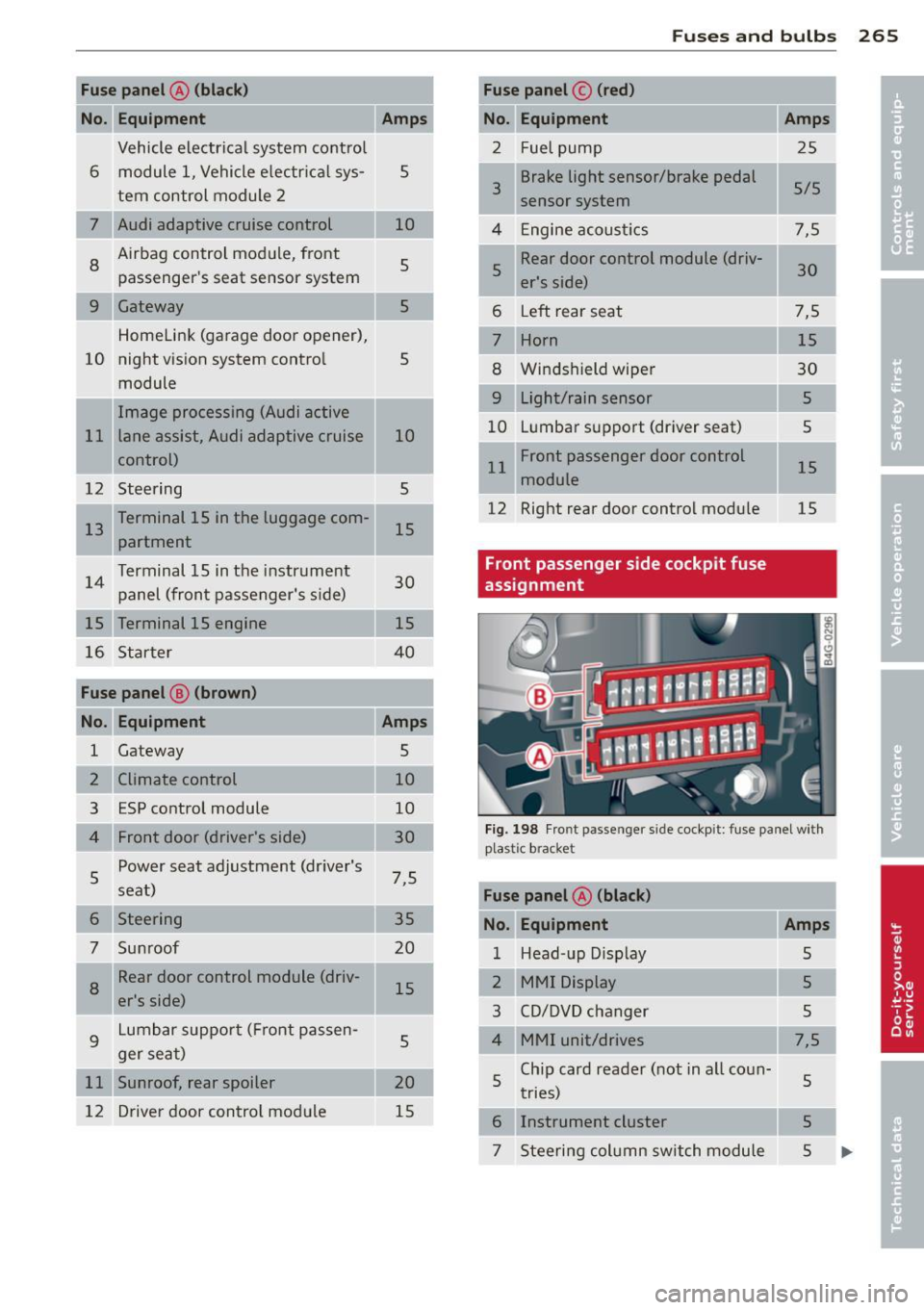
Fuse panel@ (bl ack )
No. Equipment
Vehicle electrical system control
6 module 1, Vehicle e lectr ica l sys-
tern control module 2
7 Audi adaptive cruise control
8
Airbag control module, front
passenger 's seat sensor system
9 Gateway
Homelink (garage door opener),
10 night vision system contro
l
module
Image processing (Audi active
11 lane assist , Audi adaptive cruise
control)
12 Steering
13 Terminal 15 in the luggage com-
partment
14 Terminal 15 in the
instrument
panel (front passenger's s ide)
15 Terminal 15 engine
16 Starter
Fuse panel e (brown)
No . Equipment
1 Gateway
2 Climate control
3 ESP co ntrol module
Front door (driver's side)
5
Power seat adjustment (dr iver's
seat)
6
Steering
7 Sunroof
8
Rear door control module (driv-
er's side)
9
Lumbar suppor t (Fro nt p assen-
ger seat)
11 Sunroof, rear spoiler
12 Driver door control mod ule
Amps
5
10
5
5
5
10
5
15
30 15
4 0
Amps
5
10
10
30
7,5 35
20 1 5
5
20
15
Fu se s and bulb s 265
Fuse panel © (red )
No. Equipment
2 Fue l pump
3 Brake light sensor/brake pedal
sensor system
4 Engine acoust ics
5 Rear door control module (driv-
er's side)
6 Left rear seat
7 Horn
8 Win dsh ield wipe r
9 Light/rain sensor
10 L
u mbar support (dr iver seat)
11 Front passenge
r door control
module
12 Right rear door control mod
ule
Front passenger side cockpit fuse
assignment Amps
2
5
5/5
7,5 30
7,5 15
30
5
5
15 15
Fi g. 198 Fro nt passe nge r side cock pit : fu se pa nel with
p last ic bracket
Fuse panel A (black )
No. Equipment
1 Head-up D isplay
2 MMI Display
3 CD/DVD changer
Chip card reader (not in all coun-
5 tr ies)
6 Instrument cluster
Amps
5
5
5
7,5
5
5
7 Steeri ng col umn switch module 5
Page 277 of 298
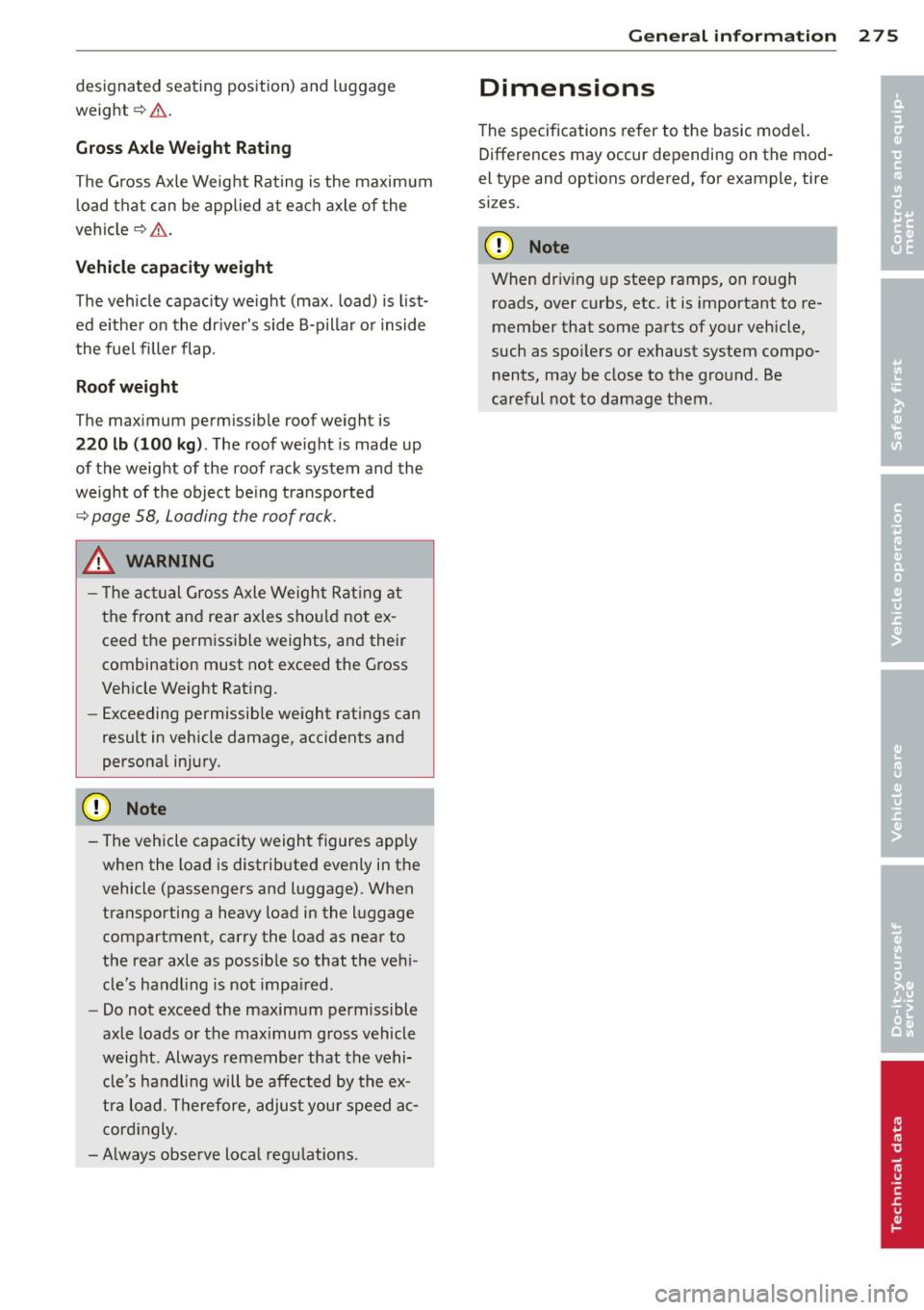
designated seating position) and luggage
weight~&. .
Gros s Axle W eight Rating
The G ross Axle Weight Rating is the maximum
l oad tha t can be applied at each axle of the
vehicle
q .&. .
Vehicle capacit y weight
The vehicle capac ity we ight (max. load) is list
ed either on the dr iver's side B-pillar or inside
the fuel filler flap.
Roof weight
The max imum perm issible roof weight is
22 0 lb (100 kg ). The roof weight is made up
of the weight of the roof rack system and the
weight of the object be ing transported
q page 58, Loading the roof rack .
.&, WARNING
- T he ac tual Gross Axle Weight Rat ing at
the front and rear axles shou ld not ex
ceed the permiss ible weights, and their
combination must not exceed the Gross
Vehicle Weight Rat ing .
- Exceeding permissib le weight ratings can
result in vehicle damage, accidents and
personal injury.
CD Note
- The vehicle capacity weight figures apply
when the load is distributed evenly in the
vehicle (passengers and luggage) . When
transporting a heavy load in the luggage
compartment, carry the load as near to
the rear axle as possib le so that the veh i
cle's handling is not impa ired.
- Do not exceed the maximum permissible
axle loads or the max imum gross vehicle
weight . Always remember that the vehi
cle's handling will be affected by the ex
tra load. Therefore, adjust you r speed ac
cord ingly.
- Always observe loca l regu lations.
-
G ene ral in formation 27 5
Dimensions
The specifications refer to the basic model.
Differences may occur depending on the mod
el type and options ordered, for example, tire
sizes.
CD Note
When driving up steep ramps, on rough roads, over curbs, etc. it is important to re
member that some parts of your vehicle,
such as spoilers or exhaust system compo nents, may be close to the ground . Be
careful not to damage them .
•
•
Page 281 of 298

complexity of today's automobi les, have
steadi ly reduced the scope of maintenance
and repairs which can be carried out by vehicle
owners.
Also, safe ty and e nvir onm en tal con
cerns p lace very strict limits on the na ture of
repairs and adjustments to engine and trans
miss io n pa rts which an owner can perform .
Maintenance, adjustments and repa irs usua lly
require special tools, testing dev ices and oth
er equipment avai lab le to specially trained
workshop personnel in order to assure prope r
performance, reliab ility and safety of the vehi
cle and its many systems .
Improper ma intenance, adjustments and re
pa irs can impair the operation and reliability
of your vehicle and even void your vehicle war ranty. The refo re, p roof of servici ng in accord
ance w ith the maintenance sched ule may be a
condition for upholding a poss ible war ranty
claim made within the warranty period.
Above all, operational safety can be adversely
affected, crea ting unnecessary risks for you
and your passengers.
If in doubt about any servicing, have it done
by your authorized Audi dealer or any other
properly equipped and q ualified workshop .
We strong ly urge you to give you r a uthorized
Audi dealer the opportunity to perform all
schedu led maintenance and necessary repairs .
Your dea ler has the facilities, or iginal parts
and trained spec ialists to keep your vehicle
running properly .
Performing limit ed m aintenance you rself
The fo llowing pages describe a limited num
ber of procedures which can be performed on
your vehicle with ordinary too ls, should the
need arise and trained personnel be unavaila
b le. Before performing any of these proce
dures, always thoroughly read all of the app li
cable text and carefully follow the instruc
tions given . Always rigorously obse rve the
WARNINGS provided .
Before you check anything in th e engine
compartment, a lway s re ad and heed all
Con sumer In formation 2 79
WARNINGS ¢ & and ¢ & in Working in the
engine comportment on page 220 .
A WARNING
-Ser ious personal injury may occur as a re
sult of improperly performed mainte nance, adjustments or repa irs.
-Always be extremely careful when work ing on the vehicle. Always follow com
mon ly accepted safety pract ices and gen
eral common sense . Never r isk personal
lnJU ry .
- Do not attempt any of the ma intenance ,
checks or repairs descr ibed on the fol
lowing pages if you are not fully fam iliar
wit h these or othe r pro cedures with re
spect to t he veh icle, or are uncerta in how
to p roceed .
- Do not do any work without the proper
too ls and equipment. Have the necessary
work done by your authorized A udi deal
er or another proper ly equipped and
qualified workshop .
- The engine compartment o f any motor
veh icle is a potentially hazardous area.
Never reach into the area around or
touch the rad iator fan. It is temperature
contro lled and can switch on suddenly -
even when the engine is
off . The radiator
fan switches on automat ically when the
coo lant reaches a certai n temperature
a nd will cont inue to run until the coo lan t
temper ature drops.
- Always sw itch
off the ignition before any
one gets under the vehicle.
- Always support your veh icle with safety
stands if it is necessary to work under
neath the vehicle . The j ack s upplied with
the vehicle is not adequate for this pur
pose and cou ld co llapse causing serio us
personal i njury .
-If you must work unde rneath the vehicle
with the wheels on the ground, a lways
make sure the vehicle is on leve l ground,
that the wheels are a lways securely
blocked and that the engine cannot be
started.
•
•
Page 287 of 298
Child safety . ... .... .... ... .. .. .. ... 168
Convertible locking retractor . . . . . . . . . 179
Important safety instructions fo r using
chi ld safety seats . . . . . . . . . . . . . . . . . . 17 2
Important things to know when dr iv ing
with chi ldren ............... ... ... 168
Tether anchors ... .. ...... .. .. .. .. . 185
Tet her straps ......... ...... .... .. 185
Ch ild safety lock
Reardoo~ .............. .... .. .... 37
Ch ild safety sea ts ....... ... .. .. .. ... 174
Booster seats .... ..... ... .. .. .. ... 177
Convertible c hild seats . ... .. .. .. .. . 175
Convertible locking retractor .. .. .. .. . 179
H ow do I properly install a child safety
seat in my vehicle? ............ ... .. 172
Infant seats . . . . . . . . . . . . . . . . . . . . . . 17 4
Install ing .. ................ ... ... 179
I nstal ling a chi ld restraint using the
L A T C H sys tem . . . . . . . . . . . . . . . . . . . . . 184
L A TCH sys tem ............ .. .. .. .. . 184
L owe r ancho rages ..... ... .. .. .. .. . 183
M ounting and releasing the ancho rage
hook .... .. .. .. ........... .. .. ... 184
Safety instructions ........ .. .. .. .. . 172
C igare tte lig hte r . . . . . . . . . . . . . . . . . . . . . 54
C lea ning and protection .......... .... 204
A lcantara (synthet ic suede) ..... ... .. 213
E ng ine compartment ...... .. .. .. .. . 214
E xha ust tail pipes ......... .. .. .. .. . 210
Fa brics and fabr ic coverings .. .. .. .. . 210
I ns trumen t panel . ..... ... .. .. .. .. . 2 11
Interior . . . . . . . . . . . . . . . . . . . . . . . . . . 210
L eather .... .. .... .... ... .. .. .. ... 212
MMI disp lay/controls ...... .. .. .. .. . 210
P lastic and v inyl .......... .. .. .. .. . 207
Plastic pa rts ... .. .. ...... .. .. .. .. . 211
Safety belts . . . . . . . . . . . . . . . . . . . . . . 213
tr im str ips .... ........... ... ... .. 208
T rim str ips . ............. .... .. ... 207
Climate control Air vents . ................ ... ... ... 65
Climate controls . . . . . . . . . . . . . . . . . . . . . 63
Climate con trol (four-zone)
Opera tion . . . . . . . . . . . . . . . . . . . . . . . . . 66
Climate control (three-zone) Operation . . . . . . . . . . . . . . . . . . . . . . . . . 64
C lock ..... .. .. ... .. ..... ... .. .. .... 26
Inde x 285
Closing
Sliding/ti lting s unroof ... .... ... .. .. . 39
Cold tire infla tion p ress ure ............ 239
Coming home . .. .. ................. . 43
Compac t spa re tire ... . ... .... ... .. .. 257
Compartments . . . . . . . . . . . . . . . . . . . . . . 55
Compliance ... .. .. .. . .. ... .... ... .. 281
Consumer Informa tion.......... 131, 278
Consumption (fuel) .. . ... .... ... .. .. . 24
Contacting NHTSA ... . .. ..... ... .. .. 131
Convenience key . . . . . . . . . . . . . . . . . . . . . 34
Star ting t he engine . . . . . . . . . . . . . . . . . 70
Stopping the eng ine (S TAR T E NGINE
S TOP b utton) . . . . . . . . . . . . . . . . . . . . . . 72
Switching the ignition on .... ... .. .. . 70
U nlocking and loc kin g vehicle . ... .. .. . 34
Conve rtib le child safe ty seats ..... .... 175
Convertib le loc king retractor
Activating . . . . . . . . . . . . . . . . . . . . . . . . 181
Deact ivat ing . .. .. .. . .. .... .... .. .. 182
U si ng to secure a child safety seat 1.79, 181
Coolant
refer to E ng ine coolant ......... .... 227
Cooling mode (automat ic climate control) 66
Cooling mode (climate control) . . . . . . . . . 64
Cornering light .. .. ................. . 95
Cruise cont ro l
Changi ng speed . ... . .. ..... ... .. .. . 76
Presetting your speed ... .... ... .. .. . 77
Switching off . . . . . . . . . . . . . . . . . . . . . . 77
Switching on . . . . . . . . . . . . . . . . . . . . . . . 76
Warning/ind icator lights ........ .. .. . 22
( upholder .. .... .. .................. 55
D
Data ....... .. .. .. ... ............ .. 276
Data recorder . . . . . . . . . . . . . . . . . . . . . . 189
Date d isp lay . ..... ... .. .. ..... ... .. . 26
Dayt ime runn ing lights ... .. .. ... ... .. . 41
Declarat ion of compliance
Adaptive cruise control ......... .. .. 281
Audi s ide ass ist .. ................. 281
Ce ll phone package . ............... 281
Co nvenience key .. .. . .. .. .. ... ... .. 281
El ectronic immob ilizer .......... .... 281
•
•
Page 288 of 298
286 Index
Homelink ® un iversal remote control .. 281
Remote control key ......... .. .... . 281
DEF
What does this mean when it appea rs in
the trip odometer display? ... .. .... ..
26
Defective light bulb warning ...... ..... 21
Defrosting (windows)
autom atic cl imate control .. .. .. .... ..
6 7
climate control . . . . . . . . . . . . . . . . . . . . . 65
Determining correct load limit ....... . 244
Dimensions .. ... ... ... .... .. .. .. .. .
275
Dimming the rearview mirror . ... .. .. .. 48
Distance . . . . . . . . . . . . . . . . . . . . . . . . . . . 24
Door/re ar lid warning . . . . . . . . . . . . . . . . .
23
Doors
Pow er child safety lock ..... ... .. ... . 37
Driver information system
CD/radio display . . . . . . . . . . . . . . . . . . . .
23
Door/rear lid warning . . . . . . . . . . . . . . . 23
Efficiency program . . . . . . . . . . . . . . . . . . 25
Exterior temperature display ..... .. .. 23
On-board computer ... .... .. .. .... .. 24
Driver seating position .... .. .. .. .. .. .
124
drive select .. .......... ...... ... .. .. 95
Adaptive dampers . . . . . . . . . . . . . . . . . . 95
Cornering light ............... .. ... . 95
Safety belt tensione r ...... .. .. .. .. . . 95
Driving safely . . . . . . . . . . . . . . . . . . . . . . 123
Driving through water ........ .. .... . 198
D .
. t· 24
riving 1me .... ... .... ..... .. .. .. . .
Duplicate key . . . . . . . . . . . . . . . . . . . . . . . 30
Dust filter
refer to Pollutant filter . . . . . . . . . . . . . . 63
E
Easy entry featu re .......... .. .. .. .. .. 70
Efficiency program . . . . . . . . . . . . . . . . . . . 25
Fuel economy messages . . . . . . . . . . . . . 25
Other equipment . . . . . . . . . . . . . . . . . . . 25
Electrical accessories (sockets) . . . . . . . . . 55
Electro-mechanical power assist .. .. ... 193
Elec tromechanical parking brake
Emergency braking ........... .. .. ..
75
Operation . . . . . . . . . . . . . . . . . . . . . . . . . 73
Parking .. .. .... ......... .. .. .. .. ..
74
Releasing and closing ..... .... .... .. 73 Starting
assist . . . . . . . . . . . . . . . . . . . . . 7 4
Starting from rest ..................
74
Starting off w ith a trailer . . . . . . . . . . . . . 7 4
Warning/ind icator lights ........ .... . 16
Electronic differential lock (EDL) ....... 189
Warning/ind icator lights ............. 19
Electronic immob ilizer . . . . . . . . . . . . 26, 31
Electronic power control ( EPC)
warning/indicator ligh t ......... .. .. .
20
Electronic speed limiter .......... ..... 29
Electronic stabilizat ion program (ESP) .. 189
Warning/indicator lights ........... .. 19
Emergency actuation
Doors .... .. .. . .................. .
36
Power sunroof ... .......... ...... .. 40
Emergency braking ................... 75
Emergency flashe r .... ... ... .... .. .. . 42
Warning/indicator lights .......... .. .
22
Emergency release
Selector lever . . . . . . . . . . . . . . . .
106, 112
Emergency starting .......... ..... .. 268
Emergency towing .............. .... 270
Emergency unlock ing
Rear lid .... ... .. .. ... ........... .. 37
Emergency warn ing triangle ..........
256
Energy management . .. ...... ... .. .. 194
Engine
Compar tment .. .. ............. ....
222
Coolant ...... ... .. .............. . 227
Data .... ... .. .. .. ...... ..... .. .. 276
starting . .. .. .. .. .... ... . .. ... .. .. . 70
Starting with jumper cables ....... .. 268
Stopping .... .. .. .. ... .. .. .... .... . 72
Engine compartment ............... . 222
Closing the hood .... ... .... ..... .. 221
Opening the hood ................ . 220
Safety instructions ................. 220
Working in the engine compartment .. 220
Engine coolant .. .. ..... ........... . 22 7
Adding coolant ... ..... ........... .
228
Checking the engine coo lant level ..... 227
Expansion tank ... ... .......... .. .. 227
Malfunction symbol ............ .. .. . 16
Radiator fan ..... .. ........... .. .. 229
Temperature gauge ............. ... . 11