weight AUDI A6 2012 Owner's Guide
[x] Cancel search | Manufacturer: AUDI, Model Year: 2012, Model line: A6, Model: AUDI A6 2012Pages: 298, PDF Size: 74.43 MB
Page 246 of 298
244 Tires and wheels -Always make sure that the total load be
ing transported -including the weight of
a trailer hitch and the tongue weight of a
loaded trailer -does not make the vehi
cle heavier than the vehicle's Gross Vehi
cle Weight Rating.
Determining correct load limit
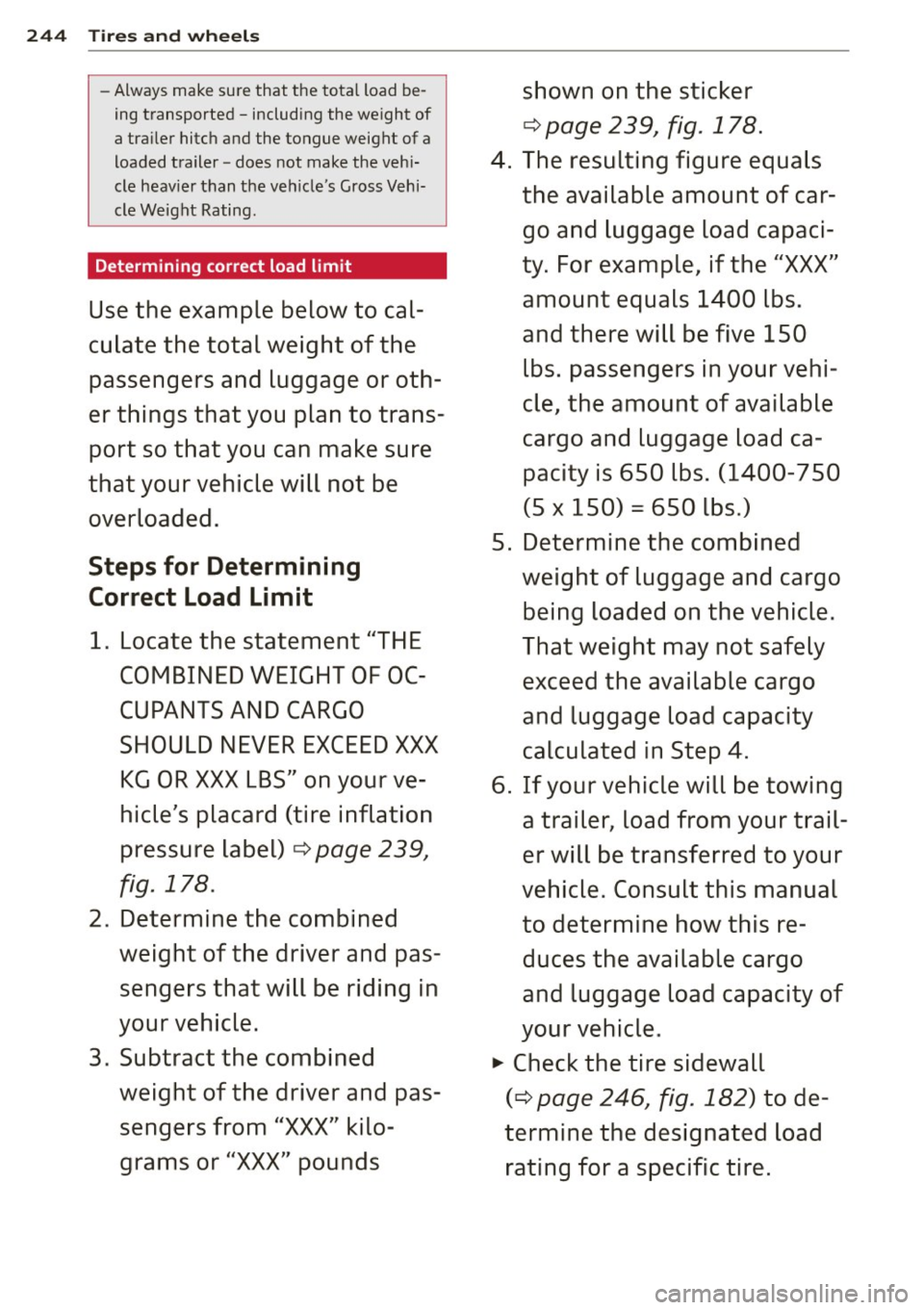
Use the example below to cal
culate the total weight of the
passengers and luggage or oth
er things that you plan to trans
port so that you can make sure
that your vehicle will not be
overloaded.
Steps for Determining
Correct Load Limit
1. Locate the statement "THE
COMBINED WEIGHT OF OC
CUPANTS AND CARGO
SHOULD NEVER EXCEED XXX KG OR XXX LBS" on your ve
hicle's placard (tire inflation
pressure label)
¢ page 239,
fig. 178.
2. Determine the combined
weight of the driver and pas sengers that will be riding in
your vehicle.
3. Subtract the combined
weight of the driver and pas sengers from
"XXX" kilo
grams or
"XXX" pounds shown on the sticker
¢ page 239, fig. 178.
4. The resulting figure equals
the available amount of car
go and luggage load capaci
ty. For example, if the
"XXX"
amount equals 1400 lbs.
and there will be five
150
lbs. passengers in your vehi
cle, the amount of available
cargo and luggage load ca
pacity is
650 lbs. (1400-7 50
(5
X 150) = 650 lbs.)
5. Determine the combined
weight of luggage and cargo being loaded on the vehicle.
That weight may not safely
exceed the available cargo
and luggage load capacity
calculated in Step
4.
6.
If your vehicle will be towing
a trailer, load from your trail
er will be transferred to your
vehicle. Consult this manual
to determine how this re duces the available cargo
and luggage load capacity of
your vehicle.
... Check the tire sidewall
(¢page 246, fig. 182) to de
termine the designated load rating for a specific tire.
Page 250 of 298
248 Tires and wheels
T up to 118 mph (190 km/h)
U up to 124 mph (200 km/h)
H up to 130 mph (210 km/h)
V up to 149 mph (240 km/h)
1l
Z over 149 mph (240 km/h)ll
W up to 168 mph (270 km/h)ll
Y up to 186 mph (298 km/h)l)
Your veh icle is normally factory equipped with
tires , which possess excellent driving charac
teristics and give your Audi opt imum driving
comfort. An electronic speed limiter
c:> page 29 will normally prevent your vehicle
from going faster than the tire speed rating
c:> & .
U.S . DOT Tire Identification Number (TIN)
and tire manufacture date
This is the tire's "serial number". It begins
with the letters "DOT" and indicates that the
tire meets all federal standards . The next two
numbers or letters indicate the plant where it
was manufactured, and the last four numbers
r epresent the week and year of manufacture.
F or example, the numbers 2211 mean the tire
was produced in the 22nd week of 2011. The
other numbers are marketing codes that may
or may not be used by the tire manufacturer .
T his information is used to contact consumers
if a tire defect requires a recall.
Audi Original tire
Tires with the identification "AO" or "RO" have
been specially matched with your Audi . We
recommend using only these tires because
they meet the highest standards regarding
safety and driving characteristics when used
correctly . Your authorized Audi dealer will
gladly provide you with more information .
Tire ply composition and materials used
The number of plies indicates the number of
layers of rubber-coated fabric in the tire. In
general, the greater the number of plies, the more weight a tire can support . Tire manufac -
ll F t· "t h . or ires w 1 a m ax im um s pee d ca pabil ity ove r
1 4 9 mp h (240 k m/h) , tire man ufactur ers sometimes
use the lette rs " ZR."
turers also must indicate the materials in the
tire, which include steel, nylon, polyester, and
others .
Maximum Load Rating
Th is number ind icates the maximum load in
kilograms and pounds that can be carr ied by
the tire.
Tire quality grading for treadwear,
traction , and temperature resistance
Tread wear, traction and temperature grades
c:> page 249.
Maximum Permissible Inflation Pressure
This number is the greatest amount of a ir
pressure that should ever be put in the tire
un der normal driv ing conditions .
_& WARNING
= -
- Using incorrect or unmatched tires and/
or wheels or improper tire and wheel
combinations can lead to loss of control
collision and serious personal in jury.
'
-Always use tires, rims and whee l bolts
that meet the specifications of original factory-installed tires or other combina
tions that have been specifically ap
proved by the vehicle manufacturer.
- Tires age even if they are not being used
and can fail suddenly, especially at high
speeds. Tires that are more than 6 years
old can only be used in an emergency
and then w ith special care and at lower
speeds.
- Never mount used tires on your veh icle if
you are not sure of the ir "previous histo
ry." Old used tires may have been dam
aged even though the damage cannot be
seen that can lead to sudden tire fa ilure
and loss of vehicle control.
- All four whee ls must be fitted with radial
tires of the same type, size (rolling cir cumference) and the same tread pattern . ..,_
Page 274 of 298

272 Emergency situations
@ Tips
Check carefully to make sure the hook- up
is sec ure before moving the ca r up the flat
bed truck ramp.
Lifting vehicle
Lifting with workshop hoist and with
floor jack
T he vehi cle may only be li~ed at the lifting
points illustra ted .
Fig. 207 Fr ont lift in g po int
Fi g. 208 Rear lift ing point
• Read and heed WARNING q &_ .
• Locate lifting points q fig. 207 and
qfig. 208.
• Adjust lift ing arms of workshop hoist or
floor jack to match vehicle lifting points.
• Inse rt a r ubber pad betw een the floor jack/
wor kshop hoist and the lifti ng points.
If you must lift your vehicle with a floor jack
to work underneath, be sure the vehicle is
safely supported on stands intended for thi s
purpose .
Front lifting point
The lifting point is located on t he floor pan re
i n forcement about at the same level as the j
ac k mounting po int
~ fig. 20 7. Do not lift
the veh icle at the vertical sill reinforcement .
Rear lifting point
The lifti ng po int is located o n the vert ica l rein
f orcemen t of the lowe r sill for the on- boar d
j a ck
q fig . 208.
Lifting with vehicle jack
Refer to ¢ page 261.
A WARNING
-- To reduce the risk of s erio us injury and
ve hicl e damage.
- Always lift the vehicle only at the spe
c ia l workshop hoist and floor jack lift
po ints illustrated
¢ fig. 207 and
q fig. 208.
-Fail ure to lift the ve hicle at these
po ints could cause the vehicle to tilt or
fall from a lift if there is a change i n ve
h icle weight distribution and balanc e.
T his mig ht happen, fo r example, whe n
h eavy com ponen ts such as the eng ine
b lo ck o r trans mission a re remove d.
- W hen removi ng heavy compone nts like
t hese, anch or vehicle to h oist or ad d cor
resp onding we ig hts t o main tain t he cen
t er of gravity. Oth erwise, t he ve hicle
might tilt or slip off the ho ist , ca using
serio us personal injury.
(D Note
- B e aw are o f the followin g poin ts before
li ft ing t he vehicle:
-The vehicle should never be lifted or
jacked up from underneath the engine oil pan, the transmission housing, the
front or rear axle or the body side
members. This could lead to serious
damage .
- To avoid damage to the underbody or
chas sis frame, a rubber pad must be
inserted between the floor jack and
the lift points.
-
- Before driving over a workshop hoist,
check that the vehicle weight doe s not .,..
Page 276 of 298

2 7 4 General information
General information
Explanation of
technical data
Some of the technical data listed in this man
ual requires further explanation .
The technical data for your vehicle is listed in
the charts starting on
r:::> page 2 76. This sec ·
tion provides general information, notes and restrictions which apply to this data .
Vehicle identification
The key data is given on the vehicle identifica·
tion number (VIN) plate and the vehicle data
sticker.
Fig. 209 Veh icle Ide ntific atio n Number (VlN) p late: lo
cation on driver 's sid e das h panel
Fig. 210 Th e vehicle identi fication label -inside the
luggage co mpa rtmen t
The Vehicle Identification Number (VIN)
is located on the driver's side so that it is visi
b le from the outside through the windshield
r:::> fig . 209. You can also display the Vehicle
Identification Number of your vehicle in the
MMI. Select: Function button
ICAR ! > Car sys
tems
> VIN number . The
vehicle identification label
is located in the luggage compartment in the
spare wheel wel l.
The label¢
fig. 210 shows the following vehi
cle data :
(D Production control No .
@ Vehicle identification No.
® Type code number
@ Type designation/engine output in Kilo·
watts
® Engine and transmission code letter
@ Paint No./Interior
(f) Optional equipment No.'s
Vehicle data 2 to 7 are also found in your War·
ranty
& Maintenance booklet.
The safety compliance sticker
is you r assurance that your new vehicle com
plies with all applicable Federal Motor Vehicle
Safety Standards which were in effect at the
time the vehicle was manufactured . You can
find this sticker on the left door jamb.
It
shows the month and year of production and
the ve hicle ident ification number of your vehi ·
cle (perforation) as well as the Gross Vehicle
Weight Rating (GVWR) and the Gross Axle
Weight Rating (GAWR) .
The high voltage warning label
is located on the lock carr ier .
The spark ignition system complies with
the Canadian standard ICES-002.
Weights
Gross Vehicle Weight Rating
The Gross Vehicle Weight Rating (GVWR), and
the Gross Axle Weight Rating (GAWR) for
front and rear are Listed on a sticker on the
left door jamb.
The Gross Vehicle Weight Rating includes the
weight of the basic vehicle plus full fuel tank,
oi l and coolant, plus maximum load, wh ich in·
eludes passenger weight (lSO lbs/68 kg per
Ill>
Page 277 of 298
designated seating position) and luggage
weight~&. .
Gros s Axle W eight Rating
The G ross Axle Weight Rating is the maximum
l oad tha t can be applied at each axle of the
vehicle
q .&. .
Vehicle capacit y weight
The vehicle capac ity we ight (max. load) is list
ed either on the dr iver's side B-pillar or inside
the fuel filler flap.
Roof weight
The max imum perm issible roof weight is
22 0 lb (100 kg ). The roof weight is made up
of the weight of the roof rack system and the
weight of the object be ing transported
q page 58, Loading the roof rack .
.&, WARNING
- T he ac tual Gross Axle Weight Rat ing at
the front and rear axles shou ld not ex
ceed the permiss ible weights, and their
combination must not exceed the Gross
Vehicle Weight Rat ing .
- Exceeding permissib le weight ratings can
result in vehicle damage, accidents and
personal injury.
CD Note
- The vehicle capacity weight figures apply
when the load is distributed evenly in the
vehicle (passengers and luggage) . When
transporting a heavy load in the luggage
compartment, carry the load as near to
the rear axle as possib le so that the veh i
cle's handling is not impa ired.
- Do not exceed the maximum permissible
axle loads or the max imum gross vehicle
weight . Always remember that the vehi
cle's handling will be affected by the ex
tra load. Therefore, adjust you r speed ac
cord ingly.
- Always observe loca l regu lations.
-
G ene ral in formation 27 5
Dimensions
The specifications refer to the basic model.
Differences may occur depending on the mod
el type and options ordered, for example, tire
sizes.
CD Note
When driving up steep ramps, on rough roads, over curbs, etc. it is important to re
member that some parts of your vehicle,
such as spoilers or exhaust system compo nents, may be close to the ground . Be
careful not to damage them .
•
•
Page 293 of 298
_______________________________ I~ n~ d:::: e~x 291
Rear window heating (automatic climate
control) . . . . . . . . . . . . . . . . . . . . . . . . . . . . 67
Rear window heating (climate cont rol) . . . 65
Recirculation mode (automatic climate
control) . . . . . . . . . . . . . . . . . . . . . . . . . . . . 66
Recirculation mode (climate control) . ... 64
Refue lling ......................... 217
Remote control
Garage door opener (Homelink ®) .. .. . 120
Unlocking and locking ........ .. .... . 34
Remote rear lid release ............... 36
R . l epair manua s ............ .... .. .. . 278
Repairs Airbag system ........... .... .. .. .
158
Replacing Fuses .... .. .. ................ .... 264
Light bulbs .............. .... .. ... 267
Tires and wheels ......... .. .. .. .. . 247
Windshield wiper blades ... .. .. .. .. .. 47
Reporting Safety Defects ............. 131
Reset button . . . . . . . . . . . . . . . . . . . . . . . . 26
Retractor .. .. ............. .... .. .. . 136
Rims (cleaning) ................ .. ... 209
Roof rack .................... ... ... . 57
L oading .. ..... ........... ... ... ... 58
Roof weight .... .. .... .... . .. .. .. .. 58
s
SAFE ...... ... ................ .... . 26
Safe driving habits ................. . 123
Safety belt position . . . . . . . . . . . . . . . . . 13 7
Safety belt height adjustment .. .. .. . 139
Safety belts worn by pregnant women . 138
Safety belt pretens ioner . . . . . . . . . . . . . . 140
Service and disposal ........... .... 140
Safety belt pretensioners Pre sense 187
Safety belts . ... ............ ... .. ... 136
cleaning 213
Danger to passengers who do not wear a
safety belt . . . . . . . . . . . . . . . . . . . . . . . 134
Fastening .. .. .. ......... .. .. .. ... 136
H eight adjustment .. .. .... .. .. .. .. . 139
Improperly worn ............ .. .... 139
Not worn ................ ... ... .. 134
Safety belt position ....... .. .. .. .. . 13 7 Safety
instructions . ......... ..... .. 136
Securing child safety seats .......... 179
Spec ia l considerations for pregnant
women ... .. .. .. ................. 138
Unfastening . .. .. .... ............. 138
Warning/indicator light ............ . 133
Warning light . . . . . . . . . . . . . . . . . . . . . . 17
Why YOU MUST wear them .......... 133
Worn properly ... .. . .......... .... 135
Safety belt tens ioner
drive select ...... .. ..... ........... 95
Safety be lt warning light ............. 133
Safety compliance sticker ........ .. .. 274
Safety equ ipment .. .... ............. 123
Safety features for occ upant restraint and
protection . ... .... ... .... ........ .. 123
Safety gu idelines
Seat adjustment . . . . . . . . . . . . . . . . . . . . SO
Safety instructions
E . ngme compartment .............. . 220
for side curtain airbags ............ . 166
for using child safety seats ......... . 172
for using safety belts ........... .. . . 136
Monitoring the Advanced Airbag Sys-
tem ...... .. .. .. .. . .............. 157
Safety systems Warning/indicator lights ........... .. 18
Seat adjustment Controls .. .. .. .. .... ............. . 51
Driver's seat . . . . . . . . . . . . . . . . . . . . . . . SO
Front passenger's seat ............. .. 51
Front seats . . . . . . . . . . . . . . . . . . . . . . . . SO
Head restrai nts . . . . . . . . . . . . . . . 52, 12 7
Safety guidelines ..... ......... .... . SO
Seat belts WhyYOUMUSTwearthem .......... 133
Seat heating/ventilation (automatic cli -
mate control) ... .. .. ............... . 67
Seat heating (climate con trol) . . . . . . . . . . 65
Seating position
Driver ....... ... .. ..... .......... 124
Front passenger .................. . 125
How to adjust the front seats ...... .. 125
Incorrect seat position .......... .... 127
Occupants ... .... .. . .. .......... .. 124
Rear passengers .. .. . .......... .. .. 126
Seat memory . . . . . . . . . . . . . . . . . . . . . . . 53 •
•
Page 296 of 298
29 4 Index
Safety belt . . . . . . . . . . . . . . . . . . . . . . . . 17
Turn signa ls . .. . ...... ... .. .. .... .. 22
War ning/Ind icator lights
A irbag system . . . . . . . . . . . . . . . 1S4, 155
PASSENGER A IR BAG OFF .. .. .. .... . 1S5
Warranty coverages ............. .... 278
Washer reservoir ....... ... .. .. .... . 234
Washing .. .... ........... .. .. .... . 204
Automat ic ca r wash ................ 205
by hand ......... ....... ... .. .... . 205
with a power washer ...... .. .... .. . 206
Waxing ........................... 207
Wear indicator ..................... 245
Weights . .. .. ............. .. .. .. .. . 274
What happens if you wear your safety belt
too loose? ......................... 137
What happens to unbelted occupants? .. 134
What impairs driving safety? . .. .. .. .. . 124
What should I do after changing a
wheel? .. .. .. ... .... ...... ... ... .. . 242
What should I do after replacing wheels? 242
Wheel bol ts
Torq ue . .. .... ........... ........ . 252
Wheels ... .. ................ ... ... 235
Cast alloy .. .................. ... . 209
Check ing tire pressure .............. 241
Cold t ire in flat ion p ressu re . .. .. .... . 239
General notes ............ .. .. .. .. . 235
Glossary of tire and loading termino lo-
gy . ..... .. ... .. ..... ... .. .. .... . 236
New tires and wheels .... .. .. .. .. ... 246
Tires and vehicle load lim its .. .. .. ... 243
When must a safety belt be rep laced? . . 136
When must the airbag system be inspect -
ed? ... .. .. .. .. . .... ...... ... ... .. . 154
When should I ad just the tire pressures? 242
When shou ld I check the tire pressures? . 242
Where are lower anchorages located? ... 183
Where can I find the tire pressures for my
car? . ... .... ... . ...... ... .. .. .... . 24 1
Why safety bel ts? . . . . . . . . . . . . . . 133, 134
W indows
Cleaning ..................... ... . 208
defrost ing (automatic climate control) . 67
defrost ing (cl imate control) .. .. .. .... 65 Windsh
ie ld
Cleaning . ..... .. .. ... ..... ... .. .. . 46
defrosting (automatic cli mate control) . 67
defrosting (climate control) . . . . . . . . . . 6S
Windsh ie ld washer system ............ 46
Washer fl u id level . . . . . . . . . . . . . . . . . . 21
Washer reservoir .... .. ..... .... . .. 234
Windsh ie ld wipers
Folding up .... .. ............. ..... 4 7
Indicator light ... ............. .. .. . 21
Rep lacing windsh ield wiper b lades . ... . 47
Switching on/off ... .... .... ... .. .. . 46
Winter operation Battery . .. .. .. .. .. ... ........ .. .. 230
Cooling system ... ............. .... 22 7
Defrost ing windows (automatic climate
control) ... .... .. .. ... ..... ... .. .. . 67
Defrosting windows (climate control) .. 65
Seat heating (automat ic climate control) 67
Seat heating (climate control) . . . . . . . . 65
Steering wheel heat ing .............. 68
Tires ............................ 193
Windows ........................ 208
Winter tires . .... ................... 250
All-wheel drive . .. ............. .... 250
X
Xenon-Lights . . . . . . . . . . . . . . . . . . . 41, 267