light AUDI A6 2013 Owners Manual
[x] Cancel search | Manufacturer: AUDI, Model Year: 2013, Model line: A6, Model: AUDI A6 2013Pages: 306, PDF Size: 76.92 MB
Page 181 of 306
belt to prevent the child safety seat from
moving
r::!>page 182 or install the seat using
the LATCH attachments.
"' Push the child safety seat down with your
full weight to get the safety belt really tight
so that the seat cannot move forward or
sideways more than one inch (2.5 cm)
r::!> page 182.
"' If the child safety seat is equipped with a
tether strap, attach it to the tether anchors
r::!> page 188.
.. Secure unused safety belts on the rear seat
r::!> page 177.
A toddler or child is usually too large for an in
fant restraint if it is more than one year old
and weighs more than 20 lbs . (9 kg).
Toddlers and children who are older than one
year up to about 4 years old and weigh more
than 20 lbs (9 kg) up to 40 lbs. (18 kg) must
always be properly restrained in a child safety
seat certified for their size and weight
r::!>fig.168and r:::>fig.169.
The airbag on the passenger side makes the
front seat a potentially dangerous place for a
child to ride. The front seat is not the safest
place for a child in a forward-facing child safe
ty seat.
It is a very dangerous place for an in
fant or a larger child in a rearward-facing seat.
A WARNING
Not using a ch ild safety seat, using the
wrong child safety seat or improperly in stalling a child restraint increases the risk
of serious personal injury and death in a
collision or other emergency situation.
- Children on the front seat of any car,
even with Advanced Airbags, can be seri
ously injured or even killed when an air
bag inflates. A child in a rearward-facing
child safety seat installed on the front
passenger seat will be seriously injured
and can be killed if the front airbag in
flates -even with an Advanced Airbag
System.
- The inflating airbag will hit the child
safety seat or infant carrier with great
-
Child Safety 1 79
force and will smash the child safety seat
and child against the backrest, center
arm rest, door or roof.
- Always install rear-facing child safety
seats on the rear seat.
- If you must install a rearward facing
child safety seat on the front passenger
seat because of exceptional circumstan
ces and the
PASSENGER AIR BAG OFF
light does not come on and stay on, im
mediately install the rear-facing child
safety seat in a rear seating position and
have the airbag system inspected by your
Audi dealer.
- The rear side of the child safety seat
should be positioned as close as possible
to the backrest on the vehicle seat. Ad
just or remove the rear seat head re
straint if it is difficult to install the child
seat with the head restraint in place
r:::> page 53. Install the head restraint
again immediately once the child seat is
removed . Driving without head restraints
or with head restraints that are not prop
erly adjusted increases the risk of serious
or fatal neck injury dramatically.
-Always read and heed all WARNINGS
whenever using a child restrained in ave
hicle is being used
r::!> page 136, Safety
belts, r::!> page 145, Airbag system
and
r::!> page 171, Important things to know .
A WARNING ~
If exceptional circumstances require the
use of a forward -facing child restraint on
the front passenger's seat, the child's safe
ty and well-being require that the follow
ing special precautions be taken:
- Make sure the forward-facing seat has been designed and certified by its manu
facturer for use on a front seat with a
passenger front and side airbag.
- Always follow the manufacturer's in
structions provided with the child safety
-
seat or infant carrier . "" •
•
Page 182 of 306
180 Child Safety
-Always move the front passenger seat in
to the rearmost position of the passen
ger seat's fore and aft adjustment range,
and as far away from the airbag as possi
ble before installing the child restraint .
- Always make sure that nothing prevents
the front passenger's seat from being
moved to the rearmost position in its
fore and aft adjustment range.
- Always make sure the backrest is in an
upright position .
- Never place or use any electrical device
(such as a laptop, CD player, electronic
games device or power inverter) on the
front passenger seat if the device is con
nected to the 12-volt socket or the ciga
rette lighter socket.
- If a seat heater has been retrofitted or
otherwise added to the front passenger
seat, never install any child restraint sys
tem on this seat.
- Make sure that there are no wet objects
(such as a wet towel) and no water or
other liquids on the front passenger seat
cushion.
- Never place objects on the seat (such as
a laptop, CD player, electronic games de
vice or power inverter). These may influ
ence the electrical capacitance measured by the capacitive passenger detection
system and can also fly around in an acci dent and cause serious personal injury.
- Make sure that the
PASSENGER AIR BAG
OFF
light comes on and stays on all the
time whenever the ignition is switched
on.
- If the
PASSENGER AIR BAG OFF light
does not come on and stay on, immedi
ately install the forward-facing child seat
at a seating position on the rear seat and
have the airbag system inspected by your
authorized Audi dealer.
- Take the child restraint off the front pas
senger seat and install it properly at one
of the rear seat positions if the
PASSEN
GER AIR BAG OFF
light does not stay on
whenever the ignition is switched on.
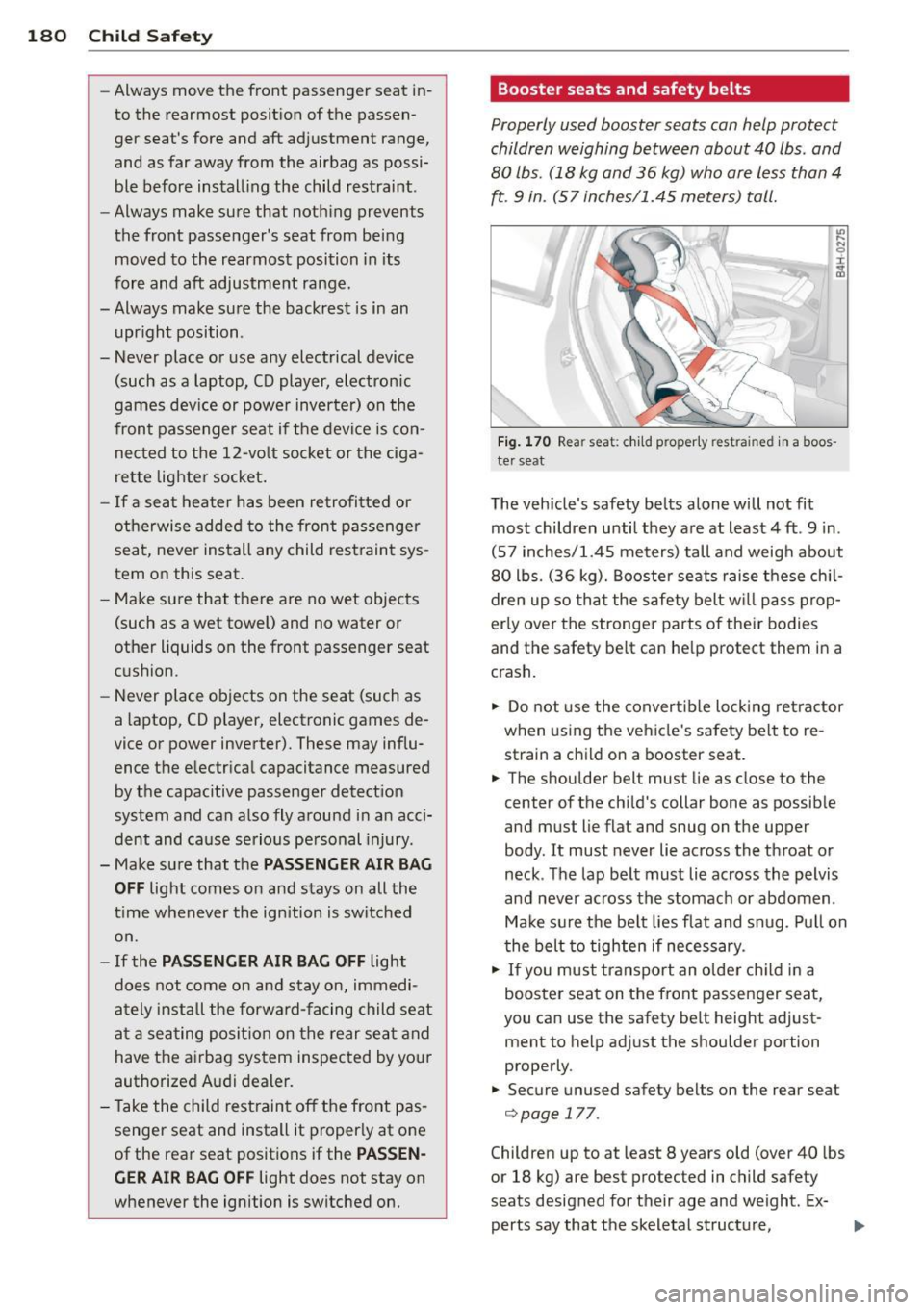
Booster seats and safety belts
Properly used booster seats can help protect
children weighing between about 40 lbs . and
80 lbs . (18 kg and 36 kg) who are less than 4
ft. 9 in. (57 inches/1.45 meters) tall.
Fig. 170 Rea r seat : child p rop erly res trained in a boos
te r se at
The vehicle's safety belts alone will not fit
most children until they are at least 4 ft . 9 in .
(57 inches/1.45 meters) tall and weigh about
80 lbs.
(36 kg). Booster seats raise these chil
dren up so that the safety belt will pass prop
erly over the stronger parts of their bodies
and the safety belt can help protect them in a
crash.
"" Do not use the convertible locking retractor
when using the vehicle's safety belt to re
strain a child on a booster seat.
"" The shoulder belt must lie as close to th e
center of the child's collar bone as possible
and mu st lie flat and snug on the upper
body.
It must never lie across the throat or
neck . The lap belt must lie across the pelvis
and never across the stomach or abdomen .
Make sure the belt lies flat and snug . Pull on
the belt to tighten if necessary .
"" If you must transport an older child in a
booster seat on the front passenger seat,
you can use the safety belt height adjust
ment to help adjust the shoulder portion
properly .
"" Secure unused safety belts on the rear seat
¢page 177.
Children up to at least 8 years old (ove r 40 lbs
or 18 kg) are best protected in child safety
seats designed for their age and weight . Ex-
perts say that the skeletal structure, ..,.
Page 184 of 306
182 Child Saf ety
- Never let a child ride in the cargo area of
your vehicle .
- Always remember that a chi ld leaning
forward, sitt ing s ideways or out of posi
t ion in any way during an acc ident can be
struck by a deploying airbag . This will re
sult in serious personal injury or death .
- If you must install a booster seat on the
front passenger seat because of excep
t ional circumstances the
PASSENGER
AIR BAG OFF
light must come on and
stay on, whenever the ignition is sw itch
ed on.
- If the PASSENGER AIR BAG OFF light
does not come on and s tay on, perform
the chec ks described ¢
page 157, Moni
toring the Advanced Airbag System.
- T ake the child rest raint off the front p as
senger seat and install it properly at one
of the rea r seat positions if the
PASS EN·
GER AIR BAG OFF
light does not stay on
whenever the ignition is switched on .
- Always read and heed all WARNINGS whenever using a child rest rained in ave
hicle is being used
¢ page 136, Safety
belts,¢ page 145, Airbag system
and
¢ page 171, Important things to know.
Installing a child safety
seat
Securing a child safety seat using a
safety belt
Safety belts for the rear seats and the front
passenger can be locked with the convertible
locking re tractor to properly secure child
safety seats.
The safety belts emergency locking retractors
for the rear seats safety belts and for the
fro nt passenger's seat safety belt have a con
vertible locking retracto r for child restra ints .
The safety belt must be locke d so that belt
webbing can not unreel. The ret ractor ca n be
activ ated to lock the safety be lt and p revent
the safety belt webbing from loosening up
d ur ing normal driv ing . A child sa fe ty seat can
on ly be proper ly installed whe n the safety belt is loc
ked so that the chi ld and child sa fety
seat wi ll stay in place.
Alw ays remember: Even tho ugh yo ur vehicle is
equipped wi th an A dvan ced Airbag system, all
c hi ldren, especially those 1 2 years and young
er, sho uld always ride in the back seat prope r
l y restra ined fo r the ir age and size.
A WARNING
Improperly installed ch ild safety seats in
crease the risk of serious personal injury
and death in a co llision.
- Always make sure that the safety belt re
tractor is locked when insta lling a child
safety seat. A n un locked safety belt re
trac to r cannot hold the child safety seat
in place dur ing norma l driving o r in a
crash.
- Always buckle the child safety seat firmly
in place even if a ch ild is not si tt ing in it.
A loose child sa fe ty se at can fly aroun d
du ring a s udden stop or in a collision .
- Always make sure that the rear seat
backres t to wh ich the center rear safety
belt * is attache d is sec urely latched
wheneve r the rea r ce nter safety belt is
be ing used to secure a child rest raint.
- If the backrest is not securely la tc h ed,
the child and the child restraint will be
thrown forward together with the back
rest and will strike parts of the vehicle
interior. The child can be seriously in
jured or killed.
- Never install rear-facing child safety
seats or infant ca rr ie rs o n the front pas
senger seat . A child will be serious ly in
jured and can be killed when the passen
ge r airbag inflates.
- The infla ting airbag will h it the ch ild
safety seat or infant carrie r w ith gr eat
for ce and will smas h the child safe ty seat
a nd child ag ai nst t he back res t, cen ter
a rmrest, doo r or roof.
- Always inst all rear-fa cing ch ild safety
se ats or in fa nt c arrie rs on the re ar se at.
Page 185 of 306
-Forward-facing child safety seats or in
fant carriers installed on the front pas
senger's seat may interfere with the de ployment of the airbag and cause serious
injury to the child.
- It is safer to install a forward-facing
child safety seat on the rear seat .
- Always read and heed all WARNINGS
whenever using a child restrained in ave
hicle is being used
c:::;,page 171. Special
precautions apply when installing a child
safety seat on the front passenger seat
c:::;, page 147, Child restraints on the front
seat -some important things to know.
A WARNING
-
Always take special precautions if you
must install a forward or rearward-facing
child restraint on the front passenger's
seat in exceptional situations:
- Whenever a forward or rearward-facing
child restraint is installed on the front
passenger seat, the
PASSENGER AIR
BAG OFF light must come on and stay on
whenever the ignition is switched on.
- If the
PASSENGER AIR BAG OFF light
does not come on and stay on, perform
the checks described
c> page 157, Moni
toring the Advanced Airbag System .
-Take the child restraint off the front pas
senger seat and install it properly at one
of the rear seat positions if the
PASSEN
GER AIR BAG OFF
light does not stay on
whenever the ignition is switched on.
- Improper installation of child restraints
can reduce their effectiveness or even
prevent them from providing any protec
tion.
- An improperly installed child restraint
can interfere with the airbag as it de
ploys and seriously injure or even kill the
child.
- Always carefully follow the manufactur
er's instructions provided with the child
safety seat or carrier.
- After checking to make sure that the
child restraint is properly installed, make
Child Safety 183
certain that the child restraint is correct
ly recognized by the capacitive passenger
detection system in the front passenger
seat and that the
PASSENGER AIR BAG
OFF
light signals the correct front pas
senger frontal airbag status .
A WARNING
Forward-facing child restraints:
-Always make sure the forward-facing seat has been designed and certified by its manufacturer for use on a front seat
with a passenger front and side airbag.
- Never put the forward-facing child re
straint up, against or very near the in
strument panel.
- Always
move the passenger seat into its
rearmost position in the seat's fore and
aft adjustment range, as far away from
the airbag as possible before installing
the forward-facing child restraint. The
backrest must be adjusted to an upright
position.
- Make sure that the PASSENGER AIR BAG
OFF light comes on and stays on all the
time whenever the ignition is switched
on .
A WARNING
Rearward-facing child restraints:
-A child in a rearward-facing child safety
seat installed on the front passenger
seat will be seriously injured and can be killed if the front airbag inflates -
even
with an Advanced Airbag System .
- The inflating airbag will hit the child
safety seat or infant carrier with great
force and will smash the child safety seat
and child against the backrest, center
armrest, door or roof.
- Always be especially careful if you must
install a rearward facing child safety seat
on the front passenger seat in exception
al circumstances.
- Make sure that the
PASSENGER AIR BAG
OFF
light comes on and stays on all the .,..
•
•
Page 190 of 306
188 Child Safet y
Tether anchors and tether straps
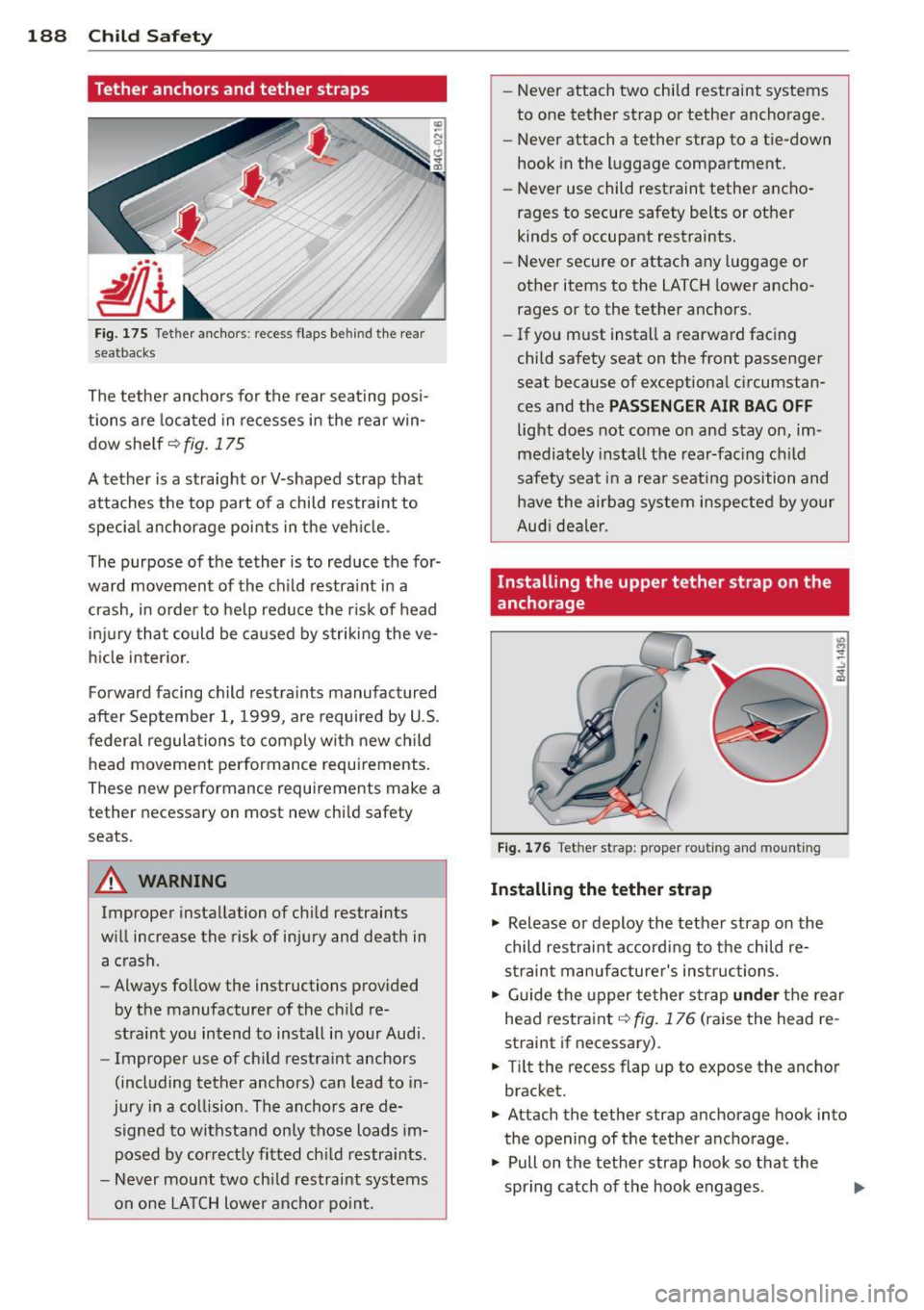
Fig. 175 Tethe r ancho rs: recess flaps be hin d the rear
sea tbacks
The tethe r anchors for the rear sea ting posi
tions are located in recesses i n the rear win
dow shelf ~ fig.
175
A tether is a straight or V-shaped strap that
attaches the top part of a child restraint to
specia l anchorage points in the veh icle.
The purpose of the tether is to reduce the for·
ward movement of the ch ild restra int in a
crash, in order to help reduce the r isk of head
in ju ry that could be ca used by s tri king the ve
hicle interior.
Forward facing child restra ints manufactured
after September 1, 1999, a re required by U .S .
federal regulations to comply with new child
head movement performance requirements.
These new performance requ irements make a
tether necessary on most new chi ld safety
seats.
A WARNING
Improper insta llation of chi ld restraints
w ill increase the risk of injury and death in
a crash.
- Always follow the instructions prov ided
by the manufacturer of the ch ild re
stra int you intend to install in your Audi.
- Improper use of c hild restra int anchors
(including tether anchors) can lead to in ·
jury in a co llision. Th e anchors are de·
sign ed to withstand only those loads im
posed by cor rect ly fi tted ch ild restraints.
- Never mou nt two chi ld restraint systems
on one LA TCH lower anchor po int. -
Never attach two child restraint systems
to one tether strap or tether anchorage .
- Never attach a tether strap to a tie-down
hook in the luggage compartment.
- Never use child restraint tether ancho
rages to secure safety belts or other
kinds o f occupant restraints.
- Never secure or attac h any luggage or
other items to the LATCH lower ancho
rages or to the tether anchors.
- If you must install a rearwa rd facing
child safety seat on the front passenger
seat because of exceptional c ircumstan
ces and the
PASSENGER AIR BAG OFF
light does not come on and stay on, im
mediately insta ll the rear-fac ing ch ild
safety seat i n a rea r seating position and
h ave the airbag system ins pe cted by your
Aud i dea le r.
Installing the upper tether strap on the
anchorage
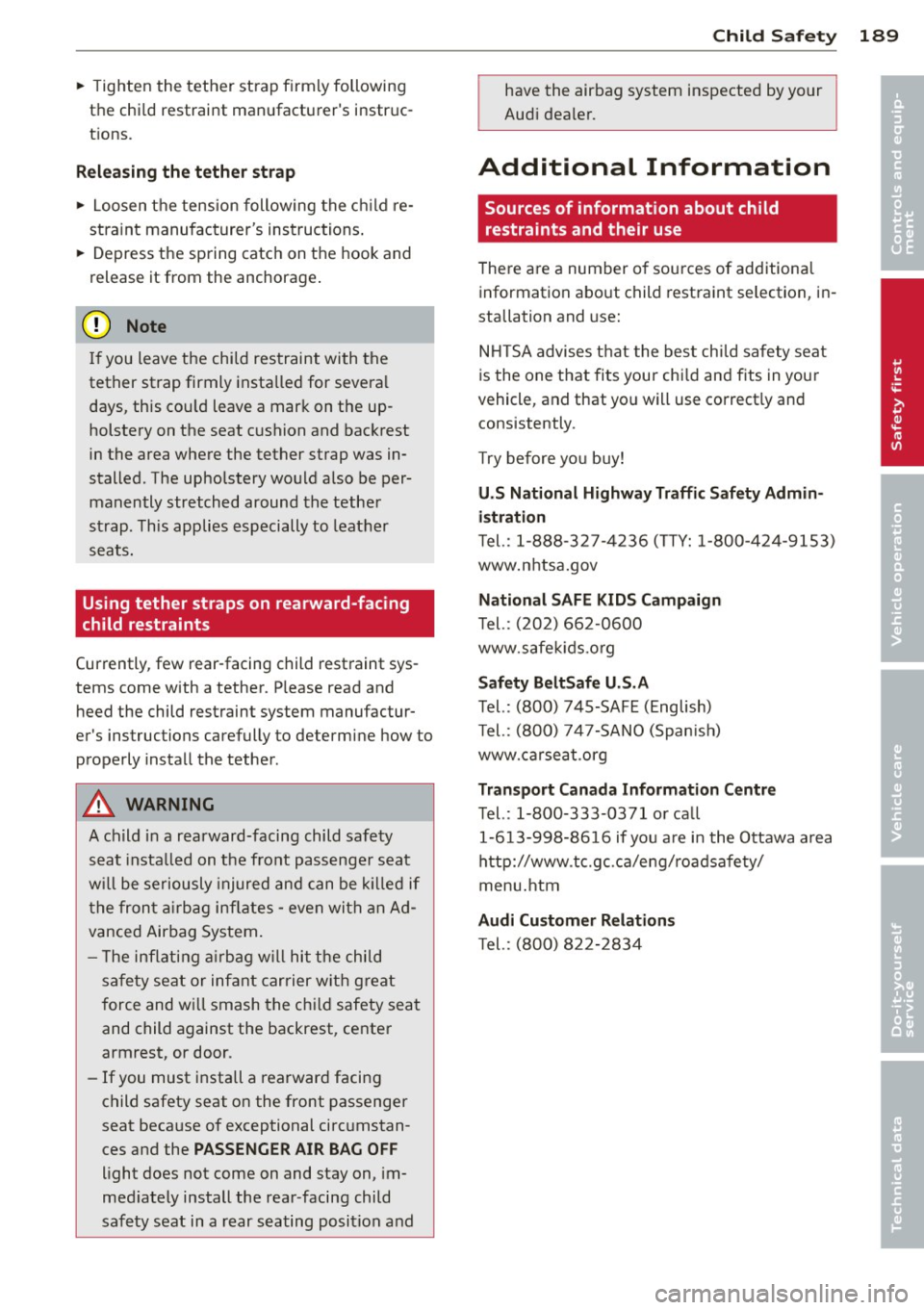
F ig . 1 7 6 Tet her st ra p : prope r rou ting and mou nting
Installing the tether strap
.,. Release or deploy the tether strap on the
child res traint accord ing to t he child re
s traint manufacturer's instructions.
.,. Guide the upper te t her s trap
under the rear
head restra int ~ fig.
176 (ra ise the head re
stra int if necessary) .
.,. Tilt the recess flap up to expose the ancho r
bracket.
.,. Attach the tether strap anchorage hook into
the opening of t he tether anchorage .
.,. Pull on the tether strap hook so that the
spring catch of the hook engages .
liJJ,
Page 191 of 306
~ Tighten the tether strap firmly following
the chi ld restraint manufacturer's instruc
t ions.
Re leasing the tether str ap
~ Loosen the tension following the ch ild re
stra int manufacturer's instructions .
~ Depress the spring catch on the hook and
release it from the anchorage .
0 Note
If you leave the child res traint with the
tether strap firmly insta lled for severa l
days, this cou ld leave a mark on the up
holstery on the seat cushion and backrest
in the area where the tether strap was in
stalled . The upholstery would a lso be per
manently stretched around the tether
strap . This applies especially to leather
seats.
Using tether straps on rearward-facing
child restraints
Currently, few rear-facing child restraint sys
tems come with a tether. P lease read and
heed the child restraint system manufactur
er's instructions carefully to determine how to properly install the tether .
A WARNING
-
A child in a rearward-facing child safety
seat insta lled on the front passenger seat
w ill be se riously injured and can be k illed if
t he fron t airbag inf lates -even with an Ad
vanced Airbag System .
- T he inflating airbag w ill hit the chi ld
sa fety sea t or infant carrier w ith g reat
f orce and wi ll smash the ch ild safety seat
and child against the backrest, center
armrest, or door.
- If you must install a rearward facing
child safety seat on the front passenger
seat because of exceptional circ umstan
ces and the
PASSEN GER AIR BAG OFF
light does not come on and stay on, im
med iately install the rear-facing child
safety seat in a rear s eating position and
Child Sa fet y 189
have the airbag system inspected by your
Aud i dea ler.
Additional Information
Sources of information about child
restraints and their use
There are a number o f sources of additiona l
information abo ut child restraint se lection, in
stallation and use:
NH TSA advises t hat the bes t ch ild safety seat
is the one that fits your chi ld and fits in your
vehicle , and that yo u will use correct ly and
consistently .
T ry before yo u buy!
U .S National Highway Traffic Safety Admin
i s tration
T el.: 1 -888 -3 27-4236 (TIY: 1-800-424-9153)
www. n htsa .gov
National SAFE KIDS Campaign
T el.: (202) 66 2-0600
www.safe kids.org
Safety BeltSaf e U.S.A
T el.: (800) 7 45-SAFE (English)
T el.: (800) 7 47-SANO (Span ish)
www. ca rseat.org
Transport C anada Information C entre
Tel.: 1-800-333-0371 o r ca ll
1-6 13-998-86 16 if you a re in the O ttawa area
http://www .tc.gc .ca /e ng/ roadsafety/
men u.htm
Audi Cu stomer Relation s
Tel.: (800) 82 2-2834 •
•
Page 192 of 306
190 Audi pre sense
Audi pre sense
Preventative passenger
protection
A pp lies to veh icles: with Audi pre se nse
Audi pre sense can initiate steps to help pro
tect vehicle occupants in certain situations.
The functions described depend on equ ipment
installed in your vehicle:
Audi pre sense basic*
The following functions can be triggered in
certain driving situations:
- Tightening of the safety belts (for example,
during heavy braking) : the front safety belts
have reversible belt pretensioners. If a colli
sion does not occur, the safety belts loosen
slightly and are ready to be tightened again.
- Closing the windows and the sunroof*: the
windows and the sunroof* close leaving a
small open gap.
Audi pre sense basic functions can be trig
gered at speeds above 20 mph (30 km/h).
Vehicles with Aud i drive select*: the deploy
ment time is adapted in
Dynamic mode.
Audi pre sense front (vehicles with
adaptive cruise control*)
Audi pre sense front includes the functions in
Audi pre sense basic. In addition, within the
limits of the system, the likelihood of a colli
sion with the vehicle immediately ahead is al
so calculated . If the system senses an immi
nent collision the following functions can be
tr iggered :
- Braking guard c::>poge
88
-Tightening the safety be lts
- Closing the windows and the sunroof* (leav -
ing a small open gap)
Audi pre sense rear (vehicles with Audi
side assist*)
Audi pre sense rear includes the functions in
Audi pre sense basic. In addition, the likeli
hood of a rear-end collision with the vehicle
coming from behind is also calcu lated.
If the risk
of a co llision is detected, the following
functions can be triggered:
- Tig htening the safety belts
- Closing the windows and the sunroof* (leav-
ing a small open gap)
Audi pre sense plus*
Audi pre sense plus includes the functions in
Audi pre sense front and Audi pre sense rear.
Error message
Audi pre sense: not available
Preventative passenger protection is not avail
able. See your authorized Audi dealer immedi
ately to have the malfunction corrected.
_& WARNING
-=
Audi pre sense cannot overcome the laws
of physics. It cannot prevent a collision. Do
not let the increased safety provided
tempt you to take risks. This will increase
the r isk of a collis ion and serious personal
in juries .
- The sensors cannot always detect all ob
jects. This increases the risk of a colli
s10n.
-Aud i pre sense does not detect people or
an im als or objects that are crossing the
veh icle's path c::> page
82.
-The radar sensor's vis ion can be reduced
by heavy rain, ice, snow, heavy road sp ray
and reflections from guard rails, tunnel
entrances, etc. These and similar condi
tions can prevent vehicles from being ac
curately detected and in some cases they
may not be detected at all.
(D Note
The sensors can be displaced by impacts or
damage to the bumper, wheel housing and
underbody. This can affect the function of
the Audi pre sense system. Have your au
thorized Audi dealer check to make sure
that the system is working properly.
Page 194 of 306
192 Intelligent technology
Intelligent technology
Notice about data
recorded by vehicle
control modules
Your veh icle is not equipped with an Event Da
ta Recorde r (EDR), ins talled by some manu
facture rs fo r the express p urpose of capturing
data for retrieval after an accident or cras h
event . EDR's are sometimes ca lled "crash re
corders".
Some state laws restr ict the retr ieval or down
loading of data stored by EDR's that were in
stalled in a vehicle for the express purpose of retrieving data after an accident or crash
event without the owner's consent.
A ltho ugh yo ur vehicle is not equ ipped wit h an
EDR, it is equipped with a number of electron
ic control modules for various vehicle systems
such as, for examp le, eng ine f unction, em is
sion control, as well as for the airbags and
safety belts.
These electronic contro l modules also record
vehicle-re lated data during norma l vehicle op
erat ion for diagnostic and repa ir purposes.
The recording capacity of the electronic con
trol modules is limited to data (no sound is re
corded) and only a small amount of data is ac
tually recorded ove r a ve ry limited pe riod of
time and stored when a sys tem faul t or o ther
cond ition is sensed by a cont ro l u nit. Some of
the data then stored may re late to vehicle
speed, direction, braking as we ll as restraint
system use and performance in the event of a
crash or other condit ion. Stored data can only
be read and downloaded w ith special equip
ment.
Electronic Stabilization
Control (ESC)
Description
ESC helps to improve road holding and vehicle
dynamics to help reduce the probability of
skidd ing and loss of ve hicle control. It works
only when the eng ine is running. ESC detects certain difficult driving situat
ions, including
when the vehicle is beginning to spin (yaw)
o ut of control and he lps you to get the veh icle
back under control by se lectively braking the
whee ls, and/or reducing eng ine power and
providing steer ing ass istance to he lp hold the
vehicle o n the dr iver's intended course. The in
dicator light
G) in the inst rument cluster
blinks when ESC is ta king action to help yo u
control the veh icle.
ESC has limitations.
It is importa nt to remem
ber that ESC cannot overcome the laws of
physics. It wi ll not always be able to help out
under a ll cond it ions you may come up aga inst.
F or example, ESC may not always be able to
help you master situations where there is a
s u dden change in the coefficient of friction of
the road surface. When there is a section of
dry road that is sudden ly covered w ith water,
s lush or snow, ESC cannot perform the same
way it wou ld on the dry surface . If the ve hicle
hydroplanes (rides on a cushion of water in
stead of the road surface), ESC will not be
able to help you steer the vehicle because con
tact with the pavement has been in terrupted
and the vehicle cannot be braked or steered .
D uring fast cornering, particularly on winding
roads, ESC cannot always deal as effectively
with difficult driving situations than at lower
speeds. When towing a trailer, ESC is not able
to help you regain control as it would if you
were not tow ing a trailer.
Always adjust your speed and driving style to road, traffic; and weather condit ions. ESC can
not override the vehicle's physical limits, in
crease the availab le tract ion, or keep a ve hicle
on the road if road departure is a result of
drive r inattent io n. Instead, ESC imp roves the
poss ibil ity of keeping the vehi cle under con
trol and on the road during ex treme maneu
vers by using the d river's steering inputs to
help keep the vehicle going in the intended di
rection . If you are traveling at a speed that
ca uses you to run off the road before ESC can
provide any assistance, you may not experi
ence the benefits of ESC.
Page 196 of 306
194 Intelligent technology
@ Tips
-ABS and ASR on ly work correctly when
all four wheels are equipped w ith identi
cal tires. Different tire sizes can lead to a
reduction in engine power.
- You may hear noises when the systems
described are working.
- If the indicator light
DJ or 11:11 (USA
models) 1i] (Canada models) appears,
there may be a malfunction¢
page 20,
c> page 19.
Switching on and off
ESC
turns on automatically when you start
the engine.
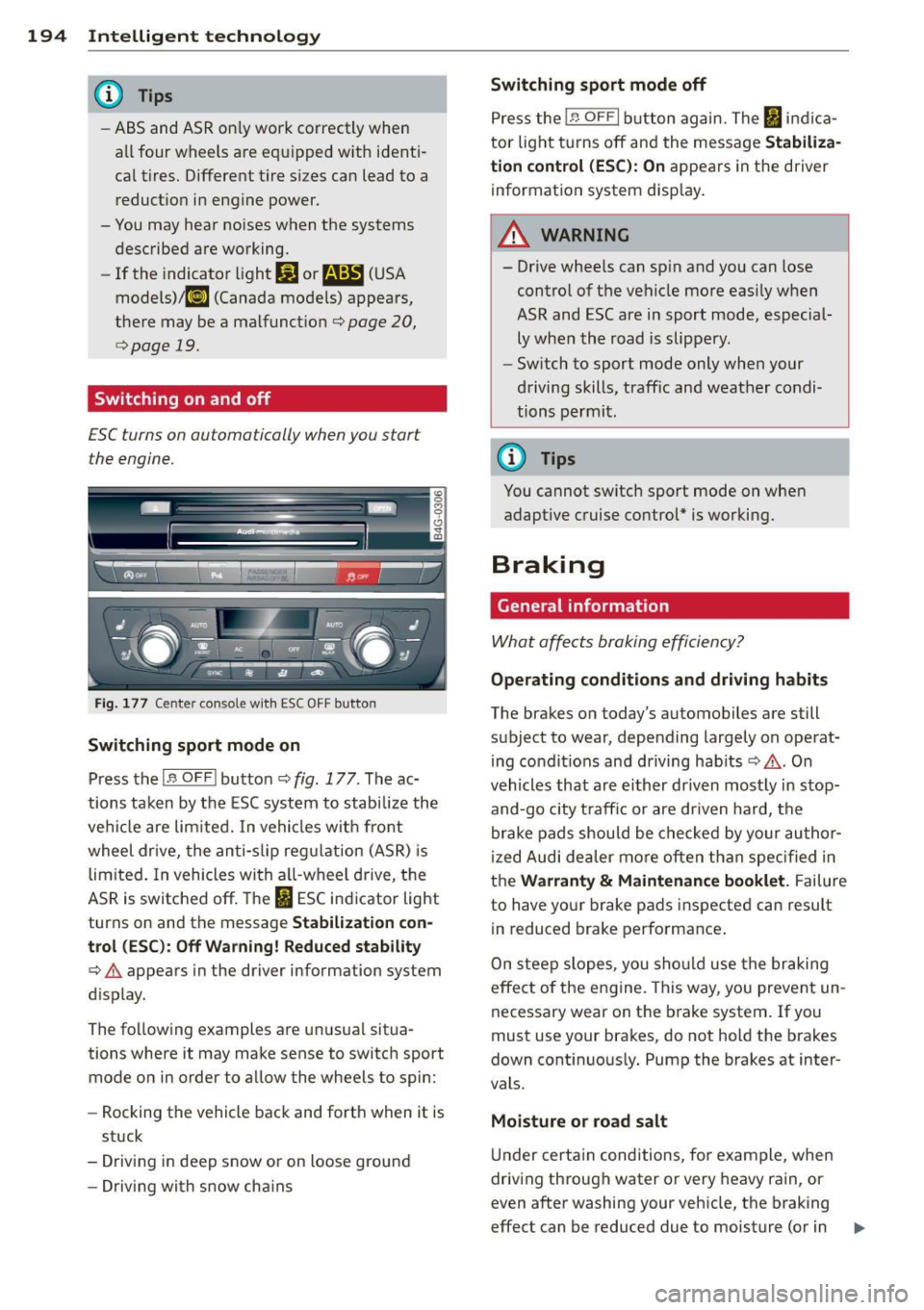
Fig. 177 Center console w it h ESC OFF button
Switching sport mode on
Press the I~ OF FI button c::> fig . 177. The ac
tions taken by the ESC system to stabilize the
vehicle are limited. In vehicles with front
wheel drive, the anti-slip regulation (ASR) is
limited. In vehicles with a ll-wheel drive, the
ASR is switched off. The
It) ESC indicator light
turns on and the message
Stabilization con
trol (ESC): Off Warning! Reduced stability
¢.&. appears in the driver information system
d isplay.
The following examples are unusual situa
tions where it may make sense to switch sport
mode on in order to allow the wheels to spin:
- Rocking the vehicle back and forth when it is
stuck
- Driving in deep snow or on loose ground
- Driving with snow cha ins
Switching sport mode off
Press the 1.$ OF FI button again. The I indica
tor light turns off and the message
Stabiliza
tion control (ESC): On
appears in the driver
information system display .
A WARNING
-
-Drive wheels can spin and you can lose
control of the vehicle more easily when
ASR and ESC are in sport mode, especial
ly when the road is slippery.
- Sw itch to sport mode only when your
driving skills, traffic and weather condi
tions permit.
@ Tips
You cannot sw itch sport mode on when
adaptive cruise control* is working.
Braking
General information
What affects braking efficiency?
-
Operating conditions and driving habits
The brakes on today's automobiles are still
subject to wear, depending largely on operat
ing condit ions and driving hab its
c::> .&. . On
vehicles that are either driven most ly in stop
and-go city t raff ic or are driven hard, the
brake pads should be checked by your author
ized Audi dea ler more often than specified in
the
Warranty & Maintenance booklet. Failure
to have your brake pads inspected can result
in reduced brake performance .
On steep slopes, you should use the braking
effect of the engine . This way, you prevent un
necessary wear on the brake system. If you
must use your brakes, do not hold the brakes
down continuously. Pump the brakes at inter
vals .
Moisture o r road salt
Under certain conditions, for example, when
driving through water or very heavy rain, or
even after washing your vehicle, the braking
effect can be reduced due to moisture (or in .,,_
Page 198 of 306
196 Intellig ent technolog y
-Never let the vehicle roll to a stop with
the engine shut off.
- If the brake booster is not working, for
example when towing your vehicle, or
because the brake booster has somehow
been damaged, the brake pedal must be
pressed considerably harder to make up
for the lack of booster assistance .
Electro-mechanical
power assist
The electro-mechanical power assist helps
the driver when steering.
Power stee ring adapts electronically based on
the veh icle speed.
Indicator lights and messages
• Steerin g d efecti ve! Stop th e vehicl e
If this indicator light turns on and stays on
and this message appears, the power steering may have fa iled.
Do
not continue driving . See your authorized
Aud i dealer or other qualified repa ir facility
for assistance.
lor-ij St eerin g: S yste m malfun ction ! You m ay
c ont inue driv ing
If the indicator light turns on and the mes
sage appears, the steering may be more diffi
cult to move or more sensitive than usual.
Drive s low ly to your author ized Audi dealer or
q ua lified workshop to have the malfunction
corrected .
(D Tips
If the . or 'Iij indicator light only stays
on for a shor t time, you may contin ue driv
ing .
Driving with your
quattro ®
Applies to vehicles : with all-wheel drive
With all-wheel drive , all four wheels are driv
en .
General info rmation
With a ll Wheel Drive, power is distributed to
all four wheels. This happens automatically
depending on your driving style and the road
condit ions at the time. See also ¢
page 192.
With the sport differential*, power distribu
t ion to the rear wheels is va riable and can be
adjusted with Audi drive select*
r::¢, page 98.
Always read and follow safety precautions
Q _& .
Winter tires
When driving in the winter, your vehicle with
all-wheel drive has an advantage, eve n wit h
regular tires. In winter road conditions it may
be advisable to mount winter tires (or all-sea
son tires) for improved driveability and brak
ing : these tires must be mo unted on
all fou r
wheel s. See also ¢ page 255 , Winter tires.
Tire chains
Where tire chains are mandatory on certain
roads, this no rma lly also app lies to ve hicles
with all-wheel drive r::¢,
page 256, Snow
chains.
Replacing wh eels /tires
Vehicles with all-wheel drive m ust always
have ti res of the same s ize. A lso avo id tires
with different t read depths . For detai ls see
page r::¢,
page 251, New tires and replacing
tires and wheels .
Off-Road driving?
You r Audi does not have e nough ground clea r
ance to be used as an off-road vehicle . It is
t h erefore best to avoid rough tracks and un
even terrain as much as possib le . Also refer to
r::¢, page 200. ..,_