recommend a rest AUDI A6 2013 User Guide
[x] Cancel search | Manufacturer: AUDI, Model Year: 2013, Model line: A6, Model: AUDI A6 2013Pages: 306, PDF Size: 76.92 MB
Page 146 of 306
144 Safety belts
,8. WARNING
Improper care, servicing and repair proce
dures can increase the risk of personal in
jury and death by preventing a safety belt
pretens ioner from act ivat ing when needed
or act ivat ing it unexpectedly:
- The belt pretensioner system can be acti
vated only once. If belt pretens ioners
have been act ivated, the system must be
replaced.
- Never repair, adjust, or change any parts
of the safety belt system.
- Safety belt systems includ ing safety be lt
pretensione rs cannot be repaired. Spe
ci al procedures are required for removal,
installation and disposal of this system.
- For any work on the safety belt system,
we strongly recommend that you see
your authorized Audi dealer or qualified
technician who has an Audi approved re
pair manual, training and specia l equip
ment necessary.
@ For the sake of the environment
Undep loyed airbag modu les and preten
sioners might be classified as Perchlorate
Material -specia l hand ling may apply, see
www.dtsc.ca.gov/haza rdou swaste/per
chlorate. When the vehicle or parts of the
restraint system including airbag modules
safety belts w ith pretens ioners are scrap
ped, all applicable laws and regulations
must be observed. Your authorized Aud i
deale r is familiar with these requ irements
and we recommend that you have your
dea ler perform this service for you.
Page 150 of 306
148 Airbag sys tem
If the front passenger airbag is turned off , the
PASSENGER AIR BAG OFF light comes on in
the instrument cluster and stays on .
I f the front passenger airbag deploys, the
F ederal Standard requires the airbag to meet
the " low risk" deployment criteria to reduce
the r isk of in jury through interaction with the
a irbag. "Low ris k" deployment oc curs in tho se
c rashe s that take pl ace a t lower decele ra tions
as defined in the electronic control un it
c::> page 158, PASSENGER AIR BAG OFF light.
A lw ays r emember, a chi ld seat or infant carri
er installed on the front seat may be s truck
and knocked out of position by the rap idly in
flati ng passenger's a irbag i n a frontal colli
sion . The airbag could greatly reduce the ef
fectiveness of t he ch ild restrai nt and even se
r io usly in ju re the child during infla tion.
For this reason, and because the back seat is
the safest place for chi ldren - when p roperly
r estra ined a ccord ing to the ir age and size - we
strongly recommend t hat childre n always si t
in the back seat
c::> page 171, Child Safety .
& WARNING
-
A child in a rearward -facing child seat in
stalled on the front passenger seat will be
ser iously injured and can be killed if the
front airbag inflates - even with an Ad
vanced Airbag System.
- The inflating a irbag will hit the child seat
or infant carrier w ith great force and w ill
smash the ch ild seat and child against
the bac krest , cen ter armres t, door or
roof.
- Always install rear-facing child seats on
the rear seat.
- If you must i nstall a rearward facing
child seat on the front passenge r seat
because of except iona l circumstances
and the
PASSENGER AIR BAG OFF ligh t
does not come on an d stay on, immedi
a tely install the re ar-facin g chi ld seat in a
rear seating position and have the ai rbag
system inspected by your Aud i dealer. -
Forwa rd- facing child seats installed on
the front passenger 's seat may interfere
wit h the dep loyment of the a irbag and
cause serious persona l injury to the
child .
& WARNING
-If, in except ional circumstances, you m ust
i nstall a forward-facing child restraint on
the front passenge r's seat:
- Always make sur e the forward-facing
seat has been designe d and certified by
its m anufacture r for u se on a fron t se at
wit h a passenger fron t and s ide airba g.
- Never p ut t he fo rward -facing child re
s tra int up agains t or ve ry near the instru
men t pa nel.
- Always move the passenge r seat into it s
rearmost pos ition in the seat' s fore and
aft a djustmen t range, as fa r away from
the air bag as possible before installing
the forwar d-facing ch ild restra int . The
backrest must be ad justed to an upright
position.
- Make sure that the
PASSENGER AIR BAG
OFF
li ght comes on and stays on all the
time whenever the ignit ion is switched
on .
& WARNING
-To reduce the risk of serious injury, make
sure that the
PASSENGER AIR BAG OFF
light w ill be display ed whe nev er a child re
straint is insta lled on the front pa ssenger
se at and the ignition is sw itche d on .
- If the
PASSENGER AIR BAG OFF light
does no t stay on, per form the che cks de
scribed
c::> page 15 7, Monitoring the Ad
vanced Airbag System.
- Ta ke t he chi ld restraint off the fron t pas
senger sea t and inst all it prope rly at one
of the rear seat positions i f the
PASSEN
GER AIR BAG OFF
li ght does not stay on.
- Have the airbag system inspected by
your Aud i dea le r i mmediately.
Page 164 of 306
162 Airbag system
experience, informat ion and specia l
too ls necessary to perform the work
safely.
- If the vehicle or the circuit interrupter
is scrapped, all applicable safety pre
cautions must be followed.
@ For the sake of the environment
Undeployed airbag modu les and preten
sioners might be classified as Perchlorate Material - special handling may apply, see
www.dtsc.ca.gov/haza rdouswaste/per
chlorate. When the vehicle or parts of the
restraint system including airbag modules
and safety belts w it h pretens ioners are
s crapped, a ll applicable laws and regula
tions mus t be observed. Your au thori zed
Audi dea le r is familiar with these requi re
ments and we recommend that you have
your dea ler perfo rm this serv ice for you.
Other things that can affect Advanced
Airbag performance
Changing the vehicle's suspension system can
change the way that the Advanced A irbag Sys
tem pe rforms in a crash. For example, us ing
tire-r im combinations not app roved by Aud i,
lowering the vehicle, ch anging the stiffness o f
the suspension, including the springs, suspen
sion struts, shock absorbers etc. can change
the forces that are measured by the a irbag
sensors and sent to the electronic control
un it. Some suspension changes can, for exam
p le, increase the force levels measured by the
sensors a nd make the airbag system deploy in
crashes in w hich it would not dep loy if the
changes had not been made . Other kinds of
ch an ges may reduce the force levels meas
u red by the sensors and prevent the airbag
from deploying when it sho uld .
The senso rs in the safety belt buckle fo r th e
d river a nd front passe nger sea t tell the elec
tronic control module if the safety belt is
l atched or not .
If the safety belt is being used,
the front airbag will dep loy at a slightly high
er rate of vehicle deceleration than if the safe
ty belt is not being used. Therefore, in a par- t
icu lar collision, it is possible that an airbag
will not dep loy at a seat ing position where the
safety belt is be ing used b ut w ill inflate at the
pos ition where the safety belt is not be ing
used. It is important that nothing interfere
with t he safety be lt buckles so that the sen
sors can send the correct info rmation about
safety belt use to the electronic control un it .
_&. WARNING
Changi ng the vehicle's suspension includ
i ng use of unapp roved tire-rim combina
tions can change Advanced Airbag per
formance and increase the risk of serious pe rsonal injury in a crash .
- Never install suspension components that do not have the same pe rformance
characteristics as the components o rigi
na lly installed on your vehicle.
- Never use tire-rim combinations that
have not been approved by Audi.
Knee airbags
Description of knee airbags
App lies to vehicles : wi th knee airbags
The knee airbag system can provide supple
mental protection to properly restrained
front seat occupants .
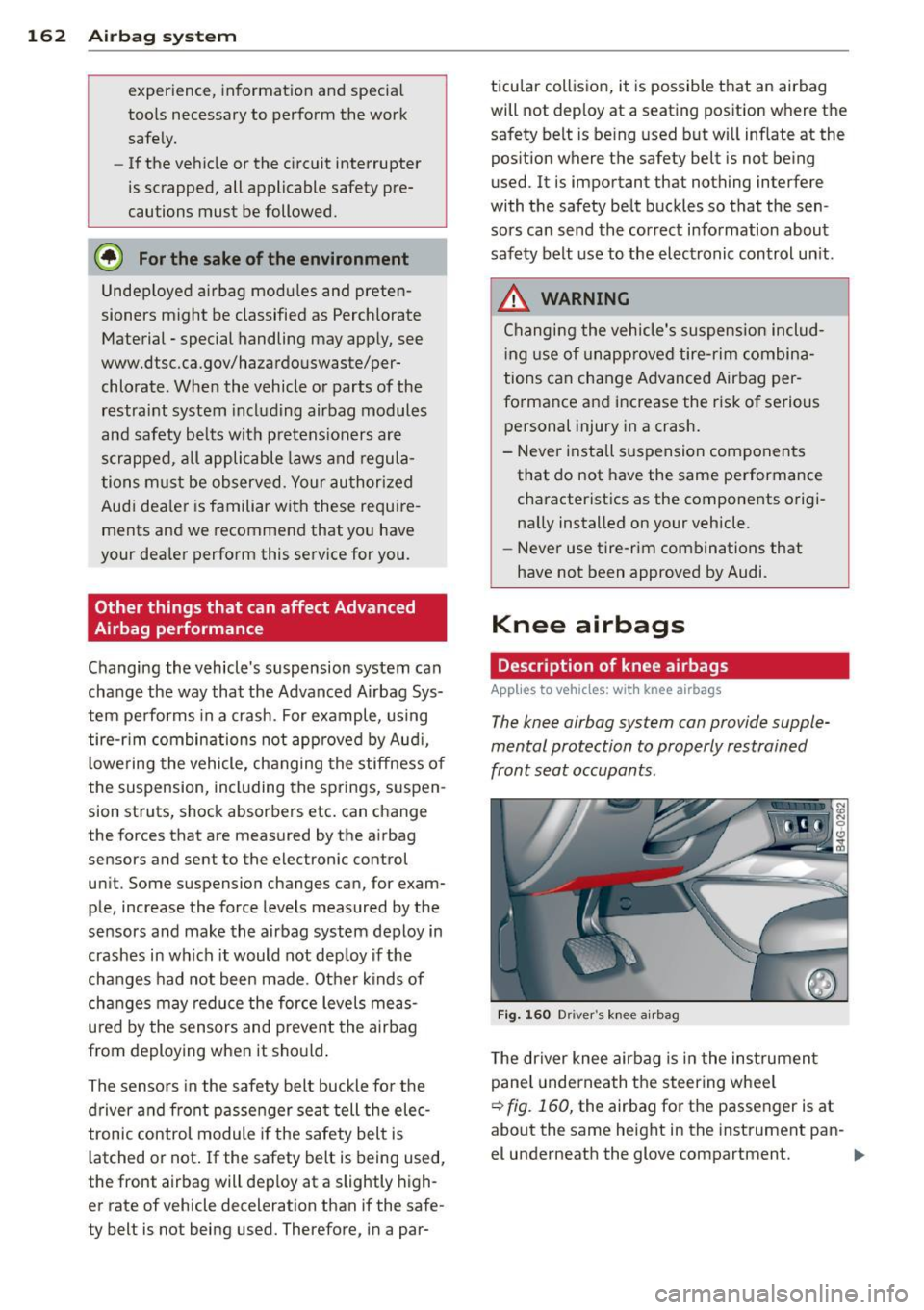
Fig . 1 60 Driver 's knee a irbag
T he dr iver knee airbag is in the ins trument
pane l underneath the steering wheel
~ fig. 160, the airbag for the passenger is at
about the same height in the instrument pan-
el underneat h the glove compartment. .,.
Page 171 of 306
-The side curtain airbags above the front and
rear side windows
- The airbag ind icator light in the instrument
pane l
The a irbag system is monitored elect ro nic ally
to make certain it is f unct io ni ng proper ly a t all
times. Eac h time you switch on the ignition,
the airbag system indicator light wi ll come on
for a few seconds (se lf diagnost ics) .
The side curtain airbag is not activated:
-if the ign ition is swit ched off,
- i n s ide coll isions when the accelerat ion
measured by the sensor is too low,
- in rear-end collisions .
_& WARNING
-Sa fety belts and t he a irbag system w ill
only p rov ide p rotection whe n occu pan ts
are in the proper sea ting posit ion
¢ page SO, General recommendations.
- If the airbag indicator light ¢ page 19
comes when the vehicle is be ing used,
have the system inspected immediate ly
by you r aut ho rized Audi dea ler . It is pos
sible that the airbag will inflate when it
is not s upposed to, or w ill not inflate
when it sho uld.
How side curtain airbags work
Side curtain airbags can work together with
side airbags to help reduce the risk of head
and upper torso injuries for occupants who
are properly restrained .
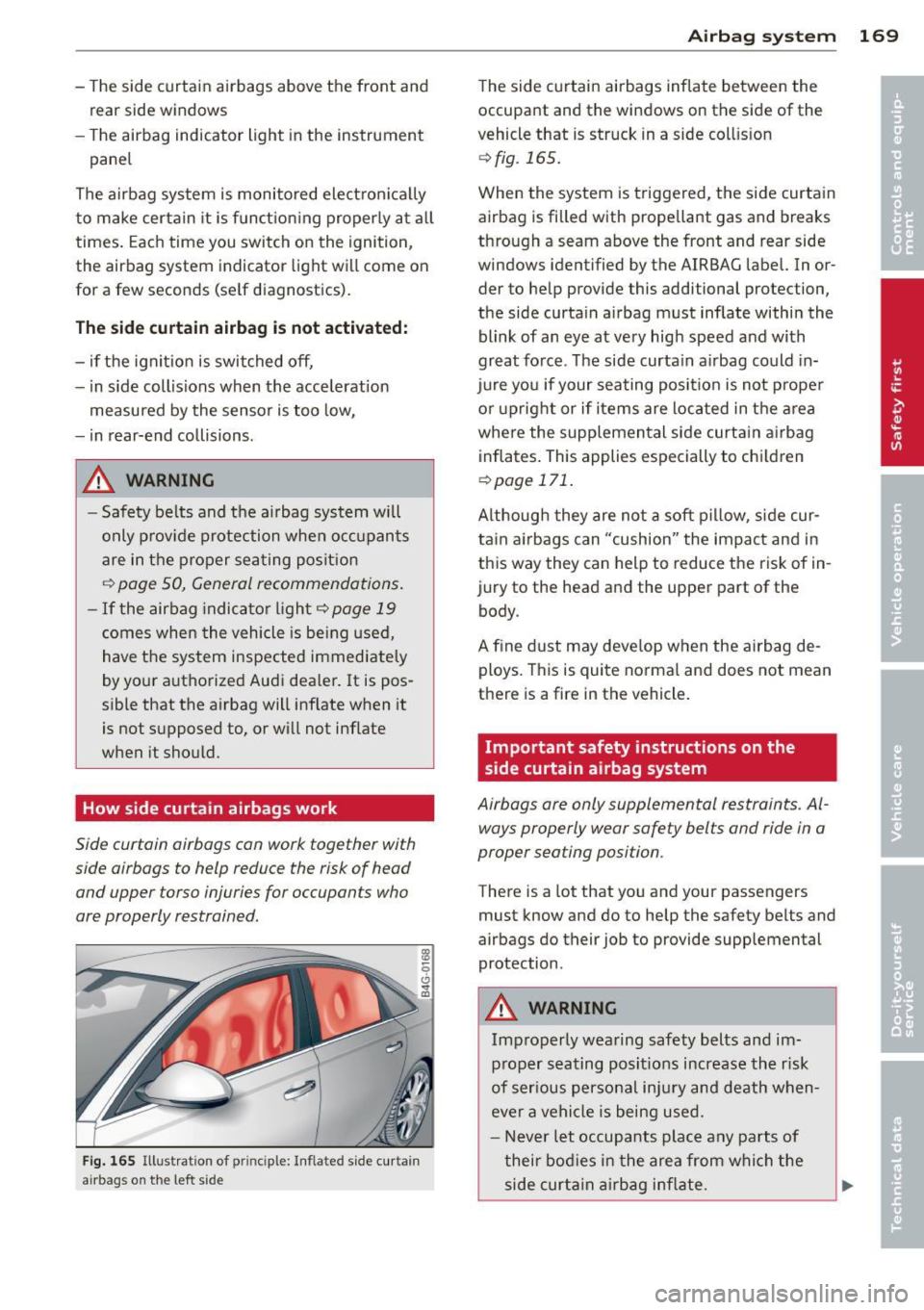
Fig . 1 65 Ill ustra tion of princip le: In flated side cur ta in
airbags on t he left s ide
.
A irba g sy stem 169
The side c urtain airbags infla te between the
occupant and the windows on the side of the
vehicle that is struck in a side coll is ion
¢ fig . 165.
When the system is trigge red, t he side curta in
airbag is filled with propellant gas and breaks
th ro ugh a seam above the front and rear side
windows identified by the AIRBAG labe l. In or
der to he lp provide this additional protection,
the side curta in a irbag must inflate withi n the
blink of an eye at ve ry hig h speed and with
great fo rce . T he side curta in a irbag could in
j u re yo u if your sea ting posit io n is not proper
o r u pright or if items are loca ted in t he a rea
where the supplemental side curta in a irbag
in flates . This applies especially to chi ld ren
~ page 171 .
Although they are no t a soft pillow, side cur
ta in a irbags can "cushion" the impact and in
this way they can help to reduce the risk of in
j u ry to the head and the uppe r part of the
body .
A fine dust may deve lop when the airbag de
ploys . This is qui te no rma l and does not mean
there is a fire in the vehicle .
Important safety instructions on the
side curtain airbag system
Airbags are only supplemental restraints . Al
ways properly wear safe ty belts and ride in a
proper seating position.
There is a lot that you and your passengers
must know and do to help the safety belts and
airbags do t heir job to provide supplemental
protection .
_& WARNING ...__
Improperly wea ring safety belts and im
p roper seating posit ions increase the risk
of ser ious perso nal inj ury and death when
ever a vehicle is being used.
- Never let occupa nts pla ce any pa rts of
thei r bo dies in t he area fro m whi ch the
side curt ain air bag inf late.
-
Page 177 of 306
@ Tips
The child seats listed in categories A to C
have been statically tested by Audi only for
the Advanced Airbag function.
Important safety instructions for using
child safety seats
Correct use of child safety seats substantially
reduces the risk of injury in an accident!
As the driver, you are responsible for the safe
ty of everybody in the vehicle, especially chil
dren:
~ Always use the right child safety seat for
each child and always use it properly
q page 177.
~ Always carefully follow the child safety seat
manufacturer's instructions on how to route
the safety belt properly through the child
safety seat.
~ When using the vehicle safety belt to install
a child safety seat, you must first activate
the convertible locking retractor on the
safety belt to prevent the child safety seat
from moving
r::!) page 182.
~ Push the child safety seat down with your
full weight to get the safety belt really tight
so that the seat cannot move forward or
sideways more than one inch (2.5 cm).
~ Secure unused safety belts on the rear seat
9 page 177.
Always remember: Even though your vehicle is
equipped with an Advanced Airbag system, all
children , especially those 12 years and young
er, should always ride in the back seat proper
ly restrained for their age and size.
.&, WARNING ,~
Not using a child safety seat, using the
wrong child safety seat or improperly in
stalling a child restraint increases the risk
of serious personal injury and death .
- All vehicle occupants and especially chil
dren must always be restrained properly
whenever riding in a vehicle.
Child Safety 175
- An unrestrained or improperly restrain
ed child can be injured or killed by be
ing thrown against the inside of the ve
hicle or by being ejected from it during
a sudden maneuver or impact.
- An unrestrained or improperly restrain
ed child is at much greater risk of injury
or death by being struck by an inflating
airbag.
- Commercially available child safety seats are required to comply with U.S . Federal
Motor Vehicle Safety Standard (FMVSS)
213 (in Canada CMVSS 213).
- When buying a child restraint, select
one that fits your child and the vehicle.
- Only use child restraint systems that
fully contact the flat portion of the
seat cushion . The child restraint must
not tip or lean to either side . Audi does
not recommend using child safety
seats that rest on legs or tube-like
frames. They do not provide adequate
contact with the seat.
-Always heed all legal requirements per
taining to the installation and use of
child safety seats and carefully follow
the instructions provided by the manu
facturer of the seat you are using.
- Never allow children under 57 inches
(1.45 meters) to wear a normal safety
belt. They must always be restrained by a
proper child restraint system. Otherwise,
they could sustain injuries to the abdo
men and neck areas during sudden brak
ing maneuvers or accidents.
- Never let more than one child occupy a
child safety seat.
- Never let babies or older children ride in
a vehicle while sitting on the lap of an
other passenger .
- Holding a child in your arms is never a
substitute for a child restraint system.
- The strongest person could not hold
the child with the forces that exist in
an accident. The child will strike the in
terior of the vehicle and can also be
struck by the passenger. •
•
Page 235 of 306
the level may be slightly above the "max"
marking .
The location of the coolant expansion tank
can be seen in the engine compartment illus
tration ¢ page 22 7.
To obtain an accurate reading, the engine must be switched
off.
The expansion tank in your vehicle is equipped
with an electric coolant level sensor.
When the coolant level is too low, the warning
light in the Auto-Check System ¢page 16will
illuminate until you add coolant and the level
has been restored to normal. Even though
there is an electric coolant level sensor , we
still recommend you check the coolant level
from time to time.
Coolant loss
Coolant loss may indicate a leak in the cooling
system. In the event of coolant loss, the cool
ing system should be inspected immediately
by your authorized Audi dealer.
It is not
enough merely to add coolant.
In a
sealed system, losses can occur only if
the boiling point of the coolant is exceeded as
a result of overheating.
& WARNING
The cooling system is under pressure and
can get very hot. Reduce the risk of scald
ing from hot coolant by following these
steps.
- Turn
off the engine and allow it to cool
down.
- Protect your face, hands and arms from
escaping fluid and steam by covering the
cap with a large, thick rag.
- Turn the cap slowly and very carefully in
a counter-clockwise direction while ap
plying light, downward pressure on the
top of the cap.
- To avoid being burned, do not spill anti freeze or coolant on the exhaust system or hot engine parts . Under certain condi
tions, the ethylene glycol in engine cool
ant can catch fire .
Checking and filling 233
@ Note
Do not add any type of radiator leak seal
ant to your vehicle's engine coolant. Add
ing radiator repair fluid may adversely af
fect the function and performance of your
cooling system and could result in damage not covered by your New Vehicle limited
Warranty .
Adding coolant
Be very careful when adding engine coolant.
Before you check anything in the engine com
partment,
always read and heed all WARN
INGS ¢ & in Working in the engine compart
ment on page 225 .
.,. Turn
off the engine .
.,. let the engine cool down.
.,. Place a thick rag over the coolant expansion
tank ¢ fig .
187 and carefully twist the cap
counter-clockwise ¢&_ .
.,. Add coolant.
.,. Twist the cap on again tightly.
Replacement engine coolant must conform to
exact specifications ¢ page
2 32, Coolant. We
recommend using only coolant additive G12+
+, G13 or in an emergency G12+. Do
not use a
different additive. In an emergency use plain
water until you can get the correct additive
and can restore the correct ratio. This should
be done as soon as possible.
If you have lost a considerable amount of
coolant, then you should add cold antifreeze
and cold water only when the engine is cold.
Always use new engine coolant when refilling.
Do not fill coolant above the "MAX" mark. Ex
cess coolant will be forced out through the pressure relief valve in the cap when the en
gine becomes hot.
A WARNING
- The cooling system is under pressure and
can get very hot. Reduce the risk of
II-
•
•
Page 250 of 306
248 Tire s and whee ls
- Only when all tires on the vehicle are fi l
led to the correct pressure, the tire pres
sure monitoring* system can work cor rectly.
- The use of incorrect tire pressure values
can lead to accidents or other damage.
Therefore it is essential that the driver observe the specified tire pressure values
for the tires and the correct pressures for
the funct ion of the tire pressure mon itor
ing system*.
- Always inflate t ires to the recommended
and correct tire pressure before driving
off.
- Driv ing with under inflated ti res bend
more, letting them get too hot resu lting
in tread separation, sudden ti re fail ure
and loss of control.
- Excess ive speed and/overloading can
cause heat bui ld -up, sudden ti re fail ure
and loss of control.
- If the tire press ure is too low or too high,
the tires wi ll wear prematurely and the
vehicle will not hand le we ll.
- If the tire is not flat and you do not have
to change a wheel immediate ly, drive at
reduced speed to the nearest service sta
t ion to check the tire pressure and add
air as required.
Driving without va lve stem caps can cause
damage to the tire va lves. To prevent this,
always make sure that factory installed
valve stem caps on all wheels are securely mounted on the valve.
@) For the sake of the environment
Underinf lated tires will a lso increase the
fuel consumption.
Tires and vehicle load limits
There are limits to the amount of load or weight that any veh icle and any t ire ca n carry.
A veh icle that is overloaded w ill not handle
well and is more difficult to stop. Over load ing
can not on ly lead to loss of veh icle contro l, but can also damage important parts of the
vehicle and can lead to sudden tire fai lure, in
clud ing a b lowout and sudden deflation that
can cause the vehicle to crash.
Your safety and that of your passengers also depends on making sure that load limits are
not exceeded. Vehicle load includes everybody
and everything in and on the veh icle. These
load lim its are technically referred to as the
vehicle's
G ro ss Vehicl e We ight R ating
("GVWR").
The "GVWR" includes the weight of the basic
vehicle, all factory installed accessories, a full
tank of fuel, o il, coolant and other fluids plus
maximum load. The max imum load includes
the number of passengers that the vehicle is
intended to car ry ("seat ing capac ity") with an
ass umed we ight of 150 lbs (68 kg) for each
passenge r at a designated seating position
and the total weight of any luggage in the ve
hicle . If you tow a trai ler, the weight of the
trailer hitch and the tongue weight of the
loaded tra iler must be included as part of the
vehicle load.
The
G ro ss Axle We ight R ating ("GAWR") is
the maximum load that can be applied at each of the vehicle's two axles.
The Gross Vehicle Weight Rating and the Gross Axle Weight Rating are listed on the
safety comp liance sticker label located on the
driver's side B-pillar . Your Audi has 5 seat ing
pos itions, 2 in the front and 3 in the rear for
total seating capacity of 5 . Each seating posi
t ion has a safety belt
Q page 136, Safety
belts.
The fact that there is an upper limit to your
vehicle's Gross Vehicle Weight Rating means
that the total weight of whatever is being car
ried in the vehicle ( includ ing the weight of a
t ra ile r hi tch and the tongue weigh t of the
loaded tra iler) is lim ited. The more passen
gers in the vehicle or passengers who are
heavier than the standard weights assumed
mean that less weight can be carried as lug-
gage.
~
Page 260 of 306
258 Tires and wheels
In order to minimize the occurrence of impact
damage to the tires of your vehicle, we recom
mend that you observe the following precau
tions :
- Always maintain recommended inflation
pressures. Check your tire pressure every
2,000 miles (3,000 km) and add a ir if neces
sary.
- Drive carefu lly on roads with potholes, deep
gullies or ridges. The impact from driving
through or over such obstacles can damage
your tires. Impact with a curb may also cause damage to your tires.
- After any impact, immediately inspect your
tires or have them inspected by the nearest
authorized Aud i dealer . Replace a damaged
t ir e as soon as possible .
- Inspect your t ires every 2,000 miles (3,000
km) for damage and wear . Damage is not al
ways easy to see. Damage can lead to loss of
air and underinflation, wh ich could event u
ally cause t ire failure.
If you believe that a
ti re may have been damaged, replace the
tire as soon as possible.
-These tires may wea r more quickly than oth
ers.
- Please also remember that, while these tires
deliver responsive handling, they may ride
less comfortably and make more noise than
other choices.
Reduced performance in winter/cold
season conditions
All tires are designed for certain purposes .
The low aspect ratio, ultra high performance
tires originally installed on your vehicle are in
tended for max imum dry and wet road per
f ormance and handling . They are not suitable
for cold, snowy or icy weather cond it ions.
If
you dr ive under those circumstances, you
should equip your vehicle with all-season or
winter tires, which offer better traction under
those conditions . We suggest you use the rec
ommended snow or all-season tires specified
for your vehicle, or their equiva lent .
Refer to~
page 255 for mo re detailed infor
mation regarding w inter tires.
Tire pressure
monitoring system
ill General notes
Applies to veh icles: w ith tire pressure monito ring system
Each tire, including the spare (if provided),
shou ld be checked monthly when co ld and in
flated to the inf lation pressure recommended
by the vehicle manufacturer on the vehicle
placard or tire inflation pressure label. (If your
vehicle has tires of a different size than the
s iz e indicated on the vehicle placard or tire in
flat io n pressu re label, you shou ld dete rmin e
the proper tire inflation pressure for those
tires) .
As an added safety feature, your veh icle has
been equipped with a tire pressure monitoring
system ( TPMS) that illuminates a low tire
pressure telltale when one or more of your
tires is significant ly under -inflated . Acco rding
ly, when the low tire pressure te lltale illumi
nates, you shou ld stop and check your tires as
soon as possib le, and inflate them to the
proper pressure. Driving on a sign ificantly un
der-inflated tire causes the tire to overheat
and can lead to tire fa ilure . Under -inflation al
so reduces fuel effic iency and tire tread life,
and may affect the vehicle 's hand ling and
stopp ing ability.
Please note that the TPMS is not a substitute
for proper tire ma intenance, and it is the driv
er's respons ibility to maintain correct tire
pressure, even if under -inflation has not
reached the level to trigger illumination of the
T PMS low tire p ressu re tellta le .
Your vehicle has also been equipped with a
TPMS malfunction indicator to ind icate when
the system is not operating properly . Th e
T PMS ma lfunction indicator is combined with
the low tire pressure telltale. When the sys
tem detects a malfunction, the telltale will
flash for approximately one minute and then
rema in con tinuously illuminated . Th is se
quence will continue upon subsequent vehicle
start-ups as long as the malfunct ion exists . .,.
Page 265 of 306
.,. Always store the vehicle too l kit, the jack*
and the replaced tire in the luggage com
partment
c!:> page 132.
.,. Unhook the cargo floor before closing the
rear lid.
Using the spare tire (compact spare tir e)
The compact spare tire is on ly intended for
emergencies until you can reach a repair shop .
Replace it as quick ly as poss ible with a stand
ard wheel and tire.
There are some restrictions on the use of the
compact spare tire. The compact spare tire
has been designed specifically for your type of
veh icle. It must not be swapped with a com
pact spare t ire from another type of vehicle.
Snow chain s
For technical reasons, the use of snow chains
on the compact spare tire is
not permitted.
If you do have to dr ive w ith snow cha ins and a
front tire f ails, mount the spare whee l with
tire instead of a rear tire . Install the snow
chains on the rear tire and use it to replace
the defective front tire.
A WARNING
-Never use the spare tire if it is damaged
o r if it is worn down to the tread wear in
dicators .
- If the spare tire is more than 6 years o ld,
use it only in an emergency and w ith ex
treme caution and careful driving.
- The spare tire is intended only for tem
porary and short-term use. It should be
replaced as soon as possible w ith the
normal wheel and t ire.
- After mounting the compact spare tire,
the tire pressure must be checked as
soon as poss ible. The tire pressure of the
c ompact sp are tire must be 4.2 bar; oth
erwise, you risk hav ing an accident .
- Do not drive faster than 50 mph (80 km/
h). You risk having an acc ident.
- Avoid fu ll-throttle acce le rat ion, heavy
braking, and fast corner ing . Yo u risk hav
ing an acc iden t.
What do I do now? 263
- Never drive using more than one spare
wheel and tire. You r isk having an acci
dent .
- Normal summer or winter t ires must not
be mounted on the compact spare wheel
rim.
- For technical reasons, the use of tire
chains on the spare tire is not permitted .
If it is necessary to drive w ith t ire chains,
the spare wheel must be mounted on the
front axle in the event of a flat in a rear
tire. The newly available front whee l
m ust then be instal led i n place of the
rea r whee l w ith the flat tire. Installing
the tire chain be fore mounting the whee l
and tire is recommended.
- Loose items in the passenger compart
ment can cause serious personal injury
during hard braking or in an accident. Never store the inflatab le spare tire or
jack and tools in the passenger compart
ment.
Changing a wheel
Before changing a wheel
Observe the following precautions for your
own and your passenger's safety when chang
ing a wheel.
.,. After you expe rience a t ire failure, p ull the
car well away from mov ing traffic and try to
reach
l e vel ground before you stop ¢ _& .
.,. All passengers should lea ve th e car and
move to a safe location (f or instance, behind
the guardrail) ¢
,&.
.. Engage the par king br ake to prevent your
veh icle from rolling unintentionally
c:> _&.
.,. Move selecto r le ver to pos ition P c:> _& .
.,. If you are towing a tra iler, unhitch the trail
er from your vehicle.
.,. Take the
jack and the spar e tir e out of the
luggage compartment¢
page 262,
¢page 262. .,.
•
•
Page 270 of 306
268 What do I do no w?
P uttin g on the spare wheel
.. Lift the spare wheel and ca refully slide it
over the alignment pin to guide it in place
¢ (D .
.. Use the hexagonal socket in the screwdriver
handle to screw in and tighten all wheel
bolts
slightly.
.. Remove the alignment pin and insert and
t ighten the remaining wheel bolt slightly
L ike the rest .
.. Turn the jack handle cou nter -clockw ise to
lower the vehicle unt il the jac k is fully re
leased.
.. Use the wheel bolt wrench to tighten all
wheel bolts firmly¢
page 265 . Tighten
them
crosswise, from one bolt to the (ap
proximately) opposite one, to keep the
wheel centered.
When removing or installing the wheel,
the rim could hit the brake rotor and dam
age the rotor. Work carefully and have a
second person help you .
(j) Tips
Never use the hexagonal socket in the han
dle of the screwdriver to loosen or t ighten
the wheel bolts .
- Pull the reversible blade from the screw
driver before you use the hexagonal
socket in the handle to turn the wheel bo lts.
- When mounting tires with
unid irectional
tread design
make sure the tread pat
tern is pointed the right way
¢ page 268.
-The wheel bolts should be clean and easy
to tu rn . Check for d irt and corrosion on
the mat ing su rfaces of both the whee l
and the h ub. Remove al l dirt from these
surfaces before remo unting the wheel.
Tires with unidirectional tread design
Tires with unidirectional tread design must be
mounted with their tread pattern pointed in the right direction .
Using a sp are t ire w ith a tre ad pattern
intended for use in a specific direction
When using a spare t ire with a tread patter n
intended for use in a spec ific d irection , please
note the following :
- The direct ion of rotation is marked by an ar
row on the side of the tire .
- If the spare tire has to be installed in the in
correct direct ion, use the spare tire only
temporarily s ince the tire will not be able to
achieve its optimum performance cha racter
isti cs wit h regard to aquap lan ing, no ise and
wear .
- We recommend that you pay part icu la r at
t ention to th is fact d uring wet wea ther and
t ha t you adjust you r speed to match road
conditions .
- Replace the fl at tir e with a new one and
have it insta lled on you r vehicle as soon as
possible to restore the handling advantages
of a u nidirectional tire .
Notes on wheel changing
Please read the information¢ page 251, New
tires and replacing tires and wheels
if you a re
going to use a spare tire which is different
from the ti res on your vehicle .
After you change a tire:
- Check the tire pre ssure on the spar e imm e
diately after install ation.
- Have th e whe el bolt tight ening torqu e
c hecked with a torque wrench as soon a s
pos sible by your author ized Audi de aler or
a q ualified service stat ion.
- With steel and allo y wheel r im s, the wheel
bolt s ar e cor re ctl y tightened at a torque of
90 ft lb (1 20 Nm ).
- If you noti ce th at the wheel bolts are cor
roded and diffi cult to turn while changing
a ti re , they should be repl aced before you
check the t ightening torque. .,..