flat tire AUDI A6 2013 Owner's Manual
[x] Cancel search | Manufacturer: AUDI, Model Year: 2013, Model line: A6, Model: AUDI A6 2013Pages: 306, PDF Size: 76.92 MB
Page 260 of 306
258 Tires and wheels
In order to minimize the occurrence of impact
damage to the tires of your vehicle, we recom
mend that you observe the following precau
tions :
- Always maintain recommended inflation
pressures. Check your tire pressure every
2,000 miles (3,000 km) and add a ir if neces
sary.
- Drive carefu lly on roads with potholes, deep
gullies or ridges. The impact from driving
through or over such obstacles can damage
your tires. Impact with a curb may also cause damage to your tires.
- After any impact, immediately inspect your
tires or have them inspected by the nearest
authorized Aud i dealer . Replace a damaged
t ir e as soon as possible .
- Inspect your t ires every 2,000 miles (3,000
km) for damage and wear . Damage is not al
ways easy to see. Damage can lead to loss of
air and underinflation, wh ich could event u
ally cause t ire failure.
If you believe that a
ti re may have been damaged, replace the
tire as soon as possible.
-These tires may wea r more quickly than oth
ers.
- Please also remember that, while these tires
deliver responsive handling, they may ride
less comfortably and make more noise than
other choices.
Reduced performance in winter/cold
season conditions
All tires are designed for certain purposes .
The low aspect ratio, ultra high performance
tires originally installed on your vehicle are in
tended for max imum dry and wet road per
f ormance and handling . They are not suitable
for cold, snowy or icy weather cond it ions.
If
you dr ive under those circumstances, you
should equip your vehicle with all-season or
winter tires, which offer better traction under
those conditions . We suggest you use the rec
ommended snow or all-season tires specified
for your vehicle, or their equiva lent .
Refer to~
page 255 for mo re detailed infor
mation regarding w inter tires.
Tire pressure
monitoring system
ill General notes
Applies to veh icles: w ith tire pressure monito ring system
Each tire, including the spare (if provided),
shou ld be checked monthly when co ld and in
flated to the inf lation pressure recommended
by the vehicle manufacturer on the vehicle
placard or tire inflation pressure label. (If your
vehicle has tires of a different size than the
s iz e indicated on the vehicle placard or tire in
flat io n pressu re label, you shou ld dete rmin e
the proper tire inflation pressure for those
tires) .
As an added safety feature, your veh icle has
been equipped with a tire pressure monitoring
system ( TPMS) that illuminates a low tire
pressure telltale when one or more of your
tires is significant ly under -inflated . Acco rding
ly, when the low tire pressure te lltale illumi
nates, you shou ld stop and check your tires as
soon as possib le, and inflate them to the
proper pressure. Driving on a sign ificantly un
der-inflated tire causes the tire to overheat
and can lead to tire fa ilure . Under -inflation al
so reduces fuel effic iency and tire tread life,
and may affect the vehicle 's hand ling and
stopp ing ability.
Please note that the TPMS is not a substitute
for proper tire ma intenance, and it is the driv
er's respons ibility to maintain correct tire
pressure, even if under -inflation has not
reached the level to trigger illumination of the
T PMS low tire p ressu re tellta le .
Your vehicle has also been equipped with a
TPMS malfunction indicator to ind icate when
the system is not operating properly . Th e
T PMS ma lfunction indicator is combined with
the low tire pressure telltale. When the sys
tem detects a malfunction, the telltale will
flash for approximately one minute and then
rema in con tinuously illuminated . Th is se
quence will continue upon subsequent vehicle
start-ups as long as the malfunct ion exists . .,.
Page 261 of 306
When the malfunction indicator is illuminat
ed, the system may not be able to detect or
signal low tire pressure as intended. TPMS
malfunctions may occur for a variety of rea
sons, including the installation of replace ment or alternate tires or wheels on the vehi
cle that prevent the TPMS from function ing
properly . Always check the TPMS malfunction
tellta le after replacing one or more tires or
wheels on your vehicle to ensure that the re
placement or alternate tires and wheels allow
the TPMS to continue to function properly.
Tire pressure indicator appears
Applies to vehicles: with tire pressure monitoring system
The tire pressure indicator in the instrument
cluster informs you if the tire pressure is too
low or if there is a system malfunction.
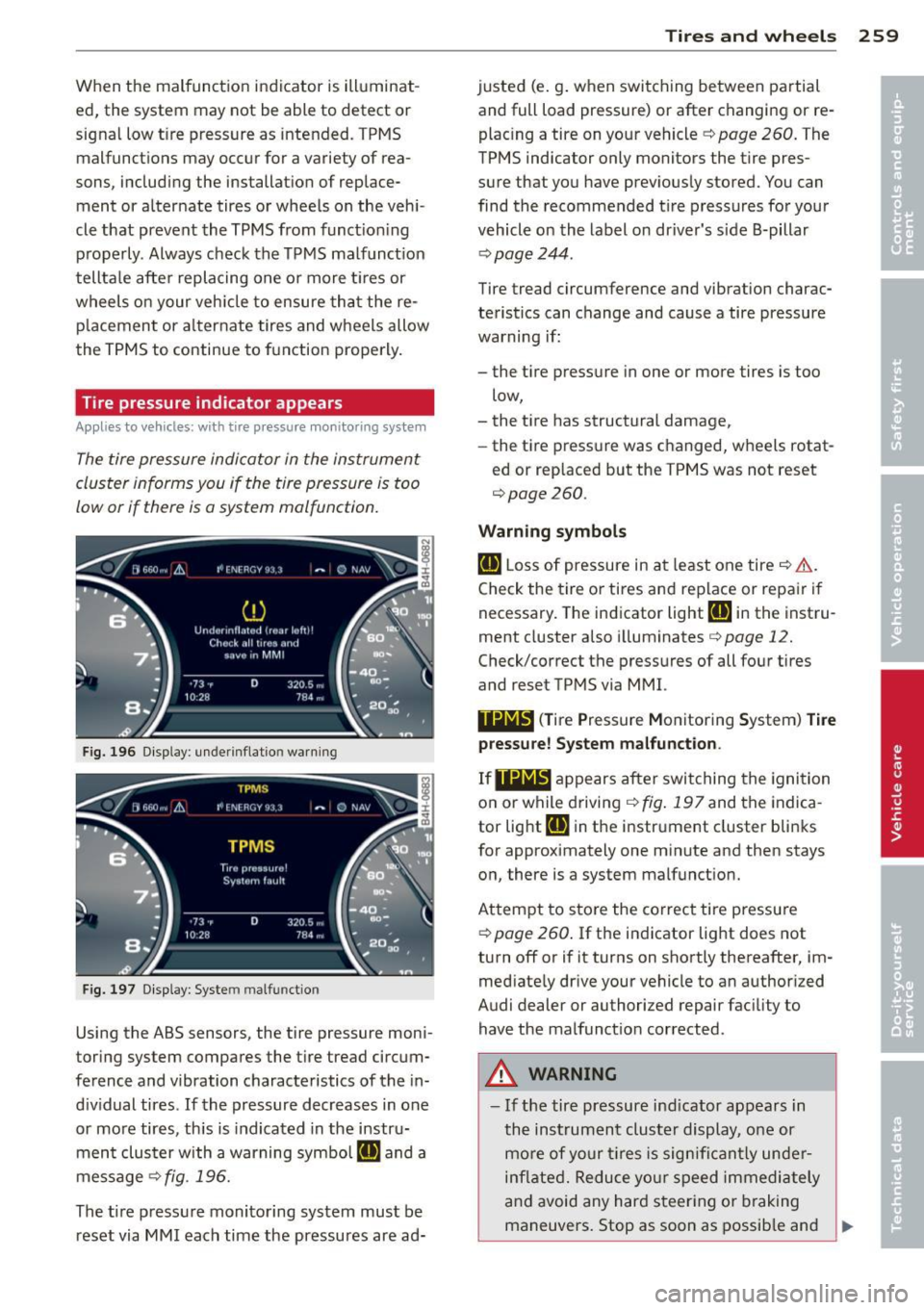
Fig. 196 Display : underinflatio n warning
Fig. 197 Display : Syste m malfun ctio n
Using the ABS sensors, the tire pressure moni
toring system compares the tire tread circum
ference and vibration characteristics of the in
dividual tires . If the pressure decreases in one
or more tires , th is is indicated in the instru
ment cluster with a warning symbol
RE and a
message
¢fig . 196.
The tire pressure monitoring system must be
reset via MMI each time the pressures are ad-
Tires and wheels 259
justed (e.g. when switching between partial
and full load pressure) or after changing or re
plac ing a tire on your vehicle¢
page 260. The
TPMS indicator only monitors the tire pres
sure that you have previously stored. You can
find the recommended tire pressures for your
vehicle on the label on dr iver's side B-pillar
~page 244.
Tire tread circumference and vibration charac
teristics can change and cause a tire pressure
warning if :
- the tire pressure in one or more tires is too
low,
- the tire has structural damage,
- the tire pressure was changed, wheels rotat-
ed or replaced but the TPMS was not reset
¢page 260.
Warning symbols
RE Loss of pressure in at least one tire¢.&. .
Check the tire or tires and replace or repair if
necessary. The indicator light
RE in the instru
ment cluster also illuminates
¢ page 12.
Check/correct the pressures of all four tires
and reset TPMS via MMI.
11;;~, ( T ire Pressure Monitoring System) Tire
pressure! System malfunction.
If11NIS, appears after switching the ignition
on or while driving¢
fig. 197 and the indica
tor light
RE in the instrument cluster blinks
for approximately one minute and then stays
on, there is a system malfunction.
Attempt to store the correct tire pressure
¢
page 260 . If the indicator light does not
turn off or if it turns on shortly thereafter, im
mediately drive your vehicle to an authorized
Audi dealer or authorized repair facility to have the malfunction corrected .
A WARNING
-If the tire pressure ind icator appears in
the instrument cluster display, one or
more of your tires is significantly under
inflated. Reduce your speed immediately
and avoid any hard steering or braking
maneuvers. Stop as soon as possib le and .,.
Page 262 of 306
260 Tire s and wheel s
check the tires and their pressures. In
flate the tire pressure to the proper pres
sure as indicated on the vehicle's tire pressure label
c> page 244. Driving on a
significantly under-inflated tire causes
the tire to overheat and can lead to tire
failure. Under-inflation also is likely to impair the vehicle's handling and stop
ping ability.
- T he driver is responsible for ma inta ining
the correct tire pressures. You must check the t ire pressures regular ly .
- Under certain cond itions (such as a spor
ty driving s tyle, win ter condit ions or un
paved roads), the pressure monitor indi
cator may be de layed .
- Ask your author ized Audi dealer if r un
flat tires may be used on your vehicle .
You r vehicle regist ration becomes invalid
if yo u use these tires when not permit
ted. Damage to your veh icle or accidents
cou ld also resu lt.
- The tire pressure monitoring system
stops wor king when there is an ESC/ABS
malfunction .
- Using snow chains may result in a system
malfunction.
- The tire pressure monitoring system on
your A udi was developed using tires with
the "AO" or "RO" identif ication on the
tire sidewall <:>page 251. We recom
mend using these t ires.
Reset tire pressure monitoring system
App lies to vehicles: with tire pressure monito ring system
If the tire pressure is adjusted, wheels are ro
tated or changed, the TPMS must be reset via
MMI.
., Switch on the ignition .
., Se lect in the MMI: !CAR !function button>
(Car )* syst ems contro l butto n > Serv icing &
checks > Tire pres sure mon itoring > Store
tire pre ssure s> Yes, store n ow .
(D Tips
Do not store the tire pressure if there are
snow cha ins on the tire .
Page 265 of 306
.,. Always store the vehicle too l kit, the jack*
and the replaced tire in the luggage com
partment
c!:> page 132.
.,. Unhook the cargo floor before closing the
rear lid.
Using the spare tire (compact spare tir e)
The compact spare tire is on ly intended for
emergencies until you can reach a repair shop .
Replace it as quick ly as poss ible with a stand
ard wheel and tire.
There are some restrictions on the use of the
compact spare tire. The compact spare tire
has been designed specifically for your type of
veh icle. It must not be swapped with a com
pact spare t ire from another type of vehicle.
Snow chain s
For technical reasons, the use of snow chains
on the compact spare tire is
not permitted.
If you do have to dr ive w ith snow cha ins and a
front tire f ails, mount the spare whee l with
tire instead of a rear tire . Install the snow
chains on the rear tire and use it to replace
the defective front tire.
A WARNING
-Never use the spare tire if it is damaged
o r if it is worn down to the tread wear in
dicators .
- If the spare tire is more than 6 years o ld,
use it only in an emergency and w ith ex
treme caution and careful driving.
- The spare tire is intended only for tem
porary and short-term use. It should be
replaced as soon as possible w ith the
normal wheel and t ire.
- After mounting the compact spare tire,
the tire pressure must be checked as
soon as poss ible. The tire pressure of the
c ompact sp are tire must be 4.2 bar; oth
erwise, you risk hav ing an accident .
- Do not drive faster than 50 mph (80 km/
h). You risk having an acc ident.
- Avoid fu ll-throttle acce le rat ion, heavy
braking, and fast corner ing . Yo u risk hav
ing an acc iden t.
What do I do now? 263
- Never drive using more than one spare
wheel and tire. You r isk having an acci
dent .
- Normal summer or winter t ires must not
be mounted on the compact spare wheel
rim.
- For technical reasons, the use of tire
chains on the spare tire is not permitted .
If it is necessary to drive w ith t ire chains,
the spare wheel must be mounted on the
front axle in the event of a flat in a rear
tire. The newly available front whee l
m ust then be instal led i n place of the
rea r whee l w ith the flat tire. Installing
the tire chain be fore mounting the whee l
and tire is recommended.
- Loose items in the passenger compart
ment can cause serious personal injury
during hard braking or in an accident. Never store the inflatab le spare tire or
jack and tools in the passenger compart
ment.
Changing a wheel
Before changing a wheel
Observe the following precautions for your
own and your passenger's safety when chang
ing a wheel.
.,. After you expe rience a t ire failure, p ull the
car well away from mov ing traffic and try to
reach
l e vel ground before you stop ¢ _& .
.,. All passengers should lea ve th e car and
move to a safe location (f or instance, behind
the guardrail) ¢
,&.
.. Engage the par king br ake to prevent your
veh icle from rolling unintentionally
c:> _&.
.,. Move selecto r le ver to pos ition P c:> _& .
.,. If you are towing a tra iler, unhitch the trail
er from your vehicle.
.,. Take the
jack and the spar e tir e out of the
luggage compartment¢
page 262,
¢page 262. .,.
•
•
Page 266 of 306
264 What do I do now?
&_ WARNING
You or your passengers could be injured
while changing a wheel if yo u do n ot fol
low t hese safety precautions:
- If you have a flat t ire, move a safe dis
tance
off the road. Turn off the engine,
turn the emergency flashers on and use other warning dev ices to alert other mo
torists.
- Make sure that passengers wait in a safe
place away from the vehicle and well
away from the road and traff ic.
- T o help p revent the veh icle from mov ing
sudden ly and possibly slipping off the
ja ck, always fully set the parking b rake
and bloc k the whee l diagona lly opposite
the whee l being changed. When one
front whee l is lifted off the gro und, plac
ing the Automat ic Transmiss ion in P
(Park) will
not prevent the vehicle from
moving.
- Before you change a wheel, be sure the
ground is level and firm. If necessary,
use a sturdy board under the jack.
- Always store the vehicle tool kit, the jack
and the replaced t ire i n the luggage com
partment
¢ page 132.
Before chang ing the wheel, yo u m ust acti
vate the jacking mode, so that the auto mat ic cont rols for the Adaptive Air S us
pens ion* do not make it more difficult to
lift the vehicle with the jack
c> page 266.
Changing a wheel
When you change a wheel, follow these
quence described below step-by-step and in
exactly that order .
1. Activate the vehicle jack mode*
~page 266.
-
2. Remove the decorative wheel cov er* . For
mo re details see also ¢
page 265, Deco
rative wheel covers
or c> page 265,
Wheels with wheel bolt caps.
3 . L oosen the wheel bolts¢ page 265.
4. Locate the proper mounting point for the
jack and alig n the jack below that point
¢ page 266 .
5.
Raise the car with the jack¢ page 266.
6. Remove the wheel with the flat tire and
then insta ll
the s pare ¢page 267.
7. Tighten all whee l bolts lightly.
8 . Lower the vehicle with the jack .
9. Use the wheel bolt wrench and firmly
t igh ten al l w heel bo lts¢ page 265.
10. Rep lace the decorat ive wh eel co ver* .
11. Deactivate the vehicle jack mode* in the
MMI:
ICARI f u nction button > (Car )* sys
tems
control button > Se rvicing & chec ks
> A ir susp .: jac k mode > Off .
The vehicle jack mode * switches off automati
ca lly at speeds above
6 mph (1 0 km/h) .
&_ WARNING ,.__
Always read and follow all WARNINGS and
i nformat ion¢ &.
in Raising the vehicle on
page 266
and c> page 268.
After changing a wheel
A wheel change is not complete without the doing the following.
.,. Always store the vehicle tool kit, the jack *
and the rep laced tire in the luggage com
partment
¢ page 132.
.,. Check t he ti re pressu re on the spare whee l
immed iate ly after mounting it .
.,. As soon as possib le, have the
tightening
torques
on all whee l bolts checked with a
t o rque wrenc h. The co rrect tighte ning tor
que is 90 ft lb (120 Nm).
.,. Have the flat tire
replaced as soon as possi
b le.
(D Tips
- If you not ice th at the wheel bo lts a re
co rroded and difficult to turn while
changing a tire, they should be rep laced
before you check the tightening torque.
- Drive at reduced speed until you have the
tightening torques checked .
ll-
Page 271 of 306
-Replace the flat tire with a new one and
have it installed on your vehicle a s soon as
possible. Remount the wheel co ve r.
U ntil th en, driv e with extr a car e and at re
du ced speeds .
~ WARNING
-
-If you are going to equip your vehicle
with t ires or rims wh ich differ from those
wh ich were factory installed, then be
sure to read the informat ion
c:> page 251,
New tires and replacing tires and
wheels.
- Always make sure the damaged wheel or
even a flat tire and the jack and tool k it
are properly secured in th e luggage com·
partment and are not loose in the pas·
senger compartment.
- In an accident o r sudden maneuver they
c ou ld fly forward, inju ring anyone in the
vehicle .
- Always store damaged w heel, jac k and
tools secure ly in the luggage compart
ment. Otherw ise, in an acc iden t or sud
den maneuver they cou ld fly forward,
causing injury to passenge rs i n the vehi·
cle .
What do I do now? 269
•
•
Page 280 of 306
2 78 Emergency situations
@ Tips
Check carefully to make sure the hook-up
is secure before moving the car up the flat
bed truck ramp.
Vehicle transport
Whenever you have your vehicle transported,
be sure to note the following:
(D Note
Mount the tie-down chains/cables over the
running surface (circumference) of the
tires. Never secure the vehicle by the axle,
the suspension struts or the front or rear
towline eye. For technical reasons, the
pressure in the suspension struts may
change during the transport and this will
adversely affect vehicle handling.
Lifting vehicle
Lifting with workshop hoist and with
floor jack
The vehicle may only be lifted at the lifting
points illustrated.
Fig. 221 Front lift in g po int
Fig. 222 Rear lifti ng point
.,. Read and heed WARNING ¢ _&.
~ N 0 6 .., (0
.,. Activate the vehicle jack mode * in the MMI:
!CARI function button > (Car)* systems con
trol button>
Servicing & checks> Air susp.:
jack mode > On .
.,. Locate lifting points ¢ fig. 221 and
¢fig. 222 .
"' Adjust lifting arms of wo rkshop hoist or
floor jack to match veh icle lifting points .
"' Insert a rubber pad between the floor jack/
workshop hoist and the lifting points .
The vehicle jack mode* must be activated so
that the automat ic adjustment of the Adap
tive Ai r Suspens ion* does not make it more
difficult to raise the vehicle with the floor
jack .
If you must lift your vehicle with a floor jack
to work underneath, be sure the vehicle is
safely supported on stands intended for this
purpose.
Front lifting point
The lifting point is located on the floor pan re
inforcement about at the same level as the
jack mounting point
¢fig. 221. Do not lift
the vehicle at the vertical sill reinforcement .
Rear lifting point
The lifting point is located on the vert ical rein
forcement of the lower sill for the on-board
jack ¢
fig. 222.
Lifting with vehicle jack
Refer to¢ page 266 .
A WARNING
-To reduce the risk of ser ious injury and
veh icle damage.
- Always lift the vehicle only at the spe
cial workshop hoist and floor jack lift
points illustrated
¢fig. 221 and
¢ fig. 222.
-Failure to lift the veh icle at these
points could cause the vehicle to tilt or
fall from a lift if there is a change in ve
hicle weight distribution and balance.
This might happen, for example, when
-
Page 294 of 306

292 Index
Checking Engine coolant level ................ 232
Tire pressure . ............. ... .... . 246
Ch ild restra ints
Danger of using child restra ints in the
front seat . . . . . . . . . . . . . . . . . . . . . . . . 147
Where can I get additional information
about child restraints and their use? .. 189
Child restraint system anchors ... .... . 185
Child safety .. .. . .......... .. .. .... . 171
Convertible locking retractor .. .. .. .. . 182
Important safety instructions for us ing
chi ld safety seats ......... .. .. .... . 175
I mportant things to know when dr iving
with chi ldren . ............... .... . 171
Tether anchors ............ ... .... . 188
Tether straps ..................... 188
Child safety lock Rear doors .............. .. .. .... .. 38
Child safety seats .......... .... .... . 177
Booster seats . .......... ... .. .. ... 180
Convertible ch ild seats .... .. .. .. .. . 178
Convertible locking retractor .. .. .. ... 182
H ow do I proper ly install a child safety
seat in my vehicle? ...... .. .. .. .. .. . 175
I nfant seats .............. ... .... . 177
I nstalling . ............... ... .... . 182
Installing a child restraint using the
LATCH system ................ .... . 187
LATCH system ............ .... ..... 187
Lower anchorages ............ ..... 186
Mounting and releasing the anchorage
hook .. .. .. ... .... ...... ... ... .. . 187
Safety instructions . . . . . . . . . . . . . . . . . 17 5
Unused safety belts on the rear seat .. 177
Cigarette lighter . . . . . . . . . . . . . . . . . . . . . 56
C leaning
Head-up Display .............. .... . 215
Matte finish paint ............ .... . 210
C leaning and protection ..... .. .. .. .. . 208
A lcantara (synthet ic suede) .......... 218
Engine compartment ....... .... ... . 219
Exhaust tail pipes .......... ... .... . 214
Fabrics and fabric coverings .. .. ..... 215
Instrument panel ............. ..... 216
Interior . . . . . . . . . . . . . . . . . . . . . . . . . . 214
Leather . . . . . . . . . . . . . . . . . . . . . . . . . . 217
MMI display/controls .. ... ... .. .. ... 214 Plastic
and vinyl . .............. .... 212
Plastic parts . . . . . . . . . . . . . . . . . . . . . . 216
Safety be lts ... .. ................ . 218
trim strips ................... .... 212
Trim strips ................... .... 212
Cleaning the Head-up Display ......... 215
Climate control Air vents . . . . . . . . . . . . . . . . . . . . . . . . . . 66
Climate controls . .. ............. .. .. . 64
Climate control (four-zone)
Operation ..... .. .. .............. .. 67
Climate control (three-zone) Operation . . . . . . . . . . . . . . . . . . . . . . . . . 65
Clock ...... .... .................... 27
Closing Sliding/tilting sunroof ............... 40
Cold tire inflation pressure ........ .. .. 244
Coming home ....................... 43
Compact spare tire ................. . 262
Compartments . . . . . . . . . . . . . . . . . . . . . . 57
Compliance ..... .. .. .............. . 288
Consumer Information . . . . . . . . . . 134, 285
Consumption (fuel) ............. .... . 24
Contacting NHTSA .............. .... 134
Convenience key . .. ... ........... ... . 35
Starting the engine ............ .... . 71
Stopping the engine (START ENGINE
STOP button) . . . . . . . . . . . . . . . . . . . . . . 73
Switching the ignition on ........ ... . 71
Unlocking and locking vehicle .... .. .. . 35
Convertib le child safety seats ..... .... 178
Convertible locking retractor Activating ... .. .. .. ..... ...... .. .. 184
Deact ivating . .. .. ... ....... ... .. .. 184
Using to secure a child safety seat 1.82, 184
Coolant
refer to Engine coolant ............. 232
Cooling mode (automatic climate control) 67
Cooling mode (climate control) . . . . . . . . . 65
Cruise contro l
Changing speed .. ............. .... . 80
Presetting your speed .............. . 80
Switching off . . . . . . . . . . . . . . . . . . . . . . 80
Switching on . . . . . . . . . . . . . . . . . . . . . . . 79
Warning/ind icator lights ........... .. 23
(upholder .. .... ............... ..... 57
Page 302 of 306
300 Index
Sunroof .......... ......... ... .... .. 40
Sun shade
Rear window ............. .... .... ..
45
Side doors . . . . . . . . . . . . . . . . . . . . . . . . . 45
Sun visors . .................. ... .. .. 45
Symbo ls
refer to Warning/indicator lights .... .. 12
T
Tachometer . . . . . . . . . . . . . . . . . . . . . 12, 23
Technical modifications .......... .... 288
Temperature disp lay .................. 23
Tether anchors .......... ...... .. .. . 188
Tether strap ................... ... . 188
The first 1,000 miles (1,500 km) and after-
wards ... .... ................ ..... .
199
Three-zone cl imate control ............ 65
Tie-downs . . . . . . . . . . . . . . . . . . . . . 62, 133
Tips for the environment
Saving fuel . . . . . . . . . . . . . . . . . . . . . . . .
60
tiptronic .. ... .............. .. .. .. . 105
tiptronic (automatic transmission) .. ... 109
Tire pressure ............... ... .... . 246
Tire pressure monitor ing system .. .. .. . 258
Loss of air pressure ......... .. .. .. . 259
Malfunct ion ............. ......... 259
Resett ing t ire pressures ............. 260
Tires .......................... ... . 240
Service life .... .... ...... ...... .. . 250
Speed rating letter code ....... .. ... 252
Tire manufacturing date ....... .... . 252
Tire specifications ................. 252
Tread depth ................ ..... . 250
Uniform tire quality grading .. ... ... . 254
Winter tires .............. ... .... . 255
Tires and vehicle load limits ........... 248
Tires and wheels
Check ing tire pressure ...... ... .. .. .
246
Cold tire inflat ion pressure ..... .. ... 244
Dimensions . .................. ... . 251
General notes . . . . . . . . . . . . . . . . . . . . . 240
Glossary of t ire and load ing termino lo-
gy .. .... .. ................ ... ...
241
Low aspect ratio tires ....... ... .... . 257
New tires and wheels .......... .... . 251
Replacing ........................ 252
Snow chains ..... ................ . 256
Tires and vehicle load limits ...... ... 248
Whee l bolts ... .. ................ . 257
Winter tires .................. .... 255
Tire service life ..................... 250
Tools .. ....... ................... . 262
Torn or frayed safety belts ......... ... 139
Touc h-up pa int ..................... 213
Towing
Tow truck procedures ...............
276
TPMS
Tire pressure monitoring system .....
259
Traile r towing .................. .... 204
Operating instructions .............. 204
Parking system ... ................ . 123
Technical requirements . . . . . . . . 204, 205
Trailer towing tips . ............... . 206
Train (transport ing your vehicle) . ...... 278
Transmission
l 't . ® 105 mu t1 ronic ..... ................ .
S tronic ® ..... ................... .
105
tiptronic ...... .. .......... ....... 105
Transmission malfunction (indicator
light) .............................
110
Transport Canada .. ................ . 134
Transporting your vehicle ............ . 278
Tread Wear Indicator (TWI) ........... 250
Trip odometer . .... .................. 27
What does it mean when DEF appears in
the trip odometer display? ....... ... .
27
T runk
refer to Luggage compartment ........ 61
Trunk escape handle ................. 261
Trunk lid
refer to Rear lid .................. .. 37
Turn signals . .. .. .. ..... ........ ..... 43
Warning/ind icator lights ............. 23
u
Undercoating ...................... 214
Unfastening safety belts ........... .. 141
U nidirectional tires ... ........... .... 240
Uniform tire quality grading .......... 254
Page 303 of 306
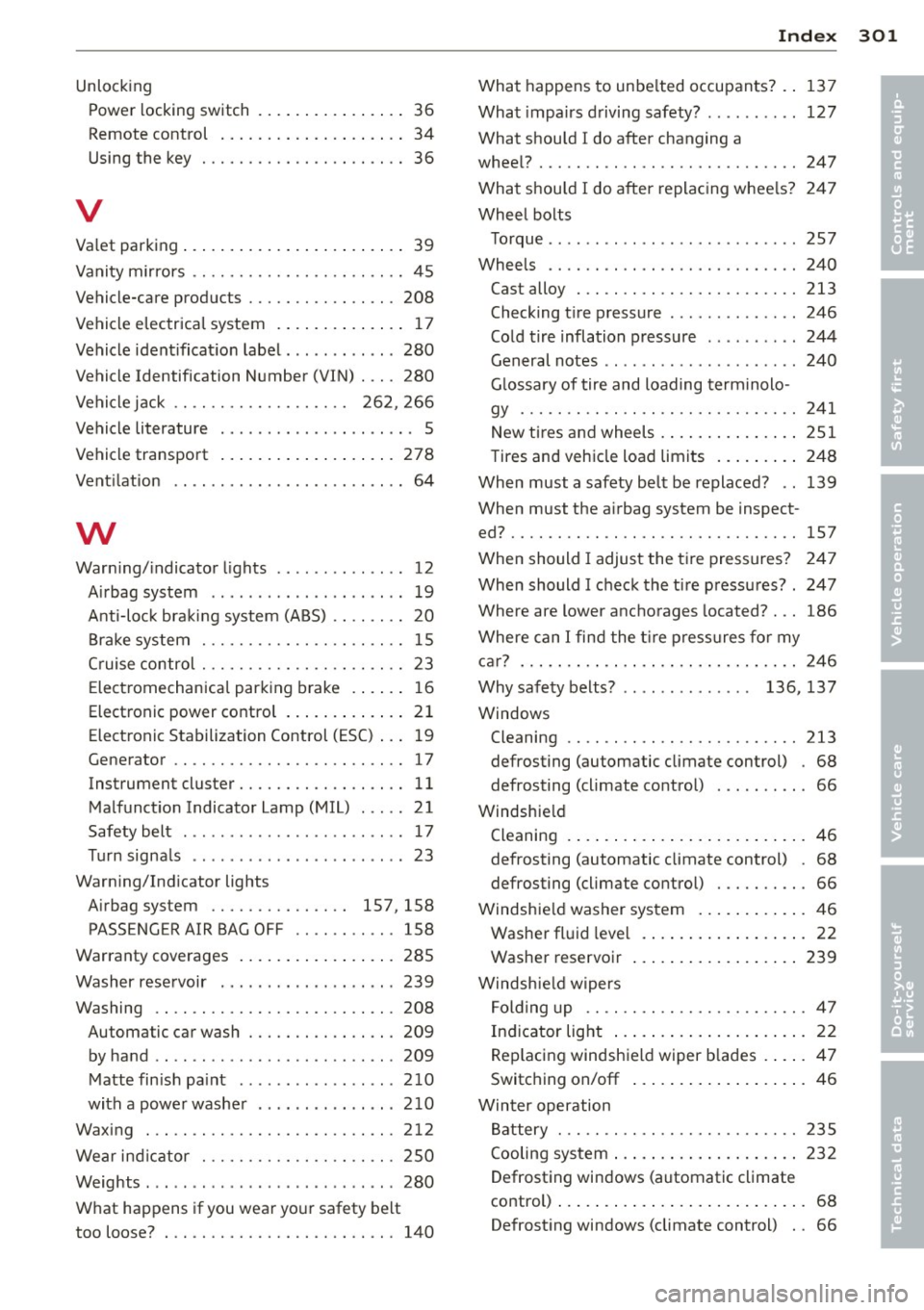
Unlocking Power lock ing switch ... ... ... ... .. .. 36
Remote control . . . . . . . . . . . . . . . . . . . . 34
Us ing the key ... .. .... ... .... .. .. .. 36
V
Va let parking ...... ..... ... .. .. .. .. .. 39
Vanity mirrors .... ......... .... .. .. .. 45
Vehicle-care produ cts ....... .. .. .. .. . 208
Vehicle e lectrica l system . . . . . . . . . . . . . . 17
Vehicle ident ificat ion label ....... ... .. 280
Vehicle Identification N umber (VIN) . .. . 280
Vehicle jack . . . . . . . . . . . . . . . . . . . 262, 266
Vehicle literature . . . . . . . . . . . . . . . . . . . . . 5
Vehicle transport .. ..... ... .. .. .. .. . 278
Vent ilation .. .. .. .. .. .... ... .. .. .. .. 64
w
Warn ing/ indicator lights ......... .... . 12
A irbag system ............ ... ... ... 19
Anti-loc k braking system (ABS) .. .. .. .. 20
Brake system . ........... .. .. .. .. .. 15
C ruise control . . . . . . . . . . . . . . . . . . . . . . 23
Elect romechanical park ing brake . ... .. 1 6
Electronic power contro l . . . . . . . . . . . . . 21
Electronic Stabilization Control (ESC) ... 19
Generator . . . . . . . . . . . . . . . . . . . . . . . . . 17
Instrument cluster. . . . . . . . . . . . . . . . . . 11
Malfunct ion Indicator Lamp (MI L) ... .. 21
Safety belt . . . . . . . . . . . . . . . . . . . . . . . . 17
Turn signa ls ... ........... ... ... ... 23
Warn ing/Ind icator lights
A irbag system . . . . . . . . . . . . . . . 157, 158
PASS ENG ER A IR BAG OFF ...... ... .. 158
Warranty coverages ..... ... .. .. .. .. . 285
Washer reservoir . ...... ... .... .. ... 239
Washing .. .. ................. .. ... 208
Automatic car wash ....... .. .. .. .. . 209
by hand . ... .. .... .... ..... ... ... . 209
Matte fin is h pa int ........... .... .. 210
with a powe r washe r ... ... .. .. .. .. . 210
Waxing ... .. ................. .. ... 212
Wear ind icator ............ .... .. .. . 250
Weights . .. ... ................... .. 280
W hat happens if you wear your safety belt
too loose? . .. .. ........... .. .. .. ... 140
Inde x 301
What happens to unbe lted occupants? . . 137
What impairs d riving safety? .......... 127
What should I do after changing a
whee l? ..... .. .. .. ................. 247
What shou ld I do after replac ing whee ls? 247
Wheel bolts To rque ...... .. .... .......... ..... 257
Wheels ...... .. .. ................. 240
Cast alloy . .. .. .. .... ............. 213
Check ing t ire pressu re ............. . 246
Co ld t ire inflation p ressure ..... ... .. 244
General notes .. ... ...... .......... 240
G lossary of tire and loading term inolo-
gy ....... .. .. .. .. .. ........... .. 241
New tires and wheels . ... .... ... .. .. 251
Tires and vehicle load limits .. ... .. .. 248
When must a safety belt be replaced? .. 139
When must the airbag system be inspect- ed? ........ .. .. .. ................. 157
When should I adjust the t ire pressures? 247
When should I check the tire p ressu res? . 247
Whe re are lower anchorages located? . .. 186
Where can I find the t ire p ress ures for my
car? .. ... .. .. .. .. .. . .. ... .... ... .. 246
Why safety belts? . . . . . . . . . . . . . . 136, 137
Windows Cleaning .. .. .. .. ................. 213
defrosting (automatic climate control) . 68
defrosting (climate control) . . . . . . . . . . 66
Windshie ld
Cleaning . ... .... .. . .. .. ..... ... .. . 46
defrosting (automatic climate control) . 68
defrosting (climate control) . . . . . . . . . . 66
Windshie ld washer system .... ... .. .. . 46
Washer fl uid level . .. .. ..... ... .. .. . 22
Washer reservoir ... . ... .... ... .. .. 239
Windshie ld wipers
F o ld ing up .. .. .. ................. . 47
Ind icator light ..... . .. .. ..... ... .. . 22
Rep lacing windsh ield wiper b lades . ... . 47
Switching on/off .... .. ..... ... .. .. . 46
Win ter operation
Battery . .. .. .. .. .... ........... .. 235
Cooling system ... .. .. ... ..... ... .. 232
Defrost ing windows (automatic climate
control) . . . . . . . . . . . . . . . . . . . . . . . . . . . 68
Defrost ing windows (climate control) . . 66
•
•