steering AUDI A6 2013 Workshop Manual
[x] Cancel search | Manufacturer: AUDI, Model Year: 2013, Model line: A6, Model: AUDI A6 2013Pages: 306, PDF Size: 76.92 MB
Page 166 of 306
164 Airbag system
How knee airbags work
Applies to vehicles: with knee airbags
The risk of injury to the leg area can be re
duced by fully inflated knee airbags.
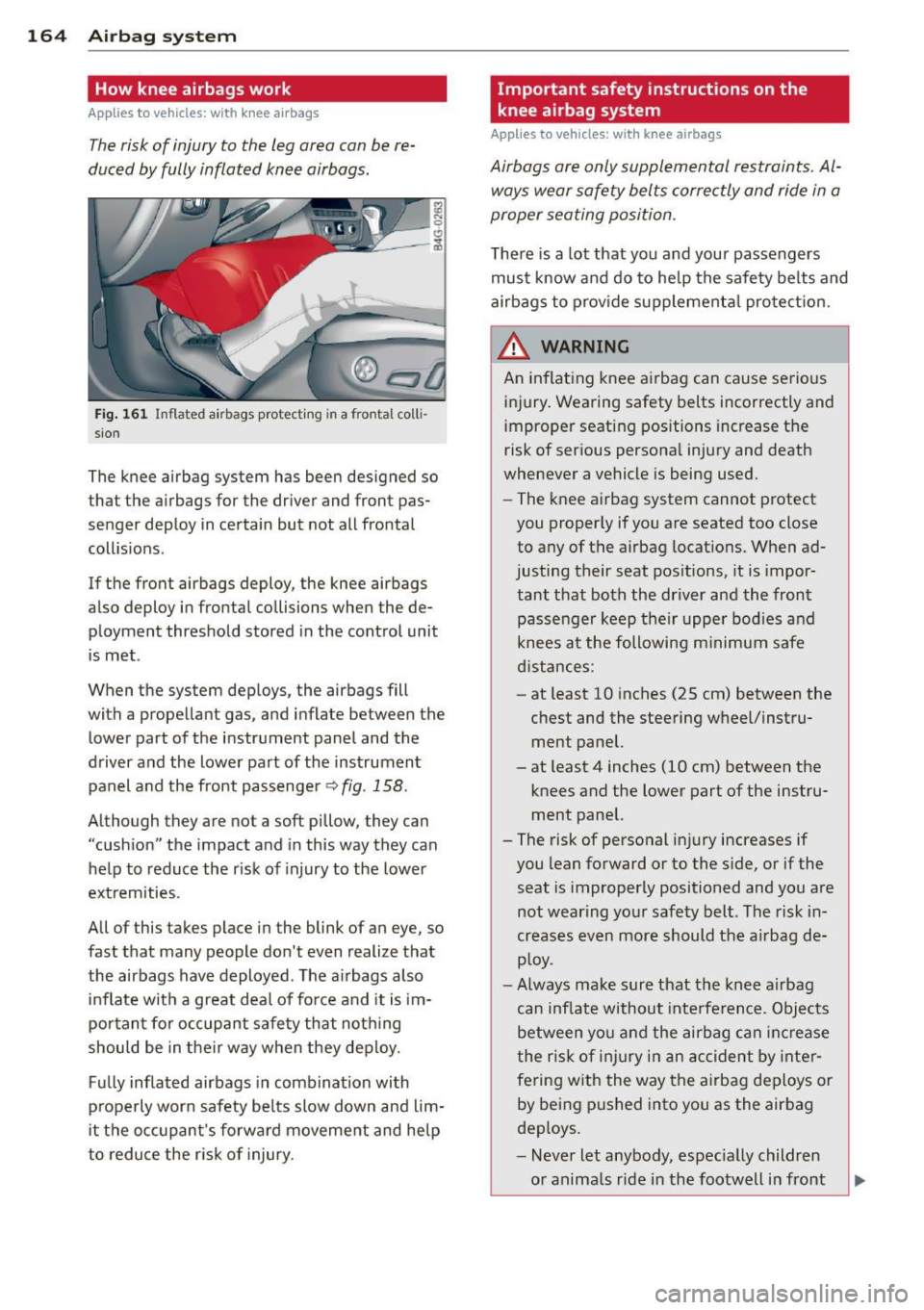
F ig . 161 Inflated airbags protecting in a fro ntal colli·
sion
The knee airbag system has been designed so
that the a irbags for the driver and front pas
senger deploy in certain but not all frontal
coll is ions.
If the front airbags deploy, the knee airbags
a lso deploy in frontal collisions when the de
ployment threshold stored in the control unit
i s met .
When the system deploys, the airbags fill
with a propellant gas, and inflate between the
lower part of the instrument panel and the
driver and the lower part of the instrument
panel and the front passenger~
fig. 158.
Although they are not a soft pillow, they can
"cush ion" the impact and in this way they can
he lp to reduce the risk of injury to the lower
ext rem ities .
All of this takes place in the blink of an eye, so
fast that many people don't even realize that
the airbags have deployed . The a irbags also
i nflate with a great deal of force and it is im
po rtan t for occupant safety that not hing
should be in their way when they deploy.
Fully inflated airbags in combination with
p roperly worn safety be lts slow down and lim
it the occ upant's forwa rd moveme nt and help
to reduce the r isk o f injury. Important safety instructions on the
knee airbag system
Applies
to vehicles: with knee airbags
Airbags are only suppl emental restraints. Al
ways wear safety belts corre ctly and ride in a
proper seating position .
There is a lot that you and you r passengers
must know and do to he lp the safe ty belts and
airbags to prov ide s uppleme nta l pro tect io n.
A WARNING
-An inflating knee a irbag can cause se rious
i n jury . Wearing safety belts incorrectly and
improper seat ing positions increase t he
risk of serious persona l injury and death
whenever a vehicle is being used.
- The knee airbag system cannot protect
you properly if you are seated too close
to any of the airbag locat ions. When ad
justing their seat pos itions, it is impor
tant that both the driver and the front passenger keep the ir upper bod ies and
knees at the following m inimum safe
d istances:
- at least 10 inches (25 cm) between the
chest and the steering wheel/instru
ment panel.
- at least 4 inches (10 cm) between the knees and the lower part of the instru
ment panel.
- The risk of personal inj ury increases if
you lean forward or to the s ide, or if the
seat is improperly positioned and you are
not wearing yo ur safety belt . The risk i n
creases even more should the a irbag de
p loy .
- Always make sure that the knee airbag
can inflate without inte rfe rence. Objects
between yo u and the airbag can in cr ea se
the risk of injury in an acc ident by inte r
fering w ith the way the a irba g deploys or
by being pushed into you as the airbag
deploys.
- Never let anybody, espec ia lly children
o r anima ls ride in the footwell i n front
Page 175 of 306
~ page 171, Important things to
know.
(D Tips
Always replace child restraints that were
installed in a vehicle during a crash. Dam
age to a child restraint that is not visible
could cause it to fail in another collision
situation.
Advanced front airbag system and children
Your vehicle is equipped with a front "Ad
vanced Airbag System" in compliance with United States Federal Motor Vehicle Safety
Standard (FMVSS) 208 as applicable at the
time your vehicle was manufactured.
The Advanced Airbag system in your vehicle
has been certified to meet the "low-risk" re
quirements for 3- and 6-year old children on
the passenger side and small adults on the
driver side. The low risk deployment criteria
are intended to reduce the risk of injury
through interaction with the airbag that can
occur, for example, by being too close to the
steering wheel and instrument panel when
the airbag inflates. In addition, the system
has been certified to comply with the "sup
pression" requirements of the Safety Stand
ard, to turn off the front airbag for infants up
to 12 months who are restrained on the front passenger seat in child restraints that are list
ed in the Standard.
Even though your vehicle is equipped with an
Advanced Airbag system, all children, espe
cially those 12 years and younger, should al
ways ride in the back seat properly restrained
for their age and size. The airbag on the pas
senger side makes the front seat a potentially
dangerous place for a child to ride. The front
seat is not the safest place for a child in a for
ward-facing child safety seat. It can be a very
dangerous place for an infant or a larger child
in a rearward-facing seat.
The vehicle 's Advanced Airbag System has a
capacitive passenger detect ion system in the
Child Safety 173
front passenger seat cushion that can detect
the presence of a baby or a child in a child re
straint system on this seat.
The capacitive passenger detection system
registers the changes that result in an electri
cal field when a child, a child restraint, and a
baby blanket are on the front passenger seat .
The change in the measured capacitance due
to the presence of a child, a child restraint,
and a baby blanket on the front passenger
seat is related to the child restraint system resting on the seat . The measured capacitance
of a child restraint system varies depending
on the type of system and specific make and
model.
The electrical capacitance of the various
types, makes, and models of child restraints
specified by the U.S.National Highway Traff ic
Safety Administration (NH TSA) in the relevant
safety standard are stored in the Advanced
Airbag System control unit together with the
capacitances typical of infants and a 1-year
old child. When a child restraint is used on the
front passenger seat with a typical
1 year-old
infant, the Advanced Airbag System compares
the capacitance measured by the capacitive passenger detection system with the data
stored in the electronic control unit.
Child restraints and Advanced front
airbag system
Regardless of the child restraint that you use,
make sure that it has been certified to meet
United States Federal Motor Vehicle Safety
Standards and has been certified by its manu
facturer for use with an airbag. Always be sure
that the child restraint is properly installed at
one of the rear seating positions. If in excep
tional circumstances you must use it on the
front passenger seat, ca refully read all of the
information on child safety and Advanced Air
bags and heed all of the applicable WARN
INGS. Make certain that the chi ld and child re
straint are correctly recognized by the capaci
tive passenger detection system in the front passenger seat, that the front passenger air
bag is turned off, and that the airbag status is ..,.
•
•
Page 194 of 306
192 Intelligent technology
Intelligent technology
Notice about data
recorded by vehicle
control modules
Your veh icle is not equipped with an Event Da
ta Recorde r (EDR), ins talled by some manu
facture rs fo r the express p urpose of capturing
data for retrieval after an accident or cras h
event . EDR's are sometimes ca lled "crash re
corders".
Some state laws restr ict the retr ieval or down
loading of data stored by EDR's that were in
stalled in a vehicle for the express purpose of retrieving data after an accident or crash
event without the owner's consent.
A ltho ugh yo ur vehicle is not equ ipped wit h an
EDR, it is equipped with a number of electron
ic control modules for various vehicle systems
such as, for examp le, eng ine f unction, em is
sion control, as well as for the airbags and
safety belts.
These electronic contro l modules also record
vehicle-re lated data during norma l vehicle op
erat ion for diagnostic and repa ir purposes.
The recording capacity of the electronic con
trol modules is limited to data (no sound is re
corded) and only a small amount of data is ac
tually recorded ove r a ve ry limited pe riod of
time and stored when a sys tem faul t or o ther
cond ition is sensed by a cont ro l u nit. Some of
the data then stored may re late to vehicle
speed, direction, braking as we ll as restraint
system use and performance in the event of a
crash or other condit ion. Stored data can only
be read and downloaded w ith special equip
ment.
Electronic Stabilization
Control (ESC)
Description
ESC helps to improve road holding and vehicle
dynamics to help reduce the probability of
skidd ing and loss of ve hicle control. It works
only when the eng ine is running. ESC detects certain difficult driving situat
ions, including
when the vehicle is beginning to spin (yaw)
o ut of control and he lps you to get the veh icle
back under control by se lectively braking the
whee ls, and/or reducing eng ine power and
providing steer ing ass istance to he lp hold the
vehicle o n the dr iver's intended course. The in
dicator light
G) in the inst rument cluster
blinks when ESC is ta king action to help yo u
control the veh icle.
ESC has limitations.
It is importa nt to remem
ber that ESC cannot overcome the laws of
physics. It wi ll not always be able to help out
under a ll cond it ions you may come up aga inst.
F or example, ESC may not always be able to
help you master situations where there is a
s u dden change in the coefficient of friction of
the road surface. When there is a section of
dry road that is sudden ly covered w ith water,
s lush or snow, ESC cannot perform the same
way it wou ld on the dry surface . If the ve hicle
hydroplanes (rides on a cushion of water in
stead of the road surface), ESC will not be
able to help you steer the vehicle because con
tact with the pavement has been in terrupted
and the vehicle cannot be braked or steered .
D uring fast cornering, particularly on winding
roads, ESC cannot always deal as effectively
with difficult driving situations than at lower
speeds. When towing a trailer, ESC is not able
to help you regain control as it would if you
were not tow ing a trailer.
Always adjust your speed and driving style to road, traffic; and weather condit ions. ESC can
not override the vehicle's physical limits, in
crease the availab le tract ion, or keep a ve hicle
on the road if road departure is a result of
drive r inattent io n. Instead, ESC imp roves the
poss ibil ity of keeping the vehi cle under con
trol and on the road during ex treme maneu
vers by using the d river's steering inputs to
help keep the vehicle going in the intended di
rection . If you are traveling at a speed that
ca uses you to run off the road before ESC can
provide any assistance, you may not experi
ence the benefits of ESC.
Page 198 of 306
196 Intellig ent technolog y
-Never let the vehicle roll to a stop with
the engine shut off.
- If the brake booster is not working, for
example when towing your vehicle, or
because the brake booster has somehow
been damaged, the brake pedal must be
pressed considerably harder to make up
for the lack of booster assistance .
Electro-mechanical
power assist
The electro-mechanical power assist helps
the driver when steering.
Power stee ring adapts electronically based on
the veh icle speed.
Indicator lights and messages
• Steerin g d efecti ve! Stop th e vehicl e
If this indicator light turns on and stays on
and this message appears, the power steering may have fa iled.
Do
not continue driving . See your authorized
Aud i dealer or other qualified repa ir facility
for assistance.
lor-ij St eerin g: S yste m malfun ction ! You m ay
c ont inue driv ing
If the indicator light turns on and the mes
sage appears, the steering may be more diffi
cult to move or more sensitive than usual.
Drive s low ly to your author ized Audi dealer or
q ua lified workshop to have the malfunction
corrected .
(D Tips
If the . or 'Iij indicator light only stays
on for a shor t time, you may contin ue driv
ing .
Driving with your
quattro ®
Applies to vehicles : with all-wheel drive
With all-wheel drive , all four wheels are driv
en .
General info rmation
With a ll Wheel Drive, power is distributed to
all four wheels. This happens automatically
depending on your driving style and the road
condit ions at the time. See also ¢
page 192.
With the sport differential*, power distribu
t ion to the rear wheels is va riable and can be
adjusted with Audi drive select*
r::¢, page 98.
Always read and follow safety precautions
Q _& .
Winter tires
When driving in the winter, your vehicle with
all-wheel drive has an advantage, eve n wit h
regular tires. In winter road conditions it may
be advisable to mount winter tires (or all-sea
son tires) for improved driveability and brak
ing : these tires must be mo unted on
all fou r
wheel s. See also ¢ page 255 , Winter tires.
Tire chains
Where tire chains are mandatory on certain
roads, this no rma lly also app lies to ve hicles
with all-wheel drive r::¢,
page 256, Snow
chains.
Replacing wh eels /tires
Vehicles with all-wheel drive m ust always
have ti res of the same s ize. A lso avo id tires
with different t read depths . For detai ls see
page r::¢,
page 251, New tires and replacing
tires and wheels .
Off-Road driving?
You r Audi does not have e nough ground clea r
ance to be used as an off-road vehicle . It is
t h erefore best to avoid rough tracks and un
even terrain as much as possib le . Also refer to
r::¢, page 200. ..,_
Page 207 of 306
Make sure that the cooling system has enough
f luid .
Tire pressure
When tow ing a trai ler, inflate the t ires of your
vehicle to the cold tire pressure listed under
"Full load" on the label located on the driver's
side B-pillar (visible when the door is open).
Inflate trailer tires to trai ler and tire manufac
turers' specifications.
Lights
Check to make sure both veh icle and trailer
lights are working properly.
Safety chains
Be sure tra iler safety cha ins are properly con
nected from the trailer to the hitch on the ve
hicle. Leave enough slack in the chains to per
mit turning corners . When you install safety
chains, make sure they wi ll not drag on the
road when you are driving.
The chains should cross under the tra ile r
tongue to prevent it from dropping in case of
sepa ration from the hitch.
Adjusting the Audi drive select
Make sure the veh icle is on a level surface be
fore hitching up the tra iler and before adjust
in g the tongue weight. The vehicle must be in
auto or comfort dr iving mode and not raised
qpage 98, q(D .
Make sure that the vehicle is lowe red. In Info
tainment, se lect:
ICARI f u nction button> Low
er
control button.
If you must drive under poor road condit ions,
you can raise the veh icle
after coupling the
traile r or
after adjusting the tongue weight
qpage 100.
- Changes in temperatu re or load can af
fect the height of the veh icle.
- Always se lect
auto or comfort mode.
Otherwise, the tongue load spec ified for
you r vehicle will no longer be applicable.
Trailer towing
Driving instructions
Driving with a trailer always requires extra
care and consideration .
To obtain the best possible handling of vehicle
and trailer, please note the following:
... Do not tow a loaded trailer when your car it
self is not loaded.
... Be especially careful when passing other
veh icles.
... Observe speed lim its .
... Do not dr ive at the maximum permissible
speed.
... Always apply brakes early .
... Monitor the temperature gauge.
Weight distribution
Towing a loaded trailer with an empty car re
sults in a highly unstable distribution of
weight. If this cannot be avoided, drive at very low speeds only to avoid the risk of losing
steering control.
A "balanced" rig is easier to operate and con
trol. This means that the tow vehicle should
be loaded to the extent possible and permissi
ble, while keeping the trailer as light as possi
ble under the circumstances. Whenever possi
ble, transfer some cargo to the luggage com
partment of the tow vehicle while observing
tongue load requirements and vehicle loading
considerations.
Speed
The higher the speed, the more difficult it be
comes for the driver to contro l the rig. Do not
drive at the maximum permissible speed. Re
duce your speed even more if load, weather or
wind conditions are unfavorable -particularly
when going downhill.
Reduce vehicle speed
immediately if the trail
er shows the slightest sign of swaying.
Do not
try to stop the swaying by accelerating.
Observe speed limits. In some areas, speeds
for vehicles towing trailers are lower than for
regular vehicles. .,.
205
•
•
Page 208 of 306
206 Trailer towing
Always apply brakes early. When driving
downhill, shift into a lower gear to use the en
g ine braking effect to slow the vehicle . Use of
the brakes alone can cause them to overheat
and fail.
Coolant temperature
The coolant temperature gauge¢ page 11
must be observed carefully. The coolant tem
perature can increase if you drive on long in
clines in a low gear at high engine speeds. Re
duce your speed immediately if the LEDs in
the top part of the display turn on .
For more information about indicator lights,
refer to. ¢
page 16 .
A WARNING
Anyone not properly restrained in a mov
ing vehicle is at a much greater risk in an
accident . Never let anyone r ide in your car
who is not properly wear ing the restraints
provided by Aud i.
Trailer towing tips
Important to know
Your vehicle handles differently when towing
a trailer because of the additional weight and
different weight distribution . Safety, perform
ance and economy w ill greatly depend on how
carefully you load your trailer and operate
your rig .
Before you actually tow your trailer, practice
turn ing, stopp ing and back ing up in an area
away from traffic. Keep practicing until you
have become comp lete ly familiar with the way
your ve hicle-trai ler comb ination behaves and
responds.
Backing up is difficult and requires practice .
Backing up with a tra iler generally requi res
steering act ion opposite to that when backing
up your vehicle without a trailer.
Maintain a greater distance between your ve
hicle and the one in front of you. You will need
more room to stop. To compensate for the trailer, you wi
ll need a larger than normal
turning radius.
When passing, remember that you cannot ac
celerate as fast as you norma lly would be
cause of the added load. Make sure you have
enough room to pass . After passing, a llow
plenty of room for your trailer before chang
ing lanes again.
Avoid jerky starts , sharp turns or rapid lane
changes.
(D Tips
- Do not tow a trailer during the break-in
period of your vehicle.
- If you tow a trailer, your Audi may re
quire more frequent maintenance due to
the extra load¢
page 285.
Parking on a slope
Do not park on o slope with a trailer. If it can
not be avoided, do so only after doing the fol
lowing:
When parking:
.,. App ly the foot brake .
.. Have someone pla ce chocks under both the
vehicle and the trailer wheels.
.. With chocks in place, slowly release the
brakes until the whee l chocks absorb the
load .
.. Turn the wheels towards the curb .
.. Apply the parking brake.
.. Select the P selector lever posit ion .
When restarting after parking:
.. Apply the foot brake.
.. Start the engine.
.. Select the D/S selector lever position .
.. Release the parking brake and slowly pull
out and away from the wheel chocks .
.,. Stop and have someone retr ieve the wheel
chocks .
Ill-
Page 243 of 306
-Never mount used tires on yo ur vehicle if
yo u are not sure of their "previous histo
ry." Old used tires may have been dam
aged even though the damage cannot be
seen that can lead to sudden tire failure
and loss of vehicle control.
- If you notice unusual vibration or if the
vehicle pulls to one side when d riving, al
ways stop as soon as it is safe to do so
and check the wheels and tires for dam
age .
(D Note
Please note that summe r and wi nte r tires
are designed for the cond itions that are
Glossary of tire and loading terminology
Accessory weight means the comb ined weight (in excess of
those sta ndard items which may be rep laced)
of au toma tic transmission, power steer ing ,
power brakes, power windows, power seats,
radio, and heater, to the extent that these
items are availab le as factory-installed equip
ment (whether installed or not) .
Aspect ratio
means the rat io o f the height to the w idth of
the tire in percent . Numbers of 55 or lower in
dicate a low sidewall for improved steering re
sponse and better overa ll handling on dry
pavement .
Bead
means the part of the t ire t hat is made o f
steel wires, wrapped or reinforced by ply cords
and that is shaped to fit the r im.
Bead separation
means a b reakdown of the bond between
components in the bead .
Cord means the strands forming the plies in the
tire.
Tire s an d wheel s 241
typica l in those seasons . Aud i recommends
using winter tires during the winter
months . Low temperatures signif icant ly
dec rease the e lasticity of summer t ires,
which affects tract ion and brak ing ability.
If summer t ires are used i n very co ld tem
peratures, cracks ca n form o n the tread
bars , res ulting in perma nen t tire damage
that can cause loud driving noise and un
bala nced ti re s. Audi i s not respon sible for
th is type of damage .
Cold tire inflation pressure
means the t ire p ress ure recommended by t he
vehicle manufacture r fo r a tire o f a des ignated
s ize t hat has not bee n driven for more than a
coup le o f miles (k ilometers) at low speeds in
the three hour period before the tire press ure
is m easured or adjusted.
Curb weight
me ans the we ight of a motor ve hicle with
st andard equipmen t incl ud ing the max imum
capacity of fuel, oi l, and coolant, air condi
tioning and additional weig ht of optiona l
equipment.
Extra load tire
means a t ire design to oper ate a t higher load s
and at higher inflation pressures than the cor
responding standa rd tire . Extra load tires may
be identified as "XL", "x l", "EXTRA LOAD", o r
"RF" on the sidewal l.
Gross Axle Weight Rating ("GAWR")
me ans the load-ca rry ing capac ity of a single
axle system , measured at the tire -ground in
te rfaces.
Gross Vehicle Weight Rating ( "GVWR ")
mea ns the maximum total loaded we ight of
the ve hicl e. .,..
•
•
Page 253 of 306
Unbalanced whee ls must be rebalanced to
avoid excessive wea r on steering, suspension
and tires. A wheel must a lso be rebalanced
when a new tire is installed .
Incorrect wheel alignment
Incorrect whee l alignment can cause exces
sive tire wear, impairing the safety o f the vehi
cle. If tires show excess ive wear, have the
wheel alignment checked by an authorized
Audi dealer or qualified workshop .
All-wheel d rive
Vehicles w ith quattro ® must always have tires
of the same size, construction and tread type .
F or detai ls see
r=!:> page 196 .
A WARNING
Sudden tire failure can lead to loss of con
trol, a crash and serious persona l injury!
- Never drive a veh icle when the tread on
any tire is worn down to the wear indica
tors.
- Worn tires are a safety hazard, they do not grip well on wet roads and increase
your risk of"hydrop lan ing" and loss of
co ntrol.
- Always keep chemicals that can cause
tire damage, such as grease, oil , gasoline
and brake fluid away from t ires.
- Tires age eve n if they are not be ing used
and can fail suddenly, especially at high
speeds. T ires that are more than 6 years
o ld can only be used in an emergency
and then with spe cial care a nd at lower
s peeds.
- Never mount used ti res on yo ur vehicle if
yo u a re not s ure of their "prev ious histo
ry." Old used ti res may have been dam
aged even though the damage cannot be
seen that can lead to s udden tire failure
and loss of vehicle control. Tires and wheels 251
New tires and replacing tires and wheels
New tires and wheels have to be broken in
.
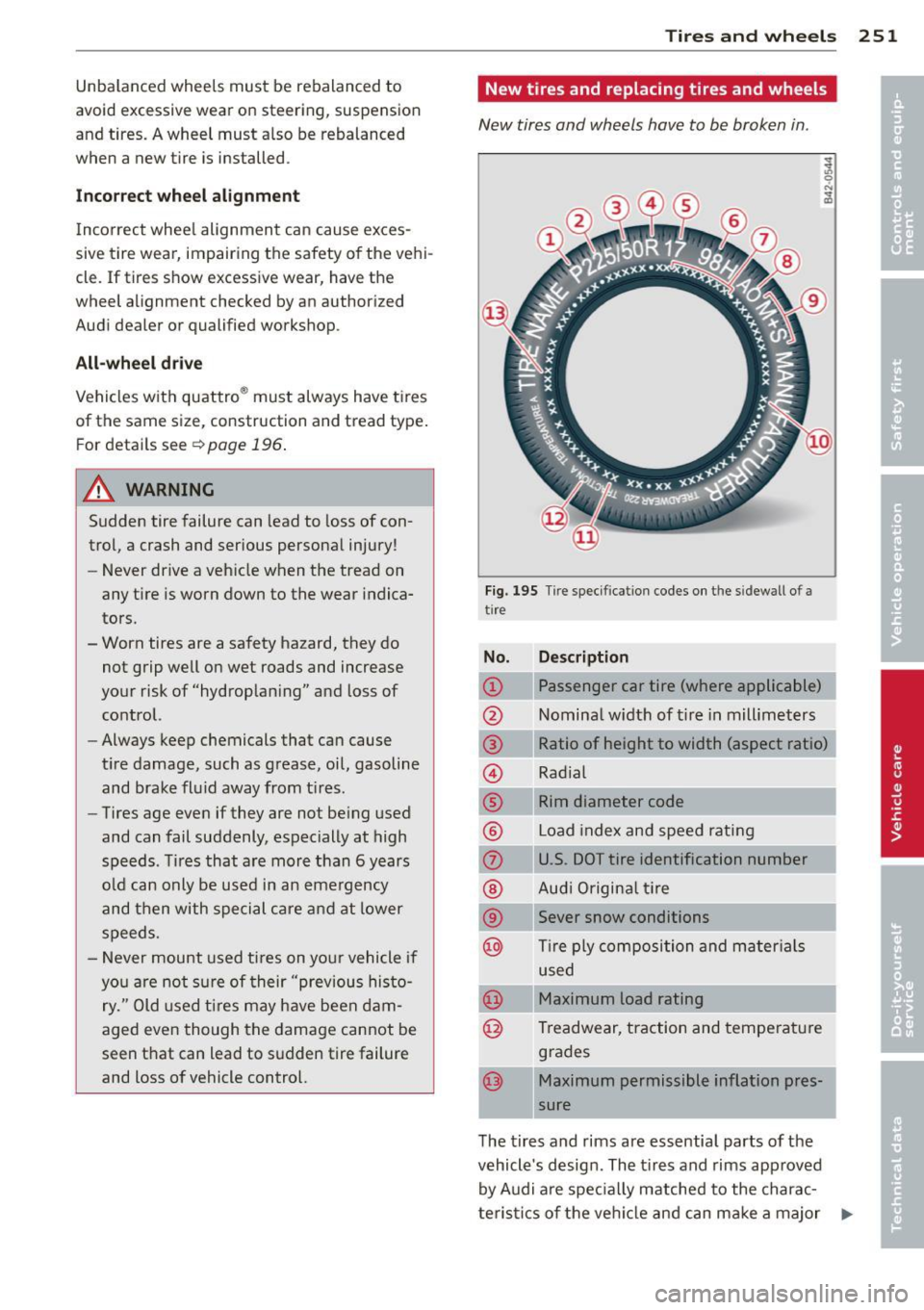
Fig. 19 5 Tir e spec ificat io n codes on t he s idewall o f a
tire
No. De sc ription
CD Passenger car tire (where applicable)
@ Nomina l w idth of t ire in mill imeters
® Ratio of height to width (aspect ratio)
© Rad ial
® Rim diameter code
® Load index and speed rating
(f) U.S. DOT tire identification number
® Aud i Origina l tire
® Sever snow conditions
@ T ire ply composition and mater ials
used
@ Maximum load rating
@ Treadwear, traction and temperat ure
grades
@ Maximum permissible inflation pres-
sure
T he tires and rims are essential parts o f the
vehicle's design . The ti res and rims app roved
by Audi a re spec ia lly matched to the charac
teris tic s of the ve hicl e and can m ake a major .,.
•
Page 261 of 306
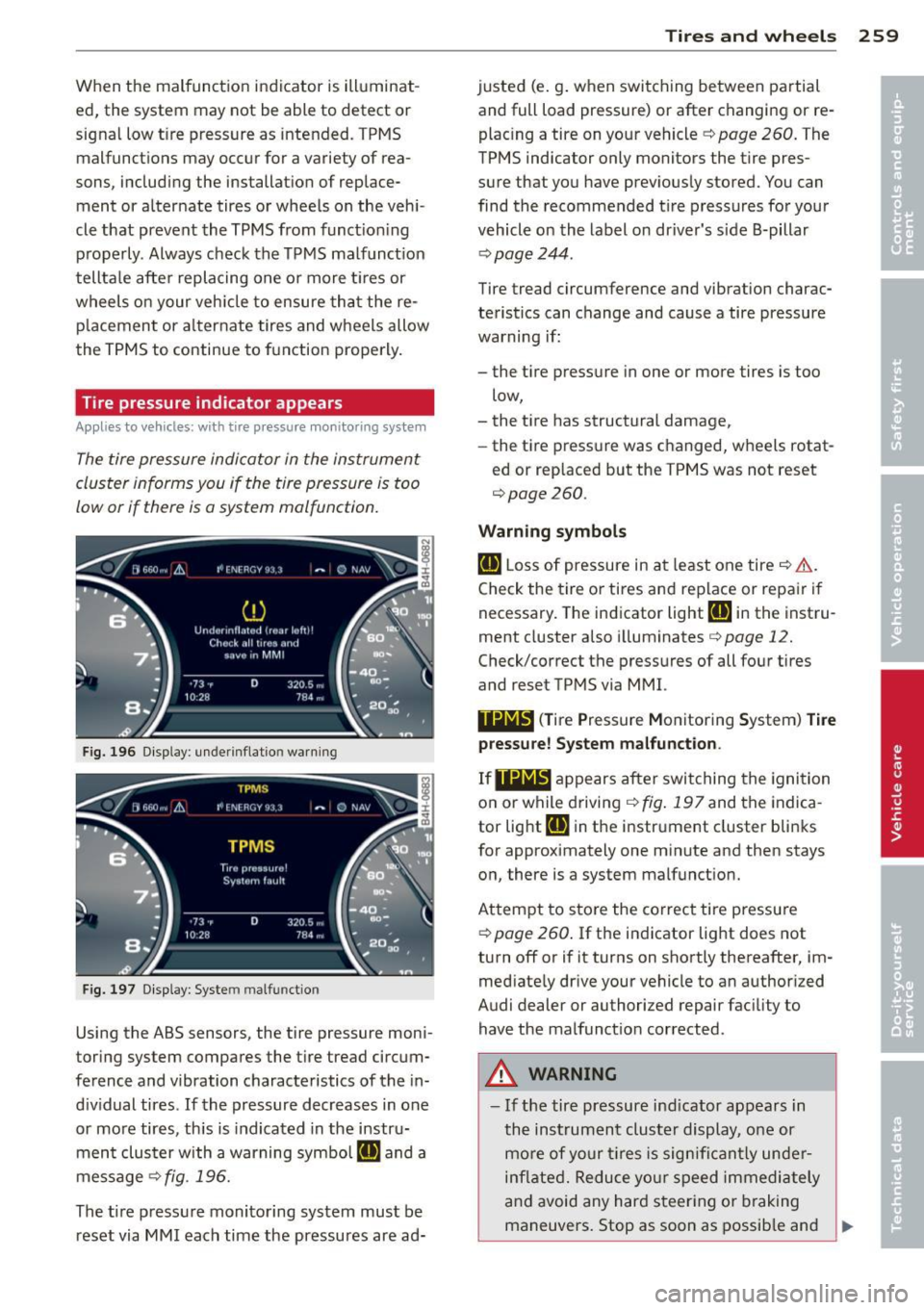
When the malfunction indicator is illuminat
ed, the system may not be able to detect or
signal low tire pressure as intended. TPMS
malfunctions may occur for a variety of rea
sons, including the installation of replace ment or alternate tires or wheels on the vehi
cle that prevent the TPMS from function ing
properly . Always check the TPMS malfunction
tellta le after replacing one or more tires or
wheels on your vehicle to ensure that the re
placement or alternate tires and wheels allow
the TPMS to continue to function properly.
Tire pressure indicator appears
Applies to vehicles: with tire pressure monitoring system
The tire pressure indicator in the instrument
cluster informs you if the tire pressure is too
low or if there is a system malfunction.
Fig. 196 Display : underinflatio n warning
Fig. 197 Display : Syste m malfun ctio n
Using the ABS sensors, the tire pressure moni
toring system compares the tire tread circum
ference and vibration characteristics of the in
dividual tires . If the pressure decreases in one
or more tires , th is is indicated in the instru
ment cluster with a warning symbol
RE and a
message
¢fig . 196.
The tire pressure monitoring system must be
reset via MMI each time the pressures are ad-
Tires and wheels 259
justed (e.g. when switching between partial
and full load pressure) or after changing or re
plac ing a tire on your vehicle¢
page 260. The
TPMS indicator only monitors the tire pres
sure that you have previously stored. You can
find the recommended tire pressures for your
vehicle on the label on dr iver's side B-pillar
~page 244.
Tire tread circumference and vibration charac
teristics can change and cause a tire pressure
warning if :
- the tire pressure in one or more tires is too
low,
- the tire has structural damage,
- the tire pressure was changed, wheels rotat-
ed or replaced but the TPMS was not reset
¢page 260.
Warning symbols
RE Loss of pressure in at least one tire¢.&. .
Check the tire or tires and replace or repair if
necessary. The indicator light
RE in the instru
ment cluster also illuminates
¢ page 12.
Check/correct the pressures of all four tires
and reset TPMS via MMI.
11;;~, ( T ire Pressure Monitoring System) Tire
pressure! System malfunction.
If11NIS, appears after switching the ignition
on or while driving¢
fig. 197 and the indica
tor light
RE in the instrument cluster blinks
for approximately one minute and then stays
on, there is a system malfunction.
Attempt to store the correct tire pressure
¢
page 260 . If the indicator light does not
turn off or if it turns on shortly thereafter, im
mediately drive your vehicle to an authorized
Audi dealer or authorized repair facility to have the malfunction corrected .
A WARNING
-If the tire pressure ind icator appears in
the instrument cluster display, one or
more of your tires is significantly under
inflated. Reduce your speed immediately
and avoid any hard steering or braking
maneuvers. Stop as soon as possib le and .,.
Page 273 of 306
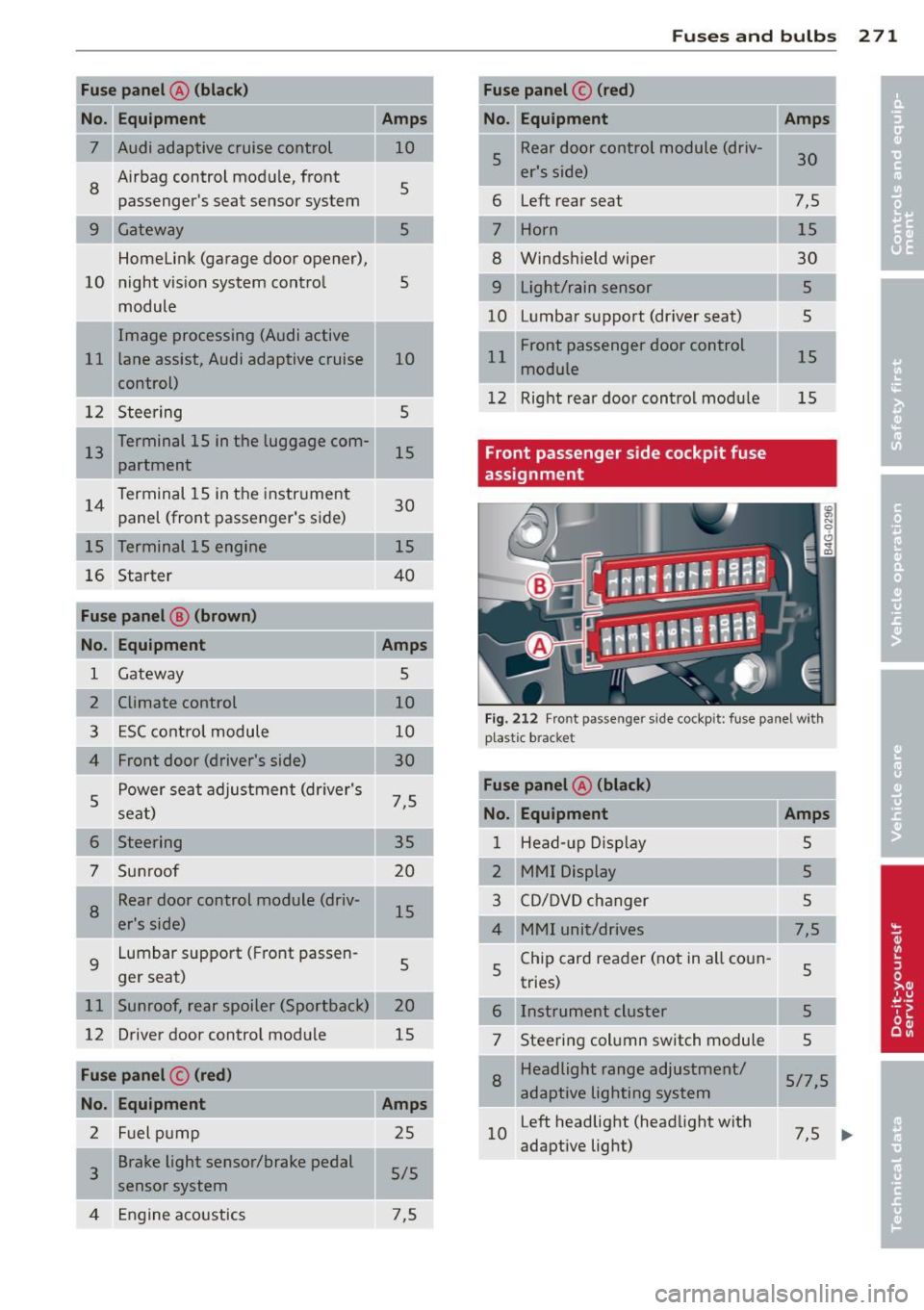
Fuse panel@ (black )
No. Equipment Amps
= = 7 Audi adaptive cruise control 10
8
Airbag control module, front
5
passenger's seat sensor system
Gateway 5
Homelink (garage door opener),
10 night vision system control
5
module
Image processing (Audi active
11 lane assist, Audi adaptive cruise
10
control)
12 Steering 5
1 13 Terminal 15 in the luggage com-
15
partment
14 Terminal 15 in the
instrument
30
panel (front passenger's side)
15 Terminal 15 engine 15
16 Starter 40
Fuse panel
B (brown)
No. Equipment Amps
1 Gateway 5
2 Climate control 10
3 ESC control module 10
Front door (driver's side) 30
s
Power seat adjustment (driver's
7,5
seat)
6 Steering 35
7 Sunroof 20
8
Rear door control module (driv-
15
er's side)
9 Lumbar support (Front passen
-
5
ger seat)
11 Sunroof, rear spoiler (Sportback) 20
12 Driver door control module
15
Fuse panel
c (red)
No. Equipment Amps
2 Fuel pump 25
3 Brake light sensor/brake pedal
sensor system 5/5
4 Engine acoustics 7,5
Fuses and bulbs
-Fuse panel © (red)
No.
u Equipment
5 Rear door
control module (driv-
er's side)
6 Left
rear seat
Horn
Windshield wiper
9 Light/rain sensor
10 L
umbar support (driver seat)
11 Front passenger door control
module
12 Right rear door control modu le
Front passenger side cockpit fuse
assignment Amps
30
7,5 15
30 5
5
15
15
Fig. 212 Front passenger side cockpit: fuse panel wit h
p last ic bracket
Fuse panel A (black)
No. Equipment
Amps
1 Head-up Display 5
2 MMI Display 5
3 CD/DVD changer 5
4 MMI unit/drives
7,5
5 Chip card reader (not in all coun
-
5
tries)
6 Instrument cluster
5
7 Steering column switch module
5
8
Headlight range adjustment/
5/7,5
adaptive lighting system
10 Left
headlight (headlight with
7,5
adaptive light)
I
271
...