airbag AUDI A6 2013 Repair Manual
[x] Cancel search | Manufacturer: AUDI, Model Year: 2013, Model line: A6, Model: AUDI A6 2013Pages: 306, PDF Size: 76.92 MB
Page 191 of 306
~ Tighten the tether strap firmly following
the chi ld restraint manufacturer's instruc
t ions.
Re leasing the tether str ap
~ Loosen the tension following the ch ild re
stra int manufacturer's instructions .
~ Depress the spring catch on the hook and
release it from the anchorage .
0 Note
If you leave the child res traint with the
tether strap firmly insta lled for severa l
days, this cou ld leave a mark on the up
holstery on the seat cushion and backrest
in the area where the tether strap was in
stalled . The upholstery would a lso be per
manently stretched around the tether
strap . This applies especially to leather
seats.
Using tether straps on rearward-facing
child restraints
Currently, few rear-facing child restraint sys
tems come with a tether. P lease read and
heed the child restraint system manufactur
er's instructions carefully to determine how to properly install the tether .
A WARNING
-
A child in a rearward-facing child safety
seat insta lled on the front passenger seat
w ill be se riously injured and can be k illed if
t he fron t airbag inf lates -even with an Ad
vanced Airbag System .
- T he inflating airbag w ill hit the chi ld
sa fety sea t or infant carrier w ith g reat
f orce and wi ll smash the ch ild safety seat
and child against the backrest, center
armrest, or door.
- If you must install a rearward facing
child safety seat on the front passenger
seat because of exceptional circ umstan
ces and the
PASSEN GER AIR BAG OFF
light does not come on and stay on, im
med iately install the rear-facing child
safety seat in a rear s eating position and
Child Sa fet y 189
have the airbag system inspected by your
Aud i dea ler.
Additional Information
Sources of information about child
restraints and their use
There are a number o f sources of additiona l
information abo ut child restraint se lection, in
stallation and use:
NH TSA advises t hat the bes t ch ild safety seat
is the one that fits your chi ld and fits in your
vehicle , and that yo u will use correct ly and
consistently .
T ry before yo u buy!
U .S National Highway Traffic Safety Admin
i s tration
T el.: 1 -888 -3 27-4236 (TIY: 1-800-424-9153)
www. n htsa .gov
National SAFE KIDS Campaign
T el.: (202) 66 2-0600
www.safe kids.org
Safety BeltSaf e U.S.A
T el.: (800) 7 45-SAFE (English)
T el.: (800) 7 47-SANO (Span ish)
www. ca rseat.org
Transport C anada Information C entre
Tel.: 1-800-333-0371 o r ca ll
1-6 13-998-86 16 if you a re in the O ttawa area
http://www .tc.gc .ca /e ng/ roadsafety/
men u.htm
Audi Cu stomer Relation s
Tel.: (800) 82 2-2834 •
•
Page 193 of 306
@ Tips
-Certain Audi pre sense functions are not
ava ilable when ASR is switched off (sport
mode) or when driving in reverse.
- The Audi pre sense functions may not be
available if there is a malfunction in the
ESC system or the airbag control mod
ule.
- The Audi pre sense front/plus functions
are not available if there is a malfunction
in the adaptive cru ise control* system
9 page89.
-The Audi pre sense rear/plus functions
are not available if there is a malfunction
i n the Audi side assist* system
9page89.
Audi pre sense 191
•
•
Page 194 of 306
192 Intelligent technology
Intelligent technology
Notice about data
recorded by vehicle
control modules
Your veh icle is not equipped with an Event Da
ta Recorde r (EDR), ins talled by some manu
facture rs fo r the express p urpose of capturing
data for retrieval after an accident or cras h
event . EDR's are sometimes ca lled "crash re
corders".
Some state laws restr ict the retr ieval or down
loading of data stored by EDR's that were in
stalled in a vehicle for the express purpose of retrieving data after an accident or crash
event without the owner's consent.
A ltho ugh yo ur vehicle is not equ ipped wit h an
EDR, it is equipped with a number of electron
ic control modules for various vehicle systems
such as, for examp le, eng ine f unction, em is
sion control, as well as for the airbags and
safety belts.
These electronic contro l modules also record
vehicle-re lated data during norma l vehicle op
erat ion for diagnostic and repa ir purposes.
The recording capacity of the electronic con
trol modules is limited to data (no sound is re
corded) and only a small amount of data is ac
tually recorded ove r a ve ry limited pe riod of
time and stored when a sys tem faul t or o ther
cond ition is sensed by a cont ro l u nit. Some of
the data then stored may re late to vehicle
speed, direction, braking as we ll as restraint
system use and performance in the event of a
crash or other condit ion. Stored data can only
be read and downloaded w ith special equip
ment.
Electronic Stabilization
Control (ESC)
Description
ESC helps to improve road holding and vehicle
dynamics to help reduce the probability of
skidd ing and loss of ve hicle control. It works
only when the eng ine is running. ESC detects certain difficult driving situat
ions, including
when the vehicle is beginning to spin (yaw)
o ut of control and he lps you to get the veh icle
back under control by se lectively braking the
whee ls, and/or reducing eng ine power and
providing steer ing ass istance to he lp hold the
vehicle o n the dr iver's intended course. The in
dicator light
G) in the inst rument cluster
blinks when ESC is ta king action to help yo u
control the veh icle.
ESC has limitations.
It is importa nt to remem
ber that ESC cannot overcome the laws of
physics. It wi ll not always be able to help out
under a ll cond it ions you may come up aga inst.
F or example, ESC may not always be able to
help you master situations where there is a
s u dden change in the coefficient of friction of
the road surface. When there is a section of
dry road that is sudden ly covered w ith water,
s lush or snow, ESC cannot perform the same
way it wou ld on the dry surface . If the ve hicle
hydroplanes (rides on a cushion of water in
stead of the road surface), ESC will not be
able to help you steer the vehicle because con
tact with the pavement has been in terrupted
and the vehicle cannot be braked or steered .
D uring fast cornering, particularly on winding
roads, ESC cannot always deal as effectively
with difficult driving situations than at lower
speeds. When towing a trailer, ESC is not able
to help you regain control as it would if you
were not tow ing a trailer.
Always adjust your speed and driving style to road, traffic; and weather condit ions. ESC can
not override the vehicle's physical limits, in
crease the availab le tract ion, or keep a ve hicle
on the road if road departure is a result of
drive r inattent io n. Instead, ESC imp roves the
poss ibil ity of keeping the vehi cle under con
trol and on the road during ex treme maneu
vers by using the d river's steering inputs to
help keep the vehicle going in the intended di
rection . If you are traveling at a speed that
ca uses you to run off the road before ESC can
provide any assistance, you may not experi
ence the benefits of ESC.
Page 218 of 306
216 Cleaning and protec tio n
8_ WARNING
Always read and heed all WARNINGS and
the information <=>
page 208.
(D Tips
Open Velcro fasteners on your clothing can
damage the seat cover. Please make sure
that Velcro fasteners are closed.
Plastic parts and instrument panel
Always use a clean cloth moistened in clear
water to clean these areas . For pers istent dirt
use an Audi approved
so lve nt-fr ee plastic
cleane r/protectant.
8_ WARNING
So lvents can change the propert ies of
some plastics and make it harder for the
airbag to dep loy.
-
- Never clean the instr ument pane l or the
surface of airbag modules with cleaning
products that contain solvents.
- Products containing solvents will make the surface of th is part porous.
- Serious injur ies can result if plastic parts
come loose when the airbag is deployed .
- Always read and heed all WARN INGS and
other information <=>
page 208 .
(J;) Note
Clean ing agents containing solvents will
attac k the mater ial a nd can change the
way it behaves.
Trim and molding
Trim and mo lding in the vehicle interior can
be cleaned w ith a dry microfiber cloth. To pre
vent scratches, do not use any cleaning solu
tions.
Natural leather
Applies to vehicles: wit h natural leather
Audi makes great efforts to maintain the
properties, natural look and feel of interior leather.
General
We offer many d ifferent types of leather on
our vehicles. Most are d ifferent types of nappa
leather, which has a smooth surface and
comes in various colors .
The intensity of the co lor determines the visu
al characterist ics and appearance . If the sur
face of the leather has a typ ica l natural look,
then the leather is a nappa leather that has
been left in a relat ively natura l condit ion. This
leather offe rs particularly good comfort and
breathes we ll. Fine veins, closed grai ns, insect
bites, skin fo lds, and subt le va ria tions in color
remain visible . These characteristics demon
strate that the material is natura l.
Natura l nappa le ather is not covered by a co l
o r finish.
It is therefore more sensit ive to soil
ing and wear, which is something you need to
consider if children, animals or other factors
might prove to be part icu larly hard on the
leather.
By contrast, leather types that are covered by
a colored finish layer are more durable . This
has a positive effect on the leather's resist
ance to wear and soiling in dai ly use. On the
other hand, the typical characteristics of natu
ral leather are barely or not apparent . Howev
er, th is does not mean that the leathe r itself
is of inferior quality .
Care and handling
Because of the exclusive nature of the types of
leather that Audi uses and their unique prop
erties (such as sens it ivity to oils, grease, soil
ing, etc.), you will need to be somewhat care
ful with these leathers, and a ce rtain type of
ca re is req uired. For example, dark clothing
mater ials can disco lor le athe r seats (especia l
ly if such clothing is damp and was not dyed
correct ly). Dust and dirt particles in pores ,
folds, and seams can have an abrasive effect .,..
Page 237 of 306
The location of the brake fl uid reservo ir can be
seen in the engine compartment illustration
c::> page227.
The fl uid level may drop slightly after some
time due to the automatic adjustment of the
brake pads. This is not cause for alarm .
If the brake fluid level falls considerably be
l ow the "MIN" mark, the bra ke wa rning/ind i
cator light
1111 (U .S . models)/ . (Canadian
models) will come on
c::> page 15. Do not con
tinue to operate the vehicle. The comp lete
brake system sho uld be thoroughly checked
by an author ized Audi dealer or other quali
fied fac ility and the cause corrected . If the
brake fluid level is too low, the brake warn ing/
i ndicator light w ill illuminate . Contact an au
thor ized Audi dealer
imm ediately .
Changing brake fluid
Have the brake fluid changed by an experi
enced technician .
Brake fluid absorbs moisture from the a ir. If
the water content in the brake fluid is too
h igh, corrosion in the brake system may result
after a per iod of t ime . The bo iling po int of t he
brake fluid w ill also decrease consider ably and
dec rease b raking per formance.
Therefore, the brake flu id must be changed
ever y two years . Always use new b rake fluid
whi ch confo rms to Fede ral Motor Vehicle
Standard "FMVSS 1 16 DO T 4".
The brake flu id rese rvoir ca n be difficult to
r eac h, therefo re , we re commend that yo u
have the brake fl uid changed by y our autho r
i z ed
Audi dealer . Your deale r has the correct
too ls, the right brake fluid and the know -how
to do this for you .
A WARNING
-Brake fluid is po isonous . It must be stor
ed only in the closed orig inal container
out of t he reac h of children!
- Brake fa ilure can result from old o r inap
propr iate brake fluid. Observe these pre
caut ions:
Checkin g and fillin g 235
-Use only brake f luid that meets SAE
spec ificat ion
J 1703 and conforms to
Federal Motor Ve hicle Standard 116.
Always check with your autho rized Audi
dealer to make sure yo u are using the
correct brake fluid . The correct type of
brake f lu id is also ind icated on the
brake flu id rese rvoi r.
- The bra ke fluid must be new. Heavy us e
of the brakes can cause a vapo r lock if
the b ra ke fluid is left i n the system too
l ong . This can se riously affec t the effi
ciency of the b rakes as well as your
safety . This co uld resu lt in an accident.
(D Note
B rak e fluid wi ll damage the pa int o f you r
vehicle .
~ For the sake of the environment
Because o f the p rob lem of pro per disposal
of bra ke fluid as well as the spe cial too ls
r equired an d the necessary exper tise, we
r ecommend that yo u have the brake flu id
changed by yo ur authorized Aud i dea le r.
Battery
General information
U nder normal ope ra ti ng cond itions , the bat
te ry in yo ur Audi doe s not need any ma inte
nance. With
high outside tempera tures or
l ong daily drives we recommend that you have
the e lectrolyte level checked by a service fa
c ili ty. The electrolyte leve l should a lso be
checked each t ime the battery is charged
c:> page 237.
Have the battery checked when yo u take your
vehicle in for service. You are well advised to
replace a batte ry that is older than 5 years .
Wi th certain types of airbag deployment, the
battery is disconnected from the vehicle elec
trical system for safety reasons
c> & in Re
pair , care and disposal of the airbags on
page 161.
~
•
•
Page 273 of 306
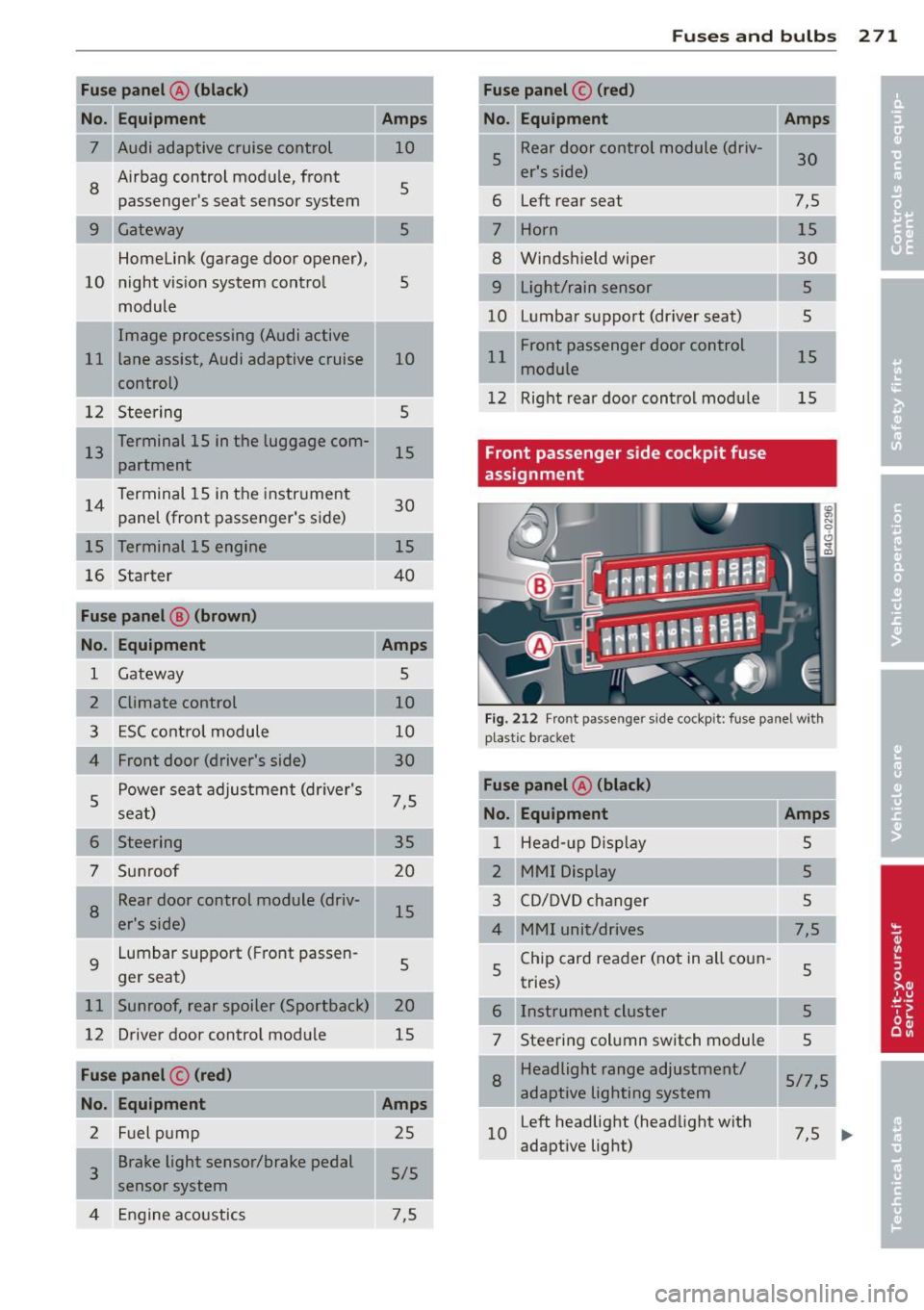
Fuse panel@ (black )
No. Equipment Amps
= = 7 Audi adaptive cruise control 10
8
Airbag control module, front
5
passenger's seat sensor system
Gateway 5
Homelink (garage door opener),
10 night vision system control
5
module
Image processing (Audi active
11 lane assist, Audi adaptive cruise
10
control)
12 Steering 5
1 13 Terminal 15 in the luggage com-
15
partment
14 Terminal 15 in the
instrument
30
panel (front passenger's side)
15 Terminal 15 engine 15
16 Starter 40
Fuse panel
B (brown)
No. Equipment Amps
1 Gateway 5
2 Climate control 10
3 ESC control module 10
Front door (driver's side) 30
s
Power seat adjustment (driver's
7,5
seat)
6 Steering 35
7 Sunroof 20
8
Rear door control module (driv-
15
er's side)
9 Lumbar support (Front passen
-
5
ger seat)
11 Sunroof, rear spoiler (Sportback) 20
12 Driver door control module
15
Fuse panel
c (red)
No. Equipment Amps
2 Fuel pump 25
3 Brake light sensor/brake pedal
sensor system 5/5
4 Engine acoustics 7,5
Fuses and bulbs
-Fuse panel © (red)
No.
u Equipment
5 Rear door
control module (driv-
er's side)
6 Left
rear seat
Horn
Windshield wiper
9 Light/rain sensor
10 L
umbar support (driver seat)
11 Front passenger door control
module
12 Right rear door control modu le
Front passenger side cockpit fuse
assignment Amps
30
7,5 15
30 5
5
15
15
Fig. 212 Front passenger side cockpit: fuse panel wit h
p last ic bracket
Fuse panel A (black)
No. Equipment
Amps
1 Head-up Display 5
2 MMI Display 5
3 CD/DVD changer 5
4 MMI unit/drives
7,5
5 Chip card reader (not in all coun
-
5
tries)
6 Instrument cluster
5
7 Steering column switch module
5
8
Headlight range adjustment/
5/7,5
adaptive lighting system
10 Left
headlight (headlight with
7,5
adaptive light)
I
271
...
Page 289 of 306
-Always make sure the transm ission se
lector lever (automatic transmiss ion) is
in P (Park position) and the park brake is
applied.
@) For the sake of the environment
- Changing the eng ine settings w ill ad
versely affect em ission levels. This is det
rimental to the environment and increas
es fuel consumption .
- Always observe env ironmental regula
tions when d isposing of old engine oil,
used brake fluid, dirty engine coolant,
spent batter ies or worn out t ires.
- Undeployed airbag modules and preten
s ioners might be classified as Perchlo
rate Material -specia l hand ling may ap
ply, see www.dts c.ca .gov/hazardous
waste/perch lorate. When the veh icle or
parts of the restraint system includ ing
airbag modules safety belts wit h preten
sioners are scrapped, all applicable laws
and regulations must be observed. Your
a uthorized Audi dea ler is familiar w ith
these requirements and we recommend
that you have your dea ler perform this
serv ice for you .
Additional accessories,
modifications and
parts replacement
Additional accessories and parts
replacement
Always consult an authorized Audi dealer be
fore purchasing accessories.
Your veh icle incorporates the latest safety de
sig n featu res ensu ring a high standard of ac
tive and passive safety.
This safety could be compromised by non-ap proved changes to the veh icle. For this reason,
if parts have to be replaced, please observe
the following points when install ing addition
a l accessories:
Con sumer In formation 287
Approved Audi accesso ries and genuine Audi
parts are available from authorized Audi deal
ers.
T hese dea lers a lso have the necessary facili
ties, tools and trained specialists to install the
parts and accessories proper ly.
A WARNING
Using the wrong spare parts or using non
approved accessories can cause damage to
the vehicle and serious persona l injury.
- Use on ly accessories express ly approved
by Audi and genu ine Audi spare parts
- These parts and accessories have been
specially designed to be used on your ve
hicle .
- Never install accessories such as tele
phone cradles or beverage holders on air
bag covers or within the airbag deploy
ment zones . Do ing so will increase the
risk of injury if a irbags are triggered in an
accident!
- Before you check anything in the engine
compa rtment, always read and heed all
WARNINGS
r:::;. page 219.
(D Note
-If items other than genuine Audi spare
parts, add-on equipment and accessory
items are used or if repair work is not
performed accord ing to spe cified meth
ods, this can result in severe damage to
yo ur vehicle's engine and body (such as
corrosion) and adversely affect your vehi
cle's warranty .
- If emergency repairs must be performed
elsewhere, have the vehicle examined by
an authorized Audi dealer as soon as
possible.
- The manufacturer cannot be held liable
for damage wh ich occurs due to failure
to comply with these stipulations.
•
•
Page 292 of 306
29 0 Index
A
Accessories . ...... ..... ... .. .. .... . 28 7
Active lane ass ist . . . . . . . . . . . . . . . . . . . . 91
Activating and deactivating . . . . . . . . . . . 92
C leaning came ra area ... .. .. .. .. .. . 211
Descr ipt ion ... ........... .. .. .... .. 9 1
I nstrument cluster indicator light . . . . . 92
Messages . . . . . . . . . . . . . . . . . . . . . . . . . 92
Notes on instrument cluster display . . . . 92
Setting the steering wheel vibrat ion . . . . 93
AC (automatic cl imate control) . .. .. .. .. 67
AC (climate control) . . . . . . . . . . . . . . . . . . 65
Adaptive air suspension/sport . ... .. .. . . 98
Adapt ive cruise control . . . . . . . . . . . . . . . . 82
C leaning sensors/cameras .. .. .. .... . 211
Messages ............... .. .. .. .. .. 89
Request for driver intervention . . . . . . . . 8 7
Stop-and-go traffic . . . . . . . . . . . . . . . . . 86
Adapt ive Lig ht (defective) ... .. .. .... .. 22
Adding Eng ine coolant ............. .. .... . 233
Eng ine oil .. ..... ........... ... .. . 230
W indshield washer fluid .. ... .. .. .. . 239
Additives Eng ine oil ............... .. .. .. .. . 230
Ad justing
Air distribution (automatic climate con-
trol) ..... .. ... .. ..... ... .. .. .... .. 68
air distribution (climate control) . .... .. 65
Front seats . . . . . . . . . . . . . . . . . . . . . . . . 50
Instrument illum inat ion ... .. .. .. .. . .
44
Steer ing column electrically .. .. .. .. . . 70
Steer ing column manually ..... .. .... 70
Tempe ratu re (automat ic climate control) 68
Tempe ratu re (climate control) .. .. .. . . 65
A irbag system . . . . . . . . . . . . . . . . . 145, 166
Advanced Airbag System . . . . . . . . . . . . 149
Advanced Airbag System components . 153
Care ....... .......... ...... ... .. . 161
C hi ldren . ............... .. .. .... . 173
C hi ld restra ints ........... .. .. .. .. . 173
Components (front airbags) . .... ... . 153
Danger of fitting a child seat on the front
passenger seat . . . . . . . . . . . . . . . . . . . . 147
Disposa l ..... ........... .. .. .... . 161
Front airbags . . . . . . . . . . . . . . . . 149, 151
H ow do the front airbags work? . .... . 155 How many a
irbags does my vehicle
have? . ... .... .. .. ... .. ..... ... .. 153
How the Advanced Airbag System com -
ponents work together ......... .... 155
Important safety instructions on the
knee airbag system ................ 164
Important things to know . .. .. .. .. .. 145
Knee airbags . .. .. .......... ...... . 162
Monito ring .. .. . .. ............ .. .. 15 7
PASS ENG ER A IR BAG OFF light ... .. .. 158
Repairs ... .... .. .. ... .. . .... ... .. 161
Safety instr uctions . .. .. ..... .... . .. 160
Side airbags ..... .. ... ..... ... .. .. 165
S ide curtain airbags ............ .... 168
Warning/ind icator lights ........ .... . 19
Warning/Indicator lights ....... .... 157
When must the system be inspected? 157
Aircraft Transporting your vehicle ..... .. .. .. 278
All-wheel drive .. .. ............. .... 196
Win ter tires . .. . .. ............ .. .. 255
Alloy wheels .. .. .. .......... ...... . 213
Alternator . . . . . . . . . . . . . . . . . . . . . . . . . . 17
Amb ience lighting ................ ... 44
Anti-freeze
refer to Eng ine coolant ............ . 232
Anti- lock braking system . ..... ... .. .. 192
Warning/ind icator lights ........ .... . 20
An ti-s lip reg ulation ............. .. .. 192
Anti-theft systems Electronic immob ilizer ............. .. 32
Ashtray . ... .... .. .. ... .. ..... ... .. . 56
Audi braking guard
refer to b rak ing guard .......... .... . 82
Audi drive select
refer to drive select ............... .. 98
Audi Serv ice Repair Manuals and Litera-
ture ... .... .... .. ............. .... 285
A UTO
a ut omatic climate contro l . . . . . . . . . . . . 68
Automatic headlights ... .... ... .. .. . 41
climate control ... .. ... ..... ... .. .. . 65
A uto Lock .. .... ... ................ . 33
Automat ic be lt retractor ........... .. 139
A utomatic car wash . .... ..... ... .. .. 209
Page 296 of 306
294 Index
------------------------------------
Data .... ....... ......... ... .... . 282
Start-Stop-System . . . . . . . . . . . . . . . . . . 76
start ing .. .. ................ ..... .. 71
Startingwithjumpercables .. .. ..... 274
Stopping . . . . . . . . . . . . . . . . . . . . . . . . . . 73
Engine compartment ........ .... ... . 227
C losing the hood .......... ... .... . 226
Opening the hood ................. 225
Safety instructions ........ .. .. .... . 225
Working in the engine compartment .. 225
Engine coolant .................... . 232
Adding coolant ............ ... .... . 233
Checking the engine coolant level .... . 232
Expansion tank ........... .. .. .. .. . 232
Malfunction symbol ....... .. .. .... .. 16
Radiator fan .............. ... .. .. . 234
Temperature gauge ........ ..... .. .. 11
Engine oil ... ................ ..... . 227
Adding .. .... ........... .... .... . 230
Additives . .. ............. .. .. .. ... 230
Changing .... ... .... .... .. .. .. .. . 231
Check ing the engine oil level .. .. .. .. . 230
I ndications and cond it ions requ iring ex-
tra checking .. ........... .. .. .... . 230
I ndicator light ........... .. .. .. .. .. 18
O il consumption .......... .... .... . 229
Oil grades . ................. ..... . 227
Oil level symbol .................... 21
Pressure malfunction ....... ... .. .. .. 17
Recommended oil check intervals ..... 230
Sensor defective . . . . . . . . . . . . . . . . . . . . 21
Specification and viscosity .. .. .. .. .. . 227
Engine sound .............. ... .... .. 98
E ng ine speed limitation ....... .. .. .. . . 21
Engine start-stop mode
refer to Star t-Stop-System ... .. .. .. .. 78
Engine start system (indicator lights) . ... 18
Environment Break-in period ......... .. .. .. .. .. . 199
Cata lytic converter ........ .. .. .. .. . 200
Disposing of your vehicle battery . ... . 239
Driving at high speeds .............. 202
Driving to minimize pollution and noise 201
Fuel . .. .. ............... .. .. .... . 222
Fuel economy ............ .... .... . 201
Leaks under your vehicle ... .. .. .. .. . 225
Lett ing the vehicle stand and warm up . 202
Proper disposal of drained brake fluid . 235 Proper disposal of d
rained engine cool-
ant ..... ..... .. .. .............. . 233
Proper disposal of drained eng ine
oil . . . . . . . . . . . . . . . . . . . . . . . . . 230,231
Recycling used engine oil ........ .... 230
Unleaded fuel .. .. ................ . 220
What should I do with an old battery? . 239
ESC (Electronic Stabilization Control) Warning/indicator lights ........ .. .. . 19
Event Data Recorder (EDR) ........ .. .. 192
Exhaust tail pipes .. .......... ...... . 214
Expansion tank .... ................ . 232
Exterior lighting . ... ............ .. .. . 41
Exterior mirrors Adjusting ..... .. .. ........ ...... .. 48
Dimming .. .. .. .. .. ..... ...... .. .. . 48
Heating ...... ... .. .............. .. 48
Exterior temperature display ...... .. .. . 23
F
Fastening
Booster seats . . . . . . . . . . . . . . . . . . . . . 180
Convertible child safety seats . . . . . . . . 178
Infant seats ... .. ............. .... 177
Floor mats . ..... .. ................ . 131
Foot pedals ..... .. ..... ........... . 131
For the sake of the environment Gasoline fumes and the environment .. 222
Reducing engine noise by early upshift-
ing ...... .... ... .. ................ 11
Refueling ... .. .. ....... ...... .. .. 222
Sav ing fuel by early upsh ifting . .. .. .. . 11
Four- zone automatic climate control . .. . 67
Front airbags
Description .... .. ................ . 149
How they work ... ................ . 155
Frontal coll is ions and the laws of phys ics 137
Front seats . . . . . . . . . . . . . . . . . . . . . . . . . 50
Adjusting ... .. .. ....... ...... .. .. 128
Child restraints in the front seat ...... 147
Fuel Additives .. .... .. ............. .... 220
Blended gasoline .............. .... 220
Current consumption .............. .. 24
Economy messages (efficiency program) 26
Fuel filler flap emergency release ... .. 223
Page 297 of 306
Fuel filler neck ................ .... 221
Fuel gauge ................. ... .... 12
Gasoline ... ................ ... .. . 220
Gasoline additives ........ .. .. .. .. . 221
Low fuel level symbol . . . . . . . . . . . . . . . 21
Octane rating ............... ... ... 220
Recommendation .... ..... .. .. .. .. . 220
Refuelling ............ ...... .... .. 222
Reserve .. .. ............. .. .. .. .. .. 12
Tank capacity . . . . . . . . . . . . . . . . . 12, 282
Fuses Assignment ..... .. ...... .. .. .. .. . 270
Replacing .. ................ ... ... 270
G
Garage door opener (Homelink ®) . ... .. 124
Garment hooks . . . . . . . . . . . . . . . . . . . . . . 58
Gas discharge lamps ........ .. .. .. .. . 273
Gauges Engine coolant temperature .. .. .. ... . 11
Fuel gauge . .. .............. ... ... . 12
Speedometer . ........ .... ... ... ... 27
Tachometer . . . . . . . . . . . . . . . . . . . . . . . 12
Trip odometer ........... .. .. .. .. .. 27
General illustration . ....... .. .. .. .. ... 8
Generator (warning/indicator lights) . ... 17
Glossary of tire and loading terminology 241
Glove compartment (cooled) . .. .. .. .. .. 58
Gross Vehicle Weight Rating (GVWR) .. . 280
H
Head -up Display . . . . . . . . . . . . . . . . . . . . . 28
Headlights Cleaning system . .......... ... ... ... 46
Defective . . . . . . . . . . . . . . . . . . . . . . . . . 22
Headlight range control . . . . . . . . . 22, 41
Washer reservoir ......... .. .. .. .. . 239
Head restraints . . . . . . . . . . . . . . . . . 53, 130
Adjusting .. .. ... .. ... ... .. .. .. .. . 130
Front seats . . . . . . . . . . . . . . . . . . . . . . . . 53
Rear seats . . . . . . . . . . . . . . . . . . . . . . . . . 53
Removing .. .... ......... .... .. .. .. 53
Heated exterior mirrors . ...... ... .. .. .. .. .. 48
rear window (automatic climate control) 68
rear window (climate control) . .. ... ... 66
Index 295
seats (automatic climate control) ...... 68
seats (climate control) . . . . . . . . . . . . . . . 66
windshield washer spray nozzles ..... . 46
Heating .. .. .. .. .. .... ........... .. . 64
Heavy clothing and safety belts .. .. .. .. 139
High beam ... ..... .. ................ 43
High voltage warning label .......... . 280
Hill descent control ................. 108
Homelink ® universal remote control . .. 124
Hood (release lever) .. .. .. ...... .... . 225
Horn ....... ... .... .. .............. . 8
How are child restraint system anchors re-
lated to child safety .... ......... .. .. 185
How many airbags does my vehicle have? 153
How often should I check my tire pres-
sures? ............................ 247
How safety belt pretensioners work .. .. 143
Hydroplaning . .. .. .. .. ........... .. 251
I
Immobilizer .. .. ...... ............. . 27
Important things to do before driving .. 126
Improperly worn safety belts .......... 142
Indicator lights
refer to Warning/indicator lights ... .. . 12
Infant seats .. .. ...... ........... .. 177
Installing child safety seats Safety belts . . . . . . . . . . . . . . . . . . . . . . 182
Installing the upper tether strap on the
anchorage .. .... .. .. . .............. 188
Instruments Adjusting the lighting ............... 44
Instruments and controls General illustration . . . . . . . . . . . . . . . . . . 8
Instrument cluster . . . . . . . . . . . . . . . . . . 11
Interior lighting Ambience lighting .. .. .. ...... .... .. 44
Front and rear ... .. .. .. ...... .... .. 44
Intermittent (windshield wipers) .... .. . 46
J
Jack ........ ... .... ............... 262
Jump-starting . .. .... .. .. ...... .... . 274
Jumper cables . .. .. ................. 275
•
•