Economic AUDI A6 2013 Owners Manual
[x] Cancel search | Manufacturer: AUDI, Model Year: 2013, Model line: A6, Model: AUDI A6 2013Pages: 306, PDF Size: 76.92 MB
Page 5 of 306
Error messages . . . . . . . . . . . . . . . . . . 123
Trailer hitch . . . . . . . . . . . . . . . . . . . . . 123
Homelink ® . . . . . . . . . . . . . . . . . . . . 124
Universal remote control . . . . . . . . . . . 124
Safety fir st . . . . . . . . . . . . . . . . . . . . 126
Driving Safely . . . . . . . . . . . . . . . . . 126
Gene ral notes . . . . . . . . . . . . . . . . . . . . 126
Proper occupant seating posit ions . . . 12 7
Driver and passenger side footwell . . . 131
Pedal area . . . . . . . . . . . . . . . . . . . . . . . 131
Stowing luggage . . . . . . . . . . . . . . . . . 132
Report ing Safety Defects . . . . . . . . . . . 134
Safety belts . . . . . . . . . . . . . . . . . . . 136
Ge neral notes . . . . . . . . . . . . . . . . . . . . 136
Why safety be lts? . . . . . . . . . . . . . . . . 137
Safety belts . . . . . . . . . . . . . . . . . . . . . 139
Safety bel t pre tens io ners . . . . . . . . . . 1 43
Airbag system . . . . . . . . . . . . . . . . . 145
I mpo rtant th ings to know . . . . . . . . . . 145
Fr ont airbags . . . . . . . . . . . . . . . . . . . . 1 49
M on itoring the Advanced Airbag
System . . . . . . . . . . . . . . . . . . . . . . . . . 157
Knee airbags . . . . . . . . . . . . . . . . . . . . . 162
Side airbags . . . . . . . . . . . . . . . . . . . . . 165
Side curta in a irbags . . . . . . . . . . . . . . . 168
Child Safety . . . . . . . . . . . . . . . . . . . 171
Important things to know . . . . . . . . . . 171
C hi ld safety seats . . . . . . . . . . . . . . . . . 177
Install ing a child safety seat . . . . . . . . 182
L ATC H Lower ancho rages and tethe rs
for ch ild ren . . . . . . . . . . . . . . . . . . . . . . 185
Addit ional Information 189
Audi pre sense . . . . . . . . . . . . . . . . 190
P reven tat ive passenger p rotection 190
Vehicle operat ion . . . . . . . . . . . . . 192
Intelligent technology . . . . . . . . 19 2
Not ice about da ta re cor ded by veh icle
control mod ules . . . . . . . . . . . . . . . . . . 192
Elect ronic Stabilization Control (ESC) . 192
Braking . . . . . . . . . . . . . . . . . . . . . . . . . 194
E lectro-mechanical power assist . . . . . 196
Table of contents 3
Driving with your q uattro ® . . . . . . . . . 196
Energy management . . . . . . . . . . . . . . 197
Driving and environment . . . . . 199
The first 1,000 miles (1,500 km) and
afterwards . . . . . . . . . . . . . . . . . . . . . . 199
Catalytic converter . . . . . . . . . . . . . . . . 200
Avoid damaging the vehicle . . . . . . . . . 200
Drivi ng throug h wate r on roads . . . . . 201
Operate your vehicle economically and
min imize poll ution . . . . . . . . . . . . . . . . 201
Trailer towing . . . . . . . . . . . . . . . . . 204
D rivi ng with a trailer . . . . . . . . . . . . . . 204
T ra ile r tow ing tips . . . . . . . . . . . . . . . . 206
Vehicle care . . . . . . . . . . . . . . . . . . . 208
Cleaning and protection . . . . . . 208
General infor mation . . . . . . . . . . . . . . 208
Care of ex ter ior . . . . . . . . . . . . . . . . . . 208
Care of interior . . . . . . . . . . . . . . . . . . . 214
Fuel supply and filling your
fuel tank . . . . . . . . . . . . . . . . . . . . . . .
220
Gasoline . . . . . . . . . . . . . . . . . . . . . . . . 220
F uel tank. . . . . . . . . . . . . . . . . . . . . . . . 221
Checking and filling . . . . . . . . . . . 225
Engine hood . . . . . . . . . . . . . . . . . . . . . 225
Engine compartment . . . . . . . . . . . . . . 227
Engine oi l . . . . . . . . . . . . . . . . . . . . . . . 227
Engine cooling system . . . . . . . . . . . . . 232
Brake fluid . . . . . . . . . . . . . . . . . . . . . . 234
Battery . . . . . . . . . . . . . . . . . . . . . . . . . 235
Windsh ield/headlight washer
co ntaine r . . . . . . . . . . . . . . . . . . . . . . . 239
Tires and wheels . . . . . . . . . . . . . . 240
T ires . . . . . . . . . . . . . . . . . . . . . . . . . . . 240
T ire pressu re mo nitoring system 258
Do-it-yourself service . . . . . . . . . 261
What do I do now? . . . . . . . . . . . . 261
T ru nk escape handle . . . . . . . . . . . . . . 261
E mergency warn ing triangle . . . . . . . . 261
Vehicle tool kit . . . . . . . . . . . . . . . . . . . 26 2
Changing a wheel . . . . . . . . . . . . . . . . . 263
•
•
Page 107 of 306
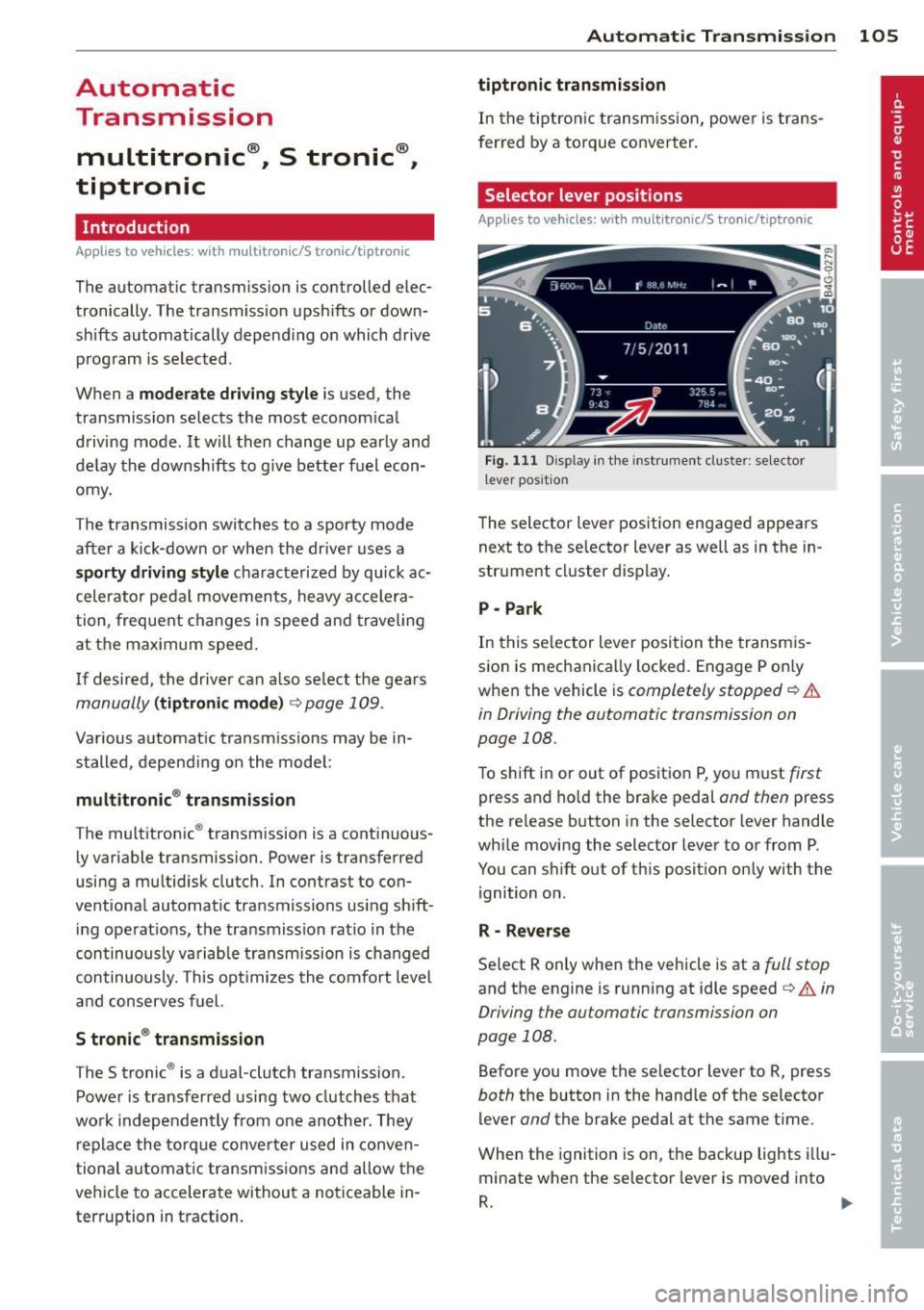
Automatic Transmission
multitronic ®, S tronic ®,
tiptronic
Introduction
App lies to vehicles: with multitro ni c/S tronic/t iptronic
The automatic transmission is controlled elec
tronically . The transmission upshifts or down
shifts automatically depend ing on which drive
program is se lected.
When a
moderate driving style is used, the
transmission selects the most economical
driving mode .
It will then change up early and
de lay the downshifts to g ive better fuel econ
omy.
The transmission switches to a sporty mode after a k ick-down or when the driver uses a
sporty driving style characterized by quick ac
celerator pedal movements, heavy accelera
tion, frequent changes in speed and traveling
at the maximum speed.
If desired, the driver can a lso se lect the gears
manually (t iptronic mode ) ¢ page 109.
Various automatic transm issions may be in
stalled, depend ing on the model :
multitronic® transmission
The multitronic ® transmission is a continuous
ly variable transmission. Power is transferred
using a multidisk clutch. In contrast to con
ventional automatic transmissions using shift
ing operat ions, the transmission ratio in the
continuously variable transmission is changed
continuously. This opt imizes the comfort level
and conserves fuel.
S tronic ® transmission
The S tronic ® is a dual-clutch transmission .
Power is transferred using two clutches that
work independently from one another. They
r eplace the torque converter used in conven
tional automat ic transmissions and allow the
vehicle to accelerate without a noticeable in
terruption in traction.
Automatic Transmission 105
tiptronic transmission
In the tiptronic transmission, power is trans
ferred by a torque converter .
Selector lever positions
Applies to vehicles: wit h mult itronic/5 tro nic/tiptro nic
Fig. 111 Disp lay in the instrument cluster: selector
l ever pos itio n
The selector lever position engaged appears
next to the selector lever as well as in the in
strument cluster display.
P -Park
In this selector lever position the transmis
sion is mechanically locked. Engage P only
when the vehicle is
completely stopped¢&.
in Driving the automatic transmission on
page 108.
To shift in or out of position P, yo u must first
press and ho ld the brake pedal and then press
the release button in the selector lever handle
while moving the selector lever to or from P .
You can shift out of this position only with the ignition on .
R -Reverse
Select R only when the vehicle is at a full stop
and the engine is running at idle speed¢ A in
Driving the automatic transmission on
page 108.
Before you move the se lector lever to R, press
both the button in the handle of the selector
lever
and the brake pedal at the same time .
When the ignition is on, the backup lights illu
minate when the selector lever is moved into
R. .,.
Page 203 of 306
Driving through water
on roads
Note the following to avoid vehicle damage
when driving through water, for example on
flooded roads:
- The water must not be any higher than the
bottom of the vehicle body.
- Do not drive faster than wa lking speed.
A WARNING
After driving through water, mud, slush,
etc., the brakes may be slow to take effect
because of wet brake rotors and pads. Dry
the brakes first by braking carefully to re
store the full b raking effect.
([) Note
-Vehicle components such as the eng ine,
transmission, suspension or electr ical
system can be severely damaged by driv
i ng th rough water.
- Always switch off the Start-Stop-System
when driving through water~ page 76.
(D Tips
-Check the depth of the water before dr iv
i ng t hrough it.
- Do not stop the veh icle, dr ive in reverse
or switch the eng ine off whe n driving
through water .
- Keep in mind that oncoming vehicles
may create waves that raise the water
level and make it too deep fo r your vehi
cle to drive t hrough safely.
- Avoid dr iv ing through salt water because
i t can cause corrosion.
Dri vin g and en vironm ent 201
Operate your vehicle
economically and
minimize pollution
General
Your personal style of driving will determine
the economy of your vehicle, as well as ex
haust and noise levels.
Fuel economy, environmenta l impact, and
wear on your eng ine, brakes and tires largely
depend on three factors:
- your pe rsonal d riving style
- operating conditions
- technical limitat ions
If you ant ic ipate what you need to do next and
drive economically, you can easily cut you r
fuel consumpt io n by 10-15 percent . T his sec
tion w ill give you some tips on how you can
help the env ironment and your po cketbook.
@ Tips
The consumption estimates as published
by ENVIRONMENTAL PROT ECTI ON AGENCY
( E PA) a nd Tra nspo rt Canada may no t corre
spond to your actual consump tion on the
road, which will va ry depending upon vehi
cle load and speed, road and weather con
ditions, trip length, etc.
Drive smoothly and keep a lookout
ahead
Vehicles use the most fuel when they are ac
celerating.
.,. Avoid unnecessary accelerating and braking.
Vehicles use the most f ue l when they a re ac
ce le rat ing. If you ant icipate what is going to
happen next, you will need to brake less and,
th us, acce lerate less . Let the vehicle coast
whenever possible - for examp le when you see
that the next traff ic light is red.
•
•
Page 204 of 306
202 Driving and environment
Avoid full throttle
Driving at moderate speeds saves fuel and
improves your mileage.
.,. Try and keep well below your car's maxi-
mum speed.
Accelerating gently reduces fuel consump
tion, engine wear, and does not disturb the
environment.
Fu el consumption, exhaust emissions and en
gine noise increase disproportionately at high
speeds. If you drive at approximately three
quarters of top speed, fuel consumption will
be reduced by one half. Never drive faster
than the posted speed limit and weather con
ditions permit .
Reducing unnecessary idling
Even when your car is just idling it burns up
fuel.
.,. Shut the engine off when you are not driv
ing the vehicle .
... Do not warm up the veh icle by letting the
engine run at idle .
The idling phase is automat ically reduced for
vehicles w ith the Start/Stop system .
It is effi
cient to switch
off the engine in vehicles with
out the Start-Stop-System when stopped at
railroad crossings and long red lights . Turning
the engine
off for just 30-40 seconds saves
more f uel than is burned by starting the en
gine again.
It takes a long time for the engine to wa rm up
fully when it is running at idle. However, wear
and noxious emissions are especially high
when the engine is warming up. So you should
drive away as soon as you start the engine and
avoid running at high rpms while the engine is
still warming up.
([) Note
Do not leave engine idling unattended af
ter starting. If warning lights should come
on to indicate improper operation, they would
go unheeded. Extended idling also
produces heat, which could result in over
heating or other damage to the veh icle or
other property .
Regular maintenance
A badly tuned engine unnecessarily wastes a
lot of fuel.
.,. Have your vehicle serviced at regu la r inter-
vals .
By having your veh icle reg ularly se rviced by an
Audi dealer he lps to ensure that it runs prop
erly and economically. The condition of your
vehicle not only affects its safety and ability to
ho ld its value, it also affects
fuel consump
tion .
Check your oil each time you fill your tank.
The amou nt of oi l used is related to engine
load and speed.
It is normal for the oil consumption of a new
engine to reach its lowest value after a certain
mileage has been driven .
You must drive your veh icle about 3,000 miles
(5,000 kilometers) before you can properly
assess oil consumpt ion.
This also app lies to fuel consumption and en
gine output .
(D Note
-Have your veh icle ma inta ined properly
and in accordance with the service rec
ommendations in your Warranty
& Main
tenance booklet. Lack of proper ma inte
nance as well as improper use of the ve
hicle will impair the function of the
em ission control system and could lead
to damage.
- Do not alter or remove any component of
t he Emission Control System unless ap
proved by the manufacturer .
- Do not alter or remove any device, such
as heat shields, switches, ignition wires,
valves, which are designed to protect
your vehicle's Emission Control System