break AUDI A6 2014 User Guide
[x] Cancel search | Manufacturer: AUDI, Model Year: 2014, Model line: A6, Model: AUDI A6 2014Pages: 304, PDF Size: 76.32 MB
Page 170 of 304
168 Airbag system
Always remember that the side airbag system
can only help to protect you if you are wearing
your safety belt and wearing it properly. This
is another reason w hy you should always wear
your safety belts, not just because the law re
quires you to do so
Q page 138, General
notes.
It is important to remember that while the
supplemental side airbag system is designed
to reduce the likelihood of serious injuries,
other injuries, for example, swelling, bruising,
friction burns and minor abrasions can also be
associated with deployed side airbags. Remember too, side airbags will deploy only
once and only in certain kinds of accidents -
your safety belts are always there to offer pro
tection .
Vehicle damage, repair costs or even the lack
of vehicle damage are not necessarily an indi
cation of over-sensitive or failed airbag activa
tion. In some collisions, both front and side
airbags may inflate. Remember too, that air
bags will deploy only once and only in certain
kinds of collisions -your safety belts are al
ways there to offer protection in those acci
dents in which airbags are not supposed to
deploy or when they have already deployed.
The side airbag system will not deploy:
- when the ign ition is switched off
- in side collisions when the acceleration
measured by the sensor is too low
- in front-end collisions
- in rear-end collisions
- in rollovers.
In some types of accidents the front airbags,
side curtain airbags and side airbags may be
triggered together.
.&_ WARNING
- Safety belts and the airbag system will
only provide protection when occupants
are in the proper seating position
Qpoge 169.
- If the airbag indicator light Q page 19
comes when the vehicle is being used,
-
have the system inspected immediately
by your authorized Audi dealer. It is pos
sible that the airbag will inflate when it
is not supposed to, or will not inflate
when it should.
How supplemental side airbags work
Side airbags deploy instantly and can help re
duce the risk of upper torso injuries for occu
pants who are properly restrained .
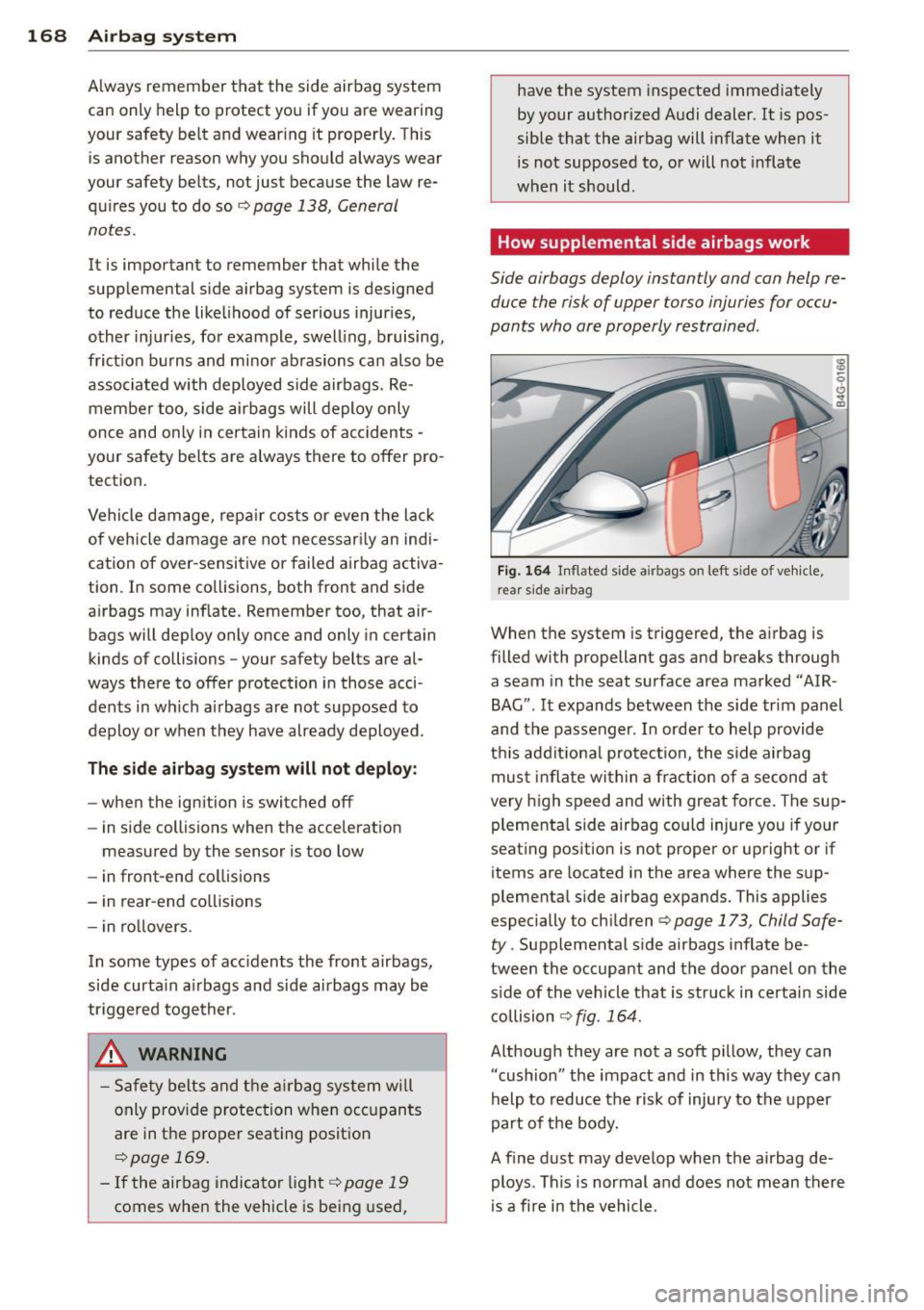
Fig. 164 Inflated side airbags on left s ide of vehicle ,
rear side a irbag
When the system is triggered, the airbag is
filled with propellant gas and breaks through
a seam in the seat surface area marked "AIR
BAG".
It expands between the side trim panel
and the passenger. In order to help provide
this additional protection, the side airbag must inflate within a fraction of a second at
very high speed and with great force. The sup
plemental side airbag could injure you if your
seating position is not proper or upright or if
items are located in the area where the sup
plemental side airbag expands. This applies
especially to children
Q page 173, Child Safe
ty .
Supplemental side airbags inflate be
tween the occupant and the door panel on the side of the vehicle that is struck in certain side
collision
Q fig. 164 .
Although they are not a soft pillow, they can "cushion" the impact and in this way they can
help to reduce the risk of injury to the upper
part of the body.
A fine dust may develop when the airbag de ploys . This is normal and does not mean there
is a fire in the vehicle.
Page 173 of 304
-The side curtain airbags above the front and
rear side windows
- The airbag ind icator light in the instrument
pane l
The a irbag system is monitored elect ro nic ally
to make certain it is f unct io ni ng proper ly a t all
times. Eac h time you switch on the ignition,
the airbag system indicator light wi ll come on
for a few seconds (se lf diagnost ics) .
The side curtain airbag is not activated:
-if the ign ition is swit ched off,
- i n s ide coll isions when the accelerat ion
measured by the sensor is too low,
- in rear-end collisions .
_& WARNING
-Sa fety belts and t he a irbag system w ill
only p rov ide p rotection whe n occu pan ts
are in the proper sea ting posit ion
¢ page 5 2, General recommendations.
- If the airbag indicator light ¢ page 19
comes when the vehicle is be ing used,
have the system inspected immediate ly
by you r aut ho rized Audi dea ler . It is pos
sible that the airbag will inflate when it
is not s upposed to, or w ill not inflate
when it sho uld.
How side curtain airbags work
Side curtain airbags can work together with
side airbags to help reduce the risk of head
and upper torso injuries for occupants who
are properly restrained .
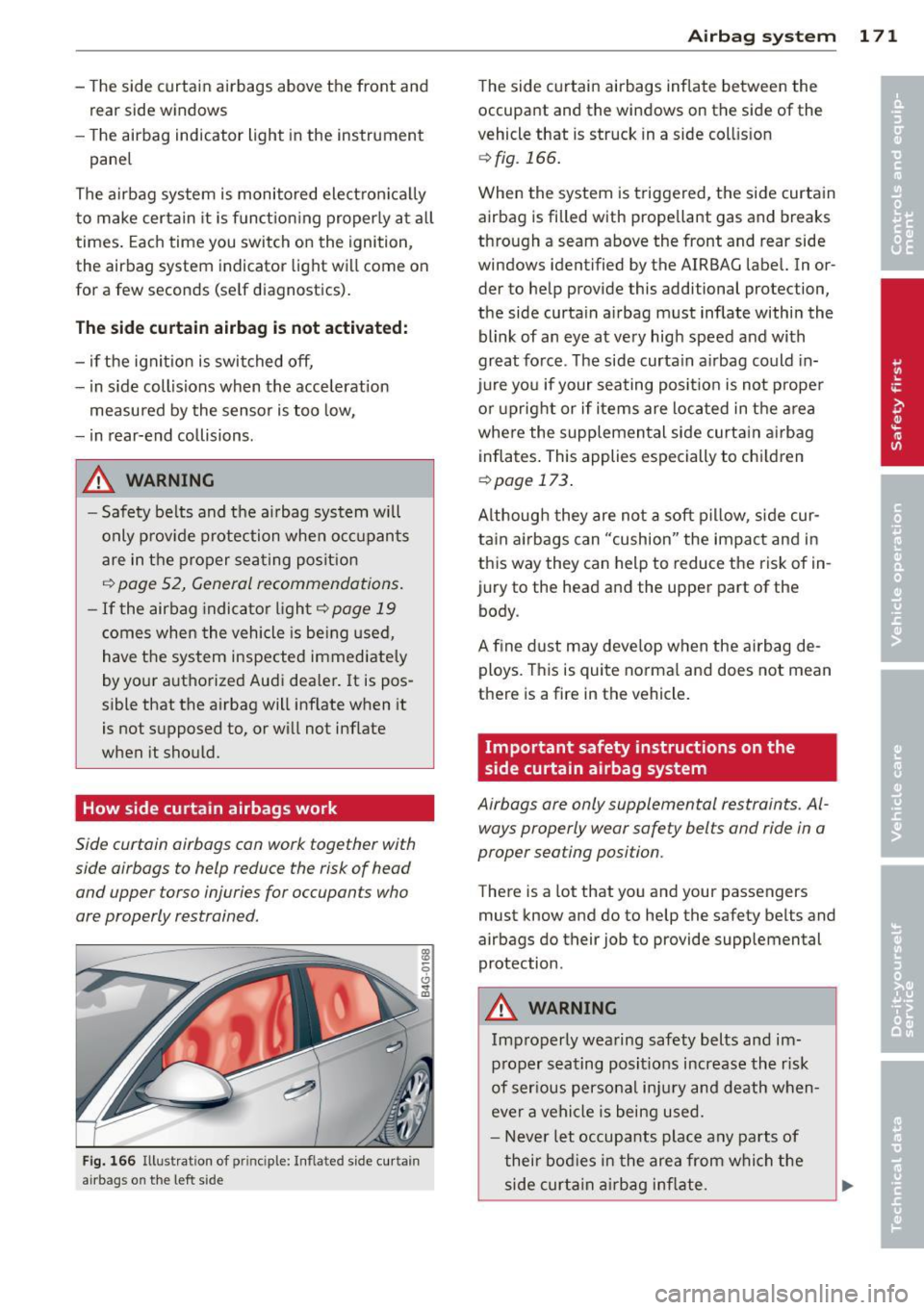
Fig . 1 66 Ill ustra tion of princip le: In flated side cur ta in
airbags on t he left s ide
.
A irba g sy stem 1 71
The side c urtain airbags infla te between the
occupant and the windows on the side of the
vehicle that is struck in a side coll is ion
¢ fig . 166.
When the system is trigge red, t he side curta in
airbag is filled with propellant gas and breaks
th ro ugh a seam above the front and rear side
windows identified by the AIRBAG labe l. In or
der to he lp provide this additional protection,
the side curta in a irbag must inflate withi n the
blink of an eye at ve ry hig h speed and with
great fo rce . T he side curta in a irbag could in
j u re yo u if your sea ting posit io n is not proper
o r u pright or if items are loca ted in t he a rea
where the supplemental side curta in a irbag
in flates . This applies especially to chi ld ren
~ page 173 .
Although they are no t a soft pillow, side cur
ta in a irbags can "cushion" the impact and in
this way they can help to reduce the risk of in
j u ry to the head and the uppe r part of the
body .
A fine dust may deve lop when the airbag de
ploys . This is qui te no rma l and does not mean
there is a fire in the vehicle .
Important safety instructions on the
side curtain airbag system
Airbags are only supplemental restraints . Al
ways properly wear safe ty belts and ride in a
proper seating position.
There is a lot that you and your passengers
must know and do to help the safety belts and
airbags do t heir job to provide supplemental
protection .
_& WARNING ...__
Improperly wea ring safety belts and im
p roper seating posit ions increase the risk
of ser ious perso nal inj ury and death when
ever a vehicle is being used.
- Never let occupa nts pla ce any pa rts of
thei r bo dies in t he area fro m whi ch the
side curt ain air bag inf late.
-
Page 203 of 304
Driving and
environment
The first 1
1000
miles
(11500 km) and
afterwards
New engine
The engine needs to be run-in during the first
1,000 miles (1 ,500 km) .
For the first 600 mile s (1,000
kilometers ):
.,. Do not use full throttle.
.,. Do not drive at engine speeds that are more
than 2/3 of the max imum permitted RPM .
.. Avoid high engine speeds .
From 600 to 1,000 mile s (1 ,000 to
1,500 kilometers):
.. Speeds can gradually be increased to the
maximum pe rm iss ib le road or eng ine speed .
During and after break-in per iod
.,. Do not rev the engine up to high speeds
when it is cold. This applies whether the
transmission is i n N (Neutra l) or in gear.
After the break- in peri od
.. Do not exceed maximum engine speed un
der any circumstances.
.,. Upshift into the next higher gear
before
reaching the red area at the end of the tach
ometer scale
¢ page 11.
During the first few hours of driving, the en
g ine's interna l friction is higher than later
when all the moving parts have been broken
i n. How well this break-in p rocess is done de
pends to a considerable extent on the way the
ve hicl e is driven du ring the first 1,000 miles
(1,500 ki lome ters).
(D Note
Extremely h igh engine speeds are auto
mat ica lly reduced. However, t hese rpm
lim its are progr amme d for an eng ine well
r u n- in, not a new engine .
Driving and environment 201
@) For the sake of the environment
Do not drive with unnecessarily high en
g ine speeds -upshifting ear ly saves f uel,
reduces noise and protects the environ
ment.
New tires
If your vehicle is running on new tires, drive
particularly caref ul for the first 350 miles
(500 kilomete rs) afte r fitt ing.
.&, WARNING
N ew tires tend to be sl ippery and mus t al
so be "b roken -in" . Be sure to remember
this dur ing the f irst 350 m iles (500 kilo
meters) . Brake gently . Avoid fo llowing
closely behind other vehicles or other sit
uations that m ight require sudden, hard
b raking .
New brake pads
Remember that new brake pads do not have a
full brak ing effect dur ing the first 250 m iles
(400 ki lomete rs) afte r they are installed.
New brake pads have to be "burnished in" be
fore they have optima l grab¢ .&. .
D uring the brea k-in period, yo u should avo id
putting severe loads on the brakes. Severe
l oads include , for example, sudden hard brak
i ng, in particular at very h igh speeds or, for
example, on mounta in passes .
.&, WARNING
New b rake pads don't have the best stop
p ing power and must be "broken-i n" dur
ing the initi al 100 to 150 miles (150 to
2 00 kilometers) o f no rma l ci ty driving . You
can compensate for this by pressing the b rake peda l more fi rm ly . This also applies
later when new pads are installed.
•
•
Page 210 of 304
208 Trailer towing
Always apply brakes early. When driving
downhill, shift into a lower gear to use the en
g ine braking effect to slow the vehicle . Use of
the brakes alone can cause them to overheat
and fail.
Coolant temperature
The coolant temperature gauge¢ page 11
must be observed carefully. The coolant tem
perature can increase if you drive on long in
clines in a low gear at high engine speeds. Re
duce your speed immediately if the LEDs in
the top part of the display turn on .
For more information about indicator lights,
refer to.
¢ page 17 .
A WARNING
Anyone not properly restrained in a mov
ing vehicle is at a much greater risk in an
accident . Never let anyone r ide in your car
who is not properly wear ing the restraints
provided by Aud i.
Trailer towing tips
Important to know
Your vehicle handles differently when towing
a trailer because of the additional weight and
different weight distribution . Safety, perform
ance and economy w ill greatly depend on how
carefully you load your trailer and operate
your rig .
Before you actually tow your trailer, practice
turn ing, stopp ing and back ing up in an area
away from traffic. Keep practicing until you
have become comp lete ly familiar with the way
your ve hicle-trai ler comb ination behaves and
responds.
Backing up is difficult and requires practice .
Backing up with a tra iler generally requi res
steering act ion opposite to that when backing
up your vehicle without a trailer.
Maintain a greater distance between your ve
hicle and the one in front of you. You will need
more room to stop. To compensate for the trailer, you wi
ll need a larger than normal
turning radius.
When passing, remember that you cannot ac
celerate as fast as you norma lly would be
cause of the added load. Make sure you have
enough room to pass . After passing, a llow
plenty of room for your trailer before chang
ing lanes again.
Avoid jerky starts , sharp turns or rapid lane
changes.
(D Tips
- Do not tow a trailer during the break-in
period of your vehicle.
- If you tow a trailer, your Audi may re
quire more frequent maintenance due to
the extra load ¢
page 283.
Parking on a slope
Do not park on o slope with a trailer. If it can
not be avoided, do so only after doing the fol
lowing:
When parking:
.,. App ly the foot brake .
.. Have someone place chocks under both the
vehicle and the trailer wheels.
.. With chocks in place, slowly release the
brakes until the wheel chocks absorb the
load .
.. Turn the wheels towards the curb.
.. Apply the parking brake.
.. Select the P selector lever position .
When restarting after parking:
.. Apply the foot brake.
.. Start the engine.
.. Select the D/S selector lever position .
.. Release the parking brake and slowly pull
out and away from the wheel chocks .
.,. Stop and have someone retr ieve the wheel
chocks .
Ill-
Page 230 of 304
228 Check ing and filling
current list of oils (manufacturers , brand
names etc.) that conform to Aud i oi l standard
VW 502 00 (vehicles with gasoline engine) or
VW 507 00 (vehicles with diesel engine).
C hang in g th e en gin e oil
The engine oil and o il filter must be changed
according to the m ileage (ki lomete rs) and
time inte rva ls spec ified in your vehicle's War
ranty
& Maintenance booklet . Do not exceed
these intervals - harmful deposits from old
engine o il can reduce engine performance and
can lead to expensive engine repairs .
Changing the oil at the recommended inte r
va ls is so very important because the lubricat
ing properties of oi l decrease grad ually during
norma l vehicle use. If you are not sure when
you have your oil changed, ask your author
ized Audi Service Advisor .
Under some circumstances the engine o il
should even be changed more frequently .
Change oil more often if you drive mostly
short d istances, operate the vehicle in dusty
areas or mostly under stop-and-go traffic con
d itions, or when you use your vehicle where
temperatures stay below freezing point fo r
l ong periods.
Detergent add it ives in the o il w ill make fresh
oil look dark after the eng ine has been run
n ing fo r a short time. This is no rma l and is not
a reason to change the o il more often than
recommended.
Dama ge or ma lfun cti ons du e to la ck of
maint enan ce
It is essential that you change your oil at the
recommended intervals using only engine oil
that complies with Audi oil standard
VW 502 00 (vehicles wi th gaso lin e engine) or
VW 507 00 (veh icles with diese l engine) . Yo ur
Limited New Vehicle Warranty does not cover
damage or ma lf u nctions due to failure to fol
low recommended maintenance and use re
qu irements as set forth in the A udi Owner's
Manual and War ranty
& Maintenance book let.
Your dea ler will have to deny warranty cover
age unless you present to the dealer proof in the form o
f Service or Repair Orders that all
scheduled maintenance was performed in a
t imely manner.
Engine oil consumption
The engine in your vehicle depends on on ade
quate amount of oil to lubricate and cool oil
of its moving ports.
In order to provide effective lubrication and
cooling of interna l engine components, all in
ternal combust ion engines consume a certain
amount of oil. Oil consumpt ion varies from
engine to engine and may change sign ificantly
over the life of the engine. Typically , engines
with a spec ified break- in period (see
¢ page 201) consume more oil during the
break -in pe riod t han they consume afte r o il
consumption has stabilized.
Under normal cond it ions, the rate of oil con
sumption depends on the q ua lity and viscos ity
of the oil , the RPM (revol utio ns per minute) at
which the engine is opera ted, the ambient
temperature and road conditions . Furt her fac
tors are the amount of oil dilution from water
condensation or fue l residue and the oxida
tion level of the oil. As any engine is subject to
wear as m ileage builds up, the oil consump
t ion may increase over time until replacement
of worn components may become necessary .
With a ll these variab les coming into p lay, no
standard rate of oil consumpt ion can be es
tablished or spec ified . There is no alternative
to regular and frequent checking of the o il lev
el, see
Not e.
If the yellow engine oil level warning symbol
in the instrument clus ter
II lights up, you
shou ld check the oil leve l as soon as possib le
¢
page 229 . Top off the oil at your earl iest
convenience
9 poge 229.
,&. WARNING
Before you che ck anything in the engine
compartmen t, a lways rea d and heed al l
WAR NIN GS ¢.&
in Working in the engine
comportment on page 224 .
-
Page 275 of 304
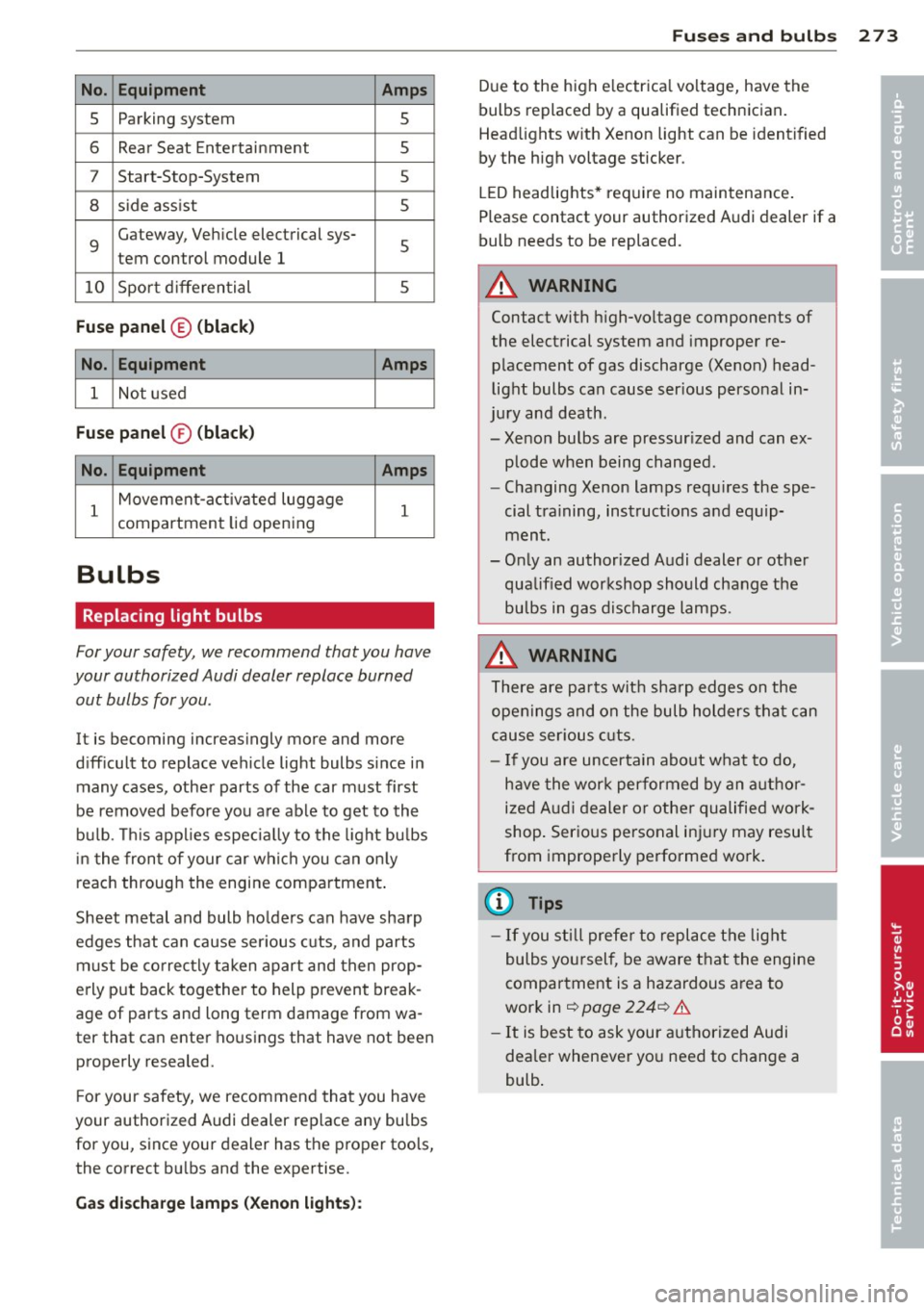
No. Equipment Amps
5 Parking system 5
6 Rear Seat Entertainment 5
7 Start-Stop-System 5
8 side ass ist 5
9
Gateway, Vehicle electrical sys-
5 tern control module 1
10 Sport differential
5
Fuse panel © (black)
No. Equipment
Amps
1 Not used
Fuse panel ® (black)
No. Equipment
Amps
1 Movement-activated luggage 1
compartment lid opening
Bulbs
Replacing light bulbs
For your safety, we recommend that you have
your authorized Audi dealer replace burned
out bulbs for you.
It is becoming increasingly more and more
difficult to replace vehicle light bulbs since in
many cases, other parts of the car must first
be removed before you are able to get to the
bulb. This appl ies especially to the light bulbs
in the front of your car which you can only
reach through the engine compartment .
Sheet metal and bulb ho lders can have sharp
edges that can cause ser ious cuts, and parts
must be correctly taken apart and then prop
erly put back together to help prevent break
age of parts and long term damage from wa
ter that can enter housings that have not been properly resealed.
F or your safety, we recommend that you have
your authorized Audi dealer replace any bulbs for you, since your dealer has the proper tools,
the correct bu lbs and the expertise .
Gas discharge lamps (Xenon lights):
Fuses and bulbs
Due to the high e lectr ica l voltage, have the
bulbs replaced by a qualified technician.
Head lights w ith Xenon light can be identified
by the high voltage sticker.
LED headlights* require no maintenance.
Please contact your authorized Audi dealer if a
bulb needs to be replaced.
_& WARNING
Contact with high-voltage components of
the electrical system and improper re
placement of gas discharge (Xenon) head
light bulbs can cause ser ious personal in
jury and death .
- Xenon bulbs are pressur ized and can ex
plode when being changed .
- Changing Xenon lamps requ ires the spe
cial tra ining, instructions and equip
ment.
- Only an authorized Audi dealer or other
qualified workshop should change the
bulbs in gas discharge lamps.
&_ WARNING
There are parts with sharp edges on the
openings and on the bulb holders that can
cause serious cuts.
- If you are uncertain about what to do,
have the work performed by an author
ized Audi dealer or other qualified work
shop . Serious personal injury may result
from improperly performed work.
(D Tips
-If you still prefer to replace the light
bulbs yourself, be aware that the engine
compartment is a hazardous area to
work in ¢
page 224¢ &.
-It is best to ask your authorized Audi
dealer whenever yo u need to change a
bulb .
273
•
•
Page 291 of 304
Index 289 ____________________________ ...:.:..:.=.:::.::.:
AUTO
automatic climate control . ... .. .. .. .. 71
Automatic headlights .... ... .. .. .. .. 43
climate control . . . . . . . . . . . . . . . . . . . . . 68
Auto Lock . . . . . . . . . . . . . . . . . . . . . . . . . . 34
Automatic belt retracto r ..... ...... .. 141
Automatic climate control Air vents ................ ...... .... 71
A t t· . l . u oma 1c recircu at1on . . . . . . . . . . . . . . 72
Operation . . . . . . . . . . . . . . . . . . . . . . . . . 70
Setup . .. ...................... ... 72
synchron izing ................... ... 71
Automatic Sh ift Lock (ASL) .. .. .. .. .. . 108
Autom atic t ransmission .............. 107
Automatic S hift Lock (ASL) ... .. .. .. . 10 8
D riving .... .. .... .... ... .. .. .. ... 109
Emergency mode . ..... ... .. .. .. .. . 1 12
Emergency release ........ .. .. .. .. . 113
Kick-down .. ............. .... .. ... 112
Manual s hift program .............. 111
Selector lever ..................... 107
Automatic wipe rs ... .... ... .. .. .. .. .. 48
Auto Safety Hotline ........ .. .. .. .. . 136
Average consumption ................. 25
Average speed . . . . . . . . . . . . . . . . . . . . . . . 25
Avo id damag ing the vehicle .. .. .. .. .. . 203
B
Ba ttery . .. .. .. .. .............. ... . 235
Cha rging ......................... 237
Impor tant war nings ...... .. .. .. .. . 235
J ump starting . ........... .. .. .. ... 274
L o cat ion . .. ............. .... .. ... 235
l ow . .. .. .. .... ............. .. .. . 199
Replacing the ba ttery .. ... .. .. .. .. . 238
State of charge . ... .... ... .. .. .. ... 199
Winte r operation . ..... ... .. .. .. .. . 235
Working on the battery ............. 235
B efore dr iving . . . . . . . . . . . . . . . . . . . . . . 128
Blended gasoline . ................ .. 215
Blower (automatic climate contro l) . . . . . . 71
B lower (climate control) . . . . . . . . . . . . . . . 68
Booster seats ............. .... .. ... 182
B rake fl uid
C hanging the brake fluid ... .. .. .. .. . 234
Chec king the brake fluid level ... .. .. . 234 What
is the correct bra ke fluid level? . . 234
What shou ld I do if the brake fluid wa rn -
i ng light comes on? .. .. ..... ... .. .. 234
B ra ke system
An ti-lock b rak ing system ........ .... . 20
B ra ke assis t sys tem .. ... .... ... .. .. 194
B rake booster . ...... .. .. ..... ... .. 197
Brake fluid . ... .. .. .. .. ...... ... .. 234
Brake fluid specifications for refill and re-
placeme nt .. .. .. ................. 234
B rake light defective . . . . . . . . . . . . . . . . 23
B ra ke pads .. .. .. .. . .. .... ...... .. 201
El ectromechan ica l pa rking brake ...... 77
Fl uid reservo ir ... ................. 234
H ow does moist ure or ro ad sal t affec t the
brakes? . . . . . . . . . . . . . . . . . . . . . . . . . . 196
Warning/ind icator lights ..... ... .. .. . 15
Wor n brake pads symbo l ..... ... .. .. . 21
braking gua rd
Settings .......................... 91
B rak ing guard . .. .. .... ....... ....... 84
Messages ......................... 91
Break-in per iod . ..... . .. .. ..... ... .. 201
Brake pads .. .. .. ................. 201
r ires ....... .. ...... ............ .
Bul bs . ... .. .. .... .. . .. .. ..... ... . .
C
201
273
Cali for nia Pr oposition 65 War ning . .. .. 22 S
B attery spe cific .. .... ...... ..... .. 236
Capacities ......................... 281
E ngine oil ... .. .. .. . .. .... ...... .. 226
Carbon parts
Cleaning . . . . . . . . . . . . . . . . . . . . 212, 213
Car car rier
T ranspo rting your vehicle .... ... .. .. 278
Care .......... .... ................ 210
Cargo area . . . . . . . . . . . . . . . . . . . . . . . . . 134
Cargo ne t . . . . . . . . . . . . . . . . . . . . . . . . . . . 6S
Catalytic converter 202
Center armrest
Cockpit ... .. .. .. ................. . 55
Central lo cki ng .. .. .... ............. . 34
E mergen cy lo ckin g ............. .. .. . 38
Ce rtif ication . . . . . . . . . . . . . . . . . . . . . . . 286
Changing a wheel .... . .. ..... ... .. .. 263
•
•
Page 294 of 304
292 Index
Starting with j umper cab les . ....... . 274
Stopping . . . . . . . . . . . . . . . . . . . . . . . . . . 7 5
E ng ine compartment ....... .... .... . 226
C lo sing the hood ....... .. .. .. .. .. . 225
Opening the hood ........ .. .. .... . 224
Safety instructions ..... ... .. .. .... . 224
Working in the engine compartment .. 224
E ng ine coolant .......... .. .. .. .. .. . 23 1
Adding co ol ant ........... .. .. .... . 23 2
Che ckin g the eng ine coolan t leve l .. ... 232
E xpansion tan k ... ..... ... .. .. .... . 23 2
M alfunctio n symbo l . . . . . . . . . . . . . . . . . 17
Radiato r fan . .. .. ..... ... .. .. .... . 233
Temperature ga uge ....... .. .. .. .. . . 11
E ng ine oi l ..... ........... .... .... . 226
Adding .... ... . ...... ... .. .. .... . 229
Addit ives ... ... .. ..... ... .. .. .... . 229
C hanging . .... . ...... ... .. .. .... . 230
Check ing the eng ine o il level .. .. .... . 229
Indications and cond it ions requ iring ex-
tra check ing .. ... .... .... .. .. .. .. . 229
Ind icator light . . . . . . . . . . . . . . . . . . . . . 18
O il consumption ........... ... .. .. . 228
O il g rades .. .. . .......... .. .. .... . 226
Pr ess ure mal function ...... .. .. .. .. . . 18
Recommended oil check in tervals .... . 229
Sensor defective . . . . . . . . . . . . . . . . . . . . 22
Specification and viscos ity . ... .. .. .. . 226
E ng ine sound ............. .. .. .... . 100
Eng ine speed limitat ion ..... .. .. .... .. 22
E ng ine start -stop mode
refer to Start -Stop -System ... ... ... .. 81
E ng ine start system (ind icator lights) .... 18
Environment Break- in period ........... .. .. .. .. . 201
Cata lytic conve rter .. ...... .. .. .. .. . 202
Diese l partic ulate fil ter ..... ... .. ... 202
Di sposing of you r vehicle batte ry .. .. . 238
Dr iving a t high speeds ... .. .. .. .. .. . 20 4
D riving to m inim ize pollu tion and no ise 203
Fu el . .... .. ... ... .... ... .. .. .... . 2 18
Fu el economy .. . ...... ... .. .. .... . 203
L eaks under your veh icle ... .. .. .. .. . 224
Lett ing the vehicle stand and warm up . 204
Proper disposal of dra ined brake f luid . 234 Proper disposal of d
rained eng ine cool -
ant . ... .. .... .. .. ... ..... ... .. .. 232
Proper d isposal of d rained eng ine
o il . . . . . . . . . . . . . . . . . . . . . . . . . 229, 230
Recycling used engine oil ........ .... 229
U nleaded fuel .. .. ................ . 215
What s hou ld I do w ith an o ld battery? . 238
Event Data Recorde r (EDR) ..... ... .. .. 194
E xhaus t tai l pipes
C leaning .. .. .. . .............. .. .. 211
Expansion tank .. .. .......... ...... . 232
Exterior lighting ... .. ... ..... ... .. .. . 43
E xte rior mi rrors
Adjus ting . .... .. .. ........... .... . 50
D imming . ..... .. .. ... ..... ... .. .. . 51
Heating . . . . . . . . . . . . . . . . . . . . . . . . . . . 50
E xterior tempera ture display ........... 24
F
Fastening
Booster seats . . . . . . . . . . . . . . . . . . . . . 182
Co nvertib le child safety seats ........ 180
I n fan t seats ... .. ............. .... 179
Floor mats .. .... .. ............. .... 133
F oot peda ls ..... .. .. ... ..... ... .. .. 133
Fo r the sake of the environment
Gasoli ne fumes and the env ironme nt .. 218
Red ucing engine noise by early upshift -
i ng ....... .. .. .. .. ............... . 11
Ref ueling ..... .. ... .. ..... .... . .. 218
Saving f uel by early ups hifting ... .. .. . 11
Fo ur- zone automatic climate control . .. . 70
Front a irbags
Descrip tion .... ... ................ 151
How they work . .. .......... ...... . 157
Frontal col lisions and the laws of p hysics 139
Front seats . . . . . . . . . . . . . . . . . . . . . . . . . 52
Adjus ting . .. .. .. ............. .. .. 130
C hild rest rain ts in the front seat . ... .. 149
Fuel Additives ...... .. ..... ........... . 215
B len ded gaso line .............. .... 215
Cur rent co nsumption ........... .... . 25
E conomy messages (e fficiency p rogram) 2 7
Fuel fi lle r flap emergency release ... .. 220
Fuel fi lle r neck ... .. .... .... ... .. .. 217
Fuel gauge . . . . . . . . . . . . . . . . . . . . . . . . 12