air condition AUDI A6 2014 Owner's Manual
[x] Cancel search | Manufacturer: AUDI, Model Year: 2014, Model line: A6, Model: AUDI A6 2014Pages: 304, PDF Size: 76.32 MB
Page 247 of 304
Tires an d wheel s 245
you have stored. The system does not recog
nize the load condition of your vehicle.
The effectiveness of the ti re pressu re monitor
ing sys tem* will be impaired if you store nor
mal load pressures but then operate the vehi
cle at its maximum load¢,& .
See the illustration ¢
fig. 195 for the location
of the label on dr iver's side B-pillar (co lor of
the actual labe l and exact location on the ve
hicle wi ll vary slig htly) .
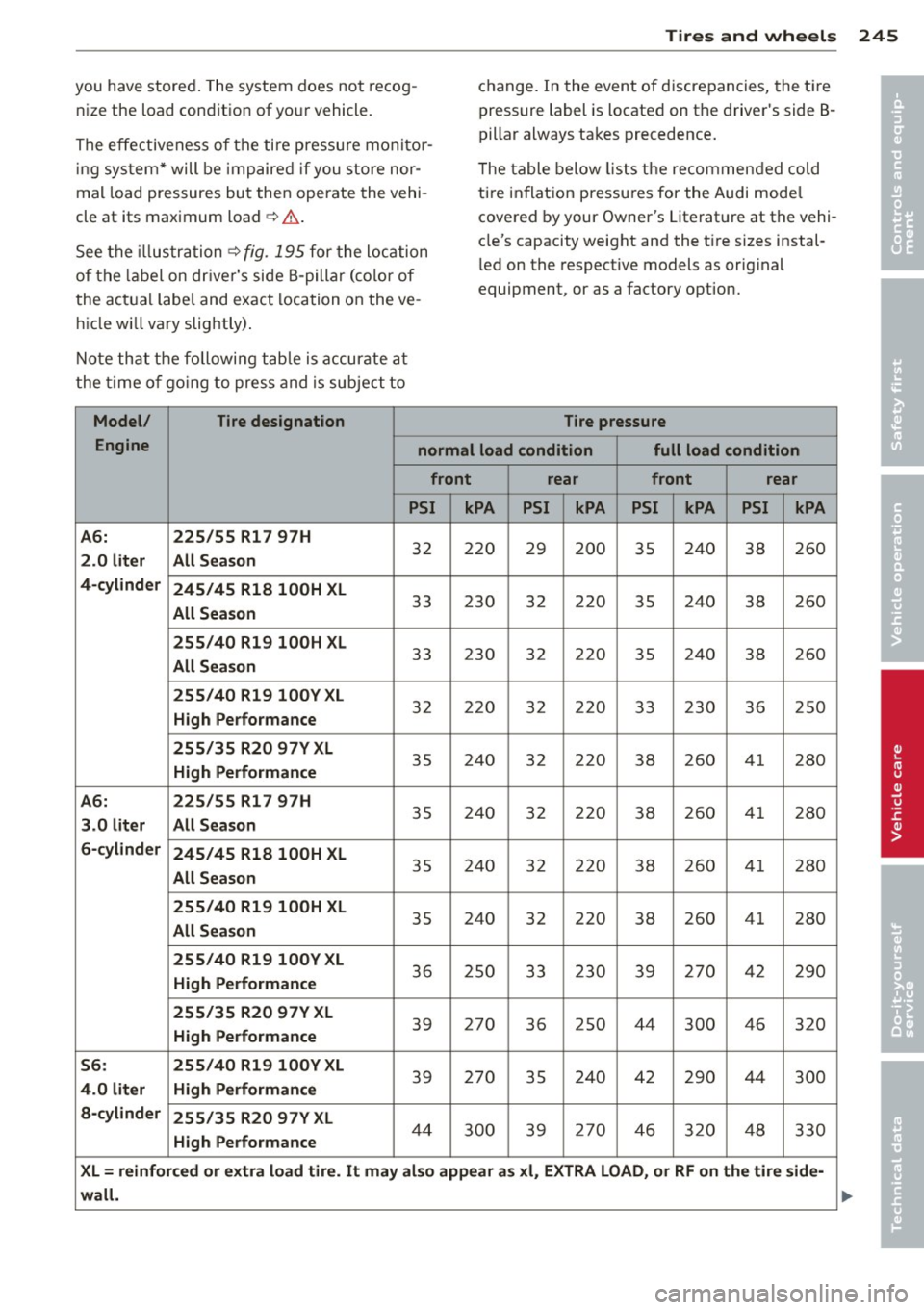
Note that the fo llowing tab le is accurate a t
the t ime o f go ing to press and is subject to
Model / Tire designation
change. In the event of discrepancies, the ti re
pressure label is located on the driver's side B
pillar always takes precedence .
T he table below lists the recommended cold
ti re inflation pressures for the Audi mode l
covered by your Owner's Literat ure at the vehi
cle's capacity weight and the t ire sizes instal
l ed on the respective models as orig inal
equipment, or as a factory option.
Tire pressure
Engine normal load condition full load condition
front rear front rear
PSI kPA PSI kPA PSI kPA PSI kPA
A6: 225 /5 5 Rl 7 9 7H
32 220 29 200 35 240
38 260 2.0 lit er All Season
4-c ylind er
245 /45 Rl8 lOOH XL
All Season
33 230 32
220
35 240
38 260
255
/40 Rl 9 lOOH XL
33 230 32 220 35 240
38 260 All Season
2 55 /40 Rl 9100Y XL
32 220 32 220 33 230 36 250 High Per formance
255 /35 R20 97V XL
35 240
32 220 38 260 41
280 High Perform ance
A6: 225 /55 Rl 7 9 7H
35 240 32 220 38 260 280 3 .0 liter All S eason
41
6 -cy lind er
245 /45 Rl8 lOOH XL
All Sea so n
35 240 32 220 38 260 41 280
255 /40 Rl 9 lOOH XL
35 240
32 220 38 260 41
280 All Seas on
255 /40 Rl9 lOOY XL
36 250 33 230 39 270 42 290 High Performance
255 /35 R 20 97V XL
39 270
36 250 44
300 46 320 High Perfo
rmance
56: 255 /40 Rl9100Y XL
39 270 35 240 42 290 44 300 4 .0 lit er High Performan ce
a -cy lind er
255 /35 R 20 97V X L
High Pe rformance
44 300 39 270 46 320 48 330
XL= r einfor ced or extra lo ad tire . It may al so appear a s xl , EXTRA LOAD , or RF on the tir e side-
wall .
•
•
Page 253 of 304
unbalanced, resulting in vib rations you can
usually feel through the steering wheel.
Unba lanced wheels mus t be rebalanced to
avoid excessive wea r on s teer ing, suspens ion
and tires. A wheel must a lso be rebalanced
when a new tire is installed.
Incorrect wheel alignment
Inco rrect whee l alignment can cause exces
sive tire wea r, impair ing t he safety of the veh i
cle. If t ires show excess ive wear, have the
wheel alignment checked by an authorized
Audi dealer or qualified workshop.
All-wheel d rive
Ve hicles w it h quattro must always have tires
of the s ame s ize, construction and tread type.
F or detai ls see
¢ page 198 .
A WARNING
Sudden tire failure can lead to loss of con
trol, a crash and serious persona l injury!
- Never drive a veh icle when the tread on
any t ire is worn down to the wear indica
tors.
- Worn tires are a safety hazard , they do
not grip well on wet roads and increase
your risk of"hydrop lan ing" and loss of
co ntrol.
- Always keep chemicals that can cause
tire damage, such as grease, oil, gasoline
and brake fluid away from tires.
- Tires age even if they are not being used
and can fail suddenly, especially at high
speeds. Tires that are more than 6 years
old can only be used in an emergency
and then with special care and at lower
sp eeds.
- Never mount used tires on yo ur vehicle if
yo u are not sure of their "previous histo
ry." Old used ti res may have been dam
aged even though the damage cannot be
seen that can lead to s udden tire failure
and loss o f vehicle control.
Tires and wheels 251
New tires and replacing tires and wheels
New tires and wheels have to be broken in.
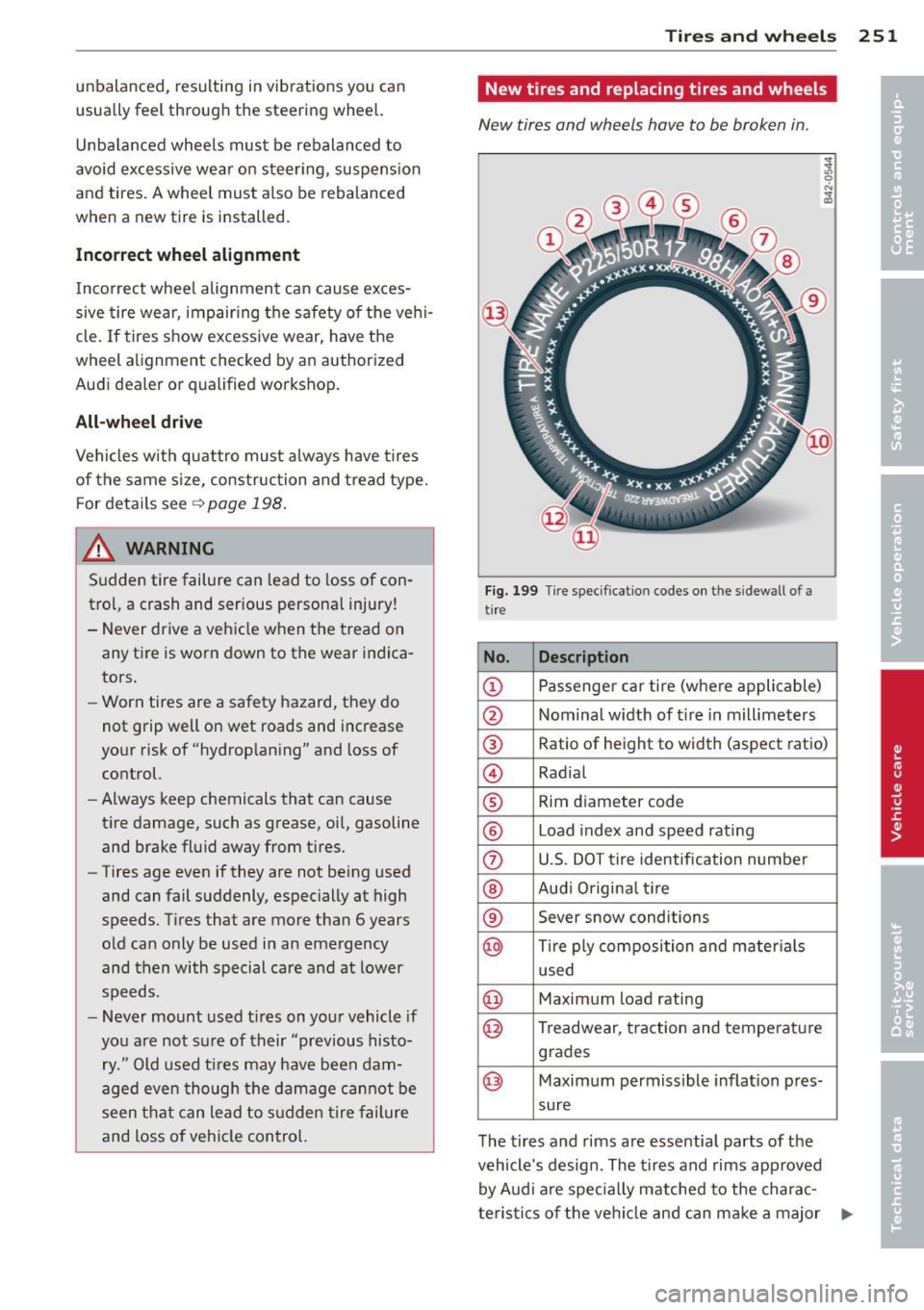
Fig. 199 Tire spec ification codes on the s idewall of a
tire
No . Description
@ Passenger car tire (where applicable)
@ Nominal w idth of t ire in millimeters
@ Ratio of height to width (aspect ratio)
© Rad ial
® Rim diameter code
® Load index and speed rati ng
0 U.S. DOT tire identification number
® Audi Original tire
® Sever snow conditions
@ Tire ply composition and ma terials
used
@ Maximum load rating
@ Treadwear, traction and tempe rat ure
grades
@ Maximum permissible inflation pres-
sure
T he tires and rims are essential parts of the
vehicle's design . The ti res and rims approved
by Audi a re spec ia lly matched to the charac
teris tics of the ve hicl e and can m ake a major .,.
Page 254 of 304
252 Tire s and wheel s
contribution to good road ho lding and safe
handling when in good condition and properly
inflated
¢ ,& .
We recommend that all work on tires and
wheels be perfo rmed by an authorized Audi
dea ler. They are familiar with recommended
proced ures and have the necessary spec ial
too ls and spare parts as well as the proper fa
cilities for disposing of the old tires.
Authorized Audi dealers have the necessary information about techn ica l requ irements for
installing or changing tires and r ims.
Re placing t ires and whe els
Tires sho uld be rep laced at least in pairs and
not individua lly (for examp le both front tires
or both rear tires together).
Be sure to read and heed the information to
the tire pressure monitoring system*
¢page 258.
Always buy rep lacement radial tires that have
the same specifications as the tires approved
for your vehicle by Audi. Replacement t ires
must always have the same load rating speci
fication as the original equipment or approved
optional tires listed in the table
c:> page 244.
Aud i-approved specification ti res are specially
matched to your vehicle and its load limits,
and can contribute to the important road ho ld
ing, driving characteristics, and safety of the
vehicle. The table
(c:> page 244) lists spec ifica
tions of the tires approved for the Audi mod
els covered by your Owner's Literature .
The tire pressure labe l located on driver's side
B-pillar
(c:> page 244, fig. 196) lists the speci
f ications of the orig inal equipment tires in
stalled on your veh icle at the time it was man
ufactured.
Federal law requires t ire manufacturers to
p lace standard ized information on the s ide
wall of all tires
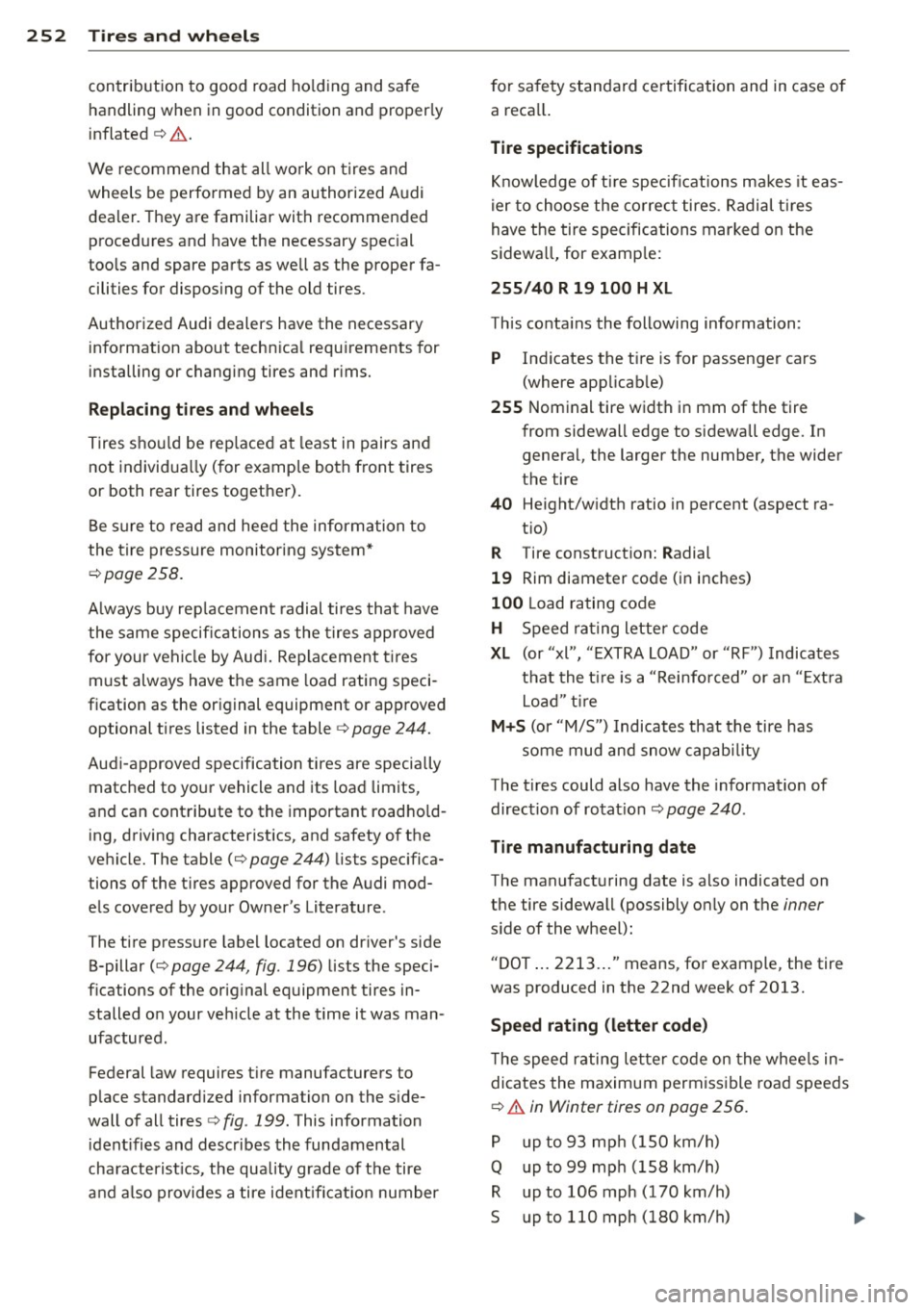
c:> fig. 199. This information
i dent ifies and describes the fundamental
characterist ics, the quality grade of the tire
and a lso provides a tire ident ificat ion number f
or sa fety standard ce rtification and in case of
a reca ll.
Tire specifications
Knowledge of ti re specificat ions makes it eas
ier to choose the correct tires. Radial ti res
have the tire specifications marked on the
sidewa ll, for examp le:
255 /40 R 19 100 H XL
This co nta ins the following information:
P Indicates the t ire is for passenger cars
(where app licab le)
2 55 Nominal tire width in mm of the tire
from sidewall edge to sidewa ll edge. In
general, the larger the number, the wider
the tire
40 Height/w idth ratio in percent (aspect ra-
t io)
R Tire construction: Radial
1 9 Rim diameter code (in inches)
100 Load rating code
H Speed rat ing letter code
X L (or "xl", "EXTRA LOAD" or "RF") Indicates
t h at the t ire is a "Reinforced" or an "E xt ra
Load " tir e
M+S (or "M/S") Indicates that the tire has
some mud and snow capabi lity
The tires could also have the information of
direction of rotat io n
c:> page 240 .
Tire manufacturing date
The manufact uring date is also indicated on
the tire sidewall (possibly on ly on the
inner
s ide of the wheel) :
"DOT ... 2213 ... " means, for example, the tire
was produced in the 22nd week of 2013.
Speed rating (letter cod e)
The speed rating letter code on the whee ls in
dicates the maximum permissible road speeds
¢ .&. in Winter tires on poge 256.
P up to 93 mp h (150 km/h)
Q up to 99 mph (158 km/h)
R up to 106 mph (170 km/h)
S up to 110 mph (180 km/h)
Page 256 of 304
254 Tires and wheels
Driving with different tires reduces vehi
cle handling and can lead to a loss of
control.
- I f the spare tire is not the same as the
tires that are mounted on the vehicle -
for example with winter tires - only use
the spare tire for a short period of time
and drive with extra care . Refit the nor
mal road wheel as soon as safely possi
ble.
- Never drive faster than the maximum
speed for which the tires on your vehicle
are rated because tires that are driven
faster than their rated speed can fail
suddenly.
- Overloading tires cause heat build-up,
sudden tire failure, including a blowout
and sudden deflation and loss of control.
- Temperature grades apply to tires that
are properly inflated and not over or un
derinflated .
- For technical reasons it is not always
possible to use wheels from other
vehicles -in some cases not even wheels
from the same vehicle model.
- If you install wheel trim discs on the ve
hicle wheels, make sure that the air flow
to the brakes is not blocked. Reduced air
flow to the brakes can them to overheat, increasing stopping distances and caus
ing a collision .
- Run flat tires may only be used on
vehicles that were equipped with them
at the factory . The vehicle must have a
chassis designed for run flat tires . Incor
rect use of run flat tires can lead to vehi
cle damage or accidents. Check with an
authorized Audi dealer or tire specialist
to see if your vehicle can be equipped
with run flat tires. If run flat tires are
used, they must be installed on all four
wheels . Mixing tire types is not permit
ted .
(D Note
-For technical reasons, it is not generally
possible to use the wheel rims from oth- er vehicles.
This can hold true for wheels
of the same vehicle type.
- If the spare tire is different from the
tires that you have mounted on your ve
hicle (for example winter tires or wide
profile tires), then use the spare tire for a
short period of time only and drive with
extra care. Replace the flat tire with the
tire matching the others on your vehicle
as soon as possible .
- Never drive without the valve stem cap .
The valves could get damaged .
® For the sake of the environment
Dispose of old tires in accordance with the
local requirements.
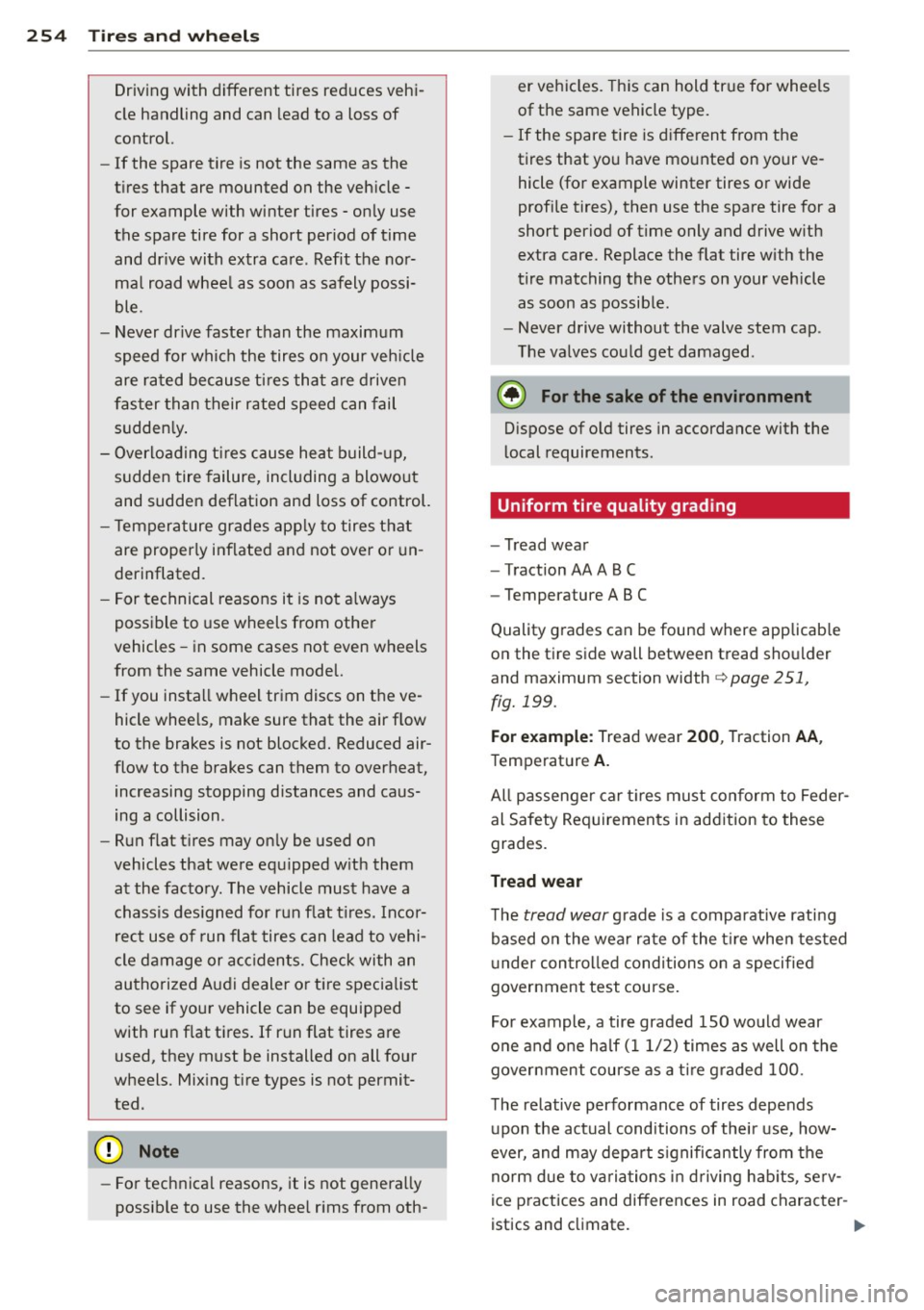
Uniform tire quality grading
-Tread wear
- Traction AA A B C
- Tempe ra ture ABC
Quality grades can be found where applicable
on the tire side wall between tread should er
and maximum section width
c;, page 251,
fig. 199.
For example:
Tread wear 200, Traction AA,
Temperature A.
All passenger car tires must conform to Feder
al Safety Requirements in addition to these
grades.
Tread wear
The tread wear grade is a comparative rating
based on the wear rate of the tire when tested
under controlled conditions on a specified
government test course.
For example, a tire graded 1S0 would wear
one and one half (11/2) times as well on the
government course as a tire graded 100.
The relative performance of tires depends upon the actual conditions of their use, how
ever, and may depart significantly from the
norm due to variations in driving habits, serv
ice practices and differences in road character-
istics and climate.
ll-
Page 257 of 304
Traction
The traction grades, from highest to lowest,
a re AA, A, Band
C. Those grades represent the
tire's ability to stop on wet pavement as
measured under controlled conditions on
specified government test surfaces of asphalt
and concrete . A tire marked C may have poor
traction performance¢ .&..
Temp eratu re
The temperature grades are A (the highest),
B, and
C, representing the tire 's resistance to
the generat ion of heat and its ability to dissi
pate heat when tested under controlled condi
tions on a specified indoor laboratory test
wheel.
Sustained high temperature can cause the
material of the tire to degenerate and reduce
tire life, and excessive temperature can lead
to sudden tire failu re ¢ .&. .
The grade C corresponds to a level of perform
ance which all passenger car tires m ust meet
u nder the Federa l Motor Ve hicle Safety Stand
ard No.
1 09. Grades Band A represent higher
l eve ls of pe rformance on the laboratory test
wheel than the m inimum required by law.
_& WARNING
Th e traction grade assigned to this tire is
based on stra ight-ahead b raking t raction
tests, and does not include acceleration,
cornering , hydrop laning or peak traction
character istics.
A WARNING
The temperature grade for this t ire is es
tablished for a t ire that is properly inflated
and not overloaded. Excessive speed, un
derinflation, or excessive loading, either
separate ly or in combination, can cause
heat buildup and possibl e tire fa ilu re.
-
Tire s an d wheel s 255
Winter tires
Winter tires can improve vehicle handling on
snow and ice . At temperatures below 45 °F
(7 °C) we recommend changing to winter
tires.
In some heavy snow areas, local governments
may require true w inter o r "snow" tir es, those
with very deeply cut t read. These tires should
o nl y be used in pairs and be installed o n all
f o ur wheels . Make sure you p urchase snow
ti res that are the same size and cons truc tion
type as the other tires on yo ur vehicle .
I f your veh icle is eq uipped w ith all-whee l
drive *, t his w ill improve trac tion durin g w in ter
driv ing, even wi th the s tanda rd tires. Howev
er, we strongly recommend that you always
equip all four wheels on your veh icle w ith cor
rect ly fitted winter tires or all-season t ires,
when winter road condit ions are expected.
This also improves the veh icle 's b rak ing per
fo rmance and reduces stoppi ng d ista nces .
Summer tires provide less grip on ice and
snow.
Winter tires (snow tires) must always be fitted
o n all fo ur whee ls .
As k your au thori zed A udi d ealer or qualified
workshop for permit ted
winter tire size s. Use
o nl y radial winter ti res .
Win ter tires lose their effec tiveness whe n the
tread is worn down to a depth o f
0.15 7 inch
(4 mm) .
Only d rive w it h w inte r tir es under w inte r con
di tions. S umme r tir es handle bette r whe n
t h e re is no s now o r ice on the ro ad s an d the
temperature is above 45 ° F (7 °C) .
I f you have a flat t ire, see notes on spare
whee l
¢page 25 1.
Please a lways remember that winter tires may
have a lowe r sp eed rating than the tires o rig i
nally i nstalled on your veh icle at t he time it
was ma nufactu red. Please see ¢
page 2 52,
Speed ra ting (letter code)
for a lis ting o f th e
speed ra ting lette r codes and the max imum
speed at which the tires can be driven .
111>-
•
•
Page 258 of 304
256 Tires and wheels
The speed rating letter code( ¢ page 243) is
on the side wall of the tire¢ page
251.
A WARNING
Winter tires have maximum speed limits
that may be lower than your vehicle's max
imum speed . Always know the maximum
speed before driving off. Never drive faster
than the speed permitted for your specific
winter tires. This will cause damage to the
tires leading to an accident and serious
personal injury to you and your passen
gers.
A WARNING I>=
Driving faster than the maximum speed
for which the winter tires on your vehicle
were designed can cause tire failure in
cluding a blowout and sudden deflation,
loss of control, crashes and serious per
sonal injuries. Have worn or damaged tires
replaced immediately.
- Winter tires have maximum speed rating
that may be lower than your vehicle's
maximum speed .
- Never drive faster than the speed for
which the winter or other tires installed on your vehicle are rated.
A WARNING
Always adjust your driving to the road and
traffic conditions. Never let the good ac
celeration of the winter tires and all-wheel
drive tempt you into taking extra risks . Al
ways remember :
- When braking , an all-wheel drive vehicle
handles in the same way as a front drive
vehicle.
- Drive carefully and reduce your speed on
icy and slippery roads, even winter tires
cannot help under black ice conditions.
@) For the sake of the environment
Use summer tires when weather condi
tions permit. They are quieter, do not wear
as quickly and reduce fuel consumption.
Snow chains
Snow chains may be fitted only to the front
wheels, and only to certain tire sizes . Ask your
authorized Audi dealer on which tire sizes snow chains can be used.
If you are going to use snow chains, then you
must install them on the front wheels at
least.
The snow chains must have low-profile links
and must not be thicker than 0.4 inch
(10,5 mm) , including the lock.
Remove wheel center covers and trim discs
before putting snow chains on your vehicle
¢ (!) . For safety reasons cover caps must then
be fitted over the wheel bolts. These are avail
able from authorized Audi dealers.
A WARNING
=
Using the wrong snow chains for your vehi-
cle or installing them incorrectly can in
crease the risk of loss of control leading to
serious personal injury.
- Snow chains are available in different
sizes . Always make sure to follow the in
structions provided by the snow chain manufacturer.
- When driving with snow chains never
drive faster than the speed permitted for
your specific snow chains.
- Always observe local regulations.
(D Note
- Remove snow chains before driving on
roads not covered with snow to avoid
damaging tires and wearing the snow
chains down unnecessarily .
- Snow chains, which come into direct con
tact with the wheel rim, can scratch or damage it. Therefore, make sure that the
snow chains are suitably covered. Check
the position of the snow chains after
driving a few yards and correct if neces
sary. Follow the instructions from the
snow chain manufacturer when doing so.
-If the Adaptive Air Suspension* should
malfunction, do not mount or use snow
11-
Page 260 of 304
258 Tires and wheels
or ridges on the road, particularly if the tire is
underinflated.
I n o rder to minim ize the occurrence of impact
damage to the tires of your vehicle, we recom
mend that you observe the following precau
tions:
- Always maintain recommended inflation
pressures. Check your tire pressure every
2,000 miles (3,000
km) and add air if neces
sary .
- Drive carefu lly on roads with potholes, deep
gullies or ridges. The impact from driving
through or over such obstacles can damage
your tires. Impact with a curb may also cause damage to your tires.
- After any impact, immediately inspect your
tires or have them inspected by the nearest
authorized Aud i dealer. Replace a damaged
t ir e as soon as possible .
- Inspect your tires every 2,000 miles (3,000
km) for damage and wear . Damage is not al
ways easy to see . Damage can lead to loss of
air and underinflation, wh ich could eventu
ally cause t ire failure . If you be lieve that a
t ir e may have been damaged, replace the
tire as soon as possible.
- T hese tires may wea r mo re quick ly than oth
ers.
- Please a lso remember that, while these t ires
deliver respons ive handling, they may ride
less comfortably and make more no ise than
other choices.
Reduced performance in winter/cold
season conditions
All tires are designed for certain purposes.
The low aspect ratio, ultra high performance
tires originally installed on your vehicle are in
tended for maximum dry and wet road per
formance and handling. They are not suitable
for cold, snowy or icy weather condit ions. If
you drive under those circumstances, you should equip your vehicle with all -season or
winter tires, which offer better traction under
those cond it ions. We suggest you use the rec
ommended snow or all-season tires specified
for your vehicle, or their equivalent. Refer
to
q page 255 for more detailed infor
mation regarding winter tires.
Tire pressure monitoring system
ill General notes
Applies to veh icles: w ith tire pressure monitoring system
Each tire, including the spare ( if provided),
shou ld be checked monthly when co ld and in
flated to the inflation pressure recommended
by the veh icle manufacturer on the vehicle
placard or tire inflation pressure label. (If your
vehicle has tires of a different size than the
s ize indicated on the vehicle placard or tire in
flation pressure label, you should determine
the proper tire inflation p ressu re fo r those
t i res).
As an added safety feature, your ve hicle has
been equipped with a tire pressure mon itoring
system ( TPMS) that illuminates a low tire
pressure telltale when one or more of your
tires is significant ly under-inflated. According
l y, when the low tire pressure telltale i llumi
nates, you should stop and check your tires as
soon as possible, and inflate them to the
proper pressure. Driving on a sign ificantly un
der-inflated t ire causes the tire to overheat
and can lead to tire fa ilure . Under-inflation al
so reduces fuel efficiency and tire tread life,
and may affect the vehicle 's handling and
stopping ability.
Please note that the TPMS is not a substitute
for proper tire ma intenance, and it is the driv
er's responsibility to maintain correct tire
pressure, even if under-inflation has not
reached the level to trigger illuminat ion of the
TPMS low tire pressu re tellta le .
Your vehicle has also been equipped with a
TPM S malfunction indicator to ind icat e when
the system is not operating properly. The
T PMS ma lfunction indicator is combined with
the low tire pressure telltale. When the sys
tem detects a malfunction, the telltale will
flash for approximately one minute and then ..,_
Page 285 of 304
Consumer Information
Warranty coverages
Your Audi is covered by the following war
ranties :
- New Vehicle Limited Warranty
- Limited Warranty Against Corrosion Perfo-
ration
- Emissions Control System Warranty
- Emissions Performance Warranty
- California Emissions Control Warranty (USA
vehicles only)
- California Emissions Performance Warranty
(USA vehicles only)
Detailed information regarding yo ur warran
ties can be found in your
Warranty & Mainte
nance booklet .
Operating your vehicle
outside the U.S.A. or
Canada
Government regulations in the United States
and Canada require that automobiles meet
specific emission regulations and safety
standards. Therefore, veh icles built for the
U.S.A. and Canada differ from vehicles sold in
other countries .
I f you p lan to take your vehicle outside the
continental limits of the United States or Can
ada, there is the possibility that:
- unleaded fuels for vehicles with cata lytic
converter may not be available;
- fuel may have a considerably lower octane
rating . Improper fuel may cause engine
damage;
- service may be inadequate due to lack of
proper service facilities, tools or testing
equipment;
- replacement parts may not be readily availa
ble.
- Navigation systems for vehicles built for the
U.S.A. and Canada will not necessari ly work
in Europe, and may not work in other coun
tries outside North America .
Consumer Information 283
@ Note
Audi cannot be responsible for mechanical
damage that could result from inadequate
fuel, serv ice or parts availab ility.
Audi Service Repair
Manuals and Literature
Audi Offic ial Factory Service Manuals and Lit
erature are published as soon as possible after
model introduct ion. Service manuals and lit
erat ure are available to order from the Audi
T echnical Literature Ordering Center at:
www.audi.techliterature.com
Maintenance
' General
Your vehicle has been designed to help keep
maintenance requirements to a m inimum.
However, a certain amount of regular mainte
nance is still necessary to assure your vehicle's
safety, economy and reliability . For detailed
vehicle maintenance consult your Warranty
&
Maintenance booklet.
Under difficult operating conditions , for ex
ample at extremely low outside temperatures,
in very dusty regions, when towing a trailer
very frequently, etc., some serv ice work
shou ld be pe rformed between the intervals
specified. This applies particularly to:
- oil changes, and
- cleaning or replacing the air filter.
® For the sake of the environment
By regularly maintaining your veh icle, you
help make sure that emission standards
are maintained, thus min imiz ing adverse
effects on the environment .
Important considerations for you and
your vehicle
The increasing use of electronics, sophistica t
ed fuel injection and emission contro l sys-
tems, and the genera lly increasing technica l ..,_
•
•
Page 286 of 304
28 4 Con sum er Inf ormation
comp lexity of today's automobi les, have
steadi ly reduced the scope of maintenance
and repairs which can be carried out by vehicle
owners.
Also, s afety an d e nvir onm ent al con
cerns place very strict limits on the nature of repairs and adjustments to engine and trans
miss ion pa rts which an owner can perform .
Maintenance, adjustments and repa irs usua lly
require special tools, testing devices and oth
er equipment avai lab le to specially trained
workshop personnel in order to assure proper
performance, reliab ility and safety of the vehi
cle and its many systems .
Improper ma intenance, adjustments and re
pa irs can impair the operation and reliab ility
of your vehicle and even void your vehicle war ranty. Therefo re , proof of servici ng in accord
ance w it h the ma intenance sched ule may be a
condition for upholding a possible warranty
claim made within the warran ty period.
Above all, operational safety can be adve rsely
affected, c reating unnecessary risks for you
and your passengers.
If in doubt about any serv icing, have it done
by your author ized Audi dealer or any other
p roperly equipped and qualified workshop .
We strong ly urge you to give your authorized
Audi dealer the opportunity to perform all
schedu led maintenance and necessary repairs .
Your dea ler has the facilities, or iginal parts
and tra ined spec ialists to keep your vehicle
running properly .
Performing lim it e d m aint en anc e y ourself
The fo llowing pages describe a limited num
ber of procedures which can be performed on
you r vehicle with ordinary too ls, shou ld the
need arise and trained personnel be unavaila
ble. Before performing any of these proce
dures, always thoroughly read all of the app li
cable text and ca refully follow the instruc
tions given. Always rigorously obse rve the
WARNINGS p rovided .
Before you ch eck anything in th e engin e
compartme nt, alway s read an d heed all WARNINGS
¢ & a
nd ¢ & in Working in the
engine comportment on page 224 .
A WARNING
--Serious personal in jury may occur as a re-
sult of improperly performed mainte nance, adjustments or repa irs.
- Always be extremely careful when work
ing on the vehicle. Always follow com
monly accepted safety pract ices and gen
eral common sense. Never r isk personal
in jur y.
- Do not attempt any of the maintenance,
checks or repairs descr ibed o n the fol
lowing pages if you are not fu lly fam iliar
with these or other procedures with re spect to the ve hicl e, or are uncerta in how
to proceed .
- Do not do any work withou t the proper
too ls and equipment . Have the necessary
work done by your authorized A udi deal
er or anothe r properly equipped and
qualified workshop.
- The engine compar tment o f any motor
vehicle is a potentially hazardous area. Never reach into the area around or
touch the rad iator fan. It is temperature
control led and can sw itch on suddenly -
even when the engine is off . The radiator
fan switches on automatically when the
coo lant reaches a ce rtain temperature
and will cont inue to ru n until the coo lant
tempera ture drops.
- Always sw itch off the ignition before any
one gets under the vehicle.
- Always support your veh icle with safety
s tands if it is necessary to work under
neath the vehicle. The j ack s upp lied with
the vehicle is not adequate for this pur
pose and cou ld co llapse causing serio us
pe rsonal injury .
- If you must work underneath the vehicle
wit h the wheels on the ground, a lways
make sure the vehicle is on leve l ground,
that the wheels are a lways secure ly
blocked and that t he engine cannot be
started .
Page 288 of 304
286 Consumer Information
Technical Modifications
Our guidelines must be complied with when technical modifications are made .
Always consult an authorized Audi dealer be
fore starting work on any modifications.
This will help ensure that vehicle function,
performance and safety are not impaired
¢ &. .
Attempting to work on electronic components
and the software used with them can cause
malfunctions. Because of the way electronic
components are interconnected with each
other, such malfunctions can also have an ad
verse affect on other systems that are not di
rectly involved. This means that you risk both
a substantial reduction in the operational
safety of your vehicle and an increased wear of
ve hicle parts ¢
A:,..
Author ized Audi dealers will perform th is
wo rk in a professiona l and competent manner
or, in special cases, refer you to a professional
company that specializes in such modifica
tions .
A WARNING
Improper repairs and modifications can
change the way vehicle systems work and
cause damage to the vehicle and serious
personal injury.
-
If emergency repairs must be performed
elsewhere, have the vehicle examined by
an authorized Audi dealer as soon as possi
ble.
Declaration of
Compliance, Telecom
munication and
Electronic Systems
Radio Frequency Devices and Radiocommuni
cation Equipment User Manual Notice.
The manufacturer is not responsib le for any
radio or TV interference caused by unauthor
ized modifications to this equipment.
Devices
T he following devices each comply with FCC
Part 15.19, FCC 15.21 and RSS-Gen Issue 1:
- Adapt ive cru ise control*
- Aud i side assist*
- Cell phone package*
- Convenience key*
- Electron ic immobilizer
- Homelink universa l remote control*
- Remo te control key
FCC Part 15.19
This device complies with part 15 of the FCC
Ru les. Operation is subject to the follow ing
two conditions:
(1) This device may not cause harmful inter
ference, and
(2) this device must accept any interference
received, including interference that may
cause undesired operation .
FCC Part 15.21
CAUTION:
Changes or modificat ions not expressly ap
proved by the party responsible for compli
ance could void the user's authority to operate
the equipment .
RSS-Gen Issue 1
Operation is subject to the following two con
ditions:
(1) this device may not cause interference ,
and