belt AUDI A6 2014 Workshop Manual
[x] Cancel search | Manufacturer: AUDI, Model Year: 2014, Model line: A6, Model: AUDI A6 2014Pages: 304, PDF Size: 76.32 MB
Page 172 of 304
1 7 0 Airbag syst em
larger, unclosed openings in the door
panel.
- Never drive w ith inter ior door trim pan
e ls removed.
- Never drive when parts have been re moved from the ins ide doo r panel and
the openings they leave have not been p roperly closed.
- Never d rive when loudspeakers in the
doors have bee n removed unless the
spea ker holes have been properly
closed.
-Always ma ke certa in that openings are
covered or fi lled if additional speakers
or other equ ipment is installed in the
inside door panels.
- Always have work on the doors done by an authorized Audi dealer or qualified
workshop .
Side curtain airbags
Description of side curtain airbags
The side curtain airbag system can provide
supplemental protection to properly restrain
ed occupants.
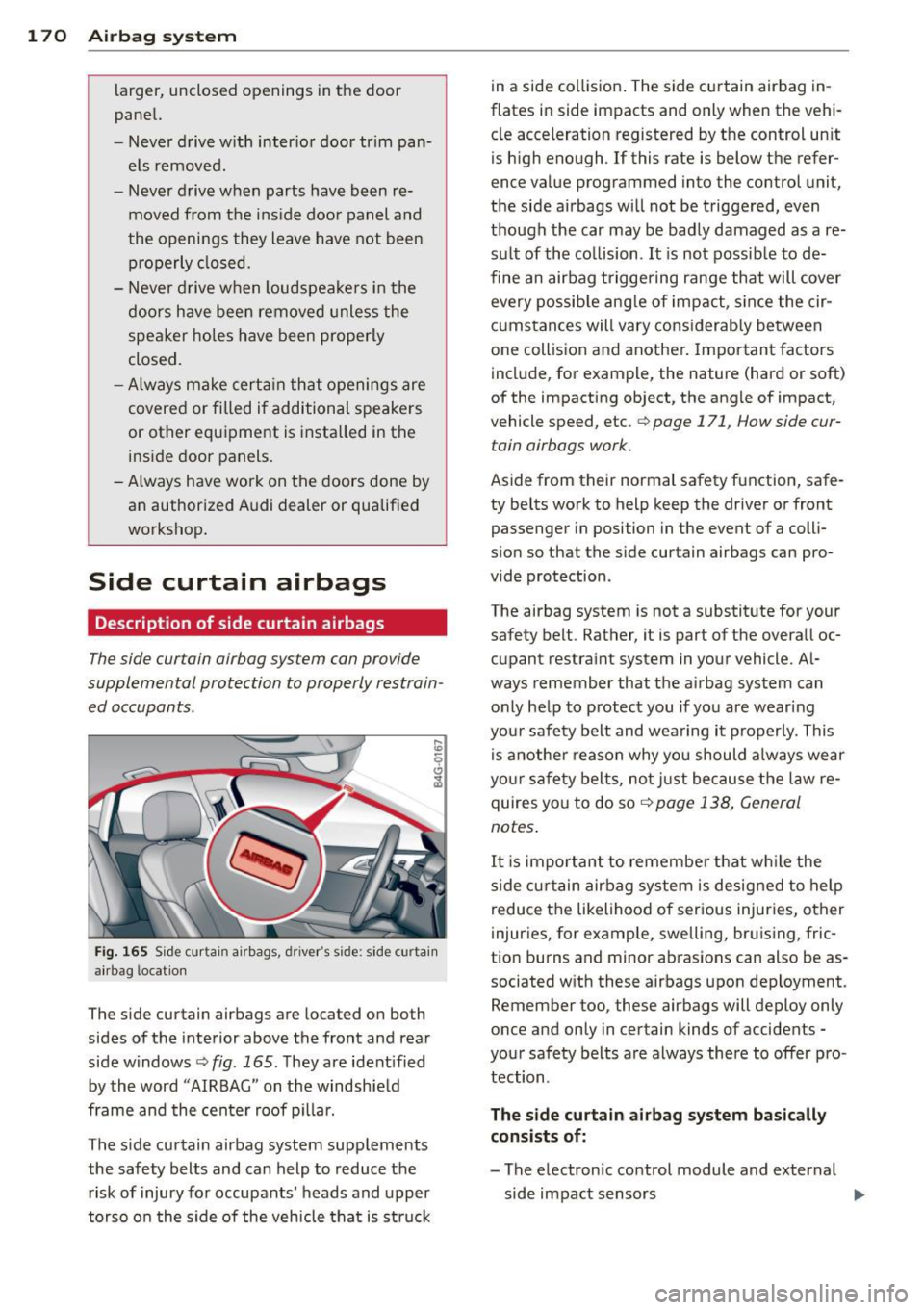
Fi g. 1 65 Side curtain a irbags, d river 's side: s ide curta in
a ir bag location
The s ide curtain airbags are located o n both
sides of the interior above the front and rea r
side windows
c:.> fig. 165 . They are ident ified
by the word "AIRBAG" on the windshield
frame and the center roof p illar.
The s ide curtain airbag system supp lements
the safety belts and can help to reduce the risk of injury for occupants' heads and upper
torso o n the side of the vehicle tha t is struc k in a side collision
. The side curtain airbag in
flates in side impacts and only when the vehi cle acceleration registered by the control un it
is h igh enough . If this rate is below the refer
ence value programmed into the control unit,
the side airbags will not be triggered, even
t h ough the car may be bad ly damaged as a re
su lt of the co llision .
It is not possib le to de
fine an airbag triggering range that will cover every possib le ang le of impact, s ince the cir
cumstances will vary cons iderably between
one collision and another. Important factors
include, for example, the nature (hard or soft)
of the impacting object, the angle of impact,
vehicle speed, etc .
c:,, page 171, How side cur
tain airbags work .
Aside from their normal safety function, safe
ty belts work to help keep the driver or front
passenger in position in the event of a colli
sion so that the side curtain airbags can pro
vide protection .
The airbag system is not a substit ute for your
safety belt . Rather, it is part of the overall oc
cupant restraint system in your vehicle. Al
ways remember that the a irbag system can
only help to protect you if you are wear ing
you r saf ety belt and wearing it properly . This
is anothe r reason why yo u should always wear
yo ur safe ty belts, no t just because the law re
quires yo u to do soc:.>
page 138, General
notes .
It is important to remember that w hile the
s ide cur tain airbag system is designed to help
reduce the likelihood of ser ious injur ies, other
injuries, for example, swelling, bruising, fric
tion burns and minor abrasions can also be as
sociated w ith these airbags upon dep loyment.
Remember too, these airbags will deploy only
once and only in certain kinds of accidents -
your safety belts are always there to offer pro
tection.
The side curtain airbag sy stem basic ally
cons ists of:
- The electronic control module and external
side impact sensors ..,..
Page 173 of 304
-The side curtain airbags above the front and
rear side windows
- The airbag ind icator light in the instrument
pane l
The a irbag system is monitored elect ro nic ally
to make certain it is f unct io ni ng proper ly a t all
times. Eac h time you switch on the ignition,
the airbag system indicator light wi ll come on
for a few seconds (se lf diagnost ics) .
The side curtain airbag is not activated:
-if the ign ition is swit ched off,
- i n s ide coll isions when the accelerat ion
measured by the sensor is too low,
- in rear-end collisions .
_& WARNING
-Sa fety belts and t he a irbag system w ill
only p rov ide p rotection whe n occu pan ts
are in the proper sea ting posit ion
¢ page 5 2, General recommendations.
- If the airbag indicator light ¢ page 19
comes when the vehicle is be ing used,
have the system inspected immediate ly
by you r aut ho rized Audi dea ler . It is pos
sible that the airbag will inflate when it
is not s upposed to, or w ill not inflate
when it sho uld.
How side curtain airbags work
Side curtain airbags can work together with
side airbags to help reduce the risk of head
and upper torso injuries for occupants who
are properly restrained .
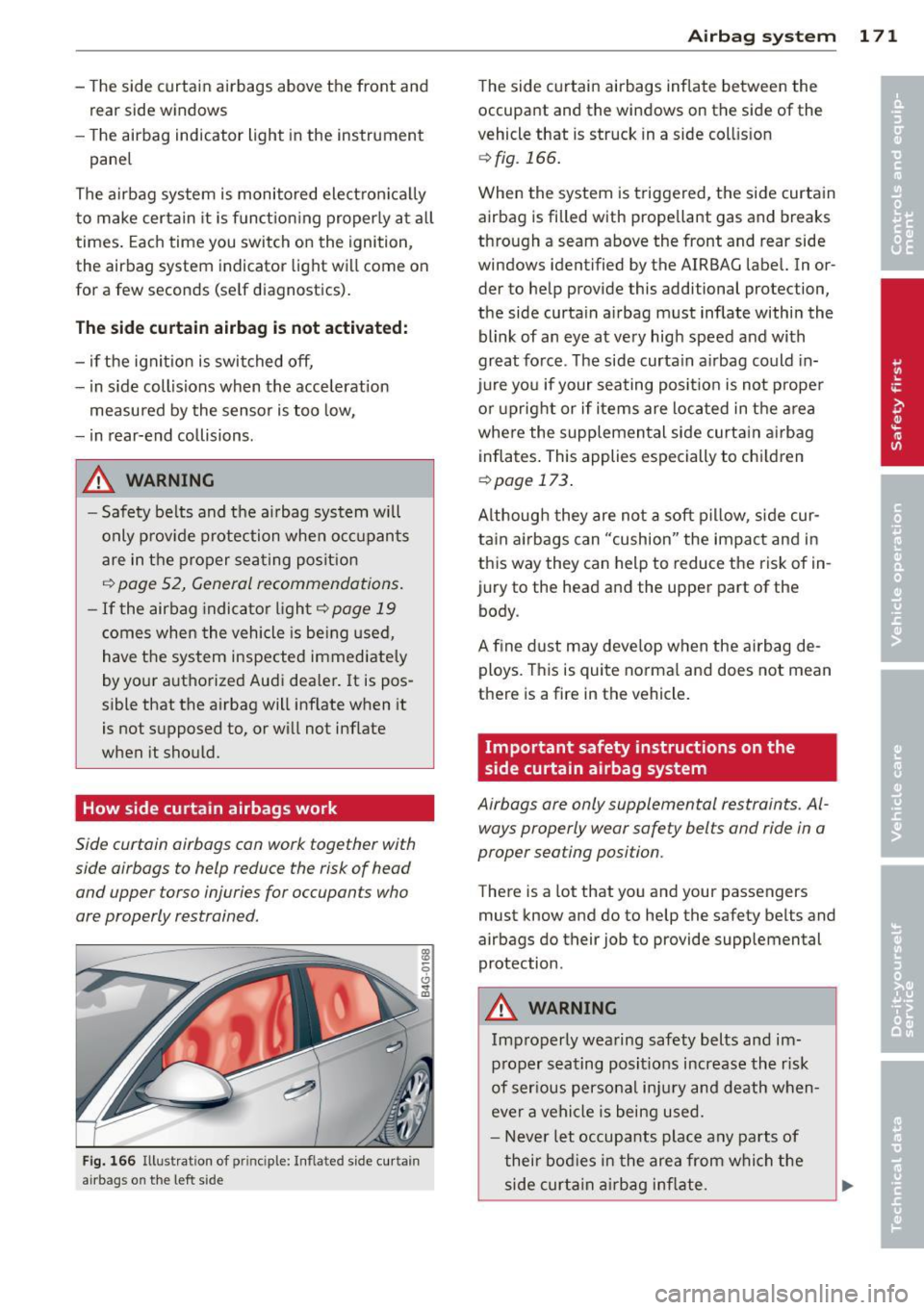
Fig . 1 66 Ill ustra tion of princip le: In flated side cur ta in
airbags on t he left s ide
.
A irba g sy stem 1 71
The side c urtain airbags infla te between the
occupant and the windows on the side of the
vehicle that is struck in a side coll is ion
¢ fig . 166.
When the system is trigge red, t he side curta in
airbag is filled with propellant gas and breaks
th ro ugh a seam above the front and rear side
windows identified by the AIRBAG labe l. In or
der to he lp provide this additional protection,
the side curta in a irbag must inflate withi n the
blink of an eye at ve ry hig h speed and with
great fo rce . T he side curta in a irbag could in
j u re yo u if your sea ting posit io n is not proper
o r u pright or if items are loca ted in t he a rea
where the supplemental side curta in a irbag
in flates . This applies especially to chi ld ren
~ page 173 .
Although they are no t a soft pillow, side cur
ta in a irbags can "cushion" the impact and in
this way they can help to reduce the risk of in
j u ry to the head and the uppe r part of the
body .
A fine dust may deve lop when the airbag de
ploys . This is qui te no rma l and does not mean
there is a fire in the vehicle .
Important safety instructions on the
side curtain airbag system
Airbags are only supplemental restraints . Al
ways properly wear safe ty belts and ride in a
proper seating position.
There is a lot that you and your passengers
must know and do to help the safety belts and
airbags do t heir job to provide supplemental
protection .
_& WARNING ...__
Improperly wea ring safety belts and im
p roper seating posit ions increase the risk
of ser ious perso nal inj ury and death when
ever a vehicle is being used.
- Never let occupa nts pla ce any pa rts of
thei r bo dies in t he area fro m whi ch the
side curt ain air bag inf late.
-
Page 175 of 304
Child Safety
Important things to know
Introduction
The rear seat is generally the safest place in a
collision .
The physical principles of what happens when
your veh icle is in a crash app ly also to chi ldren
~ page 139, What happens to occupants not
wearing safety belts? .
But unlike adults and
teenagers, their muscles and bones are not
fu lly developed. In many respects children are
at greater risk of serious injury in crashes than
adu lts.
Because children's bod ies are not fully deve l
oped, they require restraint systems especial ly designed for their size, weight, and body
structure. Many countries and all states of the
United States and provinces of Canada have
laws requiring the use of approved child re
straint systems for infants and small children .
In a fronta l crash at a speed of 20 -35 mph
(30-56 km/h) the forces acting on a 13-pound
(6 kg) infant w ill be more than 20 t imes the
weight of the child . This means the weight of
the child would suddenly be more than
260 pounds (120 kg). Under these conditions,
on ly an appropriate chi ld restraint properly
used can reduce the risk of ser ious injury .
Child restraints, like adult safety belts, must
be used properly to be effective. Used improp
erly, they can increase the risk of serious in
jury in an accident.
Consult the child safety seat manufacturer's
instructions in order to be sure the seat is
right for your chi ld's size ~
page 177, Impor
tant safety instructions for using child safety
seats.
Please be sure to read and heed all of
the important information and WARNINGS
about ch ild safety, Advanced A irbags, and the
installation of child restraints in this chapter.
There is a lot you need to know about the Ad
vanced Airbags in your vehicle and how they work when infants and children in child re-
Child Sa fet y 173
straints are on the front passenger seat . Be
cause of the large amount of important infor
mation, we cannot repeat it a ll here . We urge
you to read the detailed information in this owner's manual about airbags and the Ad
vanced Airbag System in your vehicle and the
very important information about transport
ing children on the front passenger seat .
Please be sure to heed the WARNINGS -they
are extremely important for your safety and
the safety of your passengers, especially in
fants and small chi ldren .
.A, WARNING
-Accident statistics have shown that chil
dren are generally safer in the rear seat
area than in the front seating position.
Always restrain any child age 12 and un der in the rear.
- All vehicle occupants and especially chil
dren must be restrained properly when
ever riding in a vehicle . An unrestrained
or improperly restrained chi ld could be
injured by str ikin g the interior or by be
ing ejected from the vehicle during a
sudden maneuver or impact. An un re
strained or improper ly restrained chi ld is
also at greater risk of injury or death
through contact with an inflating airbag.
- A suitable chi ld restraint properly instal
led and used at one of the rear seating
positions provides the highest degree of
protection for infants and small children
in most accident situations.
A WARNING
Children on the front seat of any car even
with Advanced Airbags can be ser iously in
jured or even killed when an a irbag in
flates. A child in a rearward-fac ing ch ild
safety seat installed on the front passen
ger seat will be ser iously injured and can
be killed if the front airbag inflates .
- The inflating airbag will h it the child
safety seat or infant carrier with great
force and will smash the child safety seat
and child against the backrest, center
armrest, or door.
•
•
Page 176 of 304
174 Child Safety
-Always install rear-facing child safety
seats on the rear seat.
- If you must install a rearward facing
child safety seat on the front passenger
seat in exceptional circumstances and
the
PASSENGER AIR BAG OFF light does
not come on and stay on, immediately
install the rear-facing child safety seat in
a rear seating position and have the air
bag system inspected immediately by
your Audi dealer.
_&, WARNING
- Forward-facing child seats installed on
the front passenger seat may interfere
with the deployment of the airbag and
cause serious personal injury to the
child.
- If exceptional circumstances require the
use of a forward-facing child restraint on
the front passenger 's seat, the child's
safety and well-being require the follow ing special precautions to be taken:
- Always make sure that the forward-fac
ing seat has been designed and certi
fied by its manufacturer for use on a
front passenger seat with a front and
side airbag.
- Always carefully follow the manufac
turer's instructions provided with the
child seat or infant carrier.
- Never install a child restraint without a
properly attached top tether strap if
the child restraint manufacturer's in
structions require the top tether strap
to be used.
- Never put the forward-facing child re
straint up against or very near the in
strument panel.
- Always set the safety belt upper an
chorage to the adjustment position
that permits proper installation in ac
cordance with the child restraint manu
facturer's instructions.
-Always move the passenger seat into
its rearmost position in the seat's fore
and aft adjustment range, as far away
.
from the airbag as possible before in
stalling the child restraint. The back
rest must be adjusted to an upright po
sition .
- Always make sure that nothing pre
vents the front passenger's seat from
being moved to the rearmost position
in its fore and aft adjustment range.
- Never place objects on the seat (such
as a laptop, CD player, electronic
games device, power inverter or seat
heater for child seats) . These may in
fluence the electrical capacitance
measured by the capacitive passenger
detection system and can also fly
around in an accident and cause serious
personal injury.
- Never place or use any electrical device
(such as a laptop, CD player, electronic
games device, power inverter or seat
heater for child seats) on the front pas
senger seat if the device is connected
to the 12 -volt socket or the cigarette
lighter socket.
- If a seat heater has been retrofitted or
otherwise added to the front passen
ger seat, never install any child re
straint system on this seat.
- Make sure that there are no wet objects
(such as a wet towel) and no water or
other liquids on the front passenger
seat cushion .
- Always make sure that the
PASSENGER
AIR BAG OFF
light comes on and stays
on all the time whenever the ignition is
switched on.
- If the PASSENGER AIR BAG OFF light
does not come on and stay on, immedi
ately install the forward-facing child seat in a rear seating position and have
the airbag system inspected by your
authori zed Audi dealer.
- Always buckle the child seat firmly in
place even if a child is not sitting in it.
A loose child seat can fly around during
a sudden stop or in a collision.
~
Page 177 of 304
-Always read and heed a ll WARNINGS
whenever using a child restraint in ave
h icle
¢ page 138, Safety belts,
¢ page 147, Airbag system and
¢ page 173, Important things to
know.
(D Tips
Always replace child restraints that were
installed in a vehicle during a crash. Dam
age to a child rest raint that is not vis ible
could cause it to fail in another collis ion
situation.
Advanced front airbag system and children
Your vehicle is eq uipped with a front "Ad
vanced Airbag System" in compliance w ith
United States Federal Motor Vehicle Safety
Standard (FMVSS) 208 as applicable at the
time your veh icle was manufactured .
T he Advanced Airbag system in your vehicle
has been certified to meet the "low-risk" re
qu irements for 3-and 6-year old ch ildren on
the passenger s ide and small adults o n the
driver side. The low risk deployment criter ia
a re i ntended to reduce the risk of inju ry
through interaction with the a irbag that can
oc cu r, fo r example , by be ing too close to the
steering whee l and instrument panel when
the airbag inflates . In addition, the system
has been certified to comply with the "sup
press ion" requirements of the Safety Stand
ard, to turn off the front airbag for infants up
to 12 months who are restra ined on the front
passenger seat in ch ild restraints that are list
ed i n the Standard .
Even though your vehicle is equipped with an
Advanced Airbag system, all chi ldren, espe
cially those 12 years and younger, shou ld al
ways ride in t he back seat properly rest ra ined
fo r the ir age and s ize. Th e a irbag on t he pas
senger side makes the fro nt seat a poten tially
d a ngerous pla ce for a child to ride. The front
seat is not the safest place fo r a child in a fo r
ward-facing child safety seat . It can be a very
Child Sa fet y 175
dange rous place fo r an infant o r a larger child
in a rearward-facing seat.
T he veh icle's Advan ced Ai rb ag Sys tem has a
capacit ive passenger detec tion system in the
front passenger seat cush ion that can detect
the presence of a baby or a c hild in a child re
stra int system on this seat .
T he capaci tive passenge r detection system
r egisters the changes that result in an electri
ca l fie ld when a chi ld, a ch ild restraint, and a
baby blanket are on the front passenger seat .
The change in the measured capac itance due
to the presence of a child, a child restraint,
and a baby blanket on the front passenger
seat is related to the ch ild restraint system
rest ing on the seat . The meas ured capacitance
of a child res traint system va ries depend ing
o n the type of sys tem and specific m ake and
model.
T he elect rical capac itance of the va rious
types, ma kes, a nd models of child restra ints
spe cified by the U.S. Nationa l Highway Traff ic
Safety Administra tion (N HTSA) in the re levant
sa fety standard are stored in the Advanced
Airbag System contro l unit together with the
capacitances typical of infants and a 1-year
o ld child. W hen a child restraint is used on t he
front passenger seat with a typica l 1 year-old
infant, t he Advanced Airbag System compares
the capacitance measu red by the capacitive
passenger detection system with the data
s tored in the ele ctronic co ntrol unit.
Child restraints and Advanced front
airbag system
Rega rdless of the c hild restraint that you use,
make sure that it has been certified to meet
U nited States Federal Motor Vehicle Safety
Standards and has been certified by its manu
facturer for use with an airbag. A lways be sure
that the c hild restra int is properly installed at
o ne of the rear seating positions. If in excep
t iona l circumsta nces yo u must use it on the
fron t passenger sea t, ca re fully read all of the
i nformation on child sa fe ty and Advanced Air -
bags and heed all of the applicable ..,.
•
•
Page 179 of 304
-Have the airbag system inspected by
your authorized Audi dealer immediate
ly.
(D Tips
The child seats listed in categories A to C have been statically tested by Audi only for
the Advanced Airbag function.
Important safety instructions for using
child safety seats
Correct use of child safety seats substantially
reduces the risk of injury in an accident!
As the driver, you are responsible for the safe
ty of everybody in the vehicle, especially chil
dren:
~ Always use the right child safety seat for
each child and always use it properly
¢ page 179.
~ Always carefully follow the child safety seat
manufacturer's instructions on how to route
the safety belt properly through the child
safety seat.
~ When using the vehicle safety belt to install
a child safety seat, you must first activate
the convertible locking retractor on the
safety belt to prevent the child safety seat
from moving
¢ page 184.
~ Push the child safety seat down with your
full weight to get the safety belt really tight so that the seat cannot move forward or
sideways more than one inch (2.5 cm) .
~ Secure unused safety belts on the rear seat
¢page 179.
Always remember: Even though your vehicle is
equipped with an Advanced Airbag system, all
children, especially those 12 years and young
er, should always ride in the back seat proper
ly restrained for their age and size.
_& WARNING
Not using a child safety seat, using the
wrong child safety seat or improperly in stalling a child restraint increases the risk
of serious personal injury and death.
-
Child Safety 177
- All vehicle occupants and especially chil
dren must always be restrained properly
whenever riding in a vehicle.
- An unrestrained or improperly restrain
ed child can be injured or killed by be
ing thrown against the inside of the ve
hicle or by being ejected from it during
a sudden maneuver or impact.
- An unrestrained or improperly restrain
ed child is at much greater risk of injury
or death by being struck by an inflating
airbag.
- Commercially available child safety seats
are required to comply with U.S. Federal
Motor Vehicle Safety Standard (FMVSS)
213 (in Canada CMVSS 213).
- When buying a child restraint, select
one that fits your child and the vehicle.
- Only use child restraint systems that
fully contact the flat portion of the
seat cushion. The child restraint must not tip or lean to either side. Audi does
not recommend using child safety
seats that rest on legs or tube •like
frames. They do not provide adequate
contact with the seat.
- Always heed all legal requirements per
taining to the installation and use of
child safety seats and carefully follow
the instructions provided by the manu
facturer of the seat you are using.
- Never allow children under 57 inches
(1.45 meters) to wear a normal safety
belt. They must always be restrained by a
proper child restraint system. Otherwise,
they could sustain injuries to the abdo
men and neck areas during sudden brak
ing maneuvers or accidents.
- Never let more than one child occupy a
child safety seat.
- Never let babies or older children ride in
a vehicle while sitting on the lap of an
other passenger.
- Holding a child in your arms is never a
substitute for a child restraint system .
- The strongest person could not hold
the child with the forces that exist in
•
•
Page 180 of 304
178 Child Safety
an accident. The child will strike the in
terior of the vehicle and can also be
struck by the passenger.
- The child and the passenger can also
injure each other in an accident .
- Never install rear-facing child safety
seats or infant carriers on the front pas
senger seat. A child will be seriously in
jured and can be killed when the passen ger airbag inflates - even with an Ad
vanced Airbag System.
- The inflating airbag will hit the child safety seat or infant carrier with great
force and will smash the child safety seat
and child against the backrest, center
armrest, door or roof.
- Always install rear-facing child safety
seats or infant carriers on the rear seat.
- Forward-facing child safety seats instal
led on the front passenger's seat can in
terfere with the airbag when it inflates
and cause serious injury to the child. Al
ways install forward-facing child safety
seats on the rear seat.
- If exceptional circumstances require the use of a forward-facing child restraint on
the front passenger's seat, the child's safety and well-being require that the
following special precautions be taken:
- Make sure the forward-facing seat has
been designed and certified by its man
ufacturer for use on a front seat with a
passenger front and side airbag.
- Always carefully follow the manufac
turer's instructions provided with the
child safety seat or carrier.
- Always move the front passenger seat
into the rearmost position of the pas
senger seat's fore and aft adjustment
range, and as far away from the airbag
as possible before installing the child
restraint.
- Always make sure that nothing pre
vents the front passenger 's seat from
being moved to the rearmost position
in its fore and aft adjustment range.
- Always make sure that the backrest is
in the upright position . -
Never place or use any electrical device
(such as a laptop, CO player, electronic
games device, power inverter or seat
heater for child seats) on the front pas
senger seat if the device is connected
to the 12-volt socket or the cigarette
lighter socket.
- If a seat heater has been retrofitted or
otherwise added to the front passen
ger seat , never install any child re
straint system on this seat.
- Make sure that there are no wet objects
(such as a wet towel) and no water or
other liquids on the front passenger
seat cushion.
- Never place objects on the seat (such
as a laptop, CO player, electronic
games device, power inverter or seat
heater for child seats) . These may in
fluence the electrical capacitance
measured by the capacitive passenger
detection system and can also fly
around in an accident and cause serious
personal injury .
- Always buckle the child safety seat firmly
in place even if a child is not sitting in it.
A loose child safety seat can fly around
during a sudden stop or in a collision.
-Always read and heed all WARNINGS
whenever using a child restrained in ave
hicle is being used
~page 138, Safety
belts,
~ page 147, Airbag system and
~ page 173, Child Safety.
A WARNING
To reduce the risk of serious injury, make
sure that the
PASSENGER AIR BAG OFF
light comes on and stays on whenever a
child restraint is installed on the front pas
senger seat and the ignition is switched
on.
- Take the child restraint off the front pas
senger seat and install it properly at one
of the rear seat positions if the
PASSEN
GER AIR BAG OFF
light does not stay on .
- Have the airbag system inspected by
your authorized Audi dealer immediate ly .
Page 181 of 304
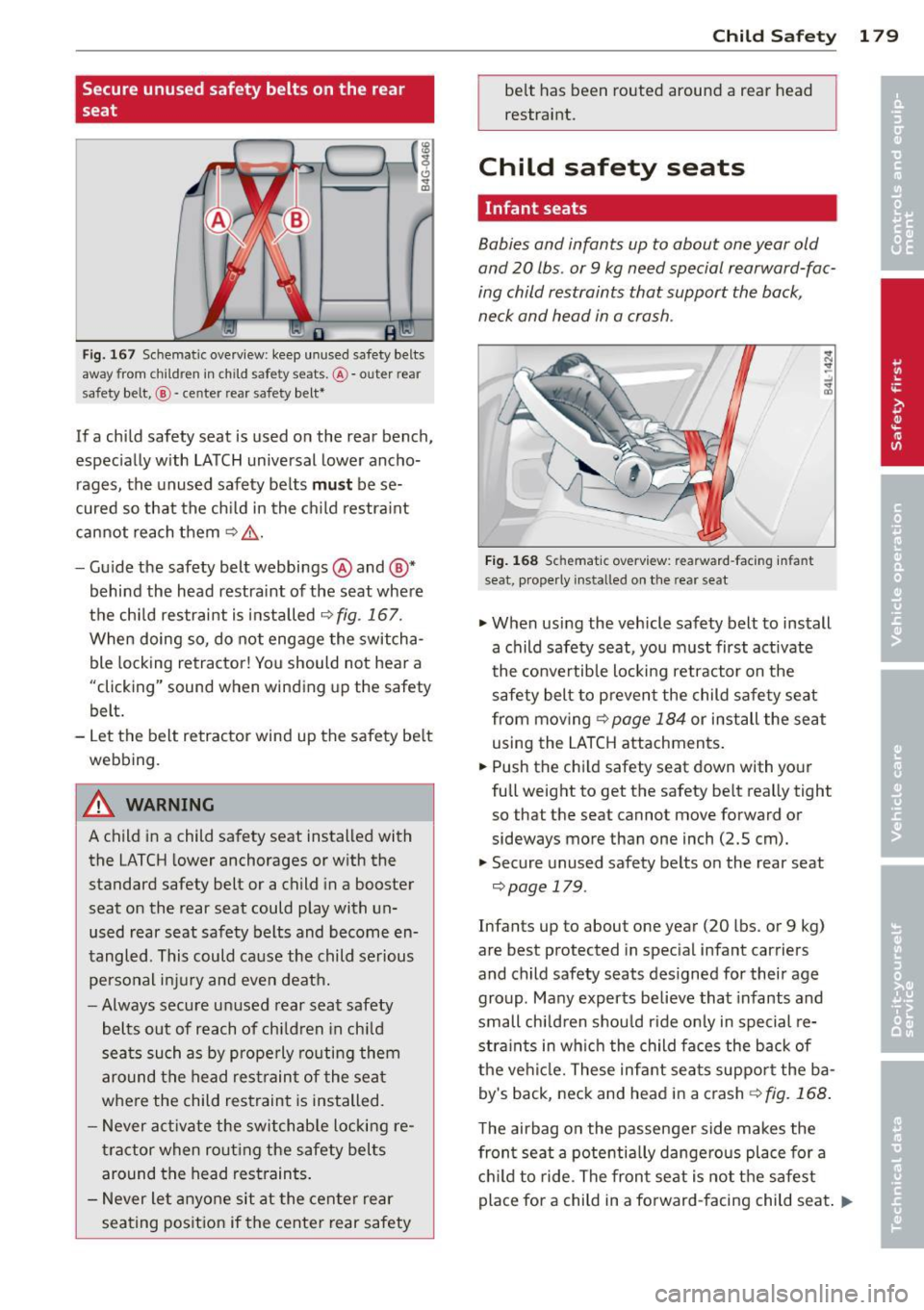
Secure unused safety belts on the rear
seat
F ig. 167 Schematic overview: keep unused safety belts
away from chi ldren in child safety seats. @-outer rear
safety belt,
@-center rear safety belt*
If a child safety seat is used on the rear bench,
espec ially with LATCH universal lower ancho
rages, the unused safety belts
must be se
cured so that the ch ild in the ch ild restra int
cannot reach them
Q ,&. .
- Gu ide the safety belt webbings@and @*
behind the head restraint of the seat whe re
the ch ild restrai nt is installed
Q fig . 167.
When doing so, do not engage the switcha
ble locking retractor! Yo u should not hear a
"clicking" sound when winding up the safety
belt.
- Let the belt retractor wind up the safety belt
webbing.
A WARNING
A child in a child safety seat installed with
the LATCH lower anchorages or w ith the
standard safety belt or a child in a booster
seat on the rear seat could play with un
used rear seat safety belts and become en
tangled. This could ca use the child serious
personal i nju ry and even death.
- Always secure un used rear seat safety
belts out of reach of chi ld ren in ch ild
sea ts such as by p rope rly routing them
around the head res traint of the seat
whe re the child restraint is installed.
- Never act ivate the sw itchab le locking re
t ractor when rout ing the safety belts
around the head res traints .
- Never le t anyone sit at the center rear
sea ting pos it ion if the cente r rear safety
Child S afety 1 79
belt has been ro uted around a rear head
restraint.
Child safety seats
Infant seats
Babies and infants up to about one year old
and 20 lbs. or
9 kg need special rearward-fac
ing child restraints that support the back,
neck and head in a crash .
Fig. 168 Schemat ic overv iew: rearward -facing infant
seat, properly installed on the rear seat
~ When using the vehicle safety belt to install
a child safety seat, you must first activate
the convertible locki ng retractor on the
safety belt to preven t the child safe ty seat
from mov ing
Qpage 18 4 or install the seat
using the LATCH attachments .
~ Push the child safety seat down with you r
full weight to get the safety belt really tight
so that the seat cannot move forward or
sideways more than one inch (2.5 cm).
~ Secure unused safety belts on the rear seat
Qpage 179.
Infants up to about one year (20 lbs. or 9 kg)
are best protected in special infant car riers
and child safety seats designed for their age
group. Many experts be lieve that infants and
small chi ld ren shou ld r ide o nly in special re
str aints in wh ic h t he child faces the back of
the ve hicle. These infant sea ts suppo rt the ba
by's back, neck and head in a crash ¢
fig. 168.
The airbag on the passenger side makes the
fron t seat a pote ntia lly dange ro us place for a
c hi ld to ride. The fron t se at is not t he safest
place for a child in a fo rward -facing child seat . ..,_
Page 182 of 304
180 Child Safet y
It is a very dangerous place for an infant or a
larger child in a rearward-facing seat.
.&_ WARNING
Not using a child safety seat, using the
wrong chi ld safety seat or improperly in
stalling a child restraint increases the risk of serious personal injury and death in a
crash .
- Never install rear-facing ch ild safety
seats or infant carriers on the front pas senger seat -even with an Advanced Air
bag System. A child wi ll be seriously in
jured and can be k il led when the inflat
ing airbag hits the child safety seat or in
fant ca rrier with great force and smashes
the chi ld safety seat and chi ld aga inst
the backrest, center armrest, door or roof
c:> page 149, Child restraints on the
front seat -some important things to
know.
- Always install rear-facing child safety
seats or infant carriers on the rear seat.
- Never install a rear-facing child restraint in the forward-facing direction. Such re
straints are des igned for the spec ial
needs of infants and very small children
and cannot protect them properly if the
seat is forward-fac ing.
- If you must install a rearward facing
child safety seat on the front passenger
seat because of exceptional circ umstan
ces and the
PA SS ENGER AIR BAG OFF
light does not come on and stay on, im
mediately install the rear -facing child
safety seat in a rear seating position and
have the airbag system inspected by your
Audi dealer.
- Never place or use any electrical device
(such as a laptop, CD player, electron ic
games dev ice, power inverter or seat
heater for child seats) on the front pas
senger seat if the device is connected to
the 12-volt socket or the cigarette light er soc ket.
- If a seat heater has been retrofitted or
otherwis e added to the front passenger seat, never install any chi
ld restraint sys
tem on th is seat.
- Make sure that there are no wet objects
(such as a wet towel) and no water or
other liquids on the front passenger seat
cushion.
- Never p lace objects on the seat (such as
a laptop, CD player, electronic games de
vice, power inverter or seat heater for
child seats). These may influence the
electrical capacitance measured by the
capacitive passenger detection system
a nd can also f ly around in an a ccident
and cause serious persona l injury.
- A lways read and heed all WAR NINGS
whenever using a child restrained in ave
hicle is being used
¢ page 138, Safety
belts,
¢ page 147, Airbag system and
c::> page 173, Important things to know .
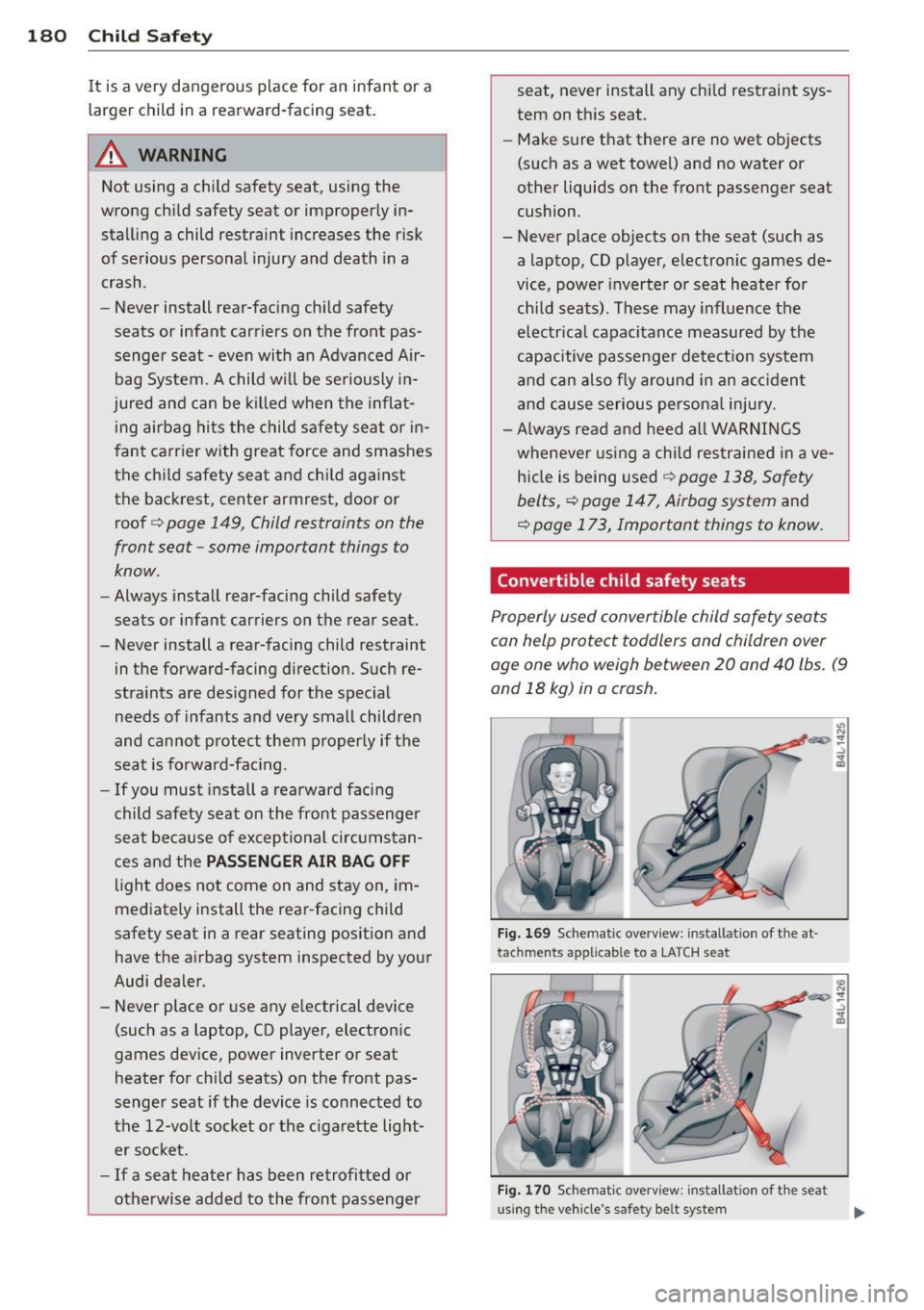
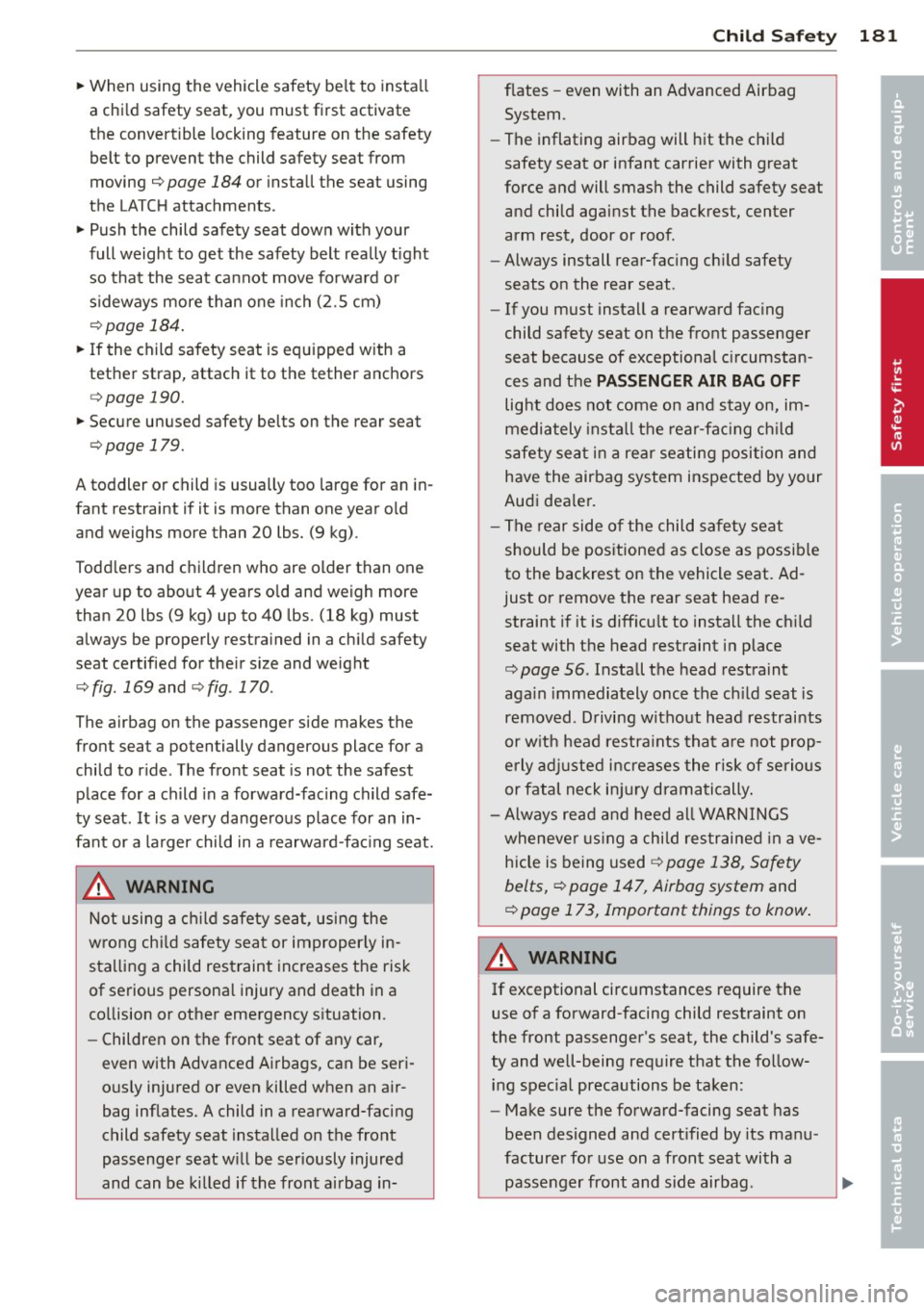
Convertible child safety seats
Properly used convertible child safety seats
can help protect toddlers and children over
age one who weigh between 20 and 40 lbs. (9
and 18 kg) in a crash.
Fig. 169 Sc hemat ic overview: instal lat ion of the at
tac hmen ts applicab le to a LA T CH seat
Fig . 170 Schemat ic overv iew: installa tion of t he sea t
using the vehicle 's safety belt syste m
Iii-
Page 183 of 304
~ When using the vehicle safety belt to install a child safety s eat, you must first activate
the convertible locking feature on the safety
belt to prevent the child safety seat from
moving
c::;,page 184 or install the seat using
the LATCH attachments .
~ Push the child safety seat down with your
full weight to get the safety belt really tight so that the seat cannot move forward or
sideways more than one inch (2.5 cm)
¢page 184.
~ If the child safety seat is equipped with a
tether strap, attach it to the tether anchors
c::;, page 190.
~ Secure unused safety belts on the rear seat
c::;, page 179.
A toddler or child is usually too large for an in
fant restraint if it is more than one year old and weighs more than 20 lbs. (9 kg) .
Toddlers and children who are older than one
year up to about 4 years old and weigh more
than 20 lbs (9 kg) up to 40 lbs. (18 kg) must alw ays be properly restrained in a child safety
seat certified for their size and weight
c:::;, fig. 169 and c:::;, fig . 170 .
The airbag on the passenger side makes the
front seat a potentially dangerous place for a
child to ride . The front seat is not the safest
place for a child in a forward-facing child safe
ty seat .
It is a very dangerous place for an in
fant or a larger child in a rearward-facing seat.
A WARNING
Not using a child safety seat, using the
wrong child safety seat or improperly in
stalling a child restraint increases the risk
of serious personal injury and death in a
collision or other emergency situation.
- Children on the front seat of any car,
even with Advanced Airbags, can be seri
ously injured or even killed when an air
bag inflates. A child in a rearward-facing
child safety seat installed on the front
passenger seat will be seriously injured
and can be killed if the front airbag in-
-
Child Safety 181
flates -even with an Advanced Airbag
System .
- The inflating airbag will hit the child
safety seat or infant carrier with great
force and will smash the child safety seat
and child against the backrest, center
arm rest, door or roof.
- Always install rear-facing child safety
seats on the rear seat .
- If you must install a rearward facing
child safety seat on the front passenger
seat because of exceptional circumstan
ces and the
PASSENGER AIR BAG OFF
light does not come on and stay on, im
mediately install the rear-facing child
safety seat in a rear seating position and have the airbag system inspected by your
Audi dealer.
- The rear side of the child safety seat
should be positioned as close as possible
to the backrest on the vehicle seat. Ad
just or remove the rear seat head re
straint if it is difficult to install the child
seat with the head restraint in place
c::;, page 56. Install the head restraint
again immediately once the child seat is
removed . Driving without head restraints
or with head restraints that are not prop
erly adjusted increases the risk of serious
or fatal neck injury dramatically.
- Always read and heed all WARNINGS
whenever using a child restrained in ave
hicle is being used
c::;, page 138, Safety
belts, c::;, page 147, Airbag system
and
c::;, page 173, Important things to know.
A WARNING
-= -
If exceptional circumstances require the
use of a forward-facing child restraint on
the front passenger's seat, the child's safe
ty and well-being require that the follow
ing special precautions be taken:
- Make sure the forward-facing seat has
been designed and certified by its manu
facturer for use on a front seat with a
passenger front and side airbag .
•
•