ignition AUDI A6 2014 Manual PDF
[x] Cancel search | Manufacturer: AUDI, Model Year: 2014, Model line: A6, Model: AUDI A6 2014Pages: 304, PDF Size: 76.32 MB
Page 239 of 304
(D Note
-Do not disconnect the ve hicle battery
when the ignition is on or when the en
gine is running, otherwise, you will dam
age electronic components in the electri
cal system .
- If your vehicle is going to stand for a
long period of time without being driven,
protect the battery from "freezing", oth
erwise it will be damaged and w ill then
have to be replaced.
Battery charging
Starting the engine requires a well charged
battery.
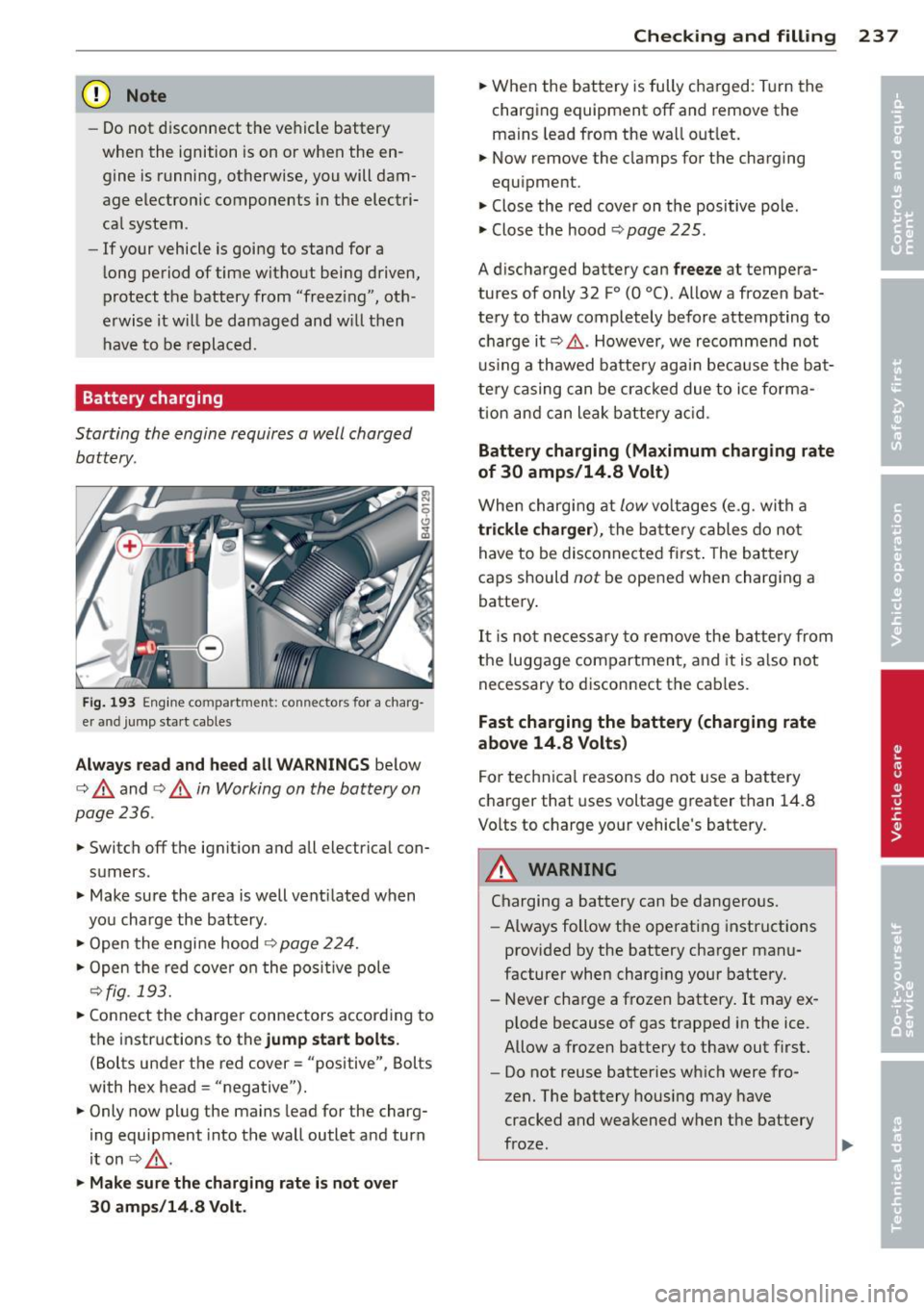
Fig. 193 Engine compartment: connectors for a charg
er and jump sta rt cables
Always read and heed all WARNINGS below
c::, &. and c::, &. in Working on the battery on
page 236 .
.,. Switch off the ignit ion and all electrical con
s umer s.
.,. Make sure the area is well vent ilated when
you charge the battery .
.,. Open the engine hood
c::, page 224.
.,. Open the red cover on the posit ive pole
¢fig. 193 .
.,. Connect the charger connectors according to
the instructions to the
jump start bolts.
(Bolts under the red cover= "positive", Bolts
with hex head= "negative").
.,. Only now plug the mains lead for the charg
ing equipment into the wall outlet and turn
it on
c::, &_ .
.,. Make sure the charging rate is not over
30 amp s/14 .8 Volt.
Checkin g and fillin g 237
.,. When the battery is fully charged: Turn the
charging equipment off and
remove the
mains lead from the wall out let.
.,. Now remove the clamps for the charging
equ ipment.
.,. Close the red cover on the positive pole .
.,. Close the hood
c::, page 225.
A discharged battery can
freeze at tempera
tures of only
32 F0 (0 °C) . Allow a frozen bat
tery to thaw completely before attempting to cha rge it
c::, ,&. . However, we recommend not
using a thawed batte ry again because the bat
tery casing can be cracked due to ice fo rma
tion and can leak battery ac id.
Battery charging (Maximum charging rate
of 30 amps/14.8 Volt )
When charging at low vo ltages (e.g. with a
trickle charger) , the battery cables do not
have to be disconnected first . The battery
caps should
not be opened when charging a
battery .
It is not necessary to
remove the battery from
the luggage compartment, and it is a lso not
necessary to disconnect the cab les .
Fast charging the battery (charging rate
above 14 .8 Volts)
For technical reasons do not use a battery
charger that uses voltage greater than 14.8
Volts to charge your vehicle's battery .
_& WARNING
-
Charging a battery can be dangerous.
- Always follow the operating instructions
provided by the battery charger manu
facturer when charg ing your battery.
- Never charge a frozen battery. It may ex
plode because of gas trapped in the ice.
Allow a frozen battery to thaw out first.
- Do not reuse batteries which were fro
zen. The battery housing may have
cracked and weakened when the battery
froze.
Page 261 of 304
remain continuously illuminated. This se
quence will continue upon subsequent vehicle
start-ups as long as the malfunction exists.
When the malfunction indicator is illuminat
ed, the system may not be able to detect or
signal low tire pressure as intended . TPMS
malfunctions may occur for a variety of rea
sons, including the installation of replace
ment or alternate tires or wheels on the vehi
cle that prevent the TPMS from functioning
properly . Always check the TPMS malfunction
telltale after replacing one or more tires or
wheels on your vehicle to ensure that the re
placement or alternate tires and wheels allow
the TPMS to continue to function properly.
Tire pressure indicator appears
Appl ies to vehicles: with tire pressur e monitoring sys te m
The tire pressure indicator in the instrument
cluster informs you if the tire pressure is too
low or if there is a system malfunction.
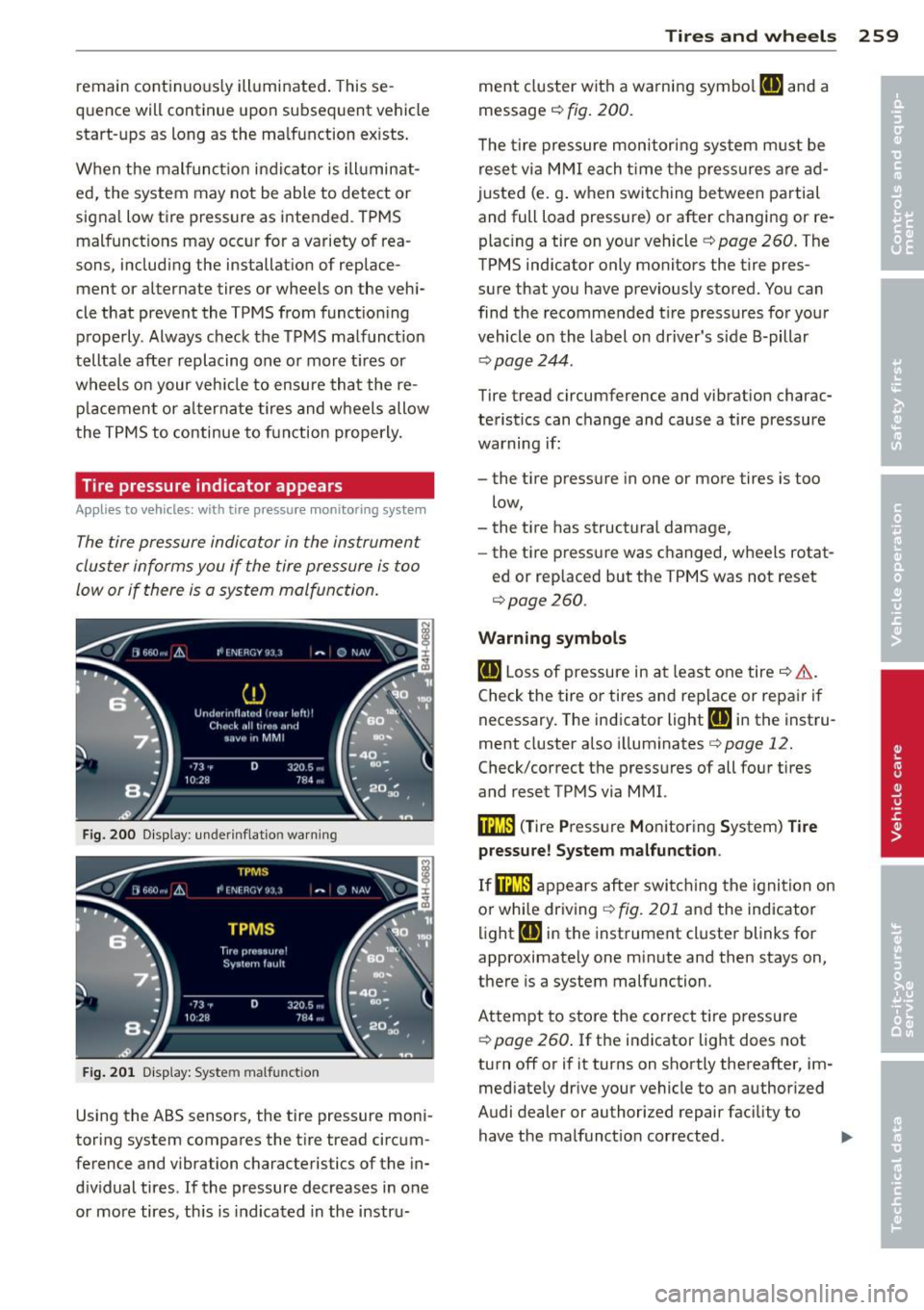
Fig. 200 Display : underinflation warning
Fig. 201 Display: System malfunction
Using the ABS sensors, the tire pressure moni
toring system compares the tire tread circum
ference and vibration characteristics of the in
dividual tires. If the pressure decreases in one
or more tires, this is indicated in the instru-
Tires and wheels 259
ment cluster with a warning symbol [I] and a
message
c::, fig. 200.
The tire pressure monitoring system must be
reset via MMI each time the pressures are ad
justed (e.g. when switching between partial
and full load pressure) or after changing or re
placing a tire on your vehicle
c::, page 260. The
TPMS indicator only monitors the tire pres
sure that you have previously stored. You can
find the recommended tire pressures for your
vehicle on the label on driver's side 8-pillar
~page 244.
Tire tread circumference and vibration charac
teristics can change and cause a tire pressure
warning if:
- the tire pressure in one or more tires is too
low,
- the tire has structural damage,
- the tire pressure was changed, wheels rotat-
ed or replaced but the TPMS was not reset
c::, page 260 .
Warning symbols
[I] Loss of pressure in at least one tire c::> &..
Check the tire or tires and replace or repair if
necessary. The indicator light
[I] in the instru
ment cluster also illuminates
c::>page 12.
Check/correct the pressures of all four tires
and reset TPMS via MMI.
i:mJ) (Tire Pressure Monitoring System) Tire
pressure! System malfunction .
If@m appears after switching the ignition on
or while driving
c::, fig. 201 and the indicator
light
[I] in the instrument cluster blinks for
approximately one minute and then stays on,
there is a system malfunction.
Attempt to store the correct tire pressure
c::, page 260. If the indicator light does not
turn off or if it turns on shortly thereafter, im
mediately drive your vehicle to an authorized
Audi dealer or authorized repair facility to
have the malfunction corrected.
Page 262 of 304
260 Tire s and wheel s
_&. WARNING
-If th e tire pressure indicator appea rs in
the instrument cluster d isplay, one or
more of your tires is s ignificantly under
inflated. Reduce your speed immediately
and avoid any hard stee ring or bra king
maneuvers . Stop as soon as possible and
check the t ires and the ir pressures. In
flate the tire pressure to the proper pres
sure as indicated on the vehicle 's t ire
pressure label
c> page 244. Driving on a
signif icant ly under-inflated tire causes
the tire to overheat and can lead to tire
failure. Under-inflation also is likely to impair the vehicle 's handling and stop
ping ab ility .
- The driver is responsible for ma inta ining
the correct tire pressures. You must che ck the t ire pressures regula rly.
- Under certain cond itions (such as a spor
ty driving style, winter condit ions or un
paved roads), the pressure mon itor ind i
c ator may be de layed.
- Ask your author ized Audi dealer if r un
flat tires may be used on your veh icle.
Yo ur vehicle regist rat ion becomes inval id
if yo u use these tires when not permit
ted . Damage to your vehicle or acc idents
cou ld also resu lt.
(D Tips
- The tire pressure monitoring system
stops working when there is an ESC/ABS
malfunction.
- Using snow chains may result in a system
malfunction.
- The tire pressure monitoring system on
you r A udi was develope d using t ires with
the "AO" or "RO" identification on the
tire sidewall ~
page 251 . We recom
mend using these t ires.
Reset tire pressure monitoring system
Applies to vehicles: with tire pressure monitoring system
If the tire pressure is adjusted, wheels are ro
tated or changed, the TPMS must be reset via
MMI .
.. Switch on the ignition.
.. Select in the MMI :
ICARI function button>
(Car)* system s control button > Servicing &
checks > Tire pres sure monitoring > Store
tire pre ssur es > Ye s, store now .
@ Tips
Do not sto re the tire pressure if there are
s now cha ins on the tire.
Page 274 of 304
272 Fu ses and bulb s
No. Equ ipment Amps
8
Headlight range adjustment/
5/7,S
adaptive lighting system
10 Left headlight
(headlight with
7,5
adaptive light)
11 Supplementary heater
s
Fu
se p ane l@ (b ro w n)
No . Equipment Amps
1 Climate control
10
2 Climate control system blower 40
3 Diagnostic interface
10
4 E lectrical ignition lock
s
s
Power steering column adjust-
s ment
6 Steering column switch module
10
7 Power
steering column adjust-
ment 25
8 Light switch
s
Luggage compartment fuse assignment
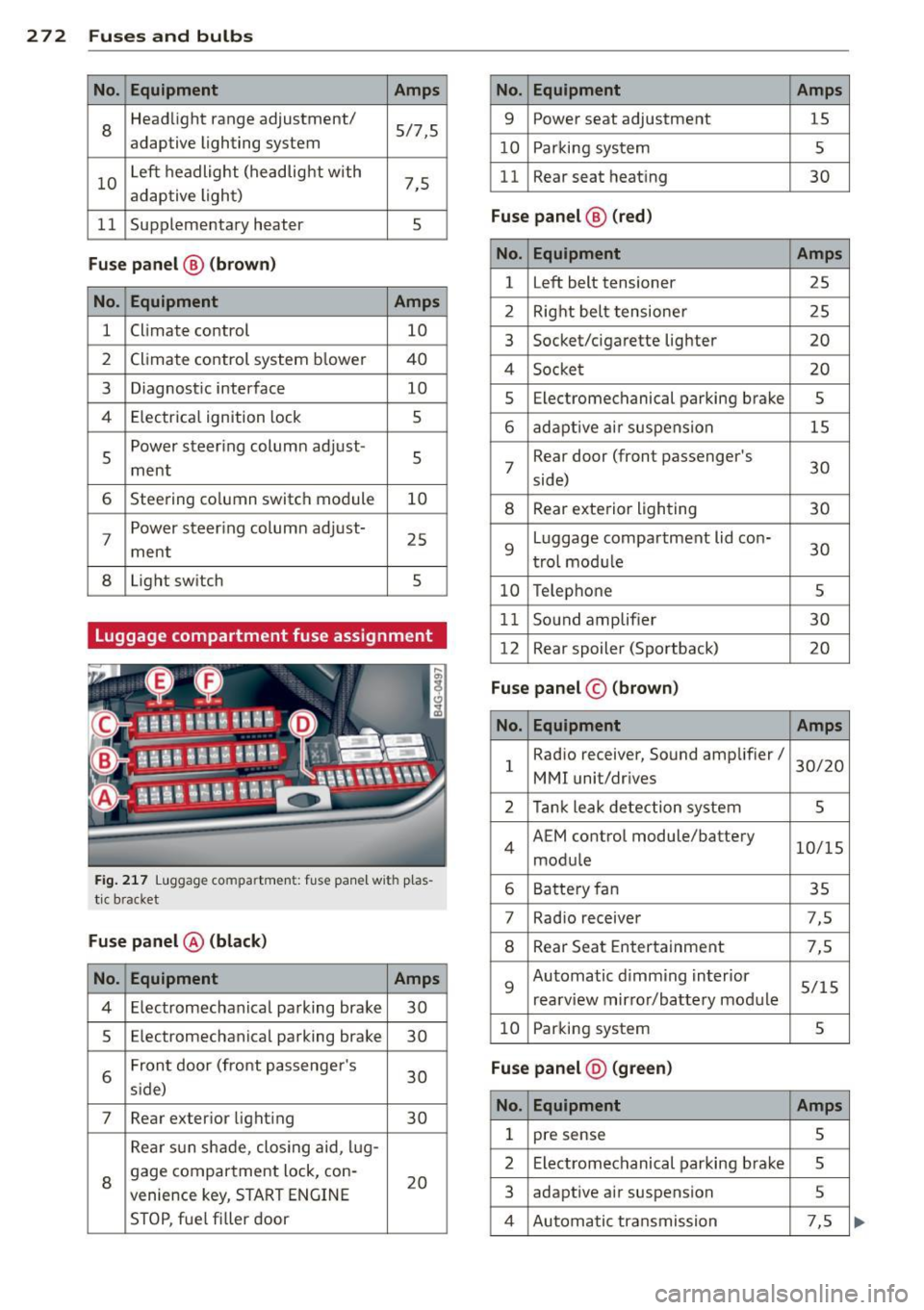
Fig
. 217 Luggage compartment: fuse panel with plas
tic bracket
Fuse p anel @ (b la ck )
No. Equipment Amps
4 E lectromechanical parking brake 30
s Electromechanical parking brake
30
6 Front door
(front passenger's
30
s ide)
7 Rear exter ior lighting
30
Rear sun shade, closing aid, lug-
8 gage compartment
lock, con-
20
venience key, START ENGINE
STOP, fuel filler door
No. Equipment Amps
9 Power seat adjustment
15
10 Parking system
s
11 Rear seat
heating
30
Fuse pan el@ (r e d )
No . Equipment Amps
l Left belt tensioner
25
2 Right belt tensioner 25
3 Socket/cigarette
lighter
20
4 Socket 20
5 Electromechanical
parking brake
5
6 adaptive ai r suspension 15
7 Rear door
(front passenger's
30
side)
8 Rear exterior lighting 30
9 Luggage compartment
lid con-
30
t rol modu le
10 Telephone 5
11 Sound amplifier 30
12 Rear
spoiler (Sportback)
20
Fuse pan el© (brown)
No . Equipment Amps
1 Radio receiver,
Sound amplifier/
30/20
MMI unit/drives
2 Tank leak detection system
s
4 AEM
control module/battery
10/15
module
6 Battery fan 35
7 Rad
io receiver 7,5
8 Rear Seat Entertainment 7,5
9 Automatic d
imming interior
5/15
rearview mirror/battery module
10 Parking system 5
Fuse pan el@ (gre en)
No . Equipment Amps
1 pre sense 5
2 Electromechanical parking brake
s
3 adaptive
air suspension
5
4 Automatic transmission 7,5
Page 286 of 304
28 4 Con sum er Inf ormation
comp lexity of today's automobi les, have
steadi ly reduced the scope of maintenance
and repairs which can be carried out by vehicle
owners.
Also, s afety an d e nvir onm ent al con
cerns place very strict limits on the nature of repairs and adjustments to engine and trans
miss ion pa rts which an owner can perform .
Maintenance, adjustments and repa irs usua lly
require special tools, testing devices and oth
er equipment avai lab le to specially trained
workshop personnel in order to assure proper
performance, reliab ility and safety of the vehi
cle and its many systems .
Improper ma intenance, adjustments and re
pa irs can impair the operation and reliab ility
of your vehicle and even void your vehicle war ranty. Therefo re , proof of servici ng in accord
ance w it h the ma intenance sched ule may be a
condition for upholding a possible warranty
claim made within the warran ty period.
Above all, operational safety can be adve rsely
affected, c reating unnecessary risks for you
and your passengers.
If in doubt about any serv icing, have it done
by your author ized Audi dealer or any other
p roperly equipped and qualified workshop .
We strong ly urge you to give your authorized
Audi dealer the opportunity to perform all
schedu led maintenance and necessary repairs .
Your dea ler has the facilities, or iginal parts
and tra ined spec ialists to keep your vehicle
running properly .
Performing lim it e d m aint en anc e y ourself
The fo llowing pages describe a limited num
ber of procedures which can be performed on
you r vehicle with ordinary too ls, shou ld the
need arise and trained personnel be unavaila
ble. Before performing any of these proce
dures, always thoroughly read all of the app li
cable text and ca refully follow the instruc
tions given. Always rigorously obse rve the
WARNINGS p rovided .
Before you ch eck anything in th e engin e
compartme nt, alway s read an d heed all WARNINGS
¢ & a
nd ¢ & in Working in the
engine comportment on page 224 .
A WARNING
--Serious personal in jury may occur as a re-
sult of improperly performed mainte nance, adjustments or repa irs.
- Always be extremely careful when work
ing on the vehicle. Always follow com
monly accepted safety pract ices and gen
eral common sense. Never r isk personal
in jur y.
- Do not attempt any of the maintenance,
checks or repairs descr ibed o n the fol
lowing pages if you are not fu lly fam iliar
with these or other procedures with re spect to the ve hicl e, or are uncerta in how
to proceed .
- Do not do any work withou t the proper
too ls and equipment . Have the necessary
work done by your authorized A udi deal
er or anothe r properly equipped and
qualified workshop.
- The engine compar tment o f any motor
vehicle is a potentially hazardous area. Never reach into the area around or
touch the rad iator fan. It is temperature
control led and can sw itch on suddenly -
even when the engine is off . The radiator
fan switches on automatically when the
coo lant reaches a ce rtain temperature
and will cont inue to ru n until the coo lant
tempera ture drops.
- Always sw itch off the ignition before any
one gets under the vehicle.
- Always support your veh icle with safety
s tands if it is necessary to work under
neath the vehicle. The j ack s upp lied with
the vehicle is not adequate for this pur
pose and cou ld co llapse causing serio us
pe rsonal injury .
- If you must work underneath the vehicle
wit h the wheels on the ground, a lways
make sure the vehicle is on leve l ground,
that the wheels are a lways secure ly
blocked and that t he engine cannot be
started .
Page 292 of 304
29 0 Index
Changing engine oil
Check ing 230
E ng ine coolan t leve l ....... .... .... . 23 2
T ire pre ssure .......... .... ... .. .. . 24 6
C hi ld restra ints
Danger of us ing child restra ints in the
front s eat . . . . . . . . . . . . . . . . . . . . . . . . 149
Where can I get add it ional information
about child restra ints and thei r use? . . 19 1
Ch ild restra int system anchors ... .. .. . 187
C hild safety .. ... .. ..... ... .. .. .... . 173
Convertible locking retractor .... .. ... 184
Important safety instructions for using
child safety seats . . . . . . . . . . . . . . . . . . 17 7
Important things to know when dr iving
with chi ldren ............. ... .. ... 173
Tether anchors ................ .... 190
Tether straps ..................... 190
C hi ld safety lock
Rear doors ... ........... .... .... .. 40
C hild safety seats ....... ... .. .. .... . 179
Booster seats .. .. ..... ... .. .. .... . 182
Convertible child seats . . . . . . . . . . . . . 180
Convertible locking retractor . . . . . . . . . 184
H ow do I properly install a child safety
seat in my vehicle? ............. .... 177
Infant seats . . . . . . . . . . . . . . . . . . . . . . 179
I nstall ing .. ................ ... ... 184
I nstall ing a chi ld res traint using the
L A T C H sys tem ............ .. .. .... . 189
L A T CH sys tem .. .. ..... ... .. .. .... . 189
Lower ancho rages ..... ... .. .. .... . 188
M ounting and releasing the anchorage
hook .. .. .. ............. .. .. .. ... 189
Safety instructions . . . . . . . . . . . . . . . . . 177
Unused safety belts on the rear seat . . 179
Cigarette lig hte r . . . . . . . . . . . . . . . . . . . . . 58
C lean ing .......................... 210
Climate control
A ir vents ..... ........... .. .. .... .. 69
Climate controls . . . . . . . . . . . . . . . . . . . . . 67
Climate control system Supp lementary heater . . . . . . . . . . . . . . . 72
Climate control (four-zone)
Opera tion . . . . . . . . . . . . . . . . . . . . . . . . . 70
Climate control (three -zone)
Operation . . . . . . . . . . . . . . . . . . . . . . . . . 68 Clock .
. . . . . . . . . . . . . . . . . . . . . . . . . . . . . 28
Closing Slid ing/tilting s unroof .......... .... . 41
Co ld tire inflation pressure ........ .... 244
Coming home ..... .. ... ..... ... .. .. . 45
Compact spa re tire ................. . 262
Compartments . . . . . . . . . . . . . . . . . . . . . . 59
Compliance . .. .. .. ............. .. .. 286
Consumer Information . . . . . . . . . . 136, 283
Consumption (fuel) . .. .. ..... ... .. .. . 25
Contacting NHTSA ................. . 136
Controls Cleaning ...... .. ............. .... 212
Convenience key ... .. ... ..... ... .. .. . 36
Starting the engine .. .. ..... ... .. .. . 74
Stopping the engine (START ENGINE
STOP b utton) ...................... 75
Switching the ignition on ............ 74
Unlocking and locking vehicle .. ..... .. 36
Co nvertib le child safety seats ... .. .. .. 180
Co nvertib le locking retractor
A ctivat ing . .. .. .. .. ... ........ .. .. 186
Deact ivat ing ..... ............. .... 186
U sing to secure a child sa fety seat 1B4, 18 6
Coolant
r e fer to E ng ine coolant .......... ... 231
Cooling mode (automat ic climate control) 70
Cooling mode (cl imate control) . . . . . . . . . 68
Cruise cont ro l
Changi ng speed .. ................ .. 83
Presett ing you r speed .......... .. .. . 83
Swi tching off .. .. ............. .. ... 83
Swi tch ing on ..... ............... .. . 82
Warning/indicator lights ..... ... .. .. . 24
( u pholder .......................... 59
C u rve light ......................... 100
Cylinder on demand System ........... 27
D
Data recorde r . . . . . . . . . . . . . . . . . . . . . . 194
Date d isp lay .... .. ... .......... .... . 28
Daytime runn ing lights . ... .... ... .. .. . 43
Declarat io n of compliance
Adaptive c ruise control ............. 286
Audi s ide ass ist .. ... .......... .... 286
Cell phone pack age . . . . . . . . . . . . . . . . 28 6